
Introduction
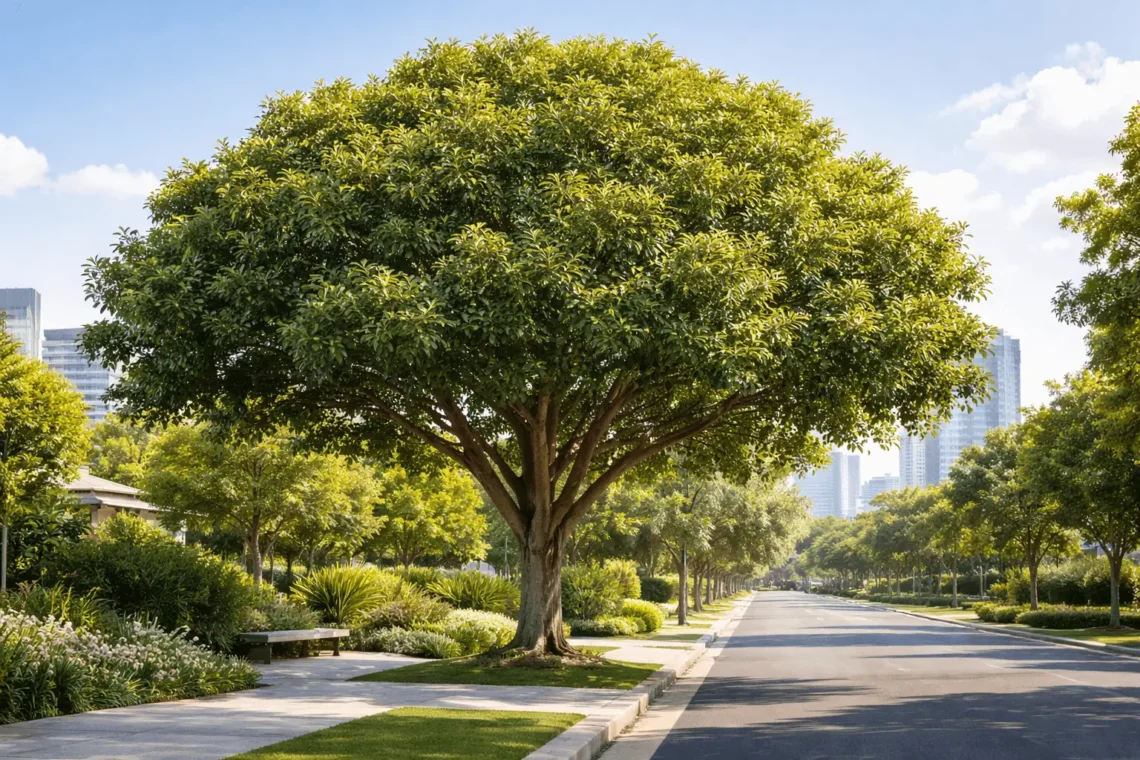
The Brisbane box tree is a tall, evergreen tree widely planted across Australia for its reliability, shade, and clean appearance. It is especially valued in urban and suburban environments where durability and low maintenance are essential. Councils, landscapers, and homeowners favour this tree for its strong structure, tolerance to pollution, and year-round foliage. One common point of confusion surrounding the Brisbane box tree is its scientific name. It is currently classified as Lophostemon confertus, but for many years it was known as Tristania conferta. Both names are still used in horticulture and landscaping, which often leads to misunderstanding among buyers and gardeners. Despite the naming confusion, the tree’s characteristics and performance remain consistent.
What Is a Brisbane Box Tree?
Botanical Classification
The Brisbane box tree is scientifically classified as Lophostemon confertus. This is the currently accepted botanical name used in modern plant taxonomy.
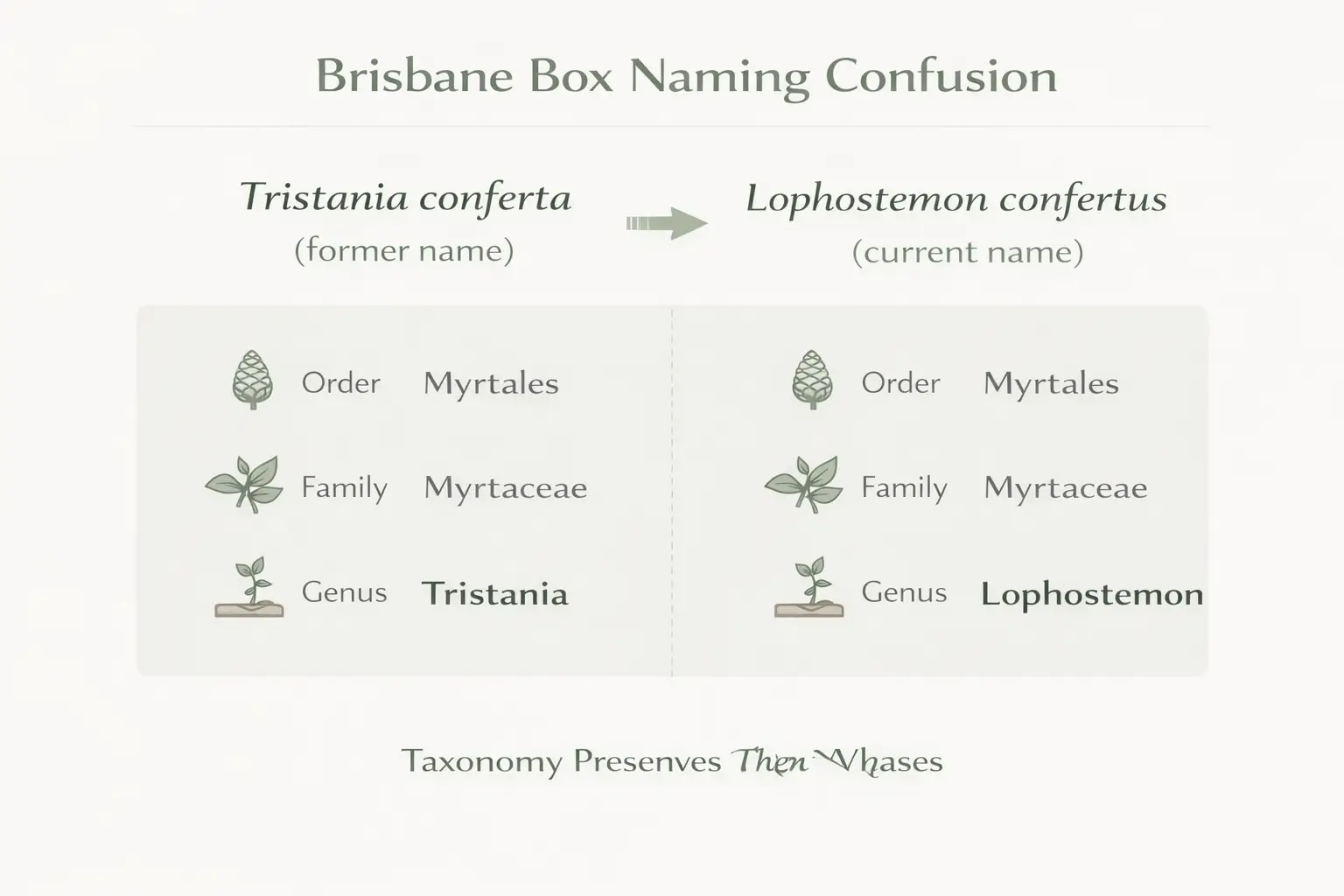
Previously, the species was classified as Tristania conferta, a name that still appears in older references, nursery labels, and landscape plans.
Common names include Brisbane box and Queensland box tree.
The terms tristania conferta and lophostemon confertus refer to the same species, with the name change resulting from taxonomic revision rather than differences in the plant itself.
Origin and Native Habitat
The Brisbane box tree is native to Queensland and parts of eastern Australia.
In its natural habitat, it grows in coastal and subcoastal regions, often along waterways and open forests.
It is well adapted to warm, temperate, and subtropical climates, making it suitable for much of eastern and northern Australia.
Its natural tolerance to heat, humidity, and variable rainfall contributes to its strong performance in cultivated landscapes.
Brisbane Box Tree Identification Features
Size, Shape, and Growth Habit
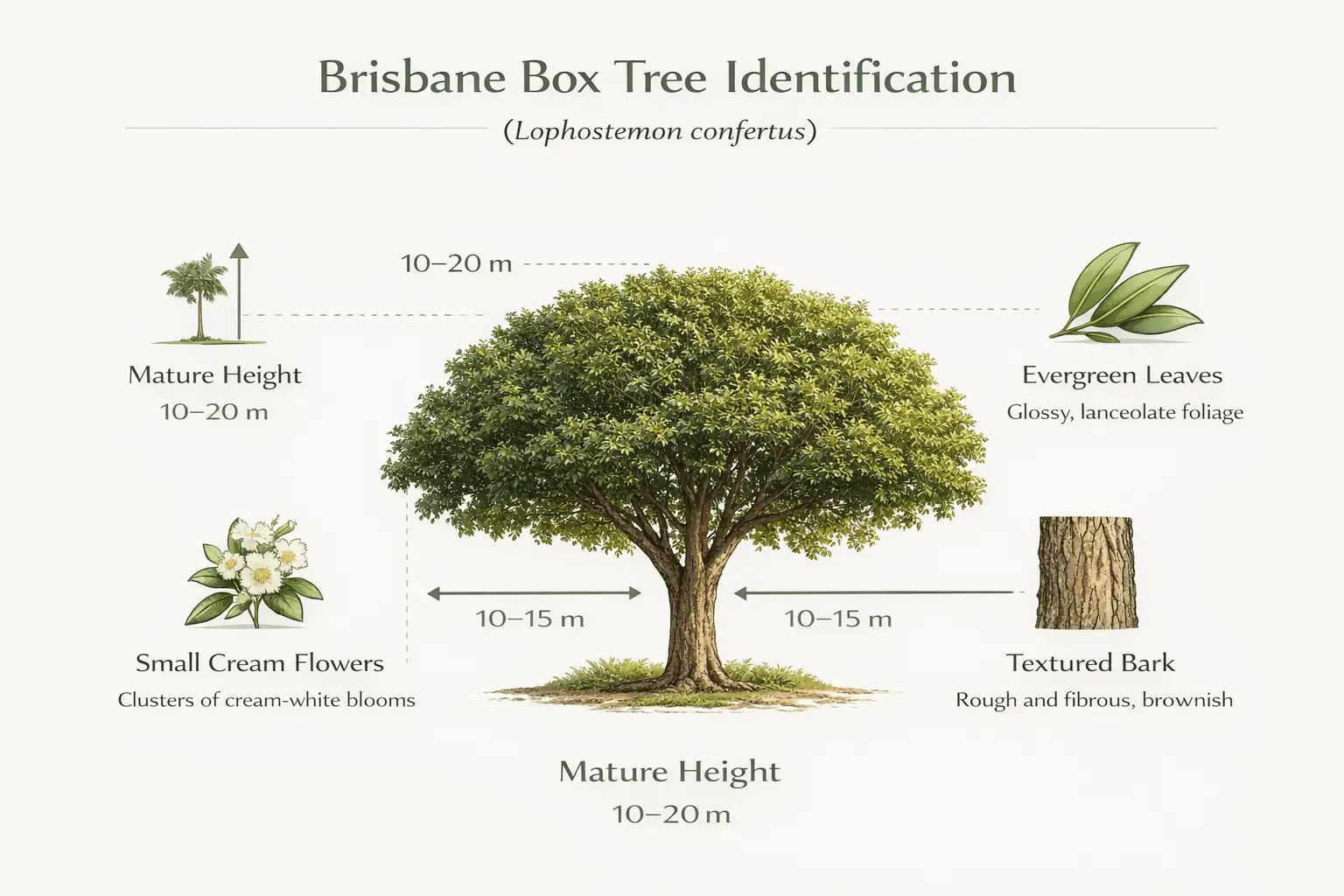
A mature Brisbane box tree typically reaches a height of 10–20 metres, with a broad, rounded canopy that provides dense shade.
The tree has an upright growth habit and maintains a well-balanced form without excessive pruning.
It is an evergreen species, retaining foliage throughout the year, and has a moderate to fast growth rate once established.
In landscaping contexts, it is often grouped with large box plant trees, and the term tristania conferta tree is commonly used when referring to mature specimens.
Leaves, Bark, and Flowers
The leaves are glossy, dark green, and leathery, contributing to the tree’s tidy appearance.
Bark is grey to brown, becoming rough and textured as the tree ages.
The Brisbane box tree produces small, cream-coloured flowers, usually in late spring to early summer.
While not highly ornamental, the flowers add seasonal interest and attract pollinators.
Common Names and Synonyms Explained
Lophostemon vs Tristania
The species was reclassified from Tristania to Lophostemon after botanical research identified structural differences within the group.
Despite this change, both names remain in circulation, particularly in landscaping and nursery trade.
Terms such as tristania Brisbane box and tristania tree are still widely understood and refer to the same plant.
Understanding these synonyms helps avoid confusion when sourcing plants or reading older planting guides.
Uses of Brisbane Box Tree in Landscaping
Street Tree and Urban Planting
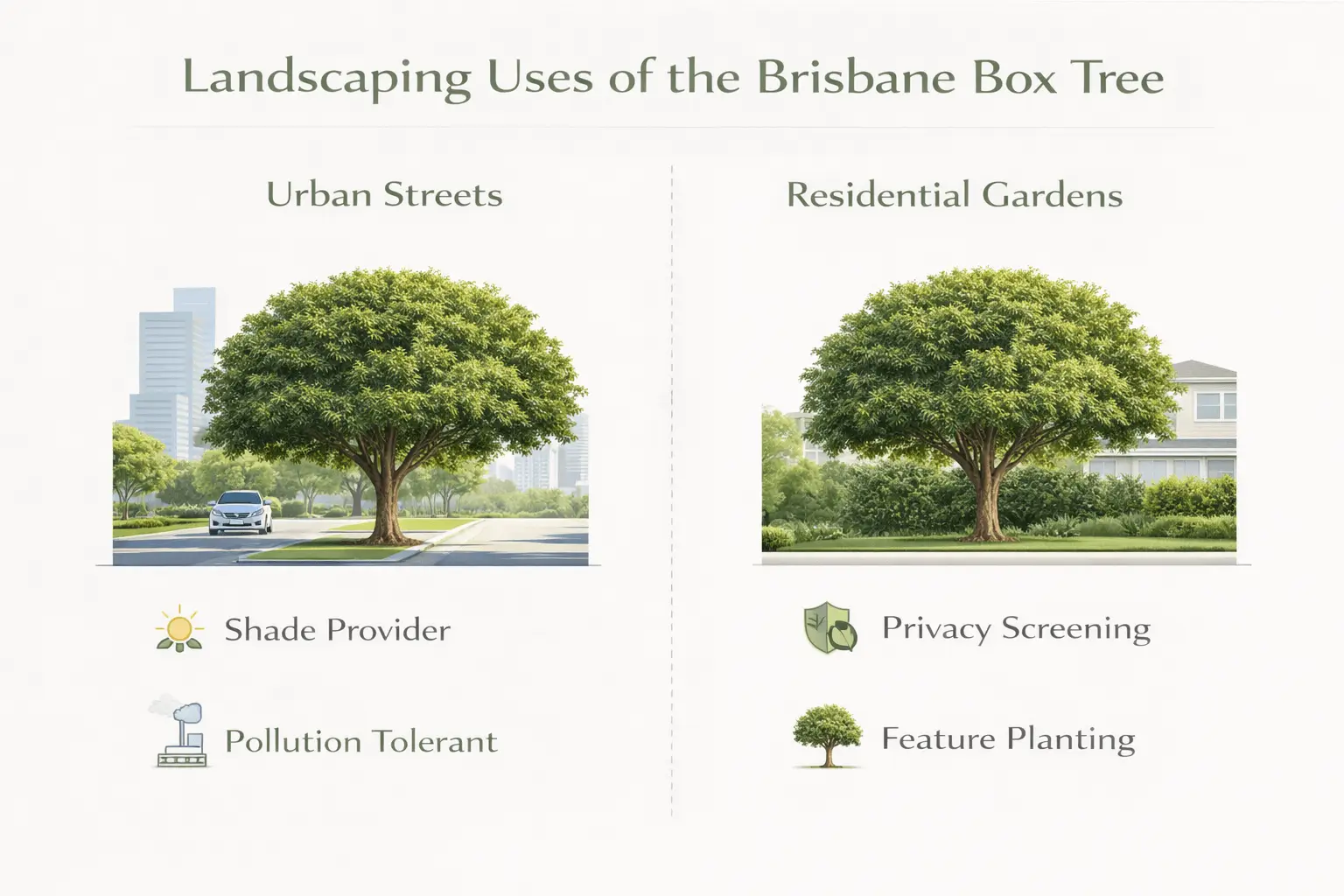
The Brisbane box tree is commonly used as a street tree due to its strong structure and tolerance to urban conditions.
It performs well along roadsides, in car parks, and in public spaces where shade is required.
Its ability to tolerate air pollution, compacted soils, and heat makes it a dependable choice for city environments.
Residential Gardens and Privacy Screening
In residential settings, the tree is best suited to large gardens with adequate space.
It can be used as a shade tree, boundary planting, or feature tree.
Both the Brisbane box and Queensland box tree are valued for their dense canopy, which can contribute to privacy and cooling.
Read more: 7 Stunning Purple Trailing Lantana Benefits for Easy Landscaping
Growing and Caring for Brisbane Box Tree
Soil, Sunlight, and Water Requirements
The Brisbane box tree prefers well-drained soils but adapts to a range of soil types, including clay and sandy loam.
Full sun to partial shade is ideal for healthy growth.
Once established, the tree shows good drought tolerance, requiring minimal supplemental watering.
Pruning, Maintenance, and Root Behavior
Pruning is generally minimal and focused on shaping or removing lower branches in urban settings.
Regular early pruning helps develop a strong structure.
The root system of lophostemon is generally non-invasive but should be considered when planting near pavements, driveways, or underground services.
Brisbane Box Tree Pros and Cons
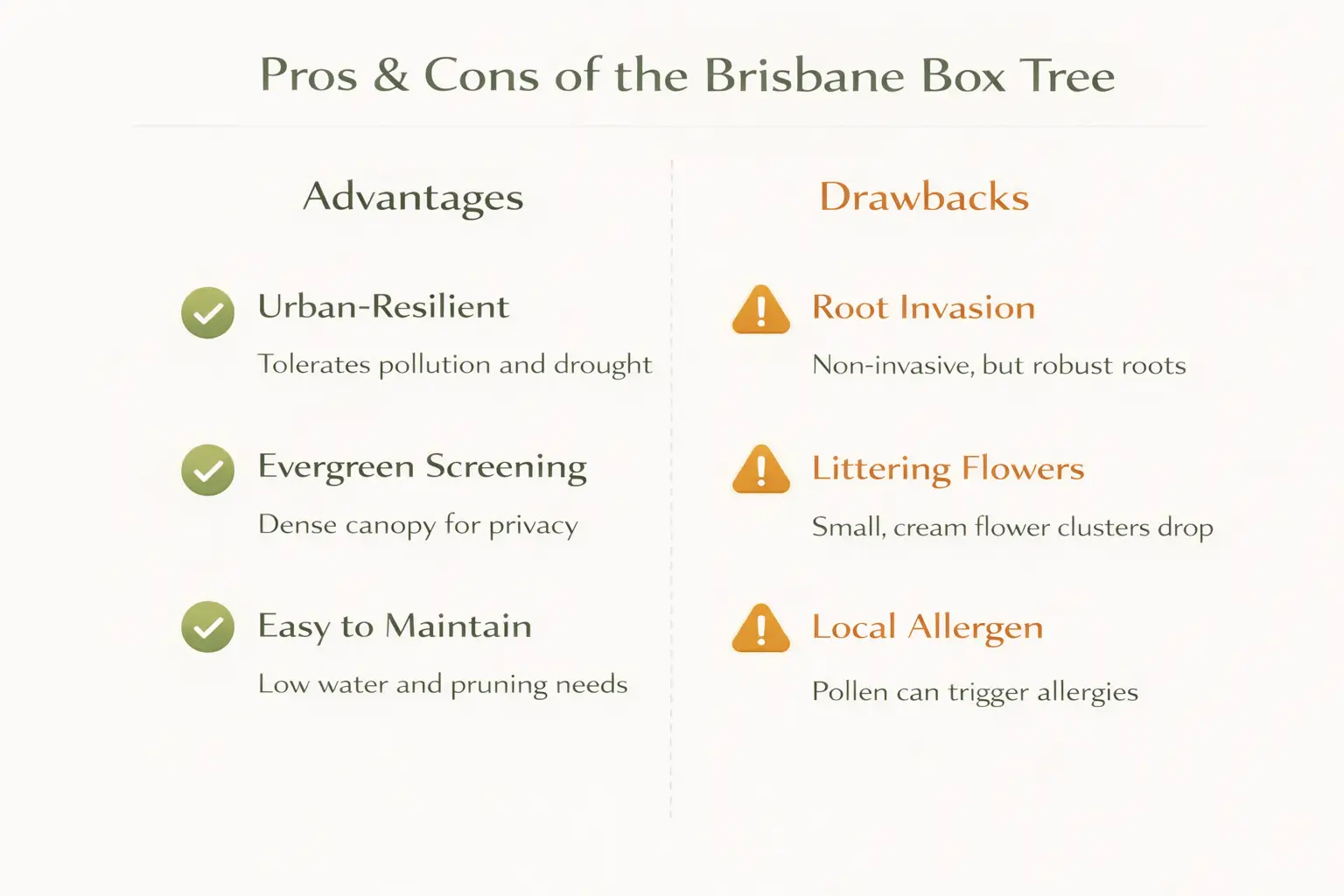
Advantages of Planting Brisbane Box Tree
Key advantages include:
- Fast establishment and steady growth
- Dense shade and long-term durability
- Low maintenance once mature
These qualities make it a practical option for both public and private landscapes.
Potential Drawbacks to Consider
Potential limitations include:
- Large mature size unsuitable for small gardens
- Seasonal leaf drop
- Root spread requiring thoughtful placement
A balanced understanding of Brisbane box tree pros and cons helps ensure appropriate site selection.
Brisbane Box Tree vs Similar Trees
Comparison With Other Box Trees
Unlike non-native box trees, the Brisbane box tree is well adapted to Australian climates and soils.
It generally requires less water and maintenance than exotic alternatives.
Its resilience, longevity, and native origin allow it to stand out as a reliable choice in Australian landscapes.
Is the Brisbane Box Tree Right for You?
Best Locations and Use Cases
The Brisbane box tree is ideal for urban streetscapes, parks, and large residential properties.
It performs best where space allows for full canopy development.
Planting should be avoided in small gardens or areas with limited root space, where size and spread may become problematic.
Conclusion / Call to Action
The Brisbane box tree is a durable, evergreen native valued for its shade, structure, and adaptability to Australian conditions. Its strengths include reliable growth, tolerance to urban stress, and low long-term maintenance, while key considerations are its mature size, root spread, and suitability for available space. When planted in the right location, it performs consistently in streetscapes, parks, and large residential gardens. As a final recommendation, choose the Brisbane box tree where ample room allows full canopy development and long-term growth. For best results, consult local arborists or professional landscapers to assess site conditions, spacing, and placement before planting.
Read more: Sweet Pea Bush: 7+ Stunning Facts Gardeners Love
FAQs — Brisbane Box Tree
Is the Brisbane box tree native to Australia?
Yes. The Brisbane box tree is native to Queensland and parts of eastern Australia, where it naturally grows in coastal and subcoastal environments.
What is the difference between Tristania conferta and Lophostemon confertus?
There is no difference in the tree itself. Tristania conferta is the former scientific name, while Lophostemon confertus is the currently accepted classification after taxonomic revision.
How fast does a Brisbane box tree grow?
The Brisbane box tree has a moderate to fast growth rate, especially during its early years, and establishes reliably under suitable conditions.
Are Brisbane box tree roots invasive?
The roots are generally not considered invasive, but due to the tree’s size, thoughtful placement is important near pavements, pipes, and structures.
Is the Brisbane box tree suitable for small gardens?
No. Due to its large mature size and canopy spread, the Brisbane box tree is best suited to large gardens, public spaces, and urban landscapes rather than small residential yards.


9 Comments on “5+ Powerful Benefits of the Brisbane Box Tree You’ll Love”