Introduction
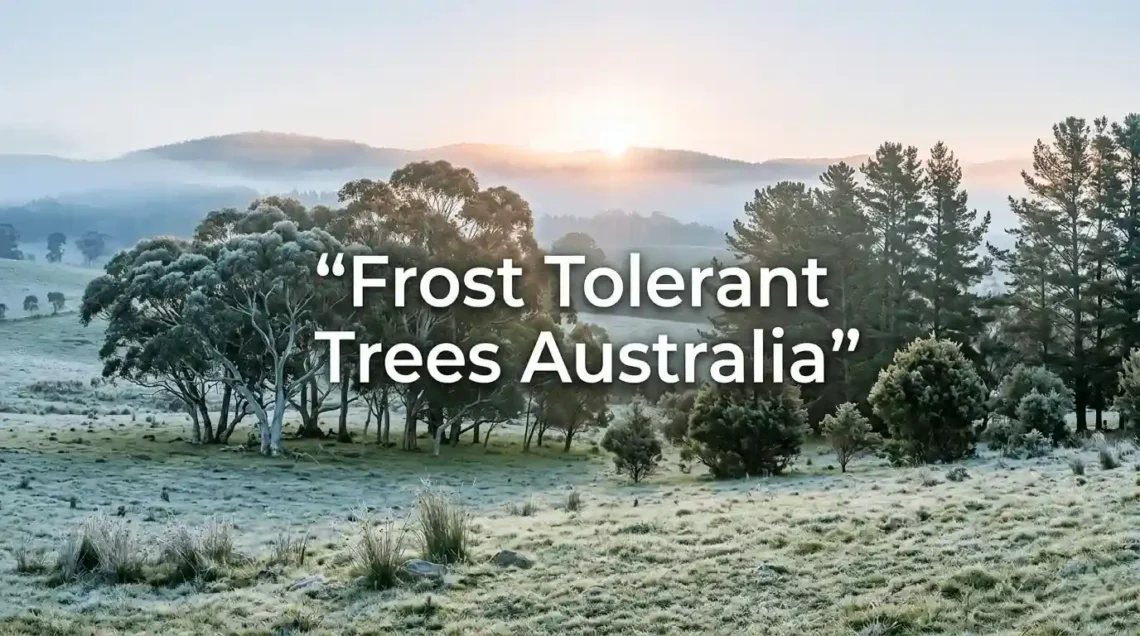
Frost tolerant trees Australia are trees that can survive and grow in regions that experience regular or occasional frosts, particularly across inland and southern climates. These trees are essential for providing shade, structure, windbreaks, and privacy while tolerating freezing temperatures that damage more sensitive species. In Australian horticulture, frost tolerance is often paired with drought resistance, making these trees highly adaptable to harsh seasonal changes. Understanding how these trees grow, their environmental preferences, and their landscape roles helps gardeners and planners select resilient, low-maintenance species suited to cold-climate conditions.
Quick Summary
- Frost tolerant trees Australia are species that survive temperatures below 0 °C once established.
- Common examples include eucalypts, pines, olives, and cool-climate fruit trees.
- Options range from tall shade trees to small trees with non-invasive roots and evergreen types.
- Many combine frost and drought tolerance, making them ideal for low-maintenance landscapes.
What “frost tolerant trees” means in the Australian climate
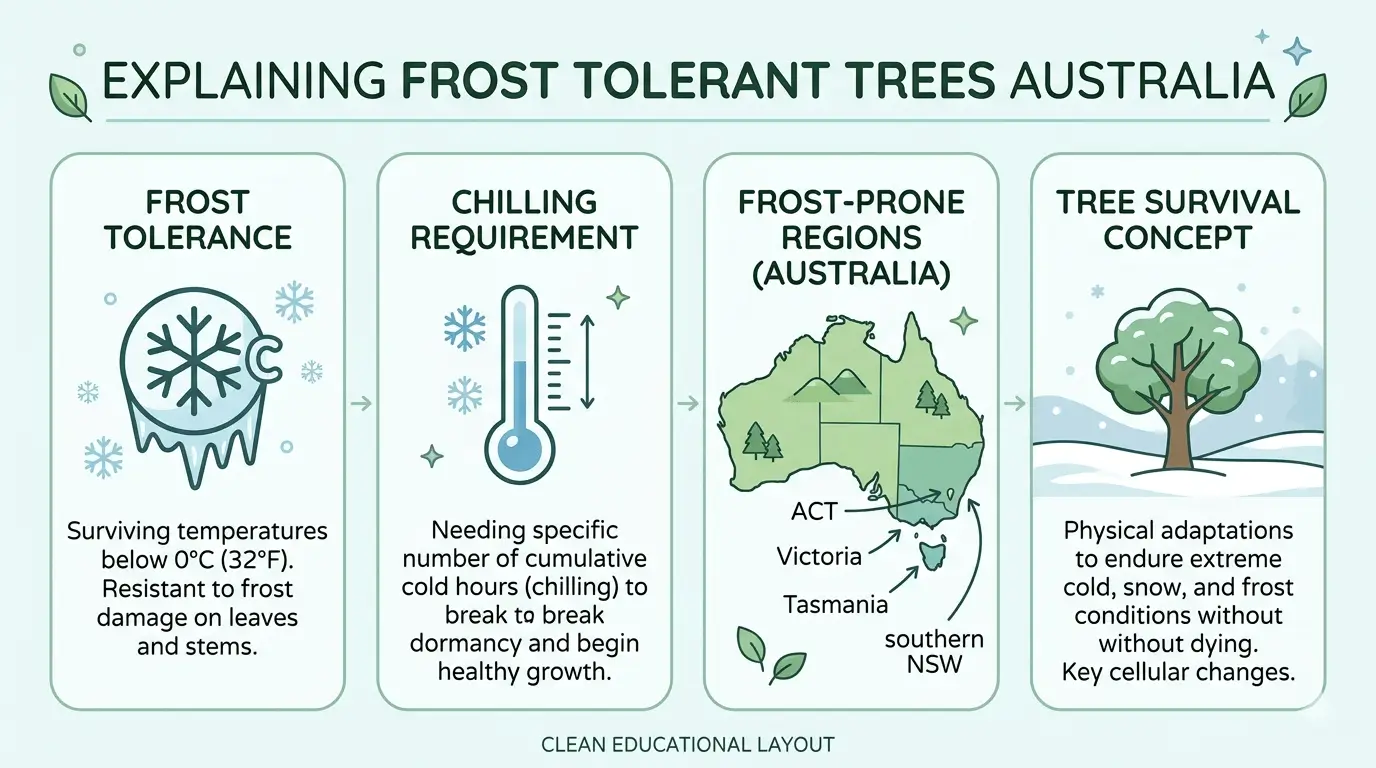
Frost tolerant trees are those that can survive aerial frost, ground frost, and repeated cold-winter conditions without significant damage. These trees may endure ice formation on leaves and stems while maintaining long-term growth and structure.
Frost tolerance differs from:
- Frost hardiness: the ability to survive extreme or prolonged freezing
- Chilling requirement: necessary cold exposure for fruiting in some species
Frost-prone regions in Australia include:
- ACT and Canberra region
- Southern New South Wales
- Victoria and Tasmania
- Elevated areas of South Australia and Western Australia
These environments align with broader categories such as cold climate plants Australia and frost hardy plants Australia.
Frost tolerance in plants is closely related to survival strategies in cold environments, which are influenced by climatic conditions such as frost and temperature drops.
How frost tolerant trees differ from other hardy trees
Frost tolerant trees are specifically adapted to cold, whereas general hardy trees may tolerate heat, drought, or salinity without handling frost conditions.
In Australian planting schemes, frost and drought tolerance are often combined because climates frequently experience:
- Cold, dry winters
- Hot, dry summers
Common traits of frost tolerant trees include:
- Deep, established root systems
- Small, waxy, or tough leaves
- Reduced growth activity during cold periods
Frost tolerant plants Australia also include shrubs and perennials, but trees are defined by their woody structure and long-term canopy development.
Key types of frost tolerant trees found in Australia
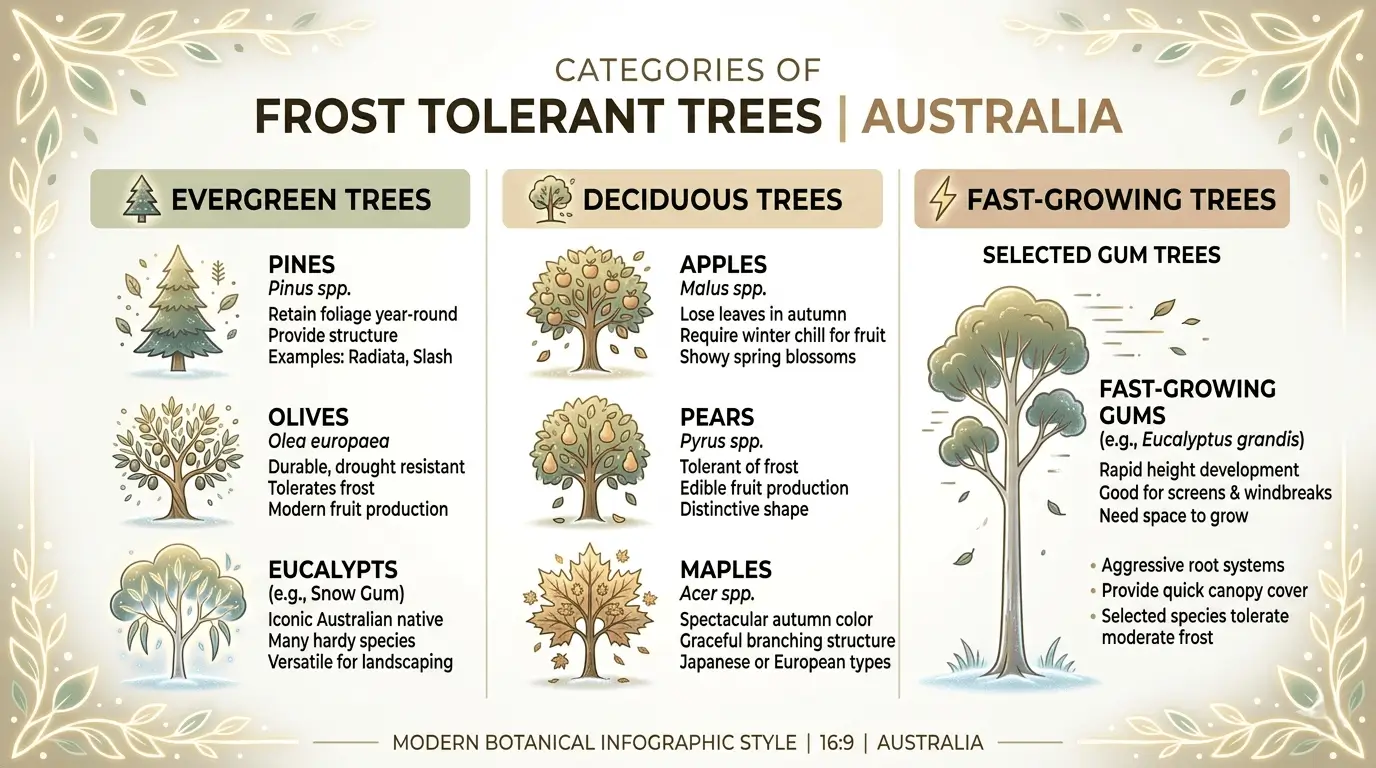
Frost tolerant trees can be grouped into native and non-native categories, each suited to different landscape needs.
Main types:
- Evergreen trees Australia: pines, olives, and some eucalypts
- Deciduous frost tolerant trees: apples, pears, and maples
- Fast-growing drought tolerant trees Australia: selected gum species
Evergreen feature trees Australia provide year-round foliage, while fast growing evergreen trees Australia are useful for rapid screening and shade. For a deeper breakdown of each species mentioned above, browse our Frost-Tolerant Trees Australia species database, organised by botanical name and origin.
It expands on evergreen, deciduous and native categories with individual species notes not covered in this guide.
Evergreen frost tolerant trees Australia
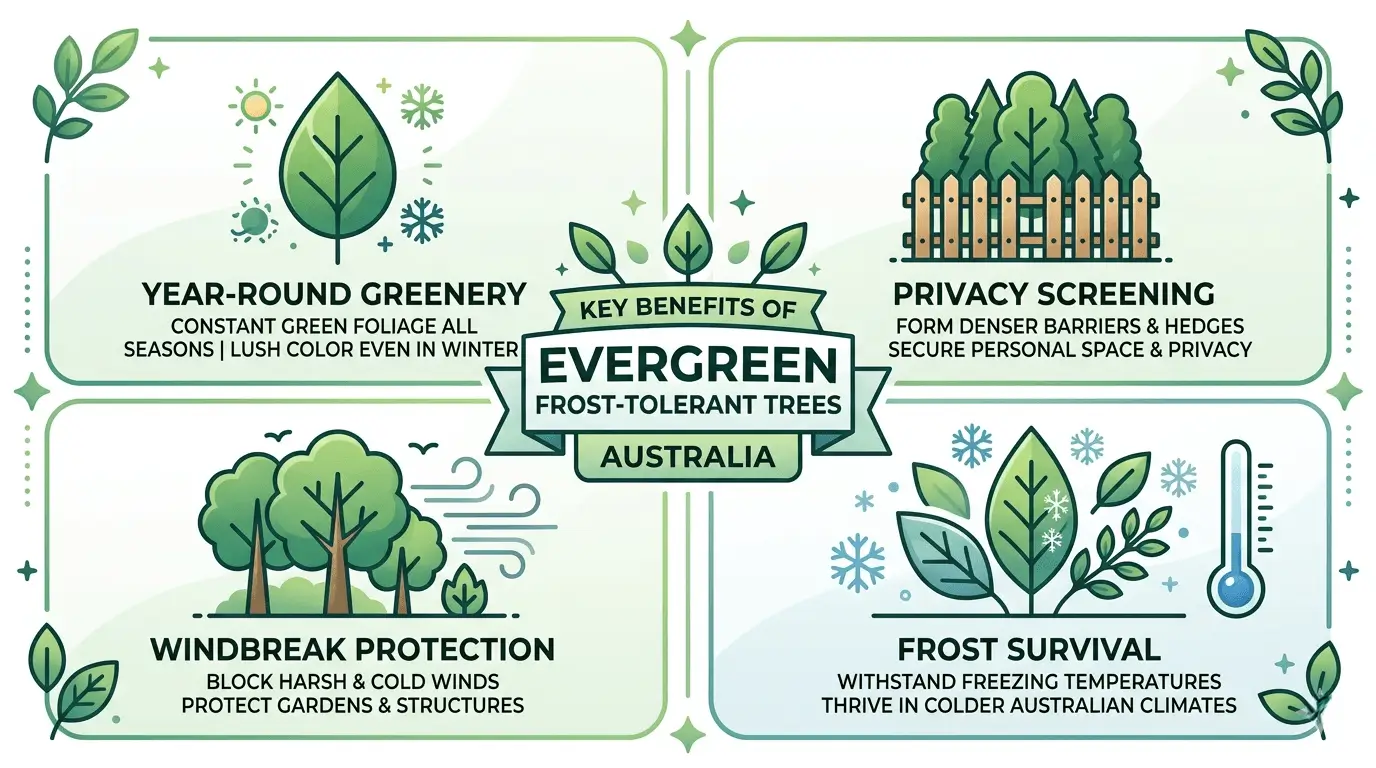
Evergreen trees are widely used in frost-prone landscapes because they provide continuous foliage, making them ideal for screening and windbreaks.
They are particularly valuable for:
- Privacy hedging
- Wind protection
- Year-round visual structure
However, not all evergreen trees tolerate frost. Selection must consider cold tolerance levels.
Common evergreen frost tolerant tree types:
- Pines (Pinus spp.)
- Olives (Olea europaea)
- Certain eucalypts such as Eucalyptus pauciflora
Small evergreen trees Australia and evergreen trees with non-invasive roots Australia are especially suitable for compact gardens.
Native vs. non-native frost tolerant trees Australia
Frost tolerant Australian native trees include species from genera such as:
- Eucalyptus
- Acacia
- Banksia (cold-tolerant varieties)
Non-native species include:
- Maples (Acer spp.)
- Pines (Pinus spp.)
- Olives (Olea europaea)
Native trees are often preferred due to:
- Lower water requirements
- Better adaptation to local soils
- Support for native biodiversity
However, some introduced species are among the most reliable hardy trees Australia in cold climates.
Choosing frost tolerant trees for different garden roles
Tall frost tolerant trees Australia
Tall trees are ideal for:
- Windbreaks
- Shade
- Large property boundaries
Examples include large eucalypts and pines.
Small frost tolerant trees Australia
Small trees suit:
- Courtyards
- Urban gardens
- Areas near buildings or power lines
These often include compact evergreen species with controlled root systems.
Low-maintenance frost tolerant trees Australia
Low-maintenance options typically:
- Require minimal pruning
- Tolerate poor soils
- Handle both frost and drought
Frost tolerant trees Australia for landscaping
Used in:
- Streetscapes
- Parks
- Commercial developments
Designs often prioritise drought and frost tolerant trees Australia for durability.
For gardeners planning structured landscapes, it is also useful to explore evergreen and hedging options such as evergreen trees for year-round greenery, best hedging trees for privacy screening, and evergreen shade trees in Australia, which complement frost tolerant species in functional garden design.
Frost and drought tolerant trees Australia: a practical pairing
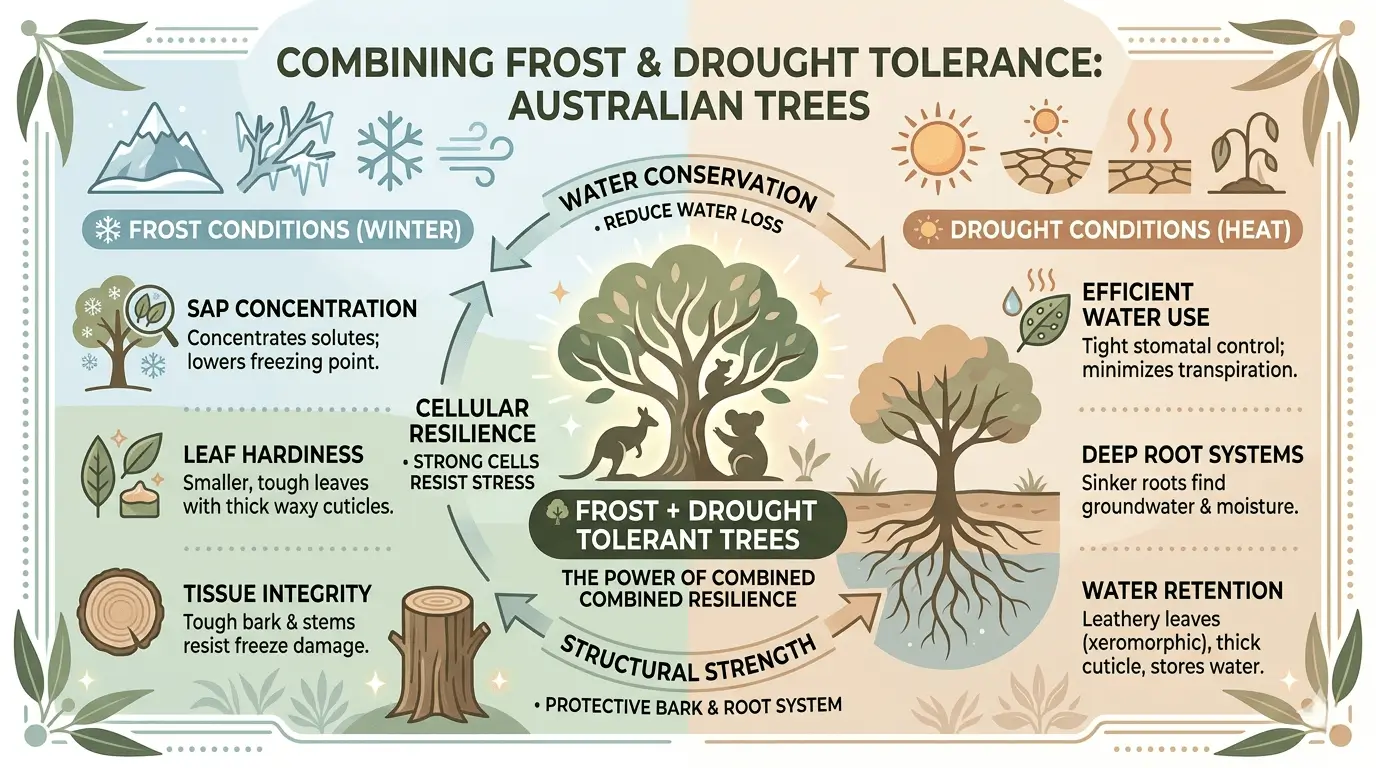
Frost and drought tolerance are commonly paired due to Australia’s seasonal extremes. Trees must survive freezing winters and dry summers.
Examples include:
- Snow gums (Eucalyptus pauciflora)
- Olives
- Pines
Fast-growing drought tolerant trees Australia are especially useful for:
- Quick screening
- Rapid shade establishment
This combination supports resilient, low-maintenance planting systems.
Frost tolerant fruit trees Australia (cool-climate options)
Frost tolerant fruit trees include species that require winter chilling for proper fruiting.
Common options:
- Apples (Malus domestica)
- Pears (Pyrus communis)
- Stone fruits (plums, peaches)
- Some mandarins (light frost tolerance)
Important notes:
- Macadamias are generally not frost tolerant
- Rootstock selection influences cold tolerance
- Site positioning affects frost exposure
These are often classified as cold climate fruit trees Australia.
Root systems and non-invasive choices
Root behaviour is critical when planting near structures.
Key considerations:
- Non-invasive roots reduce risk to foundations and pipes
- Single-trunk trees often have deeper root systems
- Multi-stemmed trees may spread laterally
Small evergreen trees Australia are often bred for compact root systems, making them suitable for tight urban spaces. If you’d prefer to sort and download the raw figures yourself, view the full frost-tolerant tree species spreadsheet with all species, root behaviour and growth-rate data in one place.
This raw dataset is useful for landscapers or councils needing exportable data rather than a visual tool.
Full-sun and shade performance in frost-prone areas
Most frost tolerant trees Australia perform best in full sun, which supports:
- Strong growth
- Better frost recovery
- Improved canopy development
However:
- Young trees may need protection from extreme afternoon heat
- Partial shade can reduce frost severity in some locations
Shade and frost tolerant plants Australia are often used as understorey companions.
Frost tolerant plants vs frost tolerant trees: when to use each
Frost tolerant trees provide height and structure, while frost tolerant plants such as shrubs and perennials fill lower layers.
Comparison:
- Trees: canopy, shade, long-term structure
- Shrubs: hedging, screening, mid-level coverage
- Perennials: ground cover, seasonal interest
Frost hardy evergreen shrubs Australia complement trees in layered garden designs.
Common care mistakes with frost tolerant trees Australia
Common mistakes include:
- Over-mulching around the trunk, leading to rot
- Planting too close to structures
- Using poorly drained soils
These errors contradict the requirements of low-maintenance frost tolerant trees Australia, which rely on proper spacing and drainage.
Seasonal care and environmental limitations
Winter care
- Protect young trees from severe frost
- Avoid excessive watering
Summer care
- Provide deep but infrequent watering
- Monitor heat stress
Environmental limitations include:
- Frost pockets in low-lying areas
- Soil pH imbalances
- High salinity zones
Cold climate plants Australia must be matched carefully to site conditions.
Troubleshooting frost-related problems
Common issues and solutions:
- Leaf scorch: caused by frost damage → prune affected growth
- Slow growth: due to poor drainage → improve soil structure
- Root rot: from over-watering → reduce irrigation
Preventive measures include:
- Proper site selection
- Well-drained soil
- Appropriate watering practices
Comparison block: frost tolerant tree options for different needs
| Tree Type | Frost Tolerance | Root Behaviour | Growth Rate |
| Tall evergreen eucalypt | Moderate to heavy frost | Deep, spreading | Fast |
| Small evergreen tree | Light to moderate frost | Non-invasive | Moderate |
| Deciduous fruit tree | Moderate frost | Moderate spread | Moderate |
Key comparisons:
- Tall vs small frost tolerant trees Australia depend on space
- Evergreen vs deciduous affects seasonal appearance
- Fast vs slow growth impacts maintenance and planning
Rather than scrolling through a static table, use our free interactive frost-tolerant tree selector tool to filter all 33 species by height, drought tolerance, root caution and garden role.
This filterable database lets you cross-reference frost band against mature size instantly, making it far faster than comparing species manually.
Seasonal and regional selection tips
ACT / Canberra
- Choose frost hardy plants Canberra suited to heavy frost
Inland and high-altitude zones
- Focus on drought and frost tolerant trees Australia
Coastal cool regions
- Select trees tolerant of frost, wind, and salt
Combining hardy plants and drought tolerant trees ensures resilience across diverse climates.
Conclusion
Frost tolerant trees Australia offer a reliable solution for creating structured, resilient landscapes in cold and variable climates. By selecting trees that combine frost tolerance with drought resistance, appropriate size, and non-invasive roots, gardeners can establish long-lasting, low-maintenance plantings. The most effective approach is to match tree species to local environmental conditions, ensuring sustainable growth and long-term landscape success.
Frequently Asked Questions (FAQs)
What does “frost tolerant trees Australia” mean?
Frost tolerant trees Australia are species that can survive freezing temperatures and recurring frost conditions commonly found in Australian climates.
Can you grow evergreen trees in frost-prone areas of Australia?
Yes, many evergreen trees Australia, including pines, olives, and some eucalypts, tolerate frost once established.
What are good frost tolerant fruit trees Australia for cool climates?
Apples, pears, stone fruits, and some mandarins are suitable, while macadamias generally are not frost tolerant.
Are there small frost tolerant trees Australia suitable for small gardens?
Yes, small evergreen trees Australia and species with non-invasive roots are ideal for compact spaces.
How do you combine frost tolerant trees with drought tolerant trees Australia?
By selecting species that tolerate both cold and dry conditions, you create resilient, low-maintenance landscapes suited to inland and high-altitude environments.