
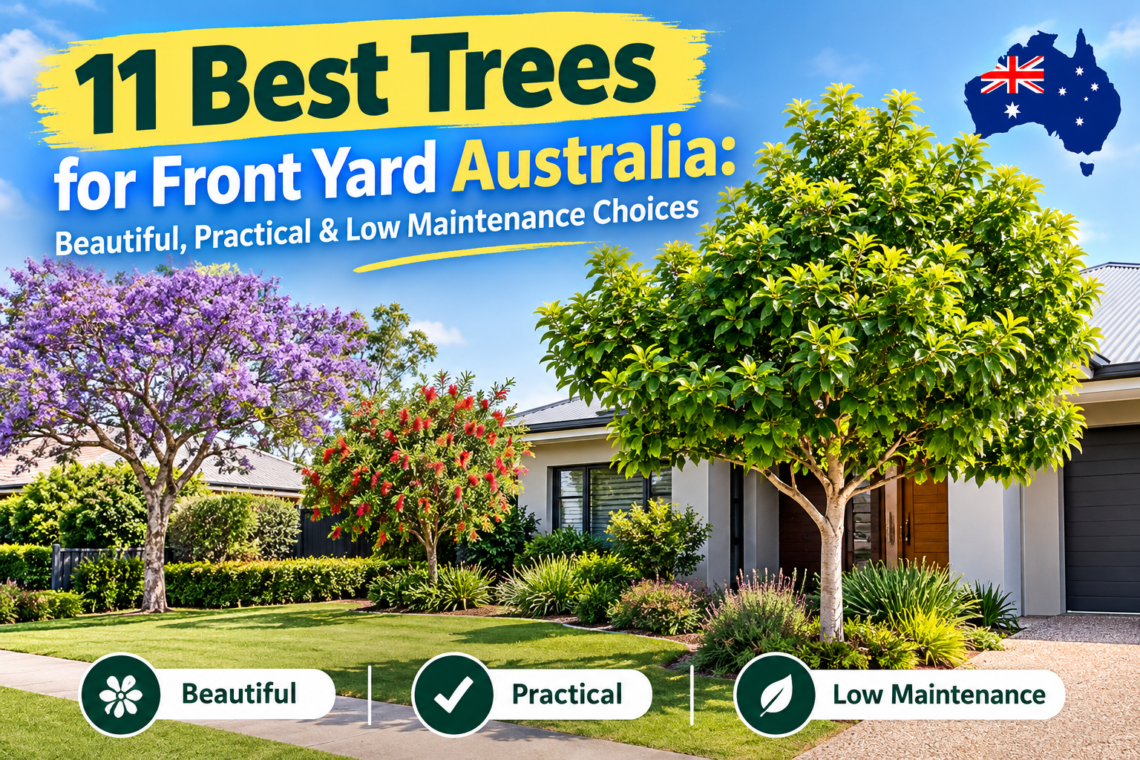
Choosing the right tree for your front yard can completely change the appearance of a home. A well-positioned tree can frame the entrance, soften hard landscaping, provide shade, create seasonal colour, attract wildlife, and give the garden a stronger sense of structure. But choosing a front-yard tree is not simply about finding the prettiest species at the nursery.
Australian front gardens often have limited planting space, driveways, footpaths, underground services, neighbouring properties and exposure to strong sun or wind. A tree that looks small when purchased can become much larger as it matures, so the final height and canopy width should always be considered before planting.
The best trees for front yard Australia are therefore those that balance appearance, mature size, climate suitability, maintenance, root behaviour and the design of the property. Whether you have a narrow suburban frontage, a modern garden, a cottage-style landscape or a native Australian planting scheme, there are excellent trees that can provide impact without overwhelming the space.
This guide explores some of the most useful front-yard tree choices for Australian gardens and explains how to select, position and care for them.
Table of Contents
- Why Choose a Tree for Your Front Yard?
- What Makes a Good Front Yard Tree?
- 11 Best Trees for Front Yard Australia
-
- Magnolia ‘Teddy Bear’
-
- Crepe Myrtle
-
- Water Gum
-
- Bottlebrush
-
- Corymbia ‘Summer Beauty’
-
- Native Frangipani
-
- Japanese Maple
-
- Dwarf Eucalyptus
-
- Acacia Cognata
-
- Olive Tree
-
- Lilly Pilly
- Best Trees for Small Front Yards
- Best Trees for Narrow Front Gardens
- Trees for Modern Australian Front Gardens
- Trees for Low-Maintenance Front Yards
- Evergreen vs Deciduous Trees
- How to Position a Tree in the Front Yard
- Common Front Yard Tree Mistakes
- Front Yard Tree Planting and Care Tips
- Frequently Asked Questions
- Final Thoughts
Quick Summary
- The best trees for front yard Australia should suit the garden’s mature available space rather than simply looking small when purchased.
- Magnolia ‘Teddy Bear’ is an attractive evergreen choice for homeowners wanting glossy foliage and large fragrant flowers.
- Crepe myrtles work particularly well in smaller gardens because of their summer flowers, attractive bark and seasonal foliage.
- Water Gum provides an Australian native option with glossy foliage, small flowers and attractive bark.
- Bottlebrush and compact flowering gums can bring native character and wildlife value to front gardens.
- Acacia cognata is useful where graceful foliage and a compact, modern appearance are important.
- Olive trees can suit Mediterranean and contemporary gardens, particularly where a slower-growing, drought-tolerant tree is desired.
- Lilly Pilly cultivars can provide dense greenery and can be useful where screening is more important than a traditional feature-tree shape.
- Always consider mature height, canopy width, roots, overhead clearance, footpaths, driveways and local council requirements before planting.
Why Choose a Tree for Your Front Yard?
Front yards are often designed with shrubs, lawns, paving and garden beds, but a carefully selected tree can add something those elements cannot easily provide: vertical structure.
Trees introduce a higher layer into the garden and help connect the scale of the house with the scale of the landscape. Gardening Australia notes that trees create canopy, shade, habitat and visual interest, making them useful even in relatively small gardens.
A front-yard tree can also perform several functions at once.
Improve street appeal
A well-shaped tree near an entrance or driveway can make a property feel more established and visually balanced.
Frame the house
Instead of allowing the building to dominate the front garden, trees can soften hard architectural lines and frame windows, doors or pathways.
Add seasonal interest
Flowering trees can introduce spring or summer colour, while deciduous species can provide changing foliage through the year.
Provide shade
A suitable canopy can eventually create shade over parts of a front garden, pathway or outdoor sitting area.
Support wildlife
Australian native flowering trees can provide nectar, shelter and habitat for birds, insects and other garden wildlife.
Create privacy
Although a feature tree is normally planted as an individual focal point, certain evergreen species can also contribute to screening.
The important point is that the tree should have a purpose. Before buying one, decide what you want it to achieve.
What Makes a Good Front Yard Tree?
Not every beautiful tree is suitable for a front garden.
A strong front-yard choice usually combines several characteristics.
1. Appropriate mature size
The tree needs enough room to develop naturally without constantly being cut back.
Gardening Australia recommends determining how high and wide a tree is expected to become and comparing that mature size with the available site.
2. Suitable canopy shape
An upright tree may work well beside a narrow path, while a rounded tree may suit an open lawn.
3. Climate suitability
Australian gardens range from tropical and subtropical regions to cool temperate and dry inland environments. The same species will not perform identically everywhere.
4. Manageable maintenance
Front gardens are highly visible from the street. Trees that require constant pruning can become frustrating when their natural growth habit does not suit the location.
5. Appropriate roots and planting space
Roots need room to develop, and the location should be considered in relation to paving, buildings, drainage and services.
6. Year-round appearance
A tree can look spectacular for three weeks and ordinary for the remaining eleven months. For a front garden, foliage, bark and form can be just as important as flowers.
7. Relationship with the house
The best tree should complement your home’s architecture rather than compete with it.
11 Best Trees for Front Yard Australia
1. Magnolia ‘Teddy Bear’
Botanical name: Magnolia grandiflora ‘Teddy Bear’
Type: Evergreen ornamental tree
Best for: Modern front gardens, entrances, feature beds and smaller suburban landscapes
Magnolia ‘Teddy Bear’ is one of the strongest options for homeowners who want an elegant evergreen focal tree.
Its glossy dark-green foliage provides structure throughout the year, while its large creamy-white flowers add seasonal impact. The flowers are also fragrant, making the tree particularly enjoyable when planted near an entry path or outdoor living area.
The cultivar is valued for a relatively compact, upright form compared with larger southern magnolias. That makes it useful where year-round foliage is wanted but the planting area is limited.
Its polished foliage also suits modern residential architecture. Against rendered walls, stone, timber fencing or neutral paving, the tree can create a strong contrast without looking overly informal.
Why choose Magnolia ‘Teddy Bear’?
It works especially well when you want:
- Evergreen foliage
- Large white flowers
- Fragrance
- A formal or polished appearance
- A feature tree near an entrance
- A compact alternative to larger magnolias
Greenery Inside already has a dedicated guide to Magnolia ‘Teddy Bear’ growth and cultivation, so that article should be used as an internal link from this section rather than repeating the complete care profile.
2. Crepe Myrtle
Botanical name: Lagerstroemia cultivars
Type: Deciduous flowering tree
Best for: Small gardens, modern front yards, summer colour and seasonal interest
Crepe myrtle is one of the most versatile ornamental trees for Australian front gardens.
Gardening Australia specifically describes crepe myrtle as an ideal choice for smaller gardens, noting its summer flowers, autumn colour and attractive bark.
Its main advantage is that it provides more than one season of interest.
During summer, the tree produces masses of flowers. Depending on the cultivar, these may range from white and pink to red or purple tones.
After the flowers fade, foliage and autumn colour continue to provide interest. Once the leaves drop, the branching pattern and bark become more visible.
This seasonal transformation can be particularly effective in a front garden because the tree does not look identical throughout the year.
Best placement
Use crepe myrtle:
- Beside a driveway
- Near a front path
- As a central lawn feature
- In a small front garden bed
- Near a modern entrance
The key is to select the right cultivar. Crepe myrtles range considerably in eventual size, so a compact cultivar is preferable when space is restricted.
3. Water Gum
Botanical name: Tristaniopsis laurina
Type: Australian native evergreen tree
Best for: Native gardens, streetscape-style planting and structured front gardens
Water Gum is a particularly attractive choice when you want Australian native character without the scale associated with many larger Australian trees.
Gardening Australia describes Tristaniopsis laurina as a small to medium-growing tree with glossy leaves, small yellow spring flowers and attractive bark. It can also be pruned to shape.
Its foliage gives it a refined appearance, meaning it can work equally well in native and contemporary landscaping.
This is an important quality for front gardens because a tree should not necessarily look “wild” just because it is native.
Design idea
Pair Water Gum with:
- Lomandra
- Dianella
- Westringia
- Native grasses
- Low flowering groundcovers
The combination creates a distinctly Australian garden while remaining clean and structured.
4. Bottlebrush
Botanical name: Callistemon cultivars
Type: Australian native flowering tree or shrub
Best for: Wildlife-friendly gardens, sunny front yards and native landscapes
Bottlebrush is a classic Australian choice for front gardens.
Its bright brush-like flowers provide an immediate focal point, while evergreen foliage gives the plant structure outside the flowering period.
Importantly, bottlebrush is not a single uniform plant. There are many species, cultivars and growth forms, ranging from compact shrubs to small trees.
This means homeowners can choose forms appropriate for their specific space.
Australian Native Plants Society Australia lists several Callistemon forms among plants suitable for smaller gardens and notes that numerous small forms are available.
Why bottlebrush works in front yards
It can provide:
- Strong flower colour
- Evergreen foliage
- Native wildlife value
- Screening
- Informal structure
- Adaptability to many Australian garden styles
The biggest mistake is buying a bottlebrush based only on the current container size. Check the cultivar’s mature dimensions before planting.
5. Corymbia ‘Summer Beauty’
Botanical name: Corymbia ficifolia ‘Summer Beauty’
Type: Compact flowering gum
Best for: Native gardens, modern landscapes and colourful feature planting
Corymbia ‘Summer Beauty’ offers the visual character of a flowering gum in a more manageable garden form.
Greenery Inside’s existing guide describes this cultivar as a compact feature tree suitable for smaller landscapes, including suburban gardens, poolside planting and wildlife gardens.
Its pink to coral-toned flowers can become a dramatic focal point in summer.
For homeowners who want a distinctly Australian tree but prefer something more ornamental than a conventional eucalyptus, it can be an excellent compromise.
Consider it for
- Contemporary native gardens
- Open lawn areas
- Feature planting near driveways
- Wildlife-friendly front gardens
- Sunny locations
As with any compact gum, exact mature size should be checked before planting.
6. Native Frangipani
Botanical name: Hymenosporum flavum
Type: Australian native flowering tree
Best for: Warm climates and informal front gardens
Native frangipani is an attractive Australian native tree known for fragrant flowers and a graceful appearance.
Australian Native Plants Society Australia includes Hymenosporum flavum among small trees suitable for smaller gardens.
It can suit homeowners who want something softer and more relaxed than a strongly formal feature tree.
The flowers provide seasonal interest while the overall form works nicely with cottage, subtropical and naturalistic landscapes.
Because Australian climate suitability varies, this is a tree where regional conditions should be considered carefully before planting.
Design idea
Allow the native frangipani to stand slightly away from the front door rather than forcing it into a symmetrical position. Its softer form can work well as a natural focal point.
7. Japanese Maple
Botanical name: Acer palmatum cultivars
Type: Deciduous ornamental tree
Best for: Cool-climate and sheltered front gardens
Japanese maple is primarily valued for its foliage rather than its flowers.
Fine leaves, elegant branching and seasonal colour make it one of the most visually sophisticated options for a front garden.
It is particularly useful in cool or temperate regions where intense summer heat is not excessive.
A Japanese maple can look spectacular beside contemporary architecture because its branching structure adds softness without creating a heavy canopy.
Best use
Consider it for:
- Courtyard-style front gardens
- Sheltered entrances
- Japanese-inspired landscapes
- Cool-climate gardens
- Small lawn features
Avoid treating it as a universal Australian tree. Climate suitability is essential.
8. Dwarf Eucalyptus
Botanical name: Various Eucalyptus species and cultivars
Type: Australian native
Best for: Native landscapes, dry gardens and distinctive feature planting
A full-sized eucalyptus would obviously be unsuitable for many front yards, but smaller eucalyptus species and cultivars provide another option.
Australian Native Plants Society Australia lists a number of smaller eucalypts suitable for smaller gardens, including species with colourful flowers and distinctive foliage.
Gardening Australia also explains that eucalyptus species range from enormous forest trees to much smaller forms, meaning gardeners need to consider the mature size of the particular selection rather than assuming all gums are large.
This is an important distinction.
“Dwarf eucalyptus” should never be interpreted as “tiny tree.”
Always verify the mature dimensions of the exact cultivar.
Best use
Dwarf and smaller eucalyptus selections are particularly attractive in:
- Dry-climate gardens
- Native landscapes
- Naturalistic gardens
- Modern Australian gardens
- Wildlife-focused planting schemes
Their foliage and bark can create year-round visual texture even outside flowering periods.
9. Acacia Cognata
Botanical name: Acacia cognata cultivars
Type: Australian native ornamental
Best for: Contemporary front gardens, narrow spaces and flowing foliage
Acacia cognata is better known for its soft, flowing foliage than for dramatic flowers.
Its weeping or cascading habit gives it a different visual character from upright feature trees.
This can make it an excellent choice where you want a tree-like focal point that softens a modern landscape.
Greenery Inside’s Acacia cognata guide covers compact forms including Mini Cog and Limelight, which are particularly useful in restricted garden spaces. The compact cultivars are commonly used for borders, containers, accent planting and contemporary landscape designs.
Why choose it?
Acacia cognata can provide:
- Fine-textured foliage
- A graceful weeping form
- Australian native character
- Contemporary appearance
- Good contrast against hard landscaping
It is particularly effective when planted beside rendered walls or geometric paving because the soft foliage contrasts with strong architectural lines.
10. Olive Tree
Botanical name: Olea europaea cultivars
Type: Evergreen ornamental tree
Best for: Mediterranean and contemporary gardens
Olive trees can create a strong architectural feature in a front garden.
Their silvery-green foliage works particularly well with stone, gravel, rendered walls and neutral-coloured landscaping.
Gardening Australia highlights European olive as a small, slow-growing tree that can suit backyards and be hedged, while also noting the need to manage fruit because olives can become weedy in some situations.
This makes cultivar and fruiting behaviour important considerations.
Ideal garden styles
Olive trees are especially useful in:
- Mediterranean landscapes
- Modern minimalist gardens
- Gravel gardens
- Dry gardens
- Courtyard entrances
A single olive with a clear trunk can create a strong focal point without requiring elaborate surrounding planting.
11. Lilly Pilly
Botanical name: Syzygium cultivars
Type: Australian native evergreen
Best for: Screening, boundary planting and structured front gardens
Lilly Pilly is a highly adaptable Australian garden plant with numerous cultivars suited to different sizes and landscape uses.
While often used as a hedge, selected forms can contribute to a front-yard planting scheme where the primary goal is density, privacy or evergreen structure.
Gardening Australia notes that lilly pillies include cultivars specifically bred for narrow beds and pots and respond well to pruning.
This makes them useful where the front garden needs greenery along a boundary rather than a single ornamental specimen.
The exact cultivar is crucial because growth habits differ.
Best use
Use lilly pilly where you want:
- Evergreen screening
- Dense foliage
- A neat hedge
- Boundary structure
- A green backdrop for feature plants
It is usually better suited to structured screening than to being treated as a solitary flowering feature tree.
Best Trees for Small Front Yards
A small front yard requires more careful selection because the tree becomes visually dominant much faster.
Some useful starting choices include:
Magnolia ‘Teddy Bear’
Best when you want evergreen foliage and a formal appearance.
Compact Crepe Myrtle
Best when seasonal flowers and autumn interest are priorities.
Compact Bottlebrush
Best when native flowers and wildlife value are important.
Acacia Cognata cultivars
Best when flowing foliage and modern landscaping are preferred.
Selected Small Eucalyptus
Best for native gardens with enough room for the particular cultivar’s mature dimensions.
The key is not simply selecting the smallest tree available.
A tree should have enough room to develop a healthy structure without constant aggressive pruning.
Gardening Australia specifically recommends pruning smaller trees from a young age when maintaining a compact form is desirable, because early shaping makes the eventual height and structure easier to manage.
Best Trees for Narrow Front Gardens
Narrow front gardens are usually more difficult than small square gardens.
The issue is not necessarily total area. It is the relationship between the tree and surrounding boundaries.
A broad canopy can quickly extend over:
- Footpaths
- Driveways
- Windows
- Neighbouring properties
- Street areas
- Garden lighting
Look for naturally narrow or upright forms.
Good starting categories include:
- Upright magnolia cultivars
- Selected lilly pillies
- Narrow-form native trees
- Compact flowering gums
- Carefully selected ornamental trees
Before planting, stand at the intended location and imagine the mature canopy from above.
The question should not be:
“Does this tree fit here today?”
Instead ask:
“Will this canopy still fit here when the tree is mature?”
That simple change in thinking prevents many front-yard tree problems.
Trees for Modern Australian Front Gardens
Modern Australian landscaping usually benefits from simplicity.
Instead of filling every part of the garden with different species, choose one strong tree and repeat a limited number of supporting plants.
A useful modern combination might include:
One feature tree + low native grasses + gravel or mulch + restrained flowering shrubs.
For example, a compact flowering gum surrounded by lomandra and low groundcovers can create a distinctly Australian appearance without making the garden feel cluttered.
Acacia cognata can create a similar effect with its flowing foliage.
Magnolia ‘Teddy Bear’ works well when the architecture is more formal and the homeowner wants an elegant evergreen statement.
Water Gum can sit between native and contemporary styles because of its refined foliage and attractive trunk.
Trees for Low-Maintenance Front Yards
Low maintenance does not mean “plant it and forget it.”
Every tree requires some establishment care.
However, maintenance can be reduced by choosing a tree with:
- Appropriate mature size
- Suitable climate tolerance
- Moderate growth
- Good natural shape
- Water requirements suited to the site
- Resistance to common local problems
Gardening Australia highlights adaptability to soil conditions, response to pruning and water-wise characteristics as desirable qualities when selecting trees for urban gardens.
This is why a species that grows extremely quickly is not always the best option.
Fast growth can sound attractive when buying a young tree, but it can result in more pruning and larger maintenance requirements later.
Evergreen vs Deciduous Trees for Front Gardens
Choosing evergreen or deciduous is primarily a design decision.
Evergreen trees
Evergreen trees retain their foliage throughout the year.
They are useful when you want:
- Consistent structure
- Year-round greenery
- Screening
- Privacy
- A stable visual backdrop
Examples include:
- Magnolia ‘Teddy Bear’
- Water Gum
- Bottlebrush
- Lilly Pilly
- Olive
Deciduous trees
Deciduous trees lose their leaves during part of the year.
They are useful when you want:
- Strong seasonal change
- Spring flowers
- Autumn colour
- Winter sunlight
- More open views during cooler months
Examples include:
- Crepe Myrtle
- Japanese Maple
- Flowering Cherry
- Chinese Redbud
- Other selected ornamental trees
There is no universal winner.
An evergreen tree may be perfect for a house that needs consistent privacy, while a deciduous tree may be better beside a living room window where winter sunlight is desirable.
How to Position a Tree in the Front Yard
Tree placement can make a good tree look fantastic or make it seem completely wrong.
Near the entrance
A carefully positioned tree can frame the front door and create a welcoming transition between garden and home.
Avoid planting so close to the pathway that the mature canopy or trunk interferes with movement.
Beside the driveway
A feature tree can visually soften a long driveway.
However, consider canopy spread and visibility for vehicles.
In the lawn
One central tree can become a strong focal point.
This is particularly effective when surrounded by open lawn rather than crowded planting.
Within a garden bed
A tree surrounded by lower planting creates a layered appearance.
This approach works well for native, cottage and modern gardens.
Near a boundary
Trees along boundaries can provide screening and visual softness.
However, narrow forms are generally more suitable where space is limited.
Think About Sightlines Before Planting
Front gardens have an additional issue that backyard gardens do not always face: visibility.
Plants around driveways and footpaths should not create unsafe blind spots.
Gardening Australia highlights the importance of maintaining line of sight near streets and paths when selecting low-growing plants for front gardens and verges.
A young tree may have a clear trunk and sparse canopy, but years later its branches may obstruct visibility.
Before planting, consider:
- Cars entering the driveway
- Pedestrians using the footpath
- Children approaching the property
- Neighbouring driveways
- Street intersections
- Security cameras
- Outdoor lighting
Good garden design should be attractive and practical at the same time.
Common Front Yard Tree Mistakes
Choosing a tree because it looks small at the nursery
This is perhaps the most common mistake.
Nursery size tells you almost nothing about final landscape size.
Always check the mature height and spread.
Planting directly in the centre without considering the house
A centred tree is not automatically a well-designed tree.
The final position should relate to windows, doors, driveways and architectural lines.
Ignoring shade
A tree may eventually cast significant shade over lawn, garden beds or windows.
Think about the sun’s movement through the year.
Choosing the wrong climate
A plant that performs well in a cool southern garden may not appreciate tropical humidity or intense inland heat.
Over-pruning
Trying to force the wrong tree into a small space through constant cutting can create an unattractive shape and unnecessary maintenance.
It is generally better to select an appropriate cultivar from the beginning.
Ignoring root-zone limitations
Paving, compacted soil, drainage infrastructure and building construction can restrict root development.
The available planting area should be assessed before choosing the tree.
Planting too many feature trees
A small front garden usually benefits from one dominant focal tree rather than several competing specimens.
Front Yard Tree Planting and Care Tips
Choose the site before buying the tree
Do not start with the tree and then search for somewhere to put it.
Start with the site.
Study:
- Sunlight
- Soil
- Drainage
- Available width
- Available height
- Wind
- Existing plants
- Nearby structures
Then choose the plant.
This approach aligns with Gardening Australia’s recommendation to assess the intended planting site and local conditions before selecting a feature tree.
Prepare the soil properly
Poor drainage can create long-term problems.
Where soil is compacted, improve its structure according to the requirements of the chosen species rather than automatically adding large amounts of material.
Avoid planting too deeply
A tree should be planted at an appropriate depth with the root flare positioned correctly.
Water consistently during establishment
Young trees require more attention than established trees.
Watering requirements depend on species, soil, season and local climate.
Mulch around the root zone
Organic mulch can help conserve soil moisture and moderate soil temperature.
Keep mulch away from the trunk.
Prune with purpose
Pruning should support the natural form rather than repeatedly fighting it.
Where a compact tree needs shaping, early formative pruning can be particularly useful. Gardening Australia recommends beginning pruning when trees are young to make size and shape easier to maintain later.
Monitor the tree seasonally
A front-yard tree is highly visible, so inspect it regularly for:
- Dead branches
- Pest problems
- Yellowing leaves
- Poor new growth
- Soil drying
- Waterlogging
- Structural issues
Early intervention is generally easier than trying to correct a major problem later.
A Simple Front Yard Tree Selection Formula
When you are unsure which tree to choose, use this five-step process.
Step 1: Measure the space
Measure available planting width.
Step 2: Observe sunlight
Identify whether the site receives full sun, morning sun, afternoon sun, filtered light or shade.
Step 3: Check mature dimensions
Look for the expected height and canopy width of the specific cultivar.
Step 4: Decide the main purpose
Ask whether you want:
Curb appeal, flowers, shade, privacy, wildlife, evergreen foliage or seasonal interest.
Step 5: Match the style of your house
Modern home?
Choose a cleaner, structured form.
Cottage home?
Consider softer branching and seasonal flowers.
Native garden?
Select Australian species and cultivars suited to your region.
Mediterranean home?
Consider olive and other drought-tolerant forms.
This simple process is often more useful than choosing a tree based on a nursery label alone.
Front Yard Tree Comparison
| Tree | Foliage | Main Feature | Best Garden Style | Best Use |
|---|---|---|---|---|
| Magnolia ‘Teddy Bear’ | Evergreen | Large white flowers | Modern | Feature tree |
| Crepe Myrtle | Deciduous | Summer flowers | Modern/Cottage | Feature tree |
| Water Gum | Evergreen | Glossy foliage and bark | Native/Modern | Feature tree |
| Bottlebrush | Evergreen | Bright flowers | Native | Wildlife and feature planting |
| Corymbia ‘Summer Beauty’ | Evergreen | Pink/coral flowers | Native/Modern | Feature planting |
| Native Frangipani | Evergreen | Fragrant flowers | Cottage/Natural | Feature planting |
| Japanese Maple | Deciduous | Fine foliage | Japanese/Cottage | Sheltered feature |
| Dwarf Eucalyptus | Evergreen | Bark, flowers and foliage | Native | Feature planting |
| Acacia Cognata | Evergreen | Flowing foliage | Modern | Accent planting |
| Olive | Evergreen | Silver foliage | Mediterranean | Architectural feature |
| Lilly Pilly | Evergreen | Dense foliage | Modern/Native | Screening |
Actual mature size and performance vary between cultivars and locations, so use this table as a starting point rather than a substitute for checking the individual plant label and local conditions.
Frequently Asked Questions
What is the best tree for a front yard in Australia?
There is no single best tree for every Australian front yard. Magnolia ‘Teddy Bear’, compact crepe myrtles, Water Gum, bottlebrush, compact flowering gums and selected small native trees are all useful options depending on climate, available space and garden style.
What is the best small front yard tree in Australia?
For a small front yard, consider a tree with a naturally controlled canopy rather than relying on heavy pruning to keep a larger species small. Magnolia ‘Teddy Bear’, compact crepe myrtle, selected bottlebrush cultivars and compact Acacia forms are useful starting points.
What tree is best for a narrow front yard?
Look for a narrow or upright cultivar whose mature canopy does not occupy the entire available width. The exact choice should be based on the site’s sunlight, climate and surrounding structures.
Are native trees good for front yards?
Yes. Australian native trees can provide flowers, foliage, habitat and regional character. Australian Native Plants Society Australia lists numerous small native trees suitable for smaller gardens, while also warning that not every plant will suit every climate or soil type.
What is a low-maintenance tree for an Australian front garden?
A low-maintenance tree is usually one that naturally suits the local climate, has an appropriate mature size and does not require constant shaping. Water-wise species and suitable Australian natives can be excellent choices, but maintenance still varies by location and cultivar.
Should I choose an evergreen or deciduous tree?
Choose evergreen when you want year-round foliage, screening and consistent structure. Choose deciduous when you prefer strong seasonal change, autumn colour, flowering displays and more winter sunlight.
How close can a tree be planted to a house?
There is no single distance that is safe for every tree. The appropriate separation depends on mature size, canopy, root characteristics, soil, foundations, paving and infrastructure. Check local requirements and the specific species before planting near buildings.
Can I keep a large tree small by pruning it?
Pruning can influence a tree’s size and shape, particularly when formative pruning begins while the tree is young. However, repeatedly forcing a naturally large tree into a very small space is usually not the best long-term strategy. Gardening Australia recommends selecting a tree that suits the site and using early pruning to help maintain size and shape.
Which trees are good for attracting birds?
Native flowering trees such as bottlebrush and flowering gums can provide valuable nectar sources for wildlife. Your choice should also consider which plants naturally occur or perform well in your region.
What is a good tree for a modern front garden?
Magnolia ‘Teddy Bear’, Acacia cognata, compact flowering gums and selected eucalyptus forms can all work well in modern Australian landscaping. The best choice depends on whether you want flowers, evergreen structure, native character or a sculptural form.
Should I plant one tree or several?
For a compact front yard, one carefully selected feature tree is often enough to establish a focal point. Multiple trees can work in larger front gardens, particularly when used to frame a driveway or entrance.
Final Thoughts
The best trees for front yard Australia are not simply the trees with the most impressive flowers or the fastest growth. The strongest choices are those that fit the space, architecture, climate and long-term maintenance expectations of the property.
A Magnolia ‘Teddy Bear’ can create a polished evergreen entrance. A crepe myrtle can provide dramatic summer flowers and seasonal colour. Water Gum and bottlebrush offer Australian native character, while compact flowering gums and eucalyptus can bring stronger wildlife and landscape value. Acacia cognata and olive trees provide softer or more architectural alternatives for contemporary gardens.
The most important decision happens before the tree goes into the ground.
Measure the planting space. Observe the sunlight. Check the mature canopy. Think about roots and surrounding infrastructure. Consider how the tree will look in five, ten and fifteen years rather than how it looks inside the nursery pot.
A successful front garden should not make the tree fight against the space.
Instead, the tree should feel as though the space was designed for it.
That is what turns an ordinary front garden into a landscape with structure, personality and lasting curb appeal.
Related Greenery Inside Guides
For a broader planting strategy, connect this article to Greenery Inside’s existing guides on Small Feature Trees in Australia, Small Evergreen Trees, Cottage Trees, Flowering Evergreen Trees, Corymbia ‘Summer Beauty’, Dwarf Eucalyptus Trees and Acacia Cognata dwarf varieties. This creates a strong internal topic cluster around tree selection, small-space landscaping and Australian garden design.
