Small gardens do not have to sacrifice beautiful seasonal colour. The right flowering tree can become the focal point of a courtyard, soften a front entrance, attract pollinators, and add height without making a compact garden feel crowded. The challenge is choosing a tree for its mature size, not the small plant you see at the nursery. Sunlight, climate, root behaviour, soil, pruning needs, and canopy width all matter.
For Australian gardeners, the best flowering trees for small gardens combine attractive blooms with a growth habit that suits residential spaces. Some are evergreen, while others offer spectacular seasonal displays before dropping their leaves. This guide compares compact flowering trees for courtyards, front yards, patios, suburban gardens, and narrow planting areas, with practical advice for choosing and caring for them successfully.
Table of Contents
- What Makes a Flowering Tree Suitable for a Small Garden?
- Best Flowering Trees for Small Gardens in Australia
- Magnolia ‘Teddy Bear’
- Dwarf Crepe Myrtle
- Corymbia ‘Summer Beauty’
- Bottlebrush
- Native Frangipani
- Japanese Maple
- Chinese Redbud
- Ornamental Pear
- Flowering Cherry
- Frangipani
- Dwarf Eucalyptus
- How to Choose the Right Flowering Tree
- Best Flowering Trees for Courtyards
- Best Small Flowering Trees for Front Yards
- Evergreen vs Deciduous Flowering Trees
- Planting and Care Tips
- Common Mistakes to Avoid
- Frequently Asked Questions
- Conclusion
Quick Summary
- The best flowering trees for small gardens Australia combines manageable mature size, suitable root behaviour, attractive flowers, and climate tolerance.
- Magnolia ‘Teddy Bear’ is a strong choice for gardeners who want evergreen foliage, fragrant white flowers, and a compact upright shape.
- Dwarf crepe myrtles provide colourful summer flowers and attractive bark while staying much smaller than many traditional flowering trees.
- Compact flowering gums such as Corymbia ‘Summer Beauty’ can bring Australian native character and wildlife value to smaller landscapes.
- Bottlebrushes are excellent native options for sunny gardens, with many cultivars available in compact forms.
- Deciduous trees such as Japanese maple, Chinese redbud, and flowering cherries can provide seasonal colour while allowing winter sunlight through.
- Always check the expected mature height and width before planting near buildings, paths, fences, paving, or underground services.
What Makes a Flowering Tree Suitable for a Small Garden?
A flowering tree is not automatically a good small-garden tree simply because it is sold in a small pot. Nursery plants can remain compact for several years before developing their mature canopy. A tree that looks perfect beside a patio today may eventually dominate the entire space.
For a compact Australian garden, look at six characteristics.
1. Mature height
Height is one of the most obvious considerations, but it should not be assessed alone. A tree that reaches several metres but has a narrow upright habit may sometimes fit better than a shorter tree with a very wide canopy.
2. Mature canopy width
Width can be even more important than height in a courtyard or small backyard. Wide branches may interfere with rooflines, paths, outdoor seating, fences and neighbouring properties.
3. Root behaviour
Trees should be selected according to the available planting space and the relationship between roots, paving, drainage and structures. Courtyard situations deserve particular care because hard surfaces and building foundations leave less room for error. Landscape guidance for courtyards recommends considering drainage and potential root issues before planting.
4. Climate suitability
Australia contains tropical, subtropical, temperate, Mediterranean, arid and cool climates. A flowering tree that performs beautifully in Brisbane may struggle in a frost-prone inland garden.
5. Maintenance requirements
A compact tree should not automatically mean low maintenance. Some fast-growing flowering trees require regular shaping, while slow-growing trees may need very little pruning.
6. Flowering period
Think about when you want your garden to look its best. Spring-flowering species provide a burst of colour, while summer flowering trees can bring interest during outdoor entertaining season.
12 Best Flowering Trees for Small Gardens in Australia
The following choices cover a range of Australian climates, garden styles and design needs. Not every tree will suit every location, so use the mature size and climate information as a starting point rather than a universal planting rule.
1. Magnolia ‘Teddy Bear’
Botanical name: Magnolia grandiflora ‘Teddy Bear’
Type: Evergreen flowering tree
Best for: Courtyards, front gardens, feature planting and screening
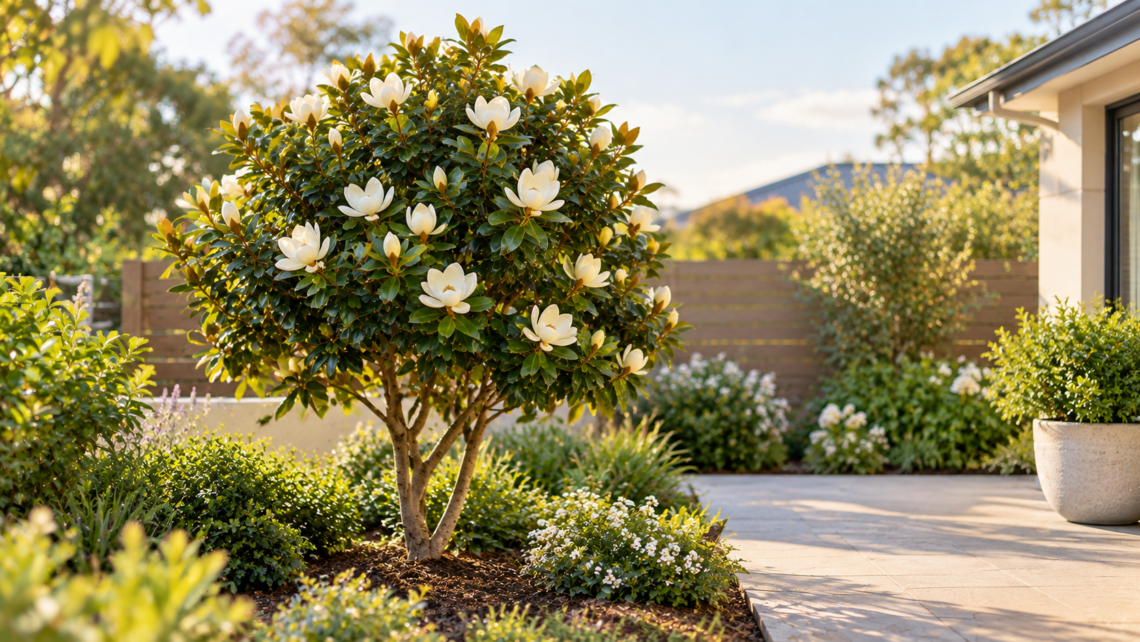
Magnolia ‘Teddy Bear’ is one of the most attractive options for gardeners who want a flowering tree with year-round foliage. It develops a compact, upright, dense form and produces large creamy-white, fragrant flowers during the warmer part of the year.
Australian nursery information commonly places the variety around 4 metres tall and about 2 metres wide during its first decade, although mature size varies according to conditions and pruning. It is also known for glossy green foliage with a distinctive bronze-brown underside.
One of its biggest advantages in a small garden is visual density. Rather than creating a sparse canopy, Teddy Bear develops a substantial evergreen presence. That makes it useful as a feature tree and, where space allows, a screening plant.
It prefers sun to part shade and well-drained soil. Established plants can tolerate periods of dry weather, but young trees benefit from consistent moisture while developing their root systems. Heavy clay or persistently wet soil should be treated carefully because drainage is important.
For gardeners interested in this variety specifically, Greenery Inside already has a dedicated guide covering Magnolia Teddy Bear growth rate, mature size and cultivation considerations. This new article can internally link to that more specialised page rather than repeating every growth detail.
Best use
Choose Teddy Bear when you want an elegant evergreen feature tree with large fragrant flowers and a relatively controlled form.
2. Dwarf Crepe Myrtle
Botanical name: Lagerstroemia indica cultivars
Type: Deciduous flowering tree
Best for: Courtyards, small lawns, patios and colourful summer displays
Crepe myrtles are valued for their spectacular flowers, attractive bark and graceful branching. Dwarf cultivars make them particularly useful where a traditional large crepe myrtle would become too big.
One compact example is Lagerstroemia indica ‘Acoma’, a dwarf white-flowering cultivar commonly listed at approximately 2 to 3 metres in height and width.
Its deciduous nature gives it an additional advantage in some Australian gardens. During summer, the canopy can contribute shade and privacy, while winter leaf loss allows more light to reach the garden.
Flower colours vary by cultivar, with options ranging from white to pink, lavender, red and deeper purple tones.
Crepe myrtles generally perform best with plenty of sunlight. They are especially attractive in modern landscapes because their combination of smooth bark, branching structure and summer flowers provides more than one season of visual interest.
For a small garden, choose the cultivar first rather than simply buying a generic “crepe myrtle.” Mature size varies substantially between selections.
Best use
Choose a dwarf crepe myrtle when summer flowers and attractive winter structure are more important than evergreen foliage.
3. Corymbia ‘Summer Beauty’
Botanical name: Corymbia ficifolia ‘Summer Beauty’
Type: Compact Australian flowering gum
Best for: Native gardens, courtyards, feature planting and wildlife-friendly landscapes
Corymbia ‘Summer Beauty’ is particularly interesting for Australian gardeners because it combines a flowering-gum appearance with a much more manageable garden scale than many larger gums.
Greenery Inside describes the cultivar as a grafted dwarf flowering gum, commonly growing around 2 to 4 metres tall, with a compact rounded canopy. It is valued for colourful summer flowering and its suitability for smaller urban gardens.
The flowers are produced in shades around deep pink to coral, creating a dramatic focal point. Because flowering gums are associated with nectar-rich blooms, they can also contribute to a wildlife-friendly planting scheme.
This tree is best considered for a sunny position with well-drained soil. Once established, it can be relatively water efficient, although young trees require care while roots are developing.
Its appearance works particularly well with other Australian plants such as lomandra, grevillea, kangaroo paw and westringia.
Best use
Choose Corymbia ‘Summer Beauty’ when you want a distinctly Australian flowering tree with strong colour and wildlife appeal.
4. Bottlebrush
Botanical name: Callistemon species and cultivars
Type: Australian native flowering tree or shrub
Best for: Native gardens, sunny courtyards, small lawns and wildlife planting
Bottlebrushes are among the most recognisable flowering plants in Australian gardens. Their cylindrical flower spikes create a strong visual effect, and compact cultivars can fit surprisingly well into smaller landscapes.
The Australian Native Plants Society notes that bottlebrushes range from prostrate plants and shrubs to small and medium-sized trees, with numerous cultivated forms available. Most flower mainly from late spring into early summer, with some capable of a second autumn flush.
This variation is important for small gardens. Instead of choosing the species with the biggest flowers, gardeners can look for forms selected for compact growth.
Some Callistemon types can tolerate a range of soils, while sunny locations and reasonable moisture availability generally produce better flowering. Once established, many tolerate extended dry conditions.
A particularly compact example is Callistemon pearsonii, including the cultivar ‘Rocky Rambler’, which ANPSA describes as a dwarf form reaching roughly half a metre in height and width.
Not every bottlebrush is technically a tree, so the exact cultivar matters.
Best use
Choose a compact bottlebrush when you want bright flowers, Australian native character and strong wildlife potential.
5. Native Frangipani
Botanical name: Hymenosporum flavum
Type: Australian native flowering tree
Best for: Warm climates, cottage-style gardens and sheltered feature planting
Despite the common name, native frangipani is not the same plant as the tropical frangipani commonly associated with Plumeria. It is an Australian native with fragrant flowers that can shift in colour as they develop.
ANPSA specifically lists native frangipani among excellent small trees for smaller gardens.
Its soft form and fragrant flowering make it a strong candidate for homeowners who want a feature tree that feels less formal. It can suit cottage, tropical, subtropical and relaxed Australian planting styles.
Because climate tolerance varies, it is particularly important to consider your region before choosing it.
Best use
Choose native frangipani for warmer gardens where fragrance, seasonal flowers and a soft natural appearance are priorities.
6. Japanese Maple
Botanical name: Acer palmatum
Type: Deciduous ornamental tree
Best for: Cool-climate courtyards and sheltered gardens
Japanese maple is one of the best-known compact ornamental trees for small gardens, particularly in cooler Australian regions.
Its flowers are not the main attraction. Instead, its refined foliage, branching structure and autumn colour make it a valuable small feature tree. In sheltered courtyards, it can create a sophisticated focal point without relying on large blooms.
Japanese maple is especially useful where a garden receives filtered light or morning sun rather than intense afternoon heat. It is therefore a very different choice from a sun-loving flowering gum or bottlebrush.
Houzz Australia identifies Japanese maple as a common courtyard choice because of its relatively small size, ease of pruning and attractive seasonal foliage.
Best use
Choose Japanese maple when foliage colour and refined structure matter more than spectacular flowers.
7. Chinese Redbud
Botanical name: Cercis chinensis
Type: Deciduous flowering ornamental tree
Best for: Sunny courtyards and cottage-style gardens
Chinese redbud is an excellent option for gardeners who want a genuine flowering display from a relatively compact ornamental tree.
The blooms appear along stems and branches, producing a distinctive effect in spring. Weeping cultivars are also available, giving gardeners an opportunity to create a softer or more sculptural silhouette.
Houzz Australia highlights Chinese redbud as a courtyard tree suited to gardens with plenty of sunlight and notes its striking clustered flowers.
The main consideration is space around the canopy and the suitability of the local climate. As with all deciduous trees, leaf fall also needs to be considered near paved entertaining areas.
Best use
Choose Chinese redbud for spring colour and a relaxed, ornamental cottage-garden feel.
8. Ornamental Pear
Botanical name: Pyrus cultivars
Type: Deciduous ornamental tree
Best for: Urban gardens, screening and structured landscapes
Ornamental pear is commonly planted in Australian urban landscapes because of its strong upright form, seasonal flowers and adaptability.
Houzz notes that ornamental pears can cope with compaction, waterlogging and moderate drought, although cultivar selection matters because some forms may develop weaker branches. It also notes that faster-growing examples can require more maintenance.
This makes ornamental pear a good example of why “small” and “easy” are not always the same thing. A young tree may fit comfortably into a small yard, but a vigorous cultivar can eventually create substantial maintenance requirements.
For compact properties, select a known garden cultivar and research its mature height and spread before planting.
Best use
Choose ornamental pear when you want an upright deciduous tree with spring flowers and strong formal structure.
9. Flowering Cherry
Botanical group: Prunus cultivars
Type: Deciduous flowering ornamental tree
Best for: Cool and temperate Australian gardens
Flowering cherries bring an unmistakable spring display. Their blossom-covered branches can make even a small garden feel more elaborate, especially when the tree is positioned where it can be viewed from inside the home.
They are generally better suited to cooler or temperate climates than the hottest parts of Australia.
The key advantage for a small garden is seasonal scale. During winter, branches remain open and allow more light through. During spring, the tree becomes a temporary focal point. After flowering, the foliage provides green structure for the rest of the growing season.
Best use
Choose a flowering cherry where cool winters and strong seasonal change support reliable performance.
10. Frangipani
Botanical name: Plumeria species and cultivars
Type: Tropical flowering tree
Best for: Frost-free warm climates
Frangipani is a popular choice in warm Australian regions because of its strongly scented flowers, sculptural branches and tropical character.
It can work well in a small garden provided the cultivar, root space and mature dimensions are appropriate. In cooler areas, its performance may be reduced by cold and frost.
Its strongest landscape quality is atmosphere. A single frangipani positioned beside a patio can transform the feeling of a compact outdoor area.
Best use
Choose frangipani for warm or subtropical gardens where fragrance and tropical character are high priorities.
11. Dwarf Eucalyptus
Botanical group: Compact Eucalyptus selections
Type: Australian native flowering tree
Best for: Native gardens and dry-climate landscapes
Dwarf and smaller eucalyptus selections offer Australian gardeners a way to introduce the characteristic foliage, bark and flowers of gum trees without planting a full-sized landscape giant.
Greenery Inside’s existing dwarf eucalyptus guide highlights compact selections such as Eucalyptus leucoxylon ‘Euky Dwarf’ and other reduced-size forms intended for smaller landscapes.
However, “dwarf eucalyptus” does not mean tiny. Some varieties remain several metres tall, and mature size differs widely between species and cultivars.
This category should therefore be approached as a selection of manageable eucalyptus forms rather than one specific tree.
Best use
Choose a compact eucalyptus when native identity, foliage texture, flowers and drought tolerance are more important than dense evergreen screening.
12. Compact Native Flowering Forms
Australia offers a much wider range of small flowering native trees than many new gardeners realise. ANPSA lists smaller options including Eucalyptus caesia, Eucalyptus curtisii, Eucalyptus forrestiana, Eucalyptus macrandra, Hymenosporum flavum, Callistemon viminalis and Tristaniopsis laurina among possibilities for smaller gardens.
This category is worth considering when your main goal is to create an Australian-native planting scheme rather than simply finding the most popular ornamental tree.
Native options can support local biodiversity and often bring strong combinations of flowers, foliage, bark and bird habitat.
The most important point is regional suitability. Australian natives are not automatically suitable for every Australian location.
How to Choose the Right Flowering Tree for Your Garden
Choosing between twelve attractive trees can be difficult, so reduce the decision to the conditions your garden already provides.
Start with sunlight
Observe how much direct sunlight reaches the planting area.
A sunny courtyard may suit:
- Bottlebrush
- Corymbia
- Crepe myrtle
- Magnolia
- Some native flowering trees
A sheltered or cooler courtyard may better suit:
- Japanese maple
- Selected flowering cherries
- Shade-tolerant ornamental species
Do not judge the site only from one visit. Watch the area through the day because reflected heat from walls and paving can dramatically change the growing environment.
Measure the planting space
Before buying a tree, measure the available width.
Then compare it with the mature canopy width, not the nursery-container width.
A useful practical rule is to leave enough space for the tree to develop without constantly hitting walls, roofs, fences or paths.
This is especially important in courtyards where hard surfaces dominate the available ground area.
Consider your climate zone
A plant label may say “full sun,” but full sun in Melbourne is not the same growing environment as full sun in Brisbane, Perth or a dry inland town.
Think about:
- Summer heat
- Winter minimum temperatures
- Frost
- Humidity
- Rainfall patterns
- Wind
- Coastal salt exposure
This is one reason Australian plant selection should always be approached regionally.
Best Flowering Trees for Courtyards
Courtyards have unique conditions. Walls can create reflected heat, shade can move quickly, and the root zone is often restricted by paving or construction.
For sunny courtyards, strong candidates include Magnolia ‘Teddy Bear’, compact crepe myrtles, bottlebrush and some compact flowering gums.
For cooler or partially shaded courtyards, Japanese maple can be especially attractive.
The position of the tree matters just as much as the species. A compact tree placed near a seating area can become an intimate feature, while the same tree planted in the middle of a narrow passage may make the garden feel cramped.
One of the best design approaches is to place the tree where it can be enjoyed from the house, outdoor seating or a frequently used garden path.
Best Small Flowering Trees for Front Yards
Front gardens benefit from trees that create a focal point without blocking the entrance.
An upright Magnolia ‘Teddy Bear’ can frame a doorway beautifully. A compact bottlebrush can introduce a native character. A dwarf crepe myrtle can create a strong seasonal display.
When designing a front garden, consider the sightline from the street.
The ideal tree should:
- Add height without hiding the front door
- Complement the architectural style
- Avoid overwhelming pathways
- Have manageable maintenance requirements
- Work with existing shrubs and groundcovers
A single well-positioned tree is often more effective than filling the garden with multiple small specimens.
Evergreen vs Deciduous Flowering Trees
Both have advantages.
| Feature | Evergreen Flowering Trees | Deciduous Flowering Trees |
|---|---|---|
| Foliage | Present year-round | Seasonal |
| Winter sunlight | More blocked | More sunlight enters |
| Privacy | Consistent | Seasonal |
| Leaf cleanup | Usually lower | Higher during leaf fall |
| Seasonal change | More subtle | Strong |
| Best for | Structure and screening | Colour and seasonal design |
Evergreen trees such as Magnolia ‘Teddy Bear’ are useful when you want a consistent green backdrop.
Deciduous trees such as crepe myrtle, Japanese maple, redbud and flowering cherry are better when you enjoy seasonal transformation.
Neither type is automatically better. The right choice depends on what you want the garden to do.
Greenery Inside already covers flowering evergreen trees in a broader guide, so this article should link there for readers specifically looking for evergreen flowering options.
How to Plant a Small Flowering Tree
Even the best tree can struggle if it is planted poorly.
Choose the position first
Place the tree where sunlight, mature canopy size and surrounding structures have been considered.
Do not plant solely because the position looks empty.
Prepare the soil
Improve compacted soil where appropriate, but avoid creating an artificial pocket of very different soil around the roots.
Drainage is particularly important for trees that dislike saturated roots.
For gardeners dealing with heavy clay, Greenery Inside’s guide to the best trees for clay soil in Australia can provide a useful complementary resource.
Plant at the correct depth
The root flare should not be buried deeply. Planting too deeply can contribute to long-term health problems.
Water during establishment
Young trees need consistent attention while their root systems expand into surrounding soil.
Deep, less frequent watering is generally more useful than constantly wetting the surface once the tree is established.
Mulch carefully
Organic mulch can help conserve moisture and moderate soil temperature.
Keep mulch away from direct contact with the trunk.
Support only when necessary
Young trees sometimes benefit from staking in exposed locations, but excessive or prolonged staking can interfere with normal trunk development.
Common Mistakes When Choosing Flowering Trees for Small Gardens
Buying for current size instead of mature size
This is the most common mistake.
A 1-metre nursery tree may become a 4-metre garden tree.
Always research mature dimensions.
Choosing a large tree and planning to prune it constantly
Regular pruning can control some trees, but selecting a naturally compact cultivar is generally a better long-term strategy.
Ignoring roots
A tree that fits visually may still be unsuitable because of root space, paving or nearby structures.
Choosing based only on flowers
Flowers are important, but consider the entire plant.
Look at:
- Foliage
- Bark
- Canopy
- Seasonal behaviour
- Water requirements
- Pruning needs
- Wildlife value
Assuming every Australian native is suitable everywhere
Native plants are adapted to particular environments. A species from a wet coastal forest may perform very differently from one adapted to dry inland conditions.
A Simple Selection Guide
Use this quick guide to narrow your choice.
| Your Main Goal | Good Starting Choices |
|---|---|
| Evergreen flowers | Magnolia ‘Teddy Bear’ |
| Summer flowers | Dwarf crepe myrtle |
| Australian native character | Bottlebrush |
| Wildlife-friendly planting | Corymbia or Bottlebrush |
| Cool-climate courtyard | Japanese maple |
| Spring blossom | Redbud or flowering cherry |
| Tropical atmosphere | Frangipani |
| Dry-climate native garden | Compact eucalyptus |
| Formal front garden | Magnolia ‘Teddy Bear’ |
| Cottage garden | Chinese redbud or flowering cherry |
Remember that these are starting points rather than universal recommendations. Local climate, soil and mature dimensions still determine whether a specific cultivar is appropriate.
How to Combine a Small Flowering Tree with Other Plants
A small tree usually looks better when it is integrated into layers rather than placed alone in an otherwise empty garden.
Use a simple three-level structure.
Upper layer
Your flowering tree provides height and the primary focal point.
Middle layer
Add compact shrubs around the tree. Choose plants with foliage colours and textures that complement the tree rather than compete with it.
Lower layer
Use groundcovers, grasses or low flowering plants to soften the base.
For an Australian-native look, combinations involving lomandra, dianella, westringia, kangaroo paw, grevillea and suitable bottlebrush cultivars can create a coherent planting palette.
For a softer cottage-style garden, combine the tree with flowering perennials, low shrubs and informal groundcovers.
Greenery Inside’s existing guides on modern Australian native gardens, cottage trees and small feature trees can form a useful internal-link cluster around this article.
When Is a Small Tree Better Than a Large Shrub?
Many gardeners ask whether they should plant a small tree or simply choose a large shrub.
The answer depends on the design goal.
A small tree gives you:
- A clearer trunk
- Vertical structure
- A canopy above eye level
- A stronger focal point
- More visual separation between garden layers
A shrub usually provides:
- Greater density near ground level
- Easier shaping
- More immediate screening
- Lower overall height
In a compact garden, a tree can be useful precisely because it uses vertical space. Instead of filling the ground with several large shrubs, one carefully selected small tree can provide height while keeping the planting area open.
Are Flowering Trees Suitable for Pots?
Some compact flowering trees can be grown in large containers, but container culture changes the way the plant behaves.
Root space becomes restricted, water requirements can increase, and the tree may eventually need repotting or replacement.
Suitable candidates may include selected compact cultivars, particularly when their natural growth habit is controlled.
Containers are most practical when the tree has been specifically selected for container growth rather than simply being placed in a pot because the garden has no room.
For permanent courtyards, in-ground planting is usually preferable where drainage and root space are appropriate.
Frequently Asked Questions
What are the best flowering trees for small gardens in Australia?
Some strong options include Magnolia ‘Teddy Bear’, dwarf crepe myrtles, compact bottlebrushes, Corymbia ‘Summer Beauty’, Chinese redbud and selected flowering cherries. The best choice depends on climate, sunlight, mature dimensions and soil.
What is the best small evergreen flowering tree?
Magnolia ‘Teddy Bear’ is an appealing choice for many Australian gardens because it combines evergreen foliage with large fragrant flowers and a relatively compact upright form. Australian retail and nursery sources commonly describe it as a compact feature or screening tree.
What is a good small flowering tree for a courtyard?
Magnolia ‘Teddy Bear’, compact crepe myrtle and suitable bottlebrush cultivars are useful starting points for sunny courtyards. Japanese maple may be better where conditions are cooler or more sheltered.
Which small flowering trees are native to Australia?
Bottlebrushes, compact flowering gums, native frangipani and selected smaller eucalyptus species are among the options worth researching. ANPSA specifically lists several smaller native trees suitable for smaller gardens.
Are crepe myrtles good for small gardens?
Yes, particularly dwarf cultivars. A cultivar such as ‘Acoma’ is listed at approximately 2 to 3 metres at maturity, making it substantially more practical for compact spaces than many larger selections.
Can I plant a small tree close to my house?
This depends on the species, mature size, root characteristics, soil and site construction. Courtyards and areas near foundations require particular care because restricted root zones and hard surfaces can increase the consequences of poor plant selection. Professional landscape guidance recommends considering drainage and root management before planting near structures.
Which flowering tree is best for attracting birds?
Australian native flowering trees can be especially useful where nectar-producing flowers provide a food source. Bottlebrushes and flowering gums are particularly attractive choices for wildlife-focused gardens.
Are small flowering trees low maintenance?
Not necessarily. Maintenance varies by cultivar and growing conditions. A naturally compact, moderate-growing tree may require relatively little pruning, while a fast-growing ornamental tree can need regular shaping.
What is the best tree for a narrow front yard?
Look for an upright or narrow-growing cultivar rather than simply choosing the shortest tree. Magnolia ‘Teddy Bear’ can work well where evergreen structure and vertical form are desired, while some narrow native cultivars can provide a more Australian aesthetic.
Should I choose a native or ornamental flowering tree?
Choose according to your site and design priorities. Native species can support Australian biodiversity and may be well adapted to local conditions, while ornamental species can offer particular flower colours, forms or seasonal effects. The strongest choice is the plant that matches your climate, space and maintenance expectations.
Final Thoughts
The best flowering trees for small gardens Australia are not necessarily the smallest trees available. They are the trees that deliver the right balance of mature size, flowering performance, foliage, climate tolerance, root space and maintenance for the site.
For an elegant evergreen focal point, Magnolia ‘Teddy Bear’ is difficult to ignore. For colourful summer flowering, dwarf crepe myrtle deserves attention. For an Australian native landscape, compact bottlebrushes and flowering gums can provide colour while supporting wildlife. In cooler gardens, Japanese maple, flowering cherries and Chinese redbud can create strong seasonal displays.
The most important step is to stop thinking about how the tree looks today and start thinking about how it will look in five, ten and fifteen years.
Measure the available space, study the sunlight, check the mature dimensions and match the plant to your local Australian climate. A carefully selected small flowering tree can then become one of the most rewarding features in the entire garden.
For more ideas, continue exploring Greenery Inside’s related guides on small feature trees in Australia, small evergreen trees, modern Australian native garden design, cottage trees and flowering evergreen trees. These related topics can help you build a complete planting plan rather than choosing a tree in isolation.