Introduction
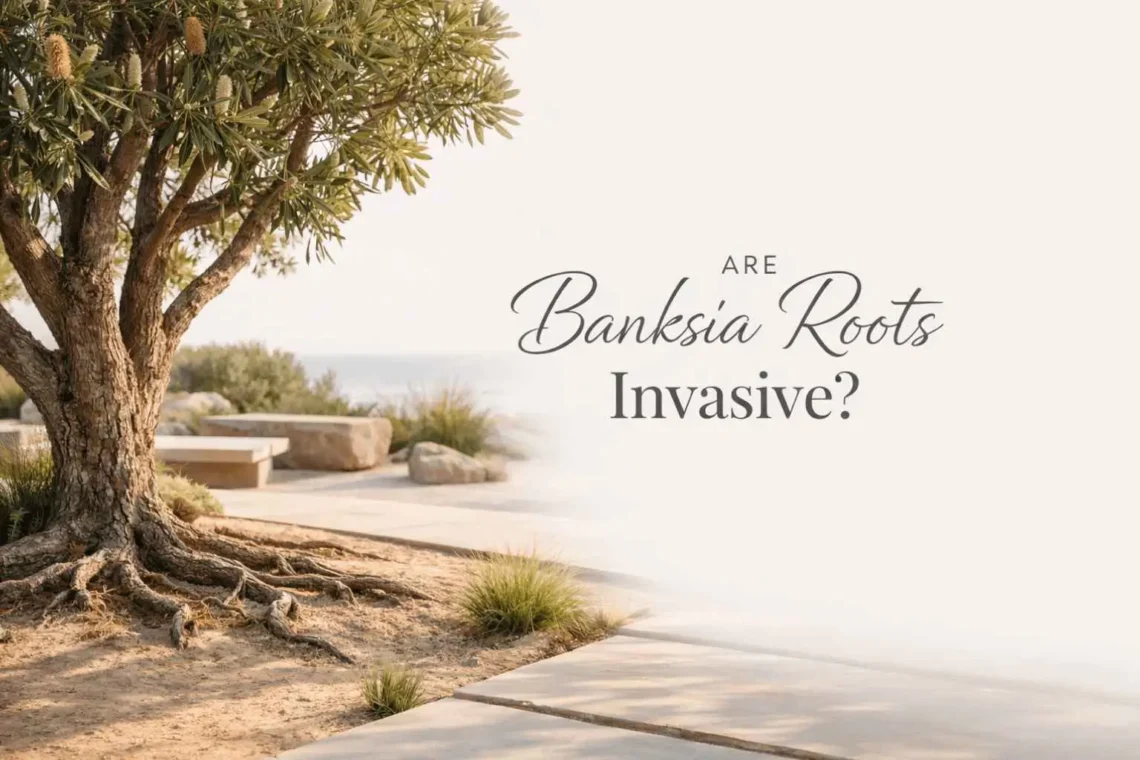
Banksia trees are popular Australian natives known for their resilience, distinctive flower spikes, and ability to thrive in nutrient-poor and coastal soils. A frequent concern among gardeners is whether the banksia root system is invasive and capable of damaging foundations, pipes, or paving.
Understanding how banksia roots behave is essential before planting them in residential spaces. Unlike many aggressive-root trees, banksias are adapted for survival rather than structural dominance. This article explains what a banksia tree root system looks like, whether banksia roots are invasive, how far they grow, and when they may become problematic in real-world conditions.
Quick Summary
- Banksia roots are generally non-invasive and adapted for low-nutrient soils
- Most species develop shallow, spreading root systems rather than aggressive deep roots
- Coastal varieties may spread wider but rarely cause structural damage
- Proper planting distance significantly reduces any risk near buildings or pipes
What Is a Banksia Root System?
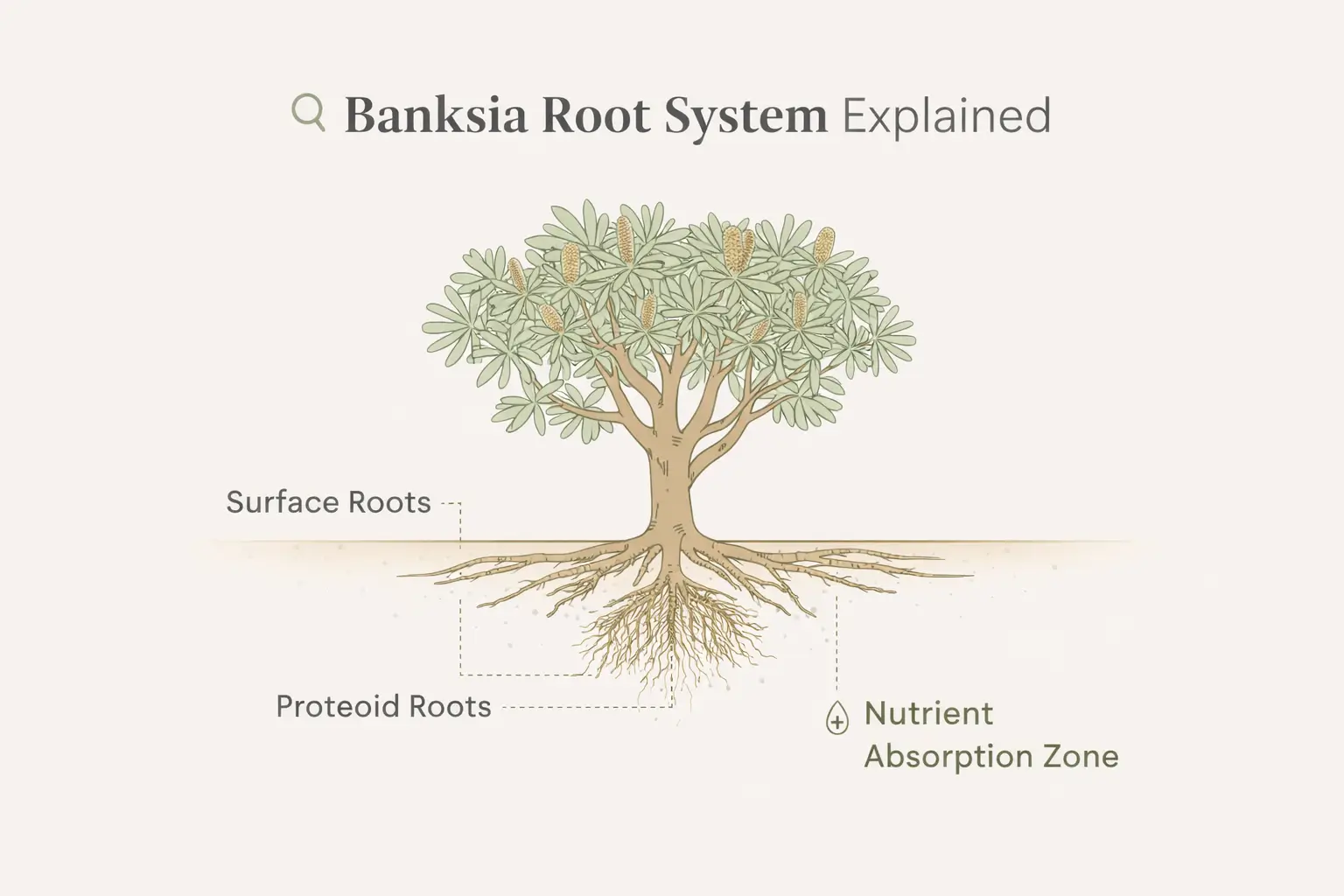
The banksia root system is a shallow, highly adaptive structure designed to extract nutrients efficiently from poor soils. Unlike trees that rely on deep taproots, banksias prioritize surface-level spread for survival.
A defining feature of what is a banksia tree root system is the presence of proteoid roots (also called cluster roots). These specialized roots form dense clusters that release organic acids, helping the plant absorb phosphorus and other nutrients from infertile soils. The banksia root system belongs to the genus Banksia, a group of Australian native plants known for their unique adaptation to nutrient-poor soils.
Key Characteristics
- Dense surface-level roots focused on nutrient absorption
- Proteoid roots increase phosphorus uptake efficiency
- Typically shallow rather than deep or aggressive
- Root spread varies based on soil quality and moisture availability
This structure makes banksias highly efficient in harsh environments but limits their ability to become invasive.
Are Banksia Roots Invasive? (Direct Answer)
Banksia roots are not considered invasive in most conditions and are generally safe for residential planting.
Most species do not exhibit aggressive root behavior toward structures. While people often ask, “do banksias have invasive roots,” the answer is typically no. Their root systems spread horizontally rather than penetrating deeply or forcefully. Similar concerns exist with other landscape trees, as explored in Are Leighton Green Roots Invasive?, where root behavior and structural risks are compared across species.
Key Points
- Banksias are not classified among invasive-root trees
- Roots are non-aggressive toward foundations and pipes
- Horizontal spread is common but rarely destructive
- Risk mainly occurs if planted too close to structures
In practical terms, proper placement eliminates most concerns.
How Far and Deep Do Banksia Roots Grow?
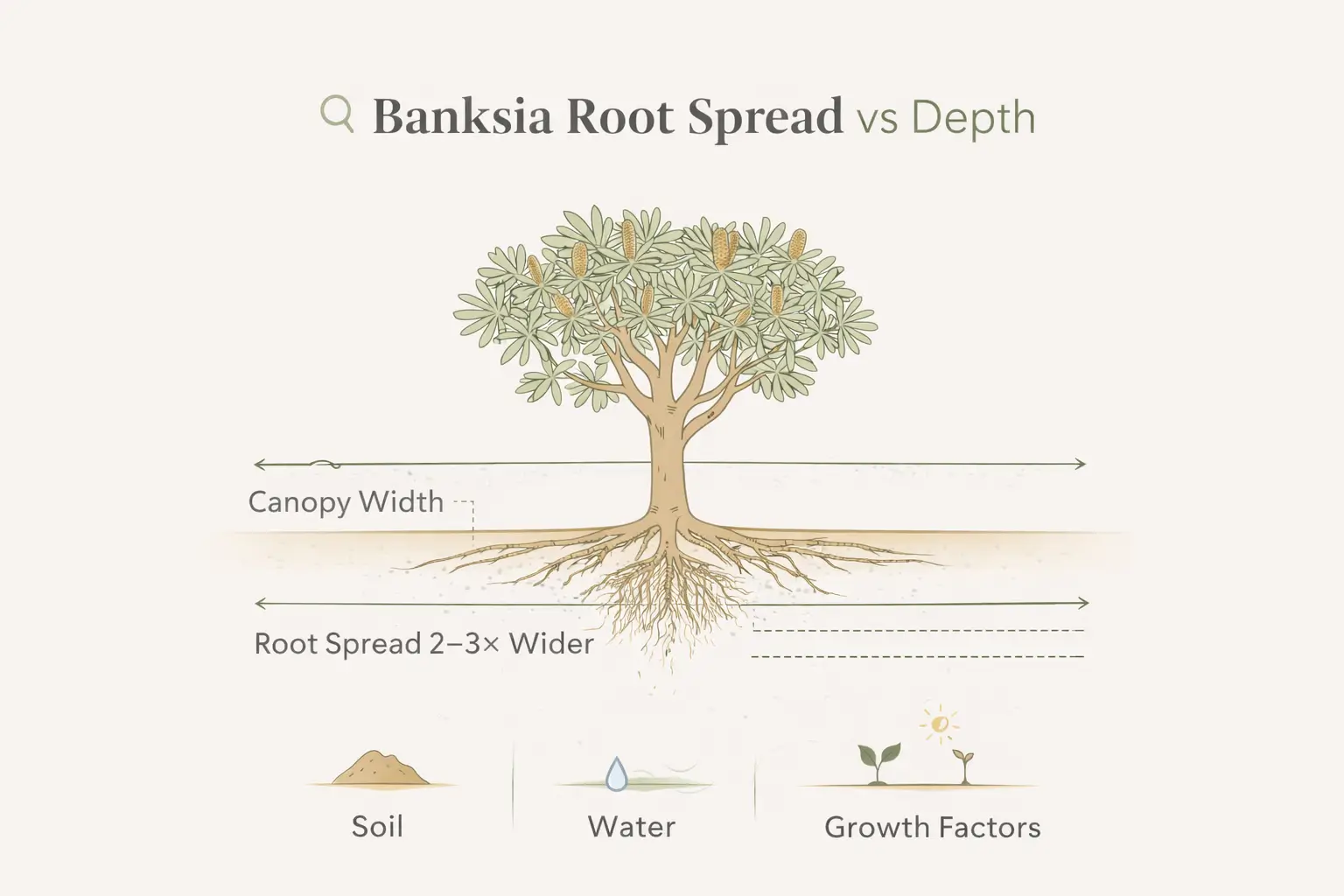
Banksia roots usually spread widely but remain relatively shallow in depth. In most cases, the root system extends outward rather than downward.
The spread often reaches 2–3 times the canopy width, depending on environmental conditions and the banksia growth rate.
Key Factors Influencing Growth
- Soil type (sandy soils encourage wider spread)
- Water availability (roots extend toward moisture)
- Tree maturity (older trees have broader systems)
Depth is typically shallow to moderate, which reduces the likelihood of structural damage.
Coastal Banksia Root Behavior (Banksia integrifolia)
The species Banksia integrifolia, commonly known as coastal banksia, is one of the fastest-growing varieties and often raises questions about root invasiveness. Despite its faster growth rate, coastal banksia roots are not considered invasive. They spread wider due to sandy soils and wind exposure but remain non-aggressive. For a deeper look at different species and sizes, see 7+ Essential Banksia Tree Varieties, which compares growth habits and landscape uses.
Key Characteristics
- Faster growth compared to many banksia species
- Wider root spread in coastal environments
- Adapted to stabilize sandy soils
- Still low risk for structural damage
When properly spaced, coastal banksias are highly suitable for coastal landscaping.
Comparison — Banksia Roots vs Other Trees
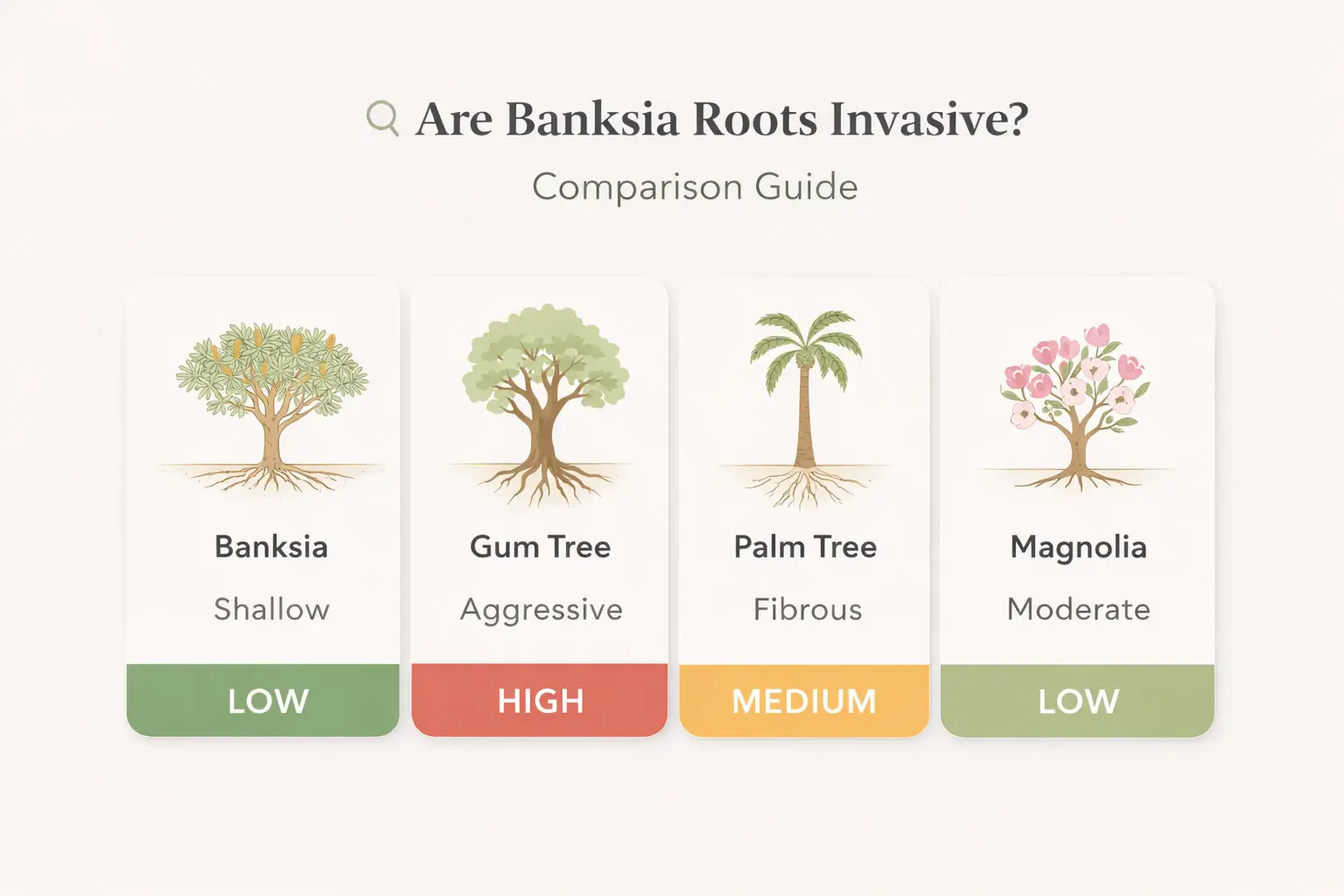
Banksias are often compared with trees known for invasive roots. The difference lies in root aggression and depth.
Root Behavior Comparison
| Tree Type | Root Behavior | Risk Level |
| Banksia | Shallow, spreading | Low |
| Gum Trees | Deep & aggressive | High |
| Palm Trees | Fibrous, non-invasive | Low |
| Magnolias | Moderate spread | Medium |
Compared to trees with invasive roots in Australia—such as gum trees—banksias are significantly less risky. They behave more like palms than aggressive species.
When Can Banksia Roots Become a Problem?
Banksia roots become problematic only under specific conditions, usually related to poor planting decisions or environmental stress.
Common Risk Situations
- Planting too close to buildings or underground pipes
- Poor soil drainage forcing roots to spread outward
- Overwatering encouraging shallow expansion
- Large mature trees confined to small spaces
These issues are avoidable with proper planning.
Safe Planting Distance for Banksia Trees
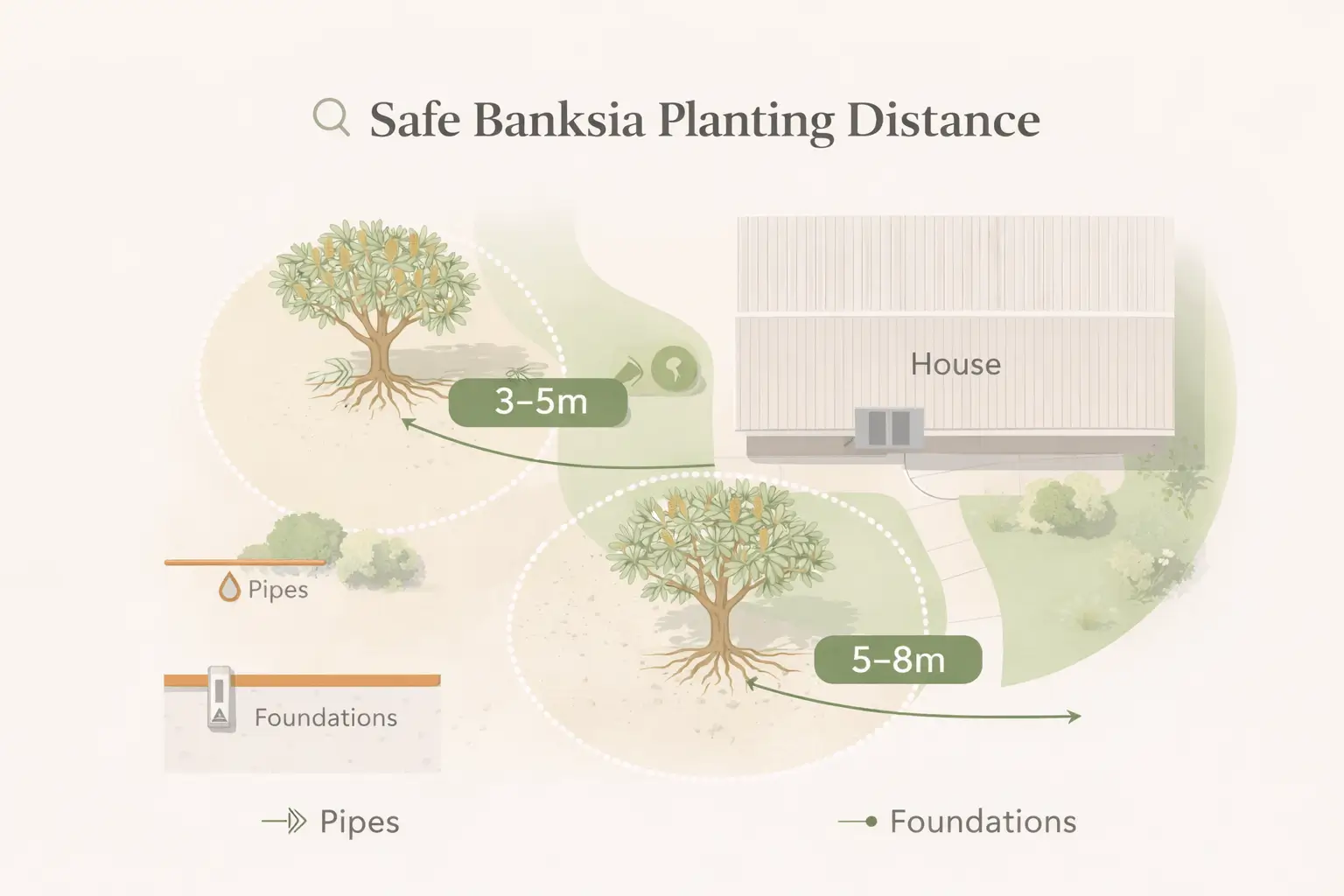
Correct spacing is the most effective way to prevent root-related issues.
Recommended Distances
- Small banksias: 3–5 meters from structures
- Large species: 5–8 meters distance
- Allow space for both canopy and root spread
- Avoid planting near underground utilities
These guidelines ensure healthy growth without structural risk.
Growth Rate and Its Impact on Roots
The banksia growth rate directly influences how quickly roots expand.
Faster-growing species tend to develop wider root systems more rapidly, while slower species remain compact for longer periods.
Key Influences
- Climate (warm regions accelerate growth)
- Soil quality (well-drained soils support expansion)
- Water availability (moderate watering promotes balanced growth)
Understanding whether banksias are fast growing helps predict root spread over time.
Common Banksia Problems Related to Roots
While banksias are low-maintenance, certain root-related issues can occur.
Common Problems
- Root rot (Phytophthora) caused by poor drainage
- Nutrient sensitivity, especially to phosphorus
- Shallow root exposure due to soil erosion
Solutions
- Use well-draining soil
- Avoid overwatering
- Apply mulch to protect surface roots
These steps prevent most banksia problems before they escalate.
Beginner Mistakes When Planting Banksia
Many issues arise from avoidable planting mistakes rather than root behavior itself.
Common Mistakes
- Planting too close to structures
- Over-fertilizing, especially with phosphorus-rich fertilizers
- Choosing the wrong species for the location
- Ignoring mature size and spread
Correcting these mistakes ensures long-term success.
Banksia Trees in Landscaping and Garden Design
The banksia tree is widely valued in landscaping due to its adaptability and ecological benefits.
Uses in Garden Design
- Ideal for coastal and drought-tolerant gardens
- Suitable as a feature tree or windbreak
- Supports native wildlife, including birds and pollinators
- Available in sizes ranging from small shrubs to medium trees
Banksia tree height varies by species, making it versatile for different garden layouts. If you’re exploring similar options, this guide on 7+ Stunning Accent Trees That Transform Any Space Instantly highlights alternative feature trees for different garden styles.
Conclusion
Banksia roots are generally non-invasive and well-suited for residential environments. Their shallow, spreading nature is designed for nutrient absorption rather than structural intrusion, making them far less aggressive than many other tree species.
With proper planting distance, suitable soil conditions, and appropriate species selection, banksias remain a safe, practical, and visually appealing choice for gardens—especially in coastal and low-nutrient environments.
FAQs
1. Do banksias have invasive roots?
No, most banksias have shallow, non-invasive root systems that do not aggressively damage structures.
2. Are banksia roots invasive in Australia?
In Australian conditions, banksia roots are well-adapted to local soils and are considered low-risk.
3. How far do banksia roots spread?
Banksia roots can spread up to 2–3 times the canopy width but remain mostly shallow.
4. Are coastal banksia roots invasive?
Coastal banksia roots spread widely but are not aggressive or destructive.
5. Can banksia roots damage pipes or foundations?
Damage is rare and typically occurs only when trees are planted too close to structures.
6. Are banksias fast growing?
Some species, such as Banksia integrifolia, grow relatively fast and may develop wider root systems over time.