Introduction
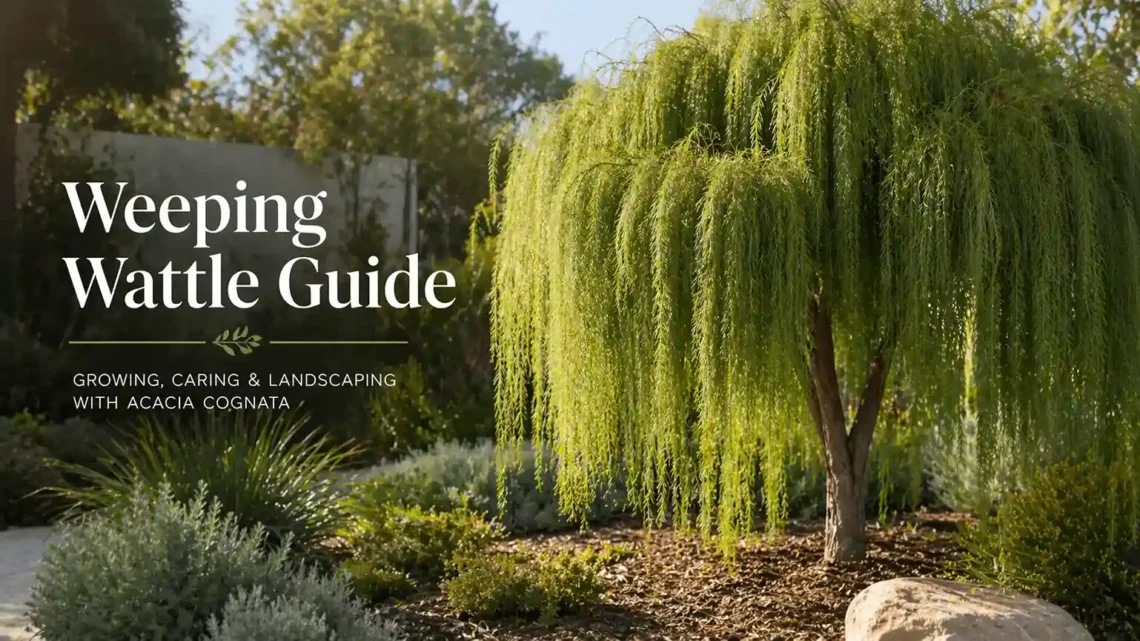
Weeping wattle is a graceful ornamental tree known for its cascading foliage and soft, pendulous form. The main botanical species associated with this plant is Acacia cognata, a member of the Fabaceae family, widely recognized for its elegant, flowing growth habit. Commonly referred to as the weeping acacia tree or weeping wattle tree, it is often confused with related species such as Acacia pendula (weeping myall). Native to Australia, this tree is extensively used in landscaping due to its visual appeal, adaptability, and low-maintenance requirements in warm climates.
Botanically known as Acacia cognata, this species belongs to the legume family (Fabaceae) and is widely recognized for its ornamental value (see Acacia cognata on Wikipedia).
Quick Summary
- Weeping wattle primarily refers to Acacia cognata, valued for its cascading foliage
- Popular in landscaping for drought tolerance, soft texture, and compact varieties
- Includes cultivars like dwarf, grafted, and colorful foliage types
- Requires well-drained soil, moderate watering, and minimal pruning
- Best suited for warm climates with good sunlight exposure
What Is Weeping Wattle? (Definition, Species, and Botanical Identity)
Weeping wattle refers mainly to Acacia cognata, an evergreen Australian tree characterized by narrow, linear leaves and a flowing, cascading growth habit. It belongs to the legume family (Fabaceae) and is prized for its ornamental value.
Botanical Identity and Naming
The Acacia cognata tree has:
- Slender, strap-like leaves
- A soft, drooping canopy
- Evergreen foliage in most climates
The term “weeping wattle” is often used interchangeably with:
- Weeping acacia
- Acacia weeping
- Waterfall acacia
However, it differs from Acacia pendula (weeping myall), which has a more rigid, open structure. Regional naming also varies; for example, the plant may be referred to as weeping wattle in Afrikaans-speaking regions.
The term “waterfall acacia” is also commonly used to describe similar cascading species, such as the Acacia waterfall tree, which shares comparable ornamental traits.
Key Characteristics of Weeping Wattle Trees
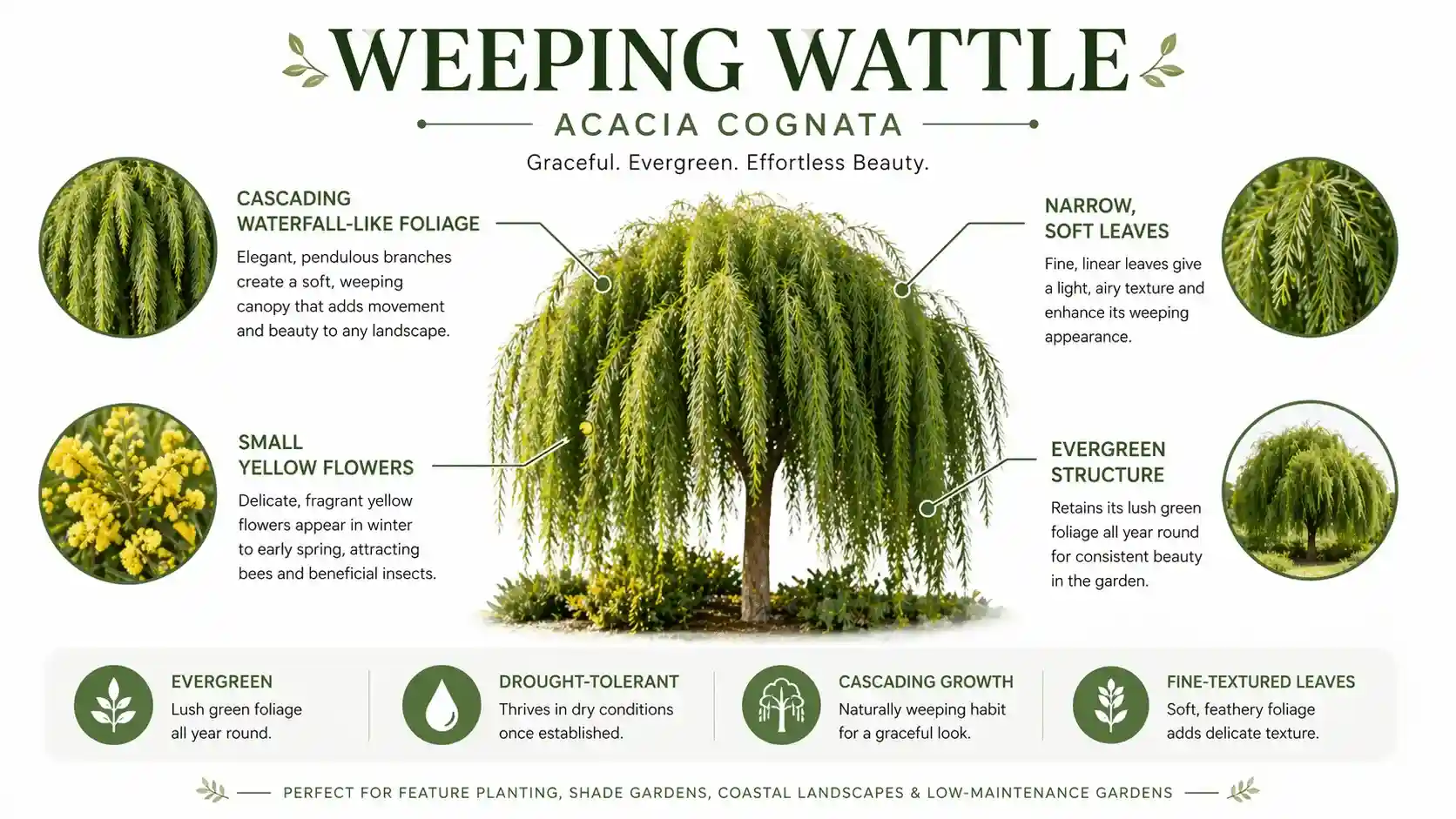
Weeping wattle trees are defined by their distinctive cascading form and adaptability to dry environments.
Growth and Appearance
- Flowing, “waterfall-like” growth habit
- Fine-textured foliage ranging from green to lime tones
- Soft, pendulous branches that create a dense canopy
Flowering
- Produces small, yellow, spherical blooms typical of acacias
- Flowers are usually subtle and not the main ornamental feature
Environmental Adaptability
- Thrives in Australian climates with warm, dry conditions
- Tolerates drought once established
Key Features
- Evergreen or semi-evergreen depending on climate
- Drought-tolerant after establishment
- Suitable for ornamental planting and natural screening
Weeping Wattle Varieties and Cultivars
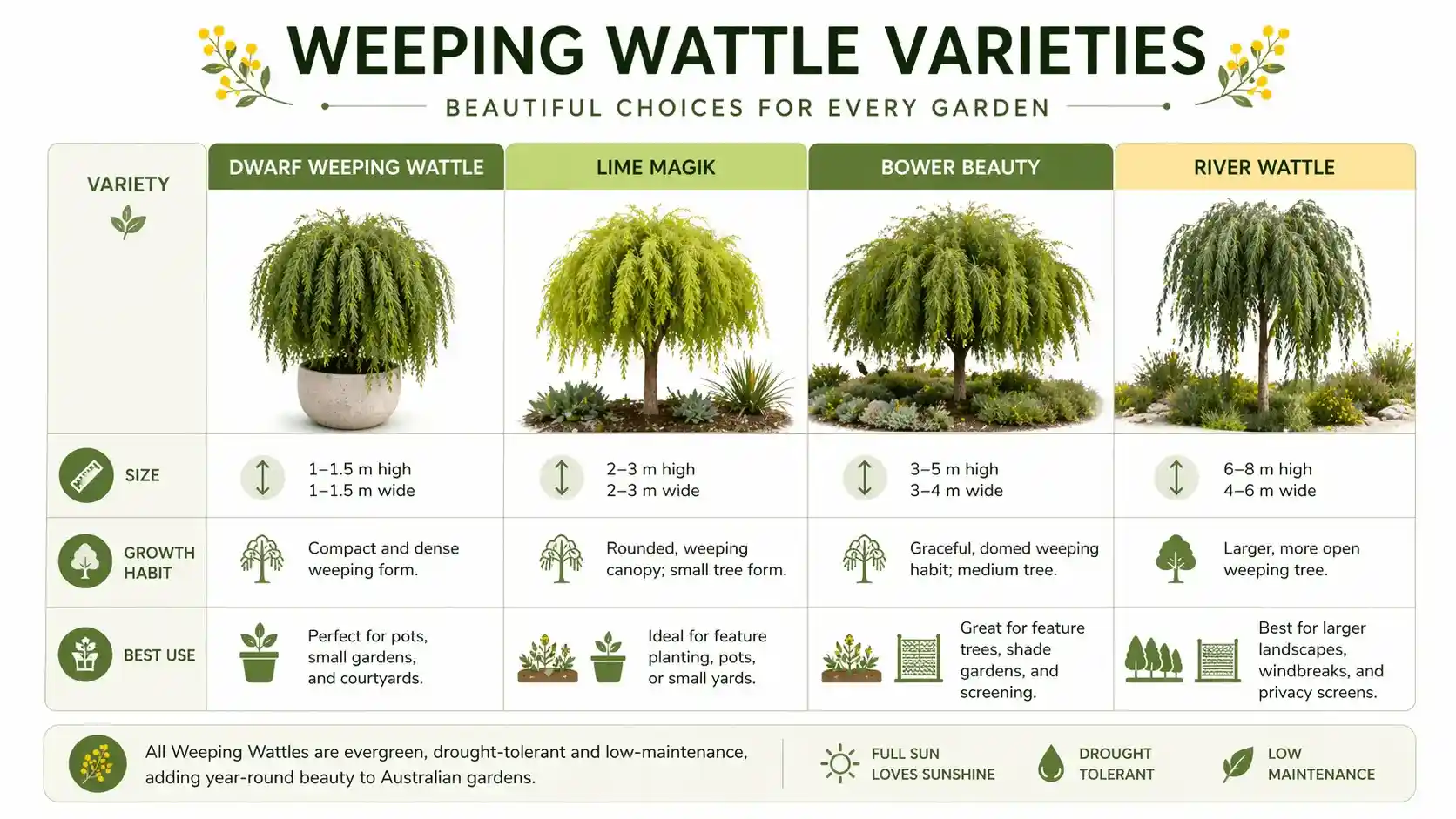
Several cultivars of Acacia cognata offer different sizes, foliage colors, and growth habits.
Common Cultivars
- Acacia cognata ‘Bower Beauty’: Dense, flowing growth ideal for screening
- Acacia cognata ‘Lime Magik’: Bright lime-green foliage for contrast planting
- Goldilocks weeping wattle: Compact and decorative
- Dwarf weeping wattle: Suitable for containers and small gardens
- Grafted weeping wattle: Controlled shape and size
Related Types
- Weeping silver wattle
- Weeping cootamundra wattle
- Weeping river wattle
- Weeping bower wattle
Table: Popular Weeping Wattle Varieties
| Variety | Size | Growth Habit | Best Use |
| Dwarf weeping wattle | Small | Compact, cascading | Pots, small gardens |
| Lime Magik | Medium | Bright foliage | Feature plant |
| Bower Beauty | Medium-large | Dense, flowing | Screening |
| River wattle | Larger | Upright with droop | Landscaping |
Weeping Wattle vs Other Weeping Acacia Trees
Weeping wattle (Acacia cognata) differs from other weeping acacias in structure, leaf form, and use.
Comparison Block
| Feature | Weeping Wattle (Acacia cognata) | Weeping Myall (Acacia pendula) |
| Origin | Australia | Australia |
| Leaf Type | Narrow, soft | Grey-green, rigid |
| Growth Form | Dense cascading | Open, drooping |
| Use | Ornamental gardens | Shade and landscaping |
Key Differences
- Acacia cognata has softer foliage and a denser appearance
- Acacia pendula is more drought-hardy and used for shade
- African weeping wattle varieties may differ in climate tolerance
Plant Size and Growth Rate
Weeping wattle trees vary significantly in size depending on the cultivar.
Size
- Height: typically 2–10 meters
- Width: varies from compact shrubs to spreading trees
Growth Conditions
- Primarily an outdoor plant
- Not suited for long-term indoor growth
Growth Rate
- Fast to moderate growth
- Influenced by:
- Rainfall levels
- Soil quality
- Temperature conditions
Care Guide for Weeping Wattle Trees
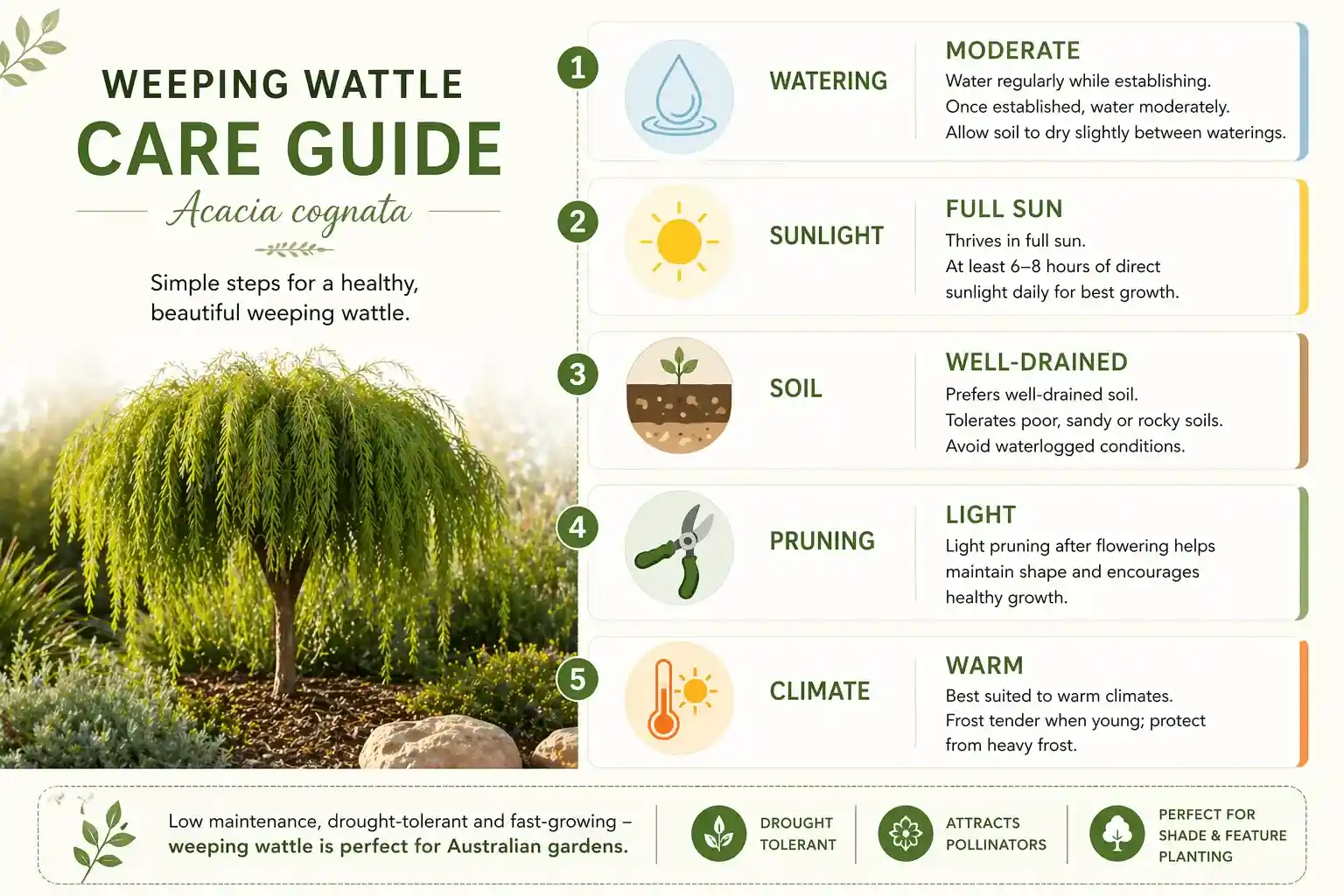
Proper care ensures healthy growth and long-term survival.
Watering
- Moderate watering during establishment
- Becomes drought-tolerant once mature
Light Requirements
- Full sun preferred
- Tolerates partial shade
Soil
- Well-drained sandy or loamy soil
- Avoid heavy clay or waterlogged conditions
Fertilization
- Minimal fertilization required
- Avoid high-nitrogen fertilizers
Pruning
- Light pruning for shape
- Avoid heavy cutting
Climate
- Best suited to warm, dry climates like Australia
Care Tips
- Avoid waterlogged soil
- Protect young plants from heavy frost
- Use mulch to retain moisture
How to Grow Weeping Wattle (Propagation and Planting)
Weeping wattle can be grown from seeds or nursery plants.
Propagation Methods
- Seeds: require pre-treatment (scarification or soaking)
- Grafted plants: provide consistent shape and growth
Planting Steps
- Choose a sunny location
- Prepare well-drained soil
- Dig a hole twice the root ball size
- Place plant and backfill soil
- Water thoroughly after planting
Establishment Tips
- Maintain consistent watering initially
- Gradually reduce watering as the plant matures
Common Problems and Solutions (Troubleshooting Guide)
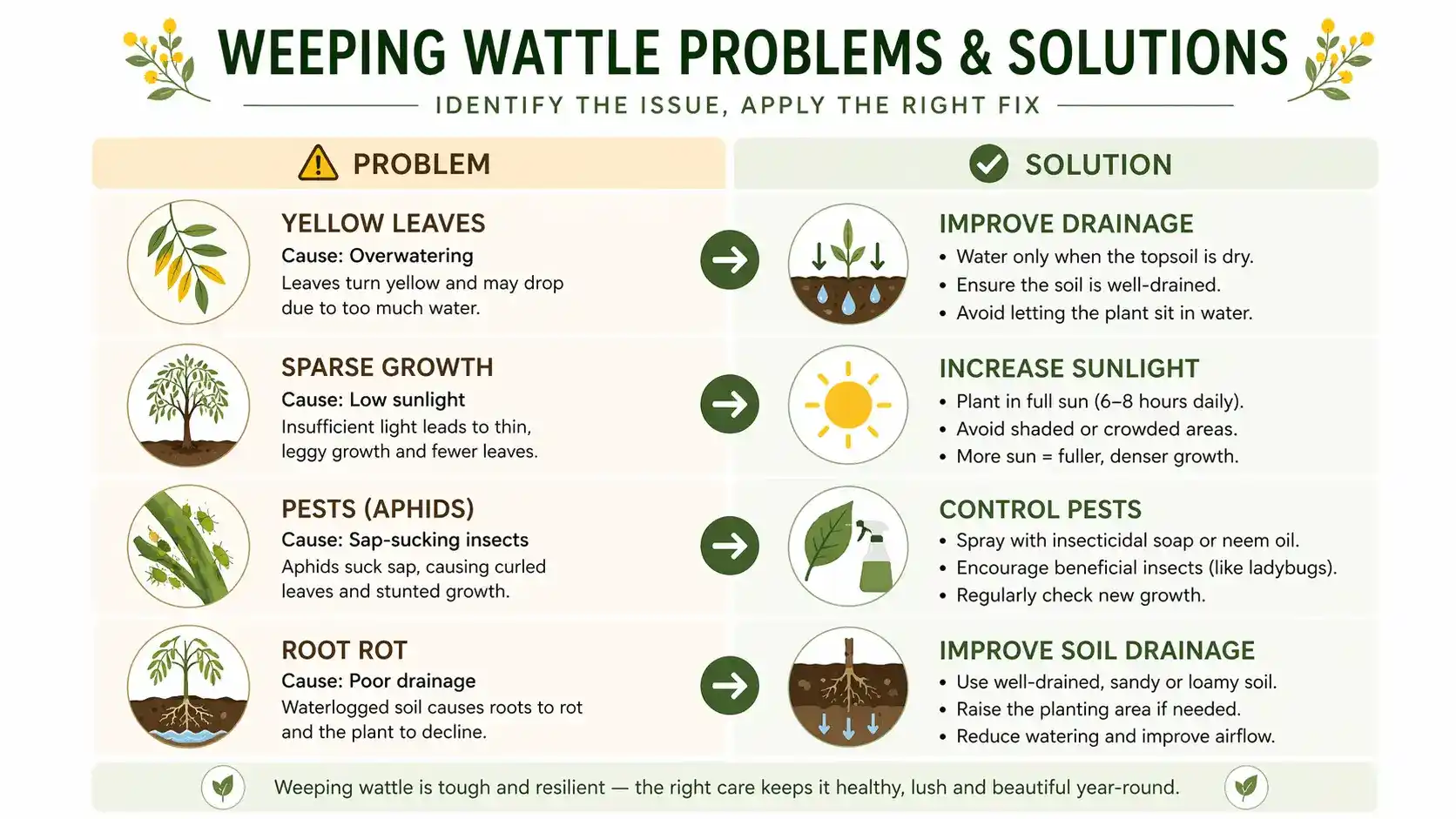
Problem–Solution Format
Problem: Leaves turning yellow
Cause: Overwatering or poor drainage
Fix: Improve soil drainage and reduce watering
Problem: Sparse growth
Cause: Lack of sunlight
Fix: Move plant to a sunnier location
Problem: Pest infestation (aphids, borers)
Cause: Environmental stress
Fix: Use appropriate pest control methods
Problem: Root rot
Cause: Waterlogged soil
Fix: Ensure proper drainage
Environmental and Growing Limitations
Weeping wattle has specific environmental requirements.
Climate Restrictions
- Limited success in cold or humid climates
- Performs best in regions similar to Australia
Regional Adaptability
- Can grow in areas like South Africa with similar climates
- Sensitive to frost, especially when young
Soil and Location Limits
- Requires well-drained soil
- May struggle in compacted urban soils
As a native species, weeping wattle performs best in climates similar to its origin, making it an important example among native trees of Australia adapted to dry, warm environments.
Landscaping Uses and Design Ideas
Weeping wattle is widely used in garden design for its aesthetic value.
Common Uses
- Feature tree in gardens
- Natural screening plant
- Ground cover (dwarf varieties)
Design Integration
- Pairs well with native Australian plants
- Suitable for modern and natural landscapes
- Enhances indoor-outdoor garden transitions
Due to its elegant cascading form, weeping wattle is often selected among feature trees for creating visual focal points in modern landscapes.
Beginner Mistakes to Avoid When Growing Weeping Wattle
Avoiding common mistakes improves plant health.
Common Errors
- Overwatering young plants
- Planting in poorly drained soil
- Ignoring structural pruning
- Choosing varieties too large for the space
How Weeping Wattle Fits Into Broader Gardening Topics
Weeping wattle connects to several key gardening concepts.
Related Areas
- Landscaping design principles
- Native plant gardening
- Plant propagation techniques
Limited Indoor Relevance
- Not ideal as a long-term indoor plant
- Occasionally used in transitional indoor-outdoor spaces
While primarily an outdoor plant, understanding its care requirements can complement broader plant knowledge found in guides to house plants and general plant care principles.
Conclusion
Weeping wattle, primarily known as Acacia cognata, is a versatile ornamental tree valued for its cascading foliage and adaptability to warm climates. Its wide range of cultivars allows it to fit various garden sizes and styles. With proper care—well-drained soil, moderate watering, and adequate sunlight—it thrives with minimal maintenance. Selecting the right variety and avoiding common growing mistakes ensures long-term success, making it a reliable choice for landscaping and native plant gardening.
FAQs
1. What is the difference between weeping wattle and weeping acacia?
Weeping wattle and weeping acacia often refer to the same plant, Acacia cognata. The terms are used interchangeably, though “weeping acacia” can also describe other drooping acacia species.
2. How fast does a weeping wattle tree grow?
Weeping wattle grows at a fast to moderate rate, typically reaching maturity within a few years under optimal conditions such as good sunlight, well-drained soil, and adequate watering.
3. Can weeping wattle grow outside Australia?
Yes, weeping wattle can grow in regions with similar climates, such as South Africa. However, it may struggle in areas with heavy frost, high humidity, or poorly drained soils.
4. What is the best variety of weeping wattle for small gardens?
Dwarf weeping wattle varieties and compact cultivars like ‘Lime Magik’ are best suited for small gardens or container planting due to their controlled size and manageable growth.
5. How do you care for a weeping wattle tree?
Care involves planting in well-drained soil, providing full sun, watering moderately during establishment, and pruning lightly. Once established, the tree requires minimal maintenance.
6. Why is my weeping wattle turning yellow?
Yellowing leaves are usually caused by overwatering or poor drainage. Improving soil conditions and adjusting watering practices typically resolves the issue.