Introduction
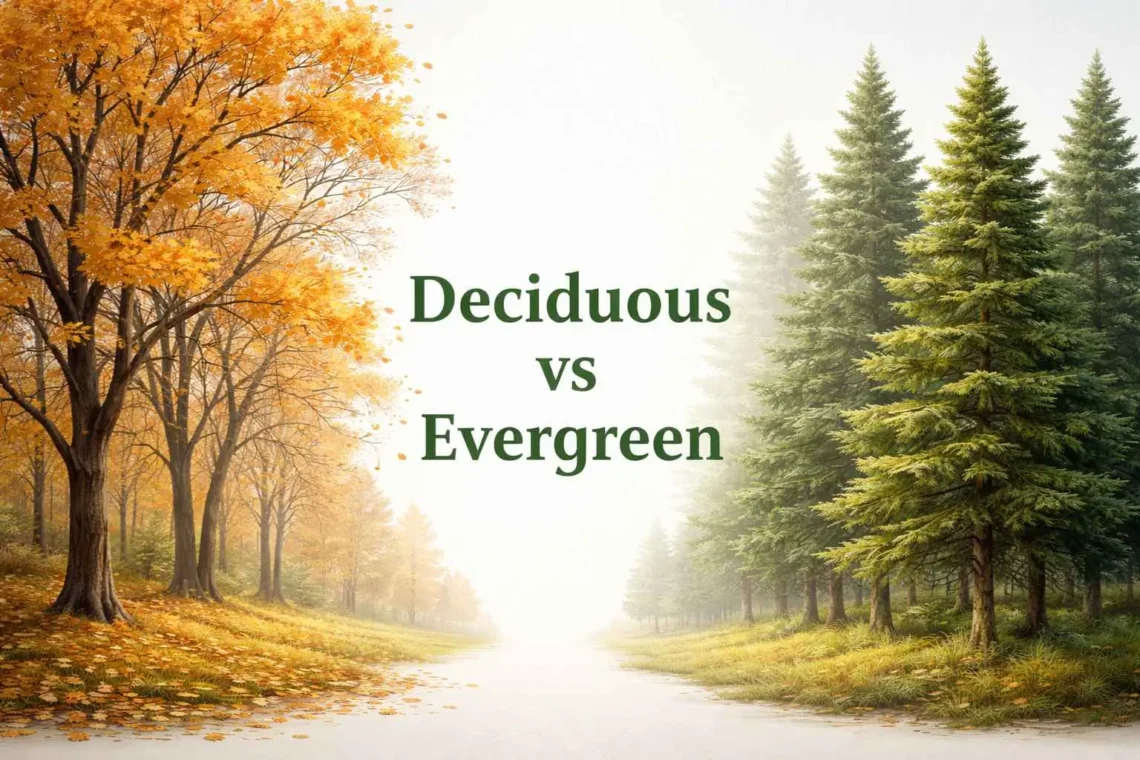
Deciduous vs evergreen refers to two main types of plants and trees based on how they grow and shed leaves. This classification helps explain how plants adapt to different climates and seasonal changes. Deciduous plants lose their leaves during certain times of the year, while evergreen plants retain foliage throughout all seasons. Understanding this difference is important for gardening, landscaping, and identifying tree species in nature. It also helps beginners choose the right plants for their environment, considering factors like climate, maintenance, and visual appeal.
Quick Summary
- Deciduous plants lose their leaves seasonally (usually autumn)
- Evergreen plants keep their leaves year-round
- The difference is mainly about leaf behavior and adaptation
- Both types serve different ecological and landscaping purposes
What Does “Deciduous” Mean?
Deciduous means plants or trees that shed their leaves annually as part of a natural seasonal cycle. You may see variations like “decideous,” “deciduos,” “decidious,” or “diciduous,” but the correct spelling is deciduous. Deciduous plants are adapted to survive harsh conditions such as cold winters or dry seasons by temporarily dropping their leaves. This reduces water loss and conserves energy. In botanical terms, deciduous plants are classified based on seasonal leaf loss, a concept widely explained in resources like Wikipedia’s page on deciduous plants.
For beginners or kids, think of deciduous trees as plants that “go to sleep” during tough seasons and wake up again in spring.
Key characteristics:
- Leaves change color before falling
- Enter a dormant phase in winter or dry periods
- Regrow fresh leaves in spring
Examples of deciduous trees:
- Oak (Quercus)
- Maple (Acer)
- Birch (Betula)
What Are Evergreen Trees?
Evergreen trees are plants that retain their leaves throughout the entire year instead of shedding them seasonally. This means they stay green in all seasons.
Their leaves are typically needle-like or have a waxy coating, which helps reduce water loss and allows them to survive in cold, dry, or nutrient-poor environments.
Core characteristics of evergreen trees:
- Continuous photosynthesis throughout the year
- No complete leaf drop at once
- Leaves are long-lasting and replaced gradually
Common evergreen trees:
- Pine (Pinus)
- Spruce (Picea)
- Fir (Abies)
Deciduous vs Evergreen: Key Differences Explained
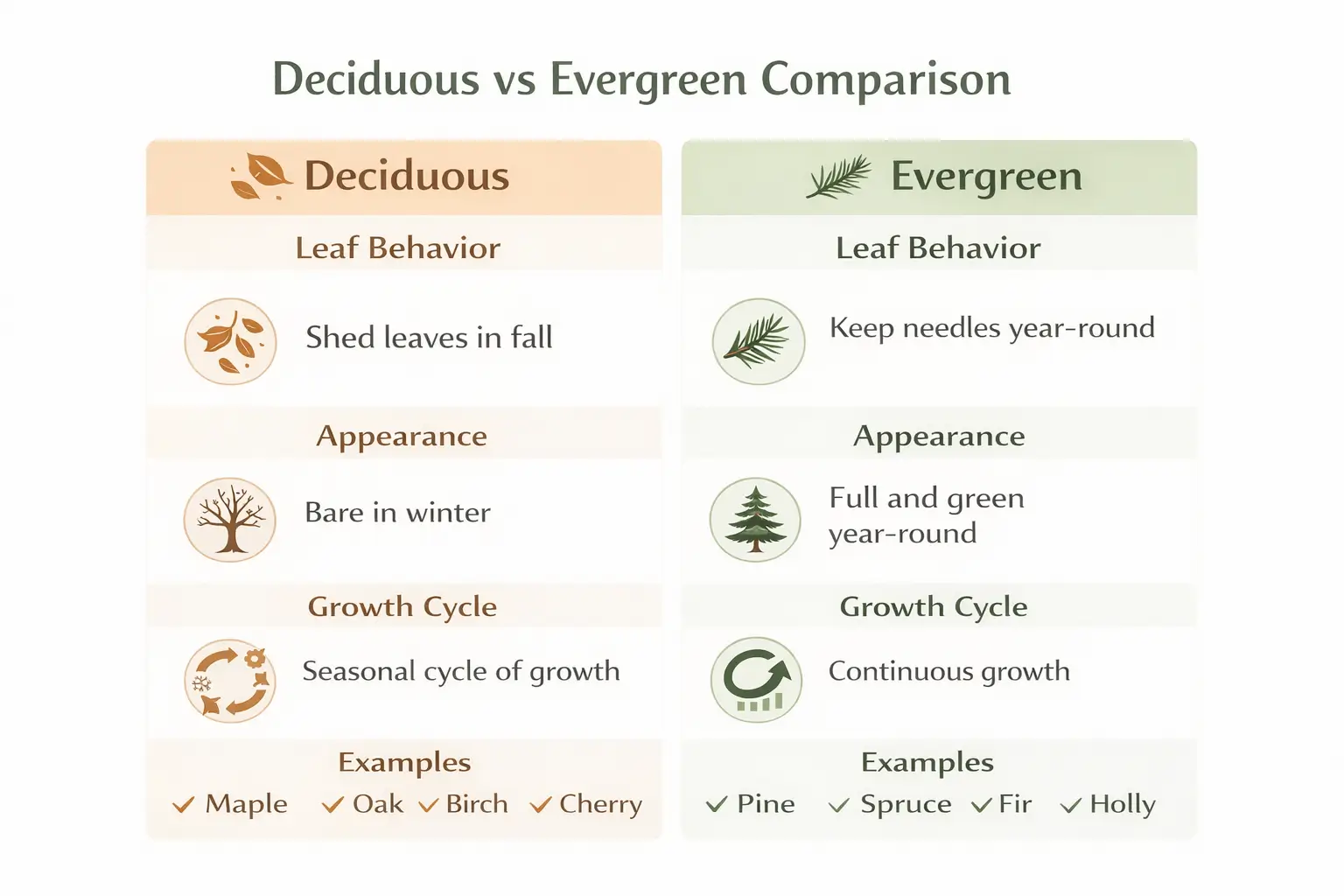
Deciduous vs evergreen trees differ mainly in how they manage their leaves and adapt to environmental conditions.
Deciduous vs Evergreen Trees
| Feature | Deciduous Trees | Evergreen Trees |
| Leaf Behavior | Shed leaves seasonally | Keep leaves year-round |
| Appearance | Bare in winter | Always green |
| Growth Cycle | Seasonal dormancy | Continuous growth |
| Examples | Oak, maple | Pine, fir |
This comparison shows that deciduous trees prioritize seasonal survival, while evergreen trees focus on continuous growth.
Deciduous vs Evergreen vs Coniferous: How They Compare
Deciduous vs evergreen vs coniferous comparisons often confuse beginners, but the key difference lies in structure and reproduction.
Coniferous trees are defined by producing cones rather than flowers. While many conifers are evergreen, not all of them are.
For example, the larch (Larix) is a coniferous tree that is also deciduous—it sheds its needles in winter.
Comparison points:
- Leaf type:
- Deciduous → broad leaves
- Evergreen → needle-like or waxy leaves
- Reproduction:
- Deciduous → flowers and seeds
- Coniferous → cones
- Seasonal behavior:
- Evergreen → retains foliage
- Deciduous → sheds leaves
Types of Deciduous and Evergreen Trees (With Examples)
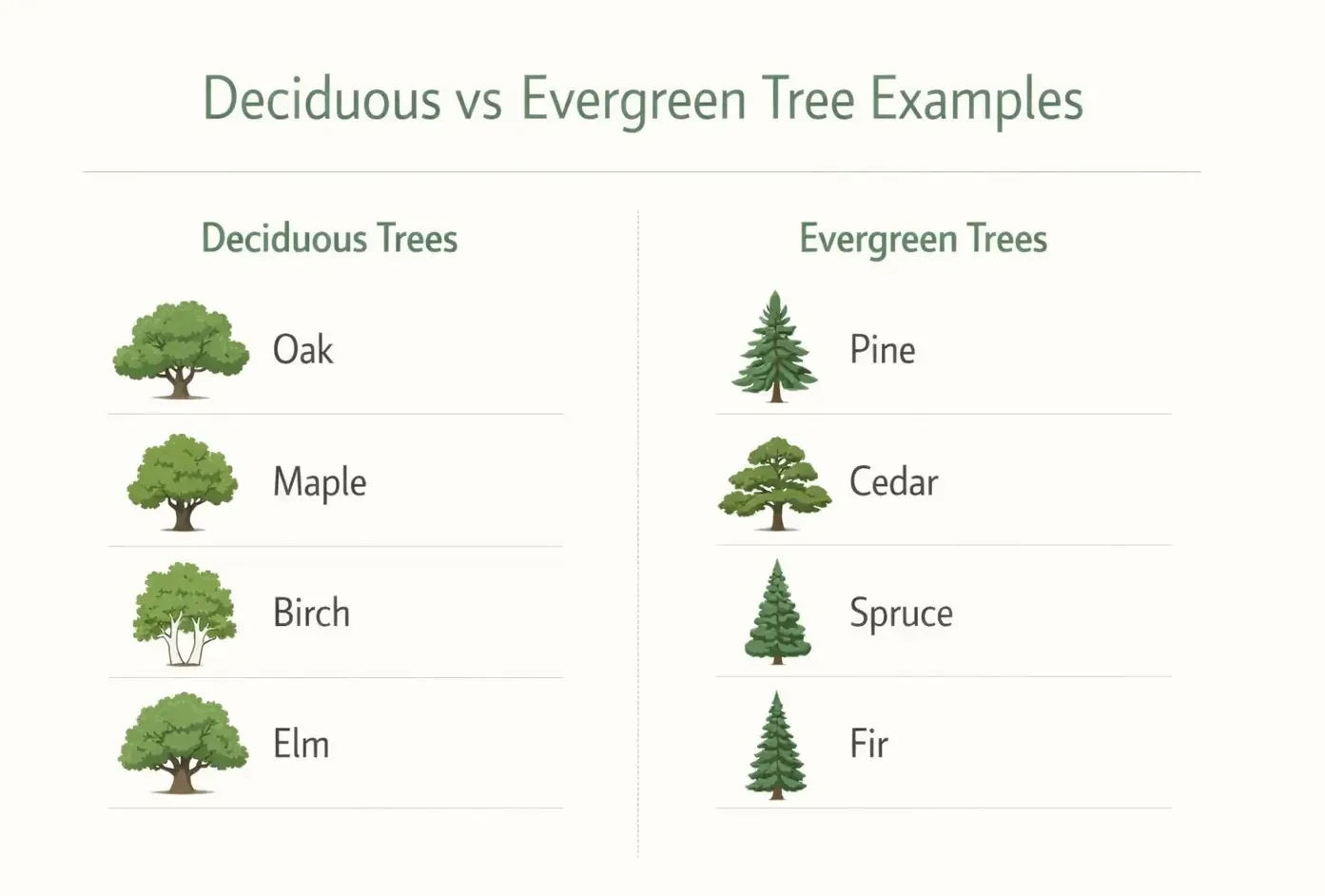
Understanding examples helps reinforce the difference between these two plant types.
Deciduous Trees Examples:
- Oak
- Maple
- Birch
- Elm
Evergreen Trees Examples:
- Pine
- Cedar
- Spruce
- Fir
These examples represent common species found in gardens, forests, and urban landscapes. Many gardeners also explore specific species differences, such as Crepe Myrtle, which can vary depending on climate—learn more in our guide on Crepe Myrtle Deciduous or Evergreen? 5+ Essential Facts.
Deciduous vs Evergreen Shrubs and Plants
Deciduous vs evergreen shrubs and plants follow the same basic principle as trees.
Shrubs and smaller plants can also either lose their leaves seasonally or keep them year-round. This classification is not limited to large trees.
Examples:
- Deciduous shrubs: Azaleas (some varieties), hydrangeas
- Evergreen shrubs: Magnolia, boxwood
Key differences:
- Deciduous shrubs lose leaves seasonally
- Evergreen shrubs provide year-round structure and greenery
A popular example of evergreen shrubs used in landscaping is Boxwood Japonica, known for its dense foliage and hedge-friendly growth—explore it in Boxwood Japonica.
Deciduous vs Evergreen Forests
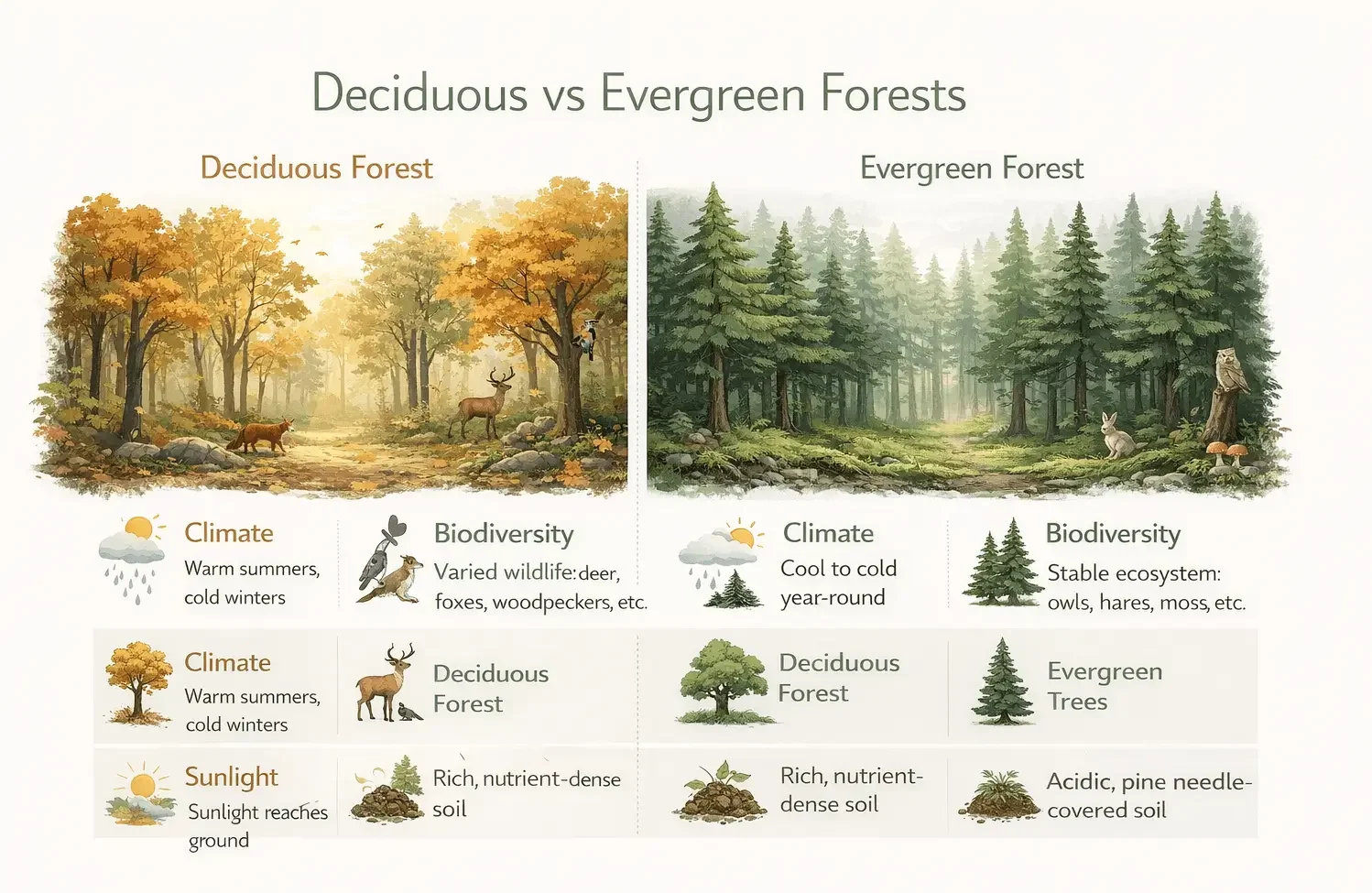
Deciduous vs evergreen forests represent two major ecological systems with different climates and biodiversity.
Deciduous forests are found in regions with distinct seasons, while evergreen forests exist in both cold (taiga) and tropical environments.
Key differences:
- Climate:
- Deciduous forests → temperate climates
- Evergreen forests → cold or tropical regions
- Biodiversity:
- Deciduous forests → seasonal variation in species
- Evergreen forests → more stable ecosystems
- Light and soil:
- Deciduous forests allow more sunlight in winter
- Evergreen forests provide constant shade
Why Do Some Trees Lose Leaves While Others Don’t?
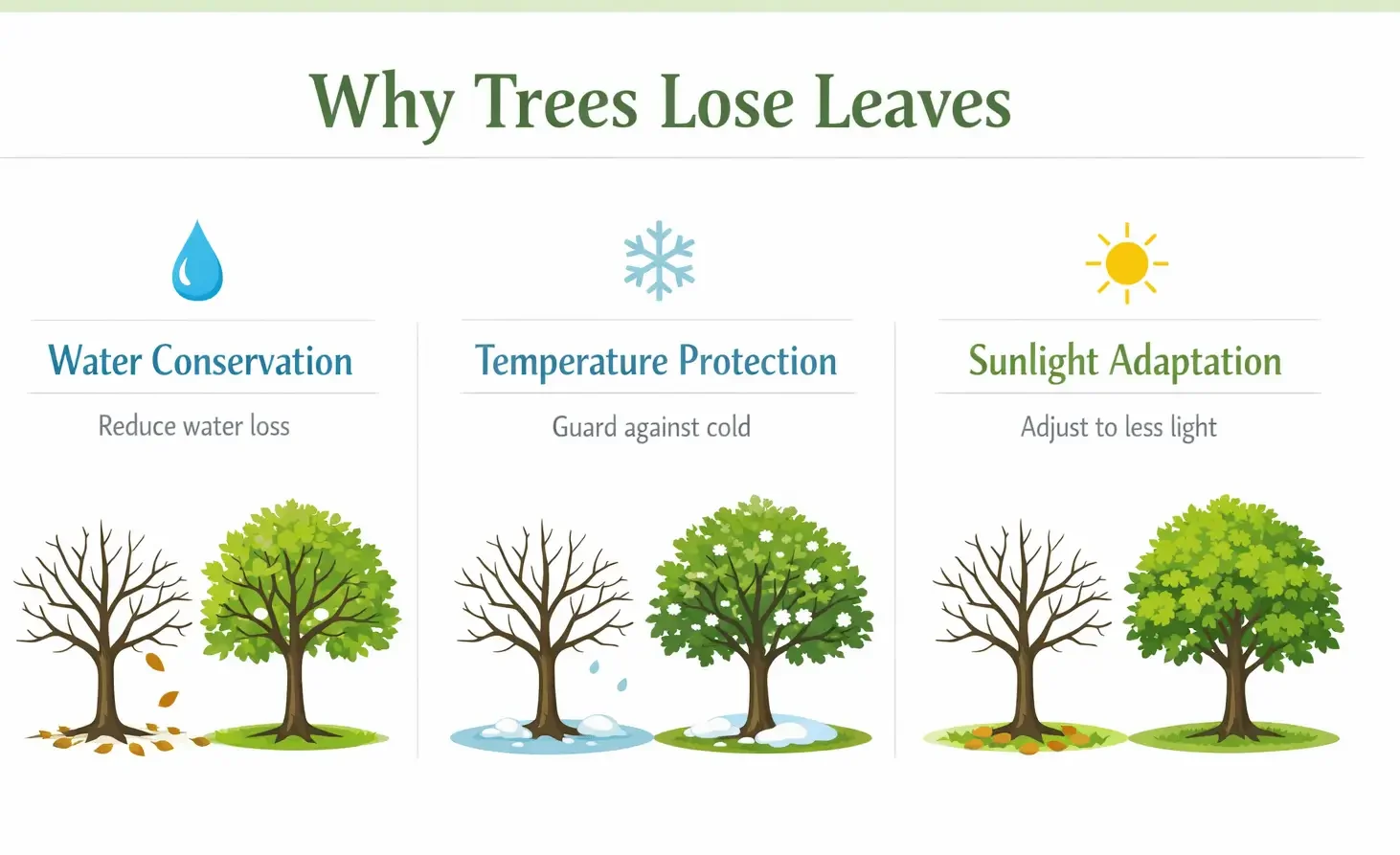
Trees lose or retain leaves based on environmental adaptation strategies. Deciduous trees drop leaves to conserve water and energy, while evergreen trees retain them to maintain continuous photosynthesis.
Main reasons:
- Water conservation: Leaf drop reduces water loss
- Temperature tolerance: Protects against freezing damage
- Sunlight availability: Evergreen trees maximize limited sunlight
This adaptation ensures survival in different climates and conditions.
Practical Uses in Gardening and Landscaping
Choosing between deciduous and evergreen trees depends on your landscaping goals. Deciduous trees are ideal for seasonal shade, while evergreen trees provide year-round coverage and privacy.
Practical applications:
- Deciduous trees offer shade in summer and allow sunlight in winter
- Evergreen trees act as windbreaks and privacy screens
- Mixed planting creates balanced landscapes
If you’re specifically looking for low-maintenance options, consider trees that retain foliage year-round—see examples in 7+ Smart Trees That Don’t Drop Leaves in Australia.
For a broader understanding of how to choose the right plants for different environments, explore our complete Plants for Homes and Gardens Guide.
Common Beginner Mistakes When Choosing Tree Types
Beginners often make simple mistakes when selecting tree types for gardens or landscapes.
Common mistakes:
- Choosing evergreen trees without considering their mature size
- Ignoring leaf drop cleanup from deciduous trees
- Misunderstanding climate suitability for certain species
Avoiding these mistakes improves long-term plant health and maintenance.
Special Cases: Plants That Blur the Line
Some plants do not fit neatly into deciduous or evergreen categories.
Semi-evergreen plants may retain leaves in mild climates but lose them in colder conditions. Examples include certain ferns, magnolia species, and azaleas.
Key points:
- Behavior can depend on climate
- Some plants partially retain leaves
- Classification may vary by region
Conclusion
Deciduous vs evergreen differences come down to how plants adapt to their environment through leaf behavior. Deciduous plants shed leaves to survive seasonal challenges, while evergreen plants retain foliage for continuous growth. Understanding these categories helps in identifying tree types, planning landscapes, and appreciating how plants adapt to different climates. Choosing the right type depends on environmental conditions and practical needs such as shade, privacy, and maintenance.
FAQs
What is the main difference between deciduous and evergreen trees?
Deciduous trees lose their leaves seasonally, while evergreen trees keep their leaves year-round. This difference is based on how each type adapts to environmental conditions like temperature and water availability.
What are some examples of deciduous trees?
Common examples include oak, maple, and birch trees. These trees shed their leaves annually and regrow them in the spring.
Are all coniferous trees evergreen?
No, not all coniferous trees are evergreen. Some, like the larch, are deciduous and lose their needles seasonally.
Why do deciduous trees lose their leaves?
They shed leaves to conserve water and energy during harsh conditions such as winter or drought. This helps them survive unfavorable seasons.
Which is better for landscaping: deciduous or evergreen?
It depends on your goal. Deciduous trees provide seasonal shade and visual changes, while evergreen trees offer year-round greenery and privacy.