
Introduction
Willow leaf hakea (Hakea salicifolia) is an evergreen Australian native shrub valued for its narrow, willow-like foliage and fragrant white flowers that bloom from winter to spring. This fast-growing plant adapts well to well-drained soils and is widely used in gardens for privacy screens, windbreaks, and wildlife-friendly landscapes. Its dense structure provides year-round coverage, while its blooms attract pollinators such as birds and bees. In addition, the plant produces woody seed pods that add ornamental interest, making it both functional and visually appealing in native and low-maintenance garden designs.
If you’re interested in other fast-growing and low-maintenance garden plants, you may also explore 7+ Powerful Australian Brush Cherry, 7+ Powerful Benefits of Coastal Rosemary, and 7+ Powerful Reasons Rosemary Prostrate Transforms Any Garden for more hedge and screening ideas.
Quick Summary
- Dense, upright shrub growing 2–6 meters tall, ideal for hedging with 1.5–2.5m spacing
- Features narrow leaves, scented white flowers, and long-lasting woody seed pods
- Thrives in full sun, tolerates light frost, and prefers free-draining soil
- Requires annual pruning and careful watering to prevent common issues
What Is Willow Leaf Hakea?
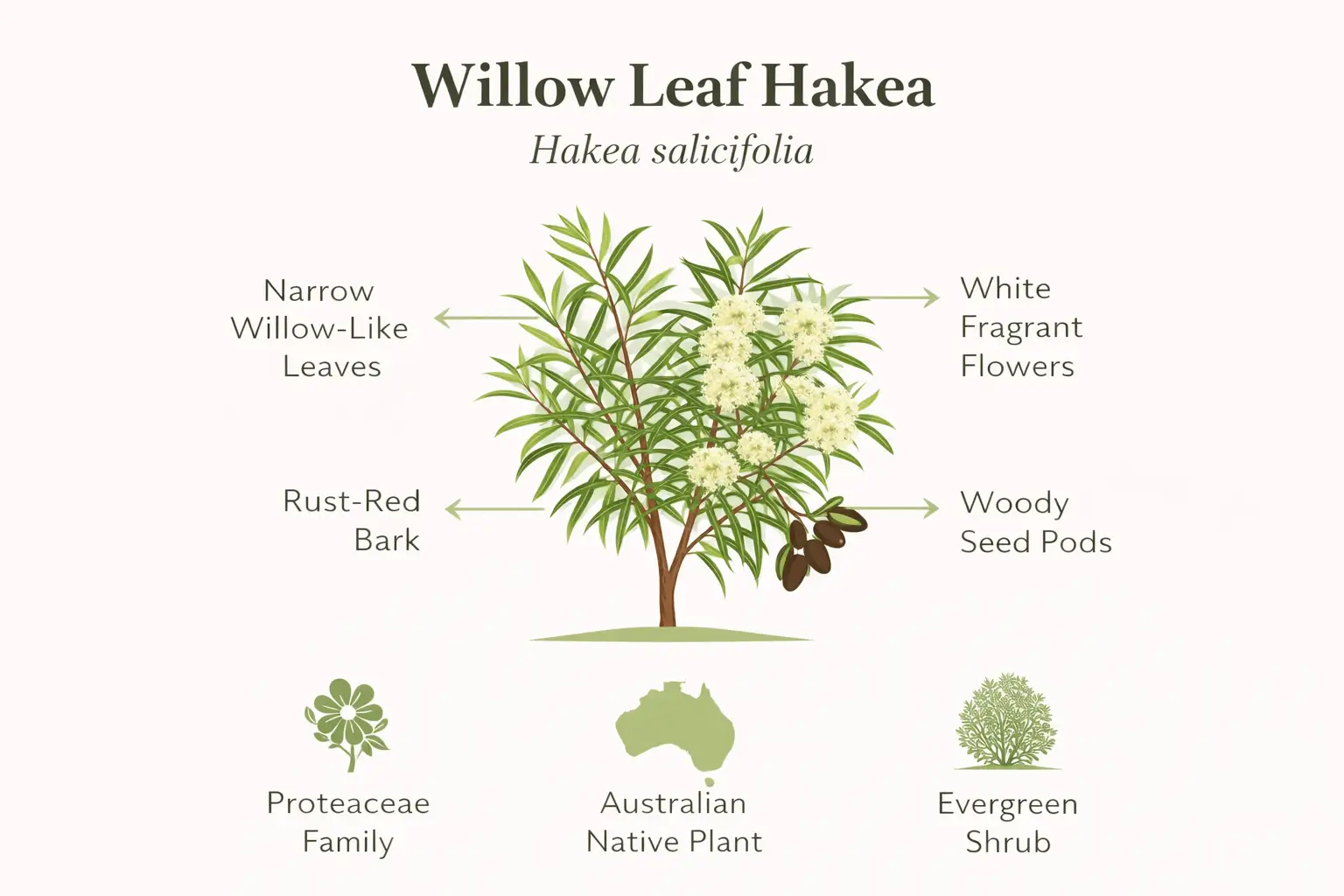
Willow leaf hakea, scientifically known as Hakea salicifolia, is a member of the Proteaceae family native to eastern Australia. It is commonly referred to as willow-leaved hakea due to its long, slender leaves that resemble those of willow trees.
This plant is recognized for several botanical features:
- Linear, narrow green leaves that create a soft, flowing appearance
- Rust-red bark that adds subtle visual texture
- Fragrant, creamy-white flowers appearing in clusters during cooler months
- Woody, ornamental seed pods that persist on the plant
In landscaping, hakea salicifolia plays an important role in erosion control and biodiversity. Its dense root system stabilizes soil, while its flowers and structure support birds, bees, and other beneficial wildlife.
Willow leaf hakea belongs to the Proteaceae family, a large group of flowering plants native mainly to the Southern Hemisphere.
Plant Size and Growth
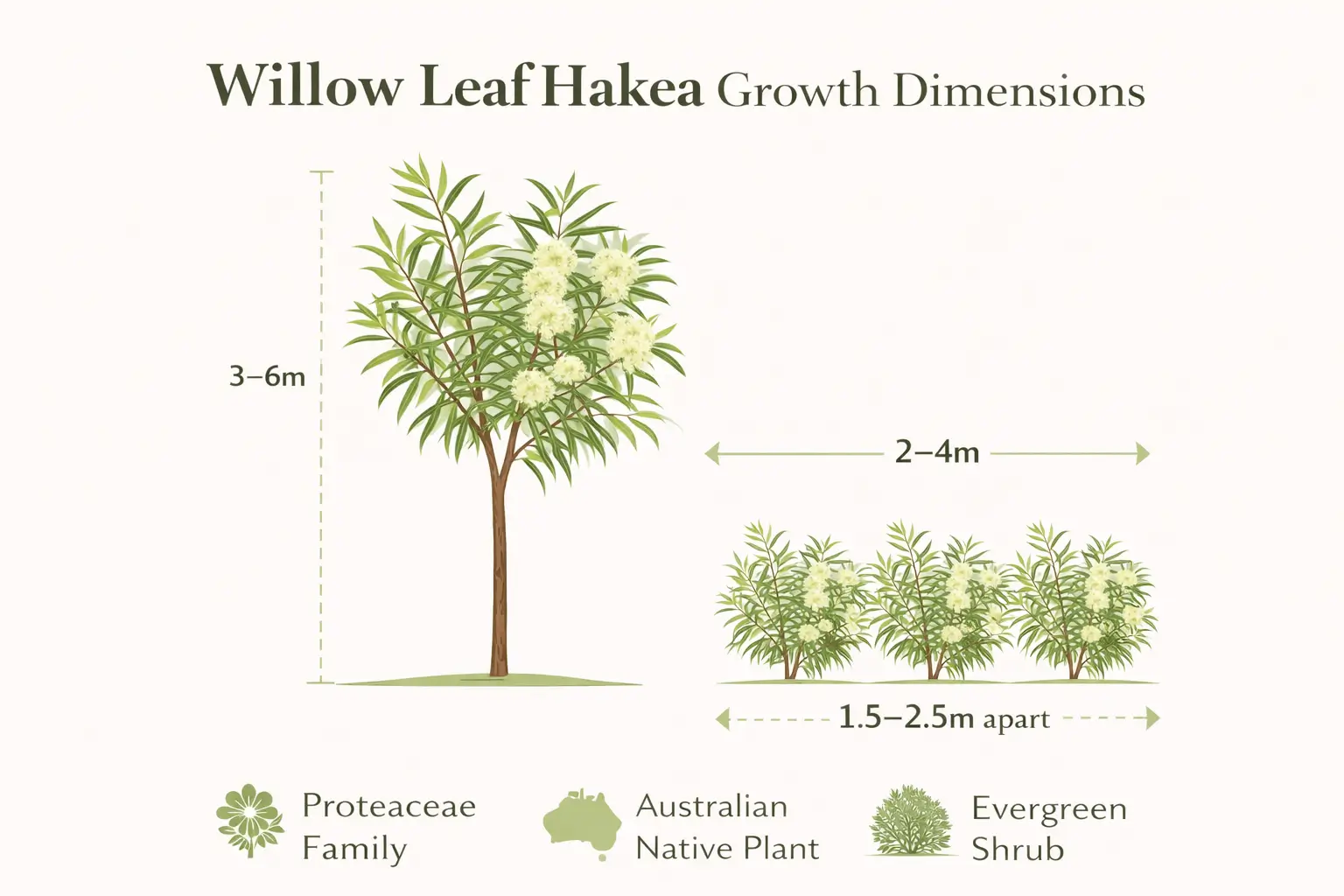
Willow leaf hakea typically grows as a large shrub reaching 3–5 meters in height and 2–4 meters in width. When left unpruned, it can develop into a small tree up to 6 meters tall.
Growth Characteristics
- Indoor growth is not suitable due to its size and light requirements
- Outdoor growth varies based on pruning and environmental conditions
- Regular trimming encourages a compact hedge form
- Rich soil and warm climates promote faster expansion
Hedge Spacing Guidelines
- Space plants 1.5–2.5 meters apart for dense coverage
- Closer spacing results in thicker hedges
- Wider spacing suits informal screens
Size Overview Table
| Growth Factor | Typical Range | Notes |
| Height | 3–6m | Taller in open ground |
| Width | 2–4m | Bushier with pruning |
| Hedge Spacing | 1.5–2.5m | Ensures density |
Growth Rate
Willow leaf hakea is a fast-growing shrub that can add more than 1 meter of growth per year under optimal conditions. This makes it highly suitable for creating quick privacy screens or windbreaks.
Growth Behavior
- Growth peaks during spring when temperatures rise
- Slows during drought or poor soil conditions
- Benefits from mulching to retain moisture
- Responds well to native, low-phosphorus fertilizers
Annual pruning is essential to maintain shape, encourage branching, and sustain vigorous growth.
Care Guide
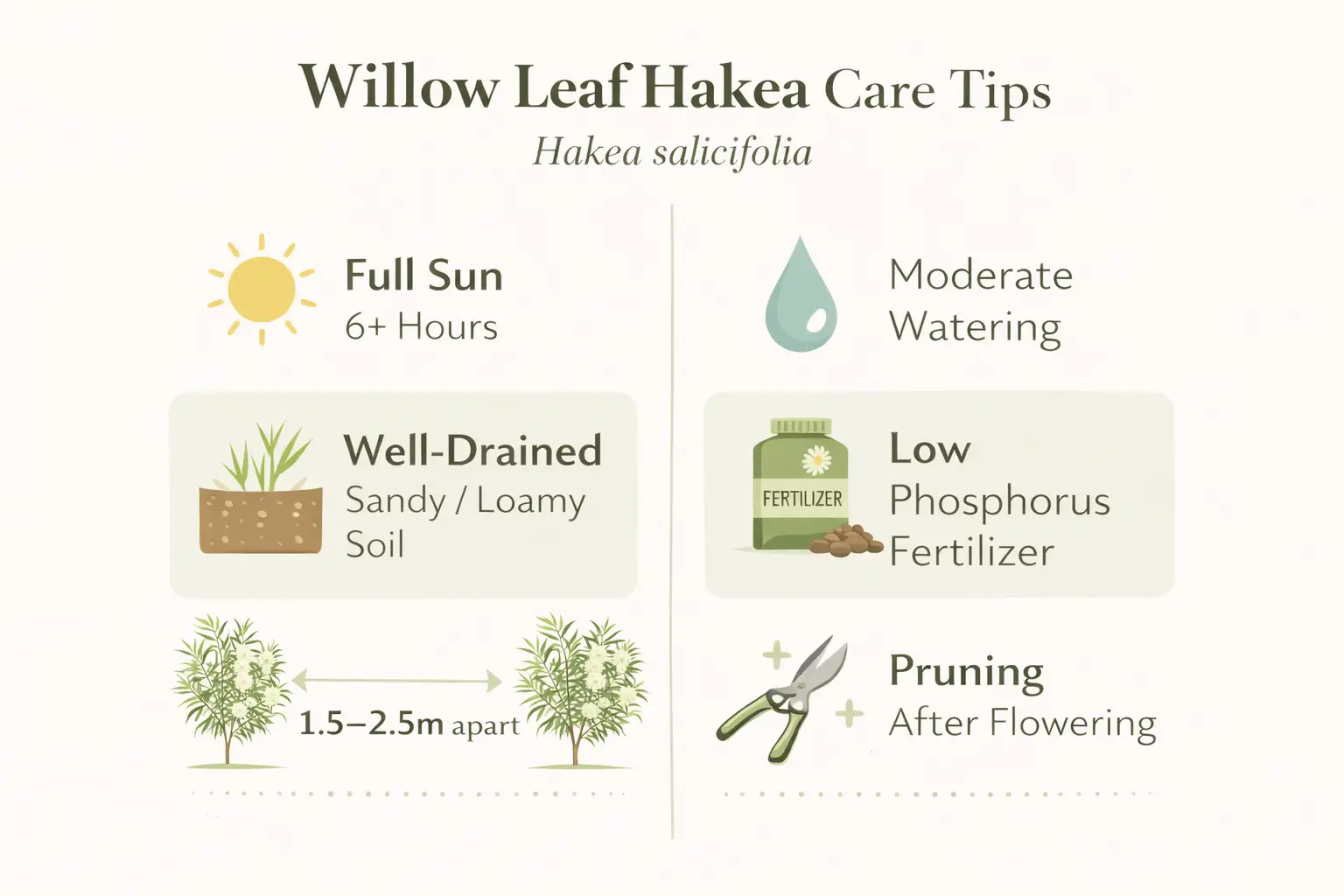
Willow leaf hakea thrives with minimal maintenance when planted in suitable conditions.
Basic Requirements
- Soil: Well-drained sandy or loamy soil
- Light: Full sun (at least 6 hours daily)
- Water: Moderate watering, drought-tolerant once established
Care Practices
- Water deeply but infrequently to avoid root rot
- Avoid consistently wet soil conditions
- Apply low-phosphorus fertilizer in spring
- Prune after flowering to maintain density and shape
Climate Tolerance
- Tolerates light frost down to approximately -5°C
- Performs well in coastal environments
- Prefers neutral to slightly acidic soil pH
For hedge applications, proper pruning and spacing improve airflow and reduce disease risk.
Willow Leaf Hakea Varieties
Willow leaf hakea has limited cultivated varieties, but some forms and selections offer slight differences in growth habit and foliage.
Common Types
- Standard Hakea salicifolia: Typical narrow leaves and white flowers
- Selected forms (e.g., ‘Gold Cap’): Slightly brighter foliage or compact growth
Seed-grown plants may show minor variation due to genetic diversity, but overall structure and characteristics remain consistent.
Variety Comparison Table
| Variety | Key Trait | Best Use |
| Standard | Willow-like leaves, white flowers | Hedges, screens |
| Selected forms | Compact growth | Small gardens |
Hakea Salicifolia as a Hedge
Hakea salicifolia is ideal for hedging due to its dense growth habit and rapid establishment. It forms both formal and informal hedges effectively.
Hedge Benefits
- Provides privacy and wind protection
- Supports pollinators and birdlife
- Maintains greenery year-round
Planting and Maintenance
- Plant in rows with proper spacing for uniform coverage
- Prune lightly each year to shape and thicken growth
- Avoid heavy cutting into old wood
Consistent pruning ensures a dense, attractive hedge that blocks views while enhancing biodiversity. For more evergreen hedge options that work well for privacy screening, you can also compare 7+ Essential Lilly Pilly Varieties for Hedges & Screening, Best Hedging Trees, and 7+ Essential Tropical Privacy Plants for Fast Screening.
Common Problems and Solutions
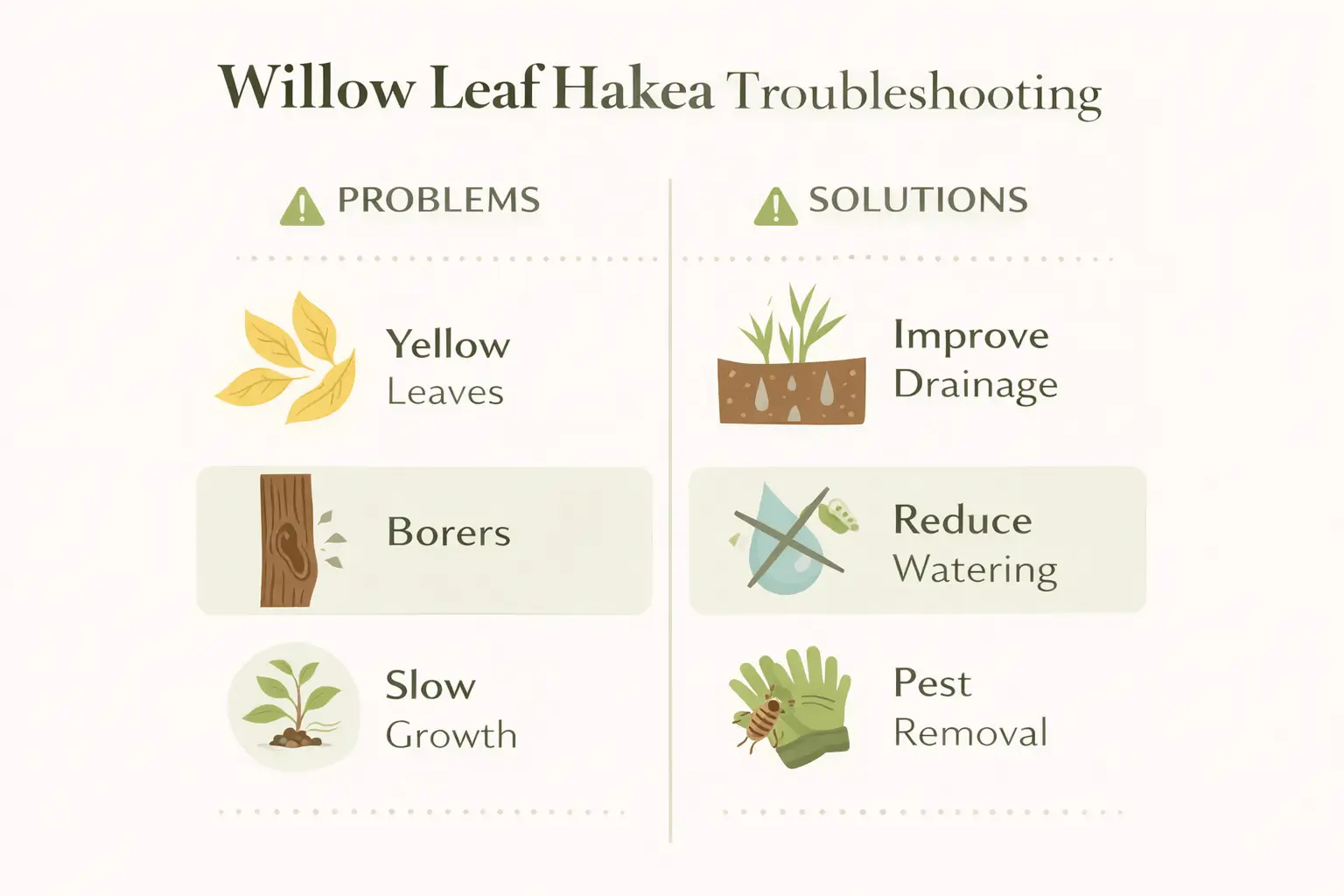
Common willow leaf hakea problems include pest damage, yellowing leaves, and poor growth, often caused by environmental stress.
Common Issues
- Borers: Indicated by small holes with sawdust
- Yellow leaves: Often due to overwatering or nutrient deficiency
- Slow growth: Usually linked to poor drainage
Causes
- Excess moisture in soil
- Poor air circulation
- Lack of nutrients or unsuitable soil
Solutions
- Remove borers manually or seal affected areas
- Reduce watering and improve drainage
- Apply appropriate fertilizer if needed
Prevention Tips
- Avoid planting in heavy clay without soil improvement
- Monitor regularly for early signs of pests
- Reduce watering during winter months
A common beginner mistake is overwatering, especially in dense or clay soils, which can lead to root problems.
Comparison: Willow Leaf Hakea vs. Similar Hakeas
Willow leaf hakea differs significantly from other hakea species, particularly pincushion hakea (Hakea laurina).
Key Differences
- Willow leaf hakea has narrow, linear leaves
- Pincushion hakea features broader leaves and distinctive round flowers
- Growth rate and landscape use vary between species
Comparison Table
| Feature | Willow Leaf Hakea | Pincushion Hakea |
| Leaves | Narrow, willow-like | Broader, rounded |
| Flowers | Curly white spikes | Red ball clusters |
| Growth | Fast hedge | Slower tree |
| Height | 3–6m shrub | 4–6m tree |
Willow leaf hakea is more suitable for hedging, while pincushion hakea is often grown as a feature tree.
Troubleshooting and Seasonal Care
Seasonal care ensures consistent growth and minimizes plant stress.
Seasonal Tips
- Spring: Apply fertilizer and prune after flowering
- Summer: Water deeply during extended dry periods
- Winter: Reduce watering and monitor frost exposure
Troubleshooting
- Frost damage: Trim affected branches after recovery
- Drought stress: Apply mulch to retain soil moisture
- Poor growth: Improve soil drainage and nutrient balance
Propagation is typically done through cuttings, allowing gardeners to replicate healthy plants efficiently.
Conclusion
Willow leaf hakea (Hakea salicifolia) is a versatile, fast-growing shrub that combines ornamental appeal with practical landscaping benefits. Its dense foliage, fragrant flowers, and adaptability make it an excellent choice for hedges, privacy screens, and wildlife-friendly gardens. By ensuring proper drainage, controlled watering, and regular pruning, gardeners can maintain healthy growth and avoid common issues. This plant stands out as a low-maintenance solution for creating structure and biodiversity in outdoor spaces.
FAQ
What is willow leaf hakea?
Willow leaf hakea is Hakea salicifolia, an Australian native shrub known for its narrow leaves and fragrant white flowers, commonly used for hedging and screening.
How tall does willow leaf hakea grow?
It typically grows between 3 and 6 meters tall, depending on pruning and environmental conditions, with hedge forms remaining more compact.
Can Hakea salicifolia be used as a hedge?
Yes, it is widely used as a hedge. Plant it 1.5–2 meters apart and prune regularly to create a dense and structured screen.
What are common Hakea salicifolia problems?
Common issues include borers, yellowing leaves due to overwatering, and slow growth caused by poor drainage or soil conditions.
How do you care for willow leaf hakea?
Provide full sun, well-drained soil, and moderate watering. Use low-phosphorus fertilizer and prune annually to maintain shape and health.