Introduction
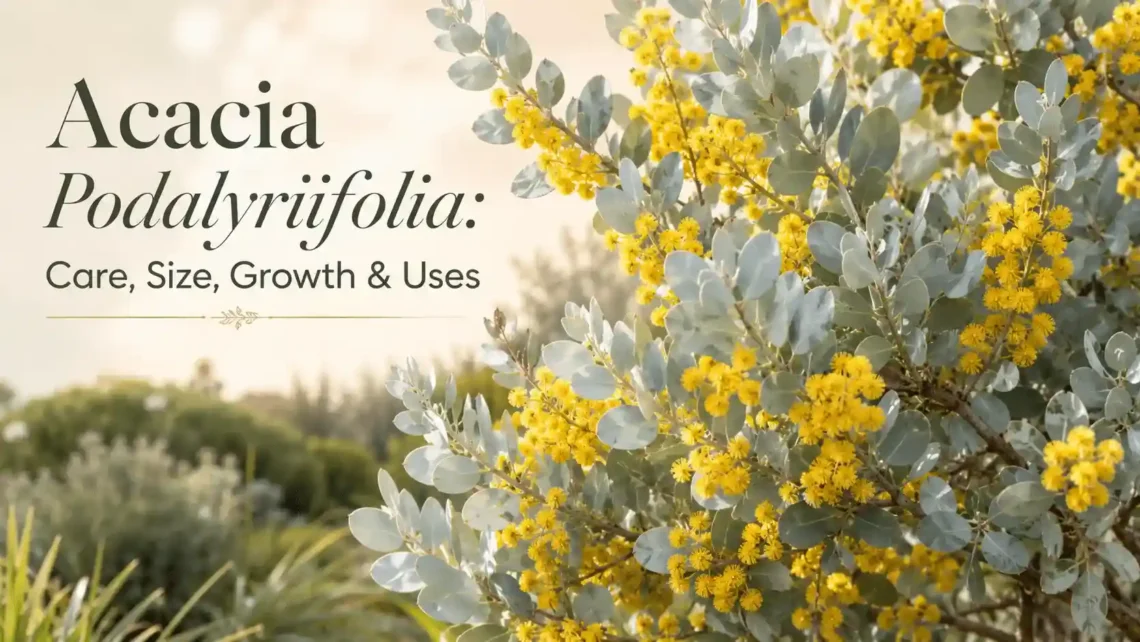
Acacia podalyriifolia is a fast-growing ornamental Australian native tree valued for its silver-grey foliage and bright yellow flowers. Commonly known as Queensland silver wattle, QLD silver wattle, pearl acacia, Mount Morgan wattle, and silver leaf wattle, this species is widely grown in warm climates for landscaping and habitat planting. Some gardeners also search for it under the spelling variant “acacia podalyrifolia,” which refers to the same plant. This guide explains how to identify acacia podalyriifolia, its size, growth rate, care needs, lifespan, and landscape uses.
Quick Summary: What Is Acacia Podalyriifolia?
- Acacia podalyriifolia, commonly called Queensland silver wattle or pearl acacia, is a fast-growing Australian native tree or large shrub in the Fabaceae family.
- It is native to southeastern Queensland but widely cultivated for its silvery foliage and bright yellow flowers.
- Common names include QLD silver wattle, Queensland wattle, Mount Morgan wattle, and silver leaf wattle.
- Mature plants usually reach 3–6 metres tall and are popular in ornamental landscaping and wildlife-friendly gardens.
- The species is drought-tolerant once established and adapts well to warm-temperate and subtropical climates.
What Is Acacia Podalyriifolia?
Botanical Classification and Common Names
Acacia podalyriifolia is a flowering legume species in the Fabaceae family. Its botanical classification is:
- Family: Fabaceae
- Genus: Acacia
- Species: Acacia podalyriifolia
This species is known by several common names, including:
- Queensland silver wattle
- QLD silver wattle
- Silver wattle acacia
- Pearl acacia
- Mount Morgan wattle / Mt Morgan wattle
- Silver leaf wattle
- Queensland wattle
- Silver wattle tree
The spelling variant “acacia podalyrifolia” is also widely used online and in plant searches. Both spellings refer to the same species. Acacia podalyriifolia belongs to the larger Acacia genus, one of the most diverse groups of flowering plants in Australia.
The names “pearl acacia” and “silver” wattle come from the plant’s silvery-white phyllodes and rounded new growth. Fine hairs covering the foliage create a soft metallic sheen that gives the tree its distinctive appearance. Like many species featured in the Ultimate Guide to Native Trees of Australia: Identification & Care, acacia podalyriifolia is valued for its adaptability, ornamental foliage, and ecological benefits in Australian landscapes.
Native Origin and Natural Range
Acacia podalyriifolia is indigenous to southeastern Queensland, Australia, especially around the Mount Morgan and Rockhampton regions. This natural distribution explains the common name Mount Morgan wattle.
Outside its native range, the species has been cultivated across other Australian states and internationally in Mediterranean and warm-climate regions. It is grown in:
- Northern New South Wales
- Western Australia
- California
- South Africa
- Mediterranean Europe
In some non-native environments, acacia podalyriifolia can naturalize and spread through self-seeding. Certain regions classify it as potentially invasive because of its rapid growth and adaptability.
How to Identify Acacia Podalyriifolia
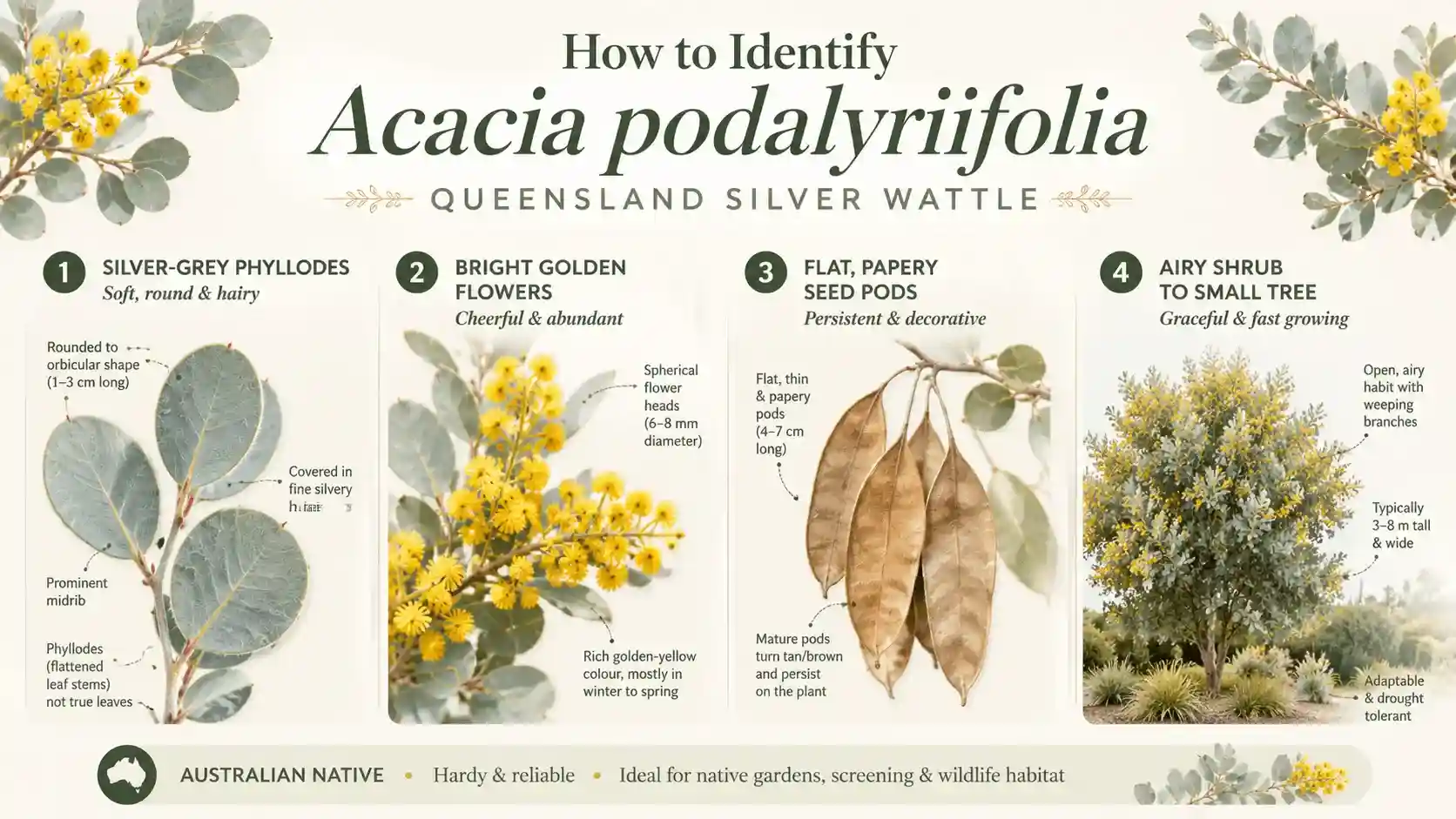
Acacia podalyriifolia is recognized by its silver-grey foliage, golden flowers, and open shrub-to-tree growth habit.
Key identification features include:
- Rounded silver-grey phyllodes instead of true leaves
- Fine silvery hairs covering foliage
- Bright golden-yellow spherical flowers
- Fragrant blooms appearing from late winter to spring
- Flat, narrow seed pods after flowering
- Smooth grey-brown bark
- Open, airy canopy structure
The phyllodes are one of the easiest identification traits. These flattened leaf-like stems are oval to rounded and coated in fine hairs that produce a silvery or pearl-like effect.
Flowers appear in clusters of bright yellow balls, usually between July and October in Australia. The blooms are fragrant and attract pollinators such as bees and native insects.
| Feature | Description |
| Phyllodes (leaves) | Silver-grey, rounded, covered in fine white hairs |
| Flower colour | Bright golden yellow, ball-shaped clusters |
| Flower season | Late winter to spring (July–October) |
| Seed pods | Flat, narrow, papery legume |
| Bark | Smooth to slightly furrowed, grey-brown |
| Growth form | Large shrub to small tree |
Acacia Podalyriifolia Size — Height, Spread, and Lifespan
How Tall Does Acacia Podalyriifolia Grow?
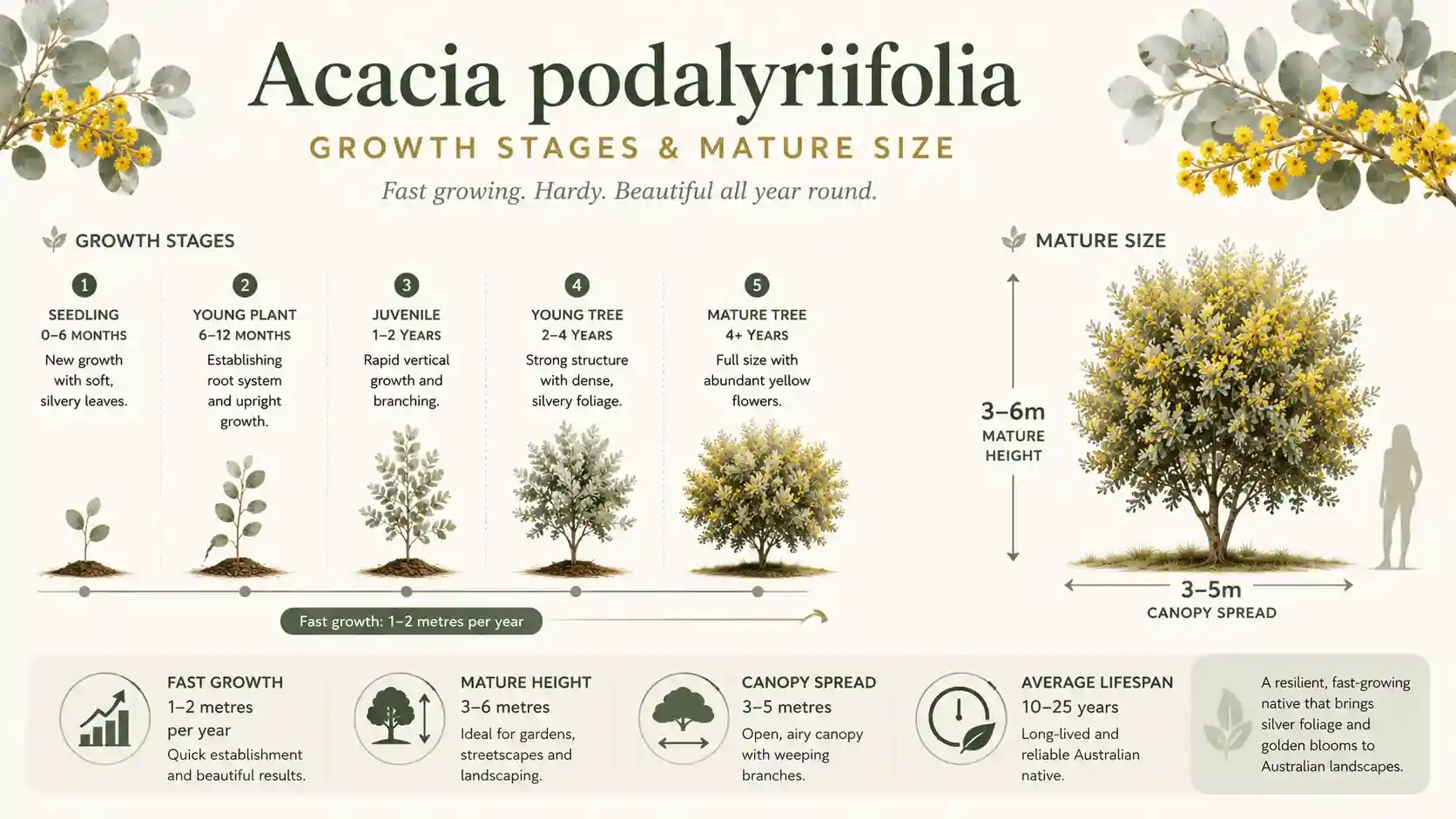
Acacia podalyriifolia typically grows between 3–6 metres tall at maturity. Under ideal conditions, some specimens may reach up to 8 metres.
The canopy spread usually matches or slightly exceeds the plant’s height, giving it a broad and airy appearance. Plants trained as single-trunk trees tend to develop a taller profile, while multi-stemmed shrubs remain wider and denser.
Key size characteristics include:
- Typical height: 3–6 metres
- Potential maximum height: 8 metres
- Spread: 3–6 metres or wider
- Growth habit: shrub or small tree
Container-grown specimens stay smaller because restricted root systems limit growth. However, container growing may also shorten lifespan and reduce flowering performance.
How Long Does Queensland Silver Wattle Live? (Lifespan)
The acacia podalyriifolia lifespan is relatively short compared to slower-growing trees. Most cultivated plants live between 10–25 years.
This shorter lifespan is common among fast-growing wattles. Rapid growth allows the species to establish quickly in disturbed or poor soils, but it also results in faster aging.
Several factors influence longevity:
- Soil drainage quality
- Climate suitability
- Pruning practices
- Drought stress
- Root health
Well-drained soil and light pruning can help extend lifespan. Although individual plants may not live for decades, acacia podalyriifolia self-seeds readily in suitable climates, helping maintain populations in gardens.
How Fast Does Acacia Podalyriifolia Grow?
Acacia podalyriifolia is considered a fast-growing species. Under optimal conditions, it can grow 1–2 metres per year. The strongest growth usually occurs during spring and summer when temperatures are warm and soil moisture is adequate. Growth slows significantly during cold weather or prolonged drought. Because of its rapid establishment and dense canopy, acacia podalyriifolia can also function as a privacy screen alongside other species featured in 6+ Smart Australian Native Screening Trees for Privacy.
Compared with other wattles:
- Acacia dealbata grows taller but at a similar speed
- Acacia baileyana also grows rapidly but develops a different canopy form
- Acacia podalyriifolia remains more compact and manageable for suburban gardens
Its rapid growth makes it useful for:
- Privacy screening
- Windbreak planting
- Quick ornamental impact
- Wildlife habitat establishment
A common trade-off in the Acacia genus is that fast growth often correlates with shorter lifespan.
Acacia Podalyriifolia Care Guide
Sunlight Requirements
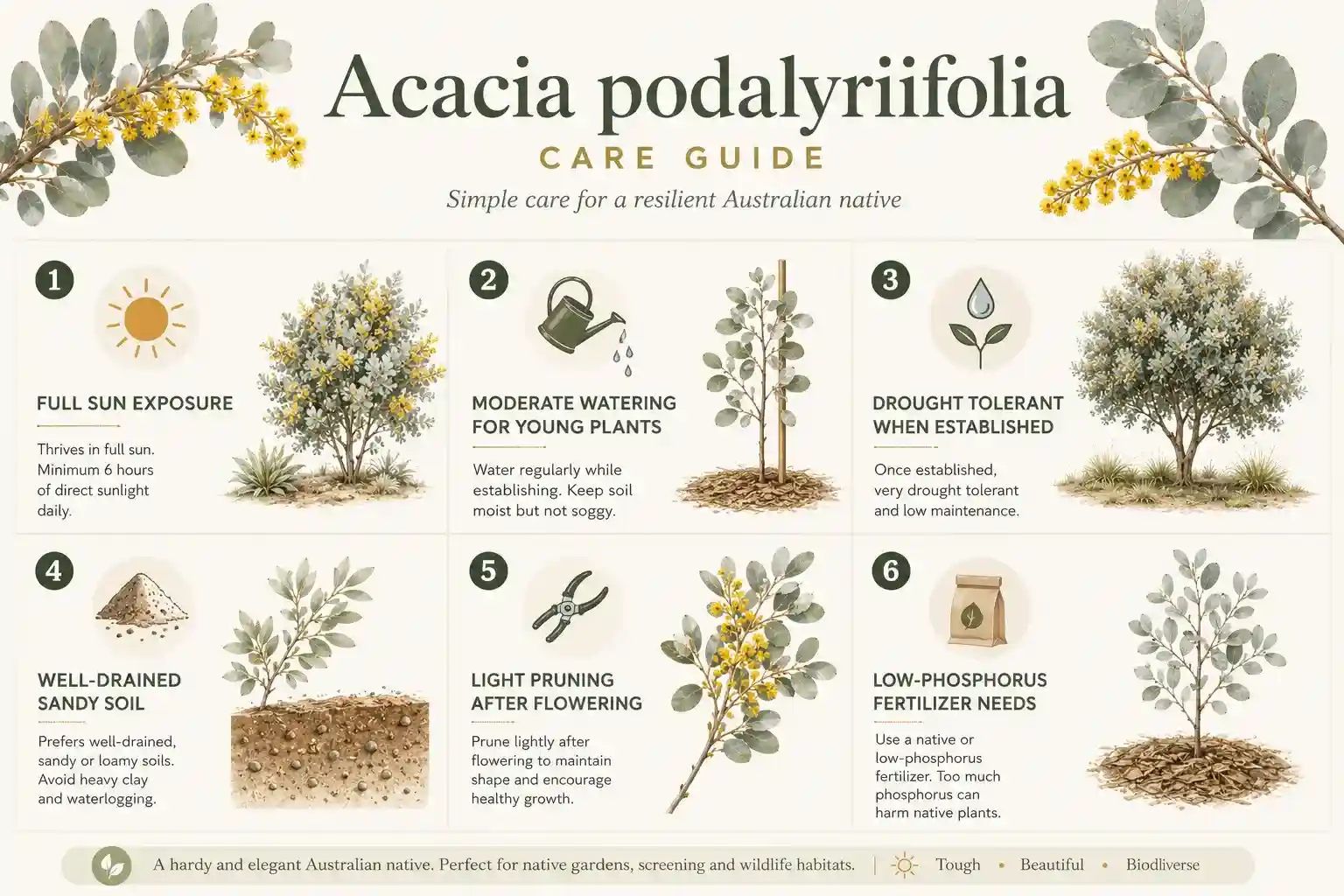
Full sun is essential for healthy growth and flowering.
- Minimum 6 hours of direct sunlight daily
- Light partial shade tolerated
- Poor flowering occurs in heavy shade
- Leggy growth develops in low light
In the Southern Hemisphere, north-facing positions usually provide the best flowering performance.
Watering Needs
Acacia podalyriifolia becomes drought-tolerant once established.
- Young plants need regular watering during dry periods
- Water deeply about once weekly during establishment
- Mature plants require minimal supplemental irrigation
- Avoid constantly wet or boggy soil
Poor drainage greatly increases the risk of root rot, especially during humid or rainy periods.
Soil Preferences
This species performs best in free-draining soils.
Preferred soil conditions include:
- Sandy soil
- Loamy soil
- Gravelly soil
- Slightly acidic to neutral pH (6.0–7.0)
Heavy clay soils should be improved with drainage materials before planting. Like many legumes, acacia podalyriifolia can tolerate low-nutrient soils because of its nitrogen-fixing ability.
Fertilization
Acacia podalyriifolia requires minimal fertilizer.
As a nitrogen-fixing plant, it naturally improves soil fertility through symbiotic root bacteria. Excess fertilizer, especially high-nitrogen products, may reduce flowering and encourage weak growth.
For best results:
- Apply low-phosphorus native plant fertilizer in early spring
- Avoid excessive feeding
- Do not use high-phosphorus fertilizers designed for exotic flowering plants
Pruning Considerations
Light pruning helps maintain shape and encourages denser growth.
Pruning recommendations include:
- Prune lightly after flowering
- Remove dead or crossing branches annually
- Avoid hard pruning into old wood
- Train young plants into tree form if desired
Severe pruning may prevent reliable regrowth because mature wood responds poorly to heavy cutting.
Climate Tolerance
Acacia podalyriifolia grows best in warm climates.
- USDA zones: 9–11
- Warm-temperate to tropical Australian climates
- Light frost tolerance once established
- Young plants sensitive to severe frost
The species performs especially well in coastal and inland Queensland-type conditions and adapts successfully to Mediterranean climates internationally.
| Care Factor | Requirement |
| Sunlight | Full sun (6+ hours) |
| Water | Low once established; moderate when young |
| Soil | Well-drained, sandy to loamy |
| Fertilizer | Minimal; low-phosphorus native blend |
| Frost tolerance | Light frost only |
| Pruning | Light post-flowering trim |
Growing Acacia Podalyriifolia from Seeds
Acacia podalyriifolia seeds germinate reliably when prepared correctly.
Follow these basic propagation steps:
- Collect mature dry seed pods when they become brown and papery.
- Scarify the seeds by nicking the coat or sanding lightly.
- Alternatively, pour near-boiling water over the seeds and soak for 24 hours.
- Sow seeds into a free-draining seed-raising mix.
- Keep the soil lightly moist but not waterlogged.
- Germination usually occurs within 7–21 days.
- Transplant seedlings once they reach 10–15 cm tall.
Spring is generally the best sowing season in most Australian climates.
In warm regions, acacia podalyriifolia self-seeds readily and may establish naturally around mature plants.
Acacia Podalyriifolia Varieties and Comparison with Similar Species
Are There Named Varieties of Acacia Podalyriifolia?
Acacia podalyriifolia is generally treated as a single species with limited named cultivars in commercial horticulture.
Some natural variation occurs in:
- Overall height
- Shrub versus tree habit
- Canopy density
- Flower abundance
The term “pearl acacia” is sometimes loosely applied to other silver-foliaged Acacia species, which can create confusion in nurseries and online searches.
Acacia Podalyriifolia vs. Similar Silver Wattles — Comparison Table
| Feature | A. podalyriifolia (QLD Silver Wattle) | A. dealbata (Silver Wattle) | A. baileyana (Cootamundra Wattle) |
| Common name | Queensland silver wattle, pearl acacia | Silver wattle | Cootamundra wattle |
| Foliage | Round silver phyllodes | Bipinnate, feathery silver-grey | Bipinnate, blue-grey |
| Mature height | 3–6 m | 8–15 m | 6–9 m |
| Flower season | Late winter–spring | Late winter | Late winter–spring |
| Native region | SE Queensland | SE Australia (VIC, NSW, TAS) | SW NSW |
| Growth rate | Fast | Fast | Fast |
| Lifespan | 10–25 years | 10–30 years | 10–20 years |
Common Problems with Acacia Podalyriifolia and How to Fix Them
Why Are the Leaves (Phyllodes) Turning Yellow?
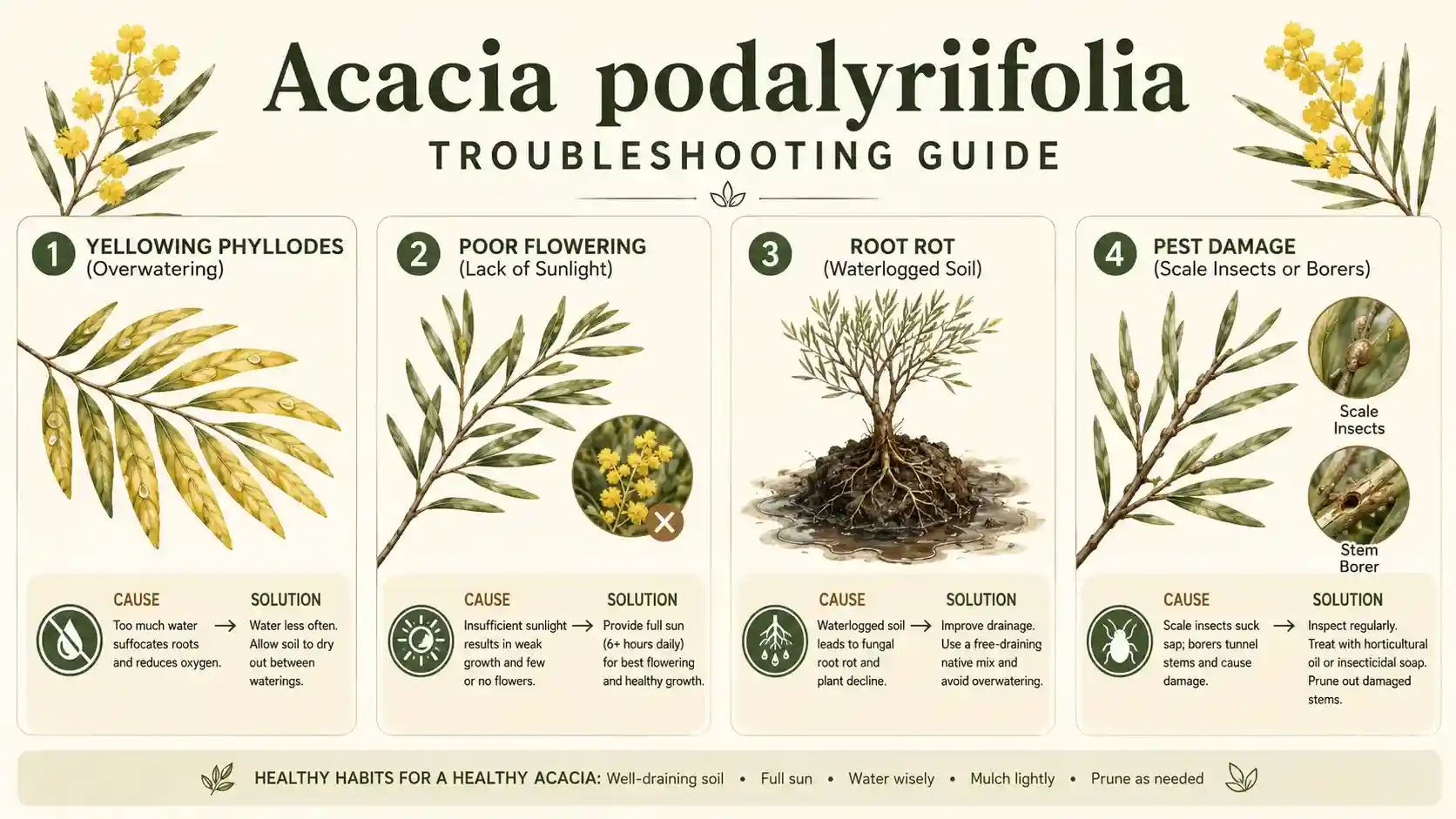
Yellowing phyllodes are usually caused by drainage or nutrient issues.
Common causes include:
- Overwatering
- Waterlogged soil
- Iron deficiency
- Poor drainage
- Natural aging of older foliage
To fix the problem:
- Improve soil drainage
- Reduce watering frequency
- Apply chelated iron if deficiency is suspected
- Avoid overhead irrigation
Preventative planting in free-draining soil is the most effective long-term solution.
Why Is My Acacia Podalyriifolia Not Flowering?
Poor flowering is usually linked to insufficient sunlight or incorrect pruning.
Common causes:
- Too much shade
- Excess nitrogen fertilizer
- Pruning before flowering
- Immature plant age
Solutions include:
- Move the plant into full sun
- Reduce fertilizer use
- Prune only after flowering
- Use low-nitrogen native fertilizer blends
At least 6 hours of direct sunlight daily is important for reliable blooming.
Pests and Diseases
Acacia podalyriifolia is generally considered a robust species with relatively few severe pest issues in its native range.
Common pests include:
- Borers
- Scale insects
- Lerp psyllids
Possible diseases and disorders:
- Root rot caused by Phytophthora
- Gall formation linked to eriophyid mites
Control measures:
- Use neem oil for mild pest infestations
- Improve drainage immediately if root rot develops
- Remove heavily infested branches
- Avoid prolonged soil saturation
Healthy plants in suitable climates usually experience fewer serious problems.
Uses and Landscape Value of Queensland Silver Wattle
Queensland silver wattle is valued for both ornamental and ecological purposes.
Major landscape uses include:
- Ornamental planting for silver foliage contrast
- Winter and spring flower displays
- Native garden design
- Cottage-style landscaping
- Screening and privacy planting
- Windbreak establishment
Its fragrant yellow blooms are also popular in cut flower arrangements and seasonal floral displays. Queensland silver wattle is commonly used in native-style landscapes and pairs naturally with concepts discussed in the Modern Australian Native Garden: 10+ Smart Design Ideas Guide.
Ecological benefits include:
- Nectar source for insects and birds
- Seed food for native wildlife
- Nitrogen fixation that improves poor soils
- Erosion control on disturbed slopes
Because of its fast establishment and adaptability, acacia podalyriifolia is often used in rehabilitation and wildlife-friendly garden projects.
Where Does Acacia Podalyriifolia Grow Best? — Climate and Regional Suitability
Acacia podalyriifolia performs best in warm-temperate, subtropical, and semi-arid climates similar to southeastern Queensland.
In Australia, it grows successfully in:
- Coastal Queensland
- Inland Queensland
- Northern New South Wales
- Some regions of Western Australia
It is less suitable for:
- Cold alpine climates
- Persistently wet environments
- Heavy frost zones
Internationally, the species performs well in:
- California
- Mediterranean Europe
- South Africa
- Other USDA zone 9–11 climates
Urban gardeners often use it in courtyards, suburban landscapes, and streetscape plantings.
Container growing is possible in large pots, although restricted roots may reduce lifespan and final size.
Conclusion
Acacia podalyriifolia, commonly known as Queensland silver wattle or pearl acacia, is a fast-growing Australian native valued for its silver foliage and bright golden flowers. Its manageable size, drought tolerance, and adaptability make it suitable for many warm-climate gardens. Although relatively short-lived, the species establishes quickly and provides strong ornamental and ecological benefits. Whether grown from seed or planted as an established specimen, understanding acacia podalyriifolia care requirements helps ensure healthy growth, reliable flowering, and long-term landscape value. For readers exploring more ornamental and landscape-friendly species, this tree also fits naturally within broader plants for homes and gardens planning strategies.
FAQ — Acacia Podalyriifolia: Common Questions Answered
Q1: What is the common name for Acacia podalyriifolia?
The most common names for Acacia podalyriifolia are Queensland silver wattle, QLD silver wattle, pearl acacia, Mount Morgan wattle, and silver leaf wattle. “Queensland silver wattle” is the most widely used national name, while “Mount Morgan wattle” is more regionally associated with its native Queensland habitat.
Q2: How tall does Acacia podalyriifolia grow?
Acacia podalyriifolia typically grows 3–6 metres tall, although some plants can reach 8 metres under ideal conditions. Its spread usually matches or slightly exceeds its height, creating a broad shrub or small tree form.
Q3: How fast does Queensland silver wattle grow?
Queensland silver wattle is a fast-growing species that can grow 1–2 metres per year in suitable conditions. Rapid growth helps it establish quickly as a screening or ornamental plant, although fast growth is often linked to a shorter lifespan.
Q4: How long does Acacia podalyriifolia live?
Acacia podalyriifolia generally lives between 10–25 years. Like many wattles, it is considered relatively short-lived because it prioritizes rapid establishment and fast growth. Self-seeding helps maintain populations in suitable gardens.
Q5: Is Acacia podalyriifolia drought-tolerant?
Yes. Once established after 1–2 growing seasons, acacia podalyriifolia is highly drought-tolerant. Young plants still require regular watering during dry weather until roots are fully established.
Q6: What is the difference between Acacia podalyriifolia and silver wattle (Acacia dealbata)?
Acacia podalyriifolia has rounded silver phyllodes, while Acacia dealbata has feathery bipinnate foliage. Queensland silver wattle is usually smaller, growing 3–6 metres tall, whereas Acacia dealbata may reach 15 metres. The two species also originate from different Australian regions.
Q7: Can Acacia podalyriifolia be grown from seed?
Yes. Acacia podalyriifolia can be grown from seed, but scarification is necessary to break the hard seed coat. Gardeners usually soak seeds in near-boiling water for 24 hours before sowing into free-draining seed mix.