Introduction
Leptospermum Vertical Drop is an attractive Australian native shrub admired for its elegant cascading branches, evergreen foliage, and seasonal flowers. This distinctive weeping leptospermum belongs to the diverse Leptospermum (tea tree) genus and is widely planted as an ornamental landscape feature in native gardens, slopes, and modern outdoor spaces. It is closely associated with Leptospermum polygalifolium, sharing many of the hardy characteristics that make Australian tea trees reliable, low-maintenance garden plants. Whether used as a specimen shrub or an informal leptospermum ground cover, this graceful leptospermum plant offers year-round structure while supporting local wildlife and pollinators.
Leptospermum Vertical Drop is also widely used in larger landscape designs featured in our guide to Australian native garden trees, where it plays a key role in sustainable and drought-tolerant planting schemes.
By Greenery Inside | Plant Care & Gardening Expert
Quick Summary
- Leptospermum Vertical Drop is a compact, weeping Australian tea tree known for its cascading foliage and seasonal flowers.
- It performs well as a feature shrub, embankment planting, and informal leptospermum ground cover.
- Full sun and well-drained soil encourage healthy growth and abundant flowering.
- Once established, it requires minimal watering, light feeding, and occasional pruning.
- Its nectar-rich flowers provide valuable food for bees, native insects, and birds.
What Is Leptospermum Vertical Drop?
Botanical Classification
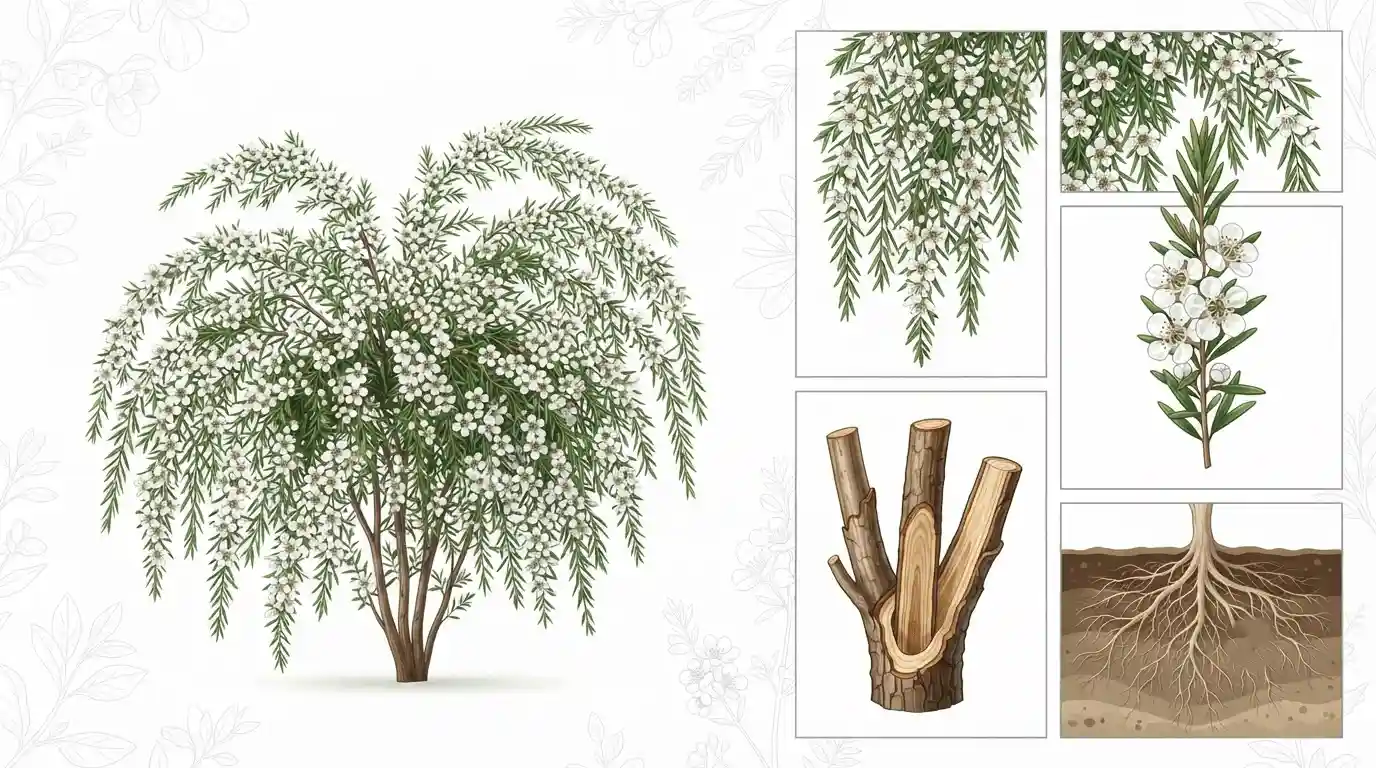
Leptospermum Vertical Drop is a cultivated Australian native tea tree selected for its naturally pendulous, cascading growth habit. It belongs to the myrtle family (Myrtaceae), a large botanical family that also includes eucalyptus, bottlebrushes, and paperbarks.
Botanical Classification
| Classification | Details |
| Scientific Genus | Leptospermum |
| Family | Myrtaceae |
| Common Group | Australian Tea Trees |
| Related Species | Leptospermum polygalifolium |
| Plant Type | Evergreen ornamental shrub |
| Growth Habit | Weeping, cascading |
Many horticulturists recognize Vertical Drop as a cultivated selection closely related to Leptospermum polygalifolium, a species naturally distributed across eastern Australia. The cultivar has been developed primarily for its elegant weeping branches rather than upright growth, making it especially valuable in ornamental landscaping.
Unlike many traditional tea trees that grow into dense upright shrubs, Vertical Drop forms graceful arching stems that soften hard landscape edges while maintaining an evergreen appearance throughout the year.
At Greenery Inside, we’ve found that gardeners often choose this cultivar when they want the resilience of Australian native tea trees combined with a more refined architectural form suitable for contemporary landscapes.
Key Characteristics
Leptospermum Vertical Drop stands out because of its unique combination of ornamental beauty and practical landscape performance. Its naturally cascading branches create movement and texture throughout the garden without requiring constant maintenance.
Some of its defining characteristics include:
- Dense evergreen foliage throughout the year
- Elegant cascading or pendulous branch structure
- Fine-textured leaves typical of many Australian tea trees
- Seasonal masses of nectar-rich flowers
- Excellent drought tolerance after establishment
- Adaptability to a range of garden settings
- Strong resistance to many common environmental stresses
Its graceful growth habit makes it noticeably different from many upright leptospermum shrubs. The cascading branches can spill over retaining walls, soften raised garden beds, or create attractive specimen plantings.
As a tea tree shrub, it provides year-round foliage interest while producing attractive flowers during its blooming season. Gardeners often refer to it as a tea tree bush because of its compact size and dense branching structure.
Another significant advantage is its ability to attract beneficial wildlife. Flowering branches become highly attractive to bees, butterflies, native insects, and nectar-feeding birds, increasing biodiversity in residential gardens.
Because of its weeping habit, weeping leptospermum cultivars like Vertical Drop are frequently chosen for landscapes where flowing forms are preferred over rigid upright shrubs.
Origin and Native Habitat
Where Does It Grow Naturally?
Although Leptospermum Vertical Drop is a cultivated ornamental selection, its botanical heritage comes from Australian native tea trees, particularly Leptospermum polygalifolium. These species naturally occur across large parts of eastern Australia, where they thrive under diverse environmental conditions.
The parent species is commonly found in:
- Open woodlands
- Coastal forests
- Rocky hillsides
- Creek margins
- Dry sclerophyll forests
- Mountain foothills
These habitats have shaped the plant’s adaptability to changing weather, seasonal rainfall, and nutrient-poor soils.
Gardeners searching for leptospermum vertical drop Australia often find it recommended because it performs exceptionally well in climates similar to its native environment. Warm summers, good air circulation, and free-draining soils encourage healthy development and reliable flowering.
Its close botanical relationship with Leptospermum polygalifolium also contributes to its toughness. The naturally occurring Leptospermum polygalifolium subsp. polygalifolium is well adapted to Australia’s varied climates, helping explain why many cultivated selections tolerate heat, wind, and periods of drought once established.
As of 2026, native Australian landscape design continues to prioritize drought-resilient plants that support biodiversity, making weeping tea tree cultivars increasingly popular for sustainable residential gardens.
In our experience, selecting a planting location that closely mimics these natural conditions—plenty of sunlight and excellent drainage—produces healthier plants with stronger flowering performance over time.
Mature Size and Growth Habit
Leptospermum Vertical Drop Height
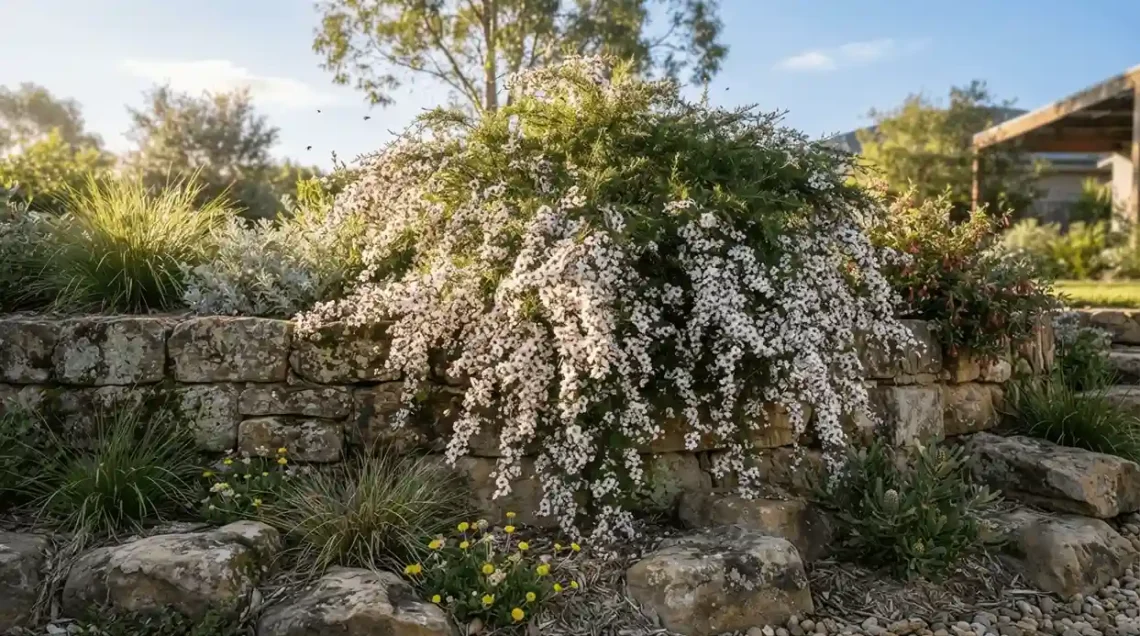
Leptospermum Vertical Drop typically develops into a compact yet spreading shrub with a distinctive cascading habit. Rather than growing upright, its branches arch downward to create a graceful waterfall-like appearance.
Typical mature dimensions are shown below.
| Feature | Typical Size |
| Mature Height | Approximately 1.5–2.5 m (5–8 ft) |
| Mature Spread | 2–3 m (6.5–10 ft) |
| Branch Habit | Cascading and pendulous |
| Foliage | Dense evergreen |
The exact leptospermum vertical drop height depends on several environmental factors, including:
- Soil quality
- Sunlight exposure
- Water availability
- Local climate
- Pruning practices
- Overall plant health
Plants grown in full sun with well-drained soil generally develop fuller canopies and produce stronger cascading growth than those grown in shaded conditions.
Unlike many upright tea tree species, Vertical Drop often appears wider than it is tall due to its naturally arching branches. This broad, flowing form makes it ideal for softening retaining walls, covering slopes, or serving as an eye-catching specimen in ornamental gardens.
Growth Rate
Leptospermum Vertical Drop has a moderate growth rate, balancing relatively quick establishment with manageable long-term maintenance. Under favorable growing conditions, young plants usually establish within one to two growing seasons before developing their characteristic cascading framework.
Growth speed is influenced by several factors:
- Full sun encourages stronger stem development.
- Well-drained soils promote healthy root expansion.
- Consistent watering during establishment supports vigorous early growth.
- Mild climates often extend the growing season.
- Excessively wet or compacted soils can significantly slow development.
Most noticeable growth occurs during spring and early summer when temperatures are warm and moisture is readily available. Once mature, the plant focuses more on producing dense foliage and seasonal flowers than rapid increases in size.
At Greenery Inside, we’ve observed that gardeners sometimes expect immediate cascading growth after planting. In reality, allowing the shrub two to three years to establish its framework results in a much more natural and attractive weeping habit. Light annual pruning also helps encourage balanced branching without sacrificing its signature flowing appearance.
How Leptospermum Vertical Drop Is Used in Landscaping
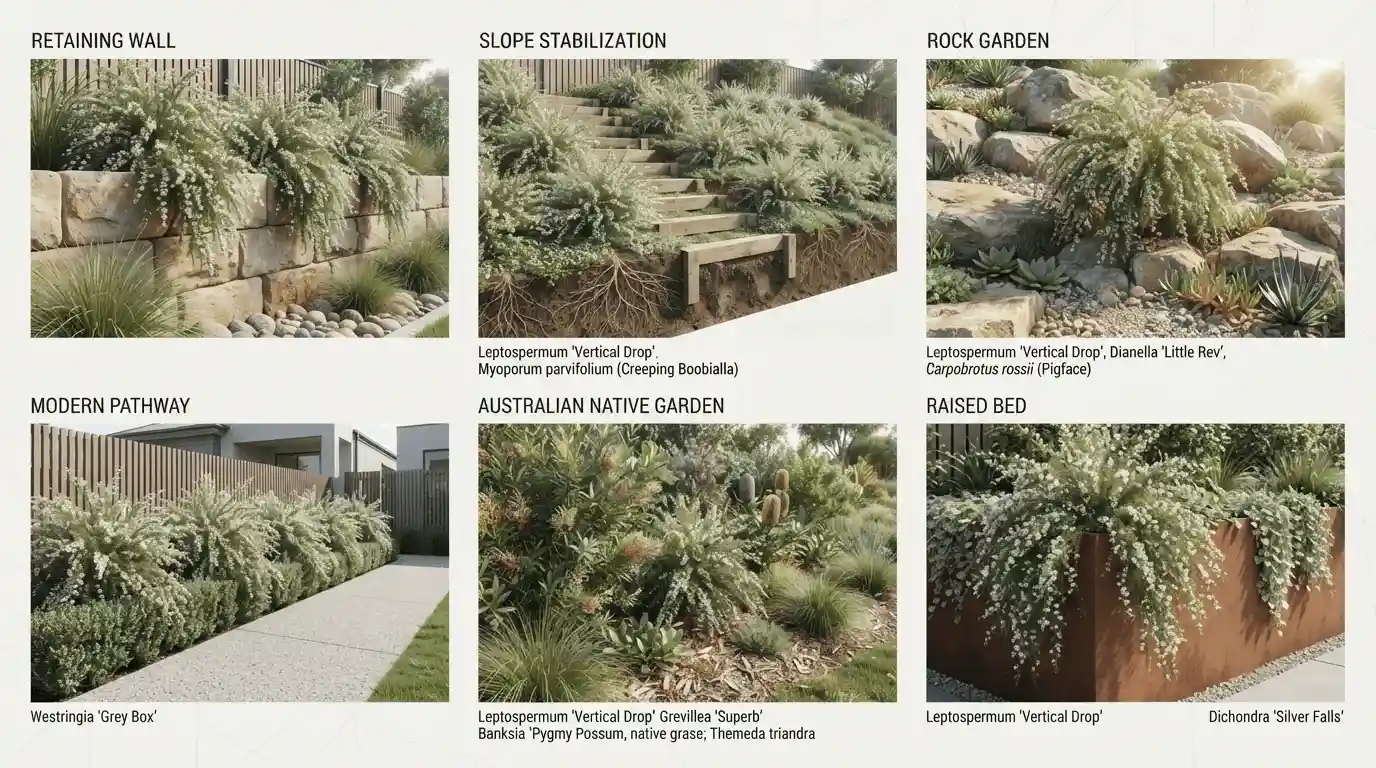
Best Landscape Applications
Leptospermum Vertical Drop is highly valued in landscape design because its naturally cascading branches create movement, soften hard edges, and add year-round texture. Its evergreen foliage and seasonal blooms make it suitable for both modern and naturalistic gardens.
Unlike many upright Australian native shrubs, this cultivar develops a graceful, weeping form that serves as both an ornamental feature and a practical planting solution.
In coastal and wind-exposed gardens, it pairs beautifully with Coastal Rosemary to create a hardy, salt-tolerant, low-maintenance planting design.
Common leptospermum vertical drop uses include:
- Feature specimen in front gardens
- Cascading over retaining walls
- Stabilizing banks and gentle slopes
- Softening rock gardens
- Mixed native garden plantings
- Informal borders
- Courtyard landscapes
- Large containers with excellent drainage
- Wildlife-friendly gardens
- Coastal landscapes
Feature Plant
The plant’s elegant branching structure naturally draws attention without overwhelming nearby plantings. As a standalone specimen, it provides visual interest throughout the year thanks to its evergreen foliage and seasonal flowering display.
Many designers position it where the cascading branches can be appreciated from multiple viewing angles, such as near entrances, patios, or garden paths.
Retaining Walls
One of the most popular applications is planting it above retaining walls. As the shrub matures, its pendulous branches spill gracefully over the edge, creating a waterfall-like effect that softens masonry, stone, or concrete structures.
Slopes and Banks
Its spreading root system helps anchor soil on gentle embankments while reducing erosion. Although it is not a deep-rooted engineering plant, it contributes to improved slope stability when used alongside other suitable native species.
Rock Gardens
The fine foliage contrasts beautifully with large rocks and gravel mulch. Its natural form complements informal landscapes inspired by Australian bush settings.
Borders and Native Gardens
As a medium-sized weeping leptospermum, it blends well with:
- Grevilleas
- Westringias
- Banksias
- Callistemons
- Native grasses
- Low-growing flowering shrubs
The soft cascading habit helps break up rigid planting lines while adding texture and seasonal color.
In our experience growing Australian native landscapes, combining Vertical Drop with contrasting upright shrubs creates a balanced design that remains visually attractive throughout the year.
Can It Be Used as Ground Cover?
Yes, Leptospermum Vertical Drop can function as an informal ground cover in the right landscape setting, although it is not a true creeping species.
Its naturally spreading branches gradually cover the surrounding ground, making it useful for larger planting areas where an attractive cascading effect is desired.
It performs particularly well as an informal leptospermum ground cover on:
- Sloping gardens
- Raised embankments
- Wide retaining walls
- Coastal dunes
- Native restoration plantings
- Low-maintenance landscape beds
Benefits as Ground Cover
- Helps reduce exposed soil.
- Suppresses some weed growth.
- Provides year-round evergreen coverage.
- Protects soil from light erosion.
- Creates natural flowing textures.
- Offers shelter for beneficial insects.
Limitations
Although it spreads outward, it should not be confused with low-growing creeping ground covers.
Compared with true mat-forming plants, it:
- grows taller
- develops woody branches
- requires occasional pruning
- leaves some open space beneath mature branches
Gardeners looking for dense, carpet-like coverage should treat Vertical Drop as a cascading shrub rather than a traditional ground cover.
Care Guide for Healthy Growth
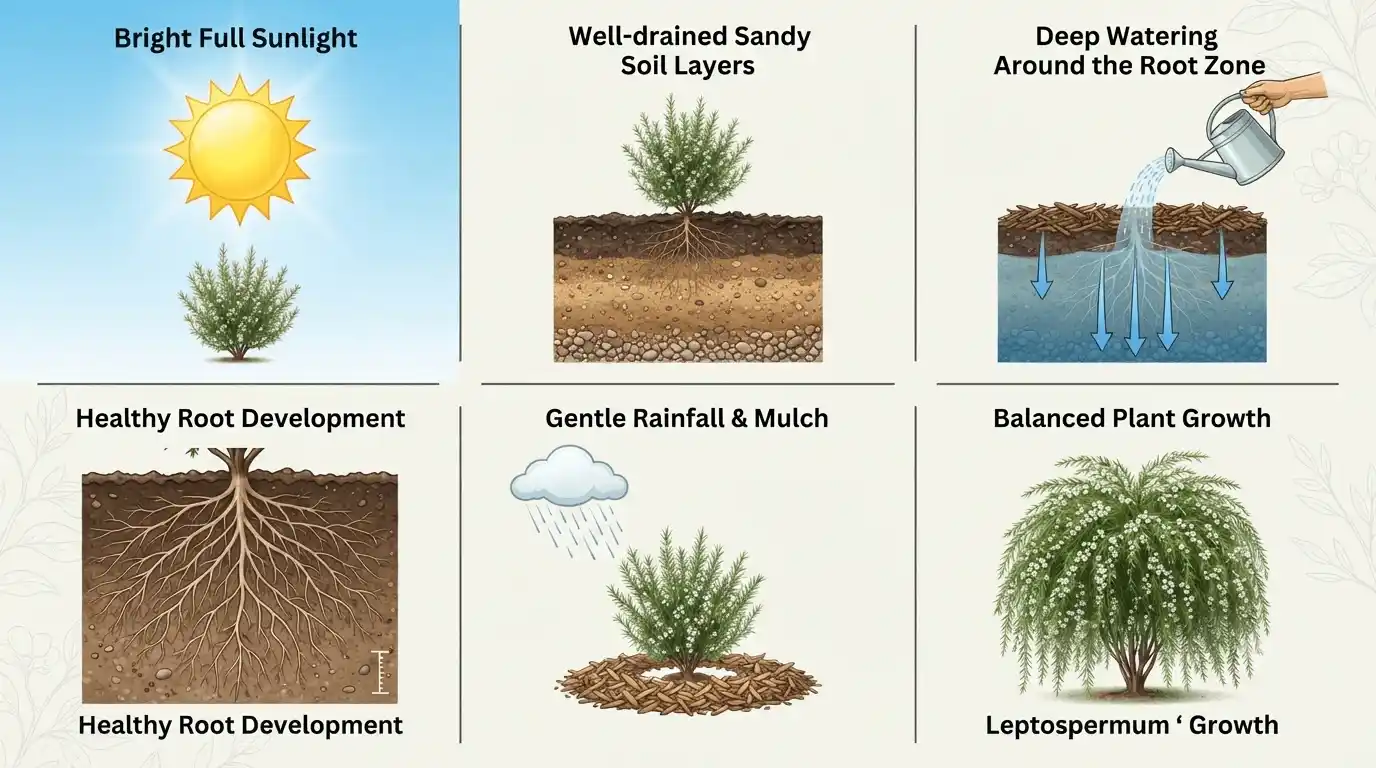
Sunlight Requirements
Leptospermum Vertical Drop performs best in full sun, where it develops dense foliage, stronger branches, and abundant flowering.
For optimum performance, provide:
| Sun Exposure | Performance |
| Full sun (6–8+ hours) | Excellent flowering and compact growth |
| Light partial shade | Healthy growth with fewer flowers |
| Heavy shade | Sparse growth and reduced blooming |
Plants grown in full sun typically produce:
- More flower buds
- Better branching
- Richer foliage color
- Stronger disease resistance
Partial shade is tolerated, particularly in hotter inland climates where afternoon protection can reduce heat stress. However, too much shade often causes stems to stretch, reducing the dense cascading appearance that makes this cultivar attractive.
Greenery Inside recommends planting the shrub where it receives morning and midday sunlight for the best balance between vigorous growth and flowering.
Watering Needs
Proper watering is most important during the establishment phase.
Newly Planted Shrubs
During the first growing season:
- Water deeply once or twice each week.
- Allow the upper soil layer to dry slightly between watering.
- Avoid constantly wet soil.
Deep watering encourages roots to grow downward instead of remaining close to the surface.
Established Plants
Once fully established, Leptospermum Vertical Drop becomes relatively drought tolerant.
Under normal conditions:
- Water every two to three weeks during prolonged dry weather.
- Increase watering during extreme heatwaves.
- Reduce irrigation during cool or rainy periods.
Overwatering remains one of the most common causes of poor performance.
In our experience, fewer deep waterings produce healthier plants than frequent shallow irrigation, particularly in free-draining Australian-style native gardens.
Soil Preferences
Healthy root development depends on excellent drainage.
The ideal soil should be:
- Sandy
- Sandy loam
- Loamy
- Gravelly
- Slightly acidic to neutral
Preferred Soil Conditions
| Factor | Preferred Range |
| Drainage | Excellent |
| Texture | Sandy or loamy |
| pH | Approximately 5.5–7.0 |
| Organic matter | Moderate |
Heavy clay soils often retain excessive moisture around the roots.
If planting in clay:
- Improve drainage with coarse organic matter.
- Create raised planting beds.
- Avoid low-lying waterlogged areas.
Good drainage remains more important than achieving perfect soil fertility.
Fertilizing
Australian native plants generally require modest fertilization.
For Leptospermum Vertical Drop:
- Apply a low-phosphorus native plant fertilizer.
- Feed once in early spring.
- A second light application may be made in early autumn if growth is weak.
Avoid:
- High-phosphorus fertilizers
- Excess nitrogen
- Frequent heavy feeding
Too much fertilizer often results in:
- Excess leafy growth
- Reduced flowering
- Weak stems
- Increased pest susceptibility
Greenery Inside recommends following the manufacturer’s application rate rather than assuming more fertilizer will produce faster growth.
Pruning Leptospermum
Proper pruning leptospermum helps maintain its graceful cascading habit while encouraging healthy new growth.
Best Time to Prune
The ideal pruning period is immediately after flowering.
This allows:
- New shoots to mature before the next flowering season.
- The natural weeping structure to remain intact.
- Better flower production the following year.
Routine Maintenance
Light annual pruning should include:
- Removing dead wood
- Trimming damaged branches
- Shaping uneven growth
- Improving airflow through the canopy
Avoid removing large amounts of healthy wood in one session.
Rejuvenation Pruning
Older shrubs that become sparse can often benefit from selective rejuvenation pruning.
Rather than cutting the plant back severely:
- Reduce older stems gradually over two or three seasons.
- Encourage fresh shoots from lower branches.
- Retain the cascading framework whenever possible.
Heavy pruning into old bare wood may delay recovery and reduce flowering for one or more seasons.
As of current horticultural recommendations in 2026, light, regular maintenance pruning remains the preferred approach for most ornamental tea tree cultivars, preserving both plant health and their distinctive cascading form.
Flowering Characteristics
Flower Appearance
The flowers of Leptospermum Vertical Drop are among its most attractive ornamental features. During the blooming season, the cascading branches become covered with numerous small blossoms that contrast beautifully against the fine evergreen foliage.
Typical flower characteristics include:
| Characteristic | Description |
| Flower Size | Approximately 1–2 cm across |
| Shape | Five-petaled, open flowers |
| Color | Usually white to soft pink, depending on the cultivar |
| Bloom Season | Primarily spring to early summer |
| Nectar Production | High |
Each tea tree flower produces abundant nectar that attracts a wide range of pollinating insects.
Because members of the Leptospermum genus are sometimes associated with jellybush species used in premium honey production, many gardeners appreciate their value as nectar plants, even though ornamental cultivars are generally selected for landscape performance rather than commercial honey production.
Flowering intensity varies according to:
- Sunlight exposure
- Plant maturity
- Seasonal rainfall
- Pruning practices
- Overall plant health
Healthy plants grown in full sun usually deliver the heaviest floral display.
Benefits for Pollinators
Leptospermum Vertical Drop contributes significantly to garden biodiversity by providing nectar and shelter for numerous beneficial species.
Its flowers commonly attract:
- Native bees
- European honeybees
- Hoverflies
- Butterflies
- Small native pollinating insects
- Nectar-feeding birds such as honeyeaters
Ecological Benefits
Growing this Australian native shrub can help:
- Support local pollinator populations.
- Increase biodiversity.
- Improve pollination of nearby flowering plants.
- Provide seasonal food sources for beneficial insects.
- Create habitat within wildlife-friendly gardens.
At Greenery Inside, we’ve observed that flowering tea trees often become some of the busiest plants in the garden during spring, with bees and native insects visiting continuously throughout the day. Pairing Vertical Drop with other Australian flowering natives can extend nectar availability across multiple seasons, creating a more resilient and pollinator-friendly landscape.
Comparing Leptospermum Vertical Drop with Similar Leptospermum Varieties
Choosing the right Leptospermum variety depends on your available space, desired growth habit, flower color, and landscape goals. While Leptospermum Vertical Drop is prized for its cascading form, other cultivars offer compact, upright, or spreading habits suited to different garden designs. Leptospermum Seclusion is often selected for dense screening and structured hedging, making it a more formal alternative compared to the flowing habit of Vertical Drop.
The comparison below highlights the most common alternatives.
| Variety | Growth Habit | Flower Color | Best Use |
| Leptospermum Vertical Drop | Cascading, weeping | White to soft pink | Retaining walls, slopes, feature planting |
| Leptospermum scoparium | Upright shrub | White, pink, red | Hedges, screens, specimen shrubs |
| Leptospermum Pink Cascade | Low, spreading and weeping | Bright pink | Rockeries, banks, containers |
| Leptospermum Seclusion | Dense, compact shrub | White | Privacy planting, informal hedges |
| Leptospermum Little Bun | Rounded dwarf shrub | White | Borders, small gardens, pots |
| Leptospermum Cardwell | Low spreading shrub | White | Coastal gardens, embankments |
Leptospermum Vertical Drop
Vertical Drop is distinguished by its elegant pendulous branches that create a graceful waterfall effect. It works particularly well where the foliage can spill over walls, raised beds, or sloping ground.
Leptospermum scoparium
Leptospermum scoparium, commonly known as the New Zealand tea tree or mānuka, grows more upright than Vertical Drop. It is widely cultivated for ornamental flowers and, in some regions, for nectar production associated with mānuka honey.
Leptospermum Pink Cascade
Leptospermum Pink Cascade, also marketed as Pink Cascade leptospermum, develops a lower, broader habit with masses of vivid pink flowers. It is an excellent choice where stronger floral color is preferred.
Leptospermum Seclusion
Leptospermum Seclusion forms a denser, more upright shrub than Vertical Drop. Gardeners commonly use it as an informal screen or low privacy hedge because of its compact branching.
Leptospermum Little Bun
For small gardens, Leptospermum Little Bun offers a naturally rounded dwarf form that requires minimal shaping. It is particularly suitable for container gardening and narrow borders.
Leptospermum Cardwell
Leptospermum Cardwell is another spreading Australian native valued for coastal landscapes and erosion control. While it also has a relaxed growth habit, it lacks the dramatic cascading effect that defines Vertical Drop.
At Greenery Inside, we often recommend selecting the variety based on the landscape’s function rather than flower color alone. Matching the plant’s mature form to the available space usually produces a more successful long-term design.
Common Problems and How to Fix Them
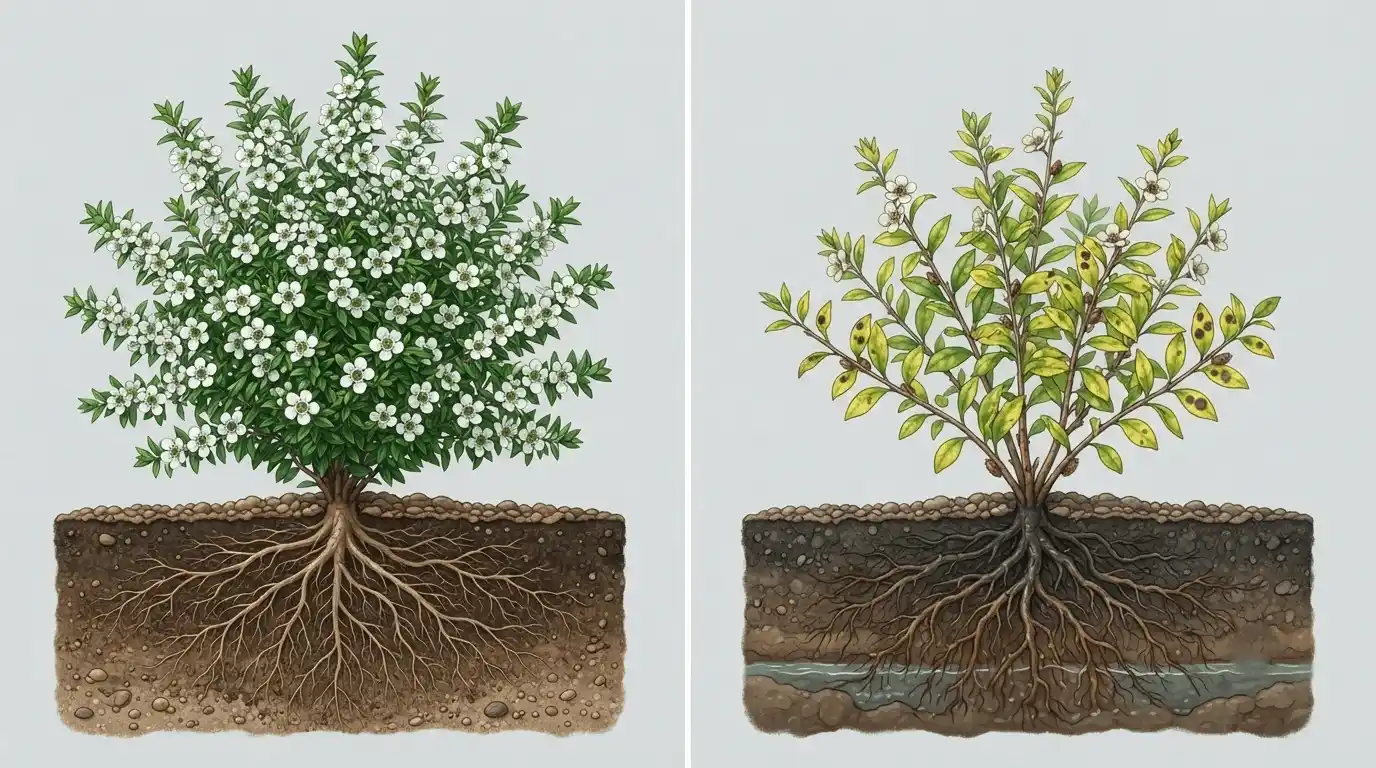
Although Leptospermum Vertical Drop is considered a hardy Australian native shrub, unsuitable growing conditions can reduce flowering, weaken growth, or increase susceptibility to pests and diseases.
Fortunately, most issues are preventable with proper planting and maintenance.
Poor Flowering
Poor flowering is usually caused by insufficient sunlight, excessive fertilization, or plant immaturity.
Healthy shrubs generally produce abundant blooms once established, but flowering may decline when environmental conditions are unfavorable.
Common Causes
- Too much shade
- Excess nitrogen fertilizer
- Heavy annual pruning
- Newly planted shrubs
- Prolonged drought stress
Solutions
- Plant in full sun whenever possible.
- Use a low-phosphorus native plant fertilizer.
- Avoid excessive nitrogen applications.
- Prune only after flowering.
- Allow young plants time to mature before expecting heavy blooms.
Most shrubs begin producing their best floral displays after developing a well-established root system.
Root Problems
Healthy roots are essential for vigorous foliage and long-term survival.
The most common root issue is waterlogging.
Signs of Root Stress
- Yellowing foliage
- Wilting despite moist soil
- Slow growth
- Leaf drop
- Branch dieback
Poor drainage reduces oxygen around the roots, encouraging root rot organisms that damage the plant’s ability to absorb water and nutrients.
Prevention
- Plant in free-draining soil.
- Improve heavy clay with coarse organic matter.
- Avoid planting in low-lying areas.
- Water deeply but infrequently.
- Allow soil to partially dry between irrigations.
If root rot develops, improving drainage is usually more effective than increasing fertilizer or watering.
Pest and Disease Issues
Leptospermum Vertical Drop experiences relatively few serious pest problems compared with many ornamental shrubs, but occasional infestations can occur.
Common Pests
- Scale insects
- Psyllids
- Myrtle-feeding insects
- Aphids on young growth
Scale insects are among the most frequently observed pests. They feed by extracting plant sap, which may weaken branches over time and encourage sooty mold development.
Common Diseases
Potential diseases include:
- Root rot
- Leaf spot fungi
- Twig dieback
- Fungal infections associated with prolonged humidity
Most fungal diseases develop when moisture remains on foliage for extended periods or when air circulation is poor.
Prevention
Good cultural practices remain the most effective defense.
Recommended measures include:
- Plant in sunny locations.
- Maintain good airflow.
- Avoid overwatering.
- Remove dead branches promptly.
- Sterilize pruning tools between plants.
- Inspect foliage regularly.
Treatment
If problems develop:
- Prune infected growth.
- Dispose of diseased material away from the garden.
- Use horticultural oils for scale insects where appropriate.
- Apply suitable fungicides only when necessary and according to product directions.
Long-term plant health depends more on proper growing conditions than on routine chemical treatments.
In our experience, shrubs planted in full sun with excellent drainage rarely develop persistent pest or disease problems.
Beginner Mistakes to Avoid
Many issues encountered with Leptospermum Vertical Drop result from simple planting or maintenance mistakes rather than difficult growing conditions.
Avoid these common errors:
- Overwatering established plants
- Planting in poorly drained clay without improving drainage
- Choosing heavily shaded locations
- Applying excessive fertilizer
- Using fertilizers high in phosphorus
- Pruning heavily before flowering
- Removing too much mature wood at one time
- Planting shrubs too closely together
- Ignoring mature spread when designing garden beds
- Watering lightly every day instead of deeply and less frequently
Greenery Inside recommends planning for the plant’s mature width before planting. Allowing adequate space helps preserve its graceful cascading habit while improving air circulation and reducing future maintenance.
Environmental Conditions That Affect Growth
Leptospermum Vertical Drop performs best when environmental conditions resemble those of its Australian native habitat.
Understanding these factors helps gardeners achieve healthier growth and more reliable flowering.
Frost Tolerance
Once established, the shrub tolerates light to moderate frosts, although young plants may require temporary protection during unusually cold weather.
Heavy or prolonged freezing conditions can damage tender new growth.
Heat Tolerance
This cultivar performs exceptionally well in warm climates.
Its fine foliage and Australian heritage enable it to tolerate extended periods of summer heat provided roots receive occasional deep watering during prolonged dry spells.
Wind Exposure
Moderate wind is generally well tolerated.
The flexible, pendulous branches are less likely to suffer structural damage than rigid upright shrubs.
However, extremely exposed sites with constant strong winds may reduce flowering and increase moisture loss.
Coastal Gardens
Leptospermum Vertical Drop adapts well to many coastal environments.
It tolerates:
- Salt-laden air
- Sandy soils
- Bright sunlight
- Strong coastal breezes
This makes it a reliable choice for seaside landscapes where many ornamental shrubs struggle.
Humidity
Moderate humidity is usually not a problem.
In regions with persistently humid conditions:
- Maintain good plant spacing.
- Improve air circulation.
- Avoid overhead watering late in the day.
These practices help minimize fungal diseases.
Extended Drought
Established plants possess good drought tolerance.
During unusually long dry periods:
- Water deeply every few weeks.
- Apply organic mulch around the root zone.
- Avoid allowing newly planted shrubs to dry excessively.
As of 2026, many Australian horticultural experts continue recommending drought-tolerant native species like Leptospermum Vertical Drop for water-wise landscaping, particularly in regions experiencing hotter summers and more variable rainfall patterns.
Frequently Confused Leptospermum Species
Many Leptospermum species share similar foliage, flowers, and growth habits, making them easy to confuse. Understanding the differences helps gardeners choose the right plant for their landscape and provide appropriate care.
Leptospermum Polygalifolium vs Leptospermum Scoparium
Leptospermum polygalifolium and Leptospermum scoparium are closely related tea trees, but they differ in appearance, growth habit, and common landscape uses.
| Feature | Leptospermum polygalifolium | Leptospermum scoparium |
| Native Range | Eastern Australia | Australia and New Zealand |
| Growth Habit | Upright to slightly spreading shrub or small tree | Dense upright shrub |
| Leaves | Narrow, elongated green leaves | Smaller, stiffer leaves |
| Flowers | Usually white, occasionally pale pink | White, pink, red, or double-flowered cultivars |
| Mature Size | Generally larger | Wide range depending on cultivar |
| Landscape Use | Native gardens, habitat planting, screening | Hedges, ornamental gardens, feature shrubs |
Because Leptospermum Vertical Drop is closely related to Leptospermum polygalifolium, it shares many of its hardy characteristics while offering a much more pronounced cascading growth habit.
By comparison, Leptospermum scoparium is better known for its extensive range of ornamental cultivars and its association with mānuka honey production.
Other Similar Cultivars
Several cultivated tea trees resemble Vertical Drop but differ in size, flowering, or overall growth habit.
Leptospermum polygalifolium ‘Copper Glow’
Leptospermum polygalifolium ‘Copper Glow’ is recognized for its attractive bronze to copper-colored new growth, which gradually matures to green. It offers year-round foliage interest and is commonly used as an ornamental feature shrub.
Leptospermum polygalifolium Cardwell
Often referred to as Leptospermum polygalifolium Cardwell, this selection has a lower, spreading habit that performs well in coastal gardens, embankments, and erosion-control plantings. Its broader form makes it less pendulous than Vertical Drop.
Leptospermum flavescens
Leptospermum flavescens is another Australian native tea tree that typically develops into a larger shrub or small tree. It is appreciated for its adaptability and naturally occurring populations in tropical and subtropical regions.
Leptospermum flavescens Cardwell
Leptospermum flavescens Cardwell combines the adaptability of the species with a more compact landscape form suitable for ornamental planting in warmer climates.
Pink Cascade
Although Pink Cascade also has a graceful spreading habit, it is primarily chosen for its vibrant pink flowers rather than the refined cascading structure that distinguishes Vertical Drop.
When selecting among these cultivars, consider:
- Mature height and width
- Growth habit
- Flower color
- Climate suitability
- Available planting space
- Intended landscape purpose
At Greenery Inside, we encourage gardeners to focus on the plant’s mature growth habit rather than selecting solely based on flower color. Choosing the right structure for the available space leads to a healthier, lower-maintenance landscape.
Buying and Selecting Healthy Plants
Purchasing a healthy Leptospermum Vertical Drop gives the plant the best possible start and reduces the likelihood of future problems.
If you’re searching for Leptospermum Vertical Drop for sale, choose reputable native plant nurseries or garden centers that specialize in Australian plants. These suppliers are more likely to provide correctly identified cultivars and healthy nursery stock.
What to Look For
Choose plants with:
- Bright green, healthy foliage
- Even branching throughout the canopy
- No signs of yellowing or leaf drop
- Strong central structure
- Healthy new growth
- No visible insect infestations
- No disease symptoms
Avoid plants showing:
- Brown or black stems
- Wilted foliage
- Root-bound containers
- Mushy or unpleasant-smelling roots
- Extensive pruning damage
Checking the Root System
If possible, gently slide the plant from its container.
Healthy roots should be:
- White to light tan
- Firm
- Evenly distributed
- Moist but not waterlogged
Avoid plants with tightly circling roots, as severe root binding can slow establishment after planting.
Choosing the Right Container Size
Larger plants provide an instant landscape impact but generally require more careful watering during establishment.
Smaller container-grown plants often establish more quickly because their roots adapt to surrounding soil with less transplant stress.
For most home gardens:
- 140–200 mm pots are suitable for general planting.
- Larger specimens work well as immediate feature plants.
- Tube stock is economical for mass planting and slope stabilization.
Best Time to Plant
The ideal planting season depends on local climate.
Generally:
| Season | Suitability |
| Autumn | Excellent |
| Early Spring | Excellent |
| Mild Winter | Suitable in frost-free areas |
| Mid-Summer | Possible with careful watering |
Planting during cooler months allows roots to establish before periods of extreme summer heat.
Greenery Inside recommends applying organic mulch after planting to conserve soil moisture while keeping mulch clear of the stem to reduce the risk of rot.
Conclusion
Leptospermum Vertical Drop is an outstanding Australian native shrub that combines graceful cascading growth, evergreen foliage, and attractive seasonal flowers into one highly versatile landscape plant. Closely related to Leptospermum polygalifolium, it performs exceptionally well as a feature specimen, retaining wall planting, slope stabilizer, and informal ground cover in gardens with well-drained soil and ample sunlight.
Its relatively low maintenance requirements, drought tolerance once established, and value for bees, birds, and other pollinators make it an excellent choice for sustainable landscaping. Routine deep watering during establishment, light annual pruning after flowering, and the use of low-phosphorus fertilizers will help maintain its natural weeping form and long-term health.
Whether you’re designing a contemporary native garden or enhancing a wildlife-friendly landscape, Leptospermum Vertical Drop offers year-round beauty with minimal upkeep. With the right planting location and ongoing care, it can remain a striking and reliable feature for many years.
Frequently Asked Questions
Is Leptospermum Vertical Drop a fast-growing plant?
No. Leptospermum Vertical Drop has a moderate growth rate. It usually establishes within one to two growing seasons before developing its characteristic cascading framework. Growth is fastest in full sun with well-drained soil and consistent watering during establishment.
How tall does Leptospermum Vertical Drop grow?
Most mature plants reach approximately 1.5–2.5 meters (5–8 feet) in height with a spread of 2–3 meters (6.5–10 feet). Its arching branches often make it appear wider than it is tall.
Can Leptospermum Vertical Drop be used as a ground cover?
Yes. Although it is not a true creeping ground cover, its cascading branches spread naturally across the soil, making it suitable for embankments, retaining walls, slopes, and large landscape beds where an informal ground-covering effect is desired.
Does Leptospermum Vertical Drop attract bees and pollinators?
Yes. Its nectar-rich flowers attract honeybees, native bees, butterflies, hoverflies, and nectar-feeding birds. Planting it alongside other flowering Australian natives can help support pollinators throughout multiple seasons.
When should Leptospermum Vertical Drop be pruned?
The best time to prune is immediately after flowering. Light pruning maintains the shrub’s graceful cascading shape, encourages fresh growth, and supports better flowering in the following season. Avoid heavy pruning into old wood whenever possible.
Is Leptospermum Vertical Drop drought tolerant?
Yes. Once established, Leptospermum Vertical Drop is considered drought tolerant. It performs well with occasional deep watering during prolonged dry periods, but it should not be grown in constantly waterlogged soil.
What is the difference between Leptospermum Vertical Drop and Pink Cascade?
Both cultivars have spreading habits, but Leptospermum Vertical Drop is best known for its elegant weeping branches and typically white to soft pink flowers. Pink Cascade generally has a lower, broader habit and produces brighter pink blooms, making it a stronger choice where vibrant flower color is the primary design goal.