Introduction
Stenanthemum scortechinii is a distinctive native Australian shrub admired for its delicate clusters of white flowers, compact growth habit, and value in supporting local wildlife. This resilient species naturally occurs in parts of eastern Australia, where it thrives in well-drained soils and sunny environments. Gardeners increasingly include it in native landscapes because it combines ornamental appeal with relatively low maintenance requirements. Stenanthemum scortechinii also fits well within broader Australian native garden trees landscapesand is commonly grouped with species found in native trees of Australia ecosystemsas well as plants used in Australian native screening trees for natural privacy planting.
If you are researching this plant, you may also encounter the scientific name Spyridium scortechinii. Botanical research has resulted in its reclassification into the genus Stenanthemum, although many gardening references, nursery labels, and older publications still use the previous name. Understanding both names makes it easier to identify reliable information and locate the plant through native nurseries.
Among native Australian white flowering shrubs Australia, Stenanthemum scortechinii stands out for its attractive floral display, adaptability, and ecological importance. Whether used in habitat restoration, wildlife gardens, or informal native landscapes, it provides seasonal beauty while supporting pollinating insects and other beneficial wildlife.
Quick Summary
- Stenanthemum scortechinii is a native Australian shrub known for its compact growth and clusters of small white flowers.
- It was previously classified as Spyridium scortechinii, so both botanical names remain common in gardening resources.
- The plant performs best in well-drained soil, full sun to partial shade, and requires little maintenance after establishment.
- It is widely valued for native gardens, habitat planting, and naturalistic landscaping because it supports biodiversity.
- With proper growing conditions, it develops into an attractive, resilient shrub suitable for many Australian climates.
What Is Stenanthemum scortechinii?
Botanical classification and scientific names
Stenanthemum scortechinii is a flowering shrub belonging to the Rhamnaceae family, commonly known as the buckthorn family. Members of this family are distributed across many regions of the world and include numerous Australian native shrubs adapted to nutrient-poor soils and seasonal rainfall patterns.
Its botanical classification is:
| Classification | Details |
| Kingdom | Plantae |
| Clade | Angiosperms |
| Order | Rosales |
| Family | Rhamnaceae |
| Genus | Stenanthemum |
| Species | Stenanthemum scortechinii |
For many years, this species was scientifically recognised as Spyridium scortechinii. Advances in botanical research, including detailed studies of plant morphology and taxonomic relationships, resulted in its transfer to the genus Stenanthemum. As a result, the accepted scientific name is now Stenanthemum scortechinii, although the former name continues to appear in:
- Older botanical publications
- Native plant databases
- Gardening books
- Nursery catalogues
- Regional plant identification guides
Because botanical name changes often take years to become universally adopted, both names remain useful when researching the species.
Greenery Inside recommends checking both scientific names when searching nursery inventories or botanical references, as availability and information may still be listed under either classification.
Natural habitat and distribution
Stenanthemum scortechinii is indigenous to eastern Australia, occurring naturally in regions of Queensland and New South Wales. It typically grows in open forests, woodland margins, dry sclerophyll forests, and heathland communities where soils remain free-draining throughout much of the year.
Its natural environment has shaped several important adaptations, including:
- Tolerance of extended dry periods
- Efficient growth in nutrient-poor native soils
- Adaptation to high sunlight exposure
- Ability to establish in rocky or sandy locations
- Seasonal flowering that supports native pollinators
Like many Australian native shrubs, it has evolved under conditions that include variable rainfall, periodic drought, and naturally low soil fertility. These characteristics make it well suited to sustainable landscaping with minimal irrigation once established.
In our experience growing Australian natives, species adapted to local environmental conditions generally require fewer inputs than exotic ornamental shrubs. Stenanthemum scortechinii follows this pattern, making it an excellent choice for gardeners seeking resilient, low-maintenance plants.
As of recent native gardening recommendations (2026), many landscape designers continue to favour indigenous shrubs such as Stenanthemum scortechinii because they contribute to biodiversity while reducing long-term water use in residential gardens.
How to Identify Stenanthemum scortechinii
Leaves, flowers, and overall appearance
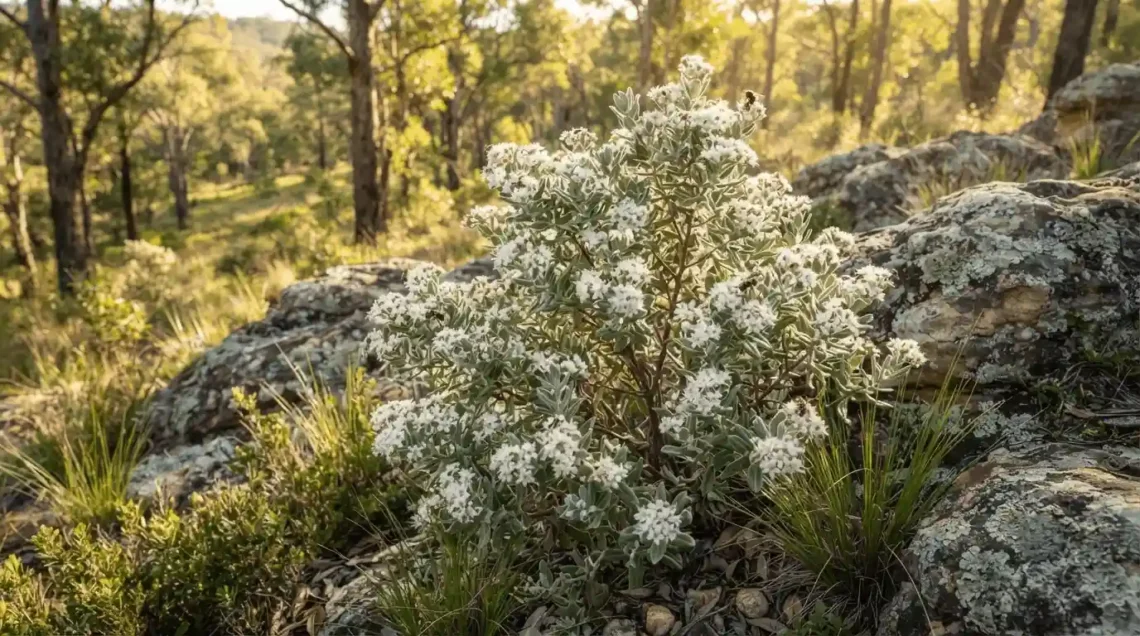
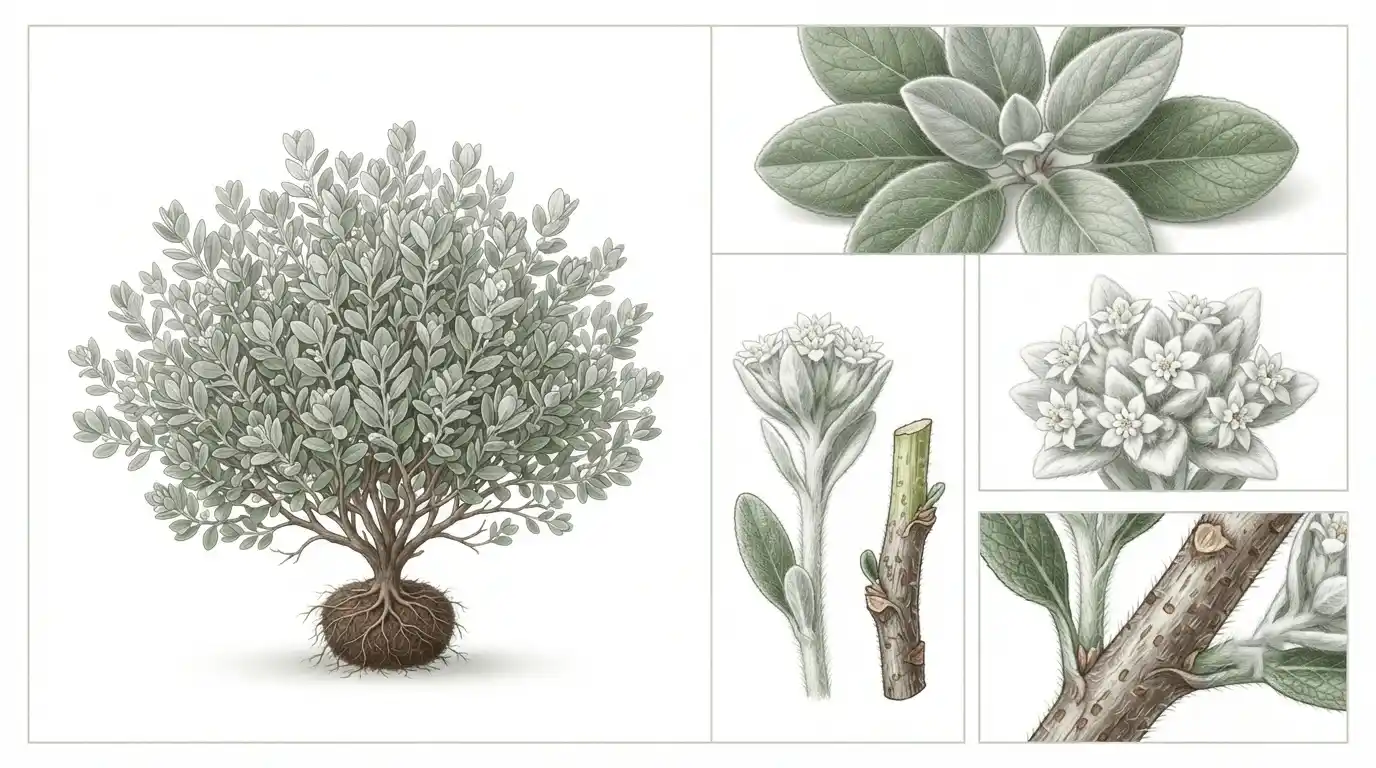
The easiest way to identify Stenanthemum scortechinii is by examining its foliage, branching habit, and distinctive clusters of small white blossoms.
The shrub generally develops a naturally rounded to slightly spreading form with numerous fine branches. Depending on growing conditions, it may appear compact in exposed locations or become fuller where moisture and soil conditions are favourable.
Its leaves are typically:
- Small to medium-sized
- Oval to broadly elliptic
- Covered with fine hairs, especially on the undersides
- Soft-textured compared with many native shrubs
- Grey-green to dark green depending on age and growing conditions
The plant’s flowers are among its most distinctive features. Rather than producing large individual blooms, it develops compact clusters of numerous tiny white flowers surrounded by hairy floral bracts. These clusters create a soft, star-like appearance when viewed from a distance and often contrast beautifully against the darker foliage.
Flowering usually occurs during the warmer months, although timing may vary slightly depending on local climate and seasonal rainfall.
The flowers attract various beneficial insects, including native bees and other pollinating species, increasing the ecological value of the shrub within wildlife-friendly gardens.
Why it is sometimes called Cotton Bush or White Star Bush
Several descriptive common names have become associated with Stenanthemum scortechinii, particularly Cotton Bush and White Star Bush.
Cotton Bush
The name Cotton Bush refers to the plant’s soft, hairy flower clusters and woolly floral bracts. These fuzzy structures resemble small tufts of cotton, especially before the flowers fully open.
The fine hairs also provide protection for developing flowers and contribute to the plant’s distinctive texture.
White Star Bush
The common name White Star Bush originates from the appearance of its flowering clusters. Numerous small blossoms combine to produce a star-like display that becomes especially noticeable during peak flowering.
Although these names are widely used, they may also refer to different Australian species in some regions. For accurate identification, the botanical name remains the most reliable reference.
Identification Summary
| Feature | Description |
| Botanical name | Stenanthemum scortechinii |
| Former scientific name | Spyridium scortechinii |
| Common names | Cotton Bush, White Star Bush |
| Flower colour | White |
| Leaf characteristics | Small, oval, softly hairy, grey-green to green |
| Native habitat | Open woodland, dry forests, heathland, well-drained Australian landscapes |
Stenanthemum scortechinii Size and Growth Habit
Typical height and width
Stenanthemum scortechinii is generally considered a small to medium-sized native shrub. Mature plants typically reach between 1 and 3 metres (3–10 feet) in height, although local environmental conditions significantly influence their ultimate dimensions.
The shrub commonly develops a similar spread, creating a naturally balanced and rounded appearance suitable for both informal and structured native gardens.
Typical mature dimensions include:
| Growth Characteristic | Typical Size |
| Mature height | 1–3 metres |
| Mature width | 1–3 metres |
| Growth form | Rounded to spreading |
| Foliage density | Moderately dense |
The exact Stenanthemum scortechinii size depends on several environmental factors, including soil quality, rainfall, sunlight exposure, and maintenance practices.
Unlike many ornamental shrubs that require constant shaping, this species usually maintains an attractive natural form with only occasional pruning.
Because it is primarily grown outdoors, there is little information regarding long-term container cultivation. Plants grown in containers generally remain considerably smaller due to restricted root development.
Growth rate and long-term development
Stenanthemum scortechinii has a moderate growth rate under favourable conditions. Young plants focus first on establishing a healthy root system before producing more vigorous top growth during subsequent growing seasons.
Most shrubs become well established within two to three years when provided with:
- Appropriate drainage
- Adequate sunlight
- Moderate watering during establishment
- Minimal root disturbance
Once mature, growth gradually slows as the shrub directs more energy toward seasonal flowering and maintaining healthy foliage.
With suitable conditions and routine maintenance, individual plants can remain productive and attractive for many years.
Greenery Inside recommends avoiding excessive fertiliser during the establishment phase. Native Australian shrubs often perform better with slower, balanced growth than with rapid soft growth encouraged by high-phosphorus fertilisers.
Factors affecting plant size
Several environmental and cultural factors determine how large Stenanthemum scortechinii ultimately becomes.
Soil quality
Although adaptable, the shrub performs best in well-drained soils with moderate organic matter. Heavy clay soils that remain saturated can restrict root development and reduce overall growth.
Sunlight
Plants grown in full sun generally produce denser branching, heavier flowering, and a more compact habit. Partial shade is tolerated but may result in slightly taller, more open growth.
Rainfall
Natural rainfall patterns strongly influence annual growth. Extended drought can temporarily reduce new growth, while consistent seasonal moisture encourages healthy development without excessive softness.
Pruning practices
Light post-flowering pruning helps maintain a compact structure and encourages branching. Excessive pruning into old wood may slow recovery and reduce flowering during the following season.
In our experience, maintaining natural shape through gentle annual trimming produces healthier plants than frequent heavy pruning. This approach improves airflow while preserving the shrub’s characteristic form and seasonal floral display.
How to Grow and Care for Stenanthemum scortechinii
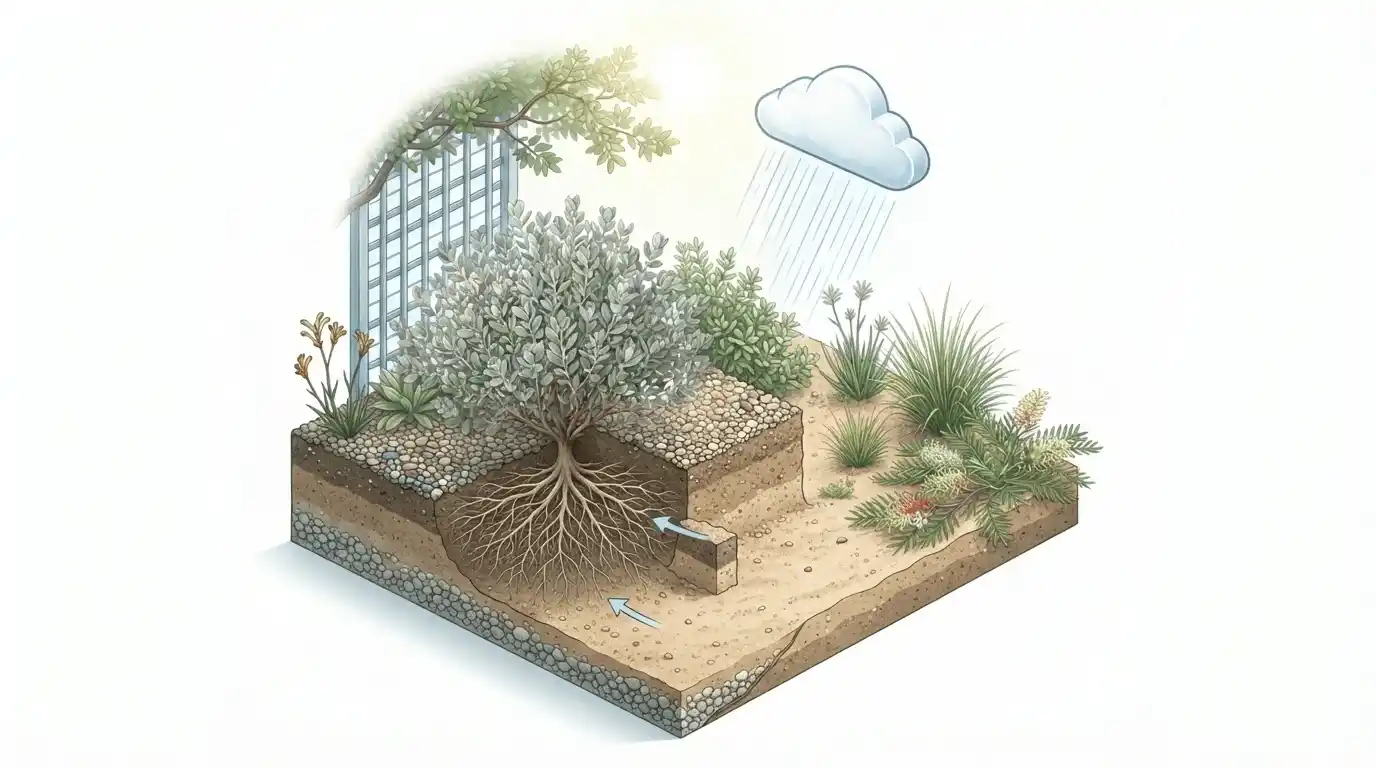
Growing Stenanthemum scortechinii successfully begins with recreating the conditions of its natural Australian habitat. This shrub thrives with plenty of sunlight, free-draining soil, moderate watering during establishment, and minimal fertiliser. Once established, it is considered a low-maintenance native plant that performs well in sustainable gardens.
Ideal light conditions
Stenanthemum scortechinii grows best in full sun, where it develops a dense branching structure and produces the greatest abundance of white flowers. It also tolerates partial shade, particularly in regions with intense summer heat, but flowering may be less prolific.
Full sun vs partial shade
| Light Condition | Plant Response |
| Full sun (6–8+ hours daily) | Best flowering, compact growth, dense foliage |
| Partial shade (3–6 hours daily) | Healthy growth with slightly fewer flowers |
| Heavy shade | Leggy growth, reduced flowering, weaker branching |
Plants receiving sufficient sunlight generally produce stronger stems and more evenly distributed flower clusters.
As of the 2026 growing season, many Australian native plant specialists continue to recommend planting Stenanthemum scortechinii in open positions with good air circulation to maximise flowering and reduce moisture-related diseases.
Soil preferences
Like many members of the Rhamnaceae family, Stenanthemum scortechinii prefers soils that drain freely and do not remain waterlogged after rainfall.
Ideal soil characteristics include:
- Sandy soils
- Sandy loams
- Gravelly native soils
- Well-structured loams
- Slightly acidic to neutral pH
The shrub naturally grows in nutrient-poor Australian landscapes and therefore does not require highly fertile garden beds.
Avoid planting in:
- Heavy clay with poor drainage
- Permanently wet sites
- Compacted soils
- Areas prone to standing water
If drainage is poor, improve the planting area by incorporating coarse sand, gravel, or organic matter and planting on a slightly raised mound.
Greenery Inside recommends checking drainage before planting by filling the planting hole with water. If water remains after several hours, choose another location or improve the soil before planting.
Watering requirements
Although mature Stenanthemum scortechinii is relatively drought tolerant, young plants require consistent moisture while establishing their root systems.
During establishment
Water deeply:
- Once or twice each week during dry weather
- More frequently during extended heat if soils dry rapidly
- Less often during periods of regular rainfall
Deep watering encourages roots to grow downward rather than remaining near the soil surface.
After establishment
Established shrubs generally require little supplemental irrigation except during prolonged drought.
Signs that watering may be needed include:
- Persistent leaf wilting
- Reduced flowering
- Dry soil several centimetres below the surface
Avoid frequent shallow watering, which encourages weak root development.
In our experience growing Australian native shrubs, infrequent deep watering produces healthier, more resilient plants than daily light watering.
Fertilising recommendations
One advantage of Stenanthemum scortechinii is its relatively low nutritional requirement.
Many Australian native plants have evolved in naturally nutrient-deficient soils and may be sensitive to excessive phosphorus.
For best results:
- Apply fertiliser sparingly.
- Use products specifically formulated for Australian native plants.
- Feed during active spring growth if required.
- Avoid repeated heavy applications.
Generally suitable fertilisers include:
- Controlled-release native plant fertilisers
- Low-phosphorus formulations
- Light organic compost applied around—not against—the stem
Excess fertiliser can encourage excessive leafy growth while reducing flower production.
Climate suitability
Stenanthemum scortechinii is naturally adapted to a range of Australian environments, particularly temperate and subtropical regions.
This species performs well alongside low-maintenance landscape plants such as those featured in best evergreen tree and compact landscaping options like small evergreen tree varietieswhich are widely used in sustainable Australian garden designs.
Suitable growing conditions include:
- Temperate climates
- Warm coastal districts
- Inland regions with seasonal rainfall
- Dry woodland environments
Heat tolerance
Established shrubs tolerate hot Australian summers well, provided roots remain healthy and soils drain properly.
Frost tolerance
Light frosts are generally tolerated, especially by mature plants. Young plants benefit from temporary frost protection during their first winter in colder regions.
Strong air movement, occasional drought, and seasonal rainfall fluctuations rarely cause significant problems once the shrub has become established.
Pruning and Ongoing Maintenance
Routine maintenance helps Stenanthemum scortechinii remain healthy, attractive, and productive. Unlike many ornamental shrubs, it rarely requires intensive pruning.
When to prune
The best time to prune is immediately after flowering.
Post-flowering pruning provides enough time for new growth to mature before the following flowering season.
Avoid heavy pruning:
- Immediately before flowering
- During severe drought
- During periods of extreme heat
- Into old woody stems that produce little new growth
Light trimming each year is usually sufficient.
How pruning improves flowering
Correct pruning provides several long-term benefits.
Encourages bushier growth
Removing the tips of young shoots stimulates additional branching, creating a fuller shrub.
Maintains plant shape
Annual trimming prevents the shrub from becoming uneven or overly open while preserving its natural appearance.
Improves air circulation
Removing crowded interior branches increases airflow throughout the plant.
Improved air circulation helps:
- Reduce humidity around foliage
- Minimise fungal problems
- Encourage healthier new growth
Greenery Inside recommends pruning no more than one-third of the current season’s growth during routine maintenance. Gentle shaping is generally more effective than severe pruning.
Common Growing Problems and How to Solve Them
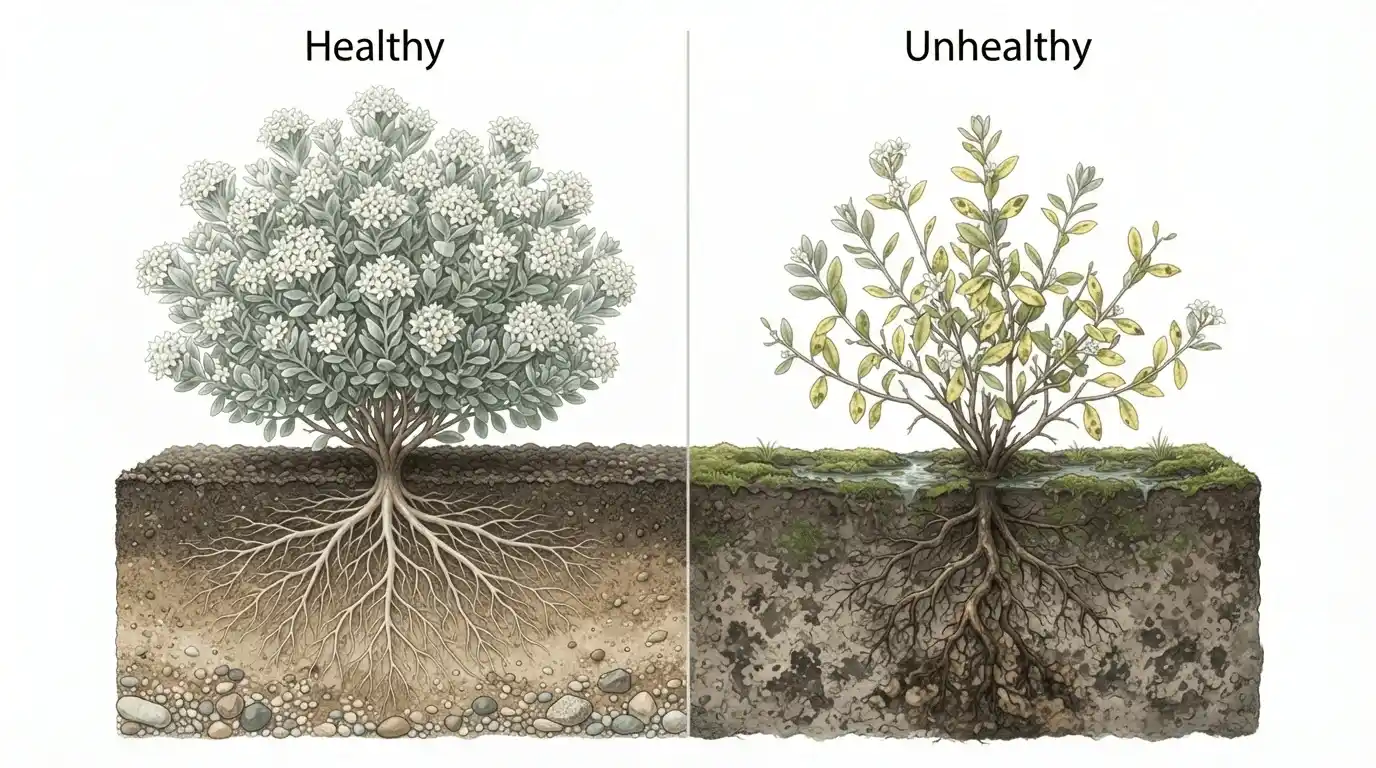
Although Stenanthemum scortechinii is considered relatively hardy, improper growing conditions may lead to reduced flowering or poor plant health.
Poor flowering
Poor flowering usually results from environmental rather than genetic factors.
Common causes include:
Insufficient sunlight
Plants grown in excessive shade often produce vigorous foliage but relatively few flowers.
Solution: Move young plants to a sunnier position or reduce surrounding shade where possible.
Excess fertiliser
High-nitrogen fertilisers encourage leafy growth instead of flower production.
Solution: Use only low-phosphorus native plant fertilisers and avoid excessive feeding.
Incorrect pruning
Pruning immediately before flowering removes developing flower buds.
Solution: Always prune shortly after flowering has finished.
Root problems from excess moisture
Poor drainage is among the most serious issues affecting this species.
Symptoms
Possible warning signs include:
- Yellowing leaves
- Soft stems
- Wilting despite moist soil
- Slow growth
- Progressive branch dieback
Prevention
The best prevention is selecting an appropriate planting site with excellent drainage.
Additional measures include:
- Raised planting beds
- Improved soil structure
- Avoiding overwatering
- Keeping mulch away from the stem base
Healthy root systems are the foundation of long-term shrub performance.
Sparse or leggy growth
Leggy growth develops when plants stretch toward available light.
Other contributing factors include:
- Overcrowding
- Heavy shade
- Lack of pruning
- Excess nitrogen fertiliser
Corrective pruning
Remove long, weak stems after flowering to stimulate new branching.
Better site selection
Where possible, relocate young shrubs to positions receiving greater sunlight and improved air circulation.
In our experience, shrubs planted with adequate spacing from neighbouring vegetation maintain a naturally compact form with less maintenance over time.
Stenanthemum scortechinii Compared with Similar Native Shrubs
Several Australian native shrubs resemble Stenanthemum scortechinii. Understanding the differences assists with identification and landscape selection.
Stenanthemum scortechinii vs Spyridium parvifolium
Although both belong to the Rhamnaceae family and share similar white flower clusters, they differ in several important characteristics.
Leaf differences
Stenanthemum scortechinii generally develops slightly larger leaves with noticeable soft hairs.
Spyridium parvifolium often has smaller foliage with a more compact appearance.
Flower appearance
Both species produce attractive white flower clusters.
However:
- Stenanthemum scortechinii often develops looser, more rounded flower heads.
- Spyridium parvifolium may display denser clusters depending on the local population.
Growth habit
Stenanthemum scortechinii usually forms a rounded shrub reaching around 1–3 metres.
Spyridium parvifolium often remains lower and more compact.
Landscape uses
Both shrubs are valuable in:
- Native gardens
- Wildlife gardens
- Bushland restoration
- Water-wise landscapes
However, Stenanthemum scortechinii is often selected where a slightly taller structural shrub is desired.
Other native Australian white flowering shrubs
Among native Australian white flowering shrubs Australia, Stenanthemum scortechinii occupies an important niche as a wildlife-supporting shrub with relatively low maintenance requirements.
Other popular white-flowering native shrubs include:
- Correa alba
- Olearia lirata
- Leptospermum polygalifolium
- Ozothamnus diosmifolius
- Spyridium parvifolium
These species are frequently combined in native landscapes to create extended flowering seasons, varied foliage textures, and increased habitat diversity.
Comparison Table
| Characteristic | Stenanthemum scortechinii | Spyridium parvifolium |
| Mature size | 1–3 m | Usually smaller and more compact |
| Flower colour | White | White |
| Leaf texture | Softly hairy, oval | Smaller, often denser foliage |
| Growth habit | Rounded, moderately spreading | Compact, bushy |
| Best use | Native gardens, habitat planting, feature shrub | Borders, smaller native gardens, habitat planting |
Proper identification remains important because growth habits and landscape suitability differ slightly between these closely related Australian native shrubs.
Landscaping Uses and Garden Design Ideas
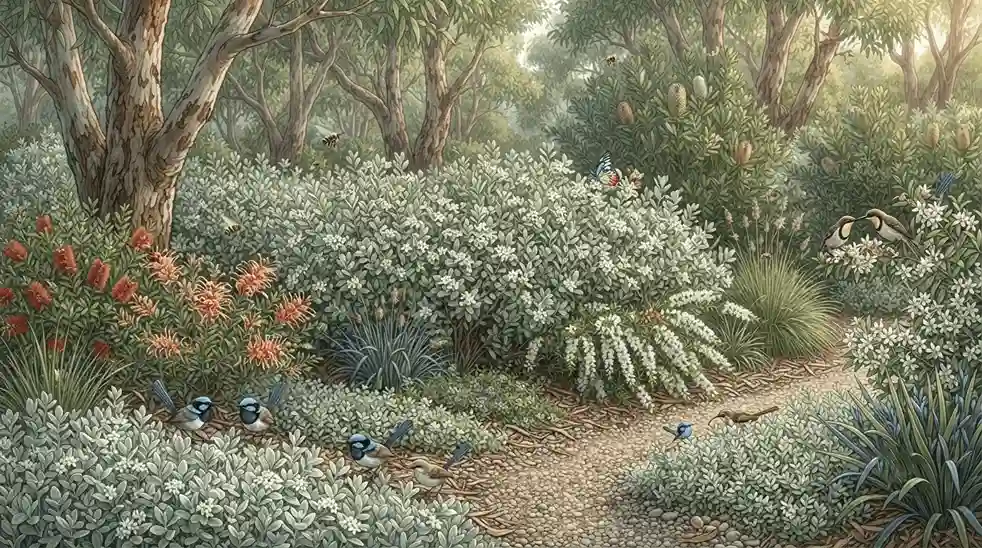
Stenanthemum scortechinii is a versatile Australian native shrub that combines ornamental beauty with ecological value. Its clusters of white flowers, naturally rounded growth habit, and adaptability make it suitable for a wide range of landscape styles. Whether used as a feature plant or incorporated into larger native plantings, it provides seasonal interest while supporting local biodiversity.
Best planting locations
Choosing the right location allows Stenanthemum scortechinii to develop its best shape and flowering performance.
Native gardens
This shrub is an excellent addition to Australian native gardens, where it blends naturally with indigenous trees, grasses, and flowering shrubs. Its soft foliage and white blooms create contrast among species with darker leaves or brighter flowers.
Wildlife gardens
Because the flowers attract native bees, butterflies, and other beneficial insects, Stenanthemum scortechinii contributes to pollinator-friendly landscapes. Dense branching can also provide shelter for small birds and insects.
Informal hedges
Although it is not traditionally grown as a formal hedge, regular light pruning allows the shrub to form an attractive informal screen or low boundary planting.
Coastal landscapes
In suitable coastal areas with well-drained soils, Stenanthemum scortechinii performs well once established. It tolerates warm conditions and occasional dry winds, although young plants benefit from protection against strong salt-laden exposure until fully established.
Greenery Inside recommends planting this species in groups of three or five for a more natural appearance. Mass plantings often create a stronger visual impact during flowering while providing greater habitat value for pollinators.
Companion plants
Pairing Stenanthemum scortechinii with other Australian natives creates year-round interest through varied foliage, flower colour, and flowering seasons.
Suitable companion plants include:
- Callistemon (Bottlebrush) for vibrant red flowers
- Grevillea species for extended nectar production
- Correa alba for complementary white flowers
- Leptospermum species for contrasting foliage textures
- Westringia fruticosa for evergreen structure
- Native grasses such as Poa labillardierei or Themeda triandra
Combining shrubs with different flowering periods ensures continuous food sources for pollinators throughout much of the year.
A layered planting design might include:
- Taller native shrubs at the rear
- Stenanthemum scortechinii as a mid-layer feature
- Native grasses and groundcovers in the foreground
This approach creates a natural woodland appearance while improving habitat diversity.
Are There Different Varieties of Stenanthemum scortechinii?
At present, there are no widely recognised horticultural cultivars or named garden varieties of Stenanthemum scortechinii. Plants available through native nurseries are generally propagated from naturally occurring wild populations.
This means gardeners can expect some natural variation in characteristics such as:
- Plant height
- Overall shape
- Leaf size
- Leaf hair density
- Flowering abundance
- Growth vigour
These differences reflect the species’ adaptation to local environmental conditions rather than distinct cultivated varieties.
Regional populations may show slight genetic variation due to differences in climate, soil type, and elevation across their natural range. However, these variations are generally subtle and do not result in formally recognised cultivars.
As interest in Australian native plants continues to grow, future horticultural selections may emerge for improved compactness, flowering performance, or landscape use. As of July 2026, however, no commercially established named selections are widely available.
When purchasing plants, it is worth asking native plant nurseries about the origin of their propagation material. Locally sourced forms may perform better in similar regional climates and contribute to the conservation of local genetic diversity.
Where Can You Find Stenanthemum scortechinii?
Availability through native plant nurseries
Stenanthemum scortechinii is primarily available through specialist Australian native plant nurseries rather than large general-purpose garden centres. Availability can vary depending on seasonal propagation schedules and regional demand.
Gardeners searching for Stenanthemum scortechinii for sale may find it listed under either:
- Stenanthemum scortechinii
- Spyridium scortechinii
Because both botanical names continue to appear in nursery catalogues, searching for both names increases the likelihood of locating available stock.
Seasonal availability often peaks during:
- Autumn planting season
- Spring planting season
These periods provide favourable conditions for successful establishment in many Australian climates.
When purchasing, choose plants that have:
- Healthy green foliage
- Well-developed root systems
- No signs of pests or disease
- Strong branching structure
- Clearly labelled botanical names
Purchasing from reputable native plant suppliers also supports responsible propagation practices and helps ensure plants are accurately identified.
For habitat restoration or conservation projects, locally propagated stock is generally preferred because it preserves regional genetic diversity and is often better adapted to local environmental conditions.
Conclusion
Stenanthemum scortechinii is an attractive, resilient Australian native shrub valued for its clusters of delicate white flowers, adaptable growth habit, and ecological importance. Formerly known as Spyridium scortechinii, it remains a popular choice for gardeners seeking a low-maintenance species that supports biodiversity while adding year-round structure to the landscape.
Growing this shrub successfully depends on providing conditions similar to its natural habitat: full sun to partial shade, well-drained soil, moderate watering during establishment, and only light fertilising with products suitable for Australian native plants. Once established, it demonstrates good drought tolerance and requires minimal ongoing care beyond occasional post-flowering pruning.
Its moderate size makes it suitable for native gardens, wildlife plantings, informal hedges, and naturalistic landscape designs. When combined with other indigenous species, it contributes to healthy ecosystems by providing food and shelter for pollinators and other beneficial wildlife.
For gardeners looking to expand their collection of native Australian white flowering shrubs Australia, Stenanthemum scortechinii offers an excellent balance of ornamental appeal, environmental resilience, and ecological value. Understanding its botanical history, identification features, and care requirements allows gardeners to enjoy a healthy, long-lived shrub that celebrates Australia’s remarkable native flora.
Frequently Asked Questions
What is Stenanthemum scortechinii?
Stenanthemum scortechinii is a flowering shrub native to eastern Australia. It belongs to the Rhamnaceae family and is valued for its clusters of small white flowers, softly textured foliage, and suitability for native gardens, wildlife landscapes, and habitat restoration projects.
Is Spyridium scortechinii the same plant as Stenanthemum scortechinii?
Yes. Spyridium scortechinii is the former scientific name of the same species. Botanical research resulted in its reclassification into the genus Stenanthemum, making Stenanthemum scortechinii the currently accepted scientific name. Older books, nursery labels, and gardening resources may still use the previous name.
How tall does Stenanthemum scortechinii grow?
Most mature plants reach approximately 1 to 3 metres (3–10 feet) in height with a similar spread. Actual size depends on sunlight, soil quality, rainfall, and pruning practices.
How do you care for Stenanthemum scortechinii?
The shrub grows best in full sun to partial shade with well-drained soil. Water regularly during establishment, use low-phosphorus fertilisers formulated for Australian native plants if needed, and prune lightly after flowering to maintain shape and encourage bushier growth.
When should Stenanthemum scortechinii be pruned?
The ideal time to prune is immediately after flowering. Light trimming at this stage promotes new branching, improves air circulation, and encourages abundant flowering in the following season while preserving the shrub’s natural form.
Is Stenanthemum scortechinii drought tolerant?
Yes. Once established, Stenanthemum scortechinii is considered relatively drought tolerant because it has evolved in Australian environments with seasonal rainfall and periods of dry weather. Occasional deep watering during prolonged drought helps maintain healthy growth and flowering.
Does Stenanthemum scortechinii attract pollinators?
Yes. Its clusters of white flowers attract native bees, butterflies, and other beneficial insects. As a result, it is frequently included in wildlife-friendly gardens and habitat plantings designed to support local biodiversity.
How is Stenanthemum scortechinii different from Spyridium parvifolium?
Although both species belong to the Rhamnaceae family and produce white flower clusters, Stenanthemum scortechinii generally grows taller, develops larger softly hairy leaves, and forms a broader rounded shrub. Spyridium parvifolium is typically more compact with smaller foliage, making it suitable for different landscape applications.