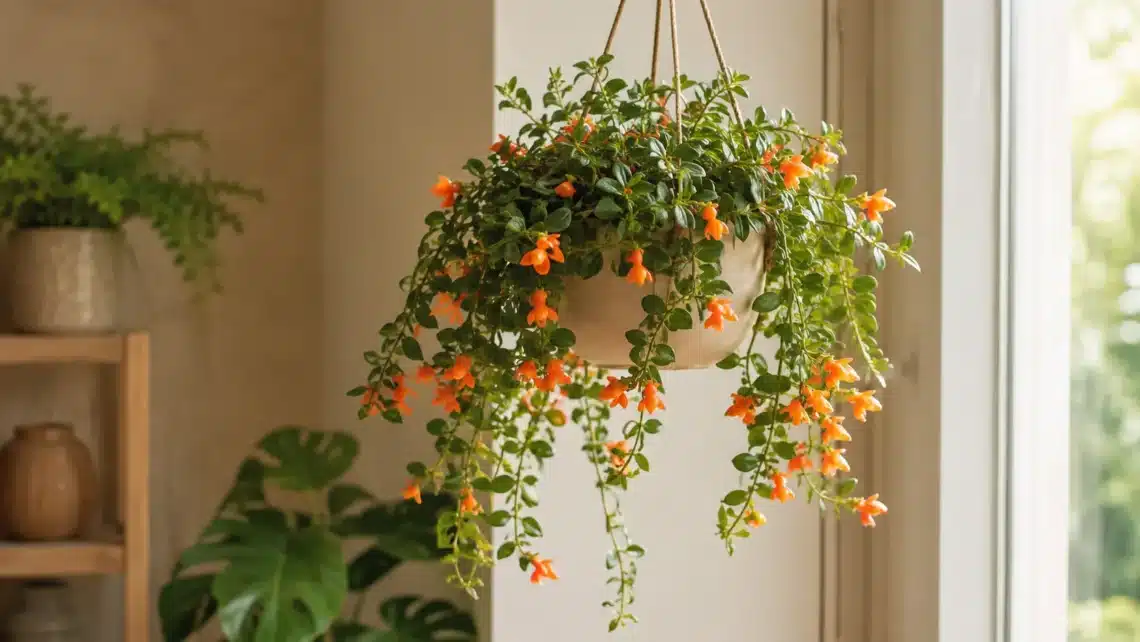
According to Greenery Inside, goldfish plants thrive in bright, indirect light with temperatures between 65-80°F, watered only when the top inch of soil dries out. They prefer 50%+ humidity, well-draining soil like an African violet mix, and monthly diluted fertilizer during spring and summer to encourage their signature orange, pouch-shaped blooms.
Goldfish plants are epiphytic by nature and actually flower more prolifically when slightly root-bound, so frequent repotting can suppress blooming. Sudden cold drafts or temperatures below 50°F often trigger leaf and bud drop, while pruning stems after flowering encourages bushier growth and yields easy cuttings for propagation. For broader advice on choosing, growing, and maintaining indoor species, explore our complete guide to house plants.
By Greenery Inside | Plant Care & Gardening Expert
Last Updated: August 2026
Quick Summary
- Bright, indirect light and temperatures around 65–75°F (18–24°C) support healthy growth and flowering.
- Water when roughly the top 1 inch of potting mix begins to dry, then drain thoroughly rather than allowing the roots to remain waterlogged.
- Goldfish plants are generally regarded as pet-friendly; the ASPCA lists the gold-fish plant under Hypocyrta nummularia as non-toxic to cats and dogs.
- Once light, drainage, and watering are balanced, Nematanthus gregarius is a relatively low-maintenance plant suitable for newer houseplant growers.
What Is a Goldfish Plant?
A goldfish plant is a tropical evergreen perennial in the Gesneriaceae family, the same botanical family that includes African violets and many other popular flowering houseplants. The accepted scientific name of the species covered in this guide is Nematanthus gregarius. Kew’s Plants of the World Online recognizes the species as native to southeastern Brazil, where it grows primarily as an epiphyte in wet tropical environments. For additional botanical background, Nematanthus gregarius is also documented as a Brazilian flowering species in the Gesneriaceae family.
Its most recognizable features are fleshy, glossy green leaves and small orange, pouch-like tubular flowers. The unusual swollen flower shape creates the appearance of tiny goldfish emerging from the foliage. Mature stems naturally trail or spread, which is why the plant is commonly displayed in elevated containers and hanging baskets.
Common names include:
- Goldfish plant
- Gold-fish plant
- Clog plant
- Candy corn plant
- Guppy plant
Older horticultural sources may also call these plants Hypocyrta. Taxonomy can become confusing because several names have changed over time. Kew currently accepts Nematanthus gregarius and lists Hypocyrta radicans among its homotypic synonyms. This distinction is useful when researching “Hypocyrta goldfish plant,” because not every plant historically called Hypocyrta is the same species.
Its epiphytic origin is also important for care. Epiphytes grow on other plants for physical support rather than rooting deeply into compact ground soil. Consequently, goldfish plant roots benefit from air around the root zone and can deteriorate when kept continuously saturated.
Goldfish Plant vs. Columnea (Look-Alike Comparison)
Nematanthus and Columnea are different genera, even though plants from both groups are commonly sold as “goldfish plants.” Their shared common name is one reason online care guides frequently mix them together. Both belong to Gesneriaceae and include tropical epiphytic plants, but their flowers and overall appearance can differ.
| Trait | Nematanthus | Columnea |
| Typical flower | Plump, pouch-like or compact tubular bloom | Usually longer, narrower tubular bloom |
| Growth habit | Compact to trailing or spreading | Often strongly trailing and loose |
| Foliage | Commonly thick, fleshy and glossy | Varies by species, often softer or more elongated |
| “Goldfish plant” name | Commonly used | Also commonly used |
| Example | Nematanthus gregarius | Columnea microcalyx and related species |
For precise plant care, identify the botanical name rather than relying only on the common name “goldfish plant.”
Is a Goldfish Plant Hard to Take Care Of?
A goldfish plant is moderately beginner-friendly rather than completely foolproof. Once given sufficient light, warmth, drainage, and consistent watering, it usually requires relatively little intervention. North Carolina Extension classifies Nematanthus gregarius as a low-maintenance plant.
The most common difficulties occur when growers treat it like a low-light foliage plant. Goldfish plants need comparatively bright conditions to flower well and do not respond well to prolonged soggy soil or cold exposure.
In our experience growing trailing tropical houseplants, three conditions make the biggest practical difference: bright filtered light, a drainage hole, and watering based on soil moisture rather than a fixed calendar.
Greenery Inside recommends checking the potting mix with your finger before watering instead of automatically watering every seven days. Seasonal changes in temperature, daylight and indoor humidity can substantially change how quickly a pot dries.
Where Is the Best Place to Put a Goldfish Plant?
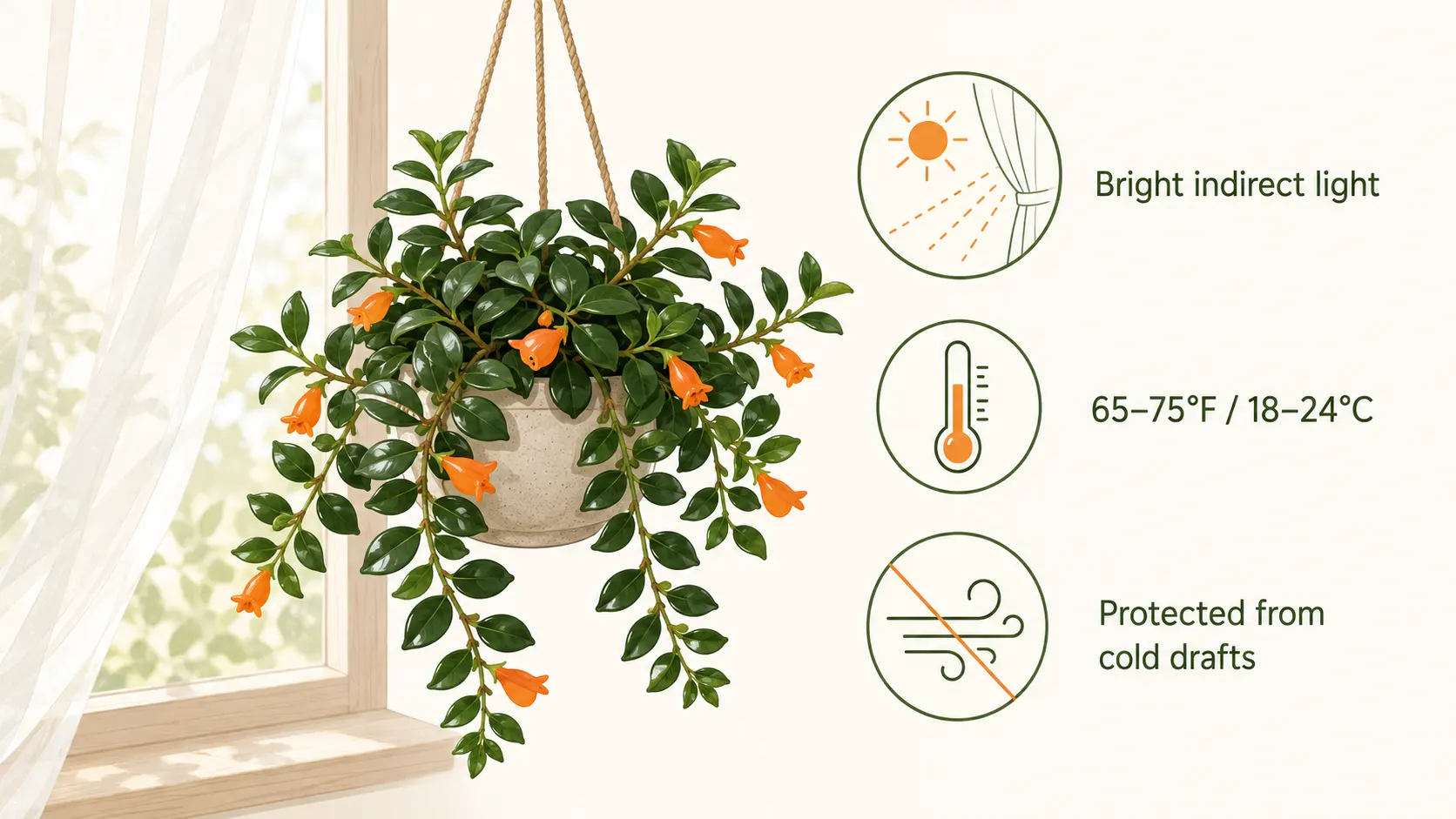
The best location for a goldfish plant is a warm position with bright, filtered light and protection from cold drafts. An east-facing window is often suitable, while a bright south- or west-facing location can work if intense direct sun is softened with a sheer curtain or some distance from the glass. RHS recommends bright filtered light and east- or west-facing exposure.
A useful indoor temperature target is approximately 65–75°F (18–24°C). Avoid placing the plant beside frequently opened winter doors, cold windows, or strong heating and air-conditioning vents. North Carolina Extension notes that N. gregarius does not tolerate temperatures below about 50°F (10°C).
As of August 2026, current horticultural references continue to classify Nematanthus gregarius as a frost-sensitive tropical plant best protected indoors in cooler climates.
Can You Keep a Goldfish Plant Outside?
Yes, a goldfish plant can spend warm weather outdoors, but it cannot tolerate frost. North Carolina Extension lists Nematanthus gregarius for approximately USDA Zones 10b–11b, while other horticultural references broadly describe Zones 10–11.
In cooler regions, move the plant outdoors only after nights are reliably warm. Choose a sheltered site with bright shade or filtered morning light rather than exposed afternoon sun.
Bring it indoors well before autumn temperatures approach 50°F.
Do Goldfish Plants Need to Be Hanging?
No. A goldfish plant does not need a hanging basket to grow successfully. Hanging containers simply complement its natural trailing habit and make the flowers easier to display. RHS describes N. gregarius as trailing, while North Carolina Extension recommends it for containers, hanging baskets and houseplant use.
Goldfish plants trail rather than climb. They do not require a moss pole or trellis in the way a climbing aroid might.
A tabletop or elevated planter works equally well if it:
- Has drainage holes
- Allows trailing stems room to spread
- Receives adequate filtered light
How to Water a Goldfish Plant
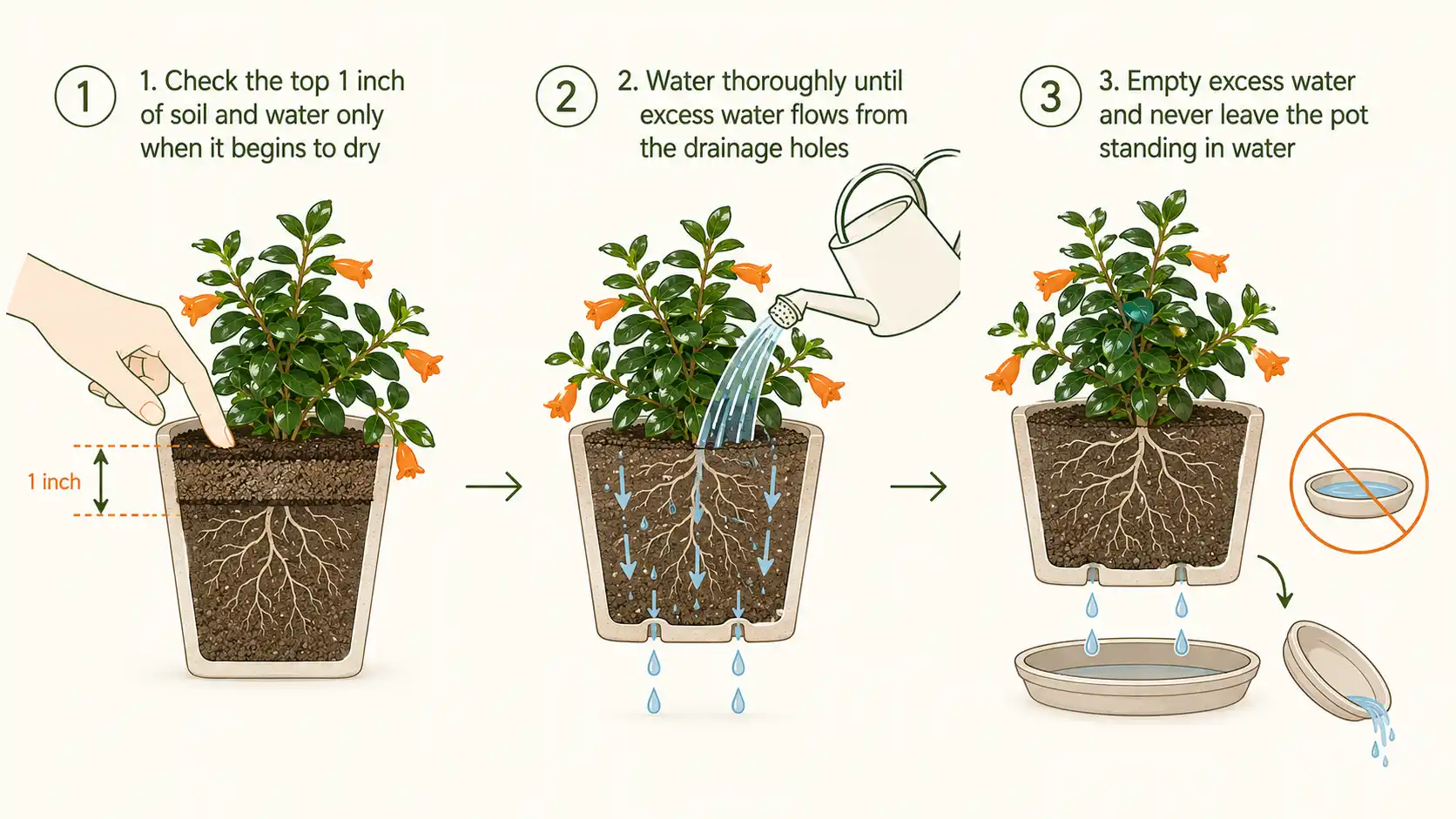
Water a goldfish plant when the upper portion of its potting mix begins to dry, rather than keeping the soil permanently wet. A practical guideline is to check the top 1 inch, or slightly deeper in larger pots, before watering. Then water thoroughly until excess moisture exits through the drainage holes.
The goal is moist but well-drained soil, which is also the moisture condition recommended by RHS.
Watering do’s:
- Check the soil before every watering.
- Water deeply enough to moisten the whole root ball.
- Let excess water drain completely.
- Reduce watering frequency when winter growth slows.
- Use room-temperature water when possible.
Watering don’ts:
- Do not leave the pot standing in collected water.
- Do not water simply because a certain number of days has passed.
- Do not repeatedly allow the entire root ball to become severely dry.
- Do not keep dense soil continuously saturated.
Greenery Inside recommends lifting the pot after watering and again several days later. With practice, the change in weight becomes a useful second indicator of when the plant actually needs water.
Should I Mist a Goldfish Plant?
Misting is optional, not essential. Goldfish plants appreciate moderate to higher humidity, but occasional misting only changes humidity around foliage briefly. In consistently dry homes, a room humidifier or grouping compatible plants together provides more stable humidity. If dry indoor air is a recurring problem, see our guide on how to increase humidity for plants naturally and with humidifiers for practical ways to maintain more stable humidity.
A pebble tray may slightly increase moisture immediately around a plant if the pot remains above the water line, but it should not be relied on to humidify an entire room.
Avoid repeatedly leaving foliage wet in cool, stagnant conditions. Good air circulation remains important even for humidity-loving tropical plants.
Best Soil and Potting for a Goldfish Plant
Goldfish plants grow best in an airy, moisture-retentive but fast-draining potting medium. Their epiphytic biology makes compact, waterlogged soil particularly unsuitable. Kew confirms that N. gregarius naturally grows as an epiphyte, while RHS recommends moist but well-drained, acidic to neutral growing conditions.
A practical houseplant mixture can combine:
- Quality peat-free houseplant compost or coco-based mix
- Perlite or pumice for aeration
- Fine orchid bark for additional structure and drainage
Always use a container with drainage holes.
Avoid moving a small plant directly into a dramatically oversized pot. Too much unused wet potting mix can remain damp longer than the root system can effectively use.
How to Repot a Goldfish Plant
Repot when the root system becomes crowded, growth stalls, or the pot dries unusually quickly despite proper watering. Goldfish plants generally tolerate being somewhat snug in their containers, so annual repotting is not automatically required. Several current references recommend repotting only every few years when necessary.
To repot:
- Water lightly the day before if the root ball is very dry.
- Remove the plant carefully from its container.
- Inspect the roots and trim any clearly dead or rotten material.
- Choose a pot only one size larger.
- Add fresh, airy potting mix.
- Position the plant at approximately its previous depth.
- Fill around the roots without heavily compacting the mix.
- Water thoroughly and allow the pot to drain.
Fertilizing a Goldfish Plant
Feed a goldfish plant during active spring and summer growth with a balanced water-soluble houseplant fertilizer. A monthly feeding at the label-recommended dilution is a practical approach, although some products are formulated for more frequent diluted applications. If you are unsure which feeding product to use, understanding plant food vs fertilizer can help you choose and apply nutrients more appropriately.
Avoid assuming that more fertilizer means more flowers. Excess fertilizer can encourage weak vegetative growth and allow salts to accumulate in the potting mix.
Reduce or stop feeding during winter when growth slows. Resume once stronger new growth begins in spring.
Goldfish Plant Size and Growth Rate
A mature Nematanthus gregarius remains manageable indoors but can develop long cascading stems. North Carolina Extension records a mature height of roughly 1.5 feet with a spread approaching 3 feet, while RHS gives a mature spread of approximately 0.5–1 meter (1.6–3.3 feet).
Indoor size depends on:
- Available light
- Container size
- Pruning
- Fertility
- Temperature
- Cultivar
- Overall plant health
Plants grown in elevated baskets may appear larger simply because their stems can cascade freely.
The goldfish plant has a moderate growth rate under typical indoor conditions. RHS estimates approximately 2–5 years to maturity, although actively growing cuttings can produce substantial trailing growth much sooner.
Growth normally accelerates during warm, bright months and slows when winter light levels decline.
How Many Times Does a Goldfish Plant Bloom? (Flowering Guide)
A goldfish plant does not have a fixed number of flowering cycles per year. The species is most strongly associated with summer flowering, but healthy plants and certain cultivars may produce flowers sporadically at other times when warmth, light and general growing conditions remain favorable.
Individual flowers are temporary, but buds can open sequentially, making the display last considerably longer than a single bloom.
The main seasonal flowering period is generally spring through summer under indoor cultivation, although greenhouse-like conditions can extend flowering.
How Do You Get a Goldfish Plant to Bloom?
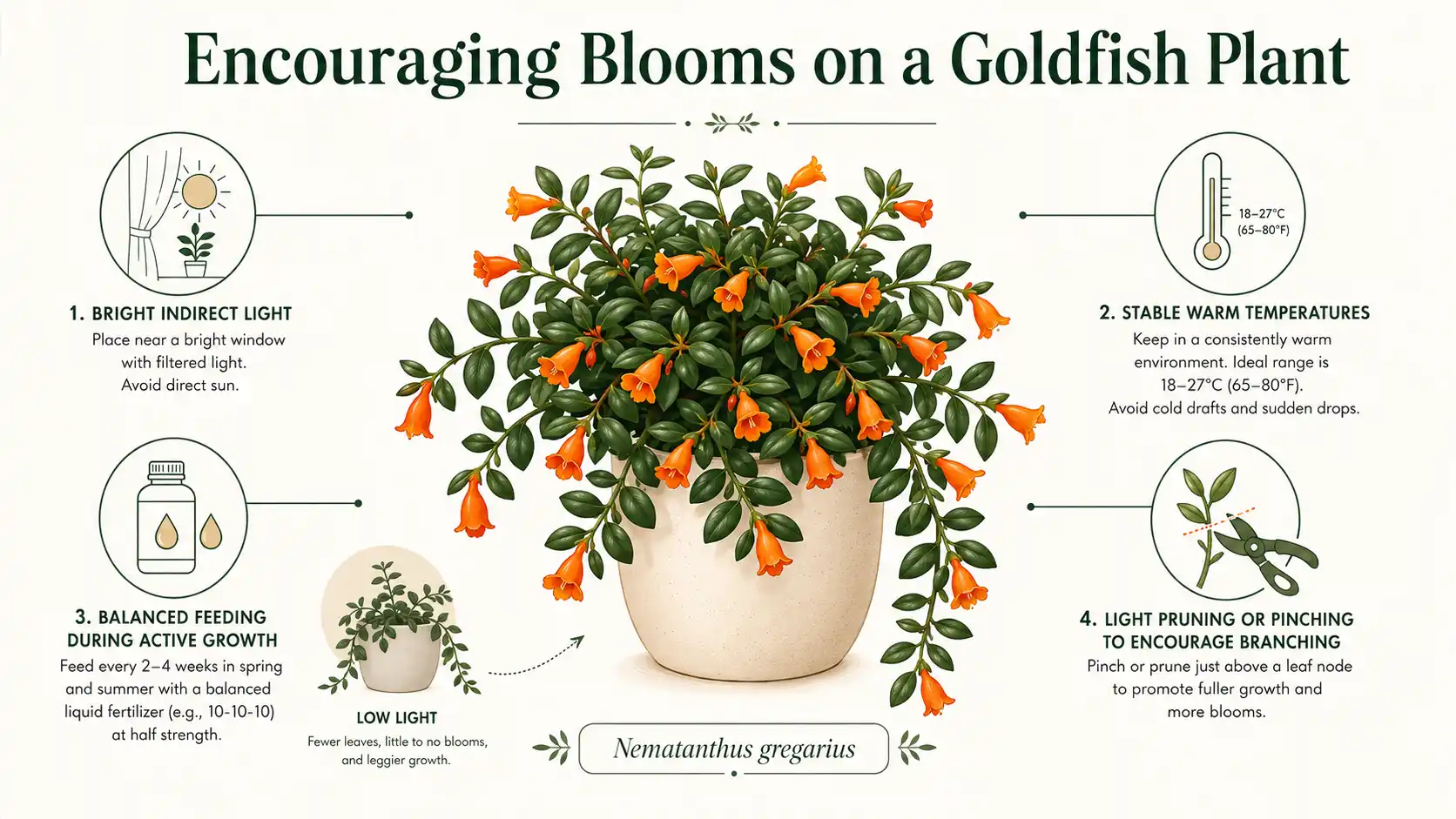
Provide abundant bright, indirect light first; inadequate light is one of the most common reasons a healthy-looking goldfish plant fails to flower. Maintain warm, stable temperatures, water consistently and provide moderate nutrition during active growth.
For better flowering:
- Move the plant closer to a bright filtered window.
- Avoid harsh afternoon sun that overheats or scorches foliage.
- Maintain steady moisture without waterlogging.
- Feed modestly during active growth.
- Pinch or prune overly long stems to encourage branching.
- Avoid unnecessary repotting into oversized containers.
Goldfish Plant Won’t Bloom — Common Reasons
Common reasons include:
- Insufficient light: foliage may survive in lower light while flowering declines.
- Temperature stress: cold drafts can disrupt growth.
- Too much nitrogen: excessive fertilizer can favor foliage over flowers.
- Overwatering: stressed roots cannot support strong flowering.
- Recent stress: repotting, pest damage or severe drying can temporarily interrupt bud production.
- Winter slowdown: shorter days naturally reduce growth in many indoor environments.
A strict dormant period is not an absolute requirement for Nematanthus gregarius. Allowing slightly slower winter growth and reducing fertilizer is generally more appropriate than deliberately forcing the plant into severe drought or cold.
Pruning a Goldfish Plant
Yes, a goldfish plant can be cut back when it becomes leggy, although heavy pruning is not routinely necessary. RHS specifically recommends removing shoot tips from young plants to encourage branching. More branches can create a fuller plant and increase the number of potential flowering shoots.
Early spring is a convenient time for shaping before vigorous seasonal growth.
For a badly leggy plant:
- Remove dead or damaged stems first.
- Shorten excessively long stems by up to about one-third.
- Cut immediately above a healthy leaf node.
- Pinch new tips periodically to encourage side branches.
- Avoid removing most of the foliage at once.
Sterilize pruning tools before use.
How to Propagate a Goldfish Plant
Goldfish plants are most easily propagated from stem-tip cuttings. RHS recommends softwood stem-tip propagation in spring, and other current horticultural guides support rooting the cuttings either directly in potting medium or in water.
To propagate:
- Choose a healthy, non-flowering stem.
- Cut a section roughly 3–5 inches long.
- Remove leaves from the lower section.
- Keep at least one bare node available for rooting.
- Place the node in moist, airy potting mix or clean water.
- Keep the cutting warm and in bright indirect light.
- Maintain light moisture without soaking the cutting.
Roots can begin appearing within roughly 2–4 weeks under favorable warmth and humidity, although individual cuttings vary.
For water propagation, transplant once several healthy roots have formed rather than leaving the cutting permanently submerged.
Common Problems With Goldfish Plants (Problem-Solution Section)
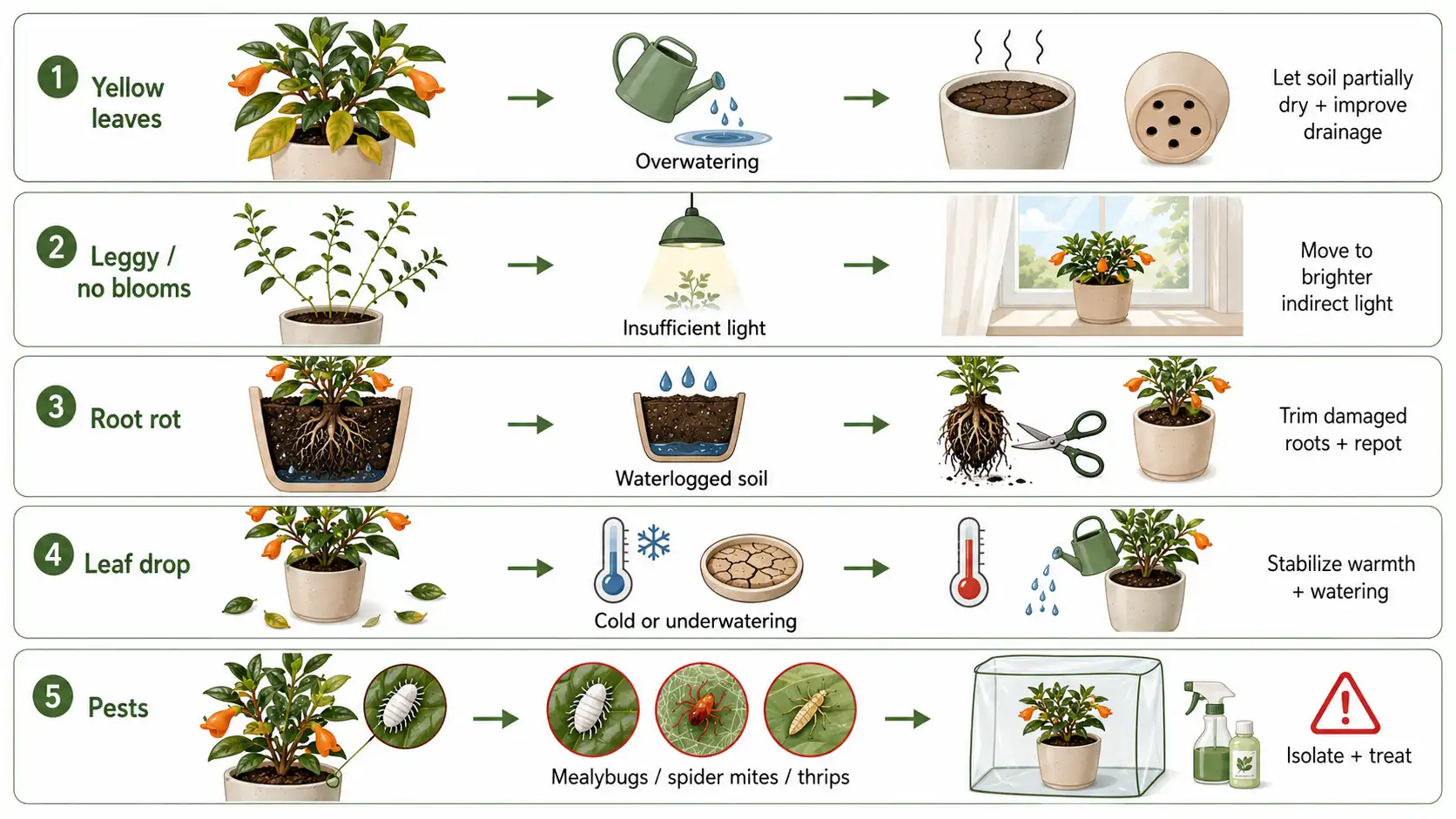
Most goldfish plant problems can be traced to light, temperature, water, drainage or common houseplant pests.
| Problem | Likely Cause | What to Do |
| Yellow leaves | Excess moisture, poor drainage or root stress | Let the upper soil dry slightly and check drainage |
| Brown leaves | Severe dryness, cold stress or environmental stress | Check moisture and move away from drafts |
| Leggy growth | Insufficient light or lack of pruning | Increase filtered light and pinch long stems |
| No flowers | Low light, root stress or excessive fertilizer | Improve light and correct care |
| Root rot | Constantly wet soil or standing water | Remove damaged roots and repot into airy mix |
| Leaf drop | Cold temperatures, drought or sudden environmental change | Stabilize warmth and watering |
| Spider mites | Tiny mites causing stippling and fine webbing | Isolate and treat promptly |
| Mealybugs | White, cotton-like insects around stems and nodes | Remove manually and treat appropriately |
| Aphids | Clusters of soft-bodied insects on young growth | Wash off or use labeled insecticidal soap |
| Thrips | Scarring, distorted growth and tiny slender insects | Isolate and use an appropriate labeled treatment |
Aphids are specifically listed as a potential pest by RHS and North Carolina Extension, while other current houseplant references also identify spider mites and related sap-feeding pests as potential problems. Before using neem-based treatments on houseplants, review what plants not to use neem oil on and always test the product on a small area first.
When using insecticidal soap, horticultural oil or neem-based products, always follow the product label and test a small section first. Avoid spraying flowers unnecessarily.
How to Revive a Dying Goldfish Plant
First identify whether the plant is too wet, too dry, too cold, poorly lit or pest-infested; recovery depends on correcting the actual cause rather than adding fertilizer.
Use this diagnostic sequence:
- Check the roots and soil. A constantly wet pot with soft, dark roots suggests root rot.
- Check light. Long, weak stems and absent flowering usually indicate inadequate light.
- Check temperature. Move the plant away from cold glass, air conditioners and winter drafts.
- Inspect leaf undersides and nodes. Look for webbing, sticky residue, white cottony material or visible insects.
- Correct watering. Rehydrate a dry root ball gradually or allow oversaturated soil to drain and dry.
- Repot if necessary. Remove rotten roots and use fresh, well-draining medium.
- Delay fertilizer. A severely stressed plant should recover active growth before regular feeding resumes.
In our experience, struggling houseplants recover more reliably when one environmental problem is corrected at a time. Simultaneously repotting, fertilizing, pruning heavily and moving a stressed plant can create additional stress.
Goldfish Plant Varieties
Several Nematanthus cultivars and hybrids are grown for differences in foliage, growth habit and flower color.
Popular examples include:
- ‘Dibley’s Gold’ — a variegated form of Nematanthus gregarius with lighter patterned foliage.
- ‘Black Magic’ — a semi-trailing cultivar with very dark green foliage and orange tubular flowers; RHS notes summer flowering with sporadic blooms at other times in warmth.
- ‘Tropicana’ — a hybrid with yellow flowers marked with reddish-brown striping and spotting.
- ‘Rio’ — a hybrid producing orange-red flowers and relatively lighter green foliage.
“Black goldfish plant care” is generally similar to standard Nematanthus care: provide bright filtered light, good drainage, warmth and careful watering. Dark-leaved cultivars do not require fundamentally different watering practices.
Is a Goldfish Plant Toxic to Cats or Dogs?
Goldfish plants are generally regarded as non-toxic to cats and dogs, but botanical identification matters. The ASPCA lists “Gold-Fish Plant,” scientifically recorded there as Hypocyrta nummularia, as non-toxic to both dogs and cats.
The naming deserves clarification: the ASPCA entry is not written under the currently accepted name Nematanthus gregarius, while North Carolina Extension’s N. gregarius record is tagged as non-toxic for cats. Because “goldfish plant” is applied to multiple related plants, verify your plant’s botanical identity if pet safety is critical.
“Non-toxic” also does not mean that pets should routinely eat the plant. Chewing significant quantities of any fibrous plant material may still lead to temporary gastrointestinal irritation.
Are Goldfish Plants Rare?
Standard goldfish plants are not considered particularly rare houseplants. Nematanthus plants are established ornamental houseplants and are commercially propagated, although availability varies significantly by region and season.
The ordinary orange-flowering goldfish plant is generally easier to find than named cultivars such as unusual variegated, dark-leaved or specialty hybrid forms.
A high price for an uncommon cultivar therefore does not mean the entire species is botanically rare.
Benefits of Having a Goldfish Plant
The main benefits of a goldfish plant are practical and ornamental:
- Distinctive flowers: orange pouch-shaped blooms provide strong color without requiring a large floor plant.
- Trailing growth: suitable for shelves, elevated pots and hanging baskets.
- Compact footprint: long stems develop without requiring substantial floor space.
- Relatively low maintenance: once watering and light are established, routine care is straightforward.
- Pet-friendly reputation: widely considered one of the safer decorative choices for homes with cats and dogs, with the taxonomic caveat discussed above.
- Easy vegetative propagation: stem cuttings make it practical to produce additional plants or share them with other growers.
Goldfish plants are sometimes promoted as “air-purifying plants,” but that benefit should not be overstated. Laboratory experiments have shown that plants can remove some volatile compounds under controlled conditions, yet a major review found that ordinary numbers of potted plants do not meaningfully improve indoor air quality in real-world buildings compared with normal ventilation. A goldfish plant should therefore be grown for its ornamental and horticultural value, not as a replacement for ventilation or air filtration.
Beginner Mistakes to Avoid
Avoiding a few common mistakes makes goldfish plant care considerably easier:
- Overwatering: moist does not mean permanently saturated.
- Using a pot without drainage: standing water greatly increases root problems.
- Growing in dim light: the plant may remain alive but become leggy and flower poorly.
- Suddenly exposing it to strong afternoon sun: foliage accustomed to indoor light can scorch.
- Using very cold water: room-temperature water avoids an abrupt temperature change around tropical roots.
- Leaving it beside drafts: temperatures below about 50°F can damage the plant.
- Skipping pruning when growth becomes leggy: pinching shoot tips encourages branching.
- Overfertilizing to force blooms: excessive feeding does not compensate for inadequate light.
- Repotting too frequently: goldfish plants do not require a larger container every year.
- Forcing winter dormancy: reduce feeding and watering as growth slows, but do not intentionally expose the plant to damaging cold or prolonged severe drought.
Greenery Inside recommends treating soil moisture as a condition to measure, not a schedule to memorize. That single habit prevents many of the watering problems seen in tropical houseplants.
Conclusion
Successful goldfish plant care depends primarily on bright filtered light, warm temperatures, an airy potting mix and consistent but controlled watering. Nematanthus gregarius is an epiphytic tropical species from southeastern Brazil, so its roots need both moisture and oxygen rather than constantly saturated soil.
Place the plant near a bright window, protect it from cold drafts, water when the upper potting mix begins drying and prune or pinch long stems when fuller growth is desired. With these conditions in balance, a goldfish plant can develop dense trailing foliage and repeated orange blooms while remaining manageable for beginner and experienced indoor gardeners alike.
Frequently Asked Questions
Is a goldfish plant hard to take care of?
No. A goldfish plant is generally considered moderately easy to care for once its basic requirements are met. Bright filtered light, warm temperatures, good drainage and consistent watering are more important than complicated maintenance. North Carolina Extension classifies Nematanthus gregarius as low maintenance.
What is the lifespan of a goldfish plant?
There is no fixed published lifespan for an indoor goldfish plant. Nematanthus gregarius is an evergreen perennial, meaning it is naturally capable of living for multiple years rather than completing its life cycle in one season. Its actual indoor lifespan depends on root health, light, watering, pests and overall growing conditions.
Can a goldfish plant live in water permanently?
No. Stem cuttings can root temporarily in water, but mature goldfish plants are not aquatic plants. For long-term growth, they are better suited to an airy, well-drained potting medium that provides both moisture and oxygen around the roots. Their natural epiphytic habit reinforces the need for good root aeration.
Is goldfish plant good for beginners?
Yes. A goldfish plant can be a good beginner houseplant, particularly for someone who has a bright indoor location. It becomes more challenging in very dark rooms or when watering is excessive, but routine maintenance is otherwise relatively simple.
How often should you water a goldfish plant?
There is no reliable fixed weekly schedule. Check the potting mix and water when approximately the upper inch begins to dry. Water thoroughly, allow excess water to drain and check less frequently during periods of slower winter growth.
Are goldfish plants toxic to cats?
Goldfish plants are generally considered non-toxic to cats. The ASPCA lists the gold-fish plant under the scientific name Hypocyrta nummularia as non-toxic to cats and dogs, while North Carolina Extension’s Nematanthus gregarius profile is tagged non-toxic for cats. Because the common name applies to several related plants, verify the botanical identification when pet safety is important.