Introduction
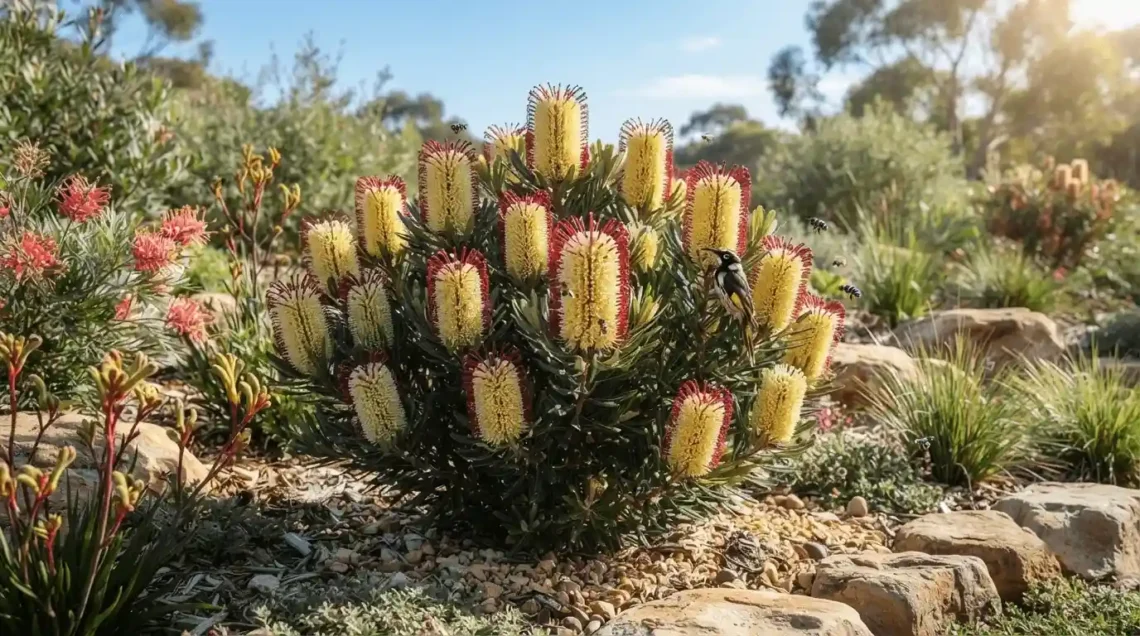
Banksia spinulosa ‘Cherry Candles’ is a compact cultivar of the Australian native Hairpin Banksia that is admired for its vibrant flower spikes, evergreen foliage, and exceptional ability to attract birds and beneficial pollinators. Popular in Australian gardens, this hardy shrub combines ornamental appeal with relatively low maintenance, making it suitable for native landscapes, rockeries, coastal gardens, and large containers. As one of several dwarf selections within Banksia spinulosa, it is often compared with cultivars such as Birthday Candles, Honey Pots, Honeyeater Delight, and Dwarf Red. Understanding the differences between these varieties helps gardeners select the best banksia cherry candles or cherry candles banksia for their available space and landscape goals. To better understand how this plant fits into broader native landscaping systems, you can explore Australian Native Garden Trees for more design inspiration and plant selection ideas.
By Greenery Inside | Plant Care & Gardening Expert
Quick Summary
- Banksia spinulosa ‘Cherry Candles’ is a compact Australian native shrub known for its colorful flower spikes and nectar-rich blooms that attract birds.
- It thrives in well-drained soil and performs exceptionally well in gardens, rockeries, coastal landscapes, and large containers.
- It belongs to a wider collection of dwarf Banksia spinulosa cultivars, each offering unique sizes, flower colors, and growth habits.
- Full sun, excellent drainage, and light pruning after flowering encourage healthy growth and reliable flowering.
What Is Banksia Spinulosa ‘Cherry Candles’?
Botanical Background
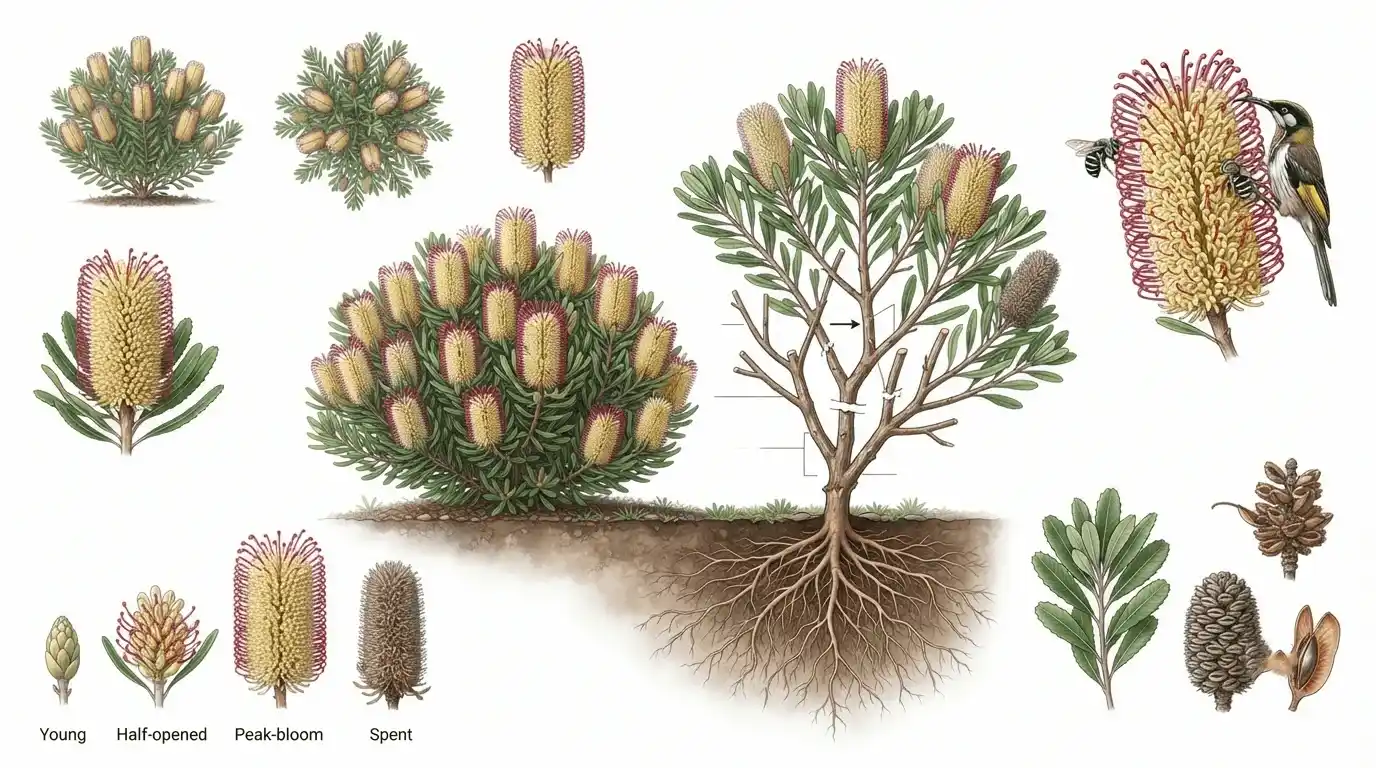
Banksia spinulosa ‘Cherry Candles’ is a cultivated selection of Banksia spinulosa, commonly known as Hairpin Banksia. It belongs to the Proteaceae family, one of Australia’s most distinctive native plant families, which also includes Grevillea, Hakea, and Protea.
Banksia spinulosa is part of a well-documented genus that plays an important role in Australian biodiversity and native ecosystems.
The parent species naturally occurs across eastern Australia, where it grows in open forests, coastal heathlands, and woodland environments. It has evolved to tolerate nutrient-poor soils, seasonal drought, and varying climatic conditions, making it a reliable choice for Australian landscapes.
Unlike the naturally variable species, Cherry Candles was selected for its compact size, dense branching habit, and abundant flowering. These characteristics make it a highly desirable dwarf coastal banksia suitable for smaller residential gardens and modern landscapes where space is limited.
From a botanical perspective, Cherry Candles retains the hardiness and ecological value of the species while offering a more manageable growth habit for everyday gardeners.
Key Characteristics
Banksia spinulosa ‘Cherry Candles’ combines ornamental beauty with practical landscape performance. Its compact form allows it to fit comfortably into gardens where larger Banksias may become difficult to manage.
Key characteristics include:
- Dense, rounded shrub with naturally compact branching
- Evergreen foliage that provides year-round interest
- Cylindrical flower spikes featuring cream to golden flowers with distinctive reddish or cherry-colored styles
- Extended flowering period, often from autumn through winter and sometimes into spring depending on local climate
- Rich nectar production that attracts honeyeaters, native bees, butterflies, and other beneficial wildlife
- Excellent tolerance of drought once established
- Adaptability to coastal conditions and sandy soils
Compared with standard Banksia spinulosa, Cherry Candles remains significantly smaller while maintaining prolific flowering. This makes it especially valuable where compact native shrubs are preferred.
The attractive flower spikes are often referred to as banksia candles, candle banksia, or simply banksia candle because of their upright cylindrical shape that resembles decorative candles emerging above the foliage.
Banksia Spinulosa ‘Cherry Candles’ Size and Growth Habit
Mature Height and Width
One of the primary reasons gardeners choose Cherry Candles is its naturally compact size. It provides the ornamental qualities of Hairpin Banksia without the larger dimensions of many naturally occurring forms.
Under typical garden conditions, the banksia cherry candles size reaches approximately:
| Growth Measurement | Typical Size |
| Mature Height | 0.8–1.5 metres |
| Mature Width | 0.8–1.5 metres |
| Growth Habit | Dense, rounded, compact shrub |
The exact banksia spinulosa cherry candles height depends on environmental conditions, soil quality, pruning practices, and climate.
In ideal growing conditions, mature plants develop into symmetrical shrubs with dense evergreen foliage and abundant flower production. Their naturally rounded form requires relatively little shaping compared with many larger Banksia species.
Greenery Inside recommends allowing enough space around the shrub for healthy air circulation. Crowding plants too closely together can reduce flowering performance and increase moisture retention within the canopy.
Unlike many larger Banksias that eventually become small trees, Cherry Candles generally maintains its compact shrub habit throughout its life, making it an excellent long-term choice for residential landscapes.
Growth Rate
Banksia spinulosa ‘Cherry Candandles’ generally has a slow to moderate growth rate.
Young plants focus first on establishing a strong root system before producing significant top growth. Once established, annual growth becomes more consistent, particularly when growing conditions are favorable.
Several environmental factors influence growth speed:
- Well-drained sandy soils promote healthier root development.
- Full sun encourages stronger branching and heavier flowering.
- Mild climates generally support longer annual growth periods.
- Poor drainage can significantly slow development.
- Excessively rich soils may encourage soft growth that performs poorly over time.
In our experience growing Australian native shrubs, patience during the first two years produces healthier, longer-lived plants. Attempting to accelerate growth through excessive fertilization often results in weaker performance rather than faster establishment.
As of 2026, Australian native plant growers continue to recommend prioritizing healthy root establishment over rapid top growth when planting young Banksias.
Mature Size Comparison
| Cultivar | Mature Height | Mature Width | Growth Habit |
| Cherry Candles | 0.8–1.5 m | 0.8–1.5 m | Dense rounded shrub |
| Birthday Candles | 0.4–0.6 m | 1–2 m | Low spreading groundcover |
| Honey Pots | 1–2 m | 1–2 m | Compact upright shrub |
| Honeyeater Delight | 1.5–2.5 m | 1.5–2.5 m | Medium upright shrub |
| Dwarf Red | 1–2 m | 1–2 m | Compact bushy shrub |
Banksia Spinulosa Varieties Explained
Popular Cultivars
The popularity of Banksia spinulosa has resulted in numerous cultivated forms that vary in mature size, flower color, and landscape application. These banksia spinulosa varieties allow gardeners to select plants suited to different garden sizes and design styles.
Cherry Candles
Cherry Candles is valued for its compact, rounded growth, colorful flower spikes, and reliable flowering performance. It performs well in garden beds, native borders, wildlife gardens, and decorative containers.
Birthday Candles
Birthday Candles is among the smallest dwarf banksias available. Its low, spreading habit makes it ideal as a groundcover, for retaining walls, rock gardens, and pathway edging.
Honey Pots
Honey Pots develops into a slightly larger shrub with rich golden flower spikes and dense foliage. It suits larger native gardens while remaining compact enough for residential landscapes.
Honeyeater Delight
Honeyeater Delight produces abundant nectar-rich flowers that attract birds throughout the flowering season. It develops into a medium-sized shrub suitable for wildlife gardens and mixed native plantings.
Dwarf Red
Dwarf Red is appreciated for its attractive reddish flower styles and compact bushy habit. It provides year-round ornamental value while supporting native pollinators.
These cultivars represent only a small selection of the available dwarf banksia varieties and small banksia varieties developed for Australian landscapes. They demonstrate the diversity found within banksia tree types, allowing gardeners to match plant size and flowering characteristics with specific landscape requirements.
Banksia Spinulosa Variety Comparison
| Variety | Mature Size | Flower Color | Growth Habit | Best Landscape Use | Container Suitable | Wildlife Attraction |
| Cherry Candles | 0.8–1.5 m | Cream with cherry-red styles | Dense rounded | Feature shrub, borders | Excellent | Excellent |
| Birthday Candles | 0.4–0.6 m × 1–2 m | Golden with red styles | Low spreading | Groundcover, rockeries | Excellent | Excellent |
| Honey Pots | 1–2 m | Golden-yellow | Compact upright | Native gardens | Good | Excellent |
| Honeyeater Delight | 1.5–2.5 m | Golden with red styles | Upright shrub | Wildlife gardens | Moderate | Outstanding |
| Dwarf Red | 1–2 m | Cream with deep red styles | Bushy compact | Mixed borders | Good | Excellent |
Banksia Birthday Candles vs Cherry Candles
Key Differences
Banksia Birthday Candles vs Cherry Candles is one of the most common comparisons among gardeners because both are compact cultivars of Hairpin Banksia. While they share similar care requirements and ecological benefits, they differ noticeably in mature size, growth habit, and landscaping applications.
Cherry Candles forms a rounded, upright shrub that works well as a specimen plant, low hedge, or feature shrub. In contrast, banksia birthday candles, also known as birthday candle banksia, naturally spreads across the ground, making it more suitable as a flowering groundcover.
Key differences include:
- Height: Cherry Candles grows taller, while birthday candles banksia remains much lower.
- Width: Birthday Candles spreads significantly wider than Cherry Candles.
- Flowering Period: Both produce long-lasting flower spikes, although local climate can influence bloom duration.
- Frost Tolerance: Both show reasonable frost tolerance once established, though young plants benefit from protection during severe frosts.
- Container Suitability: Cherry Candles performs exceptionally well in large decorative pots, while the spreading habit of the birthday candles plant is best accommodated in wider containers.
- Bird Attraction: Both cultivars provide abundant nectar that attracts honeyeaters, native bees, and other pollinating insects.
Greenery Inside has found that gardeners seeking a tidy feature shrub generally prefer Cherry Candles, while those wanting to cover open ground often achieve better results with the birthday candles plant because of its naturally spreading growth habit.
Although they belong to the same species, understanding these structural differences helps gardeners choose the cultivar best suited to their available space and intended landscape design.
Comparing Cherry Candles with Other Dwarf Banksias
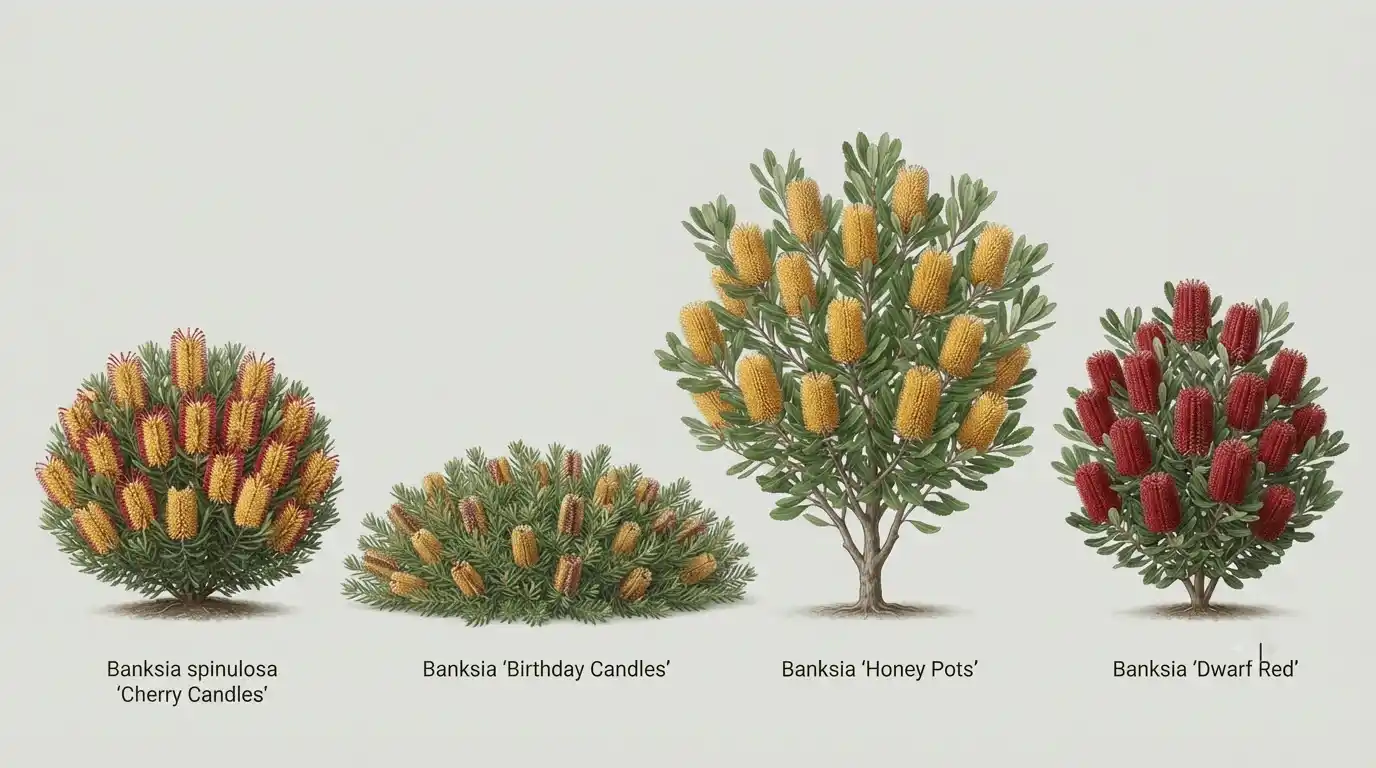
Although Banksia spinulosa ‘Cherry Candles’ is one of the most popular compact cultivars, it is not the only dwarf Banksia available. Comparing it with other cultivars helps gardeners choose a plant that best matches their climate, garden size, and landscaping goals. While all these selections share the hardy nature of Banksia spinulosa, each has unique characteristics in flower color, mature size, and growth habit.
Cherry Candles vs Honey Pots
Cherry Candles and Banksia spinulosa Honey Pots are often compared because both produce abundant flower spikes and remain relatively compact. However, Honey Pots generally grows larger and develops a more upright form.
| Feature | Cherry Candles | Honey Pots |
| Mature Height | 0.8–1.5 m | 1–2 m |
| Growth Habit | Dense, rounded shrub | Compact upright shrub |
| Flower Color | Cream with cherry-red styles | Golden-yellow |
| Best Use | Small gardens, containers | Larger garden beds |
| Bird Attraction | Excellent | Excellent |
The main differences include:
- Flower appearance: Cherry Candles is recognized for its striking cherry-red styles, while banksia honey pots displays warm golden flower spikes.
- Plant size: Honey pots banksia grows slightly taller and wider, making it more suitable where additional height is desired.
- Landscape use: Cherry Candles fits compact gardens and courtyards, whereas banksia honeypots works well in mixed native shrub borders.
- Wildlife value: Both cultivars provide abundant nectar for honeyeaters, bees, and butterflies throughout the flowering season.
- Climate suitability: Both perform well in temperate and coastal regions with excellent drainage.
Gardeners looking for a neat ornamental shrub often prefer Cherry Candles, while those wanting a fuller screening shrub may find banksia honeypot a better option.
Cherry Candles vs Honeyeater Delight
Banksia spinulosa Honeyeater Delight is another excellent native cultivar known for prolific flowering and outstanding wildlife value.
Compared with Cherry Candles:
- Honeyeater Delight grows noticeably taller.
- It develops a more upright, open shrub.
- It produces abundant nectar-rich flower spikes that attract a wide variety of native birds.
- Cherry Candles is easier to maintain in smaller residential gardens.
- Both provide year-round evergreen foliage.
For gardeners primarily interested in bird-friendly landscaping, banksia spinulosa honeyeater delight is an outstanding choice. However, Cherry Candles offers similar ecological benefits while requiring less space.
Greenery Inside has observed that Honeyeater Delight performs particularly well in larger native landscapes where its natural shape can develop without frequent pruning.
Cherry Candles vs Dwarf Red
Banksia spinulosa Dwarf Red shares many similarities with Cherry Candles but differs in flower coloration and overall appearance.
| Feature | Cherry Candles | Dwarf Red |
| Mature Height | 0.8–1.5 m | 1–2 m |
| Flower Styles | Cherry-red | Deep red |
| Growth Habit | Rounded | Bushy upright |
| Maintenance | Low | Low |
| Container Growing | Excellent | Good |
The key differences include:
- Flower differences: Banksia dwarf red produces deeper red flower styles, giving a more dramatic appearance.
- Growth habit: Dwarf Red is slightly more upright and vigorous.
- Landscape suitability: Cherry Candles suits compact formal plantings, while banksia spinulosa dwarf red blends naturally into larger native gardens.
- Wildlife benefits: Both attract nectar-feeding birds and native pollinators.
- Best climates: Both thrive in mild temperate climates with excellent drainage and full sun.
Overall, Cherry Candles remains one of the most versatile dwarf Banksias because it balances ornamental appeal, manageable size, and reliable flowering.
Ideal Growing Conditions for Banksia Cherry Candles
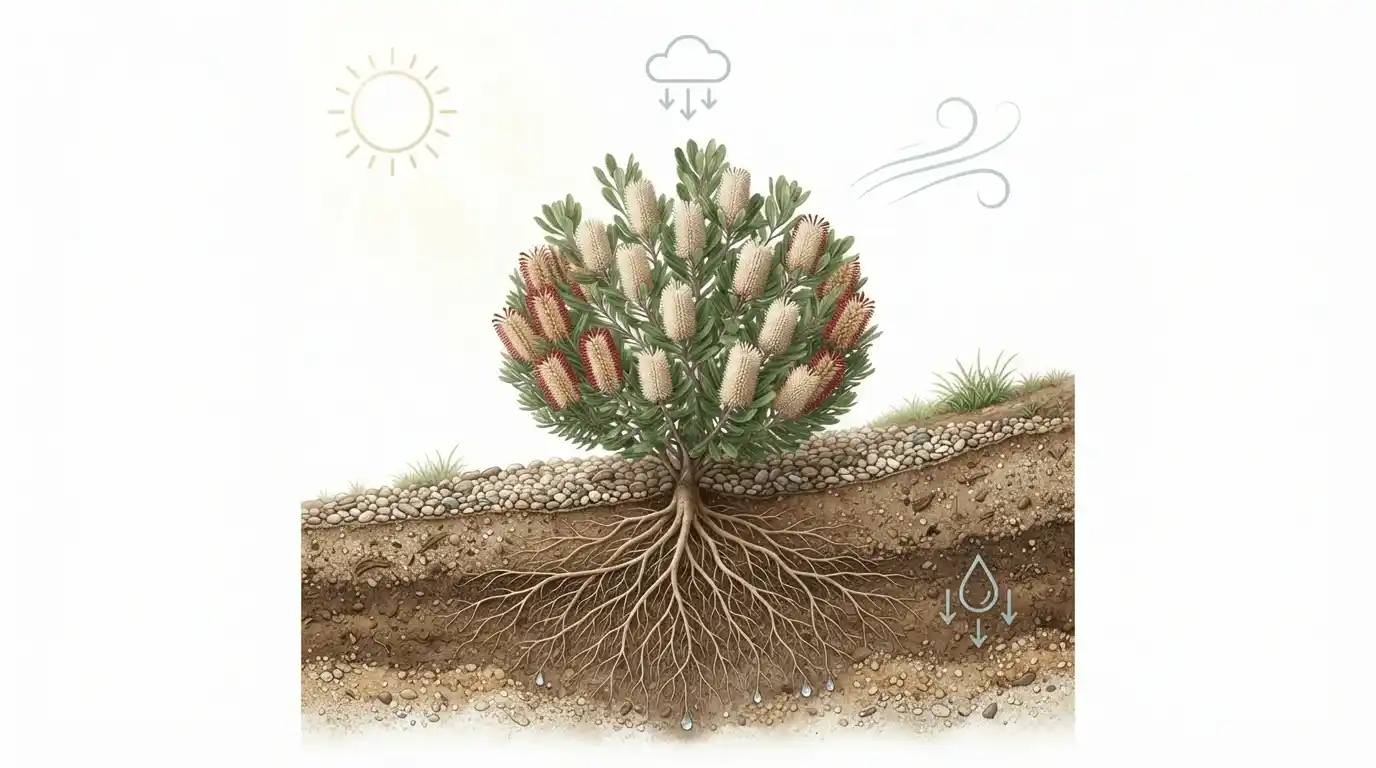
Healthy growth begins with providing the right environment. Like most Australian native Banksias, Cherry Candles thrives when its natural habitat is replicated as closely as possible.
Light Requirements
Banksia Cherry Candles grows best in full sun.
Ideally, the plant should receive at least six hours of direct sunlight daily. More sunlight generally results in:
- Heavier flowering
- Denser foliage
- Stronger branching
- Better drought tolerance
Plants grown in excessive shade often become sparse and produce fewer flower spikes.
In our experience growing native Banksias, insufficient sunlight is one of the most common reasons gardeners experience poor flowering.
Soil Preferences
Excellent drainage is the single most important requirement.
Cherry Candles naturally prefers:
- Sandy soils
- Sandy loam
- Gravelly native soils
- Slightly acidic to neutral pH
- Low-phosphorus conditions
Avoid:
- Heavy clay soils
- Permanently wet locations
- Poorly drained garden beds
If drainage is marginal, planting on raised mounds or raised garden beds significantly improves long-term success.
Greenery Inside recommends testing drainage before planting. If water remains in the planting hole for several hours after heavy watering, improve drainage before installing the plant.
Climate and Hardiness
Banksia spinulosa ‘Cherry Candles’ performs well across many temperate regions.
It is valued for:
- Good drought tolerance after establishment
- Moderate frost tolerance
- Adaptability to low-humidity environments
- Reliable flowering across a wide climate range
Young plants benefit from occasional deep watering during prolonged dry periods, but mature specimens tolerate drought remarkably well.
As of 2026, horticultural best practice continues to recommend establishing Banksias during cooler months, allowing roots to develop before extreme summer heat arrives.
Coastal Performance
Cherry Candles performs exceptionally well in coastal landscapes.
Its natural adaptations allow it to tolerate:
- Coastal winds
- Salt-laden air
- Sandy soils
- Low fertility
- Dry conditions
These qualities make it an excellent choice for seaside gardens where many ornamental shrubs struggle.
Although tolerant of coastal exposure, extremely exposed beachfront locations may still benefit from temporary shelter while young plants establish.
Complete Care Guide
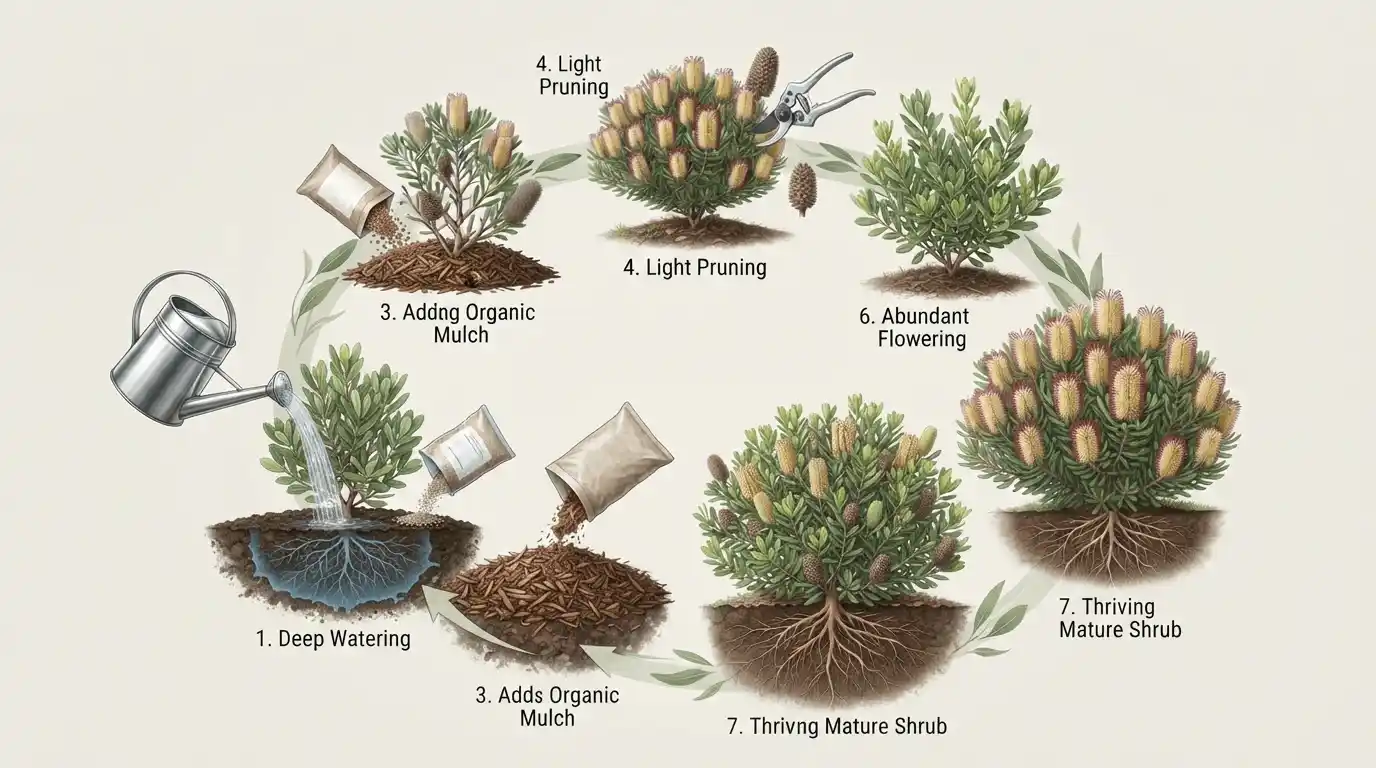
Once established, Banksia Cherry Candles is considered a relatively low-maintenance native shrub. Consistent but moderate care encourages vigorous growth and abundant flowering.
Watering
Water requirements vary with plant age.
During establishment:
- Water deeply once or twice each week.
- Allow soil to dry slightly between waterings.
- Avoid permanently wet soil.
After establishment:
- Water during extended dry periods.
- Mature plants generally require minimal supplemental irrigation.
- Deep, infrequent watering encourages stronger root systems.
One common mistake is frequent shallow watering, which promotes surface roots rather than deep, drought-resistant root development.
Fertilizing
Banksias are highly sensitive to phosphorus.
Always use:
- Low-phosphorus native plant fertilizer
- Controlled-release native formulations
- Products specifically labelled for Australian native plants
Avoid:
- General-purpose fertilizers
- High-phosphorus fertilizers
- Excessive feeding
Too much fertilizer can damage sensitive root systems and reduce overall plant health.
Mulching
Proper mulching improves moisture retention while protecting shallow roots.
Recommended mulch includes:
- Aged bark mulch
- Coarse wood chips
- Leaf mulch
- Natural eucalyptus mulch
Maintain:
- 5–8 cm mulch depth
- A small gap around the main stem
- Even coverage across the root zone
Mulch also suppresses weeds and helps moderate soil temperatures throughout the year.
Pruning
Light pruning immediately after flowering encourages:
- Compact growth
- Increased branching
- More flowering stems
- Improved plant shape
Avoid removing large woody branches unless necessary.
Regular tip pruning of younger plants often produces denser shrubs without reducing flowering.
Greenery Inside recommends removing spent flower spikes after flowering if seed production is not required, helping redirect energy into new growth.
Long-Term Maintenance
Healthy long-term growth depends on simple seasonal maintenance rather than intensive care.
A practical maintenance routine includes:
- Inspect drainage annually.
- Refresh mulch each year.
- Apply native fertilizer during active growth if needed.
- Remove damaged or dead branches.
- Monitor for pests and diseases.
- Water only during prolonged dry weather.
- Lightly shape plants after flowering.
Following these practices helps maintain attractive foliage and reliable flowering for many years.
Growing Banksia Cherry Candles in Pots
One of the greatest advantages of Cherry Candles is its suitability for container gardening. Its naturally compact habit makes it one of the easiest banksias in pots to maintain.
For beginners who are growing Banksias or other ornamentals indoors or in controlled environments, it helps to follow a structured approach similar to general houseplant care principles.
Choosing the Right Container
Select a large, well-drained container that allows healthy root development.
A suitable container should:
- Be at least 45–60 cm wide.
- Include multiple drainage holes.
- Be made from durable materials that withstand weather exposure.
- Provide room for future root growth.
Terracotta and high-quality resin pots are both excellent choices because they provide stability while supporting healthy drainage.
Potting Mix
Never use heavy garden soil in containers.
Instead, choose:
- Premium Australian native plant potting mix
- Free-draining mix with coarse sand
- Mix containing pine bark and composted organic material
- Low-phosphorus formulation
Good drainage is even more important in containers because water cannot disperse naturally into surrounding soil.
Adding coarse sand or fine gravel further improves drainage where necessary.
Ongoing Container Care
Container-grown Banksias require slightly more attention than garden-grown plants.
Routine care includes:
- Water when the top few centimetres of potting mix become dry.
- Avoid leaving containers sitting in water.
- Feed lightly using native plant fertilizer.
- Refresh the potting mix every few years.
- Repot when roots become crowded.
Although dwarf Banksia spinulosa cultivars tolerate container growing exceptionally well, they still require sufficient root space to flower consistently.
In our experience, choosing a pot slightly larger than initially required often reduces maintenance because the growing medium retains moisture more evenly while allowing healthier long-term root development.
Common Growing Problems and Solutions
Although Banksia spinulosa ‘Cherry Candles’ is considered a hardy Australian native shrub, it can develop problems if grown in unsuitable conditions. Most issues are related to watering, soil drainage, or nutrient management rather than serious diseases. Identifying symptoms early allows gardeners to correct problems before long-term damage occurs.
Yellow Leaves
Yellow leaves usually indicate environmental stress rather than disease.
Common causes:
- Poor soil drainage
- Overwatering
- Nutrient imbalance
- Root damage
- Lack of sunlight
How to fix it:
- Check soil moisture before watering.
- Improve drainage if the soil remains wet.
- Move container-grown plants into a sunnier position if necessary.
- Apply a low-phosphorus native plant fertilizer only if nutrient deficiency is suspected.
Prevention:
- Plant in free-draining soil.
- Avoid watering on a fixed schedule without checking soil moisture.
- Ensure plants receive full sun.
Poor Flowering
Poor flowering is one of the most common concerns among gardeners.
Common causes:
- Too much shade
- Excess nitrogen fertilizer
- Heavy pruning at the wrong time
- Immature plants
- Environmental stress
How to fix it:
- Relocate container plants to a sunnier location.
- Reduce fertilizer applications.
- Prune only after flowering has finished.
- Allow young plants sufficient time to mature.
Prevention:
- Provide at least six hours of direct sunlight daily.
- Use fertilizers formulated for Australian native plants.
- Maintain healthy drainage and avoid excessive watering.
Greenery Inside has found that mature Cherry Candles grown in full sun consistently produce heavier flowering than plants grown in partial shade.
Root Rot
Root rot is the most serious problem affecting Banksias and is usually caused by prolonged waterlogged soil.
Common causes:
- Heavy clay soils
- Poor drainage
- Frequent overwatering
- Containers without adequate drainage holes
How to fix it:
- Improve drainage immediately.
- Reduce watering.
- Remove severely affected plants if root damage is extensive.
- Replant only in well-drained soil or raised beds.
Prevention:
- Plant on raised mounds where drainage is poor.
- Use free-draining native potting mixes.
- Never allow pots to sit in trays filled with water.
Because Banksias have highly sensitive root systems, preventing root rot is significantly easier than treating it after symptoms appear.
Nutrient Toxicity
Banksias belong to the Proteaceae family, which has evolved to absorb nutrients efficiently from naturally infertile soils. As a result, excessive fertilizer—particularly phosphorus—can cause toxicity.
Common causes:
- High-phosphorus fertilizer
- Over-fertilizing
- Using products designed for flowering annuals
How to fix it:
- Stop fertilizing immediately.
- Flush container soils carefully with clean water if fertilizer buildup is suspected.
- Resume feeding only with native plant fertilizer if required.
Prevention:
- Choose fertilizers specifically labelled for Australian native plants.
- Apply fertilizer sparingly.
- Follow manufacturer recommendations carefully.
Pests and Diseases
Cherry Candles generally experiences few pest problems when grown under suitable conditions.
Occasionally, gardeners may encounter:
- Aphids on new growth
- Scale insects
- Leaf-chewing caterpillars
- Sooty mould developing on insect honeydew
How to fix it:
- Remove minor infestations by hand.
- Spray with horticultural oil where appropriate.
- Encourage beneficial insects such as ladybirds.
- Improve plant health through proper watering and sunlight.
Prevention:
- Inspect plants regularly.
- Avoid excessive nitrogen fertilization.
- Maintain good airflow around shrubs.
- Remove damaged growth promptly.
Healthy plants are naturally more resistant to pests than those stressed by poor growing conditions.
Troubleshooting Guide
| Problem | Most Likely Cause | Solution |
| Yellow leaves | Poor drainage or overwatering | Improve drainage and reduce watering |
| Poor flowering | Too much shade | Move to full sun |
| Root rot | Waterlogged soil | Improve drainage immediately |
| Nutrient toxicity | High-phosphorus fertilizer | Switch to native plant fertilizer |
| Aphids or scale | Plant stress | Treat infestation and improve plant health |
Beginner Mistakes to Avoid
Many problems with Banksia Cherry Candles can be prevented by avoiding a few common gardening mistakes. Understanding the plant’s natural growing requirements helps ensure healthy growth and abundant flowering for many years.
Common mistakes include:
Planting in Poorly Drained Soil
Banksias naturally grow in well-drained environments. Heavy clay soils trap water around the roots and greatly increase the risk of root rot.
Better approach:
- Improve drainage before planting.
- Use raised beds if necessary.
- Incorporate coarse sand or gravel where appropriate.
Overwatering
New gardeners often assume native plants require frequent watering.
In reality, established Cherry Candles is highly drought tolerant.
Better approach:
- Water deeply but infrequently.
- Allow the soil surface to dry slightly between watering.
- Adjust irrigation according to seasonal rainfall.
Using High-Phosphorus Fertilizer
One of the fastest ways to damage a Banksia is by applying unsuitable fertilizer.
Better approach:
- Use only low-phosphorus native plant fertilizers.
- Feed sparingly during active growth if needed.
Excessive Pruning
Heavy pruning into old woody stems may reduce flowering and slow recovery.
Better approach:
- Lightly prune immediately after flowering.
- Remove only dead, damaged, or overcrowded branches.
- Encourage natural branching through occasional tip pruning.
Growing in Too Much Shade
Although Cherry Candles tolerates light shade, flowering is significantly improved in full sun.
Better approach:
- Select an open planting location.
- Avoid planting beneath dense tree canopies.
Using Containers That Are Too Small
Small pots dry quickly and restrict healthy root development.
Better approach:
- Choose containers with room for future growth.
- Repot as the plant matures.
- Ensure excellent drainage at all times.
In our experience, gardeners who provide excellent drainage, adequate sunlight, and restrained fertilization enjoy the healthiest and longest-lived Banksia plants.
Landscaping Ideas Using Cherry Candles
The compact habit, evergreen foliage, and vibrant flower spikes make Cherry Candles one of the most versatile Australian native shrubs for residential landscapes.
Native Gardens
Cherry Candles blends naturally into Australian native gardens where it complements other drought-tolerant species.
Suitable companion plants include:
- Grevillea
- Callistemon (Bottlebrush)
- Westringia
- Correa
- Hakea
- Kangaroo Paw (Anigozanthos)
These plants share similar soil and watering requirements, making garden maintenance simpler.
Wildlife Gardens
Cherry Candles is an excellent choice for wildlife-friendly landscapes.
Its nectar-rich flowers attract:
- Honeyeaters
- Wattlebirds
- Native bees
- Butterflies
- Other beneficial pollinating insects
Planting several nectar-producing Australian natives together creates a reliable food source throughout much of the year while supporting local biodiversity.
Coastal Landscapes
Because of its tolerance to sandy soils, salt-laden air, and coastal winds, Cherry Candles performs exceptionally well in seaside gardens.
It can be used:
- Along pathways
- Around holiday homes
- In coastal native borders
- As low feature shrubs
Its evergreen foliage also provides year-round structure in exposed landscapes.
Rock Gardens
The naturally compact growth habit makes Cherry Candles an ideal addition to rock gardens.
It pairs well with:
- Decorative boulders
- Gravel pathways
- Native grasses
- Low-growing Australian groundcovers
Its upright flower spikes provide striking contrast against stone and gravel features.
Small Gardens
One of the greatest strengths of Cherry Candles is its suitability for limited spaces.
It works particularly well as:
- Feature shrub
- Low informal hedge
- Courtyard specimen
- Container focal point
- Entry planting
- Border accent
Greenery Inside recommends grouping three to five plants together for greater visual impact while still allowing enough space for mature growth.
Environmental Benefits of Banksia Spinulosa Cherry Candles
Beyond its ornamental value, Banksia spinulosa ‘Cherry Candles’ makes an important ecological contribution to Australian gardens.
Nectar Source for Birds
Its nectar-rich flower spikes provide a dependable food source for nectar-feeding birds, especially during cooler months when fewer native plants are in bloom.
Common visitors include:
- New Holland Honeyeaters
- Eastern Spinebills
- Wattlebirds
- Smaller native honeyeaters
Pollinator Support
Cherry Candles also supports numerous insect pollinators.
These include:
- Native bees
- Honey bees
- Butterflies
- Hoverflies
- Beneficial insects
Greater pollinator activity contributes to healthier garden ecosystems and improves pollination of nearby flowering plants.
Habitat Value
Dense evergreen foliage provides valuable shelter for:
- Small birds
- Beneficial insects
- Juvenile reptiles
- Garden wildlife
Even compact shrubs contribute to habitat diversity when incorporated into wildlife-friendly landscapes.
Drought Resilience
Once established, Cherry Candles requires relatively little supplemental watering.
Its drought tolerance helps:
- Reduce outdoor water consumption
- Lower irrigation costs
- Improve landscape resilience during dry periods
This makes it an excellent choice for sustainable gardening.
Low-Water Landscaping
Cherry Candles fits naturally into water-wise landscape designs.
Combined with other drought-tolerant Australian natives, it creates attractive gardens requiring considerably less irrigation than many exotic ornamental shrubs.
Native Biodiversity Benefits
Planting Australian native Banksias helps preserve regional biodiversity by supporting species that have evolved alongside them.
As of 2026, native plant specialists continue encouraging gardeners to include locally adapted native shrubs wherever practical to strengthen urban biodiversity, improve pollinator habitat, and increase climate resilience within residential landscapes.
Frequently Asked Questions About Buying Banksia Cherry Candles
Choosing the right Banksia before planting improves long-term success. Rather than focusing only on availability, gardeners should evaluate plant quality, mature size, and intended landscape use.
What should you consider before purchasing?
Before buying a Cherry Candles Banksia, consider:
- Mature height and width
- Available planting space
- Soil drainage
- Sunlight exposure
- Climate suitability
- Whether it will be grown in a garden or container
Selecting the appropriate location before purchase helps minimize transplant stress and future maintenance.
How do you choose a healthy nursery plant?
Look for plants with:
- Dense green foliage
- Healthy branching
- No yellowing leaves
- No obvious pest damage
- Strong root systems without circling roots
- Moist but well-drained potting mix
Avoid plants showing signs of wilting, root rot, or excessive fertilizer burn.
How do you select the right cultivar?
Different dwarf Banksia cultivars suit different landscape purposes.
- Cherry Candles — ideal for feature planting and containers.
- Birthday Candles — excellent as a spreading groundcover.
- Honey Pots — suitable where slightly more height is desired.
- Honeyeater Delight — ideal for wildlife gardens.
- Dwarf Red — attractive for colorful mixed native borders.
Comparing mature size before planting helps prevent overcrowding later.
Should you grow it in a container or the ground?
Both options are suitable.
Choose containers when:
- Gardening on patios or balconies
- Space is limited
- Decorative displays are desired
Choose garden planting when:
- Creating native landscapes
- Establishing wildlife gardens
- Designing low-maintenance borders
Many gardeners searching for banksia cherry candles where to buy, banksia spinulosa cherry candles for sale, or retailers such as banksia cherry candles bunnings, banksia birthday candles bunnings, banksia birthday candles for sale, and banksia honey pots bunnings should compare plant health, cultivar authenticity, and growing suitability rather than selecting solely based on price or availability.
Conclusion
Banksia spinulosa ‘Cherry Candles’ is an outstanding Australian native shrub that combines ornamental beauty, compact growth, and excellent ecological value. Its colorful flower spikes, evergreen foliage, and ability to attract birds and pollinators make it a rewarding addition to gardens of almost any size.
Compared with larger Banksias, Cherry Candles offers a naturally rounded habit that fits comfortably into small gardens, courtyards, coastal landscapes, rockeries, and large containers. Once established, it requires relatively little maintenance, provided it is grown in full sun with well-drained, low-phosphorus soil. Simple practices such as occasional deep watering during prolonged dry periods, annual mulching, and light pruning after flowering help maintain vigorous growth and reliable blooming.
Comparing Cherry Candles with other popular Banksia spinulosa cultivars—including Birthday Candles, Honey Pots, Honeyeater Delight, and Dwarf Red—also helps gardeners select the most suitable plant for their available space and landscaping goals. While each cultivar has its own strengths, Cherry Candles remains one of the most versatile choices for gardeners seeking a compact, wildlife-friendly native shrub with year-round ornamental appeal.
Whether planted as a feature specimen, incorporated into a native garden, or grown successfully in a decorative container, Banksia spinulosa ‘Cherry Candles’ offers long-lasting beauty while supporting biodiversity through its nectar-rich flowers and drought-tolerant nature.
Frequently Asked Questions
How tall does Banksia spinulosa ‘Cherry Candles’ grow?
Banksia spinulosa ‘Cherry Candles’ typically reaches 0.8–1.5 metres (2.6–5 feet) in both height and width at maturity. The final size depends on growing conditions such as sunlight, soil quality, drainage, and pruning practices. Plants grown in full sun with excellent drainage generally develop a dense, rounded habit and flower more consistently than those grown in shaded or poorly drained locations.
What is the difference between Birthday Candles and Cherry Candles Banksia?
The primary difference is their growth habit and mature size. Cherry Candles forms a compact, upright shrub that usually grows up to 1.5 metres tall, making it suitable as a feature plant or low hedge. Birthday Candles is much lower and spreads outward, functioning as a groundcover. Both cultivars belong to Banksia spinulosa, attract birds with nectar-rich flowers, and require similar care, but they serve different landscaping purposes.
Can Banksia Cherry Candles grow in pots?
Yes. Cherry Candles is one of the best dwarf Banksia cultivars for container growing because of its compact root system and manageable size. Choose a pot at least 45–60 cm wide with excellent drainage and use a premium native plant potting mix that is low in phosphorus. Container-grown plants require slightly more frequent watering than those planted in the ground but should never be left sitting in water.
Does Cherry Candles attract birds and pollinators?
Yes. Cherry Candles is highly valued for its nectar-rich flower spikes, which attract a wide range of wildlife. Common visitors include honeyeaters, wattlebirds, native bees, butterflies, and other beneficial pollinating insects. Planting Cherry Candles alongside other Australian native flowering species can provide an extended food source throughout much of the year and enhance local biodiversity.
How often should Banksia Cherry Candles be watered?
Newly planted Cherry Candles should be watered deeply once or twice a week during establishment, depending on weather conditions and soil drainage. Once established, the shrub is drought tolerant and generally requires watering only during prolonged dry periods. It is better to water deeply and infrequently than to apply small amounts of water every day, as deep watering encourages stronger root development.
Is Cherry Candles suitable for coastal gardens?
Yes. Banksia spinulosa ‘Cherry Candles’ performs exceptionally well in coastal environments because it tolerates sandy soils, salt-laden air, and strong coastal winds once established. Its natural adaptability makes it a reliable choice for seaside gardens, coastal native landscapes, and properties with challenging growing conditions. Good drainage remains essential, even in coastal settings.
Which dwarf Banksia variety is best for small gardens?
The best variety depends on the available space and intended use:
| Cultivar | Best For |
| Cherry Candles | Feature shrubs, containers, small gardens |
| Birthday Candles | Groundcovers, rockeries, retaining walls |
| Honey Pots | Medium native borders |
| Honeyeater Delight | Wildlife gardens and larger landscapes |
| Dwarf Red | Mixed native shrub plantings |
For most home gardens, Cherry Candles is considered one of the most versatile choices because it combines compact growth, abundant flowering, and low maintenance.
Why isn’t my Banksia flowering well?
Poor flowering is usually caused by environmental conditions rather than the plant itself. Common reasons include:
- Insufficient sunlight
- Excessive nitrogen fertilizer
- Heavy pruning before flowering
- Poor drainage
- Immature plants that have not fully established
To encourage better flowering:
- Grow the plant in full sun.
- Use only low-phosphorus fertilizers formulated for Australian native plants.
- Prune lightly after flowering.
- Ensure the soil drains freely and avoid overwatering.
- Allow young plants adequate time to establish before expecting maximum flower production.
Following these practices typically results in healthier plants and more abundant flower spikes during the flowering season.