
Introduction
Callistemon Brogo Overflow is a compact, cascading Australian bottlebrush cultivar admired for its graceful arching branches, evergreen foliage, and brilliant red bottlebrush flowers. Developed for modern landscapes, it offers the ornamental appeal of traditional bottlebrush plants while remaining manageable in size, making it ideal for smaller gardens, slopes, native landscapes, and decorative containers. Closely related to Callistemon subulatus, this cultivar combines attractive year-round foliage with excellent drought tolerance once established. This guide explains its botanical background, mature size, growth habit, care requirements, landscape applications, and how it compares with other popular bottlebrush varieties to help gardeners choose the right plant.
By Greenery Inside | Plant Care & Gardening Expert
Quick Summary
- Callistemon Brogo Overflow is a compact, arching bottlebrush ideal for gardens, containers, and erosion-prone slopes.
- It thrives in full sun, well-drained soil, and requires moderate watering during establishment.
- Its mature size makes it well suited to smaller residential landscapes with minimal maintenance.
- Bright red flowers attract birds, bees, and other pollinators while providing year-round evergreen interest.
- Comparing it with other bottlebrush varieties helps gardeners select the best species for their available space and growing conditions.
What Is Callistemon Brogo Overflow?
Callistemon Brogo Overflow is a compact, cascading bottlebrush cultivar grown for its weeping growth habit, vibrant red flowers, and reliable performance in Australian gardens. It is particularly valued where a smaller ornamental shrub is needed without sacrificing the colorful floral display associated with traditional bottlebrush plants.
Unlike upright bottlebrush varieties, this cultivar naturally develops graceful arching branches that spill over retaining walls, embankments, containers, and garden edges. Its dense evergreen foliage provides year-round structure while its spring and early summer flowers create a striking display that attracts nectar-feeding wildlife.
In our experience growing Australian native shrubs, Callistemon Brogo Overflow performs exceptionally well in low-maintenance landscapes because it tolerates heat, periods of drought after establishment, and only requires occasional pruning to maintain its attractive cascading form.
Although commonly marketed under the genus Callistemon, modern botanical research places many bottlebrush species within the genus Melaleuca. However, most nurseries and gardeners continue using the familiar Callistemon name for ease of identification.
Botanical Classification
| Classification | Details |
| Botanical Name | Callistemon ‘Brogo Overflow’ |
| Plant Type | Evergreen flowering shrub |
| Family | Myrtaceae |
| Related Species | Callistemon subulatus |
| Native Heritage | Australian native cultivar |
| Growth Habit | Compact, arching, cascading |
The cultivar belongs to the Myrtaceae family, one of Australia’s largest plant families, which also includes eucalyptus, paperbarks (Melaleuca), lilly pilly (Syzygium), and tea trees (Leptospermum).
Callistemon Brogo Overflow is widely considered a cultivated selection derived from or closely related to Callistemon subulatus. Plant breeders selected it for its naturally spreading growth, improved ornamental appearance, and suitability for residential landscapes.
Australia’s diverse climates have produced numerous bottlebrush species, allowing gardeners to select forms ranging from dwarf shrubs to large weeping trees. Brogo Overflow fills the niche for gardeners seeking a compact plant with elegant cascading branches.
Modern taxonomic studies using DNA analysis have merged many traditional Callistemon species into the genus Melaleuca, although the older naming convention remains common in horticulture and retail plant sales.
Key Characteristics
Callistemon Brogo Overflow combines ornamental beauty with practical landscape performance.
Its most notable characteristics include:
- Naturally cascading and arching growth habit
- Dense evergreen foliage throughout the year
- Bright crimson-red bottlebrush flowers
- Compact mature size
- Excellent drought tolerance after establishment
- Strong attraction to nectar-feeding birds and pollinators
- Adaptability to a range of Australian climates
- Low maintenance requirements
The narrow green leaves remain attractive even when the plant is not flowering, making it useful as a structural landscape shrub.
During flowering, the vivid red cylindrical flower spikes become covered with nectar-rich stamens that attract:
- Honeyeaters
- Native bees
- Butterflies
- Beneficial insects
- Occasional nectar-feeding parrots
Greenery Inside recommends planting Brogo Overflow where the arching branches can naturally spill over walls, raised beds, or rock gardens, as this showcases one of the cultivar’s most attractive ornamental features.
Callistemon Brogo Overflow Size and Growth Habit

The Callistemon Brogo Overflow size is one of the primary reasons gardeners choose this cultivar over larger bottlebrush species. It offers the colorful flowering display of traditional bottlebrushes while remaining compact enough for suburban gardens and smaller landscapes.
Mature Height and Width
A mature Callistemon Brogo Overflow typically reaches:
| Measurement | Average Size |
| Height | 1–1.5 m (3–5 ft) |
| Width | 1.5–2 m (5–6.5 ft) |
Unlike upright bottlebrush species, Brogo Overflow generally spreads wider than it grows tall.
Its flexible branches naturally arch outward, creating a soft cascading appearance rather than a rigid upright shrub.
Environmental factors influencing mature size include:
- Sunlight exposure
- Soil drainage
- Climate
- Annual rainfall
- Fertility levels
- Pruning practices
In ideal growing conditions, the plant develops a dense, rounded form with gracefully weeping outer branches.
Indoor vs Outdoor Growth
Callistemon Brogo Overflow is primarily an outdoor landscape shrub. While it can be grown temporarily in large containers, it is generally unsuitable as a permanent indoor plant because it requires abundant sunlight and good air circulation.
| Growing Location | Typical Performance |
| Outdoor garden | Excellent |
| Large patio container | Very good |
| Balcony container | Good with full sun |
| Indoor environment | Poor |
Container-grown plants usually remain slightly smaller because root space limits overall growth.
A mature container specimen commonly reaches:
- Around 0.8–1.2 metres tall
- Approximately 1–1.5 metres wide
Choosing a well-draining potting mix and a large container helps support healthy root development.
In our experience, plants grown in containers benefit from more frequent watering during summer because potting mixes dry faster than garden soil.
Growth Rate
Callistemon Brogo Overflow has a moderate growth rate, making it relatively easy to manage without frequent pruning.
Typical growth averages:
- 20–40 cm per year under good conditions
Growth speed depends largely on:
- Full sun exposure
- Soil fertility
- Drainage quality
- Water availability
- Temperature
- Root establishment
Young plants focus much of their energy on establishing healthy root systems during the first two years after planting.
Once established, growth becomes more vigorous while flowering also improves.
As of 2026, Australian native plant specialists continue recommending deep but infrequent watering during establishment, as this encourages deeper root development and improves long-term drought resilience.
How to Grow and Care for Callistemon Brogo Overflow
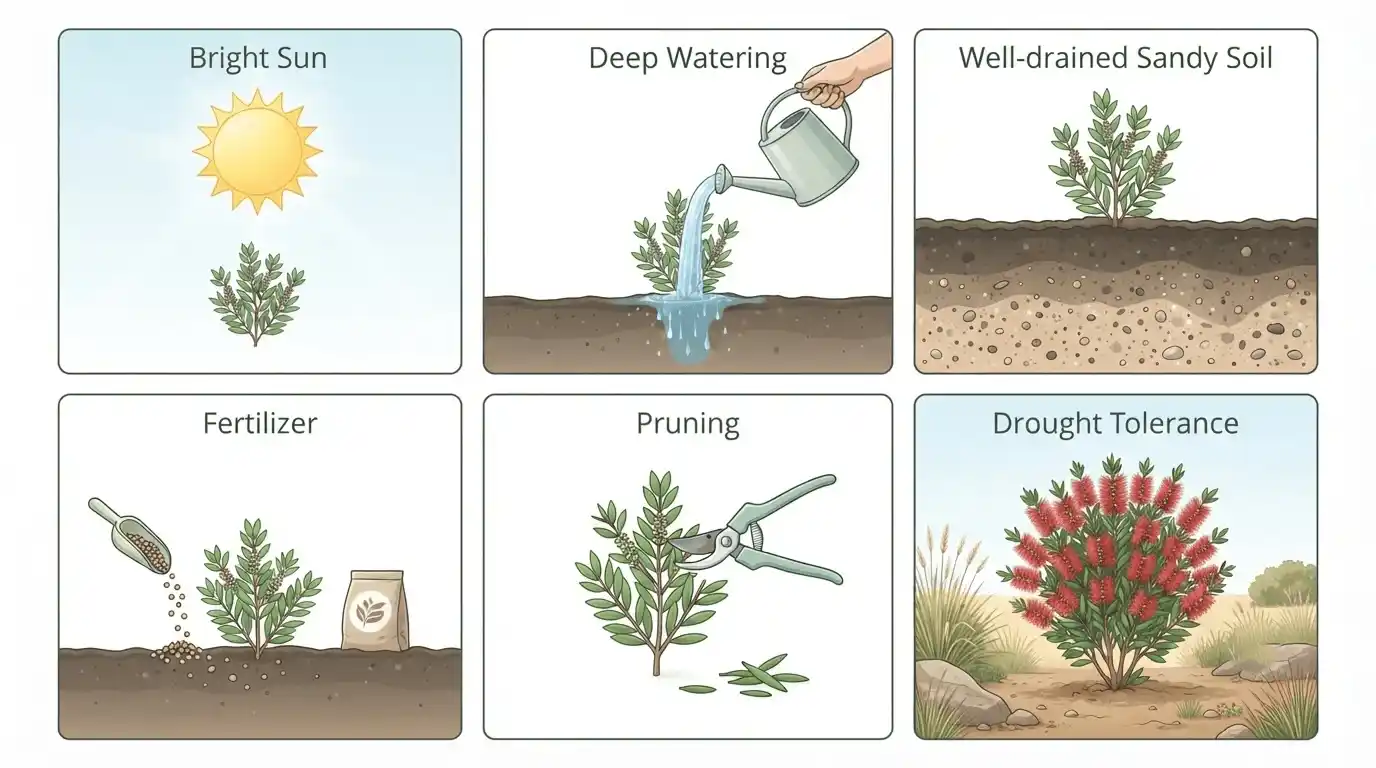
Callistemon Brogo Overflow grows best in full sun, well-drained soil, and requires relatively little maintenance once established. Like many Australian native plants, it rewards gardeners with reliable flowering when provided with suitable growing conditions.
Light Requirements
Sunlight is the single most important factor influencing flowering.
For best performance, provide:
- Full sun for at least six hours daily
- Open positions with good air circulation
- Minimal competition from taller trees
Plants grown in full sun typically produce:
- More flowers
- Denser foliage
- Stronger branching
- Better disease resistance
Although partial shade is tolerated, excessive shade often leads to:
- Sparse flowering
- Reduced branching
- Leggy growth
- Lower overall vigor
Watering Needs
Proper watering depends on the plant’s stage of establishment.
Newly planted shrubs
During the first year:
- Water deeply once or twice each week.
- Allow the soil surface to dry slightly between watering.
- Increase watering during prolonged hot weather.
Established plants
After establishment, Brogo Overflow becomes relatively drought tolerant.
Most established plants require supplemental watering only during extended dry periods.
Avoid:
- Constantly wet soil
- Poor drainage
- Standing water around roots
Excess moisture significantly increases the risk of root diseases.
Greenery Inside recommends watering deeply rather than lightly, as deep watering promotes stronger root systems and improves drought resistance.
Soil Preferences
Callistemon Brogo Overflow performs best in well-drained soils.
Suitable soil types include:
- Sandy soils
- Sandy loams
- Gravelly soils
- Improved loam
Ideal soil characteristics:
| Soil Factor | Preferred Condition |
| Drainage | Excellent |
| Texture | Sandy to loamy |
| Organic Matter | Moderate |
| Soil pH | Slightly acidic to neutral (6.0–7.0) |
Heavy clay soils can support growth if improved with organic matter and drainage amendments.
Poor drainage remains a greater concern than lower fertility.
Fertilizing
Bottlebrush plants generally require only modest fertilization.
Use:
- Low-phosphorus native plant fertilizer
- Slow-release formulations
- Balanced nutrient products formulated for Australian native plants
Feed:
- Early spring
- Lightly again after flowering if necessary
Avoid excessive nitrogen because it encourages lush foliage at the expense of flowers.
Pruning
Pruning immediately after flowering produces the best results.
Benefits include:
- Maintaining the cascading habit
- Encouraging bushier growth
- Improving air circulation
- Increasing future flowering
- Removing damaged stems
Avoid heavy pruning into old woody stems, as recovery may be slower than pruning younger growth.
Light annual pruning usually maintains an attractive natural shape.
Climate and Hardiness
Callistemon Brogo Overflow performs well across many temperate and subtropical Australian regions.
It tolerates:
- Hot summers
- Seasonal drought
- Coastal conditions
- Moderate humidity
- Light frost once established
Young plants should receive some frost protection during their first winter in colder districts.
Overall, this cultivar is well suited to Australian gardens seeking an attractive, low-maintenance native shrub that combines ornamental flowers with dependable year-round evergreen foliage.
Flowering Characteristics and Seasonal Interest
Callistemon Brogo Overflow is prized for its brilliant red bottlebrush flowers, extended seasonal display, and ability to attract a wide range of pollinators. Even when it is not in bloom, its dense evergreen foliage provides year-round structure and color, making it an attractive landscape plant in every season.
The cylindrical flower spikes are made up of hundreds of brightly colored stamens, giving them the familiar “bottlebrush” appearance. Flower production is typically most abundant on healthy plants grown in full sun with moderate feeding and proper pruning.
In our experience growing bottlebrush cultivars, plants that receive at least six hours of direct sunlight and are lightly pruned immediately after flowering consistently produce denser flowering the following season.
Flower Color
Callistemon Brogo Overflow produces vibrant crimson-red bottlebrush flowers that stand out against its narrow green foliage.
Flower characteristics include:
- Bright crimson to deep red flower spikes
- Cylindrical bottlebrush shape
- Rich nectar production
- Numerous colorful stamens
- Attractive contrast with evergreen foliage
The flowers are highly ornamental and remain attractive for several weeks before gradually fading.
Blooming Season
Flowering generally occurs during:
- Spring (main flowering period)
- Early summer
- Occasional lighter repeat flowering during late summer or autumn under favorable conditions
Blooming time may vary slightly depending on:
- Local climate
- Rainfall
- Temperature
- Plant maturity
- Seasonal weather conditions
As of 2026, many Australian growers continue to recommend post-flowering pruning as one of the most effective ways to encourage heavier blooming during the following growing season.
Pollinator Attraction
Like many Australian native plants, Callistemon Brogo Overflow is an excellent wildlife plant.
Its nectar-rich flowers commonly attract:
- Native bees
- European honeybees
- Butterflies
- Honeyeaters
- Lorikeets
- Other nectar-feeding birds
- Beneficial insects
These pollinators improve biodiversity while contributing to healthy garden ecosystems.
Because flowering often coincides with periods of high pollinator activity, Brogo Overflow is an excellent addition to wildlife-friendly gardens.
Nectar Production
The abundant nectar produced by the flowers serves as an important food source for many native Australian birds and insects.
Healthy plants growing under ideal conditions generally produce:
- More flowers
- Higher nectar production
- Longer flowering periods
- Increased wildlife activity
Avoid excessive nitrogen fertilization, as vigorous leafy growth can sometimes reduce flower production.
Evergreen Interest Throughout the Year
Even outside the flowering season, Callistemon Brogo Overflow remains attractive because it retains its foliage year-round.
Its evergreen canopy provides:
- Continuous garden structure
- Soft cascading texture
- Seasonal screening
- Attractive green foliage during winter
- Low-maintenance visual appeal
This combination of evergreen foliage and seasonal flowering makes it valuable in both residential and commercial landscapes.
Landscape Uses of Callistemon Brogo Overflow

Callistemon Brogo Overflow is one of the most versatile compact bottlebrush cultivars for Australian landscapes. Its naturally arching growth habit allows it to function as both a feature shrub and an effective ground-covering plant on difficult sites. To strengthen your native planting design, combine Brogo Overflow with other resilient Australian species such as Australian Native Garden Trees, include pollinator-friendly species from Native Plants That Attract Butterflies, and explore structure-focused species in Best Evergreen Trees for year-round landscape balance.
Unlike upright bottlebrush trees, its cascading branches soften hard landscape edges while requiring relatively little maintenance.
Greenery Inside recommends using this cultivar where its graceful form can spill naturally over retaining walls, rockeries, or raised garden beds for the greatest visual impact.
Ideal landscape applications include:
- Ground cover on slopes to reduce soil erosion
- Rock gardens where cascading branches soften stonework
- Native gardens alongside other Australian shrubs and grasses
- Feature planting near entrances or patios
- Mixed shrub borders for year-round texture
- Large decorative containers on decks and courtyards
- Erosion control on embankments and retaining walls
- Wildlife gardens that support birds, bees, and butterflies
Additional landscape advantages include:
- Compact size suitable for suburban gardens
- Attractive weeping form without becoming invasive
- Excellent drought tolerance once established
- Low pruning requirements
- Strong ornamental value throughout the year
Because of its moderate mature size, Brogo Overflow also works well beneath larger trees where adequate sunlight is available.
Callistemon Brogo Overflow vs Other Bottlebrush Varieties
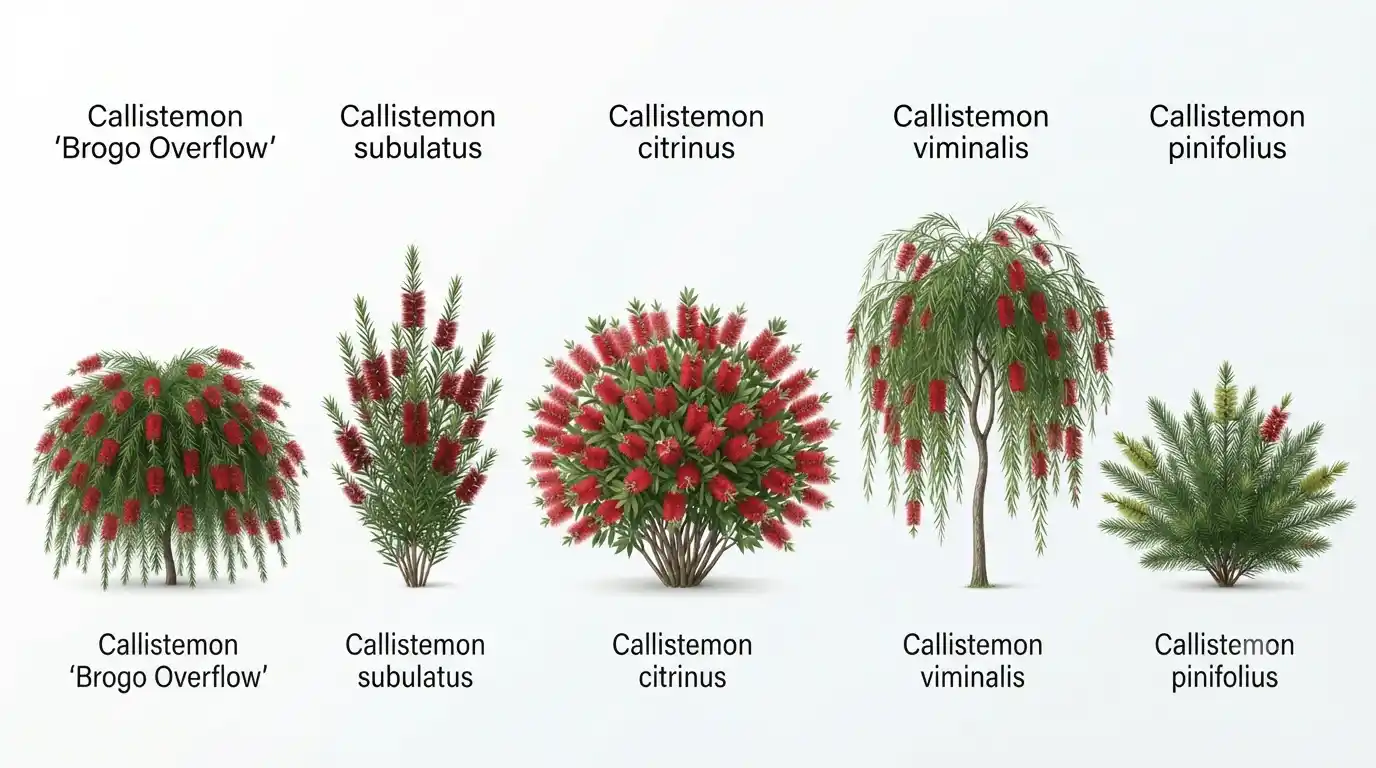
Different bottlebrush species vary considerably in mature size, growth habit, flower color, maintenance needs, and ideal landscape use. Comparing them helps gardeners choose the right plant for available space, climate, and design goals.
Many gardeners are familiar with the classic crimson bottlebrush, commonly known as Callistemon citrinus or its older botanical synonym Callistemon lanceolatus. Others may prefer the elegant Callistemon viminalis, widely known as the weeping bottlebrush, while compact species such as Callistemon pinifolius or Callistemon pachyphyllus suit smaller gardens.
The table below summarizes some of the most widely grown bottlebrush species and cultivars.
Comparison of Popular Bottlebrush Species
| Variety | Mature Size | Growth Habit | Flower Color | Leaf Type | Best Landscape Use | Wildlife Value | Maintenance |
| Callistemon Brogo Overflow | 1–1.5 m × 1.5–2 m | Compact, arching, cascading | Bright red | Narrow evergreen | Slopes, containers, borders, rock gardens | Excellent | Low |
| Callistemon subulatus | 2–3 m | Upright shrub | Red | Fine narrow leaves | Native gardens, screening | High | Low |
| Callistemon citrinus (bottlebrush plant Callistemon citrinus, formerly Callistemon lanceolatus) | 2–4 m | Dense rounded shrub | Crimson red | Aromatic lance-shaped leaves | Feature planting, hedges | Excellent | Moderate |
| Callistemon viminalis (weeping bottlebrush) | 5–10 m | Gracefully weeping tree | Bright red | Long narrow leaves | Parks, large gardens, street trees | Outstanding | Moderate |
| Callistemon pachyphyllus (Melaleuca pachyphylla, wallum bottlebrush) | 2–4 m | Dense shrub | Red to greenish-red | Thick leathery leaves | Coastal gardens | High | Low |
| Callistemon pinifolius | 1–3 m | Compact shrub | Red or green | Pine-like foliage | Rock gardens, small gardens | Moderate | Low |
| Callistemon endeavour | 2–4 m | Upright shrub | Bright scarlet-red | Narrow evergreen leaves | Native landscapes | High | Low |
| Callistemon Cherry Time | 2–3 m | Dense rounded shrub | Cherry-red | Fine green foliage | Flowering feature shrub | Excellent | Low |
Understanding the Differences
Callistemon Brogo Overflow vs Callistemon subulatus
Because Brogo Overflow is closely related to Callistemon subulatus, the two are often confused.
The main differences are:
- Brogo Overflow has a more pronounced cascading habit.
- Callistemon subulatus grows taller and more upright.
- Brogo Overflow generally requires less shaping.
- Both attract birds and pollinators effectively.
Callistemon citrinus (Crimson Bottlebrush)
Callistemon citrinus, commonly called the crimson bottlebrush, is one of Australia’s best-known bottlebrush species.
It features:
- Larger overall size
- Dense upright branching
- Bright crimson flower spikes
- Fragrant leaves when crushed
It is often sold under the older botanical name Callistemon lanceolatus, although Callistemon citrinus is now the accepted horticultural name.
Callistemon viminalis (Weeping Bottlebrush)
The Callistemon viminalis plant develops into a graceful weeping bottlebrush tree with long pendulous branches.
It is also referred to as:
- Weeping bottlebrush
- Weeping bottle brush tree
- Weeping bottle brush trees
- Bottlebrush weeping
- Bottlebrush weeping tree
Because it can reach 10 metres or more, it is better suited to parks, rural landscapes, and larger residential properties than compact gardens.
Callistemon pachyphyllus (Wallum Bottlebrush)
Callistemon pachyphyllus, now frequently classified as Melaleuca pachyphylla, is commonly called the wallum bottlebrush.
It differs from Brogo Overflow through:
- Thicker leaves
- Coastal adaptation
- Dense upright habit
- Greater salt tolerance
Some gardeners also refer to green-flowering selections as Callistemon pachyphyllus green.
Callistemon pinifolius (Green Bottlebrush)
Unlike the traditional red-flowering bottlebrushes, Callistemon pinifolius includes cultivars producing yellow-green flowers.
These are commonly marketed as:
- Callistemon pinifolius green
- Green bottlebrush
- Green bottle brush
- Bottle brush green
Its fine, pine-like foliage provides a noticeably different texture from other bottlebrush species, making it particularly useful in rock gardens and contemporary native landscapes.
Bottlebrush Taxonomy and Name Changes
Bottlebrush plants are currently classified under both Callistemon and Melaleuca because of modern botanical research. While many gardeners still use the traditional Callistemon names, DNA studies have shown that many species are more accurately placed within the genus Melaleuca. As a result, both names are commonly encountered in nurseries, plant labels, and gardening references.
The genus Callistemon has been widely studied in botanical taxonomy due to its close relationship with Melaleuca and ongoing classification updates.
Callistemon (Wikipedia)
The name changes can be confusing, especially when comparing older gardening books with newer botanical publications. Fortunately, the plants themselves remain the same, and gardeners can confidently grow them regardless of which scientific name appears on the label.
Why Are Some Bottlebrushes Called Melaleuca?
Historically, bottlebrushes were classified under the genus Callistemon because of their distinctive cylindrical flower spikes and growth habits.
However, advances in botanical genetics revealed that many bottlebrushes are closely related to paperbarks (Melaleuca). To reflect these evolutionary relationships, taxonomists transferred many species into the genus Melaleuca.
For gardeners, this means you may see both names used interchangeably.
Common examples include:
| Traditional Name | Modern Botanical Name |
| Callistemon viminalis | Melaleuca viminalis |
| Callistemon pachyphyllus | Melaleuca pachyphylla |
| Callistemon citrinus | Melaleuca citrina (accepted in many botanical references) |
| Callistemon subulatus | Melaleuca subulata |
Despite these updates, many nurseries continue using the traditional Callistemon names because they are more familiar to home gardeners.
Why Do Garden Centers Still Use Callistemon?
Most retail nurseries prioritize names that customers recognize.
Reasons include:
- Long-standing use in horticulture
- Easier plant identification for gardeners
- Consistency with older gardening books
- Consumer familiarity
As a result, it is common to find labels such as:
- Callistemon Brogo Overflow
- Callistemon citrinus
- Callistemon viminalis
Even though botanical databases may list the same plants under Melaleuca.
In our experience, focusing on the cultivar name—such as ‘Brogo Overflow’—is more important than the genus name because the cultivar remains the same regardless of taxonomic updates.
Common Problems and How to Fix Them
Callistemon Brogo Overflow is generally a hardy, low-maintenance shrub, but improper growing conditions can lead to reduced flowering, poor growth, or pest problems. Most issues can be prevented by providing full sun, excellent drainage, and appropriate watering.
In our experience, the majority of problems arise during the establishment phase, particularly from overwatering or planting in heavy clay soils.
Poor Flowering
Poor flowering is usually caused by environmental or maintenance factors rather than disease.
Common causes:
- Too much shade
- Excess nitrogen fertilizer
- Pruning at the wrong time
- Immature plants
- Prolonged drought during bud formation
How to fix it:
- Provide at least six hours of direct sunlight daily.
- Apply a low-phosphorus fertilizer formulated for Australian native plants.
- Prune immediately after flowering instead of before the blooming season.
- Water deeply during extended dry periods while flower buds are forming.
- Avoid excessive nitrogen fertilization, which encourages leafy growth instead of flowers.
Healthy, mature plants usually produce heavier flowering each year once fully established.
Yellow Leaves
Yellow leaves often indicate root stress or nutrient imbalance rather than a serious disease.
Possible causes include:
- Poor drainage
- Waterlogged soil
- Iron deficiency
- Nitrogen deficiency
- Root damage
- Extended drought
Solutions:
- Improve soil drainage before planting.
- Water only when needed and avoid constantly wet soil.
- Apply a suitable native plant fertilizer if nutrients are deficient.
- Inspect irrigation systems to prevent overwatering.
- Remove damaged branches if root stress has occurred.
Temporary yellowing after transplanting is fairly common and usually improves as the root system establishes.
Slow Growth
Young Callistemon Brogo Overflow plants naturally spend their first year developing a healthy root system before producing vigorous top growth.
Factors that may slow development include:
- Heavy or compacted soil
- Limited sunlight
- Poor soil fertility
- Root competition from nearby plants
- Water stress
- Cool temperatures
To encourage healthy growth:
- Plant in well-drained soil.
- Water consistently during establishment.
- Feed lightly with a slow-release native plant fertilizer in spring.
- Keep weeds away from the base of the shrub.
- Apply mulch to retain moisture while keeping it clear of the trunk.
Growth typically becomes more vigorous after the first one to two growing seasons.
Pests and Diseases
Callistemon Brogo Overflow is relatively resistant to serious pests and diseases, but occasional problems can occur.
Common pests:
- Scale insects
- Aphids
- Leaf-chewing caterpillars
Common diseases:
- Sooty mold
- Root rot
- Minor fungal leaf spot
| Problem | Cause | Recommended Solution |
| Scale insects | Sap feeding | Remove manually or treat with horticultural oil |
| Aphids | Feeding on young shoots | Wash off with water or encourage beneficial insects |
| Sooty mold | Honeydew from sap-sucking insects | Eliminate the insect infestation first |
| Root rot | Poor drainage | Improve drainage and reduce watering |
| Leaf spot | Prolonged wet foliage | Improve air circulation and remove affected leaves |
Regular inspections during spring and summer help detect problems before they become severe.
Beginner Mistakes to Avoid
Many growing problems can be prevented by following a few basic bottlebrush care practices. New gardeners often make mistakes that reduce flowering or weaken the plant during establishment.
Avoid these common mistakes:
- Planting in heavy clay without improving drainage
- Overwatering established plants
- Applying excessive fertilizer, especially high-nitrogen products
- Pruning before or during the flowering season
- Choosing a location with insufficient sunlight
- Crowding surrounding plants and restricting airflow
- Using containers that are too small
- Ignoring seasonal watering adjustments during hot, dry weather
From our experience, allowing young plants to establish naturally during their first year produces healthier long-term growth than trying to speed development with heavy feeding.
Choosing the Right Bottlebrush for Your Garden
The best bottlebrush variety depends on your available space, climate, preferred flower color, and maintenance expectations. Although all bottlebrush species provide ornamental flowers and attract wildlife, they differ significantly in mature size and growth habit.
Consider Your Garden Size
Choose a variety that fits comfortably into the available space.
- Small gardens: Callistemon Brogo Overflow, Callistemon pinifolius
- Medium gardens: Callistemon subulatus, Callistemon Cherry Time
- Large landscapes: Callistemon viminalis, Callistemon citrinus
Match the Local Climate
Most bottlebrush varieties thrive in:
- Temperate climates
- Subtropical regions
- Coastal areas
- Warm, sunny locations
Young plants may require temporary frost protection during their first winter in cooler regions.
Select Your Preferred Flower Color
Bottlebrush varieties offer several attractive flower colors, including:
- Bright crimson red
- Scarlet red
- Cherry red
- Red-green combinations
- Green flowers in selected Callistemon pinifolius cultivars
Combining different flowering varieties can extend seasonal interest in native landscapes.
Choose the Right Growth Habit
| Growth Habit | Recommended Variety |
| Cascading | Callistemon Brogo Overflow |
| Upright shrub | Callistemon subulatus |
| Dense rounded shrub | Callistemon citrinus |
| Graceful weeping tree | Callistemon viminalis |
| Compact shrub for rock gardens | Callistemon pinifolius |
Consider Wildlife Value
Nearly all bottlebrush plants provide valuable nectar for birds and pollinating insects.
Excellent choices for wildlife-friendly gardens include:
- Callistemon Brogo Overflow
- Callistemon citrinus
- Callistemon viminalis
- Callistemon endeavour
Think About Maintenance
If you prefer a low-maintenance garden:
- Select compact cultivars that require minimal pruning.
- Plant in full sun with well-drained soil.
- Water regularly only during establishment.
- Feed lightly with a native plant fertilizer when needed.
Callistemon Brogo Overflow is an excellent option for gardeners seeking a compact, attractive shrub that offers reliable flowering with relatively little maintenance.
Conclusion
Callistemon Brogo Overflow is an excellent compact bottlebrush cultivar that combines graceful cascading branches, vibrant red flowers, and evergreen foliage in a size perfectly suited to modern landscapes. Closely related to Callistemon subulatus, it offers all the ornamental appeal of traditional bottlebrush plants while remaining easier to manage in smaller gardens, containers, rockeries, and erosion-control plantings.
With full sun, well-drained soil, moderate watering during establishment, and light pruning after flowering, this Australian native shrub provides years of dependable growth and seasonal color. Its nectar-rich blooms also support birds, bees, butterflies, and other beneficial pollinators, making it a valuable addition to wildlife-friendly gardens.
Whether you’re creating a native landscape, planting a feature shrub, or looking for a low-maintenance flowering plant, Callistemon Brogo Overflow is a versatile choice. Comparing it with other bottlebrush varieties such as Callistemon citrinus, Callistemon viminalis, and Callistemon pinifolius will help you select the variety that best fits your garden size, climate, and landscape goals.
Frequently Asked Questions
What is Callistemon Brogo Overflow?
Callistemon Brogo Overflow is a compact, cascading Australian bottlebrush cultivar known for its arching branches, evergreen foliage, and bright red bottlebrush flowers. It is widely used in native gardens, borders, rock gardens, and containers because of its manageable size and low-maintenance growth habit.
How large does Callistemon Brogo Overflow grow?
A mature Callistemon Brogo Overflow generally grows 1–1.5 metres (3–5 feet) tall and 1.5–2 metres (5–6.5 feet) wide. Its spreading, cascading habit makes it wider than it is tall, making it ideal for compact landscapes.
Is Callistemon Brogo Overflow the same as Callistemon subulatus?
No. Although closely related to Callistemon subulatus, Brogo Overflow is a cultivated selection with a more compact size and distinctive cascading growth habit. Callistemon subulatus typically grows taller with a more upright form.
Does Callistemon Brogo Overflow attract birds and pollinators?
Yes. Its nectar-rich flowers attract honeyeaters, lorikeets, native bees, butterflies, honeybees, and many other beneficial pollinators, making it an excellent choice for wildlife gardens.
Can Callistemon Brogo Overflow grow in pots?
Yes. It grows successfully in large containers with excellent drainage and full sun. Container-grown plants require more frequent watering than those planted in the ground and benefit from occasional light pruning to maintain their shape.
How often should Callistemon Brogo Overflow be pruned?
Light pruning once each year immediately after flowering is usually sufficient. This encourages denser growth, preserves the cascading form, and promotes heavier flowering during the following season.
Is Callistemon Brogo Overflow drought tolerant?
Yes. Once established, Callistemon Brogo Overflow is highly drought tolerant and generally needs supplemental watering only during prolonged dry periods. Young plants should be watered regularly during their first growing season to establish a deep, healthy root system.