Introduction
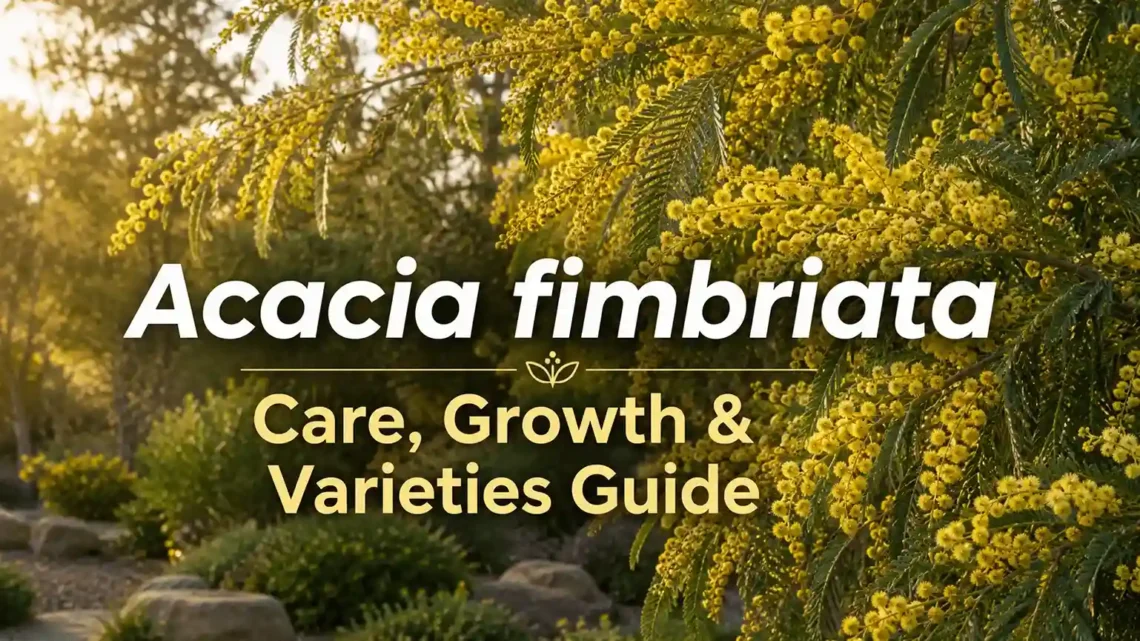
Acacia fimbriata, commonly known as the Fringed Wattle or Brisbane Wattle, is a native Australian shrub or small tree celebrated for its feathery golden-yellow flowers and graceful, weeping form. Native to subtropical regions of southeast Queensland and northeast New South Wales, this attractive member of the Fabaceae (legume) family is widely valued for both its ornamental beauty and ecological benefits.
In its natural habitat, Acacia fimbriata grows in open forests, woodland margins, and sheltered slopes, where it contributes to local biodiversity by providing food and habitat for native wildlife. The species is particularly admired for its masses of fragrant golden flower clusters that appear from late winter into spring, creating a striking display when many other plants are still dormant.
One of the reasons the Brisbane Wattle is so popular among gardeners and landscapers is its adaptability. Depending on the variety, growing conditions, and pruning practices, it can develop as a compact shrub suitable for smaller gardens or mature into a larger small tree that provides screening, structure, and seasonal color. Its fast growth rate, tolerance of a range of soil types, and relatively low maintenance requirements make it a practical choice for residential landscapes and native garden designs.
Whether you are searching for plant identification information, care recommendations, growth habits, dwarf varieties, or landscape applications, Acacia fimbriata offers a versatile and rewarding option for gardeners, landscapers, and Australian native plant enthusiasts alike.
Quick Summary
- What it is: Acacia fimbriata is a fast-growing Australian native shrub or small tree in the Fabaceae (legume) family, naturally occurring in subtropical regions of southeast Queensland and northeast New South Wales.
- Common names: It is commonly known as the Fringed Wattle, Brisbane Wattle, or Fringe Wattle, reflecting its distinctive foliage and geographic origins.
- Key feature: The plant produces masses of fragrant, golden-yellow spherical flowers from late winter to spring, while its fine, feathery phyllodes create a soft, elegant, and slightly weeping appearance.
- Growth habit: Depending on the variety and growing conditions, Acacia fimbriata can develop as a compact shrub, dense hedge, or small ornamental tree.
- Best use: Ideal for screening, hedging, wildlife-friendly gardens, erosion control, and low-maintenance landscaping, with dwarf varieties particularly well suited to small gardens, borders, patios, and large containers.
What Is Acacia Fimbriata? (Identification & Overview)
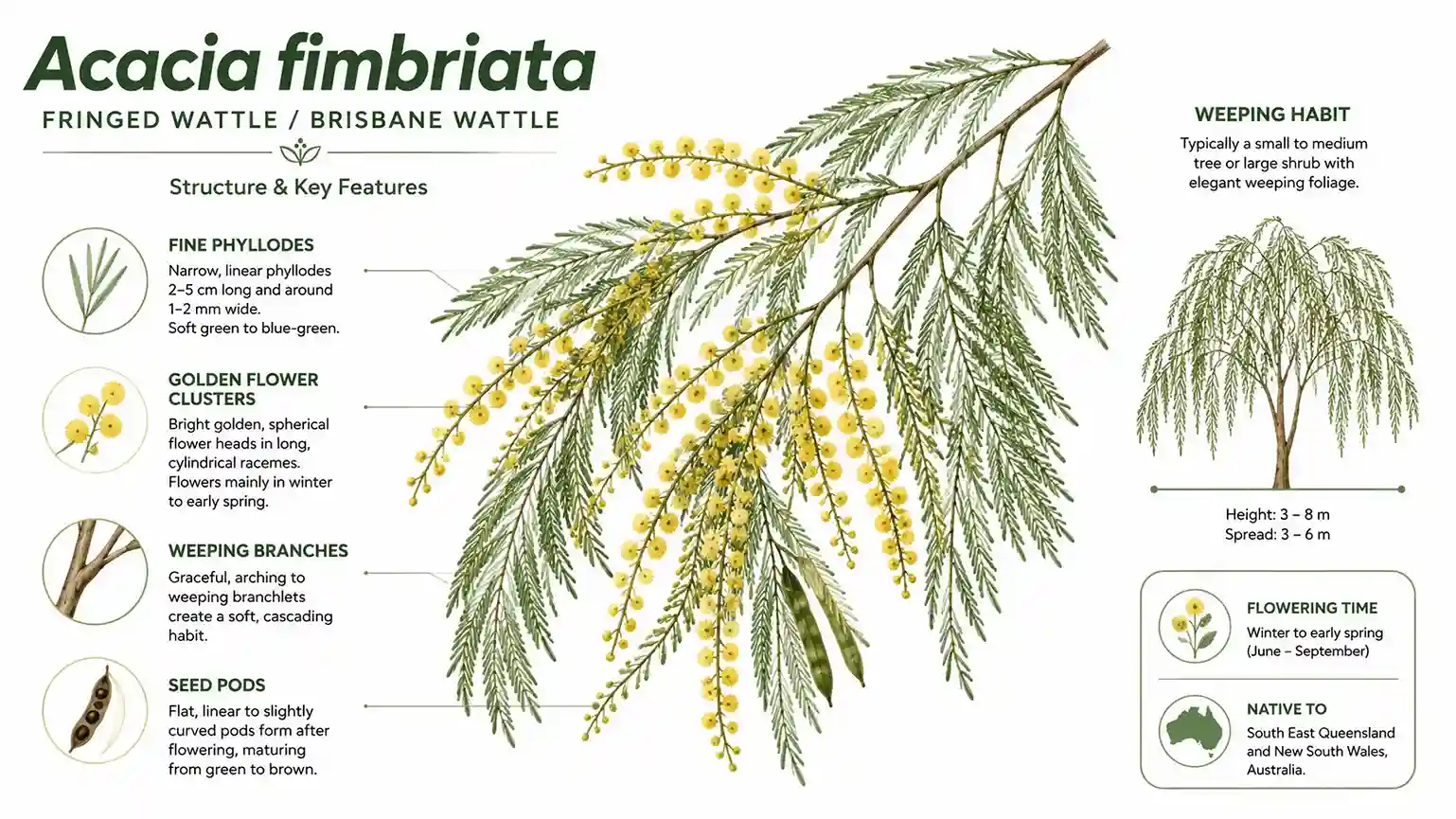
Acacia fimbriata is a flowering Australian native plant belonging to the Fabaceae (Leguminosae) family, commonly known as the pea or legume family. It is widely recognized as one of Australia’s most ornamental wattles due to its attractive foliage, abundant golden flowers, and adaptable growth habit. Depending on growing conditions and cultivar selection, it can develop as a dense shrub or a small tree, making it suitable for a wide range of landscape applications. According to botanical references from the Australian Native Plants Society (ANPSA), Acacia fimbriata is widely recognized as a valuable subtropical ornamental wattle species.
The common name Fringed Wattle or Fringe Wattle comes from the plant’s distinctive phyllodes. Unlike true leaves, wattles produce phyllodes—flattened leaf-like structures that perform the function of leaves. In Acacia fimbriata, these phyllodes are narrow, finely textured, and subtly fringed along their margins, giving the plant a delicate, feathery appearance.
The species is also frequently called the Brisbane Wattle or Brisbane Golden Wattle because of its strong geographic association with the Brisbane region and surrounding areas of southeast Queensland. In its native range, Acacia fimbriata naturally occurs throughout parts of southeast Queensland and extends into northeastern New South Wales, where it grows in forests, woodland edges, and sheltered landscapes.
Several features make the Acacia tree Brisbane gardeners commonly grow easy to identify:
- Fine, narrow phyllodes with a soft, textured appearance
- Fringed leaf margins that contribute to its common name
- Bright golden-yellow spherical flower heads produced in dense clusters
- Fragrant blooms appearing from late winter through spring
- Graceful, slightly weeping branches that create an elegant silhouette
- Dense evergreen foliage that provides year-round garden structure
During its flowering season, the plant becomes covered with masses of golden flower balls that attract pollinators and create a striking visual display. The contrast between the vivid yellow flowers and the fine green foliage is one of the primary reasons the Fringed Wattle remains popular in Australian native gardens.
Compared with many other wattle species, Acacia fimbriata combines ornamental appeal with practical landscape value. Its manageable size, fast growth, wildlife benefits, and adaptability have established it as one of the most widely planted native wattles in residential gardens, public landscapes, and ecological restoration projects throughout suitable regions of Australia.
Whether referred to as the Fringed Wattle, Fringe Wattle, Brisbane Wattle, or Brisbane Golden Wattle, Acacia fimbriata is valued for its distinctive foliage, abundant flowering, and reputation as one of Australia’s most attractive native ornamental trees and shrubs.
Acacia Fimbriata Size — How Big Does It Grow?
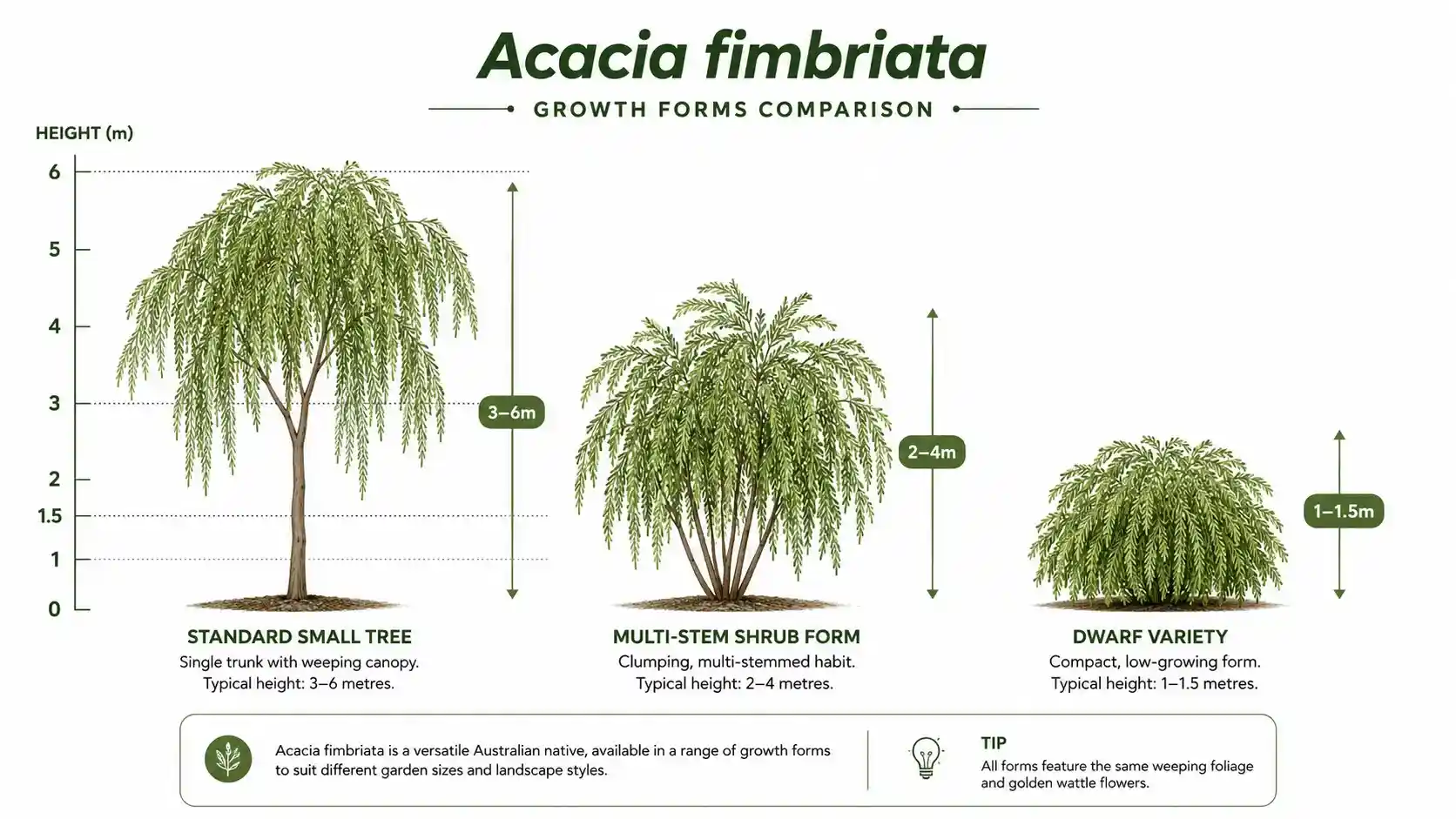
The typical Acacia fimbriata size depends on the variety, growing conditions, and how the plant is managed over time. The standard species generally reaches 3–6 metres in height and 2–4 metres in width at maturity. In ideal conditions with good soil, adequate moisture, and minimal competition from nearby plants, some specimens can grow as tall as 8 metres.
As a fast-growing native plant, Acacia fimbriata can establish quickly and develop into a substantial landscape feature within a relatively short period. Its mature size makes it suitable for privacy screening, wildlife planting, windbreaks, and feature tree applications.
Several factors influence final Acacia fimbriata height and spread:
- Soil quality: Well-drained soils encourage stronger and more vigorous growth.
- Water availability: Regular moisture during establishment promotes faster development.
- Sun exposure: Full sun typically produces denser growth and better flowering.
- Pruning history: Regular pruning can maintain a more compact shape and reduce overall size.
- Plant selection: Standard forms grow significantly larger than dwarf cultivars.
- Climate conditions: Warm subtropical and temperate regions often support the most vigorous growth.
It is important to distinguish between the standard species and dwarf selections. Standard Acacia fimbriata can become a medium-sized shrub or small tree suitable for larger landscapes, while dwarf cultivars remain much more compact and are better suited to smaller gardens, borders, and containers. These compact forms are discussed in detail in the dedicated dwarf varieties section below.
The growth habit of an Acacia fimbriata tree can also vary depending on management. Left unpruned, many plants naturally develop multiple stems from the base, creating a broad, dense shrub. With selective pruning and training, however, the plant can form a more upright single-trunk structure that resembles a small ornamental tree.
Acacia Fimbriata as a Tree vs. Shrub
Acacia fimbriata can be grown either as a small tree or as a bushy shrub, depending on its genetics and how it is pruned during its early years.
When allowed to grow naturally, the plant often develops multiple stems and dense branching from the base. This creates a full, rounded shrub that works well for screening, informal hedging, wildlife habitat, and privacy planting. The shrub form is especially valued in native gardens where dense foliage provides shelter for birds and beneficial insects.
To create a tree form, gardeners typically remove lower branches and select a dominant central leader. Over time, this training process encourages the development of a clear trunk and elevated canopy. Light formative pruning during the first few years is usually sufficient to establish the desired structure.
Tree form advantages:
- Creates a striking ornamental focal point
- Allows underplanting beneath the canopy
- Provides filtered shade
- Suitable for feature planting in larger landscapes
Shrub form advantages:
- Produces dense screening and privacy
- Offers better wind protection
- Supports wildlife habitat
- Requires less structural pruning
Whether grown as a tree or shrub, Acacia fimbriata retains its characteristic fine-textured foliage, graceful branching habit, and spectacular display of golden flowers. The choice between the two forms largely depends on available space and the desired landscape function.
Acacia Fimbriata Dwarf Varieties — Compact Forms for Small Gardens
While the standard species can develop into a substantial shrub or small tree, several compact cultivars have been selected or bred specifically for smaller landscapes. These dwarf forms retain the attractive foliage, golden flowers, and wildlife value of the species while requiring far less space. As a result, they are popular choices for urban gardens, courtyards, balconies, containers, low hedges, and native garden borders.
For gardeners seeking the beauty of a dwarf fringed wattle without the size of the full species, these compact varieties offer an excellent solution.
Acacia fimbriata ‘Dwarf’
Often referred to simply as Acacia fimbriata Dwarf, this compact selection typically reaches 1–1.5 metres in height and 1–2 metres in width. It maintains the same fine green phyllodes and golden flower display as the standard species but in a much more manageable form.
Its dense growth habit makes it particularly useful for:
- Low informal hedges
- Native garden borders
- Foundation plantings
- Small residential gardens
- Large containers and patio plantings
Because of its compact nature, this dwarf acacia generally requires less pruning to maintain its shape than the standard species.
Acacia fimbriata ‘Crimson Blush’
Among all cultivated forms, Acacia fimbriata ‘Crimson Blush’ is one of the most distinctive and widely admired. This cultivar combines the species’ famous golden flowers with attractive new growth that emerges in shades of pinkish-red, bronze, or crimson.
Typically reaching 1.5–2 metres tall and wide, it provides year-round ornamental interest. The colorful foliage tips create a striking contrast against the mature green foliage and become even more dramatic when paired with the bright yellow flower clusters that appear in late winter and spring.
The combination of colorful foliage and flowering performance has made Acacia fimbriata Crimson Blush a favorite feature plant in contemporary Australian landscapes.
Acacia fimbriata ‘Dwarf Crimson Blush’
For gardeners with limited space, Acacia fimbriata Dwarf Crimson Blush offers the best features of the Crimson Blush cultivar in an even smaller package. This compact selection generally reaches around 1 metre in height and width, making it suitable for tight garden spaces, decorative containers, low borders, and compact hedges.
Like its larger counterpart, it produces colorful crimson-toned new growth followed by the species’ signature golden flowers. Its smaller size allows gardeners to enjoy the ornamental benefits of Crimson Blush even in urban settings where space is limited.
Acacia Fimbriata Variety Comparison
| Variety | Height | Width | Foliage Feature | Best Use |
| Standard A. fimbriata | 3–6m | 2–4m | Fine green phyllodes | Screen, windbreak, tree |
| Dwarf Fringed Wattle | 1–1.5m | 1–2m | Fine green phyllodes | Small garden, hedge |
| Crimson Blush | 1.5–2m | 1.5–2m | Crimson/bronze new growth | Feature plant, contrast planting |
| Dwarf Crimson Blush | ~1m | ~1m | Crimson/bronze new growth | Pot, border, low hedge |
These compact forms have expanded the versatility of dwarf wattle trees and shrubs, allowing gardeners to incorporate native Australian plants into landscapes where the standard species may be too large.
Common applications include:
- Low-maintenance hedging
- Feature planting near entrances
- Courtyard gardens
- Balcony and patio containers
- Native-themed borders
- Wildlife-friendly urban gardens
Acacia Fimbriata ‘Crimson Blush’ — What Makes It Different?
Acacia fimbriata ‘Crimson Blush’ stands out because of its distinctive foliage coloration. While most Fringed Wattles produce only green foliage, Crimson Blush develops vibrant bronze, pink-red, or crimson-colored new growth that creates visual interest throughout active growing periods.
This colorful flush of foliage contrasts beautifully with the plant’s golden-yellow flower heads, creating one of the most striking color combinations among Australian native shrubs. The result is a plant that delivers ornamental value even when not in peak bloom.
In terms of toughness and adaptability, Crimson Blush generally retains the same hardy characteristics as the standard species. It remains relatively drought tolerant once established, adapts to a variety of well-drained soils, and performs well in full sun to partial shade.
Key advantages of Crimson Blush include:
- Distinctive crimson and bronze new growth
- Attractive contrast between foliage and flowers
- Compact, manageable size
- Strong suitability for feature planting
- Wildlife-friendly flowers that attract pollinators
- Year-round ornamental appeal
Its unique appearance has made it increasingly popular in Australian horticulture, particularly among gardeners seeking native plants with enhanced ornamental features. Today, Crimson Blush and Dwarf Crimson Blush are commonly stocked by specialist native plant nurseries and are frequently recommended for modern Australian garden designs where color, texture, and low maintenance are priorities.
Acacia Fimbriata as a Hedge — Is It Suitable for Screening?
Yes, Acacia fimbriata is highly suitable for hedging and screening. Its dense, fine-textured foliage, rapid growth rate, and attractive flowering display make it one of the more versatile Australian native plants for creating privacy screens, boundary plantings, and informal hedges. Whether grown as the standard species or in a compact dwarf form, an Acacia fimbriata hedge can provide both practical screening and ornamental appeal.
In mixed native hedge designs, Acacia fimbriata is often combined with climbers like those described in Hardenbergia Hedge Guide: 8+ Essential Growth Tips for layered screening effects.
One of the main reasons gardeners choose the Fringed Wattle for screening is its naturally dense growth habit. The fine green phyllodes create a soft yet effective visual barrier, while the plant’s fast establishment allows new hedges to fill in relatively quickly compared to many slower-growing shrubs.
Key benefits of using Acacia fimbriata as a hedge include:
- Dense evergreen foliage for year-round coverage
- Fast growth and quick establishment
- Attractive golden-yellow flowers during late winter and spring
- Wildlife-friendly habitat for birds and pollinators
- Adaptability to a range of soil types
- Native Australian species suitable for biodiversity-focused gardens
Unlike some screening plants that offer privacy but little ornamental value, Acacia fimbriata combines both functions. During its flowering season, the hedge becomes covered with masses of golden flower heads, adding seasonal color and fragrance while maintaining its screening role.
Recommended Hedge Spacing
For a dense hedge or privacy screen, plants are typically spaced 1–1.5 metres apart. The exact spacing depends on the desired effect and the variety selected.
General spacing guidelines include:
- 1 metre apart: Creates a faster-forming, denser screen.
- 1.2–1.5 metres apart: Suitable for a more natural hedge with room for individual plant development.
- Dwarf cultivars: May be planted slightly closer together for compact, low hedges.
Providing adequate spacing also improves airflow between plants, reducing the risk of moisture-related issues and promoting healthier long-term growth.
Pruning for a Dense Hedge
Proper pruning is essential for maintaining an attractive and long-lasting hedge. The best time to prune Acacia fimbriata is immediately after flowering, typically in late spring.
Post-flowering pruning offers several benefits:
- Maintains a dense, compact shape
- Encourages fresh growth
- Prevents the hedge from becoming woody and sparse
- Preserves flower production for the following season
- Helps control overall height and width
Light to moderate trimming is usually sufficient. Heavy pruning during the wrong season may remove developing flower buds and reduce the next flowering display.
Dwarf Varieties vs. Standard Species for Hedging
Different forms of Acacia fimbriata suit different screening needs.
Dwarf varieties are ideal for:
- Low formal hedges
- Garden borders
- Pathway edging
- Courtyard gardens
- Small urban landscapes
Standard Acacia fimbriata is better suited for:
- Tall privacy screens
- Boundary planting
- Wind protection
- Wildlife corridors
- Informal native hedges
The choice largely depends on the available space and the desired hedge height.
Pros and Cons of Acacia Fimbriata Hedges
Like any screening plant, Acacia fimbriata offers both advantages and limitations.
| Pros | Cons |
| Fast-growing and quick to establish | Shorter lifespan than many large trees |
| Attractive flowering display | May require periodic renewal planting |
| Dense year-round foliage | Needs occasional pruning to maintain shape |
| Supports birds, bees, and pollinators | Can become leggy if neglected |
| Adaptable to many soil types | Poor drainage can reduce longevity |
| Native Australian species | Not as long-lived as some evergreen screening trees |
For many gardeners, the benefits outweigh the drawbacks. While wattles are generally considered shorter-lived than large canopy trees, their rapid growth and ornamental value often make them an excellent choice for creating effective screens in a relatively short period.
When properly planted, watered during establishment, and pruned after flowering, an Acacia fimbriata hedge can provide years of attractive privacy, seasonal color, and wildlife habitat while contributing to a low-maintenance native landscape.
Acacia Fimbriata Growth Rate
Acacia fimbriata is classified as a fast-growing native shrub or small tree, making it one of the quicker-establishing wattles in Australian gardens and landscapes. Under favourable conditions, it can develop rapidly into a dense screen or ornamental feature, often providing noticeable structure within just a few growing seasons.
Its fast establishment is comparable to other quick screening plants such as Ficus Flash Growth Rate: 7+ Proven Facts for Faster Hedges used in privacy landscaping.
In optimal environments, the typical annual growth rate ranges from moderate to fast, with young plants commonly adding significant height and canopy spread each year. This rapid establishment is one of the main reasons it is widely used in screening, revegetation, and wildlife planting projects.
Seasonal Growth Patterns
The growth of Acacia fimbriata follows a clear seasonal rhythm:
- Spring to Summer: Peak growth period with active shoot development, leaf expansion, and canopy thickening.
- Autumn: Growth gradually slows as temperatures cool and moisture levels fluctuate.
- Winter: Minimal vegetative growth, though flowering often occurs during late winter, depending on local climate conditions.
- Dry periods: Growth may slow significantly during drought stress, especially in young plants without established root systems.
This seasonal cycle means the plant can appear to grow very quickly during favourable months, then slow noticeably during cooler or drier conditions.
Factors That Influence Growth Rate
Several environmental and management factors directly affect the Acacia fimbriata growth rate:
- Water availability: Consistent moisture during establishment greatly accelerates early growth.
- Soil fertility: While the plant tolerates poor soils, moderately fertile, well-drained soils support faster development.
- Sun exposure: Full sun conditions promote stronger, denser, and faster growth compared to shaded locations.
- Pruning practices: Light pruning encourages branching and bushier growth, while neglect can lead to uneven structure.
- Climate conditions: Warm subtropical and temperate climates typically produce the most vigorous growth response.
Advantages of Fast Growth
The rapid growth habit of Acacia fimbriata provides several important benefits in landscape design:
- Quick screening and privacy: Ideal for gardeners needing fast hedge establishment.
- Rapid ecological value: Quickly provides habitat for birds and pollinators.
- Fast landscape impact: Creates visual structure in newly designed gardens within a short timeframe.
Considerations of Fast Growth
However, fast growth also introduces some management considerations:
- Earlier pruning requirements: Regular pruning is needed sooner to maintain shape and density.
- Structural management: Without early training, plants may become leggy or uneven.
- Shorter maintenance cycle: Faster development may lead to earlier aging compared to slower-growing species.
Overall, the fast growth rate of Acacia fimbriata is a major advantage when properly managed, offering gardeners a reliable balance between rapid establishment, ornamental value, and long-term landscape performance.
Acacia Fimbriata Lifespan — How Long Does It Live?
The Acacia fimbriata lifespan typically ranges from 10 to 25 years, depending on environmental conditions, soil quality, and maintenance practices. Like many Australian wattles, it is considered a relatively short-lived shrub or small tree when compared to long-living species such as eucalypts, which can persist for many decades or even centuries.
Despite its shorter lifespan, Acacia fimbriata is valued in landscaping because it grows quickly, establishes early structure, and provides strong ornamental impact during its peak years.
Factors Affecting Lifespan
Several environmental and management factors influence how long Acacia fimbriata will remain healthy and productive:
- Soil drainage: Poorly drained soils can significantly reduce lifespan by increasing the risk of root rot and fungal issues.
- Pruning regime: Correct pruning after flowering encourages healthy regrowth, while incorrect or excessive pruning into old wood may shorten longevity.
- Climate stress: Extreme heat, frost exposure, or prolonged drought can reduce long-term plant vigor.
- Root competition: Nearby aggressive plants or overcrowded planting conditions can limit nutrient and water access.
- Water management: Overwatering or underwatering, especially during establishment, can negatively affect long-term survival.
When grown in well-prepared soil with appropriate care, Acacia fimbriata can remain vigorous for many years before showing signs of natural decline.
Lifecycle of Acacia Fimbriata
The life cycle of Acacia fimbriata generally follows a predictable pattern:
- Rapid establishment phase: The plant grows quickly, developing a strong root system and structural framework.
- Peak flowering years: The most visually impressive stage, with abundant golden flower displays and dense foliage.
- Mature phase: Growth slows slightly while maintaining structure and flowering consistency.
- Gradual decline: Over time, branches may become woody, flowering may reduce, and overall vigor declines.
This lifecycle pattern is typical of many wattles, which prioritize fast growth and early reproduction over extreme longevity.
Succession Planting Strategy
Because of its relatively short lifespan, gardeners often use a succession planting strategy with Acacia fimbriata. This involves planting new specimens every few years to ensure continuous coverage and maintain landscape consistency as older plants age out.
Common approaches include:
- Replanting new seedlings before older plants decline
- Staggered planting in hedges for continuous replacement
- Mixing age groups within larger planting schemes for long-term stability
Lifespan of Dwarf Varieties
Dwarf forms of Acacia fimbriata generally follow a similar lifespan range of 10–25 years, although environmental conditions and care practices remain the primary determining factors. In some cases, compact varieties may appear longer-lasting in small gardens due to reduced structural stress and easier maintenance, but they are not inherently significantly longer-lived than the standard species.
Overall, the Acacia fimbriata lifespan reflects its ecological strategy: rapid growth, early maturity, and strong ornamental performance within a moderate life cycle, making it ideal for dynamic and evolving garden designs.
Acacia Fimbriata Care Guide
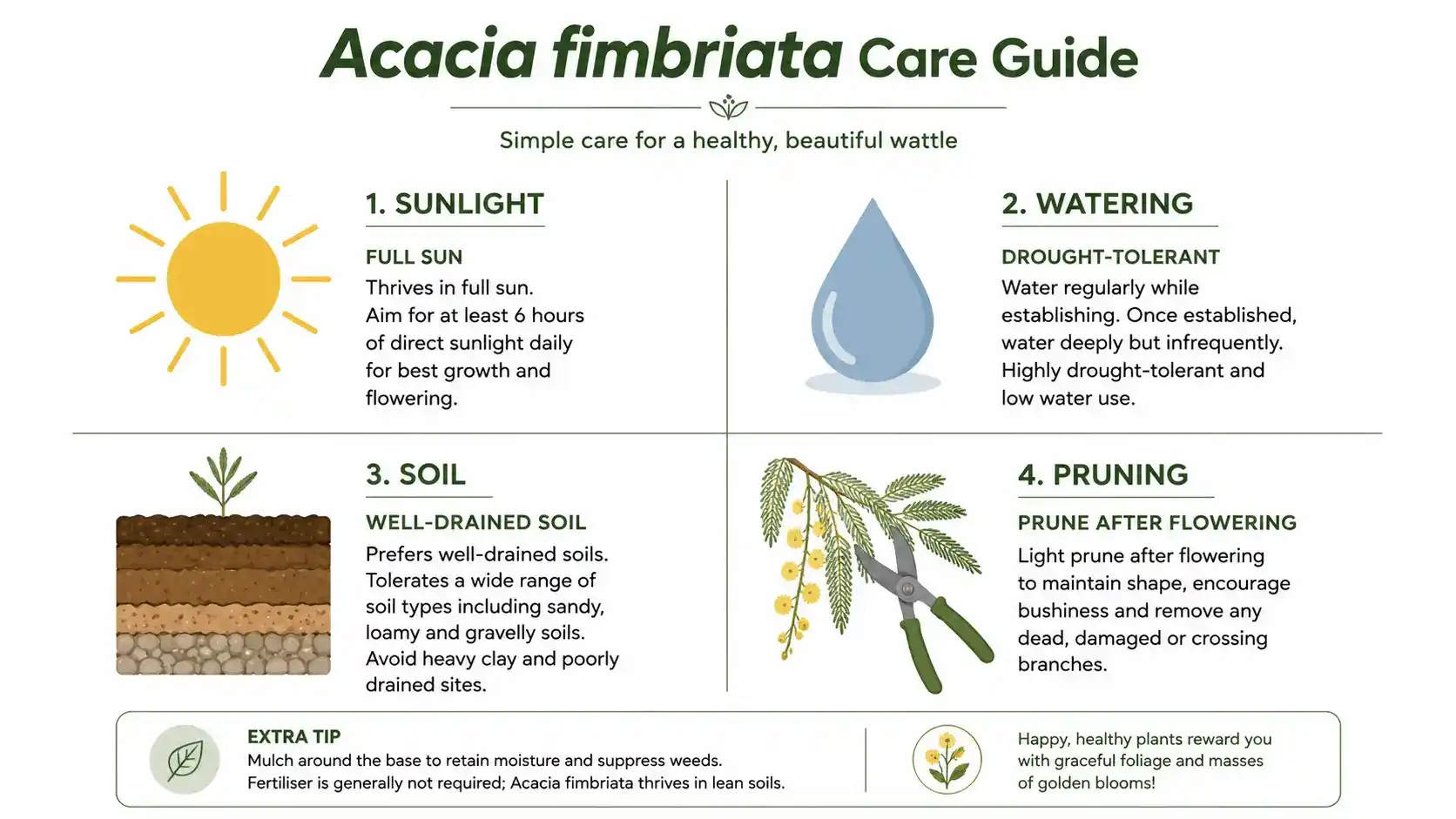
The Acacia fimbriata care guide focuses on simple, practical maintenance requirements that help this native Australian shrub or small tree thrive in home gardens. Once established, it is generally low-maintenance, drought-tolerant, and highly adaptable, making it suitable for both beginner and experienced gardeners. Acacia fimbriata shares many care traits with other Australian wattles such as Acacia Podalyriifolia: Care, Size, Growth & Uses, especially in soil preference and drought tolerance.
Watering Requirements
Acacia fimbriata is drought-tolerant once established, but it requires consistent watering during its early development stage.
Key watering guidelines include:
- Establishment phase (first 1–2 seasons): Water regularly to support strong root development.
- After establishment: Reduce watering significantly, relying mostly on natural rainfall.
- Avoid waterlogging: Poor drainage can lead to root rot and reduced plant health.
- Mulching benefits: Applying organic mulch helps retain soil moisture, regulate soil temperature, and reduce weed competition.
Proper early watering is essential for long-term resilience and strong growth.
Sunlight & Position
Acacia fimbriata performs best in full sun to partial shade, with flowering significantly improved in full sun conditions.
- Full sun: Maximum flowering, denser growth, and stronger structure
- Partial shade: Acceptable growth but reduced flowering intensity
- Exposure tolerance: Handles wind, coastal conditions, and urban environments well
Its adaptability to exposed sites makes it a reliable choice for screening and roadside plantings.
Soil Preferences
This species is highly adaptable to a wide range of soils but performs best under the following conditions:
- Well-drained soil: Essential for long-term health
- Soil types tolerated: Sandy, loamy, and even moderately clay soils
- pH preference: Slightly acidic to neutral
- Nutrient needs: Low fertility requirements due to nitrogen-fixing root nodules typical of legumes
Because it naturally enriches soil through nitrogen fixation, Acacia fimbriata does not require nutrient-rich planting media.
Fertilising
Acacia fimbriata requires minimal fertilisation and is sensitive to excess nutrients.
Best practices include:
- Use low-phosphorus native plant fertiliser
- Apply lightly in early spring if needed
- Avoid high-phosphorus fertilisers, which can damage Australian native plants
- Fertilise sparingly—once or twice per year is generally sufficient
Over-fertilisation often leads to weak, overly soft growth and reduced plant health.
Pruning Acacia Fimbriata
Pruning is important for maintaining shape, encouraging dense growth, and prolonging flowering performance.
Key pruning guidelines:
- Timing: Prune immediately after flowering (late spring)
- Method: Light to moderate shaping cuts are preferred
- Hard pruning: Can be done carefully, but avoid cutting into old woody stems that may not reshoot
- Goal: Maintain structure, prevent legginess, and encourage fresh flowering wood
For dwarf varieties, pruning is especially useful for maintaining compact hedges and borders.
Climate & Hardiness
Acacia fimbriata is suited to subtropical to temperate climates, generally corresponding to USDA zones 9–11.
- Frost tolerance: Mild frosts tolerated once established
- Young plant sensitivity: Requires protection from heavy frost during early growth
- Best regions: Southeast Queensland, coastal New South Wales, and mild southern Australian regions
- Environmental adaptability: Performs well in urban, coastal, and semi-rural landscapes
Global botanical databases such as the Royal Botanic Gardens Kew confirm that many Acacia species are adapted to low-phosphorus soils due to nitrogen-fixing root systems.
Acacia Fimbriata Varieties — What Options Are Available?
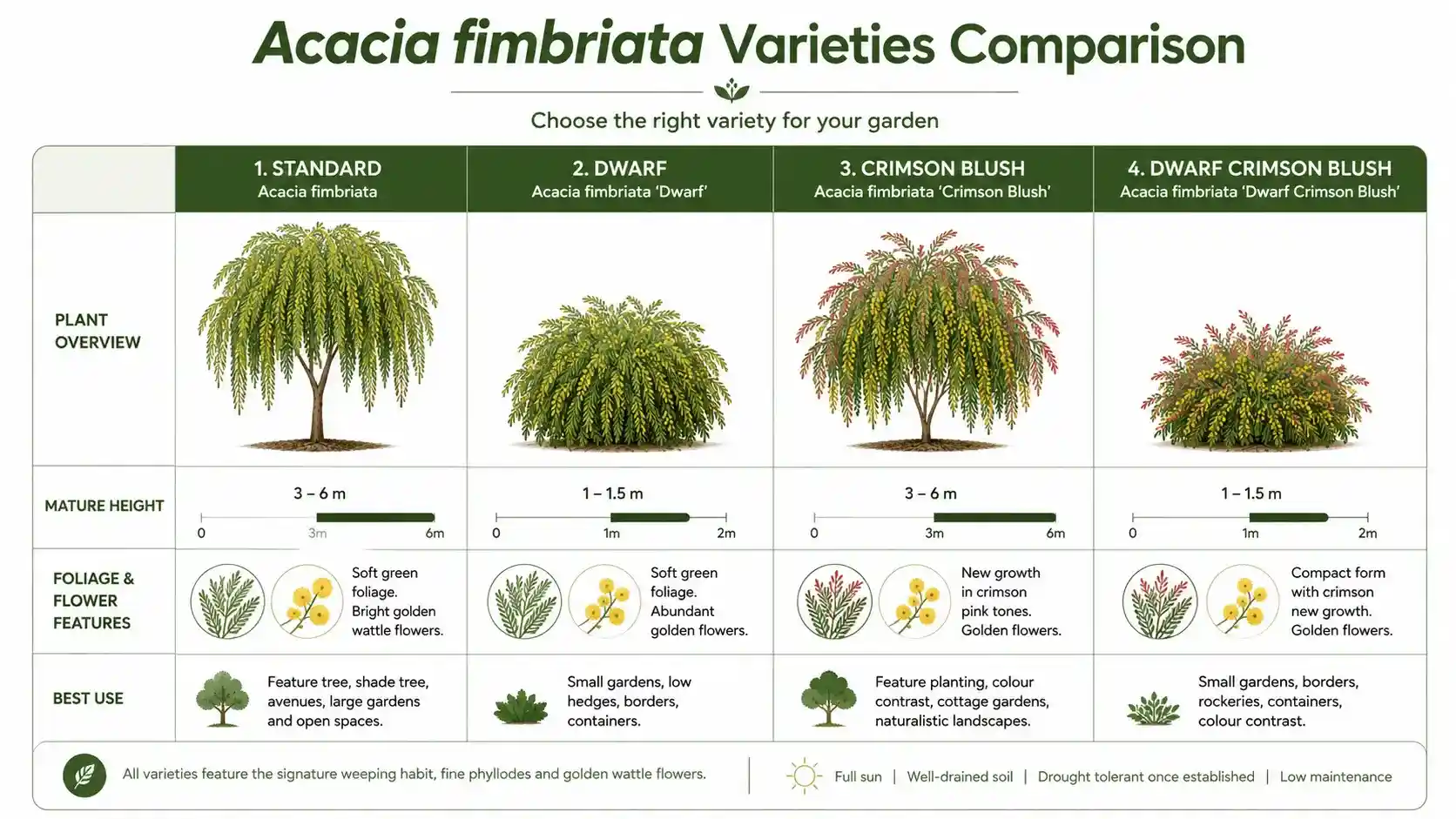
Several Acacia fimbriata varieties and cultivars are available, offering different sizes, growth habits, and ornamental features to suit a wide range of garden designs.
Main Types Include:
- Standard Acacia fimbriata (Fringed Wattle): Full-sized form used for screening, wildlife planting, and feature trees
- Dwarf form: Compact selection ideal for small gardens, hedges, and containers
- Acacia fimbriata ‘Crimson Blush’: Ornamental cultivar with crimson-toned new growth and golden flowers
- Acacia fimbriata ‘Dwarf Crimson Blush’: Compact version combining colorful foliage with small stature
Some regional selections may also exist, but these are the most widely recognized horticultural forms in cultivation.
Choosing the Right Variety
Selection depends on garden size and intended use:
- Large gardens or screening: Standard species
- Small gardens or borders: Dwarf form
- Feature planting with color contrast: Crimson Blush
- Containers or tight spaces: Dwarf Crimson Blush
These options make Acacia fimbriata fringed wattle highly versatile in modern landscape design.
Availability in Nurseries
Most standard and dwarf forms are commonly available in Australian native plant nurseries, especially in regions where the species is naturally adapted. Cultivars like Crimson Blush may be more seasonal or limited depending on supplier stock. Similar compact forms can also be seen in Essential Acacia Cognata Dwarf Varieties & Care Guide, which is often compared with dwarf Acacia fimbriata selections for small gardens.
Acacia Fimbriata in the Landscape — Uses and Design Applications
Acacia fimbriata is widely used in landscape design due to its combination of ornamental beauty, ecological value, and fast growth.
Key Landscape Uses:
- Wildlife gardens: Attracts birds, honeyeaters, native bees, and beneficial insects
- Screening and privacy planting: Dense foliage creates effective natural barriers
- Windbreaks and erosion control: Strong root systems stabilize soil
- Feature planting: Especially effective with Crimson Blush cultivars
- Native garden design: Pairs well with grevilleas, banksias, and lomandras
Its versatility makes it a core species in biodiversity-focused landscaping and low-maintenance native garden designs.
For similar ornamental planting styles, the Weeping Wattle Guide: 8+ Essential Care & Varieties Tips highlights comparable cascading native forms used in Australian landscapes.
How Does Acacia Fimbriata Compare to Similar Wattles?
Understanding how Acacia fimbriata compares to other wattles helps gardeners choose the right species for their environment and design goals.
Acacia fimbriata vs Acacia retinodes
- Acacia fimbriata: Native to subtropical eastern Australia, finer foliage, strong winter–spring flowering
- Acacia retinodes: More drought-tolerant, often has longer flowering periods, suited to drier climates
- Use difference: Fimbriata is more ornamental; retinodes is more drought-resilient
Acacia fimbriata vs Acacia baileyana (Cootamundra Wattle)
- Foliage: Fimbriata has fine green phyllodes; baileyana has silvery-blue bipinnate leaves
- Invasiveness: A. baileyana can be invasive in some regions
- Use: Fimbriata is preferred for controlled native landscaping
Dwarf Fringed Wattle vs Other Dwarf Wattles
- Acacia fimbriata dwarf forms: Soft foliage, golden flowers, compact structure
- Other dwarf wattles: May differ in flower timing, leaf texture, or climate tolerance
- Best choice: Depends on climate, space, and aesthetic preference
Comparison Overview (Quick Guide)
- Best for ornamental hedging: Acacia fimbriata (especially dwarf forms)
- Best for drought resilience: Acacia retinodes
- Best for silver foliage contrast: Acacia baileyana (with caution)
Overall, the Brisbane Golden Wattle (Acacia fimbriata) remains one of the most balanced choices for ornamental value, ecological benefit, and manageable growth in suitable climates.
Common Problems With Acacia Fimbriata — Troubleshooting Guide
Although Acacia fimbriata is generally hardy and low-maintenance, certain environmental or care-related issues can affect its health and appearance. Understanding these common problems helps gardeners quickly diagnose and correct issues before they become serious.
Improving drainage is essential, similar to techniques used in How to Improve Clay Soil for Lawns for Better Grass Growth when preparing heavy garden soils.
Yellowing Leaves
Yellowing foliage in Acacia fimbriata is usually a sign of environmental stress rather than disease.
Common causes include:
- Nutrient deficiency, particularly nitrogen or iron
- Overwatering or consistently wet soil conditions
- Poor drainage restricting root oxygen
- Natural aging of older foliage
How to diagnose and fix:
- If soil is wet or compacted, improve drainage immediately
- Reduce watering frequency if soil remains consistently damp
- Apply a low-phosphorus native plant fertiliser if nutrient deficiency is suspected
- Check for root health if yellowing is widespread
Prevention:
Proper soil preparation with well-drained conditions and light feeding helps prevent most leaf discoloration issues.
Overwatering and Root Rot
Overwatering is one of the most common problems affecting Acacia fimbriata health.
Signs include:
- Wilting despite wet soil
- Soft, darkened roots
- Sudden decline in plant vigor
- Yellowing leaves followed by dieback
How to correct drainage issues:
- Stop watering immediately and allow soil to dry
- Improve soil structure with sand, organic matter, or gravel
- Remove severely affected roots if rot is present
- Replant in a better-drained location if necessary
Important practice:
In clay soils, planting on raised beds or mounded soil significantly reduces the risk of root rot by improving drainage and airflow around the root zone.
Pest Issues
Acacia fimbriata can occasionally be affected by common Australian native plant pests.
Common pests include:
- Borers (affecting stems and branches)
- Scale insects (sucking sap from foliage)
- Lerp psyllids (causing leaf distortion and sticky residue)
Management options:
- Prune and remove heavily infested branches
- Use horticultural oils or insecticidal soaps for soft-bodied insects
- Encourage beneficial insects such as ladybirds
- In severe cases, targeted chemical treatments may be required
Prevention:
Healthy plants grown in the right location are far more resistant to pest attacks. Stress-free plants naturally maintain stronger defenses.
Poor or No Flowering
A lack of flowering is usually linked to environmental or maintenance issues rather than plant health problems.
Common causes:
- Insufficient sunlight
- Incorrect pruning timing (cutting off developing buds)
- Excessive fertiliser use, especially nitrogen-rich feeds
- Young plants still in establishment phase
How to improve flowering:
- Ensure full sun exposure where possible
- Prune only immediately after flowering
- Reduce fertiliser inputs if growth is overly leafy
- Allow young plants time to mature before expecting full blooms
Proper seasonal care typically restores strong flowering performance in subsequent cycles.
Leggy or Sparse Growth
Leggy growth occurs when the plant becomes stretched, uneven, or open in structure.
Main causes:
- Insufficient sunlight
- Lack of regular pruning
- Competition from nearby plants
How to correct:
- Move the plant to a sunnier position if possible
- Prune lightly after flowering to encourage branching
- Remove weak or inward-growing stems to improve structure
Regular maintenance helps restore a dense, balanced form, especially in hedging applications.
Beginner Mistakes When Growing Acacia Fimbriata
New gardeners often make avoidable mistakes that affect the long-term health and appearance of Acacia fimbriata. Understanding these early helps ensure stronger growth and better flowering performance.
Using High-Phosphorus Fertiliser
One of the most serious mistakes is applying standard garden fertilisers high in phosphorus.
Why it’s harmful:
- Australian natives are adapted to low-phosphorus soils
- Excess phosphorus can damage root systems
- Leads to weak or unhealthy growth
Correct approach:
Always use a low-phosphorus native plant fertiliser in small amounts.
Planting in Poorly Drained Soil
Acacia fimbriata struggles in waterlogged conditions.
Mistake:
Planting directly into heavy clay without improvement.
Correct approach:
- Improve soil with organic matter and sand
- Use raised beds in heavy soils
- Ensure water drains freely after rain
Over-Pruning Into Old Wood
Cutting too far back into old, woody stems can prevent regrowth.
Mistake:
Hard pruning beyond green growth zones.
Correct approach:
Only prune into healthy, green growth immediately after flowering.
Not Pruning at All
Neglecting pruning leads to a woody, open, and less attractive plant.
Result:
- Sparse foliage
- Reduced flowering
- Weak structure over time
Correct approach:
Light pruning after flowering maintains density and shape.
Underestimating Mature Size
Many gardeners plant without considering the full Acacia fimbriata size.
Mistake:
Planting too close to buildings or pathways.
Correct approach:
Allow sufficient space for mature height (3–6m) and spread (2–4m).
Planting Too Close to Other Plants
Overcrowding reduces airflow and increases competition.
Correct approach:
- Space plants properly based on intended use
- Maintain 1–1.5m spacing for hedges
- Ensure sunlight reaches all sides of the plant
Proper planning ensures long-term plant health and reduces maintenance issues.
Seasonal Care Calendar for Acacia Fimbriata
A seasonal care approach helps maintain strong growth, reliable flowering, and long-term plant health.
Autumn
- Ideal time for planting new specimens
- Prepare soil with good drainage improvements
- Apply mulch to retain moisture and suppress weeds
Autumn planting allows roots to establish before active spring growth.
Winter
- Peak flowering period occurs in late winter
- Minimal maintenance required
- Protect young plants from frost in colder regions
This is the most visually rewarding season for Acacia fimbriata.
Spring
- Prune immediately after flowering
- Apply light native fertiliser if needed
- Monitor for early pest activity
Spring is a key maintenance period for shaping and regeneration.
Summer
- Water young plants during dry spells
- Maintain mulch to reduce evaporation
- Allow established plants to harden and become drought-tolerant
Summer care focuses on water conservation and stress prevention. This seasonal routine ensures Acacia fimbriata remains healthy, structured, and highly ornamental throughout the year. Seasonal maintenance patterns are similar to other natives like Melaleuca Snow in Summer: 7+ Essential Growth & Care Tips, which also follows a flowering-pruning cycle.
Conclusion
Acacia fimbriata stands out as one of Australia’s most versatile and rewarding native plants due to its combination of fast growth, seasonal beauty, and adaptability. Its striking late-winter to spring display of golden-yellow flowers, paired with fine, feathery foliage, makes it a valuable addition to both ornamental and ecological garden designs. In native garden ecosystems, Acacia fimbriata is often combined with species like Banksia oblongifolia: Care, Size, Growth & Identification Guide for layered habitat planting.
One of its greatest strengths is its diversity of forms. From the standard small tree used for screening and windbreaks to compact dwarf cultivars suited for small gardens and containers, Acacia fimbriata can be adapted to almost any landscape scale. Its ability to thrive in a wide range of soil types and conditions further enhances its popularity among gardeners and landscapers. Whether you’re growing the standard Acacia fimbriata as a screen or selecting a compact Dwarf Crimson Blush for a small garden, this Brisbane Wattle rewards gardeners with minimal care and maximum seasonal impact.
The key takeaway is simple: choose the right variety for your space, prune after flowering to maintain structure, avoid high-phosphorus fertilisers, and provide well-drained soil for long-term health. With these practices, Acacia fimbriata delivers reliable growth, strong ornamental value, and long-lasting landscape performance.
FAQs
Q1: How tall does Acacia fimbriata grow?
Acacia fimbriata typically grows 3–6 metres tall in its standard form, while dwarf varieties reach about 1–1.5 metres. Final size depends on soil quality, sunlight, water availability, and pruning practices.
Q2: What is the difference between the Fringed Wattle and the Brisbane Wattle?
There is no botanical difference. Both names refer to the same species, Acacia fimbriata. “Fringed Wattle” describes its finely textured phyllodes, while “Brisbane Wattle” reflects its strong association with the Brisbane and southeast Queensland region.
Q3: How long does Acacia fimbriata live?
The typical lifespan is 10–25 years. Longevity depends on drainage, climate stress, pruning practices, and soil conditions. Many gardeners use succession planting to replace older plants and maintain continuous coverage.
Q4: Is Acacia fimbriata suitable for hedging?
Yes, Acacia fimbriata is widely used as a hedge or screen due to its dense foliage and fast growth. Dwarf forms suit low hedges, while standard plants are ideal for taller privacy screens. Spacing of 1–1.5 metres and pruning after flowering help maintain shape.
Q5: What is Acacia fimbriata ‘Crimson Blush’ and how is it different?
Crimson Blush is a cultivar of Acacia fimbriata known for its crimson or bronze new growth combined with golden flowers. It is more ornamental than the standard form and typically more compact, making it ideal for feature planting and smaller gardens.
Q6: How fast does the Fringed Wattle grow?
The Fringed Wattle is fast-growing, especially in warm, well-drained conditions. It can establish quickly within a few seasons, with strong growth during spring and summer. Growth slows in dry or cold periods.
Q7: Can Acacia fimbriata grow in pots or containers?
Yes, especially dwarf varieties like Dwarf Crimson Blush. Use a large container with well-drained soil, water regularly during establishment, and ensure full sun exposure for best flowering and compact growth.