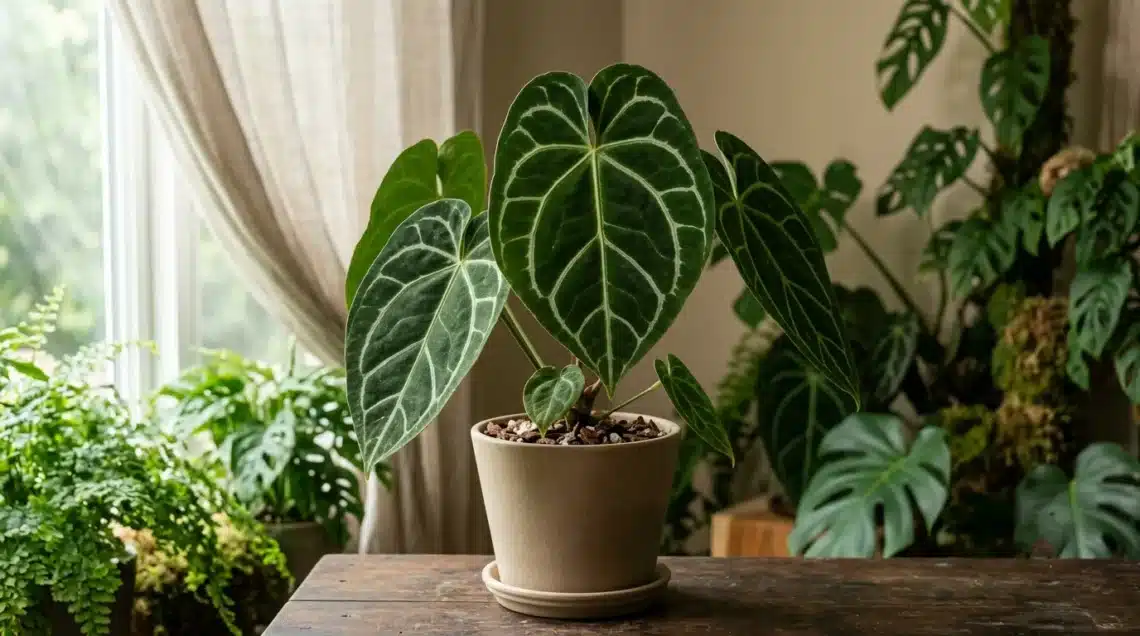
Anthurium crystallinum is a velvet-leaved tropical aroid prized for its dark green, heart-shaped foliage and prominent silver or ivory veins. Native to humid tropical regions of Colombia and Panama, it naturally grows as an epiphytic or terrestrial herb beneath filtered rainforest light. Successful anthurium crystallinum care depends on recreating these warm, airy and humid understory conditions indoors. The plant needs bright indirect light, a loose aroid potting mix, consistently moderate humidity and careful watering that keeps the roots lightly moist without becoming waterlogged. Although less forgiving than pothos or common heartleaf philodendrons, it can grow reliably when its environment remains stable.
Quick Summary
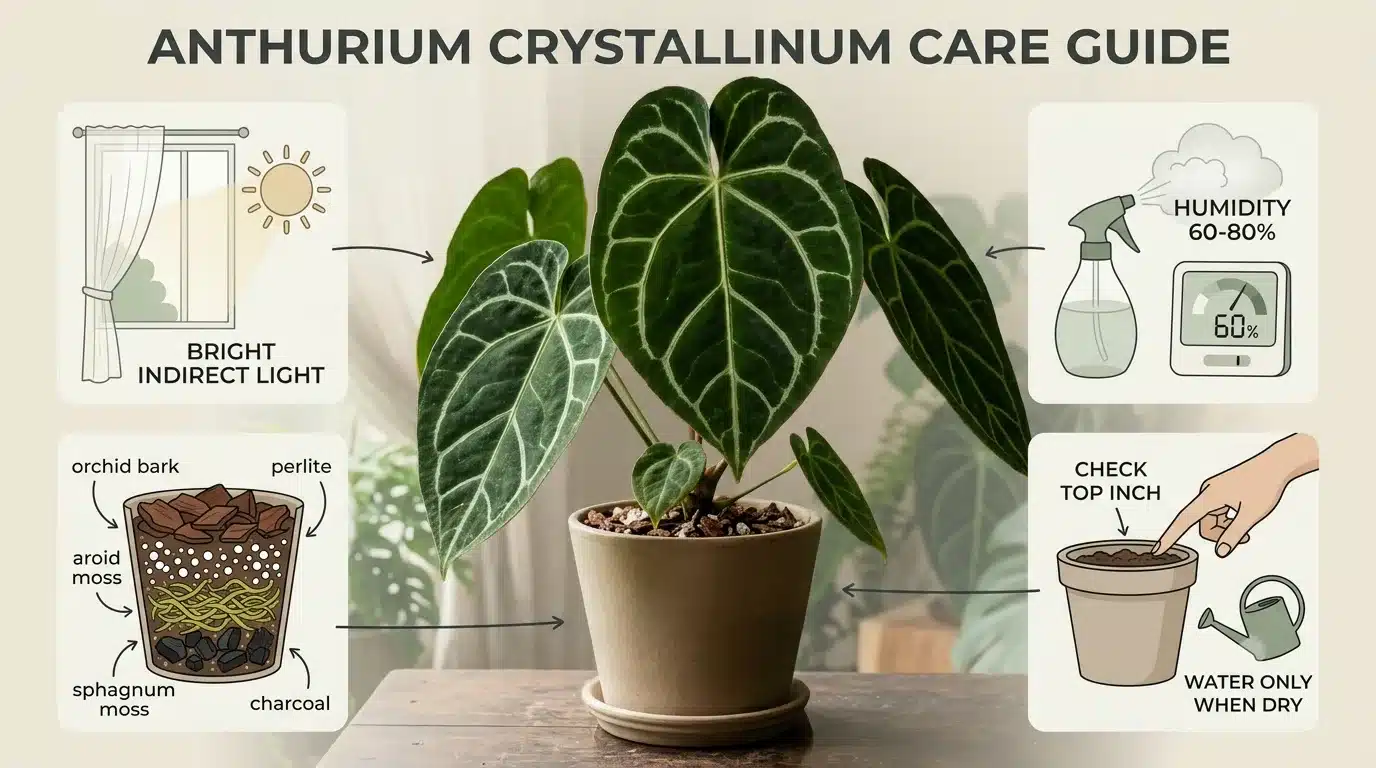
- Provide bright, indirect light, humidity above 60% and a chunky, well-draining aroid mix.
- Water when approximately the top inch of potting mix feels dry, avoiding permanently soggy roots.
- Anthurium crystallinum has moderate care difficulty and is best suited to attentive intermediate growers.
- Growth is generally slow to moderate, especially in cooler or darker indoor environments.
- The plant is grown mainly for its velvety, silver-veined foliage rather than its modest flowers.
What Is Anthurium Crystallinum?
Anthurium crystallinum is a tropical flowering plant in the Araceae family, the same botanical family as philodendrons, monsteras, peace lilies and other aroids. Its accepted botanical name is Anthurium crystallinum Linden & André, and it is commonly called crystal anthurium.
It belongs to the Anthurium genus, a large group of tropical plants known for their distinctive foliage and spadix-and-spathe inflorescences.
The plant is distinguished by broad, cordate leaves with a soft, velvety surface. Mature foliage usually develops dark green colouring and strongly contrasting pale green, ivory or silvery veins. New leaves may initially appear coppery, bronze or pale green before darkening as their tissues harden.
Unlike flowering anthurium hybrids grown for colourful spathes, A. crystallinum is primarily cultivated as a foliage plant. Its flowers are botanically interesting but visually modest compared with its leaves.
Growth Habit — Is It a Climber?
Anthurium crystallinum is not a vigorous climbing vine like many philodendrons. It is commonly described botanically as an epiphytic herb, although it may also grow in organic material close to the forest floor. In nature, its roots can interact with moss, bark and loose rainforest debris rather than dense mineral soil.
Indoors, it normally forms an upright or slightly spreading growth habit from a short central stem. Older plants may develop a visible stem and aerial roots, but they usually do not require a tall moss pole. A shallow layer of moist sphagnum around exposed roots can help maintain moisture without burying the stem deeply.
Light Requirements
Anthurium crystallinum needs bright, filtered light that resembles sunlight passing through a rainforest canopy. Direct midday or afternoon sun can bleach the leaves, create dry brown patches and damage the delicate velvety surface.
An east-facing window is usually suitable because it provides gentle morning light. Near a south- or west-facing window, place the plant behind a sheer curtain or several feet back from the glass. A north-facing window may work in a bright room, but supplementary grow lighting may be needed during darker seasons.
Signs of insufficient light include:
- Smaller new leaves
- Long or weak petioles
- Dull foliage
- Extended periods without new growth
- Potting mix that remains wet for too long
Signs of excessive light include:
- Bleached or faded areas
- Yellow-green leaf colour
- Crispy margins
- Dry tan patches on the side facing the window
A full-spectrum grow light can replace or supplement natural light. Keep it far enough from the foliage to prevent heat or light stress and provide a consistent day-and-night cycle.
Best Soil Mix & Potting
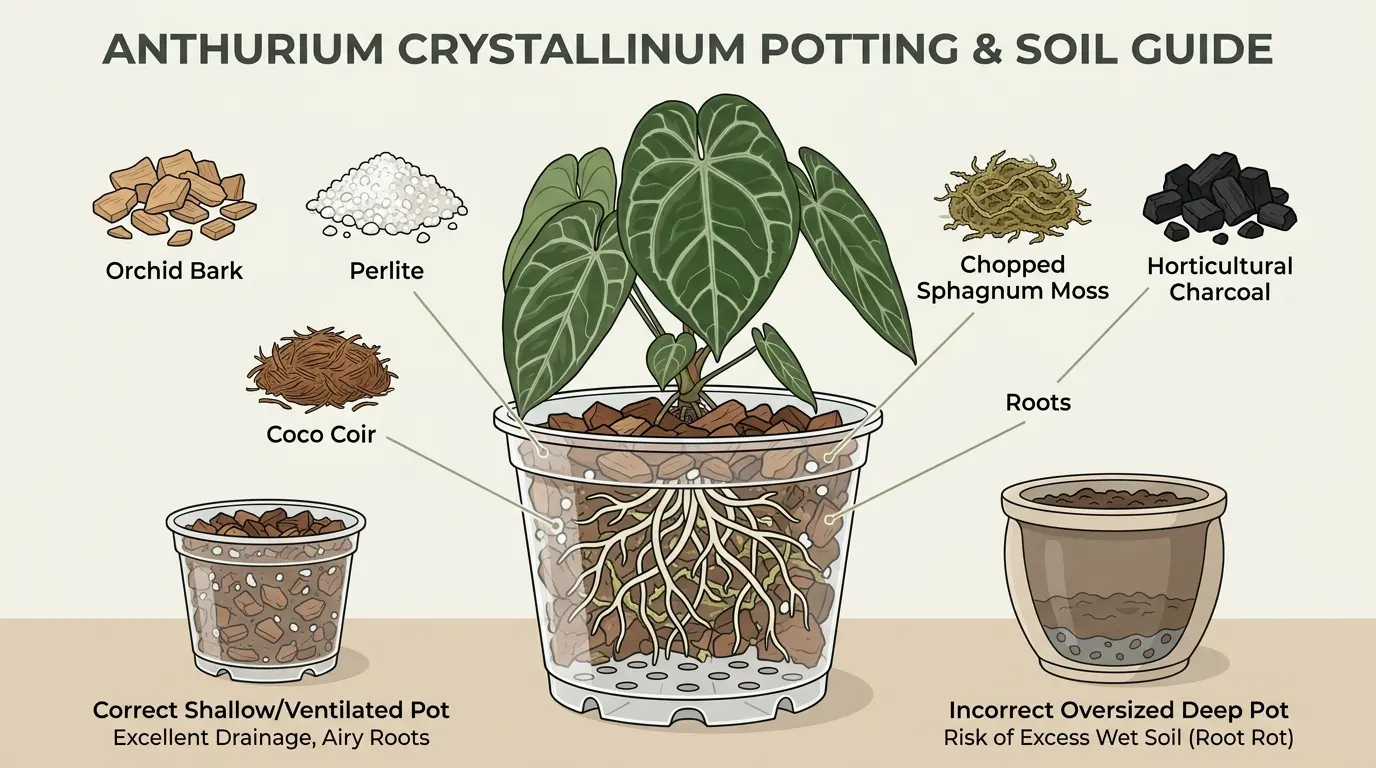
Anthurium crystallinum needs a porous potting medium that retains some moisture while allowing oxygen to reach the roots. Standard indoor potting soil used alone is usually too dense and may remain wet around the root system.
Containers must have unobstructed drainage holes. Clear plastic orchid pots or ventilated nursery pots are useful because they provide airflow and make root health easier to monitor.
What Is the Potting Mix for Anthurium Crystallinum?
The best potting mix for Anthurium crystallinum is a chunky aroid blend containing orchid bark, perlite or pumice, moisture-retentive fibre and horticultural charcoal.
A practical mixture is:
- 35% fine or medium orchid bark
- 25% perlite or pumice
- 20% coco coir or quality indoor potting mix
- 10% chopped sphagnum moss
- 10% horticultural charcoal
The exact ratio can be adjusted for the growing environment. Add more bark or perlite in cool, humid rooms where soil dries slowly. Include slightly more coir or sphagnum in warm, dry rooms where the mix dries rapidly.
Do Anthuriums Like Deep Pots?
Anthuriums generally perform better in moderately shallow, well-ventilated pots than in unnecessarily deep containers. A deep pot holds a larger volume of wet substrate beneath the active root zone, increasing the risk of low oxygen and root rot.
Choose a pot only slightly wider than the root mass. Repot when roots densely circle the container, emerge through drainage holes or displace most of the growing medium. Avoid moving a small plant directly into a much larger pot.
| Component | Main purpose | Approximate ratio |
| Orchid bark | Creates large air spaces and structure | 35% |
| Perlite or pumice | Improves drainage and root aeration | 25% |
| Coco coir or potting mix | Holds moderate moisture and nutrients | 20% |
| Chopped sphagnum moss | Maintains even moisture around roots | 10% |
| Horticultural charcoal | Adds structure and supports drainage | 10% |
Humidity Needs
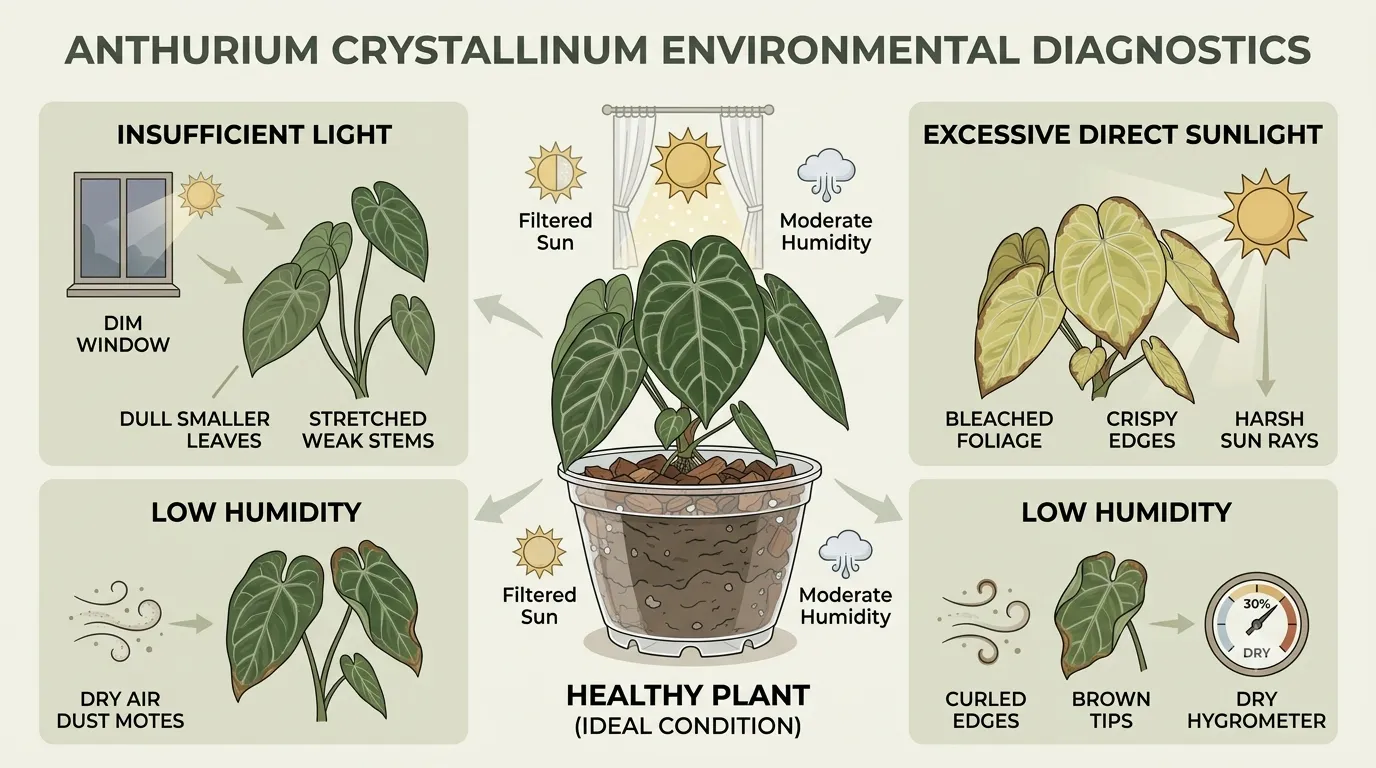
Anthurium crystallinum grows best at approximately 60–80% relative humidity. It may acclimatise to slightly lower household humidity, but rapidly changing or consistently dry air often causes brown edges, damaged new leaves and incomplete unfurling.
For additional ways to maintain stable moisture in dry indoor rooms, see our guide on how to increase humidity for plants naturally and with humidifiers.
Humidity must be balanced with airflow. A sealed cabinet with stagnant, wet air can encourage fungal spotting and bacterial disease. Use a small circulation fan when growing the plant in an enclosed cabinet, but do not direct strong air continuously at the leaves.
Do anthuriums like bathrooms? They can grow well in a bright bathroom where showers raise humidity, provided the room has sufficient natural or artificial light and regular ventilation. A dark bathroom is unsuitable regardless of its humidity level.
Useful humidity methods include:
- Operating a room humidifier
- Grouping tropical plants together
- Using a ventilated greenhouse cabinet
- Keeping the plant away from heaters and air conditioners
- Placing a pebble tray nearby for a limited local effect
Greenery Inside recommends measuring humidity with a hygrometer rather than estimating it from how the room feels.
Watering Anthurium Crystallinum
Water Anthurium crystallinum when the upper 2–3 centimetres, or approximately the top inch, of potting mix feels dry. Water thoroughly, allow excess moisture to drain and empty any water that collects in the saucer.
The plant should not remain completely dry for prolonged periods, especially while a new leaf is expanding. However, permanently saturated substrate prevents oxygen from reaching the roots and is a major cause of decline.
Watering frequency depends on light, temperature, humidity, pot size and substrate composition. A plant may need more frequent watering during warm active growth and less during cool, low-light periods. Check the potting mix rather than following a fixed weekly schedule.
In our experience growing humidity-sensitive aroids, the weight of the pot is a useful secondary watering indicator. A recently watered pot feels noticeably heavier than one approaching the correct watering point.
Top or Bottom Watering?
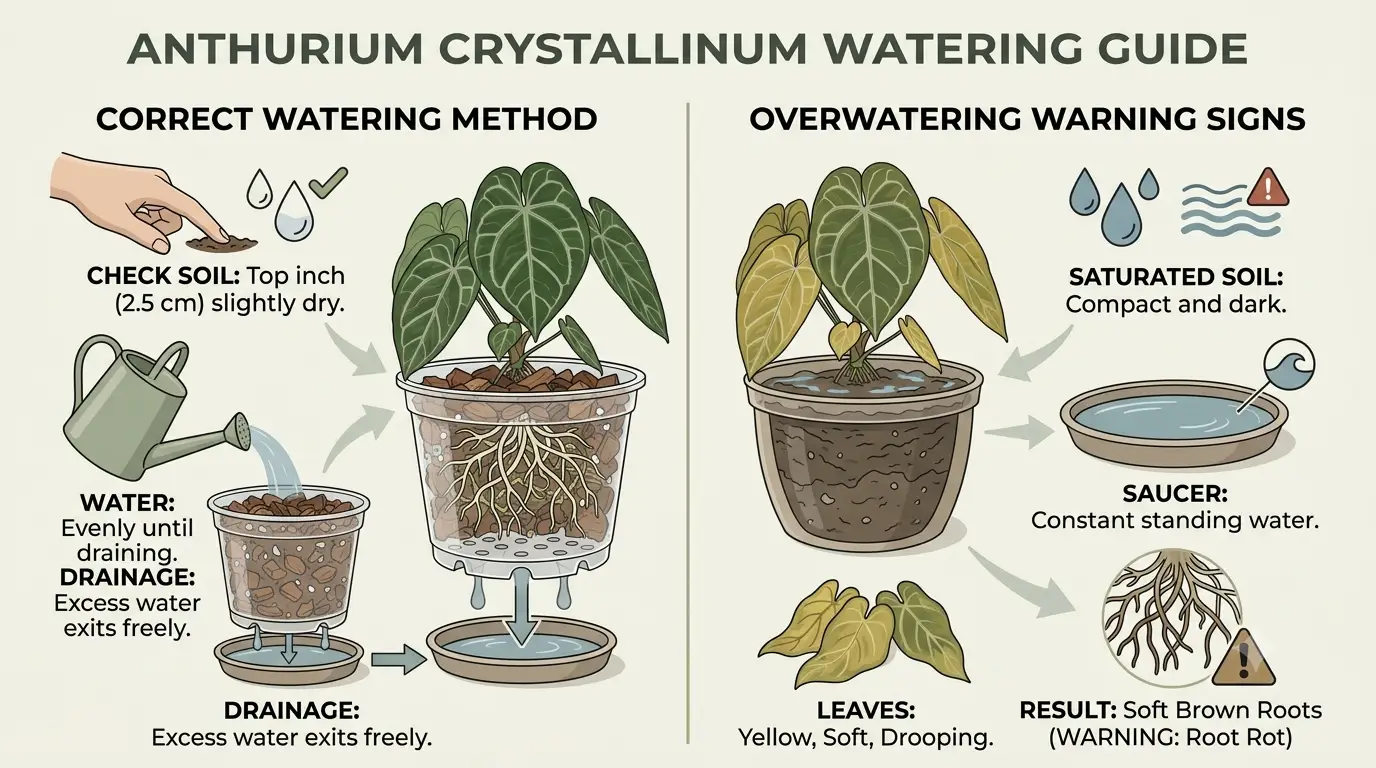
Top watering is generally preferable because it evenly moistens the substrate and helps flush accumulated fertilizer salts from the pot.
Pour water slowly across the surface until it drains freely from the bottom. Avoid repeatedly wetting the leaves and central growth point, particularly in cool rooms where water evaporates slowly.
Bottom watering can be useful when:
- The substrate has become slightly water-repellent
- The plant is in a small nursery pot
- The upper layer dries much faster than the lower roots
Place the pot in shallow water for approximately 10–20 minutes, then remove it and allow it to drain completely. Do not leave the plant standing in water for hours.
Growing Anthurium Crystallinum in Water (Semi-Hydroponics)
Anthurium crystallinum can grow in semi-hydroponic substrates such as LECA or mineral-based mixes, but moving established soil roots into water requires careful conversion.
Remove old organic material from the roots and trim any damaged tissue with sterilised tools. Place the plant in a clean, inert substrate and maintain a small reservoir below the main root mass. Existing soil roots may decline while new water-adapted roots develop.
Use a diluted hydroponic nutrient rather than plain water indefinitely. Flush the container regularly to reduce mineral buildup, monitor water quality and keep the crown above the reservoir. Yellowing, odour or soft brown roots indicate that the system requires immediate cleaning and inspection.
Fertilizing Anthurium Crystallinum
Anthurium crystallinum benefits from light feeding during active growth but is not a heavy feeder. Apply a balanced houseplant or aroid fertilizer at approximately one-quarter to one-half of the labelled strength every four to six weeks during spring and summer.
Growers who are unsure which feeding product to choose can also review the difference between plant food and fertilizer before creating a regular feeding schedule.
Reduce or pause feeding when temperatures and light levels fall enough to slow growth. Never fertilize a severely dry, recently damaged or actively rotting root system.
Does crystallinum need fertilizer? It can survive for a period without regular feeding, especially in nutrient-containing potting mix, but controlled fertilization supports larger leaves and steady growth.
Can Miracle-Gro be used on anthurium? A balanced Miracle-Gro houseplant fertilizer may be used when appropriately diluted. Full-strength or frequent applications can cause salt accumulation, root damage and brown leaf margins. Flush the substrate periodically with plain water.
Coffee grounds are not recommended as a direct pot amendment. Their nutrients are not immediately available in a controlled form, and wet grounds can compact the mix, encourage mould or alter moisture retention. Properly composted coffee grounds may be included in finished outdoor compost, but a measured houseplant fertilizer is more predictable.
Growth Rate & Mature Size
Anthurium crystallinum is a slow-to-moderate grower. Under stable warmth, humidity, light and nutrition, a healthy plant may produce a new leaf every several weeks during active growth. Growth can slow substantially during winter or after repotting, propagation and environmental changes.
Are Anthurium crystallinum fast growing? They are generally slower than common pothos and climbing philodendrons. Much of the plant’s energy is invested in producing increasingly large, thick and highly veined leaves.
Indoors, mature leaves commonly reach approximately 30–45 centimetres long under good conditions, although individual plants can remain smaller. Greenhouse-grown specimens may develop larger leaves and a broader overall footprint due to stronger light and consistently high humidity.
A new Anthurium crystallinum leaf often emerges bronze, coppery, reddish or pale green. It gradually expands, hardens and darkens over several weeks. Avoid touching, bending or wiping a soft new leaf because its surface is easily damaged.
Greenery Inside recommends maintaining especially stable moisture and humidity while a leaf is unfurling. Sudden dryness during this stage can cause creasing, torn margins or incomplete expansion.
Anthurium Crystallinum Indoors vs. in Pots
Indoor Anthurium crystallinum care requires compensation for lower humidity, weaker seasonal light and reduced airflow compared with tropical outdoor conditions. Rotate the pot periodically for even development, but avoid repeatedly relocating the plant between environments.
The preferred indoor temperature range is approximately 18–29°C. Protect the plant from cold windows, air-conditioning vents and sudden temperature drops. Prolonged exposure below about 15°C can slow root activity and increase the danger of overwatering.
For broader advice on indoor lighting, watering, potting and seasonal care, explore our complete guide to house plants.
As of the 2026 growing season, the most reliable indoor practice remains environmental consistency rather than frequent watering or feeding adjustments. During darker winter periods, reduce watering in response to slower drying instead of following a fixed calendar.
Pruning is limited to removing yellow, severely damaged or diseased leaves and spent inflorescences. Use sterilised cutting tools and avoid leaving decaying plant material on the potting surface.
Anthurium Crystallinum Flowers
Anthurium crystallinum produces a typical aroid inflorescence consisting of a spadix surrounded by a modified leaf called a spathe. The spadix carries many small individual flowers rather than functioning as one single flower.
Its inflorescence is usually greenish, pale or otherwise understated. It lacks the large, brightly coloured spathes associated with common florist anthurium hybrids.
Most growers prioritise foliage because the plant’s ornamental value comes from its velvety leaves and contrasting venation. Some growers remove developing inflorescences so a young or stressed plant can direct more energy toward roots and leaves. Healthy mature plants may be allowed to flower without significant harm.
Propagating Anthurium Crystallinum
Anthurium crystallinum is commonly propagated through division or stem sections containing viable nodes. Tissue culture is also used for commercial-scale production, but it requires sterile laboratory conditions.
For division, remove a mature plant from its pot and identify naturally separated growth points with their own roots. Divide them carefully with a clean blade and pot each section into a moist, airy substrate.
For stem propagation:
- Select a section with at least one viable node.
- Cut with a sterilised blade.
- Allow the cut surface to dry briefly.
- Place the section in lightly moist sphagnum, perlite or a similar airy medium.
- Maintain warmth, high humidity and indirect light.
- Vent the propagation enclosure regularly.
Keep the rooting medium damp but not saturated. Excess water and stagnant air can cause the cutting to rot before new roots develop.
Common Problems & Troubleshooting
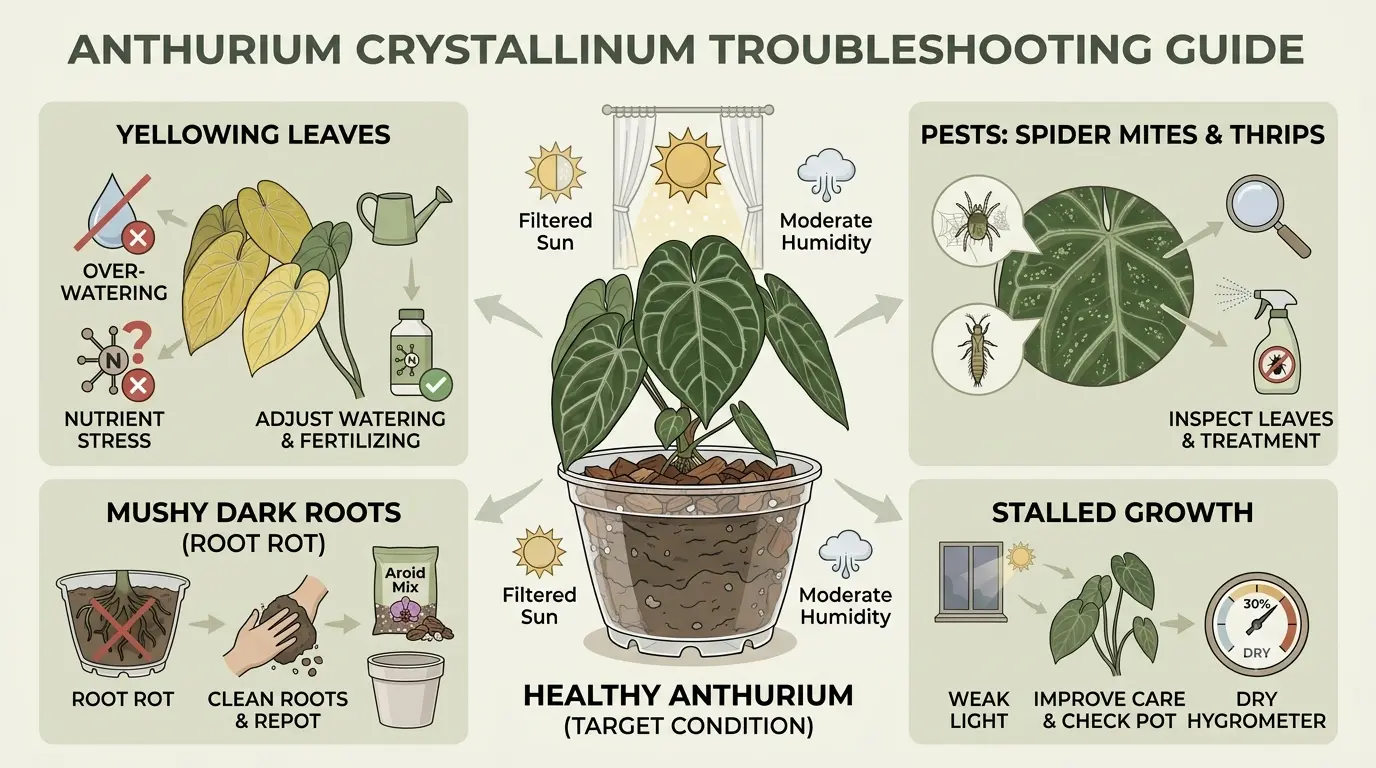
Yellowing Leaves
Yellow leaves commonly result from overwatering, poor drainage, natural ageing or fertilizer stress. Check whether the potting mix remains wet for long periods and inspect the roots if yellowing progresses rapidly.
To fix the problem, improve drainage, adjust watering and remove severely damaged roots. Prevent recurrence by using a ventilated pot and checking substrate moisture before watering.
Overwatering and Root Rot
The clearest red flag in Anthurium crystallinum is a combination of persistently wet soil, yellowing foliage, drooping despite moisture and soft brown or black roots. A sour or rotten smell is another warning sign.
Remove the plant from its pot, cut away mushy roots with sterile tools and repot it in fresh, airy substrate. Reduce watering until active root growth resumes.
Prevent root rot by avoiding oversized pots, blocked drainage holes, cold wet conditions and dense standard potting soil.
Pest Infestations
Spider mites and thrips are important Anthurium crystallinum pests. Spider mites may cause fine stippling, pale patches and delicate webbing. Thrips can create silvery scars, distorted new leaves and dark waste spots.
Before using neem-based treatments on delicate velvet foliage, check which plants may be sensitive to neem oil and test any product on a small leaf area first.
Isolate the plant, inspect both sides of every leaf and clean the foliage gently. Apply an insecticidal soap or another locally approved houseplant treatment according to its label. Repeat treatment as directed because eggs or immature pests may survive one application.
Prevent infestations by quarantining new plants, maintaining airflow and inspecting emerging leaves regularly.
Slow or Stalled Growth
Slow growth may result from insufficient light, low temperature, low humidity, nutrient deficiency, transplant shock or root damage. It can also be normal during winter.
Check the plant systematically rather than changing every care factor at once. Assess light exposure, root condition, pot size and drying speed. If roots are healthy and environmental conditions are suitable, allow time for acclimatisation.
Is Anthurium Crystallinum Hard to Care For?
Anthurium crystallinum has moderate care difficulty. It is more demanding than pothos, heartleaf philodendron and many common foliage plants because it reacts visibly to low humidity, dense soil, irregular watering and temperature changes.
It is best suited to intermediate growers who can monitor moisture and provide stable environmental conditions. Absolute beginners can still succeed by using a well-draining mix, a drainage pot, a hygrometer and a consistent inspection routine.
The plant does not require constant intervention. Once light, humidity and root aeration are balanced, regular care mainly involves checking moisture, observing new growth and adjusting watering seasonally.
Anthurium Crystallinum vs. Similar Varieties
Anthurium Crystallinum vs. Clarinervium
Anthurium crystallinum and Anthurium clarinervium both have dark, heart-shaped leaves with contrasting pale veins, but their foliage shape, texture and growth differ.
| Feature | Anthurium crystallinum | Anthurium clarinervium |
| Leaf shape | More elongated heart shape | Broader, rounder heart shape |
| Vein contrast | Silver to pale green | Bold white or cream |
| Texture | Velvety and relatively flexible | Thick, firm and leathery |
| Potential size | Usually develops longer leaves | Usually remains more compact |
| Relative care | High humidity preferred | Often slightly more tolerant of average humidity |
Both require porous substrate and careful watering. A. clarinervium may tolerate somewhat drier conditions due to its thicker leaves, but neither plant should remain waterlogged.
Anthurium Magnificum x Crystallinum
Anthurium magnificum × crystallinum is a hybrid combining traits from both parents. It may inherit the velvety surface and silver venation of crystallinum together with the heavier leaf structure and robust growth associated with magnificum. The hybrid is recognised in horticultural cultivation.
Its care is broadly similar to pure Anthurium crystallinum: bright indirect light, high humidity, warmth and an airy aroid mix. Individual hybrids vary, so leaf form, vein colour and environmental tolerance may differ between seedlings.
Rarity & Collector Status
Anthurium crystallinum is considered a desirable collector aroid because of its velvet foliage, distinctive venation and slower production compared with common mass-market houseplants. However, rarity depends on location, propagation availability, genetics and the specific form being discussed.
There is no single universally accepted “holy grail” Anthurium. Collectors may apply the term to rare species, unusually dark forms, distinctive regional variants or plants with exceptional leaf shape and venation. Highly sought-after examples often include uncommon velvet-leaved species and carefully selected hybrids.
Crystallinum can serve as a gateway into collector Anthuriums because it offers dramatic foliage while being more established in cultivation than some exceptionally rare species. Collector status should not be confused with botanical conservation status or proof of superior quality.
Beginner Mistakes to Avoid
Common Anthurium crystallinum care mistakes include:
- Overpotting: A large container holds excess moisture and increases root-rot risk.
- Misjudging humidity: High humidity does not compensate for waterlogged roots, poor airflow or weak light.
- Using standard potting soil: Dense mixes restrict oxygen and remain wet too long.
- Watering on a calendar: Moisture loss changes with temperature, light and season.
- Ignoring early root-rot signs: Persistent yellowing, wet substrate and soft roots require immediate attention.
- Handling new leaves: Soft emerging foliage can crease or tear permanently.
- Overfertilizing: Concentrated salts can burn sensitive roots and leaf margins.
- Placing the plant in direct sun: Velvet foliage is vulnerable to bleaching and scorch.
Conclusion
Successful anthurium crystallinum care depends on four core conditions: bright indirect light, a chunky and oxygen-rich potting mix, humidity above ordinary dry-room levels and careful watering after the upper substrate begins to dry.
The plant is attentive rather than impossible. It grows best when conditions remain stable and when growers respond to the potting mix and root system instead of following rigid watering schedules. By recreating the warm, humid and filtered-light environment of a rainforest understory, growers can support healthy roots, increasingly mature foliage and consistent long-term development.
Frequently Asked Questions
Are Anthurium crystallinum hard to care for?
Anthurium crystallinum has moderate care difficulty. It requires more humidity, root aeration and watering accuracy than common beginner plants, but it becomes manageable when grown in bright indirect light and a chunky, well-draining mix.
Is Anthurium crystallinum a climber?
Anthurium crystallinum is not a vigorous climbing vine. It usually grows upright from a short stem indoors, although its epiphytic nature allows it to produce aerial roots and interact with moss or organic material around its base.
Do you water Anthurium from the top or bottom?
Top watering is generally better because it moistens the substrate evenly and flushes fertilizer salts. Bottom watering can occasionally rehydrate a dry mix, but the pot should be removed from the water and drained thoroughly afterward.
What is the red flag of Anthurium?
The most serious red flag is persistently wet soil combined with yellowing or drooping leaves and soft, dark roots. These symptoms commonly indicate root rot and require immediate inspection, removal of damaged roots and repotting in fresh, airy substrate.
Do Anthuriums like deep pots?
Anthuriums generally prefer pots that closely fit their root systems rather than deep, oversized containers. Excess substrate beneath the roots can remain wet for too long and reduce oxygen availability.
Does crystallinum need fertilizer?
Anthurium crystallinum benefits from diluted balanced fertilizer during active growth. Feed approximately every four to six weeks in spring and summer, reducing or stopping applications when growth slows.
Are coffee grounds good for anthuriums?
Directly applying coffee grounds is not recommended. They may compact the substrate, retain excessive moisture or encourage mould. A measured houseplant fertilizer provides more predictable nutrition.
What is the holy grail of the Anthurium?
There is no universally recognised holy-grail Anthurium. The term is subjective and is usually applied to rare species, exceptional forms or highly distinctive hybrids valued by individual collectors.