Introduction
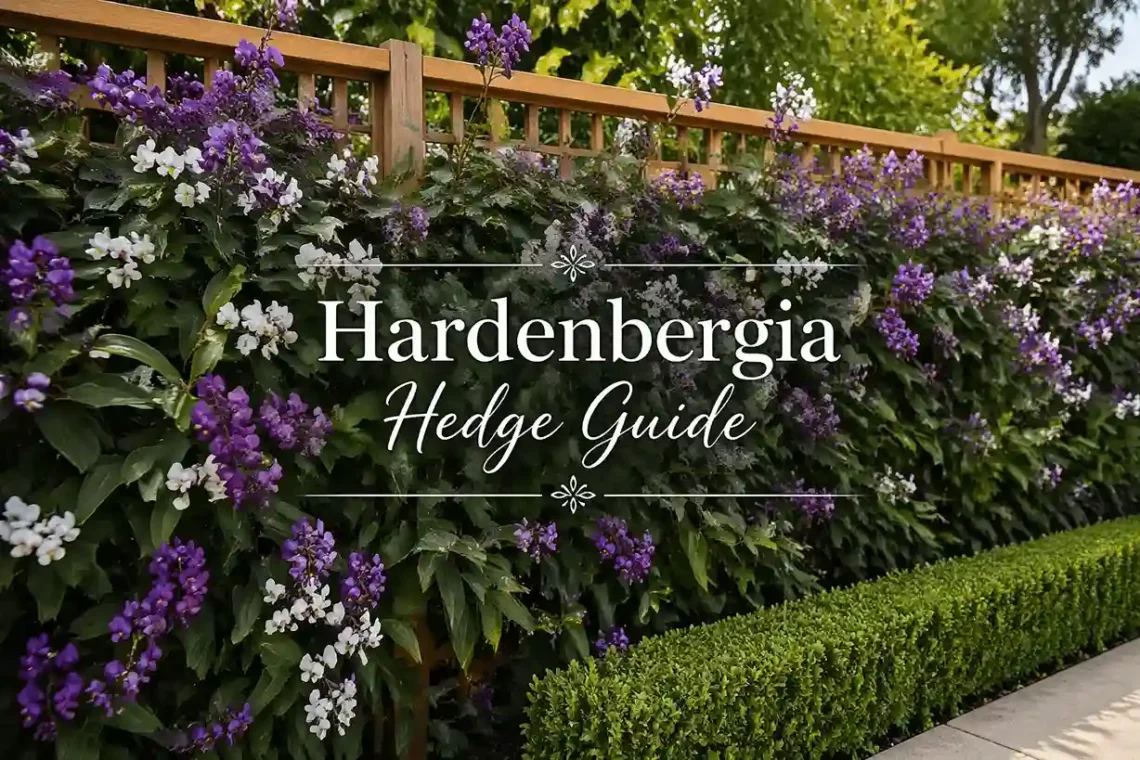
Hardenbergia hedge refers to using Hardenbergia violacea—commonly known as happy wanderer or purple coral pea—as a dense, evergreen screening plant grown along fences, walls, or trellises. This Australian native climber is valued for its fast growth, vibrant purple or white flowers, and adaptability as both a hedge and vertical cover. Unlike traditional hedges, it relies on structural support to create a living screen, making it ideal for modern garden designs focused on vertical space. Its resilience, low maintenance needs, and year-round foliage make it a practical choice for both residential and landscape applications.
If you’re exploring different plant types beyond indoor spaces, this guide complements a complete understanding of plant care alongside a guide to house plants.
Quick Summary
- Hardenbergia hedge is an evergreen climbing plant used for fences, trellises, and screening.
- It grows quickly and produces purple, white, or blue pea-shaped flowers.
- Requires support (like a trellis) to form a dense hedge structure.
- Low-maintenance and suitable for warm climates, especially Australia.
What Is a Hardenbergia Hedge and How Does It Work?
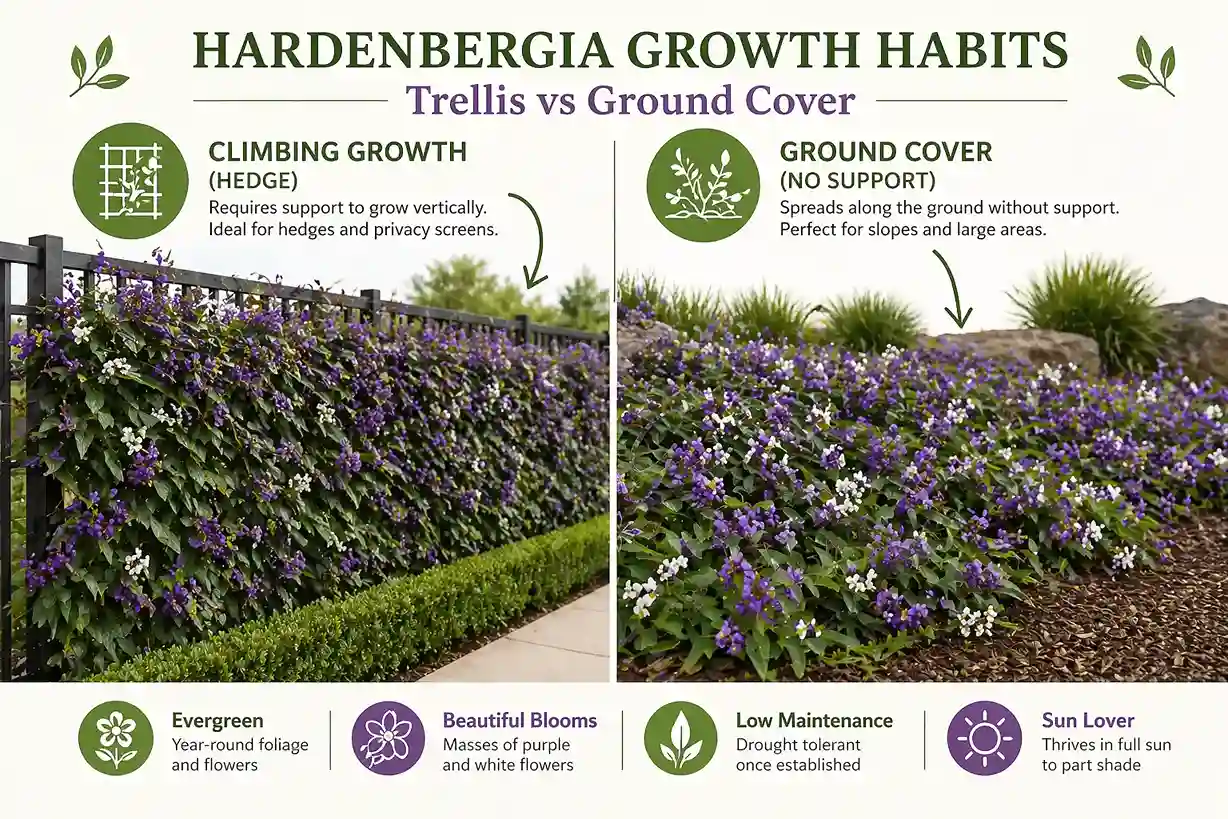
A hardenbergia hedge is a vertical or semi-vertical plant screen created using the climbing vine Hardenbergia violacea, rather than a self-supporting shrub. It works by training the plant along structures such as fences or trellises to form dense foliage coverage. Hardenbergia violacea, commonly known as happy wanderer, is a flowering plant species native to Australia (source: Wikipedia – Hardenbergia violacea).
How It Differs from Traditional Hedges
- Traditional hedges are woody shrubs that grow upright naturally
- Hardenbergia is a climber that requires external support
- Offers faster vertical coverage compared to many shrubs
Growth Habit: Climber vs Ground Cover
- As a climber: forms a dense wall (hardenbergia wall or fence)
- Without support: spreads horizontally as ground cover
Key Concepts and Names
- Happy wanderer
- Hardenbergia climber
- Purple coral pea
- False sarsaparilla / native sarsaparilla
Key Uses
- Uses vertical support (fence or trellis) to create a hedge-like screen
- Evergreen foliage provides year-round coverage
- Works well for privacy, boundaries, and decorative walls
Popular Varieties for a Hardenbergia Hedge
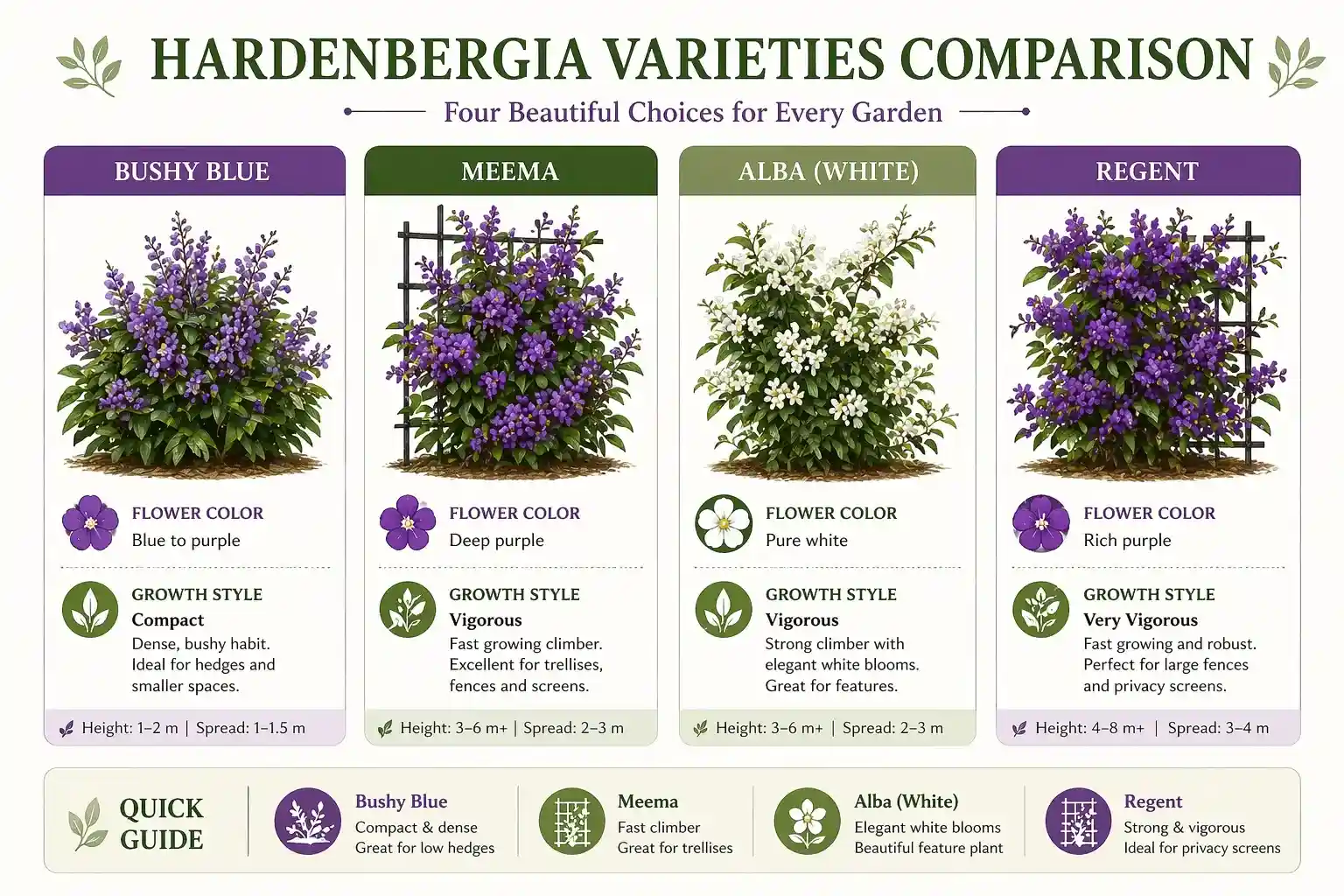
Different hardenbergia varieties offer variations in growth habit, density, and flower color.
Common Varieties
- Bushy Blue – compact and dense, ideal for hedges
- Meema – softer growth, suitable for small spaces
- Alba (white happy wanderer) – white flowering variety
- Regent – vigorous climber for large fences
- Hardenbergia mix – combination of colors
Color Variations
- Purple (most common)
- White
- Blue
If you want to compare Hardenbergia against other flowering screen climbers side-by-side, this sortable climber comparison tool lets you filter 16 species by origin, foliage type, and support needs.
It’s especially useful for weighing Bushy Blue or Regent against alternatives like star jasmine or Pandorea before committing to a variety.
Hardenbergia Hedge Size, Height, and Growth Rate
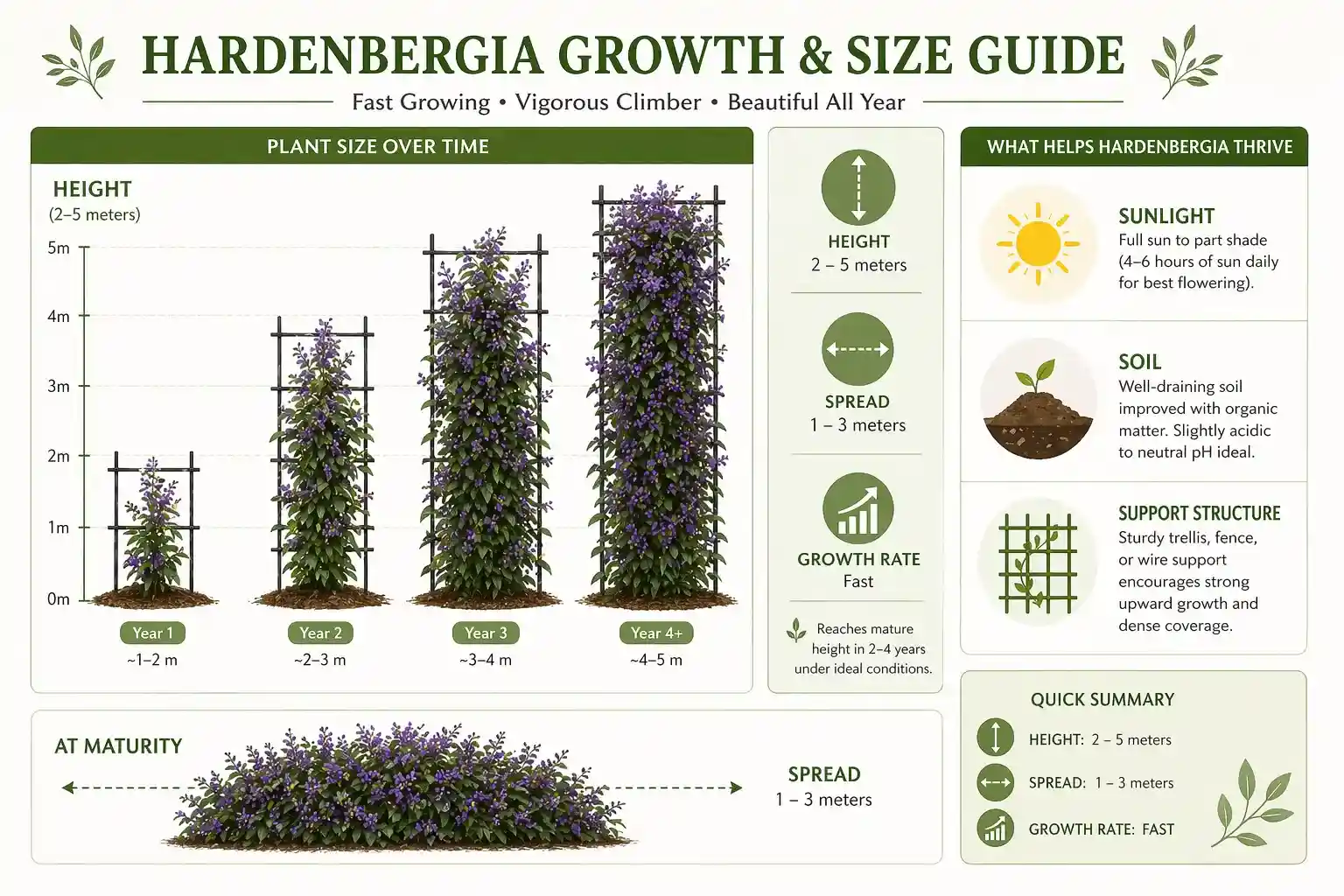
Size & Growth Overview
| Feature | Typical Range |
| Height (with support) | 2–5 meters |
| Spread | 1–3 meters |
| Growth Rate | Fast (in warm climates) |
| Lifespan | 10–20+ years |
Key Growth Insights
- Growth depends on sunlight, soil, and support structure
- Climbs higher with trellis or fence support
- Fast establishment in warm, well-drained conditions
Is Hardenbergia Evergreen, Invasive, and Long-Lived?
Hardenbergia is an evergreen, non-invasive, and long-lived plant in suitable climates.
Key Characteristics
- Evergreen in mild and warm climates
- Non-invasive in most regions, especially as an Australian native
- Can live 10–20 years or more with proper care
- Adapts well to different soil types if drainage is good
How to Grow a Hardenbergia Hedge (Step-by-Step)
Growing a hardenbergia hedge involves proper planting, spacing, and early support training.
Step-by-Step Guide
- Choose a sunny to partly shaded location
- Prepare well-draining soil
- Plant 1–1.5 meters apart for dense hedge formation
- Install support such as a trellis or fence
- Water regularly during establishment phase
Does Hardenbergia Need a Trellis or Fence Support?
Yes, hardenbergia requires a trellis or similar structure to grow as a vertical hedge. Without support, it will spread as ground cover instead.
Suitable Support Structures
- Wire fencing
- Wooden trellis
- Garden walls
Growth Behavior Without Support
- Spreads across the ground
- Does not form a hedge-like screen
- Useful as ground cover alternative
Using Hardenbergia as a Fence or Privacy Screen
Hardenbergia is widely used as a natural fence covering or privacy screen due to its dense foliage and climbing ability.
Ideal Applications
- Boundary fencing
- Decorative walls
- Garden partitions
Benefits
- Provides privacy with dense coverage
- Adds seasonal flowers and year-round greenery
- Enhances vertical garden design
For a mixed hedge approach, pairing hardenbergia with Lilly Pilly varieties for hedges and screening can enhance density and visual structure. For a broader look at plants suited to boundary screening beyond just climbers, check this Hedge Privacy Screen Plant Database covering density, height, and privacy ratings.
It’s a handy reference if you’re deciding whether Hardenbergia alone or a mixed hedge setup fits your boundary needs.
Hardenbergia Hedge Pruning and Maintenance
Regular pruning helps maintain shape, density, and healthy growth.
Pruning Guidelines
- Prune after flowering to encourage bushy growth
- Remove weak or leggy stems
- Train vines along support structures
Maintenance Tips
- Minimal fertilization required
- Monitor growth direction and adjust support
- Avoid heavy pruning during active flowering
Care Guide for a Healthy Hardenbergia Hedge
Proper care ensures long-term health and consistent growth.
Essential Care Requirements
- Water: Moderate; drought-tolerant once established
- Light: Full sun to partial shade
- Soil: Well-drained, slightly acidic to neutral
- Fertilizer: Light feeding in spring
Practical Insight
Overwatering is a common mistake—ensure soil drains well to prevent root issues.
Common Problems and How to Fix Them
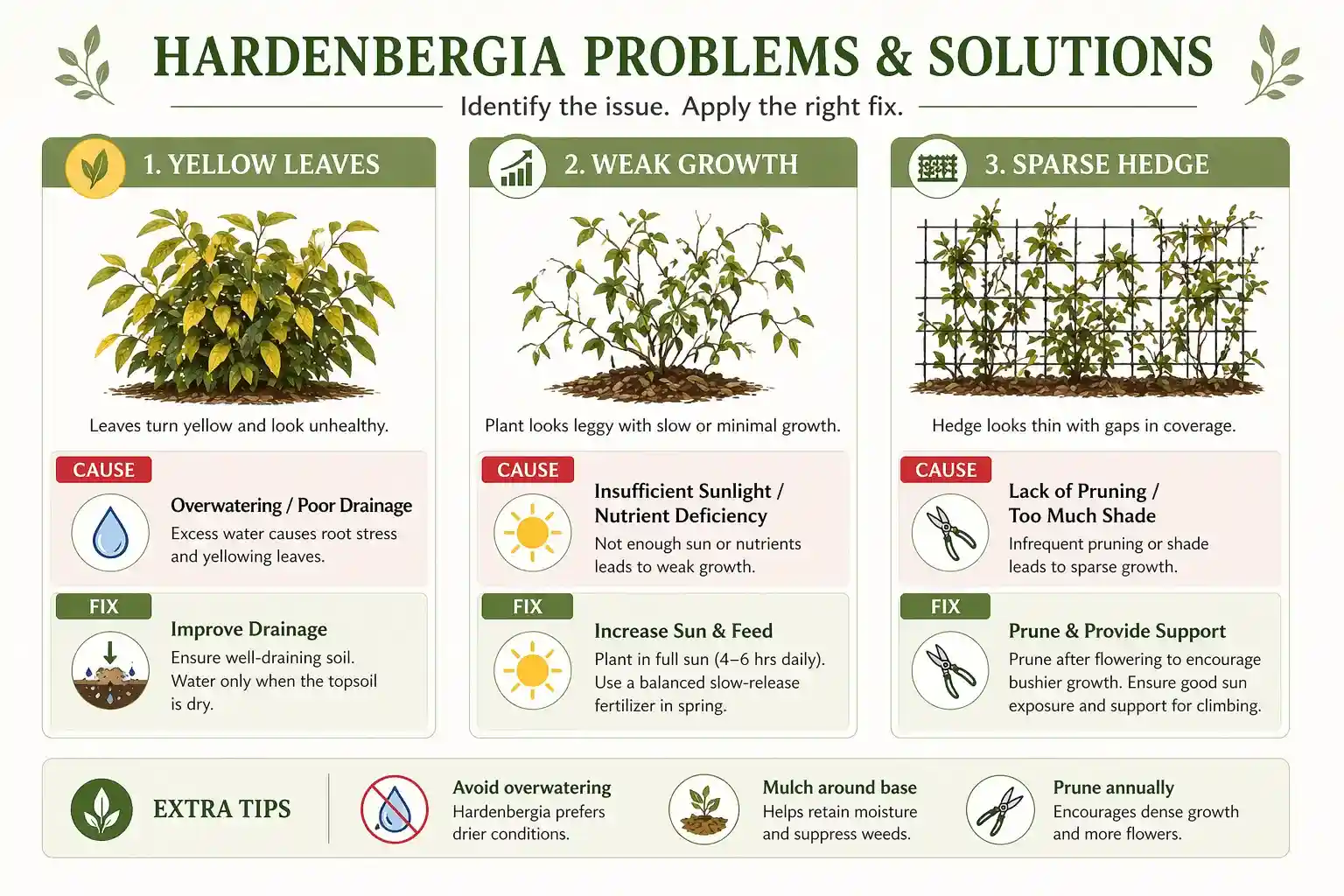
Most issues with hardenbergia hedges are related to environmental conditions or maintenance gaps.
Troubleshooting Guide
- Yellow leaves
- Cause: overwatering or poor drainage
- Fix: improve soil drainage
- Weak growth
- Cause: insufficient sunlight or lack of support
- Fix: reposition plant or install trellis
- Sparse hedge
- Cause: lack of pruning
- Fix: regular shaping after flowering
Hardenbergia Hedge in Different Regions (Australia, UK, and Beyond)
Hardenbergia adapts differently depending on climate conditions.
Regional Performance
- Thrives in Australia due to native conditions
- Can grow in the UK with frost protection
- Sensitive to extreme cold and prolonged frost
Climate Considerations
- Prefers warm, temperate environments
- Requires sheltered positioning in cooler regions
Comparison: Hardenbergia Hedge vs Traditional Hedge Plants
| Feature | Hardenbergia Hedge | Traditional Hedge |
| Growth Habit | Climbing vine | Shrub |
| Support Needed | Yes | No |
| Growth Speed | Fast | Moderate |
| Maintenance | Low | Moderate |
| Flowering | Seasonal blooms | Often minimal |
Hardenbergia offers a climbing alternative to structured hedges, unlike options such as the Carolina cherry laurel hedge, which forms dense, upright shrub barriers without support. For raw side-by-side numbers on growth rate, height, and maintenance across common screening species, this hedge screening plant comparison spreadsheet breaks it down plant-by-plant.
Cross-reference it with the table above to see exactly how Hardenbergia stacks up against shrub-based hedge alternatives.
Beginner Mistakes to Avoid When Growing Hardenbergia
Avoiding common mistakes improves success and plant longevity.
Key Mistakes
- Not providing a support structure
- Overwatering during early growth
- Skipping pruning after flowering
- Incorrect spacing between plants
Related Landscaping Uses and Planting Ideas
Hardenbergia can be integrated into various landscape designs.
Landscaping Ideas
- Vertical gardening for small spaces
- Ground cover alternative when unsupported
- Native plant landscaping schemes
- Companion planting with other climbers
For more privacy-focused designs, combining this climber with other tropical privacy plants for fast screening can create layered and highly effective garden boundaries.
Conclusion
A hardenbergia hedge is a versatile, fast-growing, and visually striking solution for creating privacy screens, fences, and vertical garden features. With proper support, pruning, and care, this evergreen climber provides long-lasting structure and seasonal color. Its adaptability, low maintenance requirements, and strong growth habit make it suitable for both beginner and experienced gardeners. When planted correctly and supported effectively, it offers an efficient and attractive alternative to traditional hedge plants.
FAQs
1. How fast does a hardenbergia hedge grow?
Hardenbergia is a fast-growing climber that can establish quickly, especially in warm climates with good sunlight and well-drained soil.
2. Can hardenbergia be grown without a trellis?
Yes, it can grow without a trellis, but it will spread as ground cover instead of forming a vertical hedge.
3. What is the best variety for a dense hedge?
Bushy cultivars such as hardenbergia bushy blue are ideal because they produce compact and dense growth.
4. Is hardenbergia suitable for cold climates?
It can grow in cooler regions like the UK, but it requires protection from frost and cold winds.
5. When should you prune a hardenbergia hedge?
Pruning should be done after flowering to maintain shape and encourage thicker, bushier growth.