Introduction
Banksia plagiocarpa, commonly known as Hinchinbrook banksia, is a rare Australian native shrub or small tree admired for its striking blue-green foliage, bright yellow flower spikes, and distinctive woody banksia fruit. Sometimes called blue banksia because of its silvery-blue leaves, this species naturally occurs on Hinchinbrook Island in tropical Queensland. Its attractive appearance, ability to support native wildlife, and suitability for Australian landscapes make it a valuable choice for gardeners seeking an unusual native plant. When grown in well-drained soil with plenty of sunlight, Banksia plagiocarpa provides year-round ornamental interest while attracting birds, bees, and other important pollinators.
By Greenery Inside | Plant Care & Gardening Expert
Quick Summary
- Banksia plagiocarpa is a rare Australian native shrub or small tree commonly known as Hinchinbrook banksia or blue banksia.
- It grows best in full sun, free-draining sandy soil, and warm tropical to subtropical climates.
- Bright yellow flower spikes attract nectar-feeding birds, bees, and other native pollinators before developing into woody banksia fruit.
- Low-phosphorus fertilizer, careful watering, and excellent drainage are essential for healthy long-term growth.
- Its attractive blue-green foliage makes it an outstanding feature plant for native, coastal, and wildlife-friendly gardens.
What Is Banksia plagiocarpa?
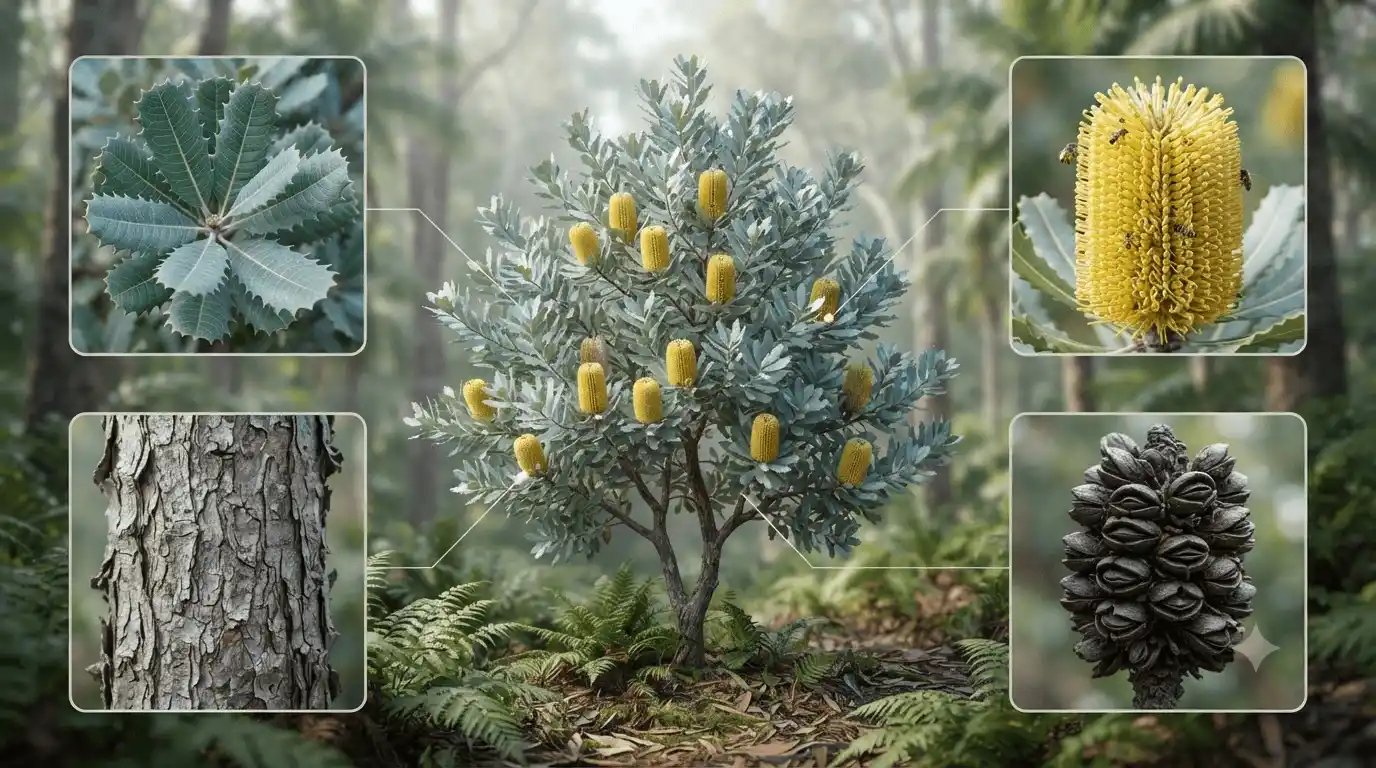
Botanical Profile and Origin
Banksia plagiocarpa is an evergreen member of the Proteaceae family, one of Australia’s most iconic groups of flowering plants. Like many Banksias, it produces nectar-rich flower spikes that play an important ecological role in supporting native wildlife. If you’re exploring more species for your landscape, our comprehensive Australian Native Garden Trees guide covers many of the best native trees and shrubs for Australian gardens. Banksia plagiocarpa is an evergreen member of the Proteaceae family, one of Australia’s most iconic groups of flowering plants.
Botanical Classification
| Classification | Details |
| Scientific Name | Banksia plagiocarpa |
| Common Names | Hinchinbrook banksia, Blue banksia |
| Family | Proteaceae |
| Genus | Banksia |
| Plant Type | Evergreen shrub or small tree |
| Native Region | Hinchinbrook Island, Queensland, Australia |
This species is naturally found on Hinchinbrook Island and nearby coastal areas of tropical Queensland. Because its natural distribution is limited, it is regarded as one of Australia’s more geographically restricted Banksia species.
The common name Hinchinbrook banksia refers directly to its native habitat, while the alternative name banksia hinchinbrook is frequently used by gardeners and native plant enthusiasts when searching for information. The nickname blue banksia comes from the distinctive bluish-grey to blue-green foliage that sets it apart from many other Banksia species.
Unlike several southern Australian Banksias adapted to dry Mediterranean climates, Banksia plagiocarpa has evolved in a warm, humid tropical environment with seasonal rainfall. This adaptation influences its preferred growing conditions in cultivation.
In our experience at Greenery Inside, gardeners who replicate these natural conditions with excellent drainage and plenty of sunlight achieve the healthiest growth and most reliable flowering.
Key Identifying Features
Banksia plagiocarpa is valued for its unique combination of ornamental foliage, bright flowers, and sculptural seed cones. These characteristics make it easy to distinguish from many other Australian native shrubs.
Banksia Leaf Appearance
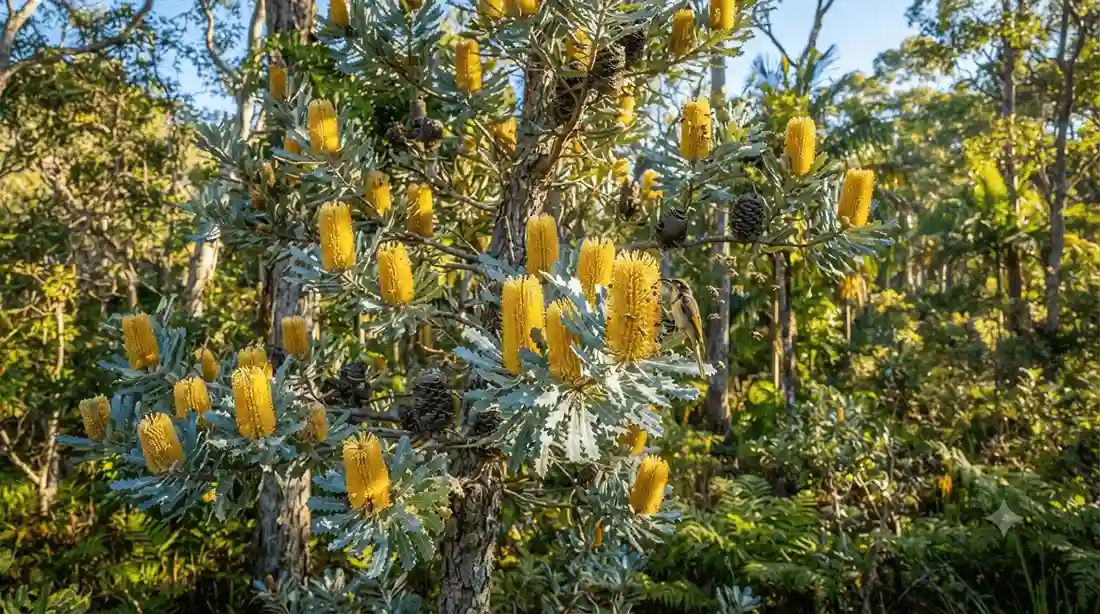
One of the most distinctive features is its attractive banksia leaf coloration. The leaves are:
- Blue-green to silvery-blue
- Thick and leathery
- Narrow to lance-shaped
- Smooth with gently curved margins
- Covered with a fine waxy coating that helps reduce moisture loss
The unusual foliage colour gives the plant year-round ornamental value, even when it is not flowering.
Flower Spikes
During the flowering season, the plant produces upright cylindrical flower spikes packed with hundreds of tiny individual flowers.
Key flower characteristics include:
- Bright golden-yellow colour
- Cylindrical flower spikes
- Rich nectar production
- Strong attraction for birds and insects
- Long-lasting ornamental display
Each flower spike contains hundreds of individual florets that gradually open over several weeks, extending the flowering period and providing a continuous nectar source.
Bark
As the plant matures, its bark becomes:
- Grey to grey-brown
- Slightly rough and textured
- Durable against coastal conditions
The bark adds subtle texture to the landscape while complementing the blue foliage and golden flowers.
Growth Habit
Banksia plagiocarpa typically develops as:
- A dense upright shrub
- A rounded small tree
- Multi-stemmed when young
- More open with age
Its naturally balanced branching habit often requires only minimal pruning.
Woody Banksia Fruit
Following flowering, the plant develops the familiar woody banksia fruit, technically known as follicles or seed cones.
These seed structures:
- Are woody and long-lasting
- Protect developing seeds
- Often remain on the plant for years
- Add architectural interest even after flowering
Many Australian birds and insects interact with these seed cones, contributing to the plant’s ecological importance within native landscapes.
From a gardening perspective, the persistent seed cones also provide attractive winter interest, making Banksia plagiocarpa visually appealing throughout the year.
How Big Do Banksia plagiocarpa Get?
Banksia plagiocarpa typically grows 4–8 metres (13–26 feet) tall and 3–5 metres (10–16 feet) wide under favorable conditions. In most home gardens, it develops as a dense shrub or small tree, while plants growing in their natural tropical habitat may reach the upper end of this range.
The final size depends on several factors, including climate, soil quality, available sunlight, moisture, and pruning. Plants grown in warm, frost-free regions with excellent drainage generally achieve their full potential, whereas those in cooler climates or containers remain smaller.
As a landscape plant, the Hinchinbrook banksia works well as:
- A feature shrub in native gardens
- A small ornamental tree
- A wildlife-attracting specimen plant
- A screening or privacy plant when spaced correctly
- A focal point in coastal landscapes
In our experience at Greenery Inside, allowing sufficient room for mature growth produces a healthier plant with better airflow, reducing disease risks and encouraging more abundant flowering.
Mature Growth Characteristics
| Characteristic | Typical Size |
| Mature height | 4–8 m (13–26 ft) |
| Mature width | 3–5 m (10–16 ft) |
| Growth habit | Dense shrub to small tree |
| Suitable garden size | Medium to large gardens |
| Container suitability | Suitable only while young or with regular root management |
For multiple plants, leave approximately 3–5 metres between specimens to provide adequate space for branching and air circulation.
Growth Rate
Banksia plagiocarpa has a moderate growth rate. Once established, it produces steady annual growth, especially during the warm, wet months typical of tropical and subtropical climates.
Young plants invest considerable energy into developing a strong root system during their first two years. While above-ground growth may initially seem slow, this early establishment supports healthier long-term development and improves drought resilience.
Typical growth pattern includes:
- First year: Root establishment with modest shoot growth.
- Years 2–5: Faster branching and canopy development.
- Mature plants: Consistent seasonal growth with regular flowering.
Growth is influenced by several environmental factors:
- Warm temperatures: Encourage active growth throughout much of the year.
- Full sun: Produces denser foliage and stronger stems.
- Excellent drainage: Prevents root diseases that can stunt growth.
- Low-phosphorus soils: Support healthy root function, as Banksias are naturally adapted to nutrient-poor Australian soils.
- Moderate rainfall or deep watering: Promotes vigorous establishment without causing waterlogging.
As of recent horticultural recommendations (2026), growers continue to emphasize improving soil drainage rather than increasing fertilizer to encourage faster growth. Excess nutrients—particularly phosphorus—often do more harm than good.
Care Guide for Banksia plagiocarpa
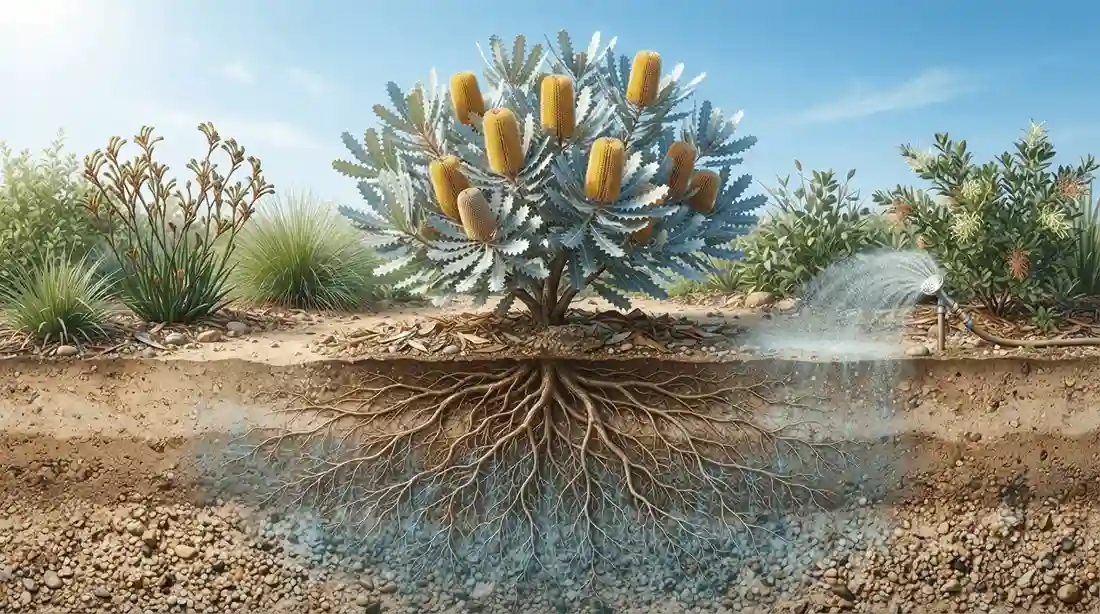
Proper care helps Banksia plagiocarpa develop healthy roots, vibrant blue-green foliage, and abundant flower spikes. Although this Australian native is relatively low-maintenance once established, providing the right growing conditions is essential for long-term success.
Light Requirements
Banksia plagiocarpa grows best in full sun, receiving at least 6–8 hours of direct sunlight daily.
Adequate sunlight promotes:
- Compact, balanced growth
- Rich blue-green leaf colour
- More abundant flowering
- Stronger stems
- Improved disease resistance
The plant tolerates light afternoon shade in very hot climates, but excessive shade often results in fewer flowers, elongated stems, and less vibrant foliage.
Greenery Inside recommends planting in the sunniest suitable location available for the best ornamental display.
Soil Requirements
Excellent drainage is the single most important factor for growing healthy blue banksia plants.
Ideal soil characteristics include:
- Sandy or sandy-loam soil
- Slightly acidic to neutral pH
- Low phosphorus levels
- High drainage capacity
- Good air movement around the roots
Avoid:
- Heavy clay soils
- Permanently wet sites
- Compacted ground
- Poorly drained garden beds
If your soil is naturally heavy, consider planting in a raised bed or raised mound to improve drainage and reduce the risk of root diseases.
Watering Needs
Young plants require regular watering while establishing, but mature specimens become relatively drought tolerant.
A practical watering schedule is:
| Plant Stage | Watering Recommendation |
| Newly planted | Deep watering 1–2 times per week, depending on rainfall |
| Establishing (first 1–2 years) | Water when the topsoil begins to dry |
| Mature plants | Water deeply during prolonged dry periods only |
Deep watering encourages roots to grow downward, improving drought resistance.
One of the most common mistakes is frequent shallow watering. This keeps the surface constantly damp, encourages weak root systems, and increases the likelihood of root rot.
Never allow water to stand around the base of the plant.
Fertilizer Requirements
Like many members of the Proteaceae family, Banksia plagiocarpa is highly sensitive to phosphorus.
Use only fertilizers specifically formulated for Australian native plants that contain very low phosphorus levels.
Suitable fertilizing practices include:
- Apply a low-phosphorus native fertilizer during spring.
- Follow manufacturer recommendations carefully.
- Avoid overfeeding.
- Use slow-release formulations where possible.
Avoid:
- General-purpose garden fertilizers
- High-phosphorus bloom boosters
- Fresh animal manure
- Excessive compost containing nutrient-rich additives
Because Banksias have specialized root systems called proteoid roots, they efficiently absorb nutrients from naturally infertile soils. High phosphorus levels can overwhelm these roots and cause toxicity.
Pruning and Maintenance
Banksia plagiocarpa generally requires only light pruning to maintain its natural form.
Routine maintenance includes:
- Removing dead or damaged branches.
- Trimming lightly after flowering.
- Removing spent flower spikes if seed collection is not desired.
- Maintaining an open canopy to improve air circulation.
Avoid heavy pruning into old, leafless wood, as recovery may be slow and uneven.
Regular inspections also help identify early signs of pests or disease before they become serious problems.
In our experience growing Australian native plants, annual light maintenance produces healthier plants than occasional heavy pruning.
Climate and Hardiness
The Hinchinbrook banksia is naturally adapted to the warm conditions of tropical Queensland.
Ideal climate conditions include:
- Tropical climates
- Subtropical regions
- Frost-free environments
- Coastal gardens
- Areas with good air circulation
The species also shows good tolerance to:
- Seasonal dry periods after establishment
- Coastal winds
- Salt-laden air near the ocean
However, it has several limitations.
Extended frost can damage young shoots and flower buds, while prolonged waterlogging often leads to root decline. In cooler climates, planting in a protected microclimate or using frost protection during unusually cold weather can improve survival.
Choosing a location that closely resembles its natural environment—with warmth, sunlight, and fast-draining soil—provides the best opportunity for long-term success and reliable flowering.
Flowers, Leaves, and Banksia Fruit
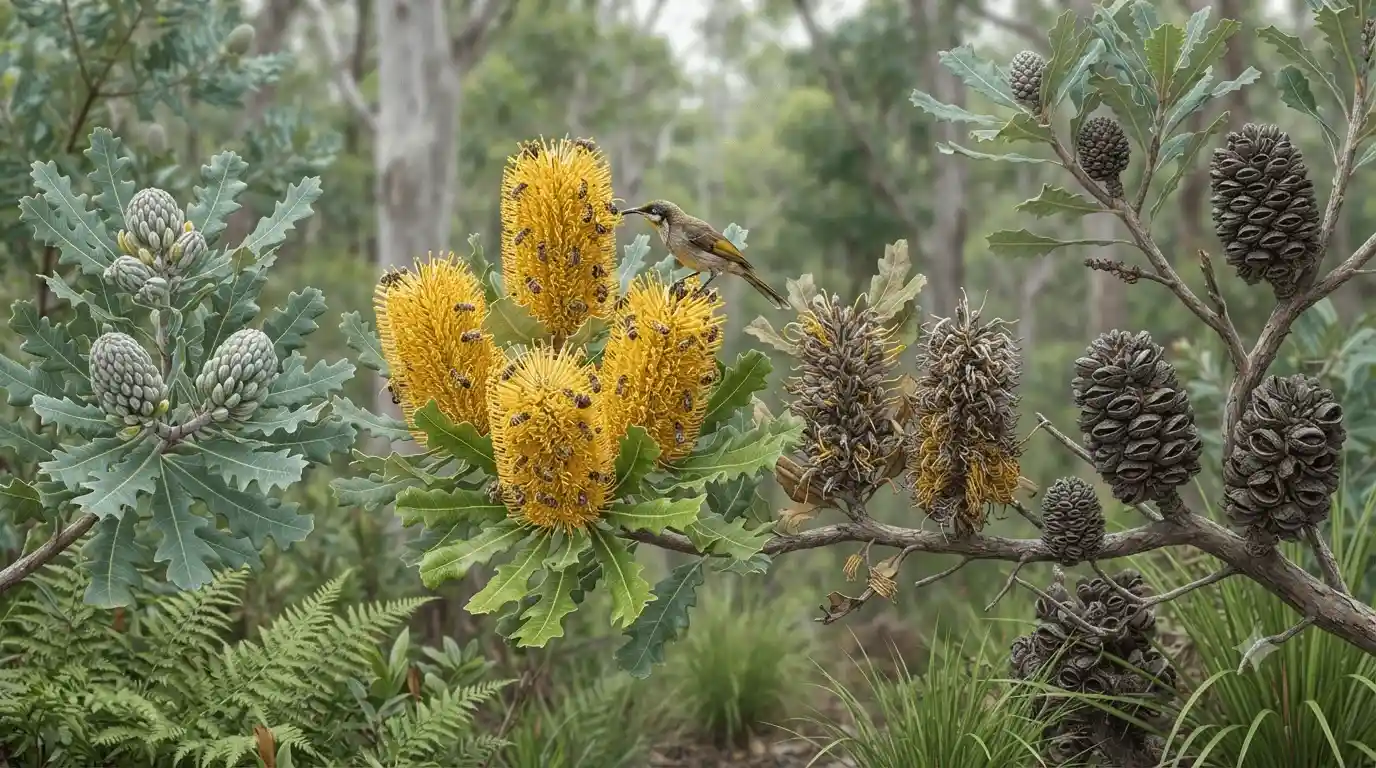
The flowers, foliage, and seed cones are the defining ornamental features of Banksia plagiocarpa. Together, they provide year-round visual appeal while supporting birds, bees, and other native wildlife.
Flower Characteristics
Banksia plagiocarpa produces striking cylindrical flower spikes made up of hundreds of tiny individual flowers. The spikes are typically golden yellow and stand upright above the blue-green foliage, creating a vivid contrast.
Flowering generally occurs from late winter through spring, although the exact timing may vary slightly depending on local climate and growing conditions.
Key flower features include:
- Bright golden-yellow flower spikes
- Cylindrical shape with densely packed florets
- Rich nectar production
- Long-lasting blooms
- Strong attraction for nectar-feeding wildlife
The flowers are an important food source for:
- Honeyeaters
- Native bees
- Butterflies
- Other beneficial pollinating insects
As each flower spike opens gradually over several weeks, it provides an extended nectar supply that benefits local ecosystems.
In our experience at Greenery Inside, plants growing in full sun and well-drained soil consistently produce larger flower spikes and more reliable seasonal displays.
Banksia Leaf Characteristics
The foliage is one of the reasons this species is often called blue banksia.
Its leaves display a distinctive blue-green to silvery-blue colour that remains attractive throughout the year, even when the plant is not flowering.
Typical leaf characteristics include:
- Blue-green or grey-blue colouring
- Narrow, lance-shaped form
- Thick, leathery texture
- Smooth or slightly curved margins
- Fine waxy coating that reduces moisture loss
The waxy surface helps protect the leaves from heat, strong sunlight, and drying coastal winds. This natural adaptation also contributes to the plant’s drought tolerance.
Unlike some Banksia species with deeply serrated foliage, the banksia leaf of Banksia plagiocarpa has a cleaner, smoother appearance, making it especially desirable as an ornamental landscape plant.
The evergreen foliage provides year-round structure in:
- Native gardens
- Coastal landscapes
- Wildlife gardens
- Mixed shrub borders
- Modern Australian garden designs
Banksia Fruit and Seed Cones
After flowering, the spent flower spikes gradually develop into the familiar woody banksia fruit, commonly known as seed cones.
These cones contain numerous woody follicles that protect the seeds until environmental conditions become suitable for release.
Characteristics of the seed cones include:
- Woody and highly durable
- Cylindrical to oval shape
- Long-lasting on the branches
- Decorative throughout the year
- Contain protected seed follicles
Unlike some Banksia species that release seed mainly after fire, Banksia plagiocarpa may gradually release seed as the follicles mature and dry.
The seed cones also have ecological importance by:
- Providing shelter for small insects
- Offering habitat complexity for wildlife
- Preserving seed for future regeneration
Many gardeners leave the cones on the plant because they add attractive texture to the garden, even long after flowering has finished.
What Are the Benefits of Banksia plagiocarpa?
Banksia plagiocarpa offers far more than ornamental beauty. It supports biodiversity, adapts well to suitable Australian gardens, and provides year-round ecological value.
Major benefits include:
Wildlife Habitat
The dense branching structure creates shelter for:
- Small native birds
- Beneficial insects
- Lizards
- Other garden wildlife
This makes the plant an excellent addition to wildlife-friendly landscapes.
Rich Nectar Source
The nectar-rich flowers attract:
- Honeyeaters
- Lorikeets
- Native bees
- Butterflies
These pollinators help maintain healthy garden ecosystems while increasing biodiversity.
Pollinator Support
Because flowering occurs over an extended period, Banksia plagiocarpa provides a reliable food source when nectar may be limited from other plants.
Including native Banksias in the landscape can significantly improve habitat availability for local pollinators.
Native Landscaping
Its distinctive blue foliage makes it an outstanding feature plant in:
- Australian native gardens
- Bushland-style landscapes
- Contemporary gardens
- Public parks
- Habitat restoration projects
Drought Tolerance
Once fully established, the plant tolerates periods of dry weather with relatively little supplemental irrigation.
Deep root development allows mature plants to survive seasonal drought far better than many exotic ornamental shrubs.
Coastal Garden Performance
The species naturally tolerates:
- Salt-laden air
- Coastal winds
- High humidity
- Warm tropical conditions
These qualities make it suitable for many seaside gardens where less-adapted plants struggle.
Erosion Control
Its extensive root system helps stabilize sandy soils and gentle slopes, making it useful for reducing soil movement in suitable landscapes.
Ornamental Foliage
The unique blue-green leaves provide visual interest throughout the year, even outside the flowering season.
The foliage pairs well with other Australian native plants that have silver, grey, or green leaves.
Cut Flower Potential
Fresh flower spikes are occasionally used in native floral arrangements because they are:
- Long-lasting
- Structurally attractive
- Rich in colour
- Popular in Australian native flower displays
Biodiversity Value
By combining nectar production, habitat creation, and seed resources, Banksia plagiocarpa contributes meaningfully to biodiversity in residential and public landscapes.
Greenery Inside recommends combining it with other native flowering shrubs to create continuous food sources for birds and pollinators throughout the year.
How to Grow Banksia plagiocarpa from Seed
Growing Banksia plagiocarpa seed is a rewarding way to propagate this uncommon Australian native. While germination can be slower than some garden plants, fresh seed and proper growing conditions greatly improve success.
Seed Collection
Seeds are collected from mature woody cones after the follicles naturally begin to open.
For the best results:
- Select healthy parent plants.
- Harvest mature, dry cones.
- Store seed in a cool, dry location until sowing.
Seed Preparation
Unlike some Australian native species, Banksia plagiocarpa generally does not require complex pre-treatment.
Before sowing:
- Remove seeds carefully from the follicles.
- Discard damaged or shriveled seed.
- Sow fresh seed whenever possible for higher germination rates.
Germination
Fill seed trays with a free-draining native propagation mix and sow the seed on the surface before covering it lightly with coarse sand or fine propagation mix.
Maintain:
- Temperatures around 20–25°C
- Bright, indirect light
- Even moisture without waterlogging
- Good air circulation
Germination typically occurs within several weeks, although timing varies depending on seed freshness and environmental conditions.
Potting Mix
Young seedlings perform best in a mix containing:
- Coarse sand
- Native potting mix
- Fine pine bark or similar low-phosphorus organic material
Avoid rich composts or mixes containing high levels of fertilizer.
Seedling Care
As seedlings develop:
- Water lightly when the surface begins to dry.
- Provide increasing sunlight gradually.
- Protect from severe frost and heavy rainfall.
- Ensure excellent drainage at all times.
Young Banksias dislike constantly wet roots, so careful watering is essential.
Transplanting
Once seedlings develop several sets of true leaves and strong root systems, they can be transplanted into larger pots or their permanent garden position.
Plant during mild weather to reduce transplant shock, and water deeply after planting to help roots establish.
In our experience, autumn and early spring planting generally produce the highest establishment success in suitable climates.
Common Problems Affecting Banksia plagiocarpa
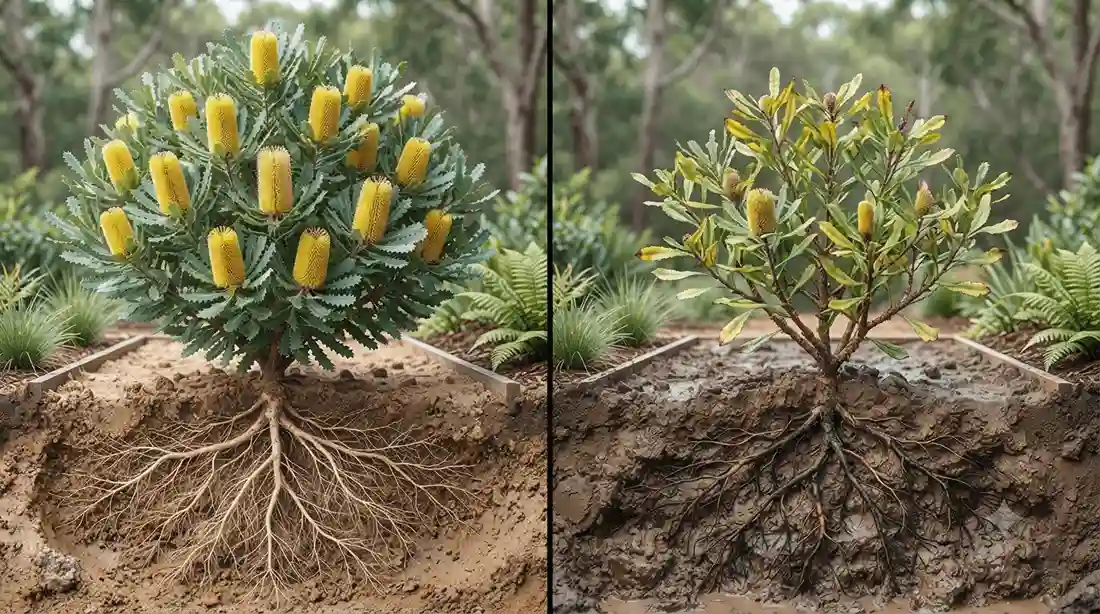
Although Banksia plagiocarpa is relatively hardy when grown correctly, several common problems can affect its health. Most issues are linked to unsuitable soil conditions, incorrect watering, or nutritional imbalances rather than the plant itself.
Root Rot
Root rot is one of the most serious problems affecting Banksia species.
Causes
- Poor drainage
- Heavy clay soils
- Constantly wet roots
- Overwatering
- Waterlogged planting sites
Prevention
- Plant in free-draining soil.
- Improve drainage with raised beds if necessary.
- Water deeply but infrequently.
- Avoid planting in low-lying areas where water collects.
Healthy drainage remains the most effective defense against root diseases.
Phosphorus Toxicity
Banksias are highly sensitive to excess phosphorus.
Symptoms
- Yellowing or browning leaf tips
- Poor growth
- Root damage
- General plant decline
Prevention
- Use only low-phosphorus native fertilizers.
- Avoid general-purpose fertilizers.
- Follow application rates carefully.
Poor Flowering
A healthy plant should flower regularly once mature.
Common causes of poor flowering include:
- Too much shade
- Excess nitrogen fertilizer
- Heavy pruning before flowering
- Immature plants
- Environmental stress
Improving sunlight exposure and avoiding excessive feeding usually restores flowering over time.
Yellowing Leaves
Yellow leaves can indicate several underlying issues.
Possible causes include:
- Overwatering
- Poor drainage
- Nutrient imbalance
- Root damage
- Natural aging of older foliage
Checking soil moisture and root health is the first step toward identifying the problem.
Pests
While generally resistant to major pest infestations, Banksia plagiocarpa may occasionally be affected by:
- Scale insects
- Stem borers
- Leaf-eating caterpillars
Regular inspections allow early treatment before damage becomes severe.
Fungal Diseases
Fungal problems become more common when plants remain damp for extended periods.
Prevention includes:
- Good air circulation
- Proper spacing between plants
- Watering at the base rather than over foliage
- Removing diseased branches promptly
Healthy growing conditions remain the best long-term strategy for minimizing disease.
Common Beginner Mistakes When Growing Hinchinbrook Banksia
Many growing problems can be avoided by understanding the natural habitat of Hinchinbrook banksia. This species has evolved in nutrient-poor, well-drained soils, so treating it like a typical garden shrub often leads to poor performance.
Common beginner mistakes include:
- Overwatering: Constantly wet soil deprives roots of oxygen and encourages root rot.
- Planting in heavy clay: Dense soils retain too much moisture and restrict root growth.
- Using high-phosphorus fertilizers: Banksias are highly sensitive to phosphorus, which can damage their specialized proteoid roots.
- Growing in too much shade: Insufficient sunlight reduces flowering and produces weak, elongated growth.
- Poor drainage: Waterlogged conditions are one of the leading causes of plant decline.
- Planting too close together: Crowded plants have poor air circulation, increasing the risk of fungal diseases.
- Over-pruning: Removing too much growth at one time can reduce flowering and spoil the plant’s natural form.
Greenery Inside recommends observing the plant during its first year after planting. Addressing watering or drainage issues early usually prevents more serious problems later.
Banksia plagiocarpa Compared with Similar Banksia Species
Banksia plagiocarpa differs from many commonly grown Banksias because of its distinctive blue foliage, tropical origin, and relatively restricted natural distribution. While all Banksias produce nectar-rich flowers and woody seed cones, each species has unique characteristics that suit different landscapes. To explore additional species suitable for different climates and garden sizes, see our complete guide to Banksia Tree Varieties.
Species Comparison
| Species | Mature Size | Flower Color | Native Range | Best Garden Use | Distinguishing Feature |
| Banksia plagiocarpa | 4–8 m | Yellow | Tropical Queensland | Feature tree, wildlife gardens | Blue-green foliage |
| banksia aquilonia | 4–8 m | Yellow | Northern Queensland | Tropical native gardens | Tropical adaptation |
| banksia spinulosa | 1–3 m | Yellow to orange | Eastern Australia | Small gardens, hedging | Compact habit |
| banksia ericifolia | 2–5 m | Orange to red | Eastern Australia | Pollinator gardens | Dense flowering display |
| banksia prionotes | 5–10 m | Orange-yellow | Western Australia | Large landscapes | Tall upright growth |
| banksia menziesii | 4–10 m | Pink to red | Western Australia | Feature tree | Spectacular colorful flower spikes |
| banksia praemorsa | 2–5 m | Red or yellow | Western Australia | Coastal gardens | Distinctive toothed leaves |
Compared with Banksia spinulosa, Banksia plagiocarpa grows significantly taller and develops broader blue-grey foliage. Banksia ericifolia generally produces brighter orange or red flowers and has finer, heath-like leaves.
Western Australian species such as Banksia menziesii, Banksia prionotes, and Banksia praemorsa thrive under different climatic conditions and may not perform as well in humid tropical environments where Banksia plagiocarpa naturally grows.
Popular Banksia Varieties and Related Species
Gardeners interested in blue banksia often explore other Banksia species and cultivars to suit different landscape sizes and climates. Gardeners looking for a more upright screening banksia may also like Banksia Sentinel, which is valued for its narrow growth habit and reliable flowering.
Popular options include:
- Hairpin banksia (Banksia spinulosa) – A compact shrub prized for its long flowering season.
- Heath-leaved banksia (Heath banksia / Heath leaved banksia) – Another common name for Banksia ericifolia, valued for its fine foliage and bright flower spikes.
- Little Eric banksia (Banksia ericifolia ‘Little Eric’) – Also searched as banksia little eric or banksia ericifolia little eric, this dwarf cultivar is ideal for smaller gardens and containers.
- Banksia ericifolia tree – Taller forms of B. ericifolia can reach around 4–5 metres, though banksia ericifolia height varies with growing conditions.
- Banksia spinulosa cultivars – Including banksia spinulosa dwarf red, banksia spinulosa var. collina, and banksia collina, which are excellent choices for compact landscapes. Gardeners often search for banksia spinulosa height when selecting a suitable cultivar.
- Banksia coastal cushions – A low-growing cultivar suitable for coastal gardens and groundcover plantings.
- Banksia cunninghamii – A naturally occurring form closely related to Banksia spinulosa with a taller growth habit.
- Banksia ‘High Noon’ – A popular ornamental cultivar known for its prolific flowering.
- Banksia ‘Red Dawn’ (Red Dawn banksia) – Appreciated for its striking flower colour and landscape performance.
- Banksia praemorsa – Available in banksia praemorsa yellow, banksia praemorsa red, and ornamental selections such as banksia praemorsa Red Dawn.
- Cut leaf banksia (Cut-leaf banksia) – Recognized by its deeply divided foliage, adding texture to native gardens.
- Yellow banksia, pink banksia, and orange banksia are common descriptive names used for species with corresponding flower colours, including those with vibrant orange banksia flowers.
- Firewood banksia (Banksia menziesii) – Also known as Menzies banksia, admired for its spectacular red and pink flower spikes.
- Dwarf Banksia menziesii and banksia menziesii dwarf – Compact selections suitable for smaller landscapes.
- Prionotes banksia (Banksia prionotes) and banksia prionotes dwarf – Excellent choices where taller or compact forms are preferred.
- Acorn banksia, miniature banksia, and small banksia are popular search terms describing compact-growing Banksia species and cultivars suitable for residential gardens.
Selecting the right Banksia depends on your available space, local climate, soil type, and desired ornamental features.
Landscaping Uses for Blue Banksia
The attractive foliage and wildlife value of Banksia plagiocarpa make it a versatile landscape plant in suitable climates.
Popular landscape uses include:
Feature Shrub or Small Tree
Its blue-green foliage and bright yellow flowers create a striking focal point throughout the year.
Native Gardens
The species blends naturally with other Australian natives, creating authentic bushland-inspired landscapes.
Wildlife Gardens
The nectar-rich flowers attract:
- Honeyeaters
- Native bees
- Butterflies
- Beneficial insects
making it an excellent biodiversity plant.
Coastal Gardens
Its tolerance of salt-laden air and coastal winds makes it suitable for many seaside landscapes with well-drained soils.
Screening
When planted in groups with appropriate spacing, mature plants can provide an attractive informal screen.
Pollinator Gardens
Combining Banksia plagiocarpa with flowering Grevilleas, Callistemons, and Melaleucas provides nectar sources across multiple seasons.
Mixed Native Borders
Its blue foliage contrasts beautifully with green-leaved shrubs and brightly coloured flowering natives.
Large Containers
Young plants can be grown successfully in large containers using premium native potting mix with excellent drainage. Long-term cultivation in containers requires periodic repotting and careful watering.
Environmental Limitations
Although Banksia plagiocarpa is adaptable within suitable climates, it performs best when its natural environmental preferences are respected.
Important limitations include:
Frost
Young plants are particularly sensitive to prolonged frost, which may damage new growth and flower buds.
High Humidity
Unlike many Australian natives, this species naturally tolerates tropical humidity, provided the soil remains well drained.
Poor Drainage
Waterlogged conditions are one of the leading causes of decline and should always be avoided.
Heavy Clay Soils
Dense clay restricts root development and retains excessive moisture, increasing disease risk.
High-Phosphorus Soils
Naturally nutrient-poor soils are ideal. Excess phosphorus may cause toxicity and long-term root damage.
Urban Gardens
The plant adapts well to urban landscapes if provided with full sun, adequate space, and free-draining soil.
Wind Exposure
Established plants tolerate coastal winds reasonably well, but newly planted specimens benefit from temporary protection while establishing.
Conclusion
Banksia plagiocarpa, or Hinchinbrook banksia, is one of Australia’s most distinctive native Banksias, valued for its striking blue-green foliage, golden flower spikes, and long-lasting woody seed cones. Its ability to support birds, bees, and other pollinators makes it an excellent addition to wildlife-friendly landscapes.
Long-term success depends on providing conditions similar to its natural habitat—full sun, excellent drainage, low-phosphorus soil, and careful watering during establishment. Once mature, it rewards gardeners with attractive evergreen foliage, seasonal flowers, and impressive drought tolerance.
For gardeners seeking a rare and ornamental Australian native, Banksia plagiocarpa is an outstanding choice that combines beauty, ecological value, and resilience in suitable tropical and subtropical gardens.
Frequently Asked Questions
What is the common name for Banksia plagiocarpa?
The most widely used common name is Hinchinbrook banksia. It is also known as blue banksia because of its distinctive blue-green foliage.
How big do Banksia plagiocarpa get?
Mature plants typically reach 4–8 metres tall and 3–5 metres wide, depending on climate, soil quality, and growing conditions.
Why is Banksia plagiocarpa called blue banksia?
The nickname comes from its attractive bluish-grey to blue-green leaves, which distinguish it from many other Banksia species.
What are the benefits of growing Hinchinbrook banksia?
It provides nectar for birds and pollinators, supports biodiversity, tolerates drought after establishment, performs well in coastal gardens, and offers year-round ornamental value.
How long does Banksia plagiocarpa live?
With suitable care and growing conditions, it can live for several decades, making it a long-lasting feature plant in Australian native landscapes.
Can Banksia plagiocarpa grow in pots?
Yes. Young plants grow well in large containers with excellent drainage and low-phosphorus native potting mix. Mature plants are generally better suited to garden planting.
Is Banksia plagiocarpa drought tolerant?
Yes. Once established, it tolerates extended dry periods, although occasional deep watering during prolonged drought promotes healthier growth and flowering.
What causes Banksia leaves to turn yellow?
Yellowing leaves are commonly caused by overwatering, poor drainage, nutrient imbalance, phosphorus toxicity, or natural aging of older foliage.
When does Banksia plagiocarpa flower?
Flowering usually occurs from late winter through spring, although timing varies slightly depending on regional climate.
How is Banksia plagiocarpa different from Banksia spinulosa?
Banksia plagiocarpa grows larger, has distinctive blue-green foliage, and is native to tropical Queensland. Banksia spinulosa is generally smaller, has greener foliage, and is more commonly grown in temperate regions of eastern Australia.