Introduction
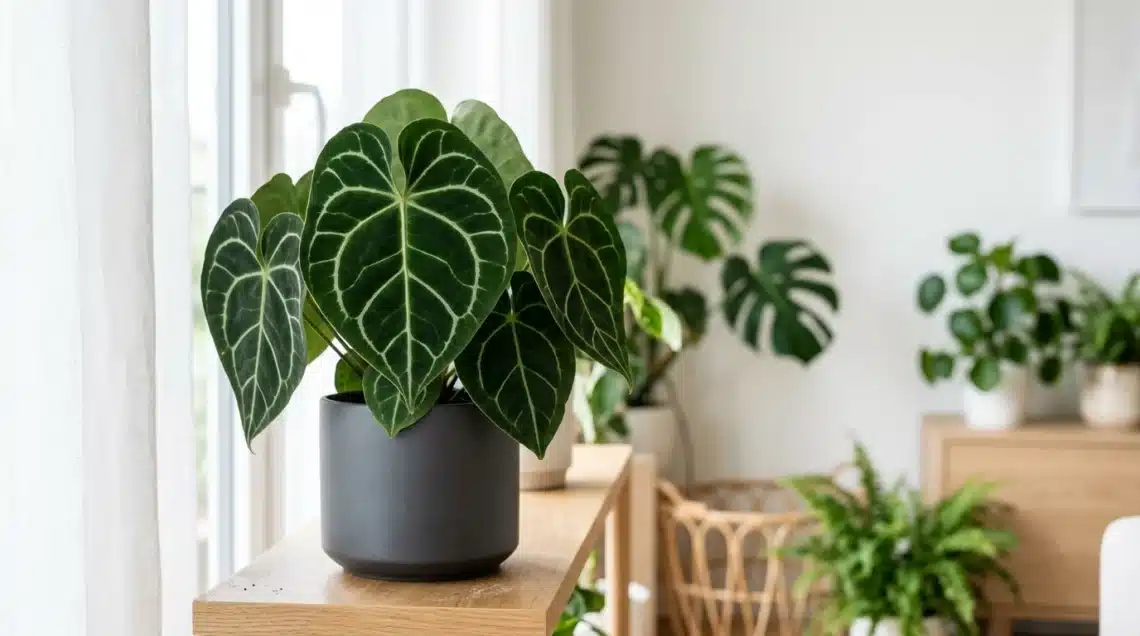
Anthurium clarinervium is a tropical aroid admired for its thick, velvety dark green leaves highlighted by striking white veins. Native to Mexico, this houseplant has become a favorite among collectors because of its unique foliage rather than its flowers. It belongs to the Araceae family and is commonly known as the velvet cardboard anthurium due to its leathery leaf texture.
Many people confuse Anthurium clarinervium with Philodendron clarinervium, but they are different plants despite their similar heart-shaped leaves. This guide explains everything you need to know about Anthurium clarinervium care, including light, soil, watering, humidity, growth rate, and solutions to common problems. If you’re building an indoor plant collection, our guide to house plants explains how to choose, position, and care for popular indoor species before adding Anthurium clarinervium.
Quick Summary
- Anthurium clarinervium grows best in bright indirect light, high humidity (60% or higher), and a chunky, well-draining aroid soil mix.
- It is considered moderately difficult to care for because it is sensitive to excess moisture and low humidity.
- Under proper conditions, it is a slow-to-moderate grower, producing only a few new leaves each year.
- Although it resembles Philodendron clarinervium, the two plants belong to different genera and have different growth habits.
- Consistent watering, excellent drainage, and stable environmental conditions are the keys to long-term success.
What Is Anthurium Clarinervium?
Anthurium clarinervium is a tropical perennial plant in the Araceae family that is grown primarily for its dramatic velvet foliage. Native to the limestone forests of southern Mexico, it naturally grows on rocky slopes where water drains quickly around its roots.
Anthurium clarinervium belongs to the Araceae family, a diverse group of flowering plants that includes many popular tropical houseplants such as philodendrons, monsteras, and peace lilies.
Its thick, heart-shaped leaves have a velvety texture and are decorated with bold white veins that create a striking contrast against the deep green surface. Mature leaves become thicker and more pronounced with age, making the plant even more attractive over time.
The common name velvet cardboard anthurium comes from the firm, almost cardboard-like feel of its leaves. Unlike many flowering houseplants, its ornamental value comes almost entirely from its foliage.
Collectors value Anthurium clarinervium because it combines unusual leaf texture with a compact growth habit. Although it has become more available through commercial growers in recent years, it is still considered a premium collector plant in many regions.
From our experience growing aroids, Anthurium clarinervium performs best when its environment remains consistent. Frequent changes in humidity, watering, or temperature often slow growth and reduce leaf quality.
Botanical Classification
| Classification | Details |
| Scientific Name | Anthurium clarinervium |
| Family | Araceae |
| Common Name | Velvet Cardboard Anthurium |
| Plant Type | Tropical perennial |
| Native Range | Southern Mexico |
| Growth Habit | Compact terrestrial aroid |
| Main Feature | Velvety leaves with bold white veins |
Why Is Anthurium Clarinervium So Popular?
Several characteristics make this plant highly desirable:
- Thick, luxurious velvet foliage
- Bright white leaf veins
- Compact indoor growth
- Long-lasting decorative leaves
- Excellent collector appeal
- Unique tropical appearance
Its dramatic foliage often becomes more beautiful as the plant matures, with larger leaves developing stronger vein patterns.
Anthurium Clarinervium vs. Philodendron Clarinervium
Although these plants are commonly confused, Anthurium clarinervium and Philodendron clarinervium are entirely different species with distinct botanical characteristics.
| Feature | Anthurium Clarinervium | Philodendron Clarinervium |
| Plant Family | Araceae | Araceae |
| Genus | Anthurium | Philodendron |
| Leaf Texture | Thick, stiff, velvety | Softer, thinner velvet |
| Leaf Shape | Broad heart-shaped | More elongated heart shape |
| Growth Habit | Compact terrestrial | Climbing vine |
| Support Needed | Usually no | Moss pole recommended |
| Root System | Thick terrestrial roots | Climbing aerial roots |
| Water Needs | Moderate | Slightly more forgiving |
If you’re weighing clarinervium against other collector aroids beyond just Philodendron, our interactive velvet aroid care comparator lets you sort 16 species side-by-side by light, humidity, and difficulty. It’s a fast way to confirm clarinervium’s needs against similar-looking Anthurium and Alocasia varieties before you buy. One of the easiest ways to distinguish them is their growth habit. Anthurium clarinervium stays relatively compact, while Philodendron clarinervium naturally climbs when given support.
Greenery Inside recommends identifying the plant by both its scientific name and growth habit before following care advice, as recommendations for philodendrons do not always apply to anthuriums.
Is Anthurium Clarinervium Hard to Care For?
Anthurium clarinervium is considered moderately difficult to care for because it requires stable humidity, careful watering, and excellent drainage. It is not the easiest houseplant for beginners, but it becomes much easier once its environmental needs are consistently met.
Unlike many common tropical plants, Anthurium clarinervium reacts quickly to excess moisture around its roots. Poor drainage is one of the most common reasons for declining health.
The main care challenges include:
- Maintaining humidity above 60%
- Preventing root rot
- Using a chunky aroid soil mix
- Avoiding direct afternoon sunlight
- Watering only when the soil partially dries
Fortunately, the plant is relatively forgiving once these basics are understood.
Why Many Beginners Struggle
Most problems result from treating Anthurium clarinervium like an ordinary houseplant.
Common beginner mistakes include:
- Planting it in dense potting soil
- Watering on a fixed schedule
- Keeping humidity too low
- Using oversized pots
- Allowing water to remain around the roots
In our experience, improving soil structure solves more problems than increasing watering frequency. Healthy roots are the foundation of healthy foliage.
With proper care, Anthurium clarinervium can remain healthy for many years while producing increasingly larger leaves.
Anthurium Clarinervium Light Requirements
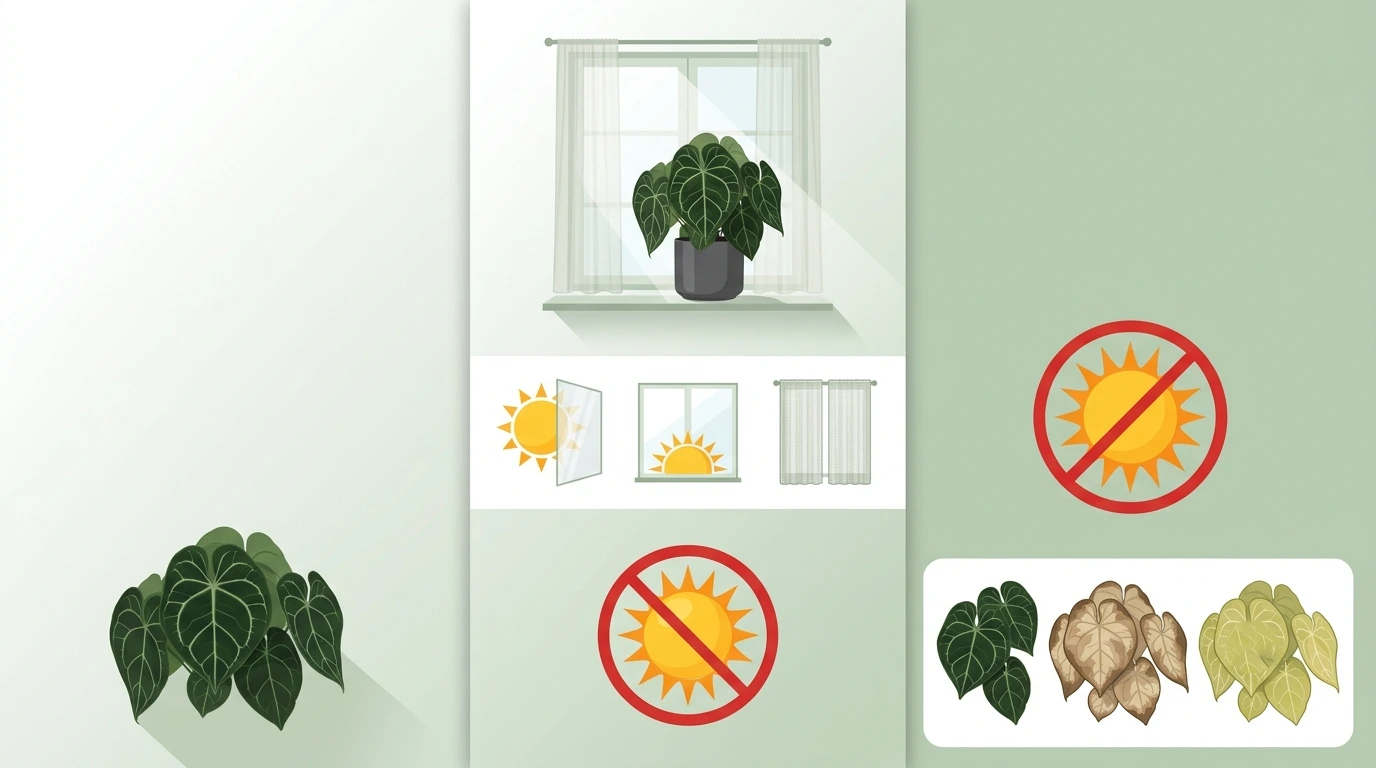
Anthurium clarinervium grows best in bright, indirect light. It naturally grows beneath forest canopies where sunlight is filtered through taller vegetation. For more ideas on selecting plants that thrive indoors, explore our guide to plants for homes and gardens.
The ideal indoor location is near an east-facing window or several feet away from a bright south- or west-facing window with a sheer curtain.
Ideal Light Conditions
- Bright indirect light
- 6–8 hours of filtered light daily
- No harsh afternoon sun
- Gentle morning sunlight is acceptable
Too much direct sunlight damages the velvet leaf surface, while insufficient light slows growth and reduces leaf size.
Signs of Too Much Light
- Yellow patches
- Brown scorch marks
- Bleached leaves
- Crispy edges
Signs of Too Little Light
- Slow growth
- Smaller leaves
- Long gaps between new leaves
- Weaker white venation
If natural light is limited, a quality LED grow light positioned 12–18 inches above the plant for 10–12 hours daily can provide excellent results.
As of the 2026 growing season, many indoor growers successfully combine indirect daylight with full-spectrum LED lighting to maintain consistent growth throughout the year.
Best Place to Put an Anthurium in the House
The best indoor locations include:
- Bright east-facing windows
- North-facing windows with ample daylight
- Bright rooms with filtered southern exposure
- Well-lit offices away from direct sun
Avoid placing the plant:
- Against hot windows
- Near heating vents
- Beside air conditioners
- In dark hallways
Stable lighting encourages healthier foliage and more consistent leaf production.
Anthurium Clarinervium Soil Requirements
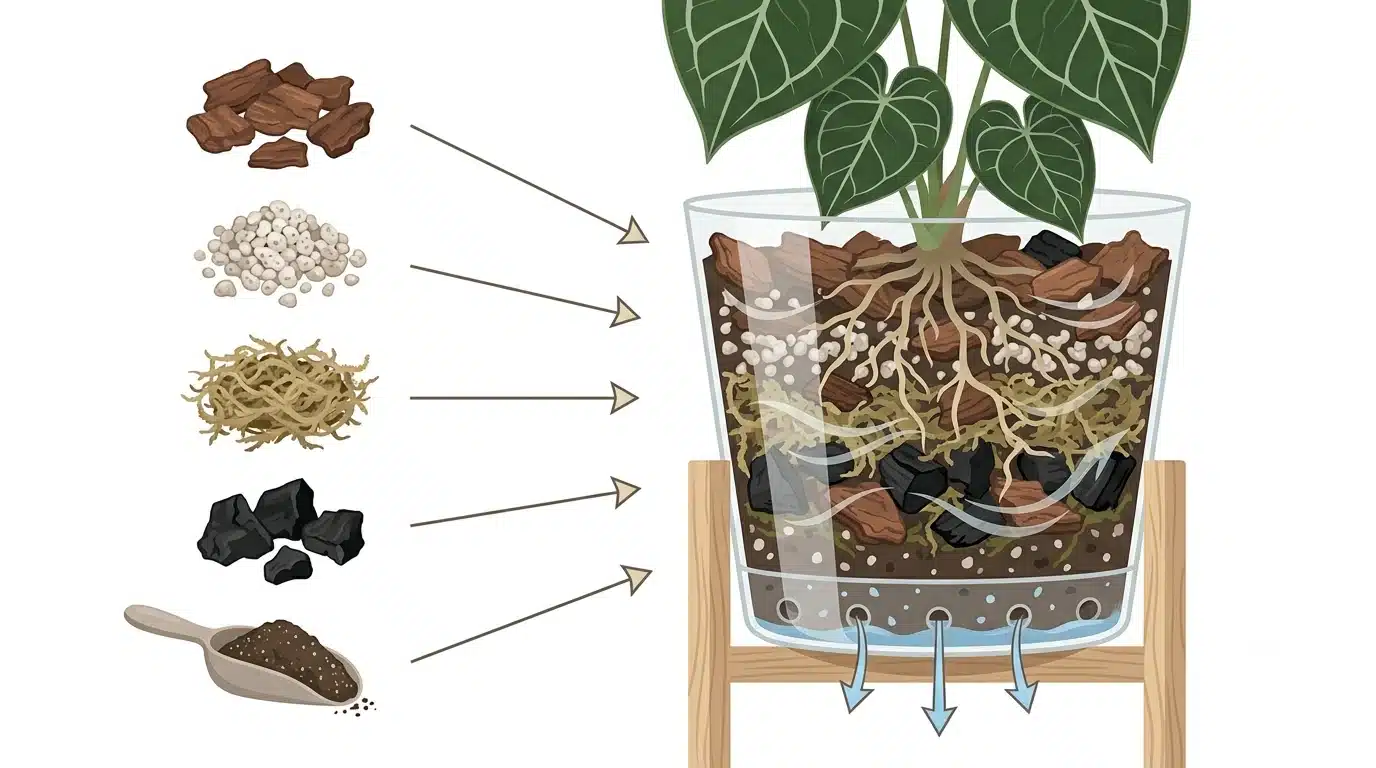
Anthurium clarinervium requires a chunky, fast-draining soil mix that allows oxygen to reach the roots while retaining moderate moisture. Dense potting soil stays wet for too long and significantly increases the risk of root rot.
In its natural habitat, this species grows in rocky environments where water drains quickly. Replicating those conditions indoors produces healthier root systems.
A quality aroid mix typically contains:
- Orchid bark
- Perlite
- Horticultural charcoal
- Sphagnum moss
- Coco chips or coarse coconut husk
- Small amount of high-quality potting mix
Each ingredient contributes a specific function.
Orchid bark creates large air pockets.
Perlite improves drainage.
Charcoal helps maintain freshness while absorbing impurities.
Sphagnum moss provides moderate moisture retention without becoming waterlogged.
Why Standard Potting Soil Doesn’t Work
Regular indoor potting soil is often:
- Too dense
- Too moisture-retentive
- Poorly aerated
- Slow draining
These conditions deprive roots of oxygen, increasing the likelihood of fungal diseases and root rot.
Greenery Inside recommends prioritizing drainage over water retention. Healthy Anthurium roots prefer frequent airflow rather than constantly wet soil.
Best Soil Mix Ratios
| Component | Purpose | Approx. Ratio |
| Orchid Bark | Air circulation | 35% |
| Perlite | Drainage | 25% |
| Sphagnum Moss | Moisture retention | 20% |
| Horticultural Charcoal | Freshness and aeration | 10% |
| Quality Potting Mix | Nutrient base | 10% |
This combination provides the balance of moisture retention, drainage, and airflow that Anthurium clarinervium naturally prefers. If you’re managing a mixed collection, our downloadable velvet aroid care comparison spreadsheet lets you log soil ratios and watering intervals per plant. It’s especially useful for comparing clarinervium’s mix against other chunky-substrate aroids you’re growing side by side.
Watering Anthurium Clarinervium
Water Anthurium clarinervium when the top 1–2 inches (2.5–5 cm) of the soil feel dry. Instead of following a fixed schedule, monitor soil moisture because watering frequency changes with temperature, humidity, pot size, and season. Understanding the difference between plant food vs fertilizer can also help you avoid overfeeding while maintaining healthy growth.
During active spring and summer growth, watering is often needed every 7–10 days. In winter, intervals commonly extend to 10–14 days or longer.
Always water thoroughly until excess water drains from the bottom of the pot, then discard any standing water.
Signs of Overwatering
- Yellow leaves
- Soft stems
- Mushy roots
- Sour-smelling soil
- Black root tips
Signs of Underwatering
- Curling leaves
- Dry leaf edges
- Wilting
- Slow growth
- Soil pulling away from the pot
One of the biggest mistakes we see is watering because the calendar says it’s time rather than checking soil moisture first. A simple finger test or moisture meter is far more reliable.
Do You Water Anthurium From the Top or Bottom?
Both top watering and bottom watering work well, but top watering is generally preferred for routine care.
Top watering flushes accumulated fertilizer salts and evenly moistens the soil profile.
Bottom watering is useful when:
- Soil has become very dry
- Water tends to run off the surface
- You want to reduce splashing on foliage
If bottom watering is used, allow the pot to absorb moisture for 20–30 minutes before removing it from the water and letting excess moisture drain completely.
Can You Use Tap Water on an Anthurium?
Tap water can be used in some areas, but water quality matters. High levels of chlorine, fluoride, or dissolved minerals may gradually cause brown leaf tips or mineral buildup in the soil.
Better alternatives include:
- Filtered water
- Distilled water
- Rainwater
- Dechlorinated tap water
If using tap water, allowing it to sit overnight may help dissipate chlorine, although it will not remove dissolved minerals or fluoride. For households with particularly hard water, filtered or rainwater is generally the safer long-term option.
Humidity Requirements for Anthurium Clarinervium
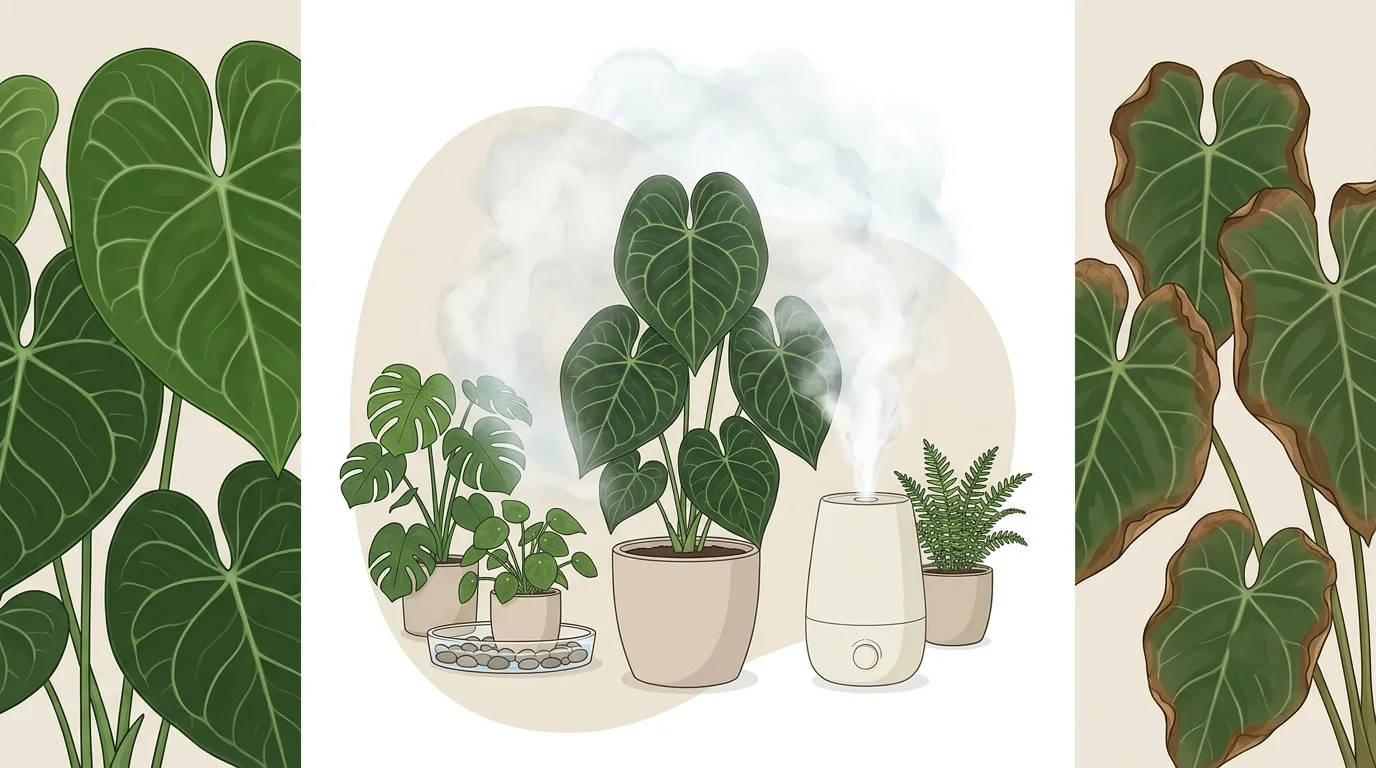
Anthurium clarinervium thrives in humidity levels of 60–80%, closely resembling the warm, humid forests of its native Mexico. While it can survive in average household humidity, consistently dry air often leads to slower growth and leaf damage. If your indoor air is too dry, our guide on how to increase humidity for plants naturally and with humidifiers covers practical methods for maintaining healthier tropical houseplants.
Maintaining adequate humidity is one of the most important factors for producing large, healthy velvet leaves. Although the plant tolerates occasional fluctuations, prolonged exposure to humidity below 50% commonly results in visible stress.
Ideal Humidity Range
| Humidity Level | Plant Response |
| Below 40% | High stress, crispy leaf edges, slow growth |
| 40–50% | Survival possible but not ideal |
| 60–70% | Excellent growth and healthy foliage |
| 70–80% | Optimal for mature plants and propagation |
In our experience growing tropical aroids, plants kept above 60% humidity consistently produce larger leaves with stronger white venation than those grown in dry indoor conditions.
How to Increase Humidity
If your home’s humidity is low, several methods can help create a more suitable environment:
- Use a room humidifier near the plant.
- Group tropical plants together to create a naturally humid microclimate.
- Place the pot on a pebble tray filled with water, ensuring the pot does not sit directly in the water.
- Grow the plant in a well-ventilated greenhouse cabinet or indoor plant cabinet.
Although misting is popular, it provides only temporary humidity and does not significantly increase the surrounding air moisture. Frequent misting can also leave mineral deposits on the leaves if hard water is used.
Signs of Low Humidity
Common symptoms include:
- Brown or crispy leaf edges
- Curling leaf margins
- New leaves becoming stuck while unfurling
- Slower overall growth
- Reduced leaf size
As of the 2026 growing season, many experienced indoor growers recommend using a humidifier instead of frequent misting because it provides more stable humidity without leaving water spots on the foliage.
Fertilizing Anthurium Clarinervium
Anthurium clarinervium benefits from light, regular feeding during its active growing season. It is not a heavy feeder, and excessive fertilizer is more harmful than occasional underfeeding.
Feed every 4–6 weeks during spring and summer using a balanced, water-soluble fertilizer diluted to one-quarter or one-half of the manufacturer’s recommended strength.
Reduce or stop fertilizing during autumn and winter when growth naturally slows.
Fertilizing Best Practices
- Apply fertilizer only to moist soil.
- Dilute fertilizer before each application.
- Avoid feeding newly repotted plants for several weeks.
- Flush the soil occasionally with clean water to remove excess fertilizer salts.
Greenery Inside recommends feeding lightly but consistently rather than applying strong fertilizer infrequently. This approach better matches how nutrients become available in natural environments.
Is Miracle-Gro Good for Anthuriums?
Yes, Miracle-Gro can be used for Anthurium clarinervium if it is properly diluted. Standard Miracle-Gro formulas contain sufficient nutrients for healthy foliage growth, but applying them at full strength may burn sensitive roots.
When using synthetic fertilizers:
- Dilute to one-quarter or one-half strength.
- Feed only during active growth.
- Avoid fertilizing stressed or dehydrated plants.
- Flush the pot periodically to prevent salt accumulation.
Balanced fertilizers with equal nitrogen, phosphorus, and potassium are generally suitable for foliage-focused growth.
Are Coffee Grounds Good for Anthuriums?
Coffee grounds are generally not recommended as a direct fertilizer for Anthurium clarinervium. Although they contain nitrogen and organic matter, fresh coffee grounds can compact the soil, reduce aeration, and alter moisture retention.
Potential drawbacks include:
- Reduced airflow around roots
- Increased fungal growth
- Excess acidity
- Uneven nutrient release
If coffee grounds are used at all, they should first be fully composted and incorporated into finished compost rather than applied directly to the potting mix.
Potting and Root Considerations
Proper pot selection is just as important as choosing the right soil. Anthurium clarinervium prefers containers that provide excellent drainage while allowing its roots to develop gradually.
Terracotta and plastic pots both work well, provided they have adequate drainage holes.
Choosing the Right Pot
A suitable pot should:
- Have multiple drainage holes
- Be only slightly larger than the current root ball
- Allow excess water to drain freely
- Match the plant’s relatively compact root system
Avoid moving the plant into an oversized container. Excess soil stays wet longer, increasing the risk of root rot.
Repotting Frequency
Most healthy plants need repotting every 2–3 years or when:
- Roots emerge from drainage holes.
- Water drains unusually quickly because roots occupy most of the pot.
- Growth slows despite proper care.
- Soil structure has broken down.
Repot during spring or early summer whenever possible, as this is when the plant is actively growing and recovers more quickly.
Does Anthurium Clarinervium Like to Be Root Bound?
Anthurium clarinervium tolerates being slightly root bound but should not remain severely root bound for long periods.
A mildly snug root system can:
- Improve soil drying
- Reduce overwatering risk
- Encourage steady growth
However, heavily crowded roots eventually reduce water absorption and nutrient uptake, slowing plant development.
Unlike some flowering anthuriums, root binding does not significantly improve flowering in Anthurium clarinervium because the plant is primarily grown for its foliage.
Do Anthuriums Like Deep Pots?
No. Anthurium clarinervium generally performs better in wider, moderately shallow pots than in very deep containers.
Its root system spreads outward rather than deeply downward.
Shallow containers:
- Improve soil aeration
- Dry more evenly
- Reduce waterlogging
- Better match the plant’s natural root structure
Deep pots often retain unnecessary moisture below the active root zone.
Growth Rate and Mature Size
Anthurium clarinervium is considered a slow-to-moderate growing houseplant. Growth depends heavily on light, temperature, humidity, and root health.
Most growth occurs during spring and summer when temperatures remain warm and daylight hours increase. Growth slows noticeably during autumn and may nearly stop during winter dormancy.
Healthy plants typically produce several new leaves each growing season rather than continuous rapid growth.
Factors Affecting Growth
Growth rate is influenced by:
- Bright indirect light
- Warm temperatures
- High humidity
- Balanced fertilization
- Healthy root development
- Proper watering practices
In our experience, improving humidity and soil aeration produces faster leaf development than increasing fertilizer.
How Fast Does Anthurium Clarinervium Grow?
Under ideal indoor conditions, Anthurium clarinervium usually produces two to six new leaves each year.
Young plants often establish slowly while developing strong roots. Once established, each new leaf typically becomes larger than the previous one.
Growth may slow considerably if:
- Humidity is too low.
- Light is insufficient.
- Temperatures remain below 18°C (65°F).
- Roots remain excessively wet.
Patience is important because this species naturally grows more slowly than many common philodendrons.
Anthurium Clarinervium Mature Size (Indoors vs. Outdoors)
Plant Size
| Growing Location | Mature Height | Mature Width |
| Indoors | 12–24 inches (30–60 cm) | 18–30 inches (45–75 cm) |
| Natural Habitat | Up to 3 feet (90 cm) or more | Wider depending on age |
Indoor plants usually remain more compact due to container size and environmental limitations.
Larger leaves are typically produced when humidity, light, and root health remain consistently favorable.
Anthurium Clarinervium Flowering and Inflorescence
Anthurium clarinervium produces a characteristic aroid inflorescence consisting of a spadix surrounded by a small spathe. Unlike ornamental flowering anthuriums grown for colorful blooms, this species is valued almost entirely for its foliage.
The flowers are relatively understated and often greenish, cream, or pale in color.
Flower Structure
The inflorescence consists of:
- Spadix: the upright spike that contains numerous tiny flowers.
- Spathe: the modified leaf surrounding the spadix.
These structures differ significantly from the bright red, pink, or white blooms commonly associated with florist anthuriums.
Does It Flower Indoors?
Yes, mature plants may flower indoors when grown under ideal conditions, although flowering is less common than leaf production.
Blooming is encouraged by:
- Bright indirect light
- Warm temperatures
- High humidity
- Consistent watering
- Balanced nutrition
Because Anthurium clarinervium is primarily cultivated for its velvet leaves, flowering is generally considered an added bonus rather than the main objective.
Propagating Anthurium Clarinervium
Anthurium clarinervium can be propagated successfully through division or stem cuttings that contain healthy growth points and roots. Propagation is usually most successful during spring or early summer when the plant is actively growing.
Healthy propagations require warmth, humidity, and excellent drainage.
Basic Propagation Methods
The most reliable methods include:
- Division during repotting
- Stem cuttings with active nodes
- Rooted offsets when available
Maintaining humidity around newly propagated plants helps reduce stress while encouraging new root growth.
How to Propagate Anthurium Clarinervium From Cuttings
Follow these general steps:
- Select a healthy stem section with at least one growth node.
- Sterilize pruning tools before making the cut.
- Allow the cut surface to dry briefly.
- Place the cutting into moist sphagnum moss, perlite, or another well-aerated rooting medium.
- Maintain temperatures between 21–27°C (70–80°F).
- Keep humidity above 70%.
- Provide bright, indirect light without direct sun.
- Transplant into a chunky aroid soil mix once healthy roots have developed.
Greenery Inside recommends avoiding excessive watering during propagation. Slightly moist rooting media encourage root development while reducing the chance of rot.
Common Anthurium Clarinervium Problems (Problem–Solution Section)
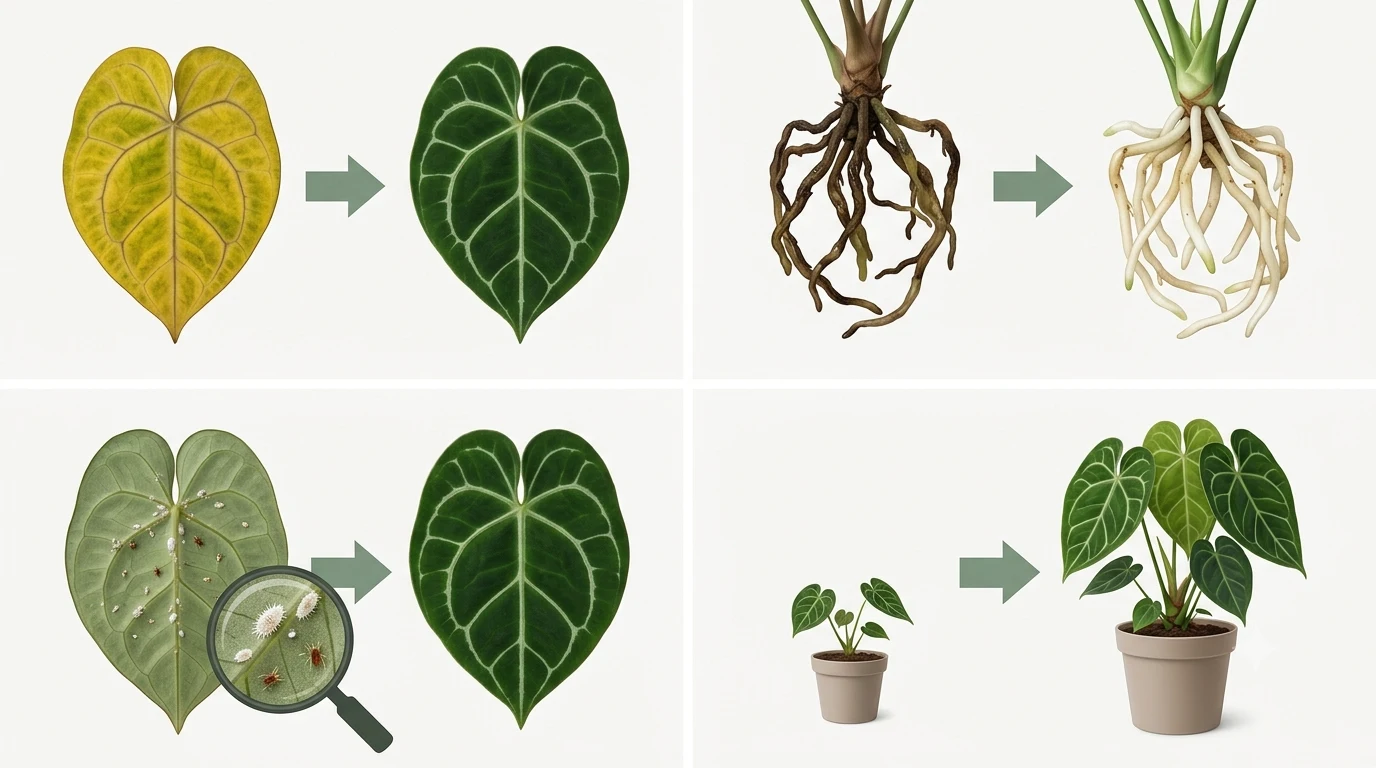
Most Anthurium clarinervium problems are caused by watering mistakes, low humidity, insufficient light, or pest infestations. Identifying symptoms early and correcting environmental conditions usually prevents long-term damage.
Healthy plants have firm roots, thick velvety leaves, and steady seasonal growth. Sudden yellowing, wilting, or leaf damage often indicates that one or more growing conditions need adjustment.
Yellowing Leaves — Cause, Fix, Prevention
Yellow leaves are most commonly caused by overwatering, although poor drainage, aging foliage, nutrient deficiencies, or incorrect lighting may also contribute.
Possible Causes
- Overwatering
- Poorly draining soil
- Natural aging of older leaves
- Low light
- Nutrient imbalance
How to Fix It
- Check soil moisture before watering.
- Remove standing water from saucers.
- Improve drainage with a chunky aroid mix.
- Move the plant to brighter indirect light if necessary.
- Trim fully yellow leaves once they have naturally declined.
Prevention
- Water only when the top portion of the soil has dried.
- Use containers with drainage holes.
- Avoid keeping the roots constantly wet.
- Inspect the plant regularly for early signs of stress.
Overwatering and Root Rot — Cause, Fix, Prevention
Root rot is one of the most serious problems affecting Anthurium clarinervium and is usually caused by excessive soil moisture combined with poor aeration.
Signs of Root Rot
- Mushy black or brown roots
- Yellowing leaves
- Soft stems
- Persistent wilting despite wet soil
- Unpleasant odor from the pot
How to Fix It
- Remove the plant from its pot.
- Trim all damaged roots using sterilized scissors.
- Allow healthy roots to dry briefly.
- Repot into fresh, well-draining aroid soil.
- Reduce watering until new root growth begins.
Prevention
- Never allow water to collect around the roots.
- Use chunky, fast-draining soil.
- Avoid oversized pots.
- Check soil moisture before watering.
In our experience, root rot is far easier to prevent than to treat. Prioritizing drainage is the most effective long-term strategy.
Pest Infestations (Spider Mites, Mealybugs) — Cause, Fix, Prevention
Spider mites and mealybugs are the most common pests affecting Anthurium clarinervium indoors.
Spider Mites
Signs include:
- Fine webbing
- Tiny yellow speckles
- Dull-looking leaves
- Leaf discoloration
Mealybugs
Signs include:
- White cotton-like clusters
- Sticky residue
- Distorted new growth
- Reduced vigor
How to Fix Pest Problems
- Isolate the affected plant.
- Wipe leaves gently with a damp cloth.
- Remove visible pests using cotton swabs dipped in isopropyl alcohol.
- Apply insecticidal soap or neem oil according to product directions.
- Repeat treatment every 7–10 days until pests disappear.
Prevention
- Inspect new plants before bringing them indoors.
- Maintain good airflow.
- Clean leaves periodically.
- Monitor the undersides of leaves where pests often hide.
Slow or Stalled Growth — Cause, Fix, Prevention
Slow growth is often caused by environmental conditions rather than disease. Anthurium clarinervium naturally grows slowly, but prolonged stagnation usually indicates that one or more care requirements are not being met.
Common Causes
- Low light
- Cool temperatures
- Low humidity
- Root-bound conditions
- Nutrient deficiency
How to Fix It
- Increase bright indirect light.
- Raise humidity above 60%.
- Fertilize lightly during spring and summer.
- Repot if roots have filled the container.
- Maintain temperatures between 65–80°F (18–27°C).
Prevention
- Keep growing conditions consistent.
- Avoid frequent location changes.
- Feed regularly during active growth.
- Monitor root health during repotting.
What Is the Red Flag of Anthurium?
The biggest red flag for Anthurium clarinervium is persistent yellowing leaves combined with soft stems or mushy roots, as this usually indicates root rot.
Other warning signs include:
- Rapid leaf collapse
- Blackening roots
- Strong foul smell from the soil
- Extensive brown leaf edges
- Sudden leaf drop
- Severe pest infestations
Early intervention greatly improves recovery. Checking the root system is often the fastest way to determine whether watering issues are responsible.
Is Anthurium Clarinervium Rare?
Anthurium clarinervium is considered uncommon rather than extremely rare. Although commercial tissue culture has increased its availability, it remains highly desirable because of its distinctive velvet foliage and relatively slow growth. If you enjoy velvet-leaf Anthuriums, our Anthurium crystallinum care guide compares another collector favorite with similar growing requirements.
Its popularity among aroid enthusiasts continues to keep demand high, especially for mature specimens with large, perfectly veined leaves.
Why Collectors Value It
Collectors appreciate Anthurium clarinervium because it offers:
- Thick velvety foliage
- Dramatic white venation
- Compact indoor growth
- Long-lasting ornamental leaves
- Excellent display value
Young nursery-grown plants are now more affordable than they were several years ago, while mature specimens remain significantly more expensive due to their slow development. For deeper cultivar-level notes on clarinervium and its collector-grade relatives, our Velvet Collector Aroid Care Database tracks provenance, sourcing difficulty, and long-term growth notes across the whole velvet-leaf group.
What Is the Holy Grail of the Anthurium World?
There is no single universally accepted “holy grail” Anthurium, but several species are widely regarded as elite collector plants.
Examples include:
- Anthurium warocqueanum (Queen Anthurium)
- Anthurium regale
- Anthurium papillilaminum
- Anthurium dressleri
- Exceptional forms of Anthurium clarinervium
These species are prized for their rarity, striking foliage, or difficulty in cultivation.
What Is the Hardest Anthurium to Grow?
Some Anthurium species are considerably more demanding than Anthurium clarinervium.
| Species | Relative Difficulty | Main Challenge |
| Anthurium clarinervium | Moderate | Humidity and drainage |
| Anthurium crystallinum | Moderate | Humidity consistency |
| Anthurium magnificum | Moderate to high | Environmental stability |
| Anthurium warocqueanum | Very high | Extremely high humidity and airflow requirements |
Compared with these species, Anthurium clarinervium is often considered one of the more approachable velvet anthuriums for experienced indoor gardeners.
Anthurium Clarinervium Lifespan
With proper care, Anthurium clarinervium can live for several decades. Individual leaves naturally age and are replaced over time, but the plant itself continues producing new growth when healthy.
Factors That Extend Lifespan
Long-lived plants typically receive:
- Bright indirect light
- Well-draining aroid soil
- Careful watering
- Stable humidity
- Regular but light fertilization
- Prompt pest management
Healthy root systems are especially important because root damage often shortens the plant’s lifespan more than any other factor.
Greenery Inside has found that growers who maintain consistent humidity and avoid chronic overwatering often enjoy healthy specimens for many years with steadily increasing leaf size.
Conclusion
Anthurium clarinervium is one of the most striking foliage plants in the Araceae family, prized for its thick velvet leaves and bold white venation. While it is considered moderately challenging to grow, its care becomes straightforward when its natural habitat is understood and replicated indoors.
Success depends on providing bright indirect light, a chunky and well-draining aroid soil mix, moderate watering, and humidity levels above 60%. Regular monitoring for root health and pests helps prevent the most common problems before they become serious.
The two biggest factors for long-term success are consistent humidity and excellent drainage. When these needs are met, Anthurium clarinervium rewards growers with beautiful, increasingly larger leaves and can remain an impressive houseplant for decades.
Frequently Asked Questions
Is Anthurium clarinervium hard to care for?
Anthurium clarinervium is considered moderately difficult because it requires high humidity, careful watering, and excellent drainage. Once these conditions are consistently maintained, it becomes much easier to grow successfully.
Does Anthurium clarinervium like to be root bound?
Yes, it tolerates being slightly root bound, but severely crowded roots eventually slow growth and reduce water and nutrient uptake. Repot when the roots begin filling the container.
Do you water Anthurium from the top or bottom?
Both methods are effective. Top watering is preferred for routine care because it flushes excess fertilizer salts, while bottom watering is useful when the soil has become very dry and is difficult to rehydrate.
Is Anthurium clarinervium rare?
It is considered uncommon rather than extremely rare. Commercial propagation has improved availability, but mature, high-quality specimens remain sought after by collectors.
What is the lifespan of an Anthurium clarinervium?
With proper care, Anthurium clarinervium can live for several decades. Healthy roots, stable humidity, and appropriate watering significantly extend its lifespan.
How fast does Anthurium clarinervium grow?
Anthurium clarinervium is a slow-to-moderate grower. Under ideal indoor conditions, it typically produces two to six new leaves per year, with each new leaf often becoming larger than the previous one.