Introduction
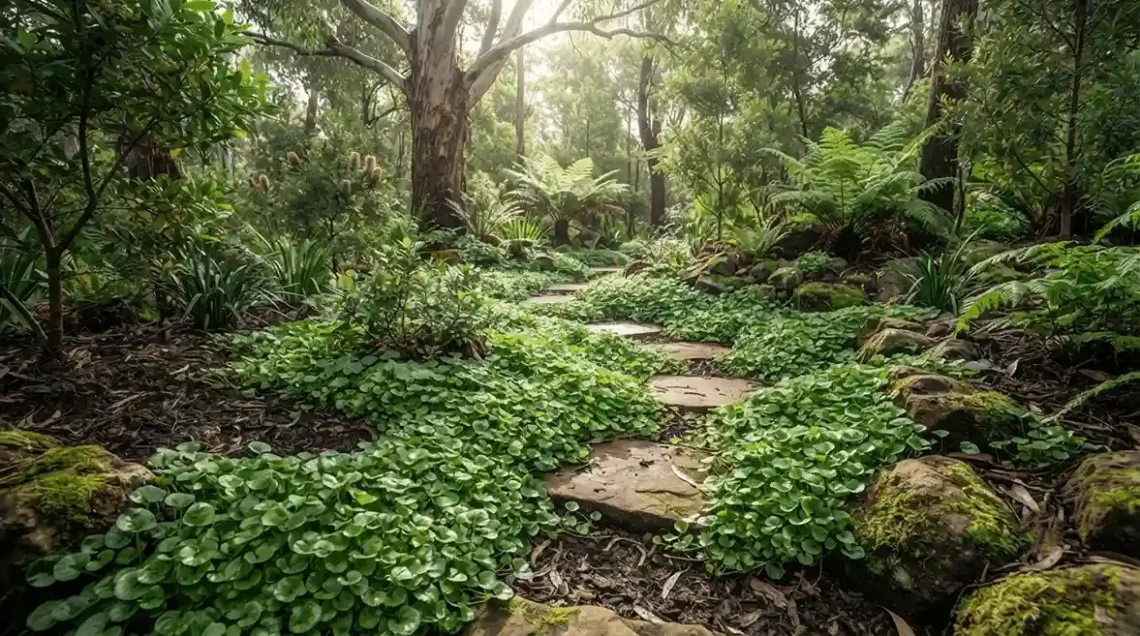
Dichondra repens shade is one of Australia’s most reliable native ground covers for shaded and partially shaded landscapes. Commonly known as kidney weed or kidney weed (Dichondra repens), this attractive creeping perennial forms a dense carpet of rounded green leaves, making it a popular lawn alternative and living mulch. The Dichondra repens common name comes from its distinctive kidney-shaped foliage. Whether planted beneath trees, between pavers, or across garden beds, Dichondra repens performs best where moisture, filtered light, and well-drained soil combine to support healthy, long-lasting growth.
Quick Summary
- Dichondra repens grows best in partial shade or filtered sunlight and tolerates more shade than most lawn grasses.
- This low-growing native kidney weed ground cover creates a dense green carpet suitable for shaded gardens and lawn alternatives.
- Consistent watering during establishment and well-drained soil promote vigorous growth.
- Plants can be propagated from seed, runners, or division depending on the desired speed of establishment.
- Regular maintenance helps maintain healthy foliage and suppress competing weeds.
What Is Dichondra Repens?
Common name and plant identification
Dichondra repens is a native Australian perennial belonging to the morning glory family, Convolvulaceae. Its most widely used common name is kidney weed, referring to the distinctive kidney-shaped leaves that spread across the soil surface.
The plant is also commonly called:
- Kidney weed
- Kidneyweed
- Native dichondra
- Creeping dichondra
Unlike many traditional turf grasses, Dichondra repens spreads by creeping stems instead of producing upright blades. It naturally roots wherever stems touch moist soil, allowing it to gradually cover bare ground.
Its key identification features include:
- Small glossy kidney-shaped leaves
- Bright to deep green foliage
- Thin creeping stems
- Tiny inconspicuous flowers
- Low-growing spreading habit
These characteristics make the kidney weed plant easy to distinguish from grasses and other common ground covers.
Appearance and natural growing habit
The beauty of dichondra lies in its simple yet elegant growth habit. Rather than growing upright, it spreads horizontally across the soil, producing an attractive green mat.
Key characteristics include:
- Rounded kidney-shaped leaves measuring approximately 1–3 cm wide
- Creeping stems that root at each node
- Evergreen foliage in mild climates
- Dense ground-covering habit that suppresses weeds over time
- Soft texture suitable for informal pathways and garden beds
Because kidneyweed continually produces new runners, healthy plants slowly expand into surrounding spaces while maintaining a neat appearance.
In our experience growing Dichondra repens, plants establish more evenly when surrounding weeds are removed before planting. Reducing early competition allows runners to root faster and produce fuller coverage during the first growing season.
Does Dichondra Repens Grow Well in Shade?
Ideal light conditions
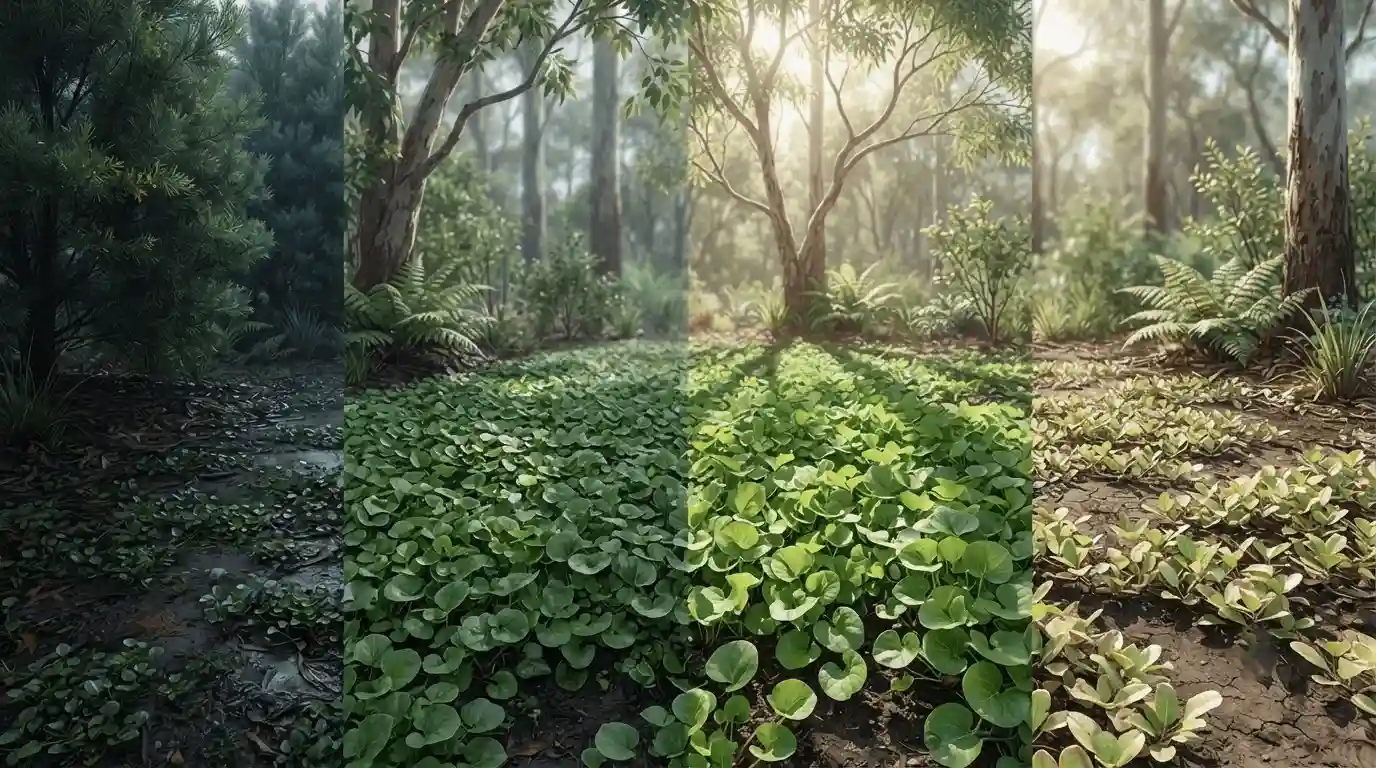
Yes. Dichondra repens performs exceptionally well in partial shade and filtered sunlight, making it one of Australia’s best native ground covers for low-light gardens.
Its preferred light conditions are:
| Light Condition | Performance |
| Partial shade | Excellent |
| Filtered sunlight | Excellent |
| Morning sun with afternoon shade | Very good |
| Full shade | Moderate |
| Full sun | Suitable with adequate moisture |
Partial shade encourages lush green foliage while reducing heat stress and excessive moisture loss.
Although the plant tolerates full shade, extremely dark locations beneath dense evergreen trees may slow growth and reduce leaf density because less light is available for photosynthesis.
Greenery Inside recommends selecting locations that receive several hours of filtered light each day for the healthiest and most uniform ground cover.
Can it grow in full sun?
Yes, but success depends on climate.
Many gardeners ask, Does Dichondra need full sun? The answer is no. While Dichondra repens tolerates full sun in cooler regions, it generally performs better with some afternoon protection, especially in warmer parts of Australia.
In hot inland climates, prolonged summer sun may lead to:
- Leaf scorch
- Reduced vigour
- Faster soil drying
- Increased irrigation requirements
In coastal and temperate regions, however, full sun is often acceptable when soil moisture remains consistent.
Providing afternoon shade during extreme heat helps maintain greener foliage throughout summer.
Best growing conditions in Australia
Dichondra repens shade Australia performs best across temperate, coastal, and many subtropical regions where moderate rainfall supports steady growth.
Ideal growing conditions include:
- Partial shade or filtered sunlight
- Well-drained soil rich in organic matter
- Moderate humidity
- Regular rainfall or supplemental irrigation
- Protection from prolonged waterlogging
The plant adapts well to eastern and southern Australian gardens and is commonly used beneath native trees, around shrubs, and in shaded courtyards. It also pairs beautifully with many shade-loving Australian natives, creating layered plantings that thrive in low-light garden conditions.
As of 2026, many Australian growers continue favouring native ground covers like Dichondra repens because they generally require less mowing than traditional lawns while supporting more natural garden designs.
Dichondra Repens Size and Growth Habit
Mature size
Although it spreads widely, Dichondra repens size remains relatively low, making it an excellent living carpet rather than a tall ground cover.
Mature Plant Size
| Height | Spread | Growth Habit | Suitable Uses |
| 2–5 cm | 50 cm to several metres over time | Creeping perennial | Ground cover, lawn alternative, pathways, between pavers, native gardens |
The spread depends largely on growing conditions and available space. Healthy runners continue extending throughout the growing season.
Is Dichondra Repens fast growing?
Dichondra repens has a moderate growth rate rather than a fast one. Once established, it gradually spreads through creeping stems that root along the soil surface.
Growth generally occurs in three stages:
- Root establishment after planting
- Production of creeping runners
- Dense ground coverage as runners root and branch
Several factors influence growth speed:
- Sunlight: Filtered light encourages vigorous foliage.
- Watering: Even moisture promotes continuous runner development.
- Soil quality: Fertile, well-drained soil accelerates establishment.
- Temperature: Warm spring and summer temperatures support the fastest growth.
Gardeners expecting instant coverage are often disappointed. Under favourable conditions, however, plants steadily expand each season and gradually create a thick, attractive carpet.
How to Grow Dichondra Repens Successfully
Soil requirements
Healthy growth begins with suitable soil.
Dichondra repens prefers:
- Well-drained soil
- Loamy or sandy loam textures
- Organic matter such as compost
- Slightly acidic to neutral pH (approximately 6.0–7.0)
Heavy clay soils should be improved with compost and coarse organic material before planting. Good drainage is essential because constantly saturated soil increases the risk of root diseases.
Watering requirements
Newly planted Dichondra repens requires regular watering while roots establish.
A practical schedule is:
- Water two to three times weekly during establishment, depending on rainfall.
- Reduce watering once plants are fully rooted.
- Water deeply rather than frequently to encourage stronger root systems.
Established plants tolerate short dry periods but perform best with consistent moisture during prolonged warm weather.
Avoid waterlogging, as overly wet soil can encourage fungal diseases and root rot.
In our experience, deep watering in the early morning produces healthier root systems than frequent shallow watering, particularly during Australia’s warmer months.
Fertilising and maintenance
Although relatively low maintenance, Dichondra repens benefits from occasional feeding.
Recommended care includes:
- Apply a balanced slow-release fertiliser in spring.
- Add compost annually to improve soil structure.
- Remove invading weeds before they become established.
- Trim or mow lightly if used as a lawn alternative to maintain an even surface.
- Avoid mowing too short, as excessive cutting weakens the creeping stems.
Routine maintenance encourages denser foliage, improves weed suppression, and helps the ground cover remain attractive throughout the growing season.
Dichondra Repens Propagation

Growing from seed
Dichondra repens propagation can be achieved from seed, although it takes longer than planting divisions or rooted runners. Growing from dichondra repens seeds is a practical option when covering larger areas or establishing a new lawn alternative on a budget.
Whether sold as dichondra repens seed, dichondra seed, dichondra seeds, or kidney weed seeds, the sowing method is generally the same.
For the best results:
- Sow seeds during spring or early autumn when temperatures are mild (around 18–25°C).
- Prepare a fine, weed-free seedbed with well-drained soil.
- Scatter seeds evenly and lightly press them into the soil without burying them deeply.
- Keep the soil consistently moist until germination.
- Avoid allowing the seedbed to dry out during the first few weeks.
Under suitable conditions, germination usually occurs within 7–21 days, depending on soil temperature and moisture.
Young seedlings benefit from:
- Bright, filtered light rather than harsh afternoon sun.
- Gentle watering to avoid washing away seedlings.
- Protection from heavy foot traffic until established.
- Regular removal of competing weeds.
Growing from seed requires patience, but healthy seedlings gradually develop creeping stems that spread naturally across the soil.
Propagation by division and runners
Division is the quickest and most reliable method of dichondra repens propagation.
Mature plants naturally produce creeping runners that root at each node. These rooted sections can be separated and replanted with minimal stress.
To propagate by division:
- Lift a healthy, established clump.
- Separate rooted sections using clean garden shears or a spade.
- Ensure each division has healthy roots and several leaves.
- Replant immediately into moist, prepared soil.
- Water thoroughly until new growth appears.
Another easy method is layering existing runners. Simply pin creeping stems onto moist soil and allow new roots to form before cutting them from the parent plant.
Greenery Inside recommends propagation by runners for gardeners wanting the fastest establishment. In most home gardens, rooted runners spread more quickly and evenly than seed-grown plants.
Planting Guide for Shade Gardens
Recommended spacing
Correct spacing allows plants to fill in efficiently without excessive competition.
Recommended spacing guide
| Planting Purpose | Recommended Spacing |
| Fast ground cover | 20–30 cm apart |
| Lawn replacement | 15–20 cm apart |
| Between stepping stones | 10–15 cm from stone edges |
| Under trees | 25–30 cm apart |
Closer spacing produces quicker coverage but requires more plants initially.
When planning dichondra repens shade spacing, consider both your budget and the desired establishment time. Wider spacing reduces planting costs but increases the time required for the runners to meet.
Avoid overcrowding, as poor airflow may increase disease problems in persistently damp locations.
Where to use Dichondra Repens
The versatility of ground cover dichondra makes it suitable for many landscape designs, particularly where turf grasses struggle.
Popular planting locations include:
- Beneath established trees
- Between pavers and stepping stones
- Shaded courtyards
- Rock gardens
- Native Australian gardens
- Woodland landscapes
- Around shrubs and garden borders
- Sloped areas requiring erosion control
Many gardeners also establish a kidney weed lawn as a low-growing alternative to traditional grass. It is also an excellent companion beneath Australian native garden trees, where it suppresses weeds while complementing larger canopy plants.
A dichondra lawn Australia is particularly popular in shaded backyards where conventional lawns become thin due to limited sunlight.
Common landscape uses include:
- Dichondra repens ground cover beneath ornamental trees.
- Kidney weed ground cover around native shrubs.
- Soft green pathways between stepping stones.
- Living mulch to suppress weeds.
- Decorative edging around garden beds.
In our experience, planting Dichondra repens beneath lightly shaded deciduous trees often produces the healthiest foliage. Seasonal sunlight changes encourage strong spring growth while summer shade protects the leaves from excessive heat.
Flowers of Dichondra Repens
What do the flowers look like?
Although primarily grown for its foliage, Dichondra repens does produce flowers.
The dichondra repens flower is very small and often overlooked because it sits close to the foliage. Unlike many ornamental flowering plants, the blooms are subtle rather than showy.
Typical flower characteristics include:
- Diameter of only a few millimetres.
- Greenish-white to pale cream colour.
- Bell-shaped or cup-like appearance.
- Produced singly in the leaf axils.
- Short flowering stems hidden beneath the leaves.
The dichondra repens flowers usually appear from late spring through summer, although flowering periods vary slightly with climate.
Like other dichondra flowers, they attract small native pollinating insects, contributing modestly to local garden biodiversity.
After flowering, the plant produces small seed capsules that can be collected for propagation.
While gardeners rarely grow dichondra flower varieties for their blooms, the flowers play an important ecological role by supporting pollinators and enabling natural seed production.
For most landscapes, however, the real ornamental value of Dichondra repens remains its dense carpet of lush, rounded green foliage that provides year-round visual appeal in suitable climates.
Dichondra Repens vs Silver Falls
Key differences
Although both plants belong to the Dichondra genus, Dichondra repens and Silver Falls differ significantly in appearance, growing conditions, and landscape use. Choosing the right variety depends on your climate, light levels, and desired aesthetic.
Dichondra Repens vs Silver Falls
| Feature | Dichondra repens | Silver Falls (Dichondra argentea ‘Silver Falls’) |
| Leaf colour | Bright to deep green | Silvery-grey |
| Growth habit | Dense creeping ground cover | Cascading, trailing habit |
| Shade tolerance | Excellent | Moderate |
| Sun tolerance | Moderate | Excellent |
| Landscape use | Lawns, pathways, native gardens | Hanging baskets, retaining walls, containers |
| Water needs | Moderate | Low once established |
| Climate suitability | Temperate, coastal, subtropical Australia | Warm, dry, sunny climates |
For shaded landscapes, dichondra repens vs Silver Falls is an easy choice. Dichondra repens performs much better under trees and in partially shaded gardens, while Silver Falls is best suited to sunny positions where its silvery foliage can shine.
Common Problems, Disadvantages, and Solutions

What are the disadvantages of Dichondra Repens?
Like any ground cover, Dichondra repens has a few limitations.
Common disadvantages include:
- Slower establishment than many turf grasses.
- Limited tolerance to heavy foot traffic, making it unsuitable for frequently used play areas.
- Frost damage in colder inland regions.
- Weed invasion during the establishment phase.
- Sensitivity to poor drainage, which can lead to root diseases.
These disadvantages are usually manageable with proper site selection and regular maintenance.
What kills Dichondra Repens?
Several environmental and management factors can cause decline or plant death.
Common causes include:
- Overwatering and permanently wet soil.
- Prolonged drought without supplemental irrigation.
- Heavy or repeated foot traffic that damages creeping stems.
- Exposure to non-selective herbicides.
- Fungal diseases encouraged by poor air circulation.
- Poor drainage leading to root rot.
Healthy plants growing in suitable conditions are generally resilient and recover well from minor stress.
Troubleshooting poor growth
If your Dichondra repens is struggling, identifying symptoms early helps prevent larger problems.
| Problem | Likely Cause | Solution |
| Yellow leaves | Overwatering, nutrient deficiency | Improve drainage and apply balanced fertiliser if needed |
| Bare patches | Heavy traffic or slow establishment | Replant runners and reduce foot traffic |
| Slow spread | Too much shade, poor soil, lack of moisture | Improve soil, provide filtered light, water consistently |
| Root rot | Waterlogged soil | Improve drainage and reduce watering |
| Weed competition | Sparse early growth | Remove weeds regularly and mulch surrounding areas |
Regular inspection allows gardeners to correct issues before they spread across the planting area.
Beginner Mistakes to Avoid
Many first-time growers experience avoidable problems because they expect Dichondra repens to behave like traditional lawn grass.
Common mistakes include:
- Planting in deep, dense shade where little light reaches the leaves.
- Overwatering newly established plants.
- Using overly wide spacing and expecting rapid coverage.
- Planting into compacted or poorly drained soil.
- Expecting an instant lawn rather than gradual spreading.
- Mowing too short, which weakens creeping stems.
- Ignoring drainage improvements before planting.
Greenery Inside recommends preparing the soil thoroughly before planting. In our experience, improving drainage and incorporating compost before installation prevents many of the issues gardeners encounter during the first year.
Landscaping Ideas Using Kidney Weed
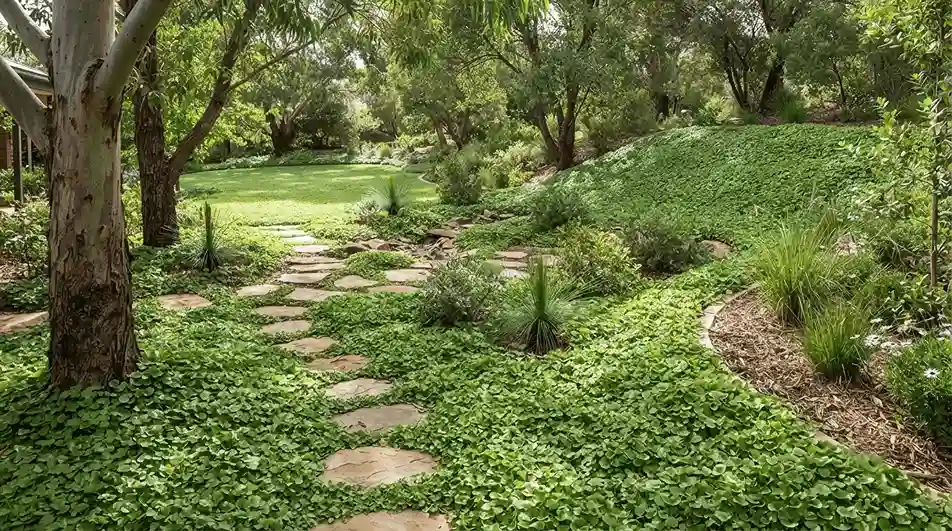
Dichondra repens offers exceptional versatility for both formal and naturalistic landscapes.
Creative uses include:
- A soft lawn alternative for lightly used shaded areas.
- Green carpets beneath mature trees.
- Filling spaces between stepping stones.
- Covering shaded pathways.
- Softening the edges of native garden beds.
- Underplanting shrubs in woodland gardens.
- Covering slopes to help reduce soil erosion.
- Adding texture to courtyard gardens.
- Spilling gently over the edges of raised beds.
- Using as an accent around large containers and feature pots.
Its dense, low-growing habit provides year-round greenery while helping suppress weeds and reduce exposed soil.
Conclusion
Dichondra repens shade is one of Australia’s most dependable native ground covers for low-light gardens. Its attractive kidney-shaped foliage, creeping growth habit, and ability to thrive in partial shade make it an excellent choice for lawn alternatives, native landscapes, pathways, and shaded courtyards.
Success depends on providing well-drained soil, consistent moisture during establishment, and suitable light conditions. Whether propagated from seed, division, or runners, healthy plants gradually develop into a dense green carpet with minimal maintenance.
By choosing the right planting location and avoiding common mistakes such as poor drainage or excessive shade, gardeners can enjoy a long-lasting, attractive kidney weed ground cover that enhances both biodiversity and landscape appeal.
Frequently Asked Questions
Does Dichondra repens grow in full shade?
Yes, but it performs best in partial shade or filtered sunlight. Dense, full shade can reduce growth, produce thinner foliage, and slow the plant’s ability to spread.
Is kidney weed a good lawn alternative in Australia?
Yes. Kidney weed is an excellent lawn alternative for lightly used, shaded areas where traditional turf grasses struggle. It requires less mowing and forms a soft, dense green carpet.
How quickly does Dichondra repens spread?
Growth is moderate. Once established, creeping runners root at their nodes and gradually fill surrounding spaces. Warm temperatures, fertile soil, and regular watering encourage faster coverage.
How often should Dichondra repens be watered?
Water newly planted specimens two to three times per week until established, depending on rainfall and soil conditions. Mature plants require less frequent watering but benefit from deep irrigation during extended dry periods.
Can Dichondra repens be grown from seed?
Yes. Dichondra repens can be grown from seed in spring or early autumn. Keep the soil evenly moist during germination, and provide filtered light until seedlings become established.
Does Dichondra repens produce flowers?
Yes. The plant produces small greenish-white to pale cream flowers from late spring through summer. Although inconspicuous, they support pollinating insects and contribute to seed production.
What is the difference between Dichondra repens and Silver Falls?
Dichondra repens has green leaves and thrives in partial shade, making it ideal for ground cover and lawn alternatives. Silver Falls has silvery foliage, prefers full sun, and is commonly grown in hanging baskets, containers, and cascading landscape displays.