Philodendron verrucosum is a velvet-leafed tropical aroid prized for its dark, heart-shaped foliage, prominent pale veining, and textured petioles. Successful philodendron verrucosum care depends on providing bright filtered light, consistently moist but aerated soil, warm temperatures, high humidity, and a suitable climbing support. It can be grown indoors in a controlled houseplant setup or outdoors in a warm, frost-free climate protected from direct sun. Although it is more demanding than common heartleaf philodendrons, it is manageable when moisture, airflow, and root aeration remain balanced. This guide explains its growth habit, mature size, propagation, varieties, common problems, and complete care requirements.
For broader guidance on selecting, positioning, and maintaining indoor greenery, explore our complete guide to house plants.
Quick Summary
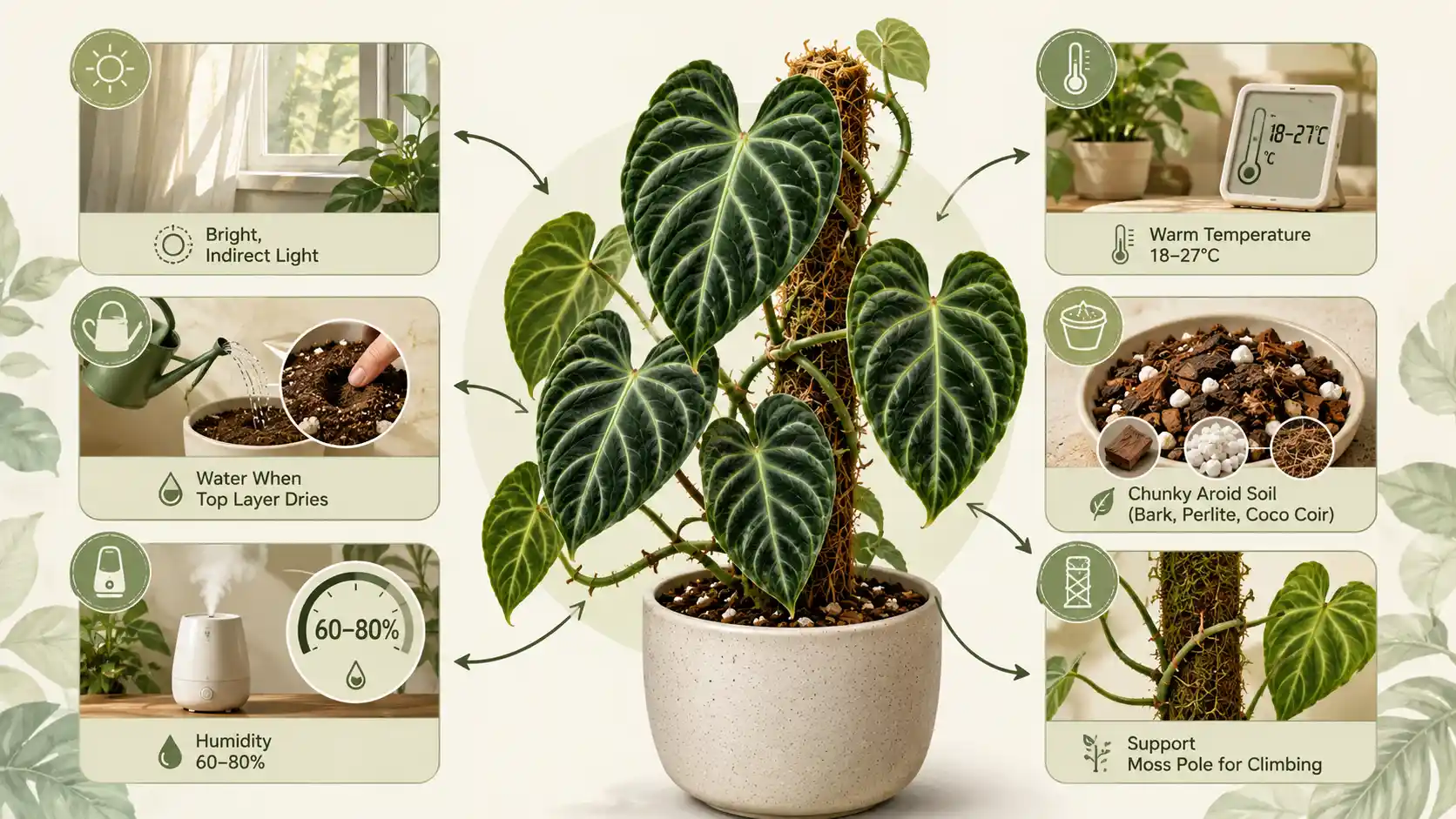
- Philodendron verrucosum is a natural climbing species in the aroid family, Araceae.
- Give it bright indirect light, ideally around 800–1,500 foot-candles indoors.
- Water when the upper 2–4 cm of the potting mix begins to dry, but never leave the roots waterlogged.
- Maintain approximately 60–80% humidity, warm temperatures, airflow, and a chunky aroid mix.
- Its care difficulty is moderate because it reacts quickly to dry air, dense soil, and inconsistent watering.
What Is Philodendron Verrucosum?
Philodendron verrucosum is an accepted tropical plant species in the family Araceae. It is naturally distributed from Costa Rica through Panama, Colombia, Ecuador, and Peru, where it grows as a climber in wet tropical environments. Many recognised forms originate from humid Andean forests, particularly in Colombia and Ecuador.
Like other members of the Philodendron genus, Philodendron verrucosum belongs to the aroid family, Araceae, whose plants produce an inflorescence consisting of a spadix surrounded by a spathe.
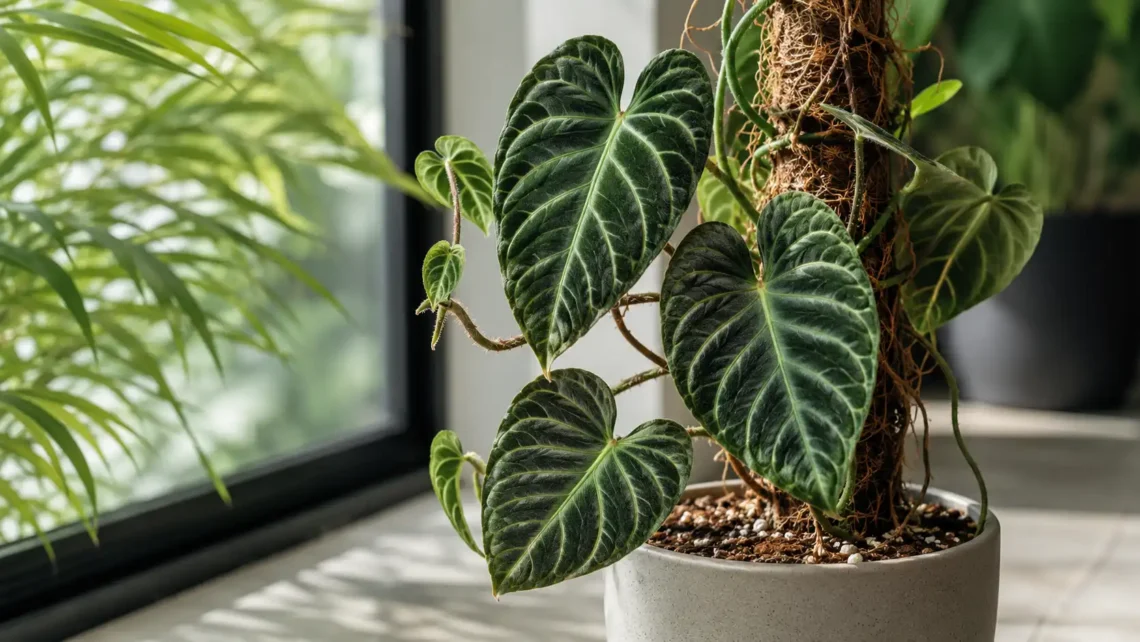
The plant is best known for its velvety, heart-shaped leaves. Depending on the individual form, the foliage may be bright green, deep green, bronze-green, or almost black, with pale green, gold, or silvery veins. Its petioles are usually covered with fine hairs or rough projections.
The name verrucosum comes from botanical Latin and means “warty” or “covered with wart-like projections.” It refers primarily to the rough, textured surface of the petioles rather than the leaves.
Like other philodendrons, it is an aroid. Aroids produce flowers consisting of a central spadix surrounded by a modified leaf called a spathe. Indoor specimens are grown mainly for foliage and rarely flower unless they are mature and maintained under highly favourable conditions.
Is Philodendron Verrucosum a Hybrid or a Natural Species?
Philodendron verrucosum is a natural species, not a hybrid. Its accepted botanical name is Philodendron verrucosum L.Mathieu ex Schott, and it was formally published in 1856.
Names such as Dark Form, Rojo, Panther, Incensi, and Magic Marks are generally used in horticultural trade to distinguish selected forms, regional variants, or cultivated lines. These labels do not automatically indicate hybrid origin.
However, the species has been used to create hybrids. One well-known example is Philodendron ‘Glorious’, commonly regarded as a cross involving P. verrucosum and P. gloriosum. Buyers should therefore check whether a plant is labelled as the true species or as a named hybrid.
Why Philodendron Verrucosum Is So Sought After
Philodendron verrucosum is sought after because it combines velvet-textured foliage, contrasting veins, colourful leaf backs, textured stems, and dramatic increases in leaf size as it matures. Few houseplants display all these ornamental features on one plant.
Growers attracted to velvety foliage and contrasting veins may also enjoy our Anthurium Crystallinum Care guide, which covers another sought-after tropical aroid with similar environmental needs.
Its popularity is also influenced by availability. The species was once relatively uncommon and expensive in the international houseplant trade. Tissue culture and specialist propagation have made some forms easier to obtain, but mature specimens and distinctive collector forms can still be scarce.
Collectors sometimes describe it as a “holy grail” philodendron, although there is no official plant with that title. The term is subjective and may also be applied to rare plants such as Philodendron spiritus-sancti, unusual variegated species, or uncommon regional forms.
The main ornamental benefits of Philodendron verrucosum include:
- Large, heart-shaped leaves with a velvet-like surface
- Strongly defined pale or metallic-looking veins
- Red, purple, or bronze colouring on some leaf undersides
- Hairy or textured petioles that add visual interest
- Vertical growth that suits moss poles and indoor plant displays
- Noticeable progression from small juvenile foliage to larger mature leaves
The “prettiest” philodendron is a matter of preference. Growers who prefer dark, velvety foliage often choose P. verrucosum, P. melanochrysum, or P. gloriosum. Verrucosum stands apart because of its vein contrast and characteristically textured petioles.
Growth Habit and Mature Size
Is Philodendron Verrucosum a Climber or a Crawler?
Philodendron verrucosum is a climber, not a terrestrial crawler. In nature, it grows upward against trees and other vertical surfaces, using aerial roots for attachment. Kew identifies the species as a climber of wet tropical habitats.
Indoors, it should be given a moss pole, tree-fern fibre pole, cork panel, or another moisture-retentive support. A plain stake can hold the stem upright, but it does not provide the humid surface into which aerial roots naturally grow.
In our experience growing climbing aroids, leaf size improves most reliably when aerial roots are allowed to enter a moist support. Plants left trailing may survive, but they commonly produce wider spaces between leaves and remain in a more juvenile growth stage.
Attach the stem loosely rather than tying the petioles. Petioles must remain free because they reposition the leaves toward available light.
How Big Does Philodendron Verrucosum Get?
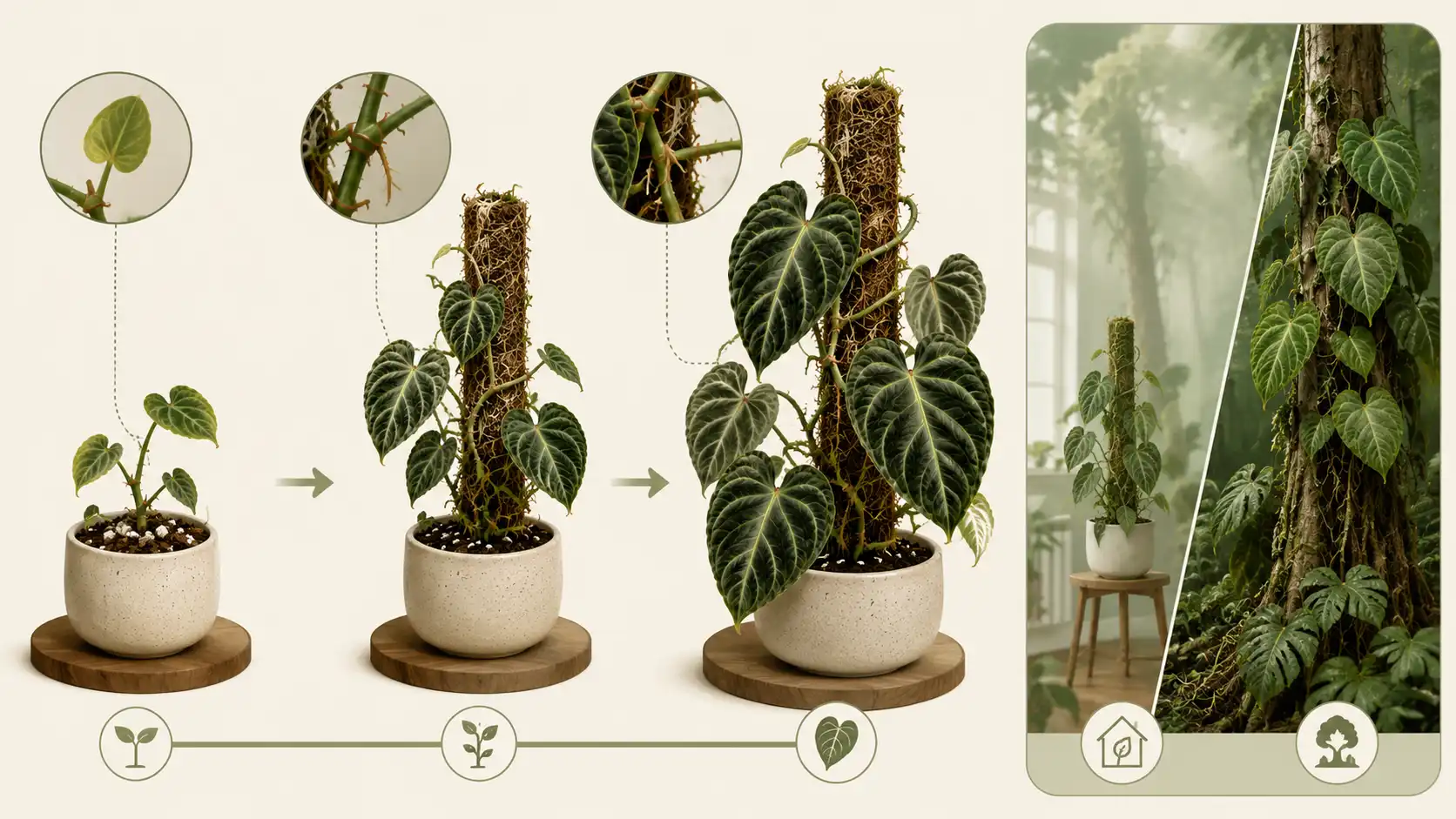
Indoors, a supported Philodendron verrucosum commonly reaches approximately 1–2 metres in height before it requires pruning, extension, or restarting. Mature leaves under good indoor conditions may grow about 30–60 cm long, although size varies considerably among forms and growing environments.
Wild plants can climb substantially higher because they grow against trees in consistently humid forests. Their leaves may also become larger than those produced by an average houseplant.
Mature size is influenced by:
- Genetic form or regional variation
- Light intensity and duration
- Root health
- Humidity and temperature
- Nutrient availability
- The quality of the climbing support
- Whether aerial roots remain hydrated
A juvenile plant should not be expected to produce mature foliage immediately. Leaf size usually increases gradually as the stem climbs and the root system becomes established.
Philodendron Verrucosum Care Guide
Light Requirements
Philodendron verrucosum needs bright indirect light. This means strong, diffused light without prolonged exposure to intense direct sun.
A practical indoor target is approximately 800–1,500 foot-candles at leaf level for much of the day. The plant may tolerate readings outside this range depending on exposure duration, temperature, humidity, and acclimation.
Suitable positions include:
- Near an east-facing window
- A short distance from a bright south- or west-facing window
- Behind a sheer curtain
- Beneath a full-spectrum grow light for 10–14 hours daily
Low light causes slow growth, long internodes, smaller leaves, and prolonged wet soil. Harsh afternoon sun can bleach the velvet surface or create dry, tan scorch patches.
Greenery Inside recommends increasing light gradually over one to two weeks. Leaves grown in subdued conditions are more likely to burn when suddenly moved into stronger light.
Watering
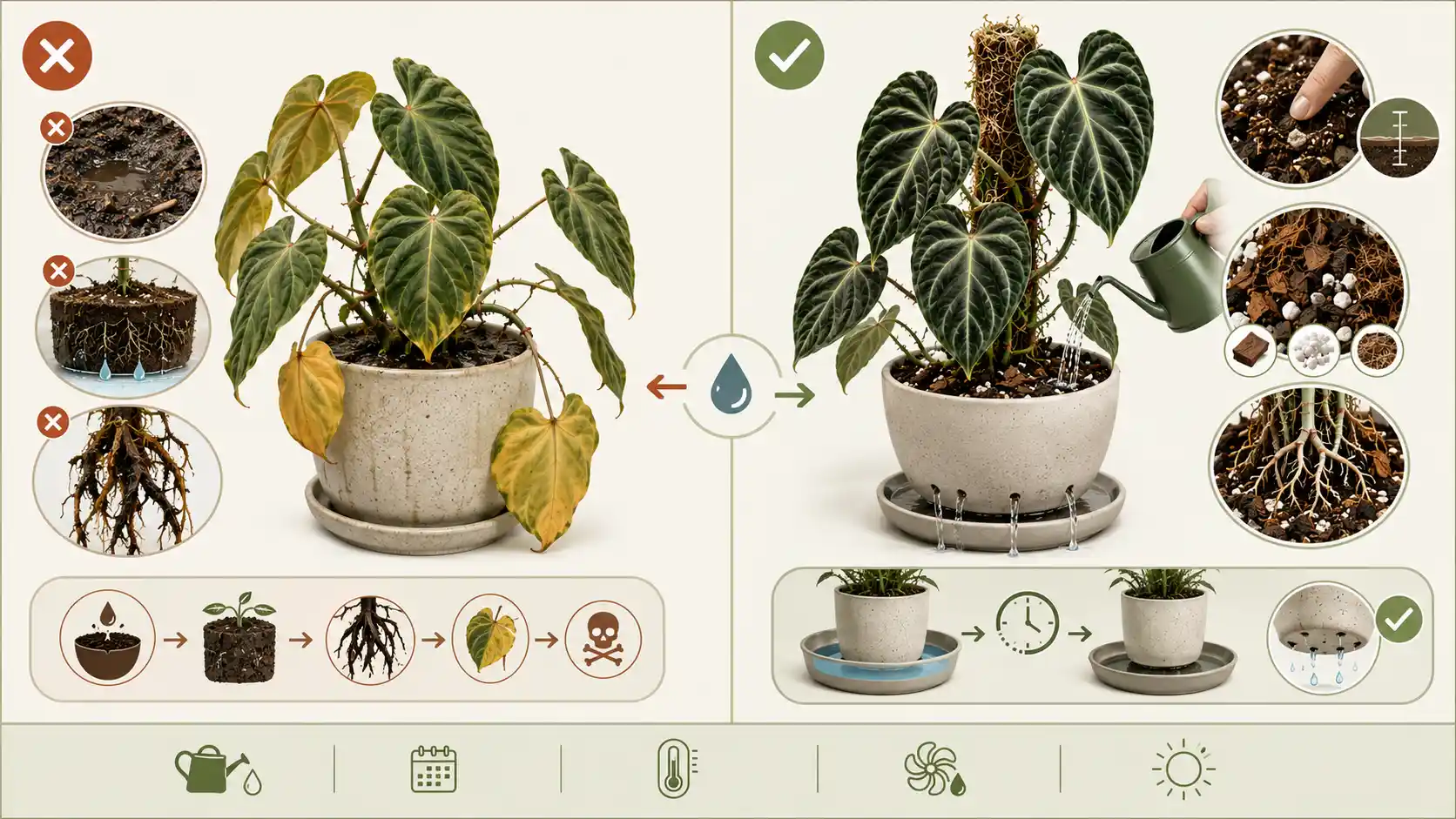
Water Philodendron verrucosum when the upper 2–4 cm of the potting mix feels slightly dry. Water thoroughly until excess moisture drains from the pot, then empty the saucer or outer cachepot.
Do not water according to a fixed weekly schedule. The drying rate changes with temperature, season, light, pot size, and root density. Check the substrate before every watering.
Watering intervals differ between species, so readers growing several philodendrons may also find our guide on How Often to Water Heartleaf Philodendron useful for understanding moisture checks and seasonal adjustments.
The objective is to maintain even moisture without removing oxygen from the root zone. Repeatedly allowing the entire pot to become bone dry can damage fine roots and cause leaf edges to curl or brown. Keeping it permanently saturated can cause root rot.
Bottom watering can work, particularly when a mix has become slightly water-repellent. Place the nursery pot in shallow water for approximately 10–20 minutes, then allow it to drain completely. Alternate with top watering to flush accumulated fertilizer salts from the substrate.
Soil and Potting Mix
Use a chunky, moisture-retentive but free-draining aroid mix. Ordinary potting soil alone is usually too dense because it compacts around the roots and limits oxygen.
A suitable mixture may include:
- 30% fine to medium orchid bark
- 25% coco coir or high-quality potting mix
- 20% perlite or pumice
- 15% chopped sphagnum moss
- 10% horticultural charcoal or worm castings
The exact percentages are flexible. The finished mix should hold some moisture while allowing water and air to move through it quickly.
Choose a pot with unobstructed drainage holes. Clear nursery pots can be helpful because they allow growers to inspect root development and substrate moisture.
Humidity and Temperature
Maintain relative humidity around 60–80% for consistent growth. Established plants may tolerate humidity near 50%, but new leaves are more likely to stick, tear, or develop dry margins when the surrounding air is persistently dry.
When household air is too dry, follow our guide on How to Increase Humidity for Plants Naturally and with Humidifiers to create more stable conditions without leaving the foliage constantly wet.
Provide gentle air movement with room ventilation or a small fan positioned away from the leaves. High humidity without airflow encourages prolonged leaf wetness and may increase fungal or bacterial spotting.
The preferred temperature range is approximately 18–27°C. Protect the plant from cold drafts, air-conditioning vents, heaters, and temperatures below about 15°C. It is not frost tolerant.
As of winter 2026, the most dependable indoor approach remains balancing humidity with airflow rather than trying to maintain sealed, constantly wet conditions. A humidifier paired with air circulation is more effective than frequent misting.
Fertilizing
Feed during active growth with a balanced liquid houseplant fertilizer diluted to half the manufacturer’s recommended strength. Apply approximately every two to four weeks in spring and summer, depending on the product and growing conditions.
Reduce feeding during cool or low-light periods when growth slows. Fertilizing inactive plants can cause salts to accumulate around the roots.
A complete fertilizer should provide nitrogen, phosphorus, potassium, and micronutrients. Nitrogen supports leaf development, but excessive nitrogen cannot compensate for insufficient light or unhealthy roots.
Flush the potting mix periodically with plain water, especially when using mineral fertilizers or hard tap water.
Pruning and Maintenance
Remove yellow, badly damaged, or diseased leaves using clean, sharp pruners. Cut the petiole close to the main stem without damaging the node or new growth point.
Additional maintenance includes:
- Wiping leaves gently with a damp cloth
- Checking leaf undersides for pests
- Redirecting aerial roots toward the support
- Extending the moss pole before the plant reaches its top
- Rotating the pot only when the plant is not firmly attached to a fixed support
- Removing dead organic matter from the soil surface
Avoid commercial leaf-shine products. They can leave residues on velvet foliage and make pest inspection more difficult.
| Verrucosum Care At a Glance | Recommended Conditions |
| Light | Bright indirect light; approximately 800–1,500 foot-candles |
| Water | Water when the upper 2–4 cm begins to dry |
| Humidity | Ideally 60–80% with gentle airflow |
| Temperature | Approximately 18–27°C |
| Soil | Chunky, aerated, moisture-retentive aroid mix |
| Fertilizer | Balanced diluted feed every 2–4 weeks during active growth |
Indoor vs. Outdoor Care Differences
Indoor Philodendron verrucosum care requires deliberate control of light, humidity, watering, airflow, and climbing support. Outdoor plants may receive stronger natural light and better ventilation, but they are also exposed to temperature fluctuations, wind, heavy rain, pests, and direct sun.
Permanent outdoor cultivation is suitable only in warm, humid, frost-free climates. Even in tropical or subtropical regions, place the plant beneath tree cover, shade cloth, or a protected patio. Avoid unfiltered midday and afternoon sun.
In temperate climates, it can be moved outdoors during warm weather when nighttime temperatures remain reliably above 16°C. Acclimate it over one to two weeks, beginning in deep shade before introducing brighter filtered light. Bring it indoors before cool autumn nights begin.
Greenhouse cabinets and terrariums provide high humidity, but mature plants can quickly outgrow enclosed spaces. They also require ventilation to prevent condensation from remaining on the foliage.
Standard household conditions can work when the plant receives:
- A bright window or effective grow light
- A humidifier where indoor air is dry
- A free-draining substrate
- Stable room temperatures
- A well-hydrated climbing pole
- Regular pest inspection
Potting and Root-Bound Considerations
Philodendron verrucosum can tolerate being moderately snug in its pot, but it does not benefit from becoming severely root bound. A dense root mass dries unevenly, restricts nutrient availability, and makes thorough watering more difficult.
Do not place a small plant in a disproportionately large pot. Excess unused substrate remains wet longer than the roots can use it, increasing the risk of oxygen deficiency and rot.
Choose a new pot approximately 2–5 cm wider than the existing root mass. Repot when:
- Roots circle densely inside the pot
- Water passes through unusually quickly
- The substrate has broken down or become compacted
- Growth slows despite adequate light and feeding
- Roots emerge heavily from the drainage holes
- The plant requires watering much more frequently than before
Repotting may be necessary every 12–24 months, although vigorous young plants can require it sooner. The condition of the roots and substrate is more important than the calendar.
In our experience, keeping verrucosum slightly snug while maintaining an airy mix produces more predictable moisture levels than moving it into an oversized decorative pot.
How to Propagate Philodendron Verrucosum
Stem Cutting Method
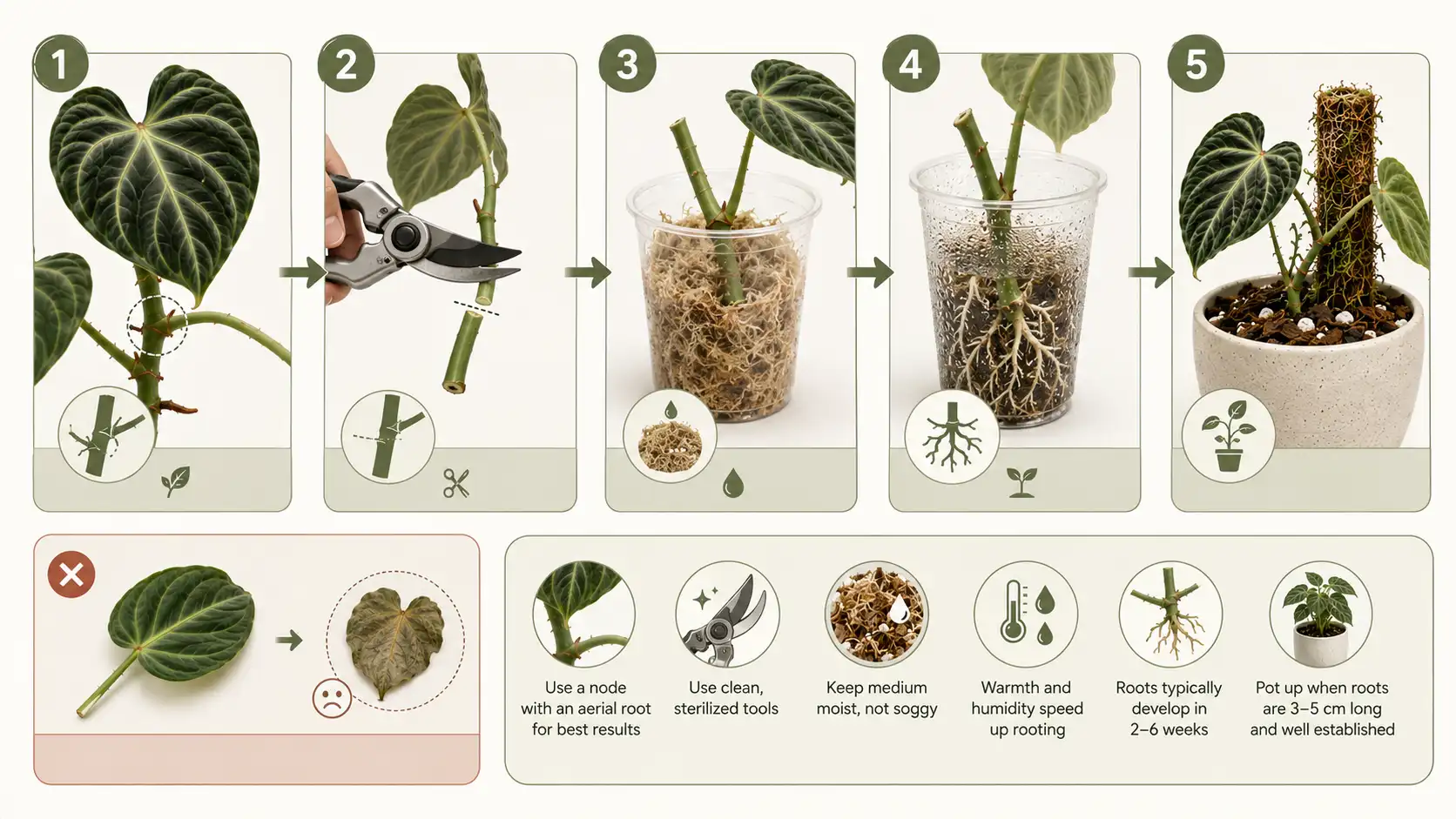
Propagate Philodendron verrucosum from a stem cutting containing at least one healthy node. A leaf and petiole without a node cannot produce a complete new plant.
A node is the thickened section of stem where a leaf, aerial root, or dormant growth bud emerges.
To take a cutting:
- Select a healthy section with one or two nodes.
- Sterilise pruning shears with alcohol.
- Cut approximately 1–2 cm below the chosen node.
- Allow the cut surface to dry briefly.
- Place the node in moist sphagnum, perlite, or water.
- Keep it warm, humid, and in bright indirect light.
- Pot it into an aroid mix after it develops several established roots.
Do not bury the petiole deeply. Position the node against or just beneath the surface of the rooting medium.
Timing and Rooting Medium
Spring and early summer are usually the best propagation periods because warmth and longer daylight support active root growth. Propagation is possible at other times when stable warmth and supplemental lighting are available.
Water propagation makes root development easy to observe, but water-grown roots must adapt after transfer to soil. Sphagnum moss, perlite, or a sphagnum-perlite blend provides more oxygen and can produce roots already accustomed to a solid medium.
Keep sphagnum damp rather than saturated. A sealed propagation container may maintain humidity, but it should be opened regularly for air exchange.
Root development commonly begins within several weeks, but a cutting may need six to twelve weeks or longer to establish enough roots for potting. Temperature, node health, season, and light strongly affect the rooting period.
Philodendron Verrucosum Varieties and Comparisons
Philodendron Verrucosum vs. Incensi
Philodendron verrucosum ‘Incensi’ is generally treated in horticulture as a cultivated or selected verrucosum form rather than a separate accepted botanical species. Trade descriptions often associate it with rounder foliage and a relatively compact climbing habit, but characteristics can differ among sellers.
| Feature | Philodendron Verrucosum | Verrucosum ‘Incensi’ |
| Leaf texture | Velvety | Velvety |
| Leaf shape | Usually elongated to broad heart-shaped | Often described as rounder or more compact |
| Vein colour | Pale green, silver or gold-toned | Usually pale and strongly contrasting |
| Growth habit | Climbing | Climbing, sometimes sold as more compact |
| Care requirements | Bright filtered light, humidity and airy soil | Essentially the same |
| Botanical status | Accepted natural species | Horticultural or trade designation |
Because plant-trade names are not always standardised, compare the actual leaf shape, petiole texture, vein colour, and seller documentation rather than relying only on the label.
Popular Forms — Dark Form, Panther, Rojo, ‘Magic Marks’
Several named forms circulate among collectors:
- Dark Form: Selected for deeper green or near-black mature foliage.
- Panther: Usually sold for dark leaves, bold veins, and strong contrast.
- Rojo: Commonly associated with reddish petioles, leaf backs, or emerging growth.
- ‘Magic Marks’: A trade form valued for distinctive markings or vein contrast.
These names may represent selected clones, regional forms, or nursery labels rather than formally registered cultivars. Appearance can vary according to maturity, light, nutrition, and growing conditions.
“Mini” and “regular” verrucosum labels should also be interpreted cautiously. A plant sold as mini may be juvenile, genetically compact, or simply a smaller trade form. Confirm its expected mature habit with the supplier.
Variegated Philodendron Verrucosum
Variegated Philodendron verrucosum produces leaves with cream, yellow, pale green, or sectoral colour variation. Stable variegated specimens are uncommon and usually more expensive than standard green forms.
Variegation reduces the amount of chlorophyll available for photosynthesis. As a result, heavily variegated plants may grow more slowly and require brighter filtered light than green plants. They should not be exposed to harsh direct sunlight because pale tissue burns easily.
A plant showing isolated pale marks is not necessarily genetically variegated. Pest damage, nutrient disorders, viral symptoms, oedema, or physical injury can also alter leaf colour.
Common Philodendron Verrucosum Problems
Yellowing Leaves
Yellow leaves are commonly caused by excess moisture, poor drainage, low light, root stress, or natural ageing.
Fix: Check the root zone before watering again. Improve drainage, increase indirect light, and remove roots that are brown, hollow, or mushy.
Prevention: Use an airy substrate and water according to soil moisture rather than a fixed schedule. One old lower leaf turning yellow occasionally is usually normal.
Overwatering and Root Rot
Root rot develops when roots remain oxygen-deprived in saturated or compacted substrate. Affected plants may show yellow leaves, wilting despite wet soil, a soft stem base, or a sour smell.
Fix: Remove the plant from its pot, cut away rotten roots with sterile tools, and repot it in fresh, aerated mix. If most roots are lost, propagate a healthy stem section above the damaged area.
Prevention: Use a correctly sized pot, maintain open drainage holes, provide adequate light, and allow the upper layer of substrate to partially dry.
Pests
Thrips, spider mites, and mealybugs are the most common pests affecting velvet-leaf philodendrons.
Thrips can cause silvery scars, distorted new growth, and black waste spots. Spider mites create fine stippling and may produce webbing. Mealybugs appear as white, cotton-like clusters near petiole joints and leaf undersides.
Fix: Isolate the plant, wash accessible pests away, remove severely damaged foliage, and apply an appropriate insecticidal soap, horticultural oil, or registered pest treatment according to its label. Repeat treatment because eggs may survive the first application.
Prevention: Inspect new plants before placing them near a collection and examine emerging leaves weekly.
Slow or Stunted Growth
Slow growth may result from insufficient light, low temperature, unhealthy roots, low humidity, lack of support, or nutrient deficiency.
Fix: Confirm that the plant receives bright indirect light and temperatures above approximately 18°C. Inspect the roots, provide a climbing pole, and fertilize lightly during active growth.
Prevention: Maintain stable conditions rather than repeatedly moving the plant. Growth may naturally slow during winter when indoor light levels fall.
Beginner Mistakes to Avoid
The most common mistake is watering too frequently because Philodendron verrucosum is described as moisture-loving. It needs consistent moisture, but its roots also require oxygen. Dense, continuously wet soil creates more problems than allowing the surface to dry slightly.
Other mistakes include:
- Providing insufficient humidity: Dry air can cause stuck new leaves, torn foliage, and brown margins.
- Using direct afternoon sun: Velvet leaves scorch more easily than thick, glossy philodendron foliage.
- Skipping a moss pole: Without vertical support, the plant may produce smaller leaves and elongated growth.
- Using an oversized pot: Too much unused substrate remains wet and increases root-rot risk.
- Misting without ventilation: Misting provides only a brief humidity increase and can leave foliage wet.
- Fertilizing a stressed plant: Fertilizer does not repair rotten roots, cold damage, or severe pest infestations.
- Forcing a new leaf open: Manually pulling a stuck leaf can tear soft tissue. Increase humidity and allow it to release naturally.
- Ignoring the leaf undersides: Thrips and mites often become established before damage is obvious from above.
- Changing several conditions simultaneously: Multiple sudden changes make it difficult to determine what caused improvement or decline.
Greenery Inside recommends correcting the most likely root cause first, then observing the next developing leaf. New growth provides a clearer measure of recovery than damaged foliage, which will not return to its original appearance.
Conclusion
Successful philodendron verrucosum care depends on reproducing the plant’s warm, humid, well-aerated forest environment without keeping its roots continuously wet. Give it bright indirect light, a chunky aroid mix, consistent but controlled watering, approximately 60–80% humidity, and a moisture-retentive climbing support.
The species is more sensitive than common philodendrons, but it is not unmanageable. Most problems result from dense soil, oversized pots, low light, dry air, or watering without first checking the substrate. When root health, humidity, airflow, and climbing support remain balanced, Philodendron verrucosum can develop increasingly large leaves with the velvet texture and pronounced veining that make it a prized collector plant.
FAQs
Is Philodendron Verrucosum easy to care for?
Philodendron verrucosum has a moderate care difficulty. It grows reliably when provided with bright indirect light, high humidity, warm temperatures, an aerated potting mix, and consistent moisture. It is less forgiving of dry air and overwatering than common heartleaf philodendrons.
Is Philodendron Verrucosum a climber or crawler?
Philodendron verrucosum is a climber. It grows upward against trees in its natural habitat and benefits from a moss pole, tree-fern support, or similar vertical structure indoors.
Does Philodendron Verrucosum like to be root bound?
It tolerates being slightly snug in its pot but should not remain severely root bound. Repot when the root mass becomes dense, the substrate breaks down, or the pot dries much faster than usual.
Is Philodendron Verrucosum rare?
It is uncommon compared with mass-market philodendrons, although propagation and tissue culture have increased availability. Distinctive forms, mature specimens, and stable variegated plants remain relatively rare and may command higher prices.
What is the holy grail of philodendrons?
There is no official “holy grail” philodendron. The phrase is used subjectively for highly desired species such as Philodendron verrucosum, P. spiritus-sancti, rare velvet-leaf forms, and unusual variegated specimens.
Should philodendrons be bottom watered?
Philodendrons can be bottom watered, provided the pot is allowed to drain fully afterward. Alternate with top watering to flush fertilizer salts and ensure the entire root zone is evenly hydrated.
What is the prettiest Philodendron?
Beauty is subjective, but Philodendron verrucosum is often considered one of the prettiest because of its velvet foliage, heart-shaped leaves, contrasting veins, colourful undersides, and textured petioles.