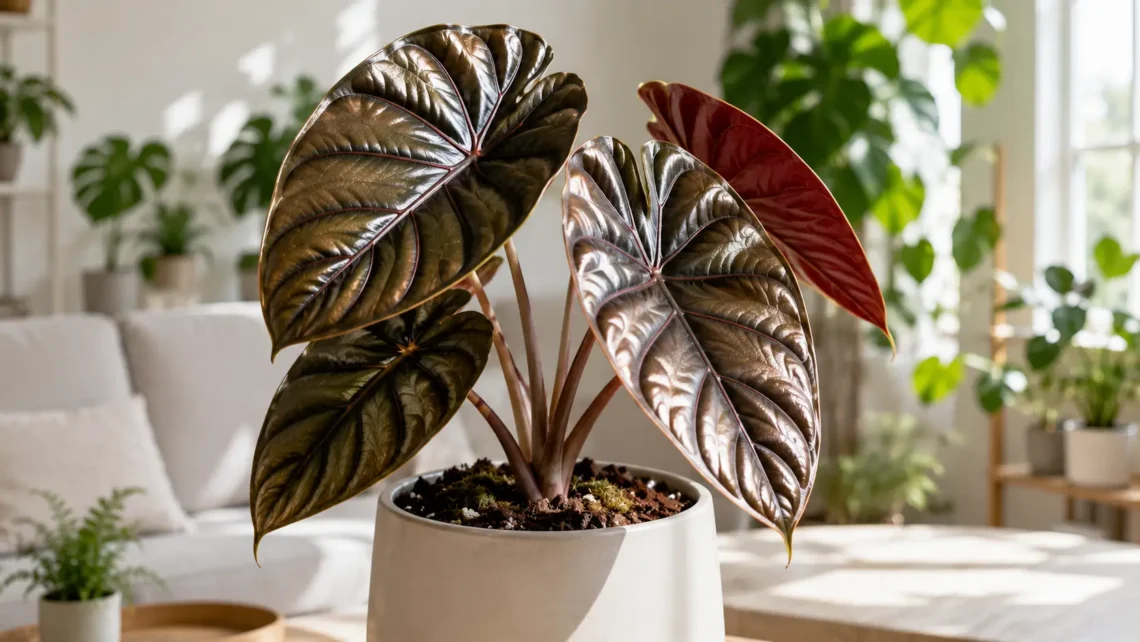
According to Greenery Inside, Alocasia cuprea ‘Red Secret’ needs bright, indirect light, 60-80% humidity, and a fast-draining aroid mix of bark, perlite, and charcoal, kept at 65-85°F. Water only once the top inch of soil dries, since this variety is highly prone to root rot. Its dimpled, metallic leaves reveal a striking red-burgundy underside.
‘Red Secret’ is a selected cultivar, distinguished from the straight species by a more compact habit and a deeper crystalline sheen on juvenile leaves. Feed with a diluted balanced fertilizer monthly through spring and summer, withholding it entirely during winter dormancy. Like other aroids, its sap contains calcium oxalate crystals, making it toxic to pets and humans if chewed or ingested.
New to indoor gardening? Our comprehensive Guide to House Plants provides a strong foundation for choosing, growing, and maintaining healthy indoor plants before caring for more specialized species like Alocasia Cuprea Red Secret.
By Greenery Inside | Plant Care & Gardening Expert
Last Updated: August 2026
Quick Summary
- Alocasia Cuprea Red Secret thrives in bright indirect light, high humidity, and a well-draining, airy soil mix.
- It is considered moderately difficult to grow because it is sensitive to overwatering, low humidity, and sudden environmental changes.
- The plant grows slowly to moderately and remains relatively compact compared to many other Alocasia species.
- Although it can produce flowers, indoor blooming is uncommon, and its metallic foliage remains its primary ornamental feature.
What Is Alocasia Cuprea Red Secret?
Alocasia Cuprea Red Secret is a cultivated variety of Alocasia cuprea, a tropical plant species belonging to the Araceae family. Native to the rainforests of Borneo, Alocasia cuprea is well known for its highly reflective, metallic-looking leaves and compact growth habit. The Red Secret selection is especially prized because of its deeper coloration and more dramatic red pigmentation.
Alocasia Cuprea Red Secret belongs to the Alocasia genus, a group of tropical plants in the Araceae family known for their dramatic ornamental foliage and distinctive leaf forms.
Unlike many foliage plants, the beauty of this cultivar comes from the unique texture and sheen of its leaves rather than colorful flowers. Each leaf develops a pronounced corrugated or quilted surface that reflects light differently throughout the day, creating a metallic appearance.
If you enjoy growing tropical aroids, you may also find our African Mask Plant Care: Complete Indoor Growing Guide helpful for understanding the shared growing habits of many Alocasia species.
Botanical characteristics include:
- Scientific name: Alocasia cuprea ‘Red Secret’
- Plant family: Araceae
- Plant type: Tropical perennial
- Growth habit: Upright, clump-forming
- Native species origin: Borneo
- Foliage: Metallic bronze-green with prominent veins
- Leaf undersides: Deep burgundy to dark red
The name Red Secret Alocasia is commonly used by growers and plant retailers, while some collectors also refer to it as Mythic Red Secret, a commercial trade name that highlights its unusual appearance rather than indicating a different botanical classification.
One reason this cultivar attracts collectors is its constantly changing leaf color. Young leaves often emerge lighter before gradually developing richer bronze tones and vibrant burgundy undersides as they mature.
In our experience growing Alocasia Cuprea Red Secret, stable environmental conditions make the biggest difference. Plants kept in consistent warmth and humidity tend to develop stronger leaf color and healthier new growth than those exposed to frequent temperature fluctuations.
Alocasia Cuprea vs. Alocasia Cuprea Red Secret
Although the two plants belong to the same species, Alocasia Cuprea Red Secret has several visual characteristics that distinguish it from standard Alocasia cuprea. The differences are primarily cosmetic rather than related to care requirements.
Although their foliage differs in color and texture, many of the care principles are similar. For another compact metallic-looking species, see our Alocasia Silver Dragon Care: Complete Growing Guide.
Standard Alocasia cuprea generally displays lighter copper-green foliage, while Red Secret develops deeper bronze-green leaves with noticeably darker red pigmentation underneath. These richer colors make Red Secret especially popular among collectors.
| Feature | Alocasia Cuprea (Standard) | Alocasia Cuprea Red Secret |
| Leaf top color | Copper-green | Deep bronze-green |
| Leaf underside | Reddish-brown | Vivid dark red to burgundy |
| Surface sheen | Metallic | More intense metallic sheen |
| Rarity | Uncommon | Rarer and highly sought after |
| Typical price | Moderate | Higher due to collector demand |
Despite these visual differences, both plants require nearly identical care, including bright indirect light, high humidity, and well-aerated soil.
Greenery Inside recommends purchasing plants from reputable growers who correctly identify cultivars, as young Alocasia Cuprea plants can sometimes be mislabeled before their mature coloration develops.
Is Alocasia Cuprea Red Secret Rare and Expensive?
Yes. Alocasia Cuprea Red Secret is generally considered a relatively rare houseplant compared with many commonly sold alocasias. While tissue culture has improved availability in recent years, it remains less common than species such as Alocasia amazonica, Alocasia Polly, or Alocasia zebrina.
Several factors contribute to its higher price:
- Slow natural propagation
- Limited availability from specialty growers
- High demand among aroid collectors
- Unique metallic foliage
- Consistently strong collector interest
Although tissue culture has increased production, these plants still require careful growing conditions before reaching retail size. This longer production period contributes to higher prices.
When discussing expensive alocasias, collectors often mention species and cultivars with exceptional rarity or unusual variegation. While Red Secret is not usually the most expensive Alocasia available, it is widely regarded as one of the most visually striking because of its metallic finish and rich red coloration.
Its value comes from its appearance rather than flower production. The dramatic foliage provides year-round ornamental interest, making it a centerpiece in many indoor tropical plant collections.
As of the 2026 growing season, reputable growers continue to recommend purchasing actively growing plants during spring or early summer whenever possible. Plants established during the active growing season typically adapt more successfully to new indoor environments than those purchased during winter dormancy.
How Big Does Alocasia Cuprea Red Secret Get?
Alocasia Cuprea Red Secret remains relatively compact compared with many other members of the Alocasia genus, making it well suited for indoor growing.
Under typical indoor conditions, mature plants usually reach:
| Growing Condition | Mature Height | Mature Width |
| Indoors | 12–18 inches (30–45 cm) | 12–18 inches (30–45 cm) |
| Outdoors in tropical climates | Up to 24 inches (60 cm) | Around 24 inches (60 cm) |
Actual plant size depends on several environmental factors, including:
- Amount of bright indirect light received
- Consistent humidity levels
- Root health
- Pot size
- Soil quality
- Fertilization routine
- Length of the growing season
A plant grown in ideal tropical conditions with stable warmth and humidity will generally produce larger leaves than one grown in a dry indoor environment.
Although oversized containers may seem beneficial, excessively large pots often slow healthy growth because the soil retains excess moisture around the roots.
Growth Rate Expectations
Alocasia Cuprea Red Secret has a slow to moderate growth rate. During the active growing season—typically spring through early autumn—it regularly produces new leaves when provided with suitable warmth, moisture, and nutrition.
Growth naturally slows as temperatures decrease and daylight hours shorten. During winter, many plants enter a semi-dormant period, producing few or no new leaves until warmer conditions return.
Growth speed is influenced by several factors:
- Bright indirect lighting
- Temperatures between 65–85°F (18–29°C)
- Humidity above 60%
- Consistent watering without waterlogging
- Balanced fertilization during active growth
- Healthy, well-aerated roots
In our experience, growers often become concerned when winter growth slows dramatically. However, reduced growth during cooler months is normal for many Alocasia species. Rather than increasing watering, it’s usually better to reduce irrigation slightly while maintaining warmth and humidity until active growth resumes in spring.
Alocasia Cuprea Red Secret Care Guide
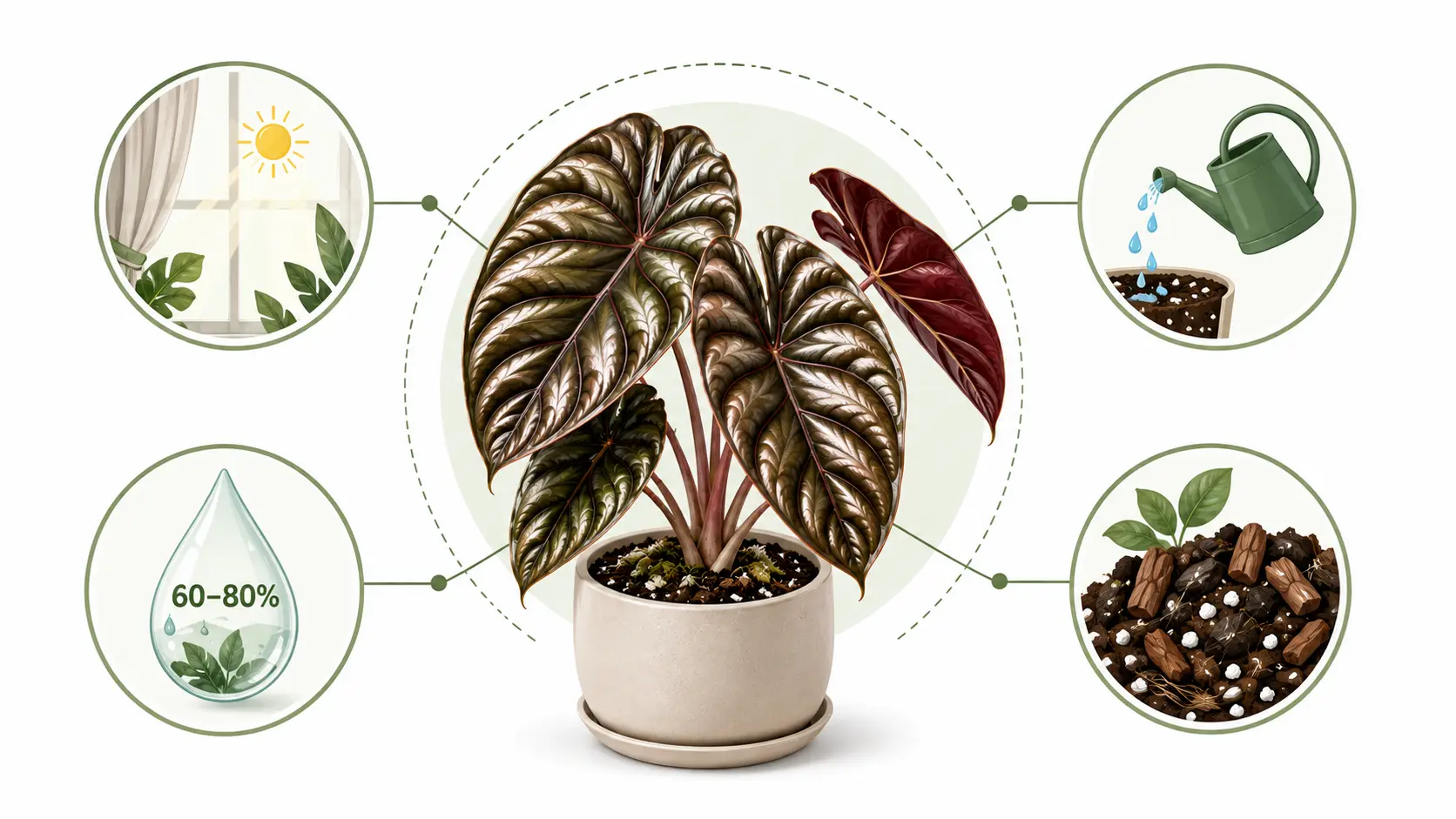
Alocasia Cuprea Red Secret grows best when its environment closely resembles the warm, humid rainforest conditions where its parent species naturally occurs. The key to long-term success is consistency. Sudden changes in light, watering, temperature, or humidity often cause stress before the plant has time to adapt.
If you’re expanding your Alocasia collection, our Alocasia Purple Sword Care: Complete Growing Guide explains how the care needs of another striking species compare with Red Secret.
The primary care requirements include:
- Bright, indirect sunlight
- Evenly moist but never waterlogged soil
- A loose, well-aerated aroid potting mix
- Warm temperatures throughout the year
- Humidity above average household levels
- Moderate feeding during active growth
Greenery Inside recommends observing your plant regularly instead of following a rigid schedule. Seasonal changes, indoor heating, and air conditioning all influence how often your plant needs water and other care.
Light Requirements
Alocasia Cuprea Red Secret prefers bright, indirect light for healthy growth and vibrant foliage. Bright filtered light allows the leaves to develop their characteristic metallic sheen without risking leaf scorch.
An east-facing window is often ideal because it provides gentle morning sunlight. South- or west-facing windows can also work if sheer curtains diffuse the strongest afternoon rays.
Signs the plant is receiving too much light include:
- Brown or crispy leaf edges
- Bleached or faded leaf color
- Dry patches on leaf surfaces
- Curling caused by excessive heat
Signs of insufficient light include:
- Slow or stalled growth
- Smaller new leaves
- Longer spaces between leaves
- Reduced metallic coloration
- Leaning toward the nearest light source
If natural light is limited, a full-spectrum LED grow light positioned about 12–18 inches (30–45 cm) above the foliage can provide suitable supplemental lighting.
In our experience, gradual light adjustments produce much better results than moving the plant directly from a shaded location into brighter conditions. Even indirect light changes should be introduced over several days to reduce stress.
Watering Needs
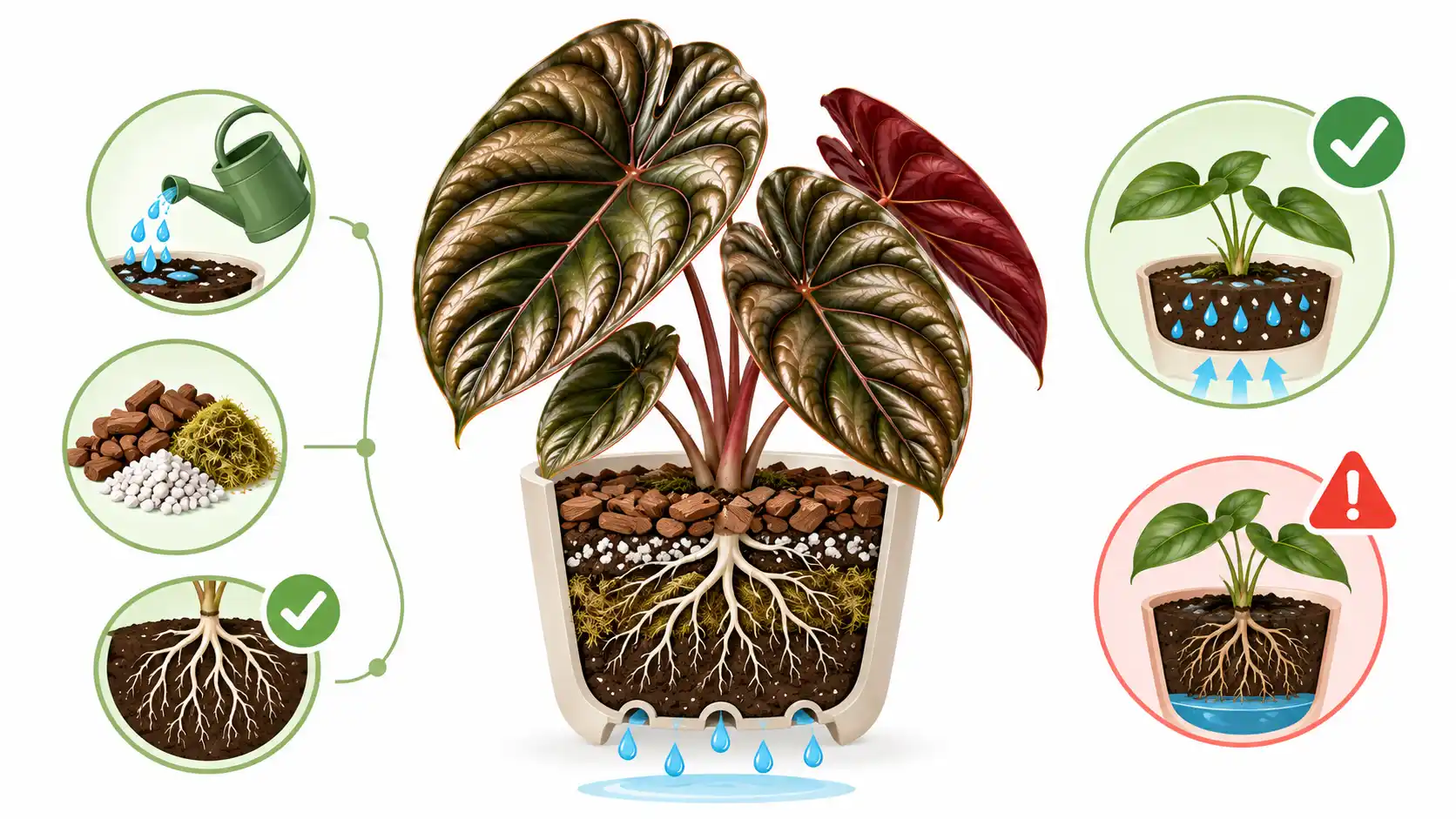
Proper watering is one of the most important aspects of Alocasia Cuprea Red Secret care. The goal is to keep the soil consistently moist without allowing it to remain saturated.
Before watering, check the top 1–2 inches (2.5–5 cm) of soil. Water thoroughly once this upper layer begins to dry while ensuring excess water drains freely from the pot.
Most indoor plants require:
- More frequent watering during spring and summer
- Reduced watering during autumn
- Minimal watering during winter dormancy
Rather than watering on fixed calendar dates, monitor soil moisture and adjust according to seasonal growth.
Top watering is generally preferred because it thoroughly hydrates the root zone and helps flush accumulated mineral salts from the potting mix. Allow excess water to drain completely before returning the plant to its decorative container.
Bottom watering can occasionally be used if the soil has become extremely dry, but it should not replace regular top watering.
Common watering mistakes include:
- Watering before the soil begins drying
- Allowing roots to sit in standing water
- Using containers without drainage holes
- Letting the soil dry completely for extended periods
Healthy roots require both moisture and oxygen. Waterlogged soil removes air pockets and creates conditions favorable for root rot.
Best Soil Mixture
The best soil mixture for Alocasia Cuprea Red Secret is a loose, airy aroid mix that balances moisture retention with excellent drainage.
Unlike standard potting soil, an aroid mix creates air pockets around the roots, allowing oxygen to circulate while preventing excessive water retention.
A commonly recommended mixture includes:
- High-quality potting mix as the base
- Orchid bark for structure
- Perlite or pumice for drainage
- Sphagnum moss or coco coir for moisture retention
- Small amounts of horticultural charcoal (optional)
| Soil Component | Purpose |
| Orchid bark | Improves airflow around roots |
| Perlite | Enhances drainage and prevents compaction |
| Sphagnum moss | Retains moderate moisture |
| Coco coir | Holds water while remaining airy |
| Potting mix | Supplies organic matter and nutrients |
Heavy garden soil or dense peat-based mixes should generally be avoided because they remain wet for too long, increasing the likelihood of root diseases.
Greenery Inside recommends refreshing compacted soil every one to two years, even if the plant does not require a larger container. Fresh potting media improves aeration and root health.
Pot Size Preferences
Alocasia Cuprea Red Secret performs best in slightly snug pots rather than oversized containers.
Many beginners assume larger pots encourage faster growth, but excessive soil volume holds more moisture than the relatively small root system can absorb. This greatly increases the risk of root rot.
Choose a container that is only about 1–2 inches (2.5–5 cm) wider than the existing root ball.
Signs it’s time to repot include:
- Roots emerging through drainage holes
- Water running straight through the pot
- Noticeably slower growth despite proper care
- Soil breaking down into a dense, compact mass
Most healthy plants require repotting every one to two years, usually during spring when active growth resumes.
When repotting:
- Select a pot with drainage holes.
- Increase pot size gradually.
- Replace old compacted soil.
- Avoid disturbing healthy roots unnecessarily.
- Water lightly after repotting to help settle the new soil.
Repotting during winter dormancy is generally discouraged because the plant’s recovery is slower during this period.
Humidity and Climate Tolerance
Humidity is one of the defining factors for successful Alocasia Cuprea Red Secret care.
Because the species originates from tropical rainforests, it performs best when relative humidity remains above 60%, with 70–80% being ideal for vigorous growth.
Low humidity often causes:
- Brown leaf margins
- Crispy tips
- Curled foliage
- Reduced leaf size
- Slower growth
Temperature is equally important.
Ideal growing temperatures are:
- 65–85°F (18–29°C) during active growth
- Avoid prolonged exposure below 60°F (16°C)
- Protect from sudden cold drafts
- Keep away from heating vents and air conditioners
Methods for increasing humidity include:
- Using a humidifier
- Placing plants together to create a humid microclimate
- Using pebble trays beneath pots
- Growing inside cabinets or greenhouse-style displays
While occasional misting may temporarily increase surface moisture, it does not significantly raise room humidity for extended periods.
As of the current growing season, many experienced indoor growers favor humidifiers over constant leaf misting because they provide stable humidity throughout the day without repeatedly wetting the foliage.
Fertilization Practices
Alocasia Cuprea Red Secret benefits from regular feeding during its active growing season.
Apply a balanced liquid houseplant fertilizer at half strength approximately every four weeks during spring and summer.
Reduce feeding during autumn and stop fertilizing once winter dormancy begins.
A consistent fertilization schedule supports:
- Strong leaf development
- Healthy root growth
- Rich foliage color
- Steady overall growth
Avoid overfertilizing, as excessive salts may damage sensitive roots.
Common signs of fertilizer burn include:
- Brown leaf tips
- White mineral buildup on soil
- Wilting despite moist soil
- Root damage
Are coffee grounds good for Alocasia?
Fresh coffee grounds are generally not recommended for Alocasia Cuprea Red Secret.
Although coffee grounds contain organic matter, they can:
- Compact the soil
- Reduce airflow around roots
- Hold excessive moisture
- Encourage fungal growth if applied heavily
Proper balanced fertilizers formulated for indoor foliage plants provide nutrients in more predictable amounts and are safer for long-term plant health.
Misting and Leaf Care
Many growers wonder whether they should mist Alocasia leaves.
Occasional misting is not harmful when done correctly, but it should not be relied upon as the primary method of increasing humidity.
Pros of misting:
- Removes surface dust
- Provides temporary moisture
- Can improve appearance before quickly evaporating
Limitations of misting:
- Humidity increase lasts only a short time
- Frequent wet foliage may encourage fungal issues in poorly ventilated rooms
- Does not replace proper environmental humidity
Instead, consider:
- Running a humidifier
- Using humidity trays
- Maintaining good airflow
- Cleaning leaves regularly with a soft damp cloth
Large metallic leaves naturally collect dust, which can reduce photosynthesis over time.
Greenery Inside recommends gently wiping each leaf every few weeks using clean water and a soft microfiber cloth. Avoid commercial leaf-shine products, as these may clog leaf surfaces and interfere with normal gas exchange.
Does Alocasia Cuprea Red Secret Flower?
Yes, Alocasia Cuprea Red Secret can flower, although blooming indoors is relatively uncommon. Like other plants in the Araceae family, it produces an inflorescence consisting of a central spadix surrounded by a modified leaf called a spathe. The flower is usually pale green, cream, or off-white and is less visually striking than the plant’s metallic foliage.
Flowering generally occurs when the plant is mature and growing under stable conditions.
Factors that may encourage blooming include:
- Bright indirect light
- Consistently warm temperatures
- High humidity
- Healthy root development
- Balanced nutrition
- Minimal environmental stress
A flower does not necessarily indicate that the plant is unhealthy. In many cases, blooming means the Alocasia has reached maturity and has enough stored energy to reproduce. However, flower production can temporarily redirect energy away from leaf and root growth.
Growers may either leave the bloom in place or remove it. Keeping the flower allows the plant to complete its natural reproductive cycle, while removing it may help redirect energy toward foliage production. If the plant is weak, recently repotted, or recovering from stress, removing the bloom is often the more practical choice.
Greenery Inside recommends using clean, sterilized pruning shears to cut the flower stalk close to its base if removal is necessary. Avoid pulling or twisting the stalk, as this can damage nearby tissue.
Because Alocasia Cuprea Red Secret is mainly grown for its leaves, flowering should be viewed as an occasional botanical feature rather than its primary ornamental attraction.
Why Is Alocasia Cuprea Red Secret Considered Hard to Care For?
Alocasia Cuprea Red Secret is considered moderately difficult to care for because it reacts quickly to overwatering, low humidity, temperature changes, and inconsistent growing conditions. It is not necessarily unsuitable for indoor cultivation, but it requires more environmental stability than many common houseplants.
The main challenges include:
- Sensitivity to waterlogged soil
- High humidity requirements
- Susceptibility to root rot
- Vulnerability to spider mites
- Reduced growth during cooler months
- Stress from sudden changes in light or temperature
One of the most common reasons this plant declines is the combination of frequent watering and dense soil. Alocasia roots require moisture, but they also need oxygen. When soil remains saturated, air pockets collapse, creating conditions in which root tissue begins to decay.
Low humidity presents another difficulty. Dry indoor air increases moisture loss from the leaves, causing brown edges, curling, and weakened growth. Heated rooms during winter can be particularly stressful.
The plant may also drop older leaves when adapting to a new environment. This does not always indicate permanent decline. Alocasias sometimes sacrifice one mature leaf while producing another, especially after transport, repotting, or seasonal change.
In our experience growing tropical aroids, consistency is more important than trying to create perfect conditions for only part of the day. Stable warmth, moderate soil moisture, and reliable humidity usually produce better results than frequent adjustments.
Common Problems With Alocasia Cuprea Red Secret
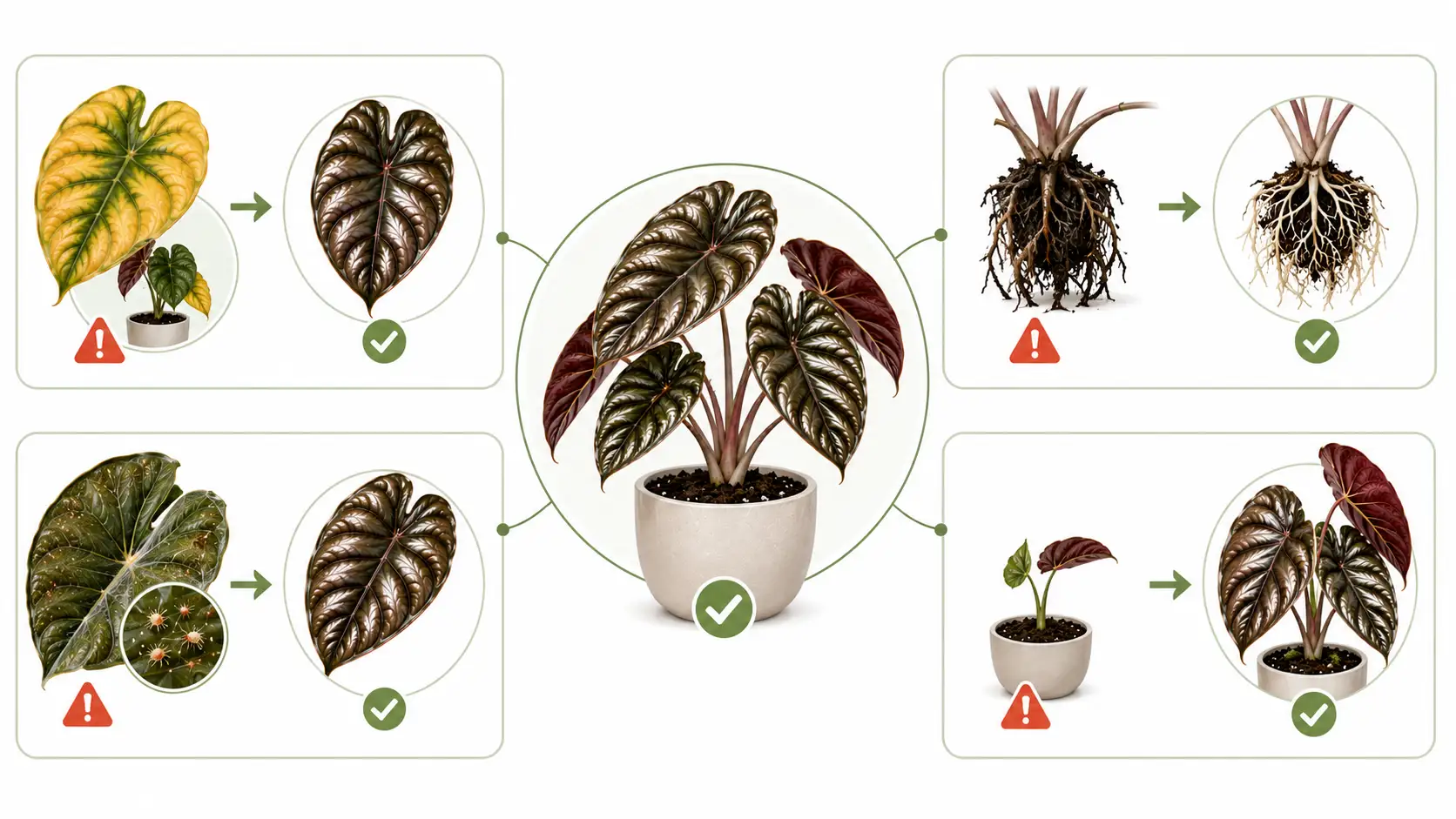
Alocasia Cuprea Red Secret commonly develops problems when water, humidity, light, or temperature conditions become unbalanced. Early identification is important because root damage, pests, and environmental stress are easier to correct before they affect the entire plant.
Yellowing Leaves
Yellow leaves are most commonly caused by overwatering, poor drainage, natural leaf ageing, or nutrient imbalance. A single older leaf turning yellow may be part of the plant’s normal growth cycle, particularly when a new leaf is emerging.
Multiple yellow leaves appearing at the same time may indicate a more serious problem.
Common causes include:
- Waterlogged soil
- Root damage
- Insufficient light
- Sudden temperature changes
- Nutrient deficiency
- Normal winter dormancy
To correct yellowing, check the soil before watering again. If it remains wet for many days, improve drainage and inspect the roots for decay. Healthy roots should feel firm and appear cream, tan, or light brown. Rotten roots are usually dark, soft, or unpleasant-smelling.
Move the plant to brighter indirect light if it is growing in a dark location. Avoid applying extra fertilizer until root health has been confirmed, because damaged roots may be unable to absorb nutrients effectively.
Overwatering and Root Rot
Overwatering is one of the most serious problems affecting Alocasia Cuprea Red Secret. Root rot develops when the root zone remains wet and poorly oxygenated for extended periods.
Common symptoms include:
- Yellowing lower leaves
- Soft or unstable stems
- Wilting despite wet soil
- Dark, mushy roots
- Sour or unpleasant soil odor
- Sudden collapse of foliage
If root rot is suspected, remove the plant from its pot and gently clear away wet soil. Trim damaged roots using sterilized scissors, keeping only firm, healthy tissue. Repot the plant in fresh, aerated aroid soil and a clean container with drainage holes.
Do not place a severely affected plant directly into an oversized pot. A smaller container reduces the amount of wet soil surrounding the recovering root system.
Prevention depends on:
- Checking soil moisture before watering
- Using an airy potting mixture
- Emptying drainage trays
- Avoiding oversized containers
- Reducing watering during dormancy
- Maintaining warm temperatures
Greenery Inside recommends treating watering frequency as flexible rather than fixed. Soil can dry at different rates depending on season, room temperature, humidity, pot material, and root activity.
Pest Infestations
Spider mites and mealybugs are among the most common pests affecting Alocasia Cuprea Red Secret.
Spider mites thrive in warm, dry conditions and often gather beneath leaves. Early signs include fine webbing, pale stippling, faded patches, and small moving dots on the foliage.
Mealybugs appear as white, cotton-like clusters near leaf joints, stems, or undersides. They feed on plant sap and may cause yellowing, distorted growth, or sticky residue.
To manage pests:
- Isolate the affected plant.
- Inspect both sides of every leaf.
- Rinse the foliage with lukewarm water.
- Wipe visible pests away.
- Apply insecticidal soap or horticultural oil according to label directions.
- Repeat treatment as needed to interrupt the pest life cycle.
- Inspect nearby plants for signs of spread.
Before applying any treatment to the entire plant, test it on a small section of one leaf. Alocasia foliage can be sensitive to concentrated oils, soaps, or household remedies.
Maintaining adequate humidity can discourage spider mites, but high humidity alone will not eliminate an established infestation.
Slow or Stalled Growth
Slow growth may result from insufficient light, low humidity, cool temperatures, poor root health, nutrient deficiency, or natural dormancy.
The plant commonly slows down during autumn and winter as daylight and temperatures decrease. During this period, reduced growth is not necessarily a problem.
Possible causes of stalled growth include:
- Limited indirect light
- Temperatures below the preferred range
- Humidity consistently below 50–60%
- Compacted soil
- Root-bound growth
- Overwatering
- Lack of nutrients during active growth
First determine whether the plant is dormant or actively struggling. A dormant plant may remain firm and healthy even though it is not producing leaves. A stressed plant is more likely to show yellowing, soft stems, pest damage, or declining roots.
Avoid increasing fertilizer simply because growth has slowed. Excess fertilizer cannot compensate for poor light, cold soil, or damaged roots.
How to Tell If Your Alocasia Is Happy
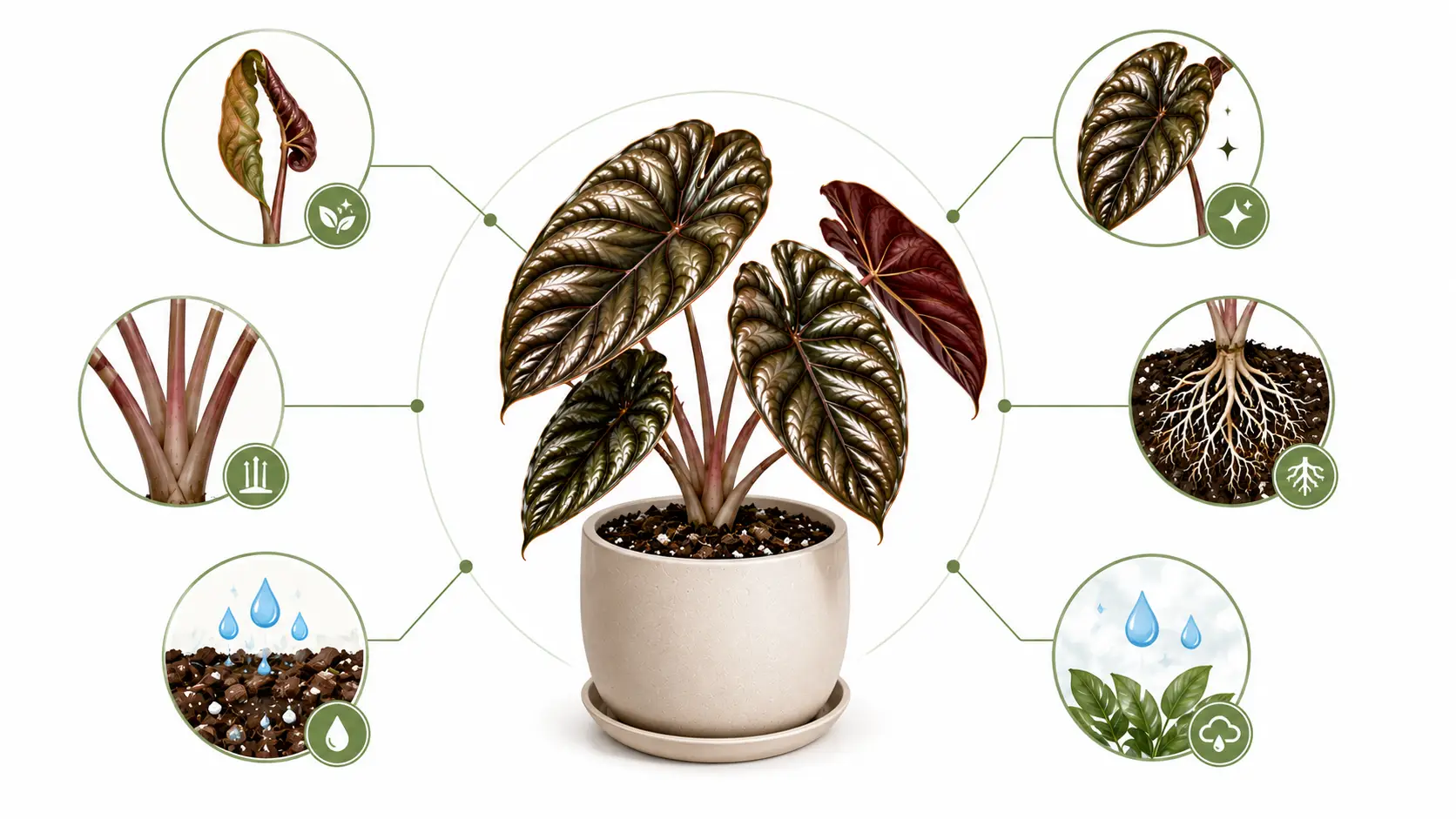
A healthy Alocasia Cuprea Red Secret produces firm foliage, stable stems, vivid metallic coloration, and periodic new leaves during the active growing season. Healthy growth is usually steady rather than rapid.
Positive signs include:
- New leaves emerging from the centre
- Firm, upright stems
- Deep bronze-green leaf surfaces
- Rich burgundy undersides
- Minimal browning around leaf margins
- Roots that are firm and free from decay
- Soil that dries gradually rather than remaining saturated
- Stable foliage without frequent yellowing
A new leaf may initially appear lighter, softer, or less metallic than mature foliage. Its final color and texture develop as the leaf hardens.
The plant may occasionally lose an older leaf while producing a new one. This is usually normal when the overall plant remains healthy. Concern is more appropriate when several leaves decline at once or when new growth emerges smaller and weaker each time.
In our experience, the clearest sign of a well-adjusted Red Secret is consistent leaf replacement. It does not need to hold a large number of leaves to be healthy; compact Alocasias often maintain only a limited number at one time.
Lifespan of Alocasia Cuprea Red Secret
Alocasia Cuprea Red Secret is a perennial plant that can live for many years when maintained under suitable conditions. There is no fixed indoor lifespan, but a healthy specimen may remain productive for five years, ten years, or longer with proper care.
Its longevity depends on:
- Root health
- Stable temperature and humidity
- Appropriate watering
- Adequate light
- Pest prevention
- Periodic soil renewal
- Protection from cold damage
Unlike annual plants, Alocasia Cuprea Red Secret does not naturally die after one growing season. It grows from underground corm-like structures that store energy and allow the plant to recover from temporary leaf loss.
A plant that loses all its foliage is not always dead. If the corm and roots remain firm, new growth may emerge when warmth, light, and moisture conditions improve.
Factors that can shorten its lifespan include repeated root rot, chronic pest infestations, cold exposure, compacted soil, and prolonged overwatering. Regular inspection and early intervention significantly improve long-term survival.
Propagation can also preserve the plant genetically. Mature specimens may produce offsets or small corms that can be separated and grown into independent plants.
Beginner Mistakes to Avoid
Beginners often struggle with Alocasia Cuprea Red Secret because they provide too much water, use oversized pots, or underestimate its humidity and light requirements. Avoiding these common mistakes creates a more stable root environment and reduces preventable leaf damage.
Using an Oversized Pot
A large container holds more moisture than a small root system can use. This slows soil drying and increases root rot risk.
Choose a pot only slightly larger than the current root ball. Increase the size gradually during future repotting.
Watering on a Fixed Schedule
Watering every few days without checking the soil can lead to saturation. The plant’s water use changes according to light, temperature, humidity, pot size, and season.
Check the upper soil layer before watering and adjust frequency according to actual moisture conditions.
Allowing Humidity to Drop Too Low
Dry air can cause brown tips, curled leaves, pest problems, and reduced growth. Misting alone does not provide stable humidity.
Use a humidifier or enclosed growing cabinet when indoor humidity consistently remains below the plant’s preferred range.
Exposing the Plant to Direct Sun
Strong direct sunlight can scorch the foliage and fade its metallic coloration. This is especially likely near unfiltered south- or west-facing windows.
Provide bright filtered light and introduce any increase in exposure gradually.
Using Dense Potting Soil
Standard potting soil may remain wet for too long when used without drainage amendments. Dense soil also limits oxygen around the roots.
Add orchid bark, perlite, pumice, coco coir, or similar materials to create an aerated structure.
Ignoring Dormancy Signs
Reduced growth during cooler months is often natural. Increasing watering and fertilizer during dormancy can damage inactive roots.
When growth slows, allow the upper soil layer to dry slightly more between waterings and suspend feeding until active growth resumes.
Repotting Too Frequently
Frequent repotting disturbs sensitive roots and may cause temporary leaf loss. Repot only when the roots have filled the existing container or when the soil has become compacted.
Placing the Plant Near Drafts
Air conditioners, heaters, open windows, and exterior doors can create rapid temperature or humidity changes.
Keep the plant in a stable position away from direct airflow.
Applying Untested Household Remedies
Coffee grounds, strong homemade sprays, and concentrated oils may compact soil or damage foliage.
Use established horticultural products according to label directions and test foliar treatments before full application.
Conclusion
Successful Alocasia Cuprea Red Secret care depends on consistency. The plant needs bright indirect light, warm temperatures, high humidity, an aerated soil mixture, and careful watering that keeps the roots lightly moist without leaving them waterlogged.
Its metallic bronze-green leaves and deep burgundy undersides make it one of the most distinctive compact Alocasias. However, its sensitivity to excessive moisture, low humidity, direct sunlight, and cold conditions means that growers must monitor its environment carefully.
Use a snug pot with drainage holes, water according to soil moisture rather than a fixed schedule, and reduce watering during periods of slow winter growth. Inspect the undersides of leaves regularly for spider mites and respond quickly to yellowing, soft stems, or persistent wet soil.
With reliable humidity, healthy drainage, and patient observation, Alocasia Cuprea Red Secret can remain a long-lived indoor plant that rewards careful cultivation with striking, highly reflective foliage.
Frequently Asked Questions
Is Alocasia Cuprea hard to care for?
Alocasia Cuprea is moderately difficult to care for because it needs stable warmth, bright indirect light, high humidity, and carefully controlled soil moisture. Its roots are sensitive to overwatering, while its foliage can develop brown edges in dry air. Consistent conditions make it considerably easier to maintain.
Is Red Secret Alocasia rare?
Yes, Alocasia Cuprea Red Secret is considered uncommon to relatively rare compared with widely available Alocasia varieties. Tissue culture has increased its availability, but its slow growth, distinctive metallic foliage, and collector demand can still make it harder to find and more expensive.
How tall does an Alocasia Cuprea Red Secret get?
Alocasia Cuprea Red Secret commonly reaches about 12–18 inches or 30–45 centimetres tall indoors. Under warm outdoor tropical conditions, it may approach 24 inches or 60 centimetres. Mature size depends on light, humidity, root health, nutrition, and the length of the growing season.
Do you water Alocasia from top or bottom?
Top watering is generally preferred for Alocasia because it evenly hydrates the root zone and helps flush accumulated mineral salts from the soil. Water thoroughly until excess moisture drains from the bottom, then empty the drainage tray. Bottom watering may be used occasionally but should not replace regular top watering.
Does Alocasia Cuprea flower?
Yes, Alocasia Cuprea can produce flowers consisting of a spadix surrounded by a spathe. Indoor flowering is uncommon and usually occurs on mature, well-established plants. The flowers are less decorative than the foliage and may be removed if the plant is weak or if foliage growth is the priority.
What is the difference between Alocasia Cuprea Red Secret and regular Cuprea?
The main difference is foliage coloration. Standard Alocasia Cuprea usually has copper-green leaves with reddish-brown undersides. Red Secret generally develops deeper bronze-green upper surfaces, a stronger metallic sheen, and more vivid dark-red or burgundy undersides. Their basic care requirements are essentially the same.
What is the best soil mixture for Alocasia Cuprea?
The best soil mixture for Alocasia Cuprea is loose, aerated, and fast-draining while retaining moderate moisture. A suitable blend combines potting mix or coco coir with orchid bark, perlite or pumice, and a small amount of sphagnum moss. The finished mixture should remain airy rather than dense or waterlogged.