Anthurium ‘Big Red Bird’ needs bright, indirect light, water only when the top 1-2 inches of soil dry out, and 60-80% humidity, according to Greenery Inside. Keep temperatures between 65-80°F in well-draining soil, and feed monthly with a diluted balanced fertilizer during the growing season to prevent root rot.
As the plant matures, its leaves turn wavy and crinkled while the veins deepen to red, a trait intensified by bright light and cooler temperatures. Being an epiphyte in the Anthurium section Pachyneurium, it thrives in a chunky, bark-based mix rather than dense potting soil, and removing spent spathes at the base encourages repeat blooming that can last for weeks at a time.
If you’re building an indoor plant collection, our Guide to House Plants provides a broader overview of choosing, growing, and maintaining healthy houseplants in different home environments.
By Greenery Inside | Plant Care & Gardening Expert
Last Updated: August 2026
Quick Summary
- Anthurium big red bird is a tropical Anthurium cultivar valued for its dramatic red flowers and lush green foliage.
- It grows best in bright, indirect light, evenly moist but well-draining soil, and high humidity.
- Difficulty Level: Beginner to intermediate, provided watering and humidity are managed correctly.
- Individual blooms commonly remain attractive for 6–8 weeks, while healthy plants can flower repeatedly throughout the year under ideal conditions.
What Is an Anthurium Big Red Bird?
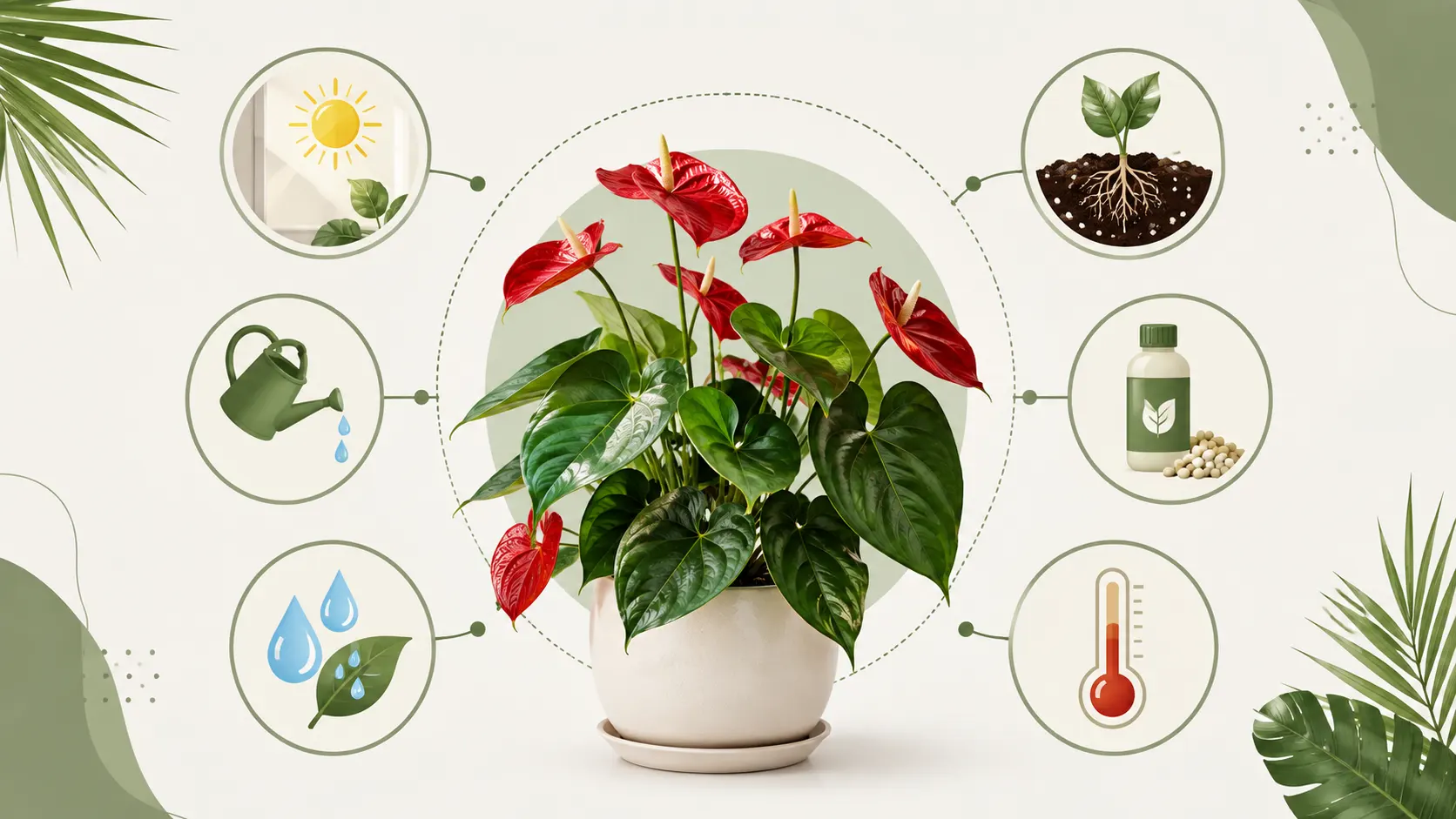
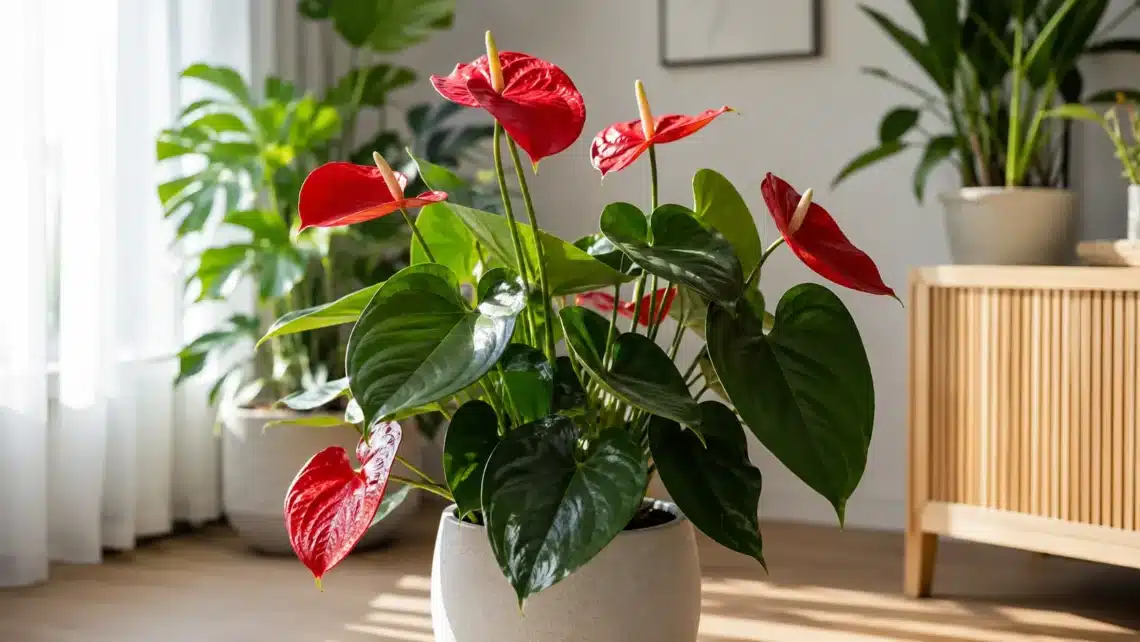
Anthurium big red bird is an ornamental tropical plant belonging to the Anthurium genus, one of the largest groups within the aroid family (Araceae). For additional botanical background on the genus and its species diversity, see the Anthurium article on Wikipedia. Like many cultivated anthuriums, it is appreciated for its glossy foliage and vibrant red spathes surrounding a central spadix. Although often grouped with other decorative anthurium big red varieties, the big red bird plant is recognized for its bold appearance and long-lasting blooms.
Although Anthurium Big Red Bird is primarily grown for its colorful blooms, foliage-focused species have slightly different care priorities. Our Anthurium Clarinervium Care Guide: Light, Soil & Water explains how growing conditions vary between flowering and ornamental foliage Anthuriums.
Unlike some foliage-focused Anthurium species, the anthurium big red bird flower is one of its defining features. Proper anthurium big red bird care focuses on maintaining stable humidity, bright filtered light, and consistent watering to support continuous growth and flowering.
From our experience at Greenery Inside, plants grown in stable indoor conditions generally perform better than those exposed to frequent environmental changes.
Key Characteristics
The Anthurium big red bird stands out because of several distinctive features:
- Large, glossy, deep green leaves with a leathery texture.
- Bright red waxy spathes that resemble flowers but are actually modified leaves.
- Upright growth habit with compact stems suitable for indoor containers.
- Thick aerial roots typical of many tropical aroids.
- Long-lasting blooms that remain attractive for several weeks.
Compared with many other anthuriums, this cultivar is known for maintaining colorful blooms for extended periods while remaining relatively compact, making it well suited for homes and offices.
How Hard Is It to Keep an Anthurium Alive?
Anthuriums are generally considered easy to moderately difficult to keep alive when their basic environmental needs are met. They are not demanding plants, but they respond poorly to inconsistent watering, poor drainage, and dry indoor air.
For beginners, the biggest challenge is usually watering. Overwatering causes more problems than underwatering because Anthurium roots require oxygen as well as moisture. Providing bright indirect light and a well-draining potting mix dramatically reduces the risk of common issues.
Common beginner concerns include:
- Watering too frequently
- Using heavy garden soil
- Placing the plant in direct afternoon sun
- Ignoring humidity during winter
- Fertilizing too heavily
Greenery Inside recommends observing the plant rather than following a rigid watering schedule. Environmental conditions such as season, temperature, and indoor humidity have a significant effect on water requirements.
Overall, Anthurium big red bird is an excellent choice for growers willing to provide consistent care rather than constant attention.
Ideal Placement — Where to Put Anthurium Big Red Bird in Your House
The best place for an Anthurium big red bird is near a bright window that receives indirect sunlight throughout the day. East-facing windows are often ideal, while south- or west-facing windows may require sheer curtains to protect the leaves from intense afternoon sun.
Suitable indoor locations include:
- Bright living rooms
- Home offices
- Bedrooms with filtered natural light
- Sunrooms protected from direct midday sunlight
Avoid placing the plant:
- Directly above heating vents
- Next to air conditioners
- Near frequently opened exterior doors
- In dark corners with insufficient light
As of the 2026 growing season, many indoor plant specialists continue to recommend maximizing natural indirect light instead of relying solely on artificial lighting unless natural light is limited.
Can Anthurium Big Red Bird Go Outside in Summer?
Yes, Anthurium big red bird can be placed outdoors during summer if temperatures remain consistently warm and the plant is protected from direct sunlight.
Ideal outdoor conditions include:
- Temperatures between 18–30°C (65–86°F)
- Bright shade or filtered sunlight
- Protection from strong winds
- High natural humidity
Before moving the plant outdoors, gradually acclimate it over one to two weeks to prevent leaf scorch. Likewise, bring it back indoors before nighttime temperatures fall below approximately 15°C (59°F).
Sudden environmental changes are one of the most common causes of leaf stress after seasonal relocation.
Watering Anthurium Big Red Bird Correctly
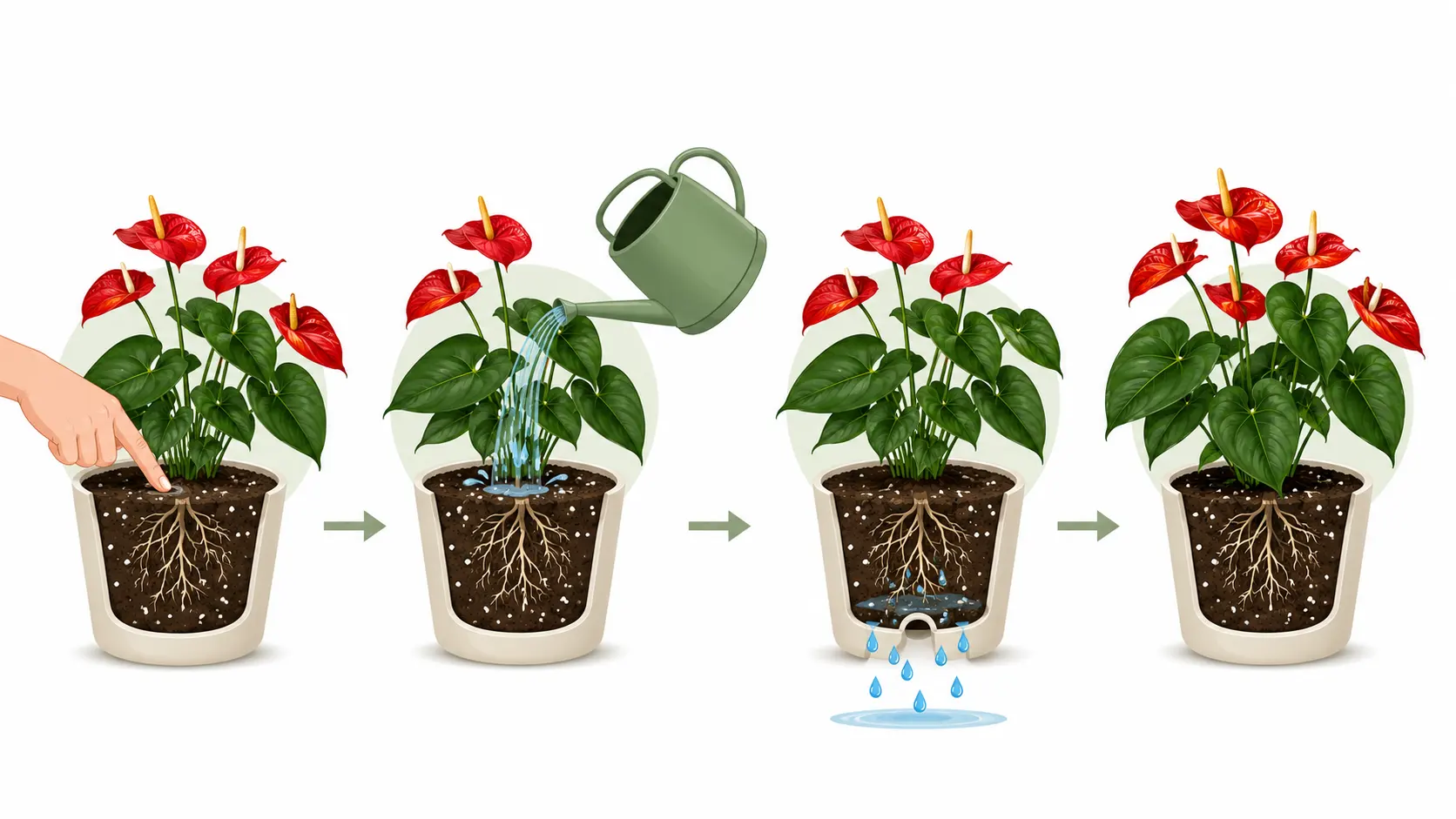
Proper watering is one of the most important aspects of anthurium big red bird care. The goal is to keep the growing medium evenly moist without allowing the roots to remain waterlogged.
A practical approach is to water when the top 2–3 cm (about 1 inch) of the potting mix feels dry. The exact schedule varies depending on temperature, humidity, pot size, and season.
In our experience growing tropical aroids, watering frequency naturally decreases during winter because plant growth slows and evaporation is reduced.
Top or Bottom Watering?
Both top and bottom watering can work, but top watering is generally recommended for Anthuriums.
Top watering helps:
- Flush excess fertilizer salts from the soil.
- Ensure the entire root system receives moisture.
- Promote even soil hydration.
Bottom watering may occasionally help dry soil absorb moisture more evenly, but it should not completely replace regular top watering.
Signs Your Anthurium Needs Water
A healthy Anthurium provides several visual clues when it becomes thirsty.
Common signs include:
- Slightly drooping leaves
- Dry upper soil layer
- Reduced leaf firmness
- Slower growth during active seasons
If the leaves become yellow while the soil remains wet, overwatering—not underwatering—is the more likely cause.
Tap Water, Ice Cubes, and Water Quality
Most Anthuriums tolerate tap water if it is relatively low in minerals and chlorine. However, hard water can gradually lead to mineral buildup in the soil.
Better water options include:
- Filtered water
- Rainwater
- Distilled water when necessary
Some care guides recommend watering with ice cubes, but this practice is generally not considered ideal. Anthuriums are tropical plants whose roots naturally experience warm soil temperatures. Slowly melting ice may expose roots to unnecessary cold stress without offering measurable benefits.
Can Anthurium Be Submerged in Water?
No, Anthurium should not remain permanently submerged when grown in soil.
Although some growers successfully cultivate Anthuriums using semi-hydroponic systems or full hydroponics with specialized techniques, traditional soil-grown plants require well-aerated roots.
If grown in soil:
- Water thoroughly.
- Allow excess water to drain completely.
- Never leave the pot standing in water for extended periods.
Healthy oxygen exchange around the roots is essential for preventing root rot.
Soil, Pots, and Potting Mix
Anthurium big red bird grows best in an airy, fast-draining growing medium that mimics its natural epiphytic environment. In the wild, many Anthurium species grow on trees or in organic debris where roots receive both moisture and excellent airflow.
A suitable potting mix typically contains:
- Orchid bark
- Coco coir or peat moss
- Perlite
- Pumice or coarse horticultural charcoal
This combination provides moisture retention while preventing soil compaction and poor drainage.
Do Anthuriums Like Deep Pots?
No, Anthuriums generally prefer wider pots rather than excessively deep containers.
Their root systems tend to spread outward rather than grow deeply. Using an oversized deep pot can hold excessive moisture around unused soil, increasing the risk of root rot.
Choose a container that is only slightly larger than the current root ball and always includes drainage holes.
Can I Use Orchid Potting Mix for Anthuriums?
Yes, orchid potting mix can be an excellent component of an Anthurium growing medium.
Because both orchids and many Anthurium species appreciate excellent root aeration, orchid bark provides ideal structure. However, orchid mix alone often dries too quickly.
For best results, combine orchid mix with moisture-retaining ingredients such as:
- Coco coir
- High-quality peat moss
- Perlite
- Composted pine bark
This creates a balanced aroid mix that supports healthy root development while reducing the risk of waterlogging.
Fertilizing Anthurium Big Red Bird
Proper fertilization helps Anthurium big red bird maintain healthy foliage and produce consistent blooms. Anthuriums are moderate feeders, so they benefit from regular but light applications of fertilizer during active growth rather than heavy, infrequent feeding.
A balanced fertilizer with equal or slightly higher phosphorus content supports flowering while maintaining strong roots and foliage. Feed every 4–6 weeks during spring and summer, then reduce or stop fertilizing during winter when growth naturally slows.
In our experience growing tropical aroids, using fertilizer at half the manufacturer’s recommended strength produces healthier plants than full-strength applications. Over-fertilizing is one of the most common reasons for brown leaf tips and salt buildup in the soil.
What Type of Fertilizer Should I Use for My Anthurium Plants to Bloom?
For reliable flowering, choose a fertilizer designed for flowering houseplants or tropical aroids.
Good options include:
- Balanced liquid fertilizer (such as 10-10-10 or 20-20-20 diluted to half strength)
- Bloom-supporting fertilizers with slightly higher phosphorus
- Slow-release fertilizers formulated for tropical plants
- Organic liquid fertilizers suitable for indoor houseplants
Always water the plant before applying fertilizer to reduce the chance of root burn.
Are Coffee Grounds Good for Anthuriums?
Coffee grounds should not be added directly to the potting mix on a regular basis.
Fresh grounds can:
- Reduce soil aeration
- Hold excessive moisture
- Encourage fungal growth
- Alter soil chemistry over time
Composted coffee grounds may be used occasionally in outdoor compost systems, but they should not replace a balanced fertilizer for indoor Anthuriums.
Can I Use Miracle-Gro on Anthurium?
Yes, Miracle-Gro can be used on Anthuriums when diluted correctly.
Many growers successfully use Miracle-Gro water-soluble fertilizers because they provide balanced nutrients that support healthy growth. However, applying it too frequently or at full strength can cause fertilizer burn.
Greenery Inside recommends:
- Diluting to approximately half strength
- Feeding every 4–6 weeks during active growth
- Flushing the soil with plain water every few months to remove accumulated salts
Is Miracle-Gro Good for Anthuriums?
Miracle-Gro can be effective when used correctly, but it is not the only suitable option. The best fertilizer is one that supplies balanced nutrients without encouraging excessive leaf growth at the expense of flowers.
| Fertilizer Type | Frequency | Pros | Cons |
| Balanced liquid fertilizer | Every 4–6 weeks | Easy to control, promotes healthy growth | Requires regular application |
| Miracle-Gro (diluted) | Every 4–6 weeks | Widely available, balanced nutrition | Can cause salt buildup if overused |
| Slow-release fertilizer | Every 2–3 months | Convenient, consistent feeding | Less flexible for seasonal adjustments |
| Coffee grounds | Not recommended as fertilizer | Can be composted outdoors | Poor indoor fertilizer, may affect soil structure |
Humidity, Misting & Outdoor Care
Anthurium big red bird thrives in 60–80% relative humidity, reflecting its tropical rainforest origins. While it can adapt to average indoor humidity, growth and flowering usually improve when moisture levels remain consistently high.
Many humidity recommendations also apply to other tropical houseplants. For example, our African Mask Plant Care: Complete Indoor Growing Guide covers similar moisture and environmental requirements for another humidity-loving indoor species.
If indoor air is dry, especially during winter heating seasons, consider increasing humidity using:
- A humidifier
- Pebble trays filled with water
- Grouping tropical plants together
- Growing the plant in naturally humid rooms
Do Anthuriums Like Being Misted?
Occasional misting can temporarily increase humidity around the leaves, but it should not be the primary method of humidity control.
Frequent misting offers only short-term benefits because water evaporates quickly. Excessive misting may also leave water sitting on foliage, increasing the risk of fungal issues in poorly ventilated spaces.
A humidifier provides a much more stable environment.
For outdoor-grown Anthuriums during warm months, naturally higher humidity often reduces the need for supplemental moisture, provided the plant remains protected from direct sun and heavy rain.
Encouraging Blooms — How to Make Anthurium Bloom Fast
Healthy Anthuriums bloom when they receive the right combination of light, nutrition, temperature, and consistent care. While no method can force instant flowering, creating ideal growing conditions encourages more frequent blooms.
The most important factors include:
- Bright indirect light
- Balanced fertilization
- Consistent watering
- Warm temperatures
- High humidity
- Healthy root development
Plants kept in low light often produce lush leaves but very few flowers.
Light Thresholds for Blooming
Bright, filtered light is essential for flower production.
Ideal conditions include:
- East-facing windows
- Bright north-facing rooms
- South-facing windows with sheer curtains
Direct afternoon sun may scorch leaves, while insufficient light reduces flowering.
Fertilizer Timing
Feed during active growth from spring through early autumn.
Avoid excessive nitrogen because it encourages leaf production more than flowers.
A balanced feeding schedule combined with proper lighting typically produces the best flowering results.
Should I Cut Off Dead Anthurium Flowers?
Yes. Remove faded flowers once they begin turning brown or lose their color.
Deadheading helps the plant:
- Redirect energy toward new growth
- Improve appearance
- Reduce the chance of fungal development around aging blooms
Use clean, sterilized pruning scissors and cut the flower stalk near its base without damaging nearby stems.
How Big Do Red Anthuriums Get?
Most indoor red Anthuriums reach approximately 30–60 cm (12–24 inches) tall and 30–45 cm (12–18 inches) wide, although mature specimens grown under ideal conditions may become larger.
Growth varies depending on:
- Available light
- Pot size
- Fertility
- Humidity
- Overall plant health
Plant Size
Typical mature size:
| Growing Condition | Height | Width |
| Indoors | 30–60 cm (12–24 in) | 30–45 cm (12–18 in) |
| Outdoors (tropical climates) | Up to 90 cm (36 in) | Up to 60 cm (24 in) |
Environmental factors influencing size include:
- Consistent warmth
- Adequate nutrition
- Healthy root space
- Bright indirect light
- Stable humidity
Growth Rate
Anthurium big red bird has a moderate growth rate.
During spring and summer, new leaves and flower stalks develop steadily. Growth naturally slows during autumn and winter as daylight decreases.
Environmental conditions affecting growth include:
- Temperature
- Light intensity
- Water availability
- Fertilization
- Root health
Greenery Inside has observed that plants maintained in consistent temperatures with stable humidity typically produce more uniform growth than those exposed to fluctuating indoor conditions.
How Long Do Red Anthuriums Last?
Individual Anthurium blooms commonly remain attractive for six to eight weeks, while healthy plants themselves can live for many years with proper care.
Flower longevity depends on:
- Light quality
- Watering consistency
- Humidity
- Temperature
- Overall plant health
Many indoor growers enjoy multiple flowering cycles each year when environmental conditions remain favorable.
The plant itself is considered a long-lived perennial and may continue producing new leaves and flowers for decades if maintained properly.
Will My Anthurium Grow Back If I Cut Off All Its Leaves?
Yes, an Anthurium can regrow after losing all of its leaves, provided the roots and growing crown remain healthy.
Recovery depends on:
- Healthy root system
- No root rot
- Proper watering
- Warm temperatures
- Bright indirect light
During recovery:
- Water sparingly while new growth develops.
- Avoid fertilizing until fresh leaves appear.
- Maintain humidity around 60–70%.
- Keep temperatures consistently warm.
Recovery may take several weeks or even months depending on the plant’s overall condition.
Common Anthurium Big Red Bird Problems
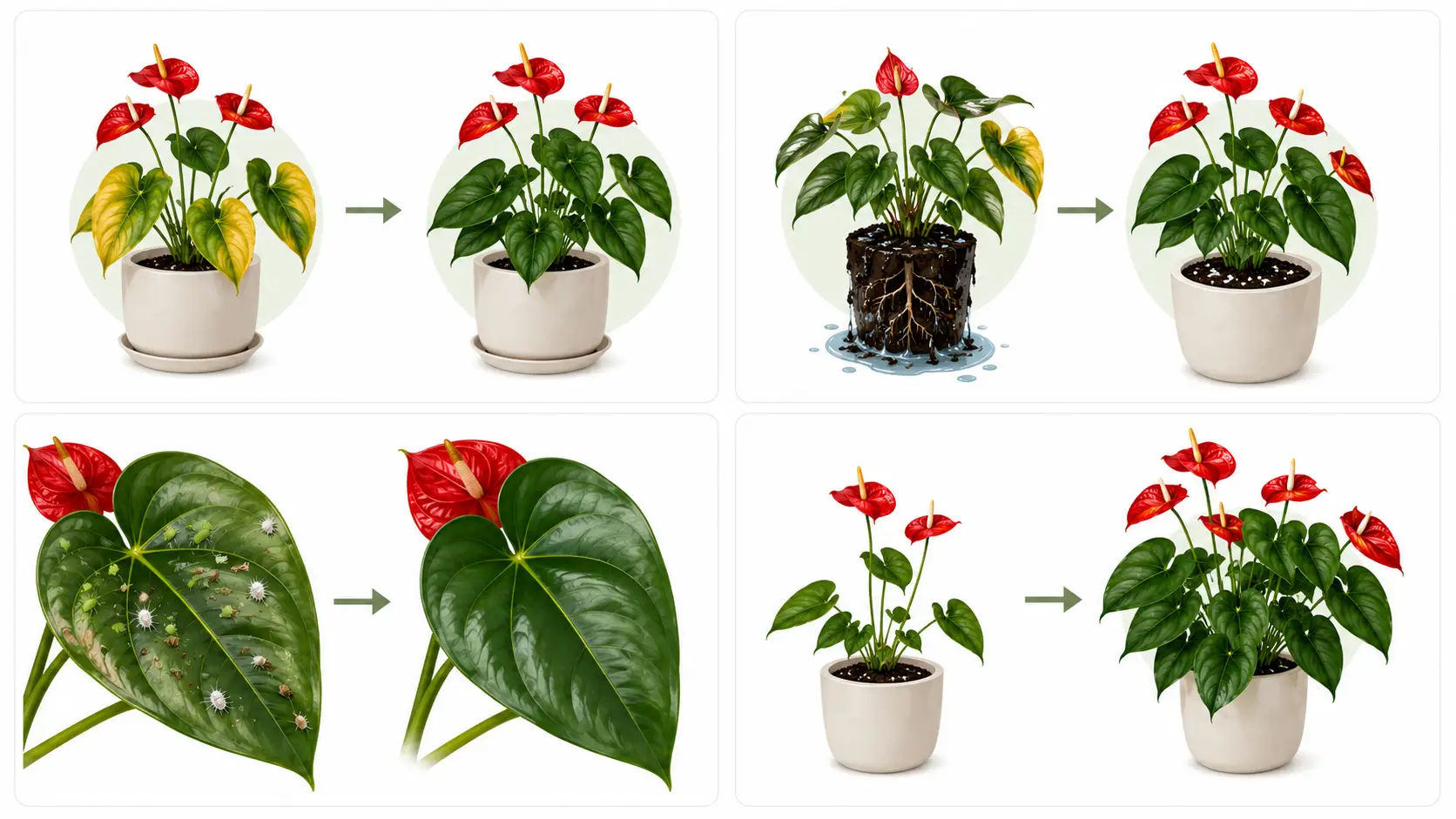
Most Anthurium problems result from environmental stress rather than disease. Identifying symptoms early allows most issues to be corrected before permanent damage occurs.
Leaves Turning Yellow
Why it happens
- Overwatering
- Poor drainage
- Aging leaves
- Nutrient imbalance
How to fix it
- Check soil moisture before watering.
- Improve drainage.
- Remove naturally aging leaves.
- Review fertilization practices.
How to prevent it
- Water only when needed.
- Use a well-draining aroid mix.
- Avoid standing water.
Overwatering Issues
Why it happens
- Frequent watering
- Heavy soil
- Pots without drainage
How to fix it
- Allow soil to partially dry.
- Repot if root rot develops.
- Trim damaged roots with sterilized tools.
How to prevent it
- Choose airy potting mixes.
- Water according to soil moisture rather than a fixed schedule.
- Use containers with drainage holes.
Pest Infestations
Common pests include:
- Spider mites
- Mealybugs
- Scale insects
- Aphids
How to fix it
- Isolate affected plants.
- Wipe leaves with a damp cloth.
- Apply insecticidal soap or horticultural oil if necessary.
How to prevent it
- Inspect new plants before bringing them indoors.
- Maintain good airflow.
- Regularly examine leaf undersides.
Slow Plant Growth
Why it happens
- Insufficient light
- Low temperatures
- Root-bound containers
- Nutrient deficiency
How to fix it
- Increase indirect light.
- Repot when necessary.
- Resume balanced fertilization during active growth.
How to prevent it
- Provide consistent care year-round.
- Maintain temperatures above 18°C (65°F).
- Refresh the potting mix every few years.
Common Problem Reference Table
| Problem | Likely Cause | Fix | Prevention |
| Yellow leaves | Overwatering, poor drainage | Reduce watering and improve drainage | Check soil before watering |
| Root rot | Waterlogged soil | Repot and trim damaged roots | Use airy potting mix |
| Pests | Dry air or new infestations | Treat with insecticidal soap | Inspect plants regularly |
| Slow growth | Low light or nutrient deficiency | Increase light and fertilize appropriately | Maintain ideal growing conditions |
How to Propagate Anthurium Big Red Bird
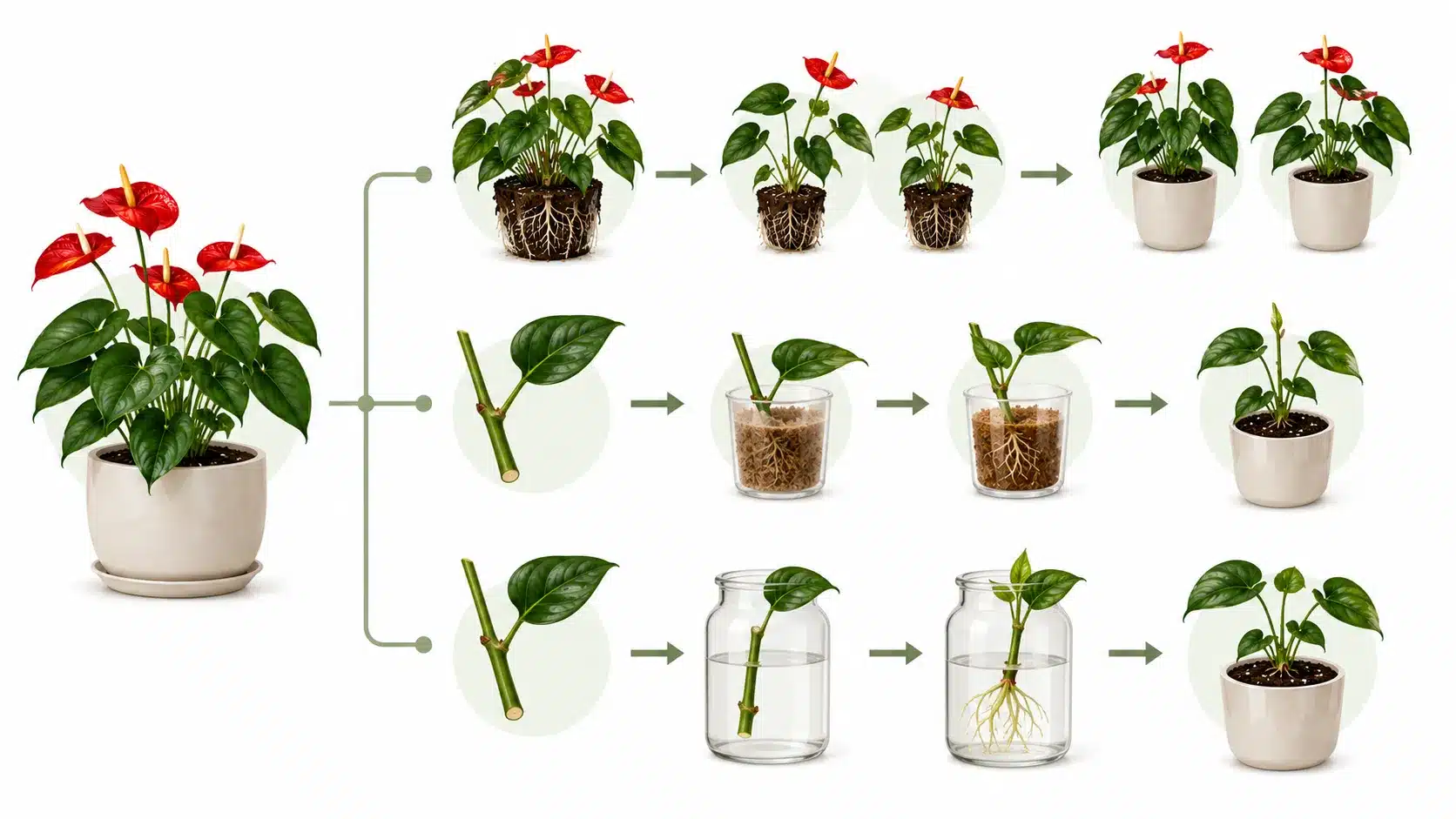
Anthurium Big Red Bird can be propagated through division, stem cuttings, or water rooting, provided the parent plant is mature and healthy. Division is usually the most reliable method because each separated section already has roots and an active growth point.
The best time to propagate is during spring or early summer, when warmer temperatures and longer daylight support faster root establishment. Avoid propagating a stressed, diseased, or recently overwatered plant.
Propagation by Division
Division is the simplest and most dependable propagation method.
- Water the plant lightly one day before propagation.
- Remove it carefully from its container.
- Gently loosen the potting mix around the roots.
- Identify natural offsets or separate crowns with their own roots.
- Divide the sections by hand or use a clean, sterilized knife.
- Place each division in a small pot containing an airy aroid mix.
- Water lightly and keep it in bright, indirect light.
Each division should ideally have at least one healthy growth point, several roots, and one or more leaves. Avoid placing small divisions in oversized pots because excessive unused soil can remain wet and encourage root rot.
In our experience, divisions recover more successfully when humidity remains stable and the potting mix is kept lightly moist rather than continuously saturated.
Propagation by Stem Cuttings
Stem cuttings are possible when the plant has a visible stem containing nodes. A node is the section from which roots, leaves, or new shoots can develop.
To propagate a stem cutting:
- Select a healthy stem with at least one node.
- Cut below the node using sterilized pruning shears.
- Allow the cut surface to dry briefly.
- Place the cutting in moist sphagnum moss, perlite, or an airy propagation mix.
- Maintain warmth, humidity, and bright indirect light.
A cutting without a node cannot produce a complete new plant. A detached leaf may remain green temporarily, but it will not normally develop into a new Anthurium.
Water Propagation
Anthurium cuttings or divisions can be rooted in water when they include a viable node or growth point. Place the roots or node in clean water while keeping the leaves and crown above the waterline.
For successful water propagation:
- Use a clean glass container.
- Change the water every five to seven days.
- Keep the cutting away from direct sunlight.
- Maintain warm room temperatures.
- Transfer it to potting mix after several healthy roots develop.
Water propagation is useful for monitoring root development, but roots formed in water may need time to adjust when transferred to soil. Semi-hydroponic growing is also possible, although it requires controlled nutrition, oxygen around the roots, and regular reservoir maintenance.
Anthurium Big Red Bird vs. Similar Anthurium Varieties
Anthurium Big Red Bird differs from many related Anthurium varieties through its ornamental red spathes, upright growth, and conventional flowering-houseplant appearance. Similar species may instead be grown primarily for unusual leaf shapes, textured foliage, climbing growth, or bird’s-nest rosettes.
If you’re interested in another highly sought-after Anthurium, our Anthurium Crystallinum Care guide explains how to grow one of the most popular velvet-leaved species and highlights the differences from flowering Anthuriums like Big Red Bird.
Plant names used in retail trade are not always botanically consistent. For that reason, growers should compare leaf shape, growth habit, flowers, and the botanical label supplied with the plant rather than relying only on a common name.
| Variety | Leaf or Flower Style | Difficulty | Notable Trait |
| Big Red Bird | Glossy leaves with prominent red spathes | Beginner to intermediate | Long-lasting ornamental blooms |
| Anthurium superbum | Broad, heavily textured leaves in a rosette | Intermediate | Upright bird’s-nest growth |
| Anthurium Fingers, often A. pedatoradiatum | Deeply divided, finger-like leaves | Intermediate | Leaves become more divided with maturity |
| Water Dragon | Trade name that may refer to different foliage Anthuriums | Intermediate | Identity should be verified from the botanical label |
| Bird’s-nest Anthurium | Strap-like leaves arranged in a central rosette | Beginner to intermediate | Grown mainly for architectural foliage |
| Anthurium gracile | Narrow leaves and clusters of red berries | Intermediate | Epiphytic growth and decorative fruit |
| Black Dragon Variegated | Dark foliage with lighter variegated sections | Advanced | Requires stable light and careful moisture control |
Big Red Bird vs. Anthurium Superbum
Anthurium Big Red Bird is generally selected for its red floral display, while Anthurium superbum is primarily a foliage plant. A. superbum produces a dense rosette of textured, upright leaves and does not resemble the standard red-flowering Anthurium commonly sold for indoor decoration.
Big Red Bird vs. Anthurium Fingers
Anthurium Fingers usually refers to Anthurium pedatoradiatum, a species known for leaves divided into narrow lobes. Big Red Bird has a more conventional broad-leaved form and is valued for its red spathes, while Anthurium Fingers is grown for its unusual mature foliage.
Big Red Bird vs. Bird’s-Nest Anthuriums
Bird’s-nest Anthuriums form a central rosette of long leaves that can collect organic matter in their natural habitat. Big Red Bird has a more flower-focused appearance and does not usually develop the same strongly defined nest-like structure.
Big Red Bird vs. Water Dragon
“Anthurium Water Dragon” is used as a trade name rather than a consistently recognized botanical name. Plants sold under this label may vary between nurseries. Buyers and growers should confirm the scientific name before comparing its mature size, care requirements, or growth habit with Big Red Bird.
Beginner Mistakes to Avoid
The most common mistakes with Anthurium Big Red Bird involve excessive watering, unsuitable light, poor drainage, low humidity, and unnecessary fertilizer. Avoiding these problems is more effective than trying to correct severe root or foliage damage later.
The same watering and humidity mistakes commonly affect many tropical aroids. Our Alocasia Silver Dragon Care: Complete Growing Guide offers additional tips for maintaining healthy indoor foliage plants.
Overwatering the Plant
Do not water simply because a certain number of days has passed. Check the upper layer of the potting mix and consider the plant’s weight, temperature, season, and humidity.
A pot that remains wet for long periods may indicate:
- Compacted potting mix
- Insufficient drainage
- An oversized container
- Reduced winter growth
- Low light and slow evaporation
Exposing It to Harsh Sunlight
Direct midday or afternoon sunlight can scorch the foliage and fade the red spathes. Bright indirect light is preferable because it supports photosynthesis and flowering without overheating leaf tissue.
Move the plant gradually when increasing its light exposure. Sudden relocation from a dim room to strong sunlight can cause permanent bleached or brown patches.
Choosing the Wrong Pot Size
A pot that is too large contains more wet growing medium than the root system can use. This slows drying and increases the risk of root rot.
Repot into a container only slightly wider than the root mass. Drainage holes are essential, regardless of whether the decorative outer pot is made from ceramic, plastic, or another material.
Ignoring Humidity and Airflow
Low humidity can contribute to dry leaf edges, but very humid stagnant air may encourage fungal or bacterial problems. Aim for balanced conditions: moderate-to-high humidity combined with gentle airflow.
Greenery Inside recommends using a humidity meter when indoor air becomes especially dry during heating or air-conditioning seasons. It provides more reliable guidance than estimating humidity by touch.
Over-Fertilizing
More fertilizer does not produce faster flowering. Excess mineral salts can damage roots, brown the leaf tips, and interfere with water absorption.
Apply diluted fertilizer only during active growth and periodically flush the potting mix with plain water. Never fertilize a plant suffering from root rot, severe dehydration, or recent transplant stress.
Conclusion
Anthurium Big Red Bird performs best when its tropical requirements are met consistently rather than excessively. Bright indirect light, an airy potting mix, careful watering, warm temperatures, moderate-to-high humidity, and diluted fertilizer create the strongest foundation for healthy foliage and repeat flowering.
Successful Anthurium Big Red Bird care depends especially on protecting the roots from prolonged saturation. The plant should be watered thoroughly, allowed to drain, and checked again only after the upper potting mix begins to dry. Dead flowers may be removed, mature plants can be propagated by division or stem cuttings, and summer outdoor placement is possible in warm, shaded conditions.
With stable care and early attention to yellowing leaves, pests, or slow growth, Big Red Bird Anthurium can remain an attractive, long-lived indoor plant for many years.
Frequently Asked Questions
Is Anthurium Big Red Bird hard to keep alive?
Anthurium Big Red Bird is not especially hard to keep alive when it receives bright indirect light, good drainage, warmth, and careful watering. Beginners are most likely to encounter problems from overwatering or placing the plant in dense soil. Allowing the upper potting mix to dry slightly helps protect the roots.
Do you water Anthurium Big Red Bird from the top or bottom?
Top watering is generally best for Anthurium Big Red Bird. Pour water evenly over the potting mix until excess drains from the container. This hydrates the roots and helps flush accumulated fertilizer salts. Bottom watering can be used occasionally, but the plant should never remain standing in water for prolonged periods.
How long do red Anthurium blooms last?
A healthy red Anthurium spathe commonly remains attractive for approximately six to eight weeks, although longevity varies with temperature, light, humidity, and plant health. Several blooms may appear at different times, allowing a well-established plant to display colour for much of the year.
Can I use Miracle-Gro on my Anthurium Big Red Bird?
Miracle-Gro may be used if the selected product is appropriate for houseplants and diluted according to the plant’s needs. Applying approximately half the label strength during active growth reduces the risk of root burn and salt accumulation. Do not fertilize dry soil or a plant with damaged roots.
Will my Anthurium grow back if all the leaves are cut off?
An Anthurium may grow back after all leaves are removed if its roots, crown, and growth points remain alive. Keep the plant warm, provide bright indirect light, and water cautiously because a leafless plant uses less moisture. Do not fertilize until visible new growth confirms that recovery has begun.
How big does an Anthurium Big Red Bird get indoors?
An indoor Anthurium Big Red Bird commonly grows about 30–60 cm tall and 30–45 cm wide. Final size depends on its genetic identity, light exposure, root health, nutrition, humidity, and available growing space. Mature plants kept in highly favourable conditions may exceed these typical dimensions.
Can Anthurium Big Red Bird live outside in summer?
Anthurium Big Red Bird can live outside during summer when temperatures remain above approximately 15°C at night. Place it in bright shade, protect it from direct afternoon sun, and acclimate it gradually. Bring the plant indoors before cool weather returns or temperatures fall below its tropical comfort range.