Introduction
Hakea Red Pokers is a striking Australian native shrub admired for its upright clusters of brilliant red flowers, evergreen foliage, and exceptional drought tolerance. Officially grown as Hakea bucculenta ‘Red Pokers’, this ornamental cultivar has become a popular choice for gardeners seeking a low-maintenance plant that also supports local wildlife. Its nectar-rich blooms attract birds and beneficial pollinators while its hardy nature makes it well suited to water-wise landscapes. Whether planted as a feature shrub or incorporated into a native garden, Hakea Red Pokers performs best in sunny locations with excellent drainage and rewards gardeners with vibrant seasonal displays. Hakea Red Pokers is a strong addition to any Australian native garden trees planting design, especially when combined with other drought-tolerant and wildlife-friendly species for a balanced native landscape.
By Greenery Inside | Plant Care & Gardening Expert
Our team has grown Australian native plants in a variety of garden conditions, and we consistently find that Hakea Red Pokers performs best when its natural growing environment is closely replicated. Proper drainage and restraint with watering are the two most important factors for long-term success.
Quick Summary
- Hakea Red Pokers is a compact Australian native shrub grown for its vivid upright red flower spikes.
- Hakea bucculenta ‘Red Pokers’ thrives in full sun, well-drained soil, and low-water gardens.
- The shrub attracts nectar-feeding birds, native bees, and other beneficial pollinators.
- Proper pruning, excellent drainage, and plenty of sunlight encourage healthy growth and reliable flowering.
- Its drought tolerance and evergreen foliage make it an excellent choice for sustainable Australian landscapes.
What Is Hakea Red Pokers?
Hakea Red Pokers is a cultivated selection of Hakea bucculenta, an Australian native species renowned for its spectacular red flower spikes. It combines ornamental beauty with the resilience typical of native plants, making it highly valued in residential gardens, public landscapes, and conservation-friendly plantings.
Like many other Proteaceae family plants such as Grevillea olivacea hedge, Hakea Red Pokers shares excellent drought tolerance, nectar-rich flowers, and strong adaptability to low-maintenance native gardens.
Unlike many ornamental shrubs that require intensive care, this cultivar is adapted to Australia’s naturally dry conditions and poor soils. Once established, it needs relatively little maintenance while continuing to provide seasonal color and habitat for wildlife.
Botanical identity and classification
Hakea Red Pokers is botanically classified as Hakea bucculenta ‘Red Pokers’, a named cultivar selected for its particularly vibrant flowering display and compact, garden-friendly growth habit. Hakea Red Pokers belongs to the Proteaceae family, a diverse group of predominantly Southern Hemisphere plants known for their unique flower structures and adaptation to nutrient-poor soils, as described in botanical references on the Proteaceae family (Wikipedia).
Its botanical classification includes:
| Classification | Details |
| Scientific name | Hakea bucculenta ‘Red Pokers’ |
| Common name | Hakea Red Pokers |
| Family | Proteaceae |
| Genus | Hakea |
| Plant type | Evergreen native shrub |
| Origin | Southwestern Australia |
The genus Hakea contains more than 150 species, the vast majority of which are native to Australia. Members of the Proteaceae family are closely related to well-known ornamental plants such as Grevillea, Banksia, and Telopea (waratah).
The original species, Hakea bucculenta, naturally occurs in the south-west of Western Australia, where it grows in sandy, nutrient-poor soils under full sun. The cultivar ‘Red Pokers’ retains these hardy characteristics while offering a particularly attractive floral display suitable for modern gardens.
Its narrow leaves, woody stems, and specialized root system allow it to tolerate periods of drought better than many traditional ornamental shrubs.
As of 2026, native plant specialists continue to recommend cultivars like Hakea Red Pokers for sustainable landscaping because they combine ornamental value with lower water requirements and improved support for local biodiversity.
Key identifying features
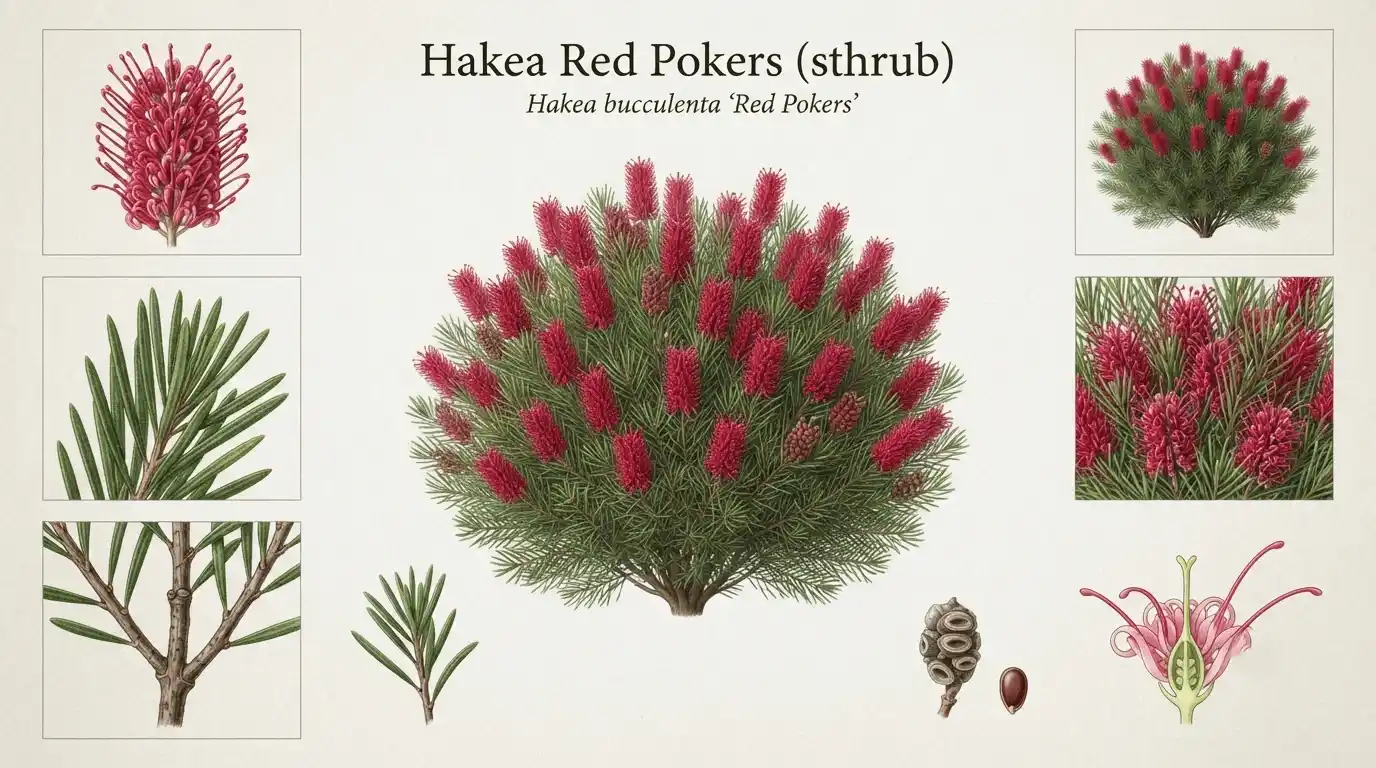
Hakea Red Pokers is easy to recognize thanks to its bold floral display and upright branching structure. Even when not flowering, its dense evergreen foliage provides year-round structure and texture in the landscape. Other Hakea species such as Hakea sericea share similar needle-like foliage and bird-attracting flower structures, making them equally valuable in wildlife-focused native planting schemes.
Some of its most recognizable characteristics include:
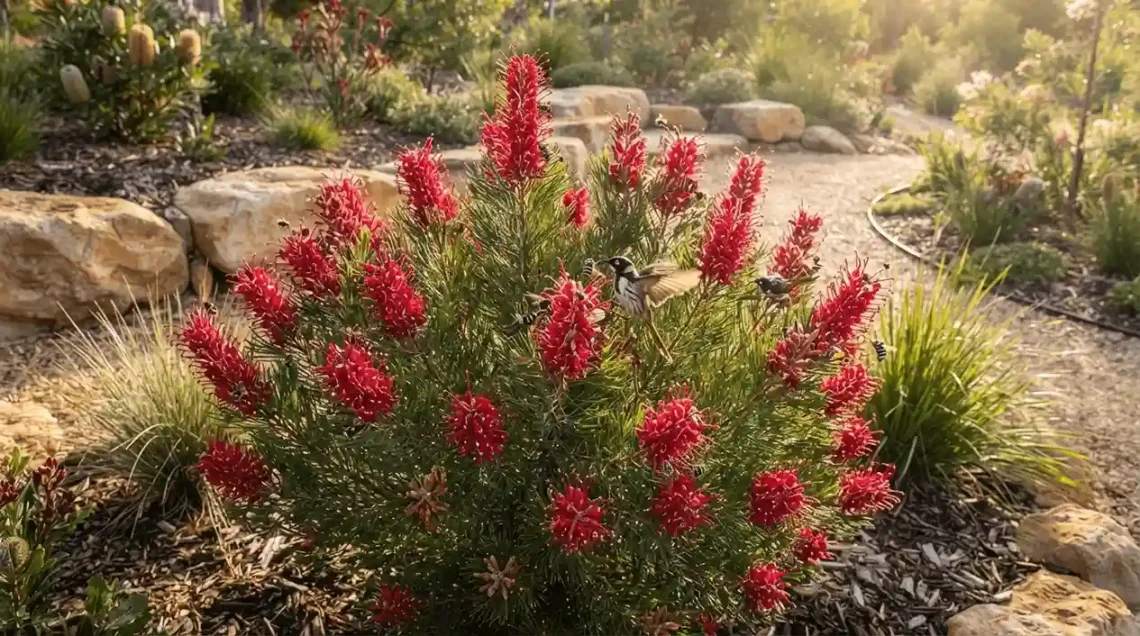
- Bright upright red flower spikes resembling glowing pokers
- Narrow, leathery evergreen leaves
- Compact, bushy shrub with multiple woody stems
- Dense branching that creates an attractive rounded form
- Excellent nectar production for birds and insects
- Long-lasting seasonal floral display
Flower appearance
The flowers are perhaps the plant’s most distinctive feature.
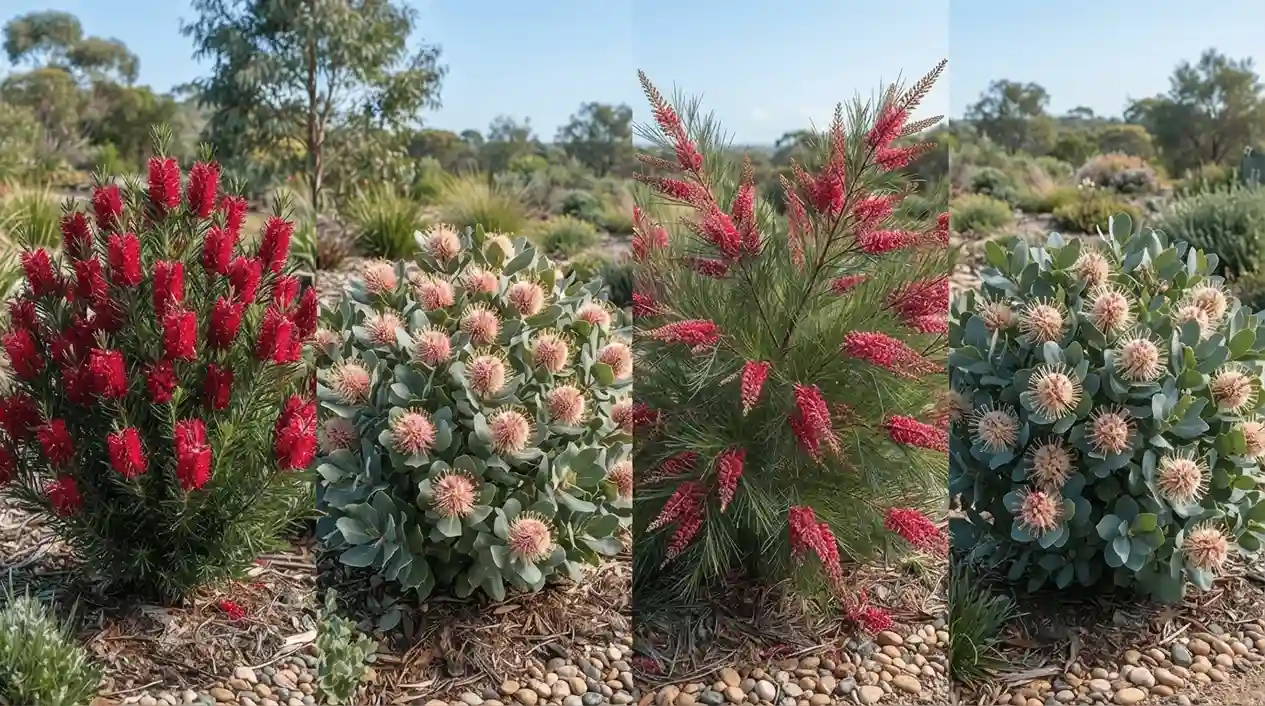
Instead of large petals, each flower spike consists of hundreds of tightly packed individual flowers with long protruding styles that create the characteristic poker-like appearance. Their brilliant crimson to deep scarlet color stands out dramatically against the green foliage.
Flower spikes are typically upright and densely packed, making them highly visible from a distance.
Leaf characteristics
The foliage consists of narrow, stiff, leathery leaves typical of many Australian native shrubs.
These leaves help reduce water loss during hot weather and contribute to the plant’s excellent drought tolerance. Their evergreen nature ensures the shrub remains attractive throughout the year.
Shrub form
Hakea Red Pokers develops into a dense, upright shrub with multiple woody branches emerging from the base.
This compact habit makes it suitable for:
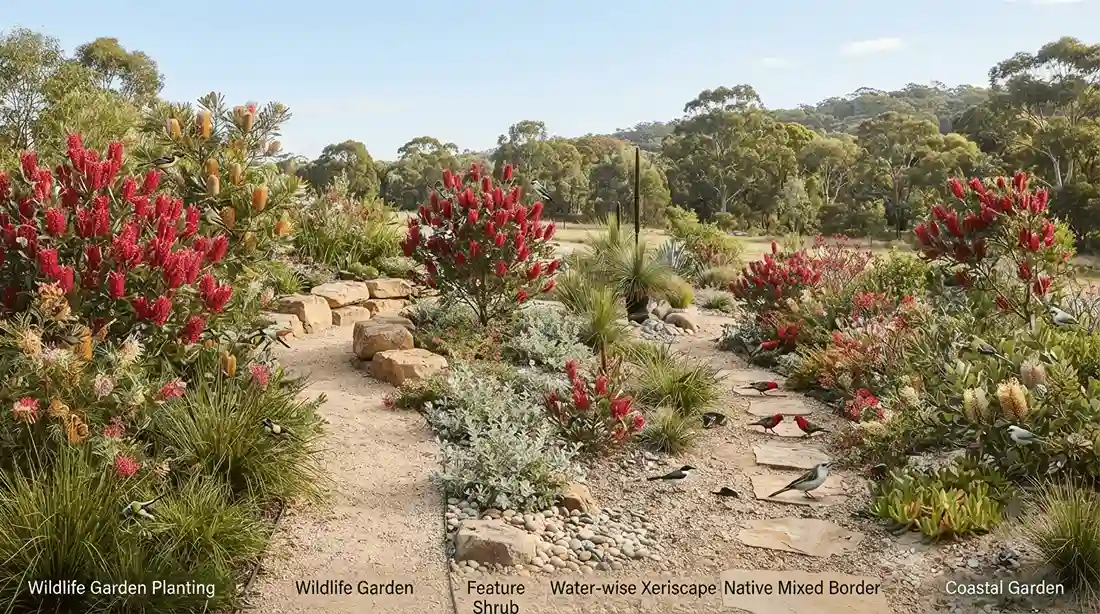
- Native gardens
- Mixed shrub borders
- Wildlife gardens
- Feature plantings
- Water-wise landscapes
- Large native containers in suitable climates
Seasonal flowering
Flowering generally occurs during the cooler months, although timing varies depending on regional climate and local growing conditions.
The bright red flower spikes can remain attractive for several weeks, providing welcome color when many other garden plants are less active.
Wildlife value
One of the greatest strengths of Hakea Red Pokers is its ecological value. In mixed native landscapes, Hakea Red Pokers pairs beautifully with species like Banksia integrifolia ‘Roller Coaster’, creating layered nectar-rich habitats that significantly increase bird activity and pollinator diversity.
Its nectar-rich flowers attract numerous beneficial wildlife species, including:
- Honeyeaters
- Wattlebirds
- Native bees
- Small nectar-feeding insects
- Various pollinating birds
At Greenery Inside, we’ve repeatedly observed flowering Hakea shrubs becoming focal feeding stations for nectar-loving birds, especially during cooler months when floral resources are more limited.
Plant Size and Growth Habit
Hakea Red Pokers is considered a medium-sized evergreen shrub with a naturally compact growth habit. While mature dimensions vary according to climate and growing conditions, it generally remains manageable without frequent pruning.
Its balanced size makes it suitable for both small residential gardens and larger native landscapes.
Mature size
Under ideal growing conditions, Hakea Red Pokers typically reaches:
| Growth Measurement | Typical Size |
| Height | 2–3 meters (6.5–10 feet) |
| Spread | 1.5–2.5 meters (5–8 feet) |
| Growth form | Upright, rounded shrub |
Individual specimens may become slightly larger in exceptionally favorable environments with deep, well-drained soils.
Plants growing in harsher, drier conditions often remain more compact.
Growth habit and branching
The shrub develops a naturally upright framework with numerous woody stems branching from the lower portion of the plant.
This growth habit provides several advantages:
- Dense screening foliage
- Good structural stability
- Attractive year-round appearance
- Minimal pruning requirements
- Strong support for heavy flowering
Unlike sprawling shrubs, Hakea Red Pokers maintains a relatively tidy silhouette throughout its life.
Its evergreen foliage remains evenly distributed along the branches, preventing the sparse appearance sometimes seen in older shrubs.
Factors affecting plant size
Several environmental conditions influence the mature size of Hakea Red Pokers.
Climate
Warm Mediterranean climates generally produce the healthiest and largest specimens.
Cooler climates may slightly reduce annual growth but often improve flower longevity.
Sunlight
Full sun encourages:
- Strong branching
- Dense foliage
- Compact shape
- Increased flowering
- Better overall vigor
Plants grown in shade often become taller, thinner, and less floriferous.
Soil drainage
Excellent drainage is essential.
Poor drainage restricts root development and limits overall growth while increasing the risk of root diseases.
Water availability
Consistent watering during establishment supports healthy root development.
Once mature, moderate moisture combined with dry intervals encourages balanced growth without producing weak, overly lush stems.
Soil fertility
Because Australian native plants evolved in nutrient-poor soils, excessive fertilization—particularly with phosphorus-rich products—can reduce plant health instead of improving growth.
Greenery Inside recommends focusing on soil structure and drainage rather than heavy feeding. Healthy root systems consistently outperform heavily fertilized plants over the long term.
Growth Rate
Hakea Red Pokers has a moderate growth rate, balancing steady development with long-term structural strength. It is neither a fast-growing screening shrub nor a particularly slow ornamental plant, making it suitable for gardeners seeking reliable establishment without excessive maintenance.
Most healthy plants become well established within the first two to three years after planting. During this period, the shrub focuses on developing a strong root system before producing its fullest flowering displays.
Growth typically follows these seasonal patterns:
- Spring: Active production of new shoots and foliage.
- Summer: Growth slows during periods of intense heat, especially in dry climates.
- Autumn: Moderate growth may resume if temperatures are mild and soil moisture is adequate.
- Winter: Vegetative growth slows significantly, while many plants begin or continue flowering depending on local conditions.
Several factors influence the overall growth rate:
- Full sun encourages stronger, more compact growth.
- Well-drained sandy or gravelly soils promote healthy root development.
- Overly fertile soils can lead to soft, weak growth that is more susceptible to stress.
- Moderate watering during establishment supports faster early development, while mature plants perform best with infrequent deep watering.
- Regional climate also plays an important role, with Mediterranean and temperate conditions generally producing the most vigorous plants.
From our experience at Greenery Inside, gardeners sometimes assume slow initial growth indicates a problem. In reality, young Hakea Red Pokers often prioritize root establishment during their first year. Once a healthy root system is in place, top growth and flowering typically become much more vigorous in subsequent seasons.
Care Guide for Hakea Red Pokers
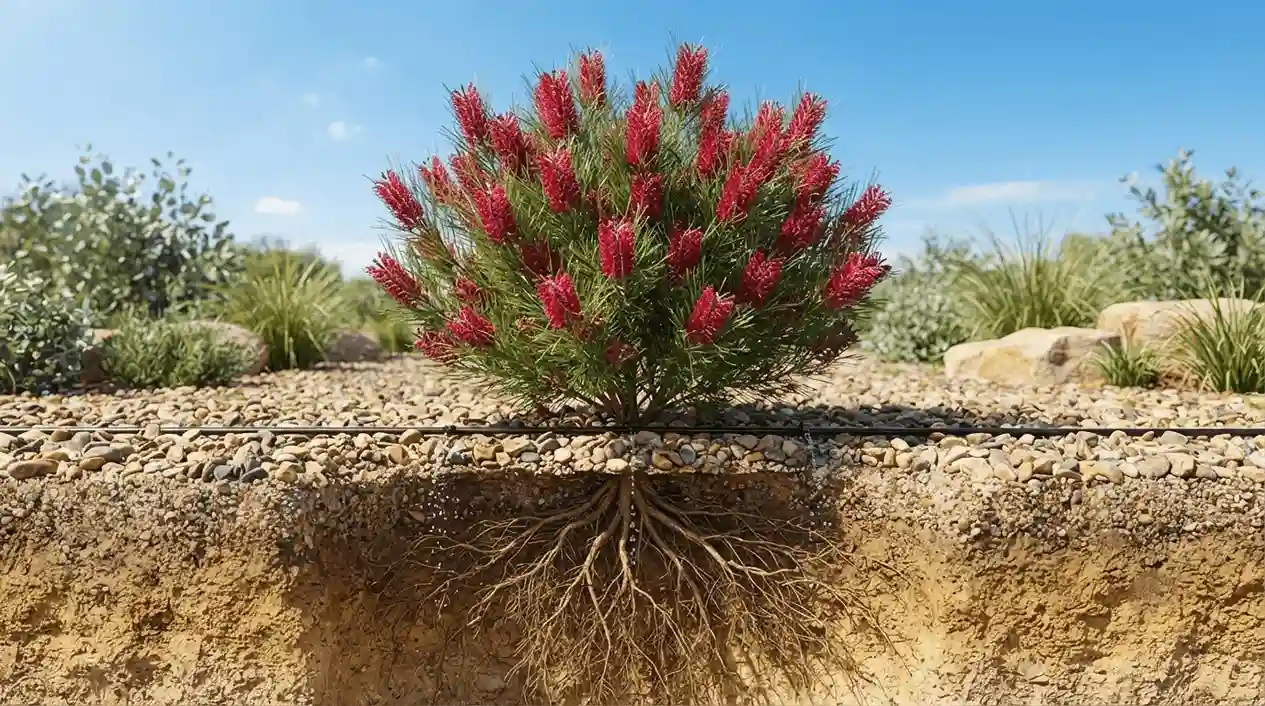
Hakea Red Pokers is one of the easier Australian native shrubs to grow when its natural habitat is replicated. Like many members of the Proteaceae family, it thrives in sunny, well-drained locations with relatively low soil fertility. Once established, it requires minimal maintenance and is highly drought tolerant.
The most important care principles are:
- Plant in full sun.
- Ensure excellent soil drainage.
- Avoid excessive watering.
- Use only low-phosphorus fertilizers formulated for native plants.
- Prune lightly after flowering to maintain shape and encourage branching.
Light Requirements
Hakea Red Pokers grows best in full sun, receiving at least 6–8 hours of direct sunlight daily.
Adequate sunlight directly influences:
- Flower production
- Compact growth
- Healthy foliage
- Strong branching
- Disease resistance
Plants grown in shaded conditions often produce fewer flowers and develop long, sparse stems as they stretch toward available light.
For the best ornamental display, choose an open position free from large trees or buildings that cast prolonged shade.
Best lighting conditions:
- ✔ Full sun (ideal)
- ✔ Morning and afternoon sun
- ✔ Open garden beds
- ✘ Deep shade
- ✘ Dense tree canopies
Greenery Inside recommends avoiding locations that receive less than half a day of sunlight, as reduced light almost always results in diminished flowering.
Soil Preferences
Well-drained soil is the single most important requirement for growing healthy Hakea Red Pokers.
In its native habitat, Hakea bucculenta naturally grows in sandy, gravelly, and free-draining soils that rarely remain wet for extended periods.
Ideal soil characteristics include:
- Sandy soil
- Sandy loam
- Gravelly soil
- Slightly acidic to neutral pH
- Excellent drainage
Heavy clay soils should be improved before planting or avoided altogether.
Poorly drained soil can lead to:
- Root rot
- Weak growth
- Yellowing foliage
- Reduced flowering
- Plant decline
If your garden contains clay soil, consider:
- Building a raised garden bed.
- Mixing coarse sand or gravel into the planting area.
- Planting on a slight mound to improve runoff.
Avoid rich composts that hold excessive moisture around the roots.
Watering Requirements
Proper watering changes significantly as the plant matures.
During establishment
For the first 12–18 months:
- Water deeply once or twice each week during dry weather.
- Allow the soil to partially dry between waterings.
- Avoid constantly wet soil.
Deep watering encourages roots to grow downward, producing a more drought-resistant shrub.
After establishment
Once established, Hakea Red Pokers becomes highly drought tolerant.
Most mature plants only require supplemental watering during prolonged dry periods.
Watering guidelines for mature shrubs:
- Water deeply every few weeks during extended drought.
- Reduce irrigation during cool seasons.
- Never allow water to pool around the roots.
One of the most common mistakes we see is treating Australian native shrubs like thirsty flowering ornamentals. Mature Hakea plants generally perform better with occasional deep watering than with frequent shallow irrigation.
Fertilizing
Unlike many ornamental shrubs, Hakea Red Pokers does not require heavy feeding.
Members of the Proteaceae family have specialized root systems that efficiently absorb nutrients from nutrient-poor soils. Excess fertilizer—especially phosphorus—can damage these roots.
Use only:
- Low-phosphorus native plant fertilizer
- Slow-release native formulations
- Light applications during spring if needed
Avoid:
- High-phosphorus fertilizers
- Lawn fertilizers
- Frequent feeding
- Fresh manure
In many established gardens, healthy Hakea plants may require little to no fertilization once established.
Pruning and Maintenance
Hakea Red Pokers benefits from light annual pruning rather than aggressive cutting.
The best time to prune is after flowering has finished.
Pruning helps:
- Maintain a compact shape
- Encourage branching
- Improve air circulation
- Increase future flowering
- Remove damaged stems
Avoid cutting into old leafless wood, as regeneration from older branches can be slow.
Maintenance tasks include:
- Removing dead branches
- Cleaning away storm damage
- Monitoring for poor drainage
- Replacing mulch annually
Light tip pruning each year generally produces denser, healthier shrubs than infrequent heavy pruning.
Climate and Hardiness
Hakea Red Pokers is naturally adapted to Mediterranean-type climates with dry summers and mild winters.
It performs exceptionally well in many parts of Australia and similar climates worldwide.
Heat tolerance
Excellent.
Established shrubs tolerate prolonged summer heat when growing in well-drained soil.
Frost tolerance
Moderate.
Light frosts are usually tolerated, although young plants benefit from protection during severe freezes.
Coastal performance
The shrub performs well in coastal gardens where soils drain freely.
Its tolerance of coastal winds makes it suitable for many seaside landscapes, although extremely salty spray may reduce flowering in exposed locations.
As of 2026, horticultural experts continue recommending drought-tolerant Australian natives like Hakea Red Pokers for climate-resilient gardens that require less supplemental irrigation.
Growing Conditions Table
| Growing Factor | Ideal Conditions |
| Sunlight | Full sun (6–8+ hours daily) |
| Soil | Sandy, gravelly, well-drained soil |
| Water | Regular during establishment, minimal once mature |
| Fertilizer | Low-phosphorus native plant fertilizer |
| Pruning | Light pruning after flowering |
| Climate | Mediterranean, temperate, coastal, drought-prone regions |
Flowering Characteristics
One of the biggest reasons gardeners grow Hakea Red Pokers is its spectacular floral display.
Unlike many flowering shrubs, the blooms are highly architectural, creating upright spikes that stand above the evergreen foliage. The flowers are rich in nectar, making the shrub an important food source for birds and beneficial insects.
When Does Hakea Red Pokers Bloom?
Hakea Red Pokers generally flowers from late winter through spring, although flowering times vary depending on regional climate.
In warmer areas, flowering may begin slightly earlier, while cooler climates may delay blooming.
Flowering is usually most abundant when the shrub receives:
- Full sun
- Good drainage
- Moderate watering during establishment
- Proper annual pruning
Healthy mature plants often produce hundreds of flower clusters across the shrub, creating a striking display for several weeks.
Flower Appearance and Color
The flowers are one of the most distinctive features of Hakea bucculenta ‘Red Pokers’.
Each flower spike consists of numerous tiny individual flowers tightly packed together.
Characteristics include:
- Brilliant crimson to scarlet red
- Upright cylindrical flower spikes
- Long protruding styles
- Dense nectar-rich blooms
- Long-lasting floral display
The upright flower spikes inspired the cultivar’s common name, “Red Pokers,” because they resemble glowing fireplace pokers emerging from the foliage.
The evergreen leaves provide an attractive contrast, making the flowers even more eye-catching.
Pollinators and Wildlife Benefits
Hakea Red Pokers plays an important ecological role by supporting a wide range of pollinating wildlife.
Its abundant nectar attracts:
- Honeyeaters
- Wattlebirds
- Native bees
- Butterflies
- Beneficial insects
Birds are often seen visiting the shrub repeatedly throughout the flowering season, helping transfer pollen between flowers.
Growing native flowering shrubs like Hakea Red Pokers increases biodiversity by providing reliable food sources during cooler months when fewer plants are in bloom.
At Greenery Inside, we’ve found that adding several nectar-rich native shrubs together creates a continuous food supply for local wildlife and significantly increases bird activity in the garden.
How to Plant Hakea Red Pokers Successfully
Proper planting gives Hakea Red Pokers the best possible start and reduces the likelihood of future problems. Because Australian native plants are sensitive to poor drainage and root disturbance, careful site preparation is essential.
Choose a location that receives full sun throughout most of the day and has freely draining soil. Avoid low-lying areas where water collects after rain.
Before planting:
- Remove weeds from the planting area.
- Improve drainage if necessary by creating a raised bed or mound.
- Dig a hole twice as wide as the root ball but no deeper than the container.
- Handle the root ball carefully to avoid damaging fine roots.
After planting, backfill with the original soil rather than rich compost. Water thoroughly to settle the soil, then apply a layer of mulch around the base while keeping it several centimeters away from the stem to prevent rot.
During the first year, monitor soil moisture regularly. Deep but infrequent watering encourages strong root establishment and improves long-term drought tolerance.
Step-by-Step Planting Process
- Select a sunny location with excellent drainage.
- Remove weeds and loosen the surrounding soil.
- Dig a planting hole twice as wide as the root ball.
- Position the shrub so the top of the root ball is level with the soil surface.
- Backfill using the existing soil.
- Water deeply after planting.
- Apply organic mulch, leaving space around the stem.
- Water regularly during establishment, allowing the soil to dry slightly between waterings.
- Avoid applying high-phosphorus fertilizers during the first growing season.
Common Problems and How to Fix Them
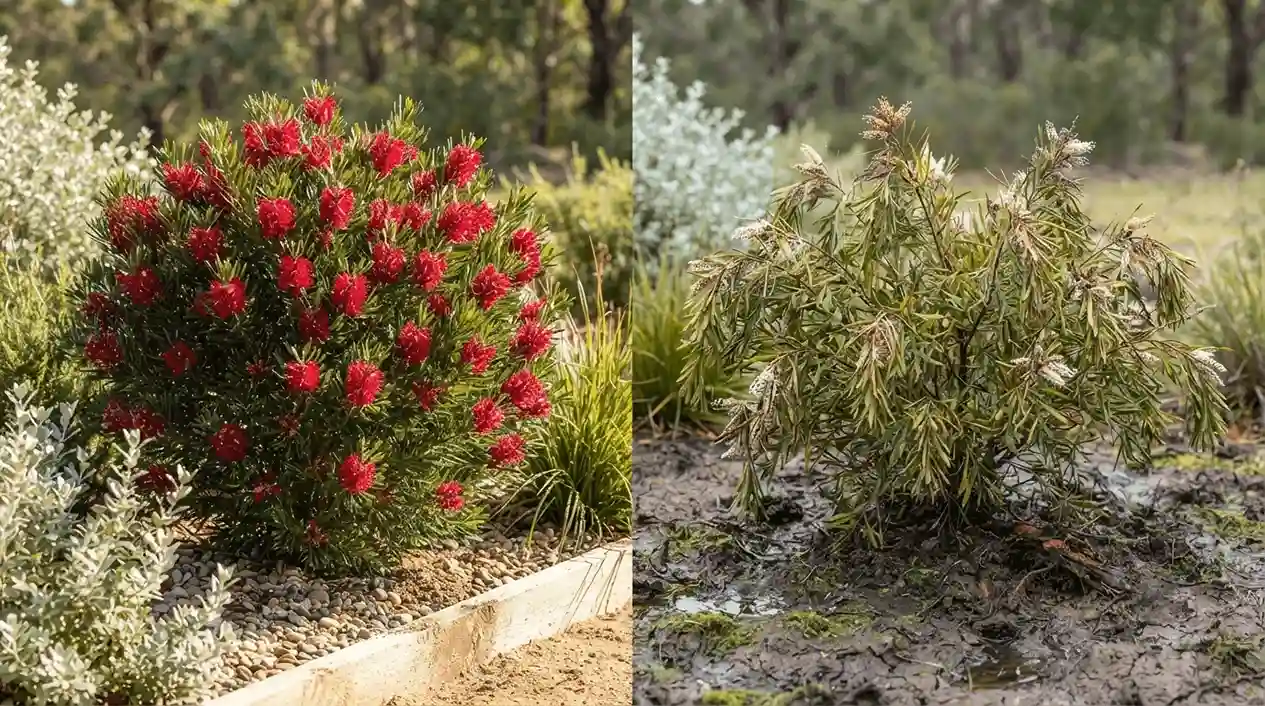
Hakea Red Pokers is generally a hardy, low-maintenance shrub when grown in suitable conditions. Most problems arise from incorrect watering, poor soil drainage, or unsuitable planting locations rather than pests or diseases. Identifying the cause early helps restore plant health and prevents long-term damage.
Poor Flowering
Poor flowering is usually caused by insufficient sunlight, excessive nitrogen fertilizer, or heavy pruning at the wrong time.
Why it happens
- Too much shade reduces flower production.
- High-nitrogen fertilizers encourage leafy growth instead of blooms.
- Pruning before flowering removes developing flower buds.
- Young plants may require one to three years to reach their full flowering potential.
How to solve it
- Move container-grown plants to a sunnier location if possible.
- Switch to a low-phosphorus fertilizer designed for Australian native plants.
- Prune only after the flowering season has finished.
- Be patient with newly established shrubs.
Prevention
- Plant in full sun.
- Avoid overfeeding.
- Follow an annual pruning schedule after flowering.
Root Rot from Excessive Moisture
Root rot is the most serious issue affecting Hakea Red Pokers and is almost always linked to poor drainage or excessive watering.
Why it happens
- Heavy clay soils retain too much moisture.
- Overwatering deprives roots of oxygen.
- Waterlogged conditions encourage fungal pathogens.
How to solve it
- Reduce watering immediately.
- Improve soil drainage or transplant to a better-drained location if practical.
- Remove severely damaged roots if the plant is container-grown.
Prevention
- Plant in sandy or gravelly soil.
- Water deeply but infrequently.
- Never allow the root zone to remain constantly wet.
Yellowing Foliage
Yellow leaves can indicate several environmental stresses rather than a specific disease.
Why it happens
- Poor drainage
- Overwatering
- Nutrient imbalance
- Temporary transplant shock
- Insufficient sunlight
How to solve it
- Check soil moisture before watering.
- Improve drainage if needed.
- Apply a suitable low-phosphorus native fertilizer only if a nutrient deficiency is suspected.
- Remove badly damaged foliage.
Prevention
- Maintain consistent but moderate watering.
- Avoid waterlogged soils.
- Grow the shrub in full sun.
Pest and Disease Issues
One advantage of Hakea Red Pokers is its natural resistance to many common garden pests.
Occasionally, gardeners may encounter:
- Scale insects
- Aphids on young growth
- Leaf-chewing caterpillars
These pests rarely cause significant damage to healthy plants.
Why it happens
Stressed plants are more attractive to insects than vigorous shrubs.
How to solve it
- Wash minor infestations off with water.
- Prune heavily infested stems.
- Encourage beneficial insects such as ladybirds and lacewings.
Prevention
- Maintain good airflow.
- Avoid excessive fertilization.
- Grow plants under appropriate conditions.
Slow Growth
Some gardeners worry that their Hakea Red Pokers is growing too slowly.
Why it happens
- Root establishment during the first year
- Poor sunlight
- Low temperatures
- Compacted soil
- Drought stress during establishment
How to solve it
- Ensure adequate sunlight.
- Water appropriately during establishment.
- Improve drainage and soil structure.
- Avoid unnecessary fertilization.
Prevention
- Plant during the cooler months.
- Water deeply while roots develop.
- Allow time for natural establishment.
Common Beginner Mistakes
Many problems with Hakea Red Pokers can be avoided by understanding how Australian native plants naturally grow. Beginners often provide too much care rather than too little.
Common mistakes include:
Planting in Poorly Drained Soil
The biggest mistake is planting in heavy clay where water remains around the roots. Excellent drainage should always be the priority.
Overwatering Native Plants
Although newly planted shrubs need regular watering, mature plants are highly drought tolerant. Frequent watering often causes more harm than dry conditions.
Excessive Fertilization
Australian native plants evolved in nutrient-poor soils. Applying large amounts of fertilizer—especially phosphorus-rich products—can damage their specialized root systems.
Heavy Pruning
Removing large sections of older wood may reduce flowering and slow recovery. Light annual pruning after flowering is usually sufficient.
Growing in Too Much Shade
Shaded plants often become leggy and produce significantly fewer flowers. Full sun encourages dense growth and abundant blooms.
From our experience at Greenery Inside, gardeners who mimic the plant’s natural environment—with plenty of sunlight, excellent drainage, and minimal intervention—consistently achieve the healthiest and most floriferous shrubs.