Introduction
Grevillea Billy Bonkers is a compact, cascading Australian native shrub prized for its vibrant flowers, attractive evergreen foliage, and ability to attract birds and beneficial pollinators. This low-growing grevillea is widely planted in water-wise landscapes, native gardens, rockeries, and large containers because it combines ornamental beauty with excellent drought tolerance once established. Its spreading habit makes it an effective ground cover while requiring relatively little maintenance compared to many flowering shrubs. Whether used to soften retaining walls, brighten garden beds, or provide nectar for wildlife, Grevillea Billy Bonkers offers year-round landscape value and adapts well to a variety of growing conditions when planted in well-drained soil.
By Greenery Inside | Plant Care & Gardening Expert
Quick Summary
- Grevillea Billy Bonkers is a low-growing ornamental grevillea valued for its cascading growth habit and colorful spider-like flowers.
- It grows best in full sun, well-drained soil, and requires minimal maintenance after establishment.
- The plant attracts nectar-feeding birds, bees, butterflies, and other beneficial pollinators.
- It performs exceptionally well in native gardens, coastal landscapes, slopes, retaining walls, and large containers.
- Proper watering, occasional pruning, and low-phosphorus fertilization help maintain vigorous growth and abundant flowering.
What Is Grevillea Billy Bonkers?
Plant Overview
Grevillea Billy Bonkers is a compact ornamental cultivar belonging to the genus Grevillea within the family Proteaceae, one of Australia’s best-known native plant families. It is primarily grown for its spreading, cascading growth habit and its clusters of colorful nectar-rich flowers that bloom over an extended period.
Unlike upright grevillea varieties, Billy Bonkers naturally forms a dense, arching mound that gradually spreads outward. This characteristic makes it especially useful as a decorative ground cover, cascading feature over retaining walls, or filler plant in water-wise landscapes.
The name Billy Bonkers Grevillea reflects its energetic, sprawling growth pattern and profuse flowering display. Rather than growing vertically, its branches gracefully trail and cascade, creating a softer appearance than many larger grevillea cultivars.
Like many modern grevillea cultivars, Billy Bonkers was selected for improved ornamental performance, reliable flowering, and adaptability in residential landscapes. Although it shares characteristics with many members of the Grevillea genus, it offers a more compact form suitable for smaller gardens.
The cultivar is often associated with other compact grevilleas, including Grevillea Billy, although Billy Bonkers has its own distinctive growth habit, flower display, and landscaping uses.
In our experience growing Australian native shrubs, Billy Bonkers performs best when given plenty of sunlight and unrestricted drainage. Once established, it becomes one of the lowest-maintenance flowering shrubs in a native garden. Grevillea belongs to the diverse Grevillea genus, which includes hundreds of Australian native species known for their unique flowers and ecological value.
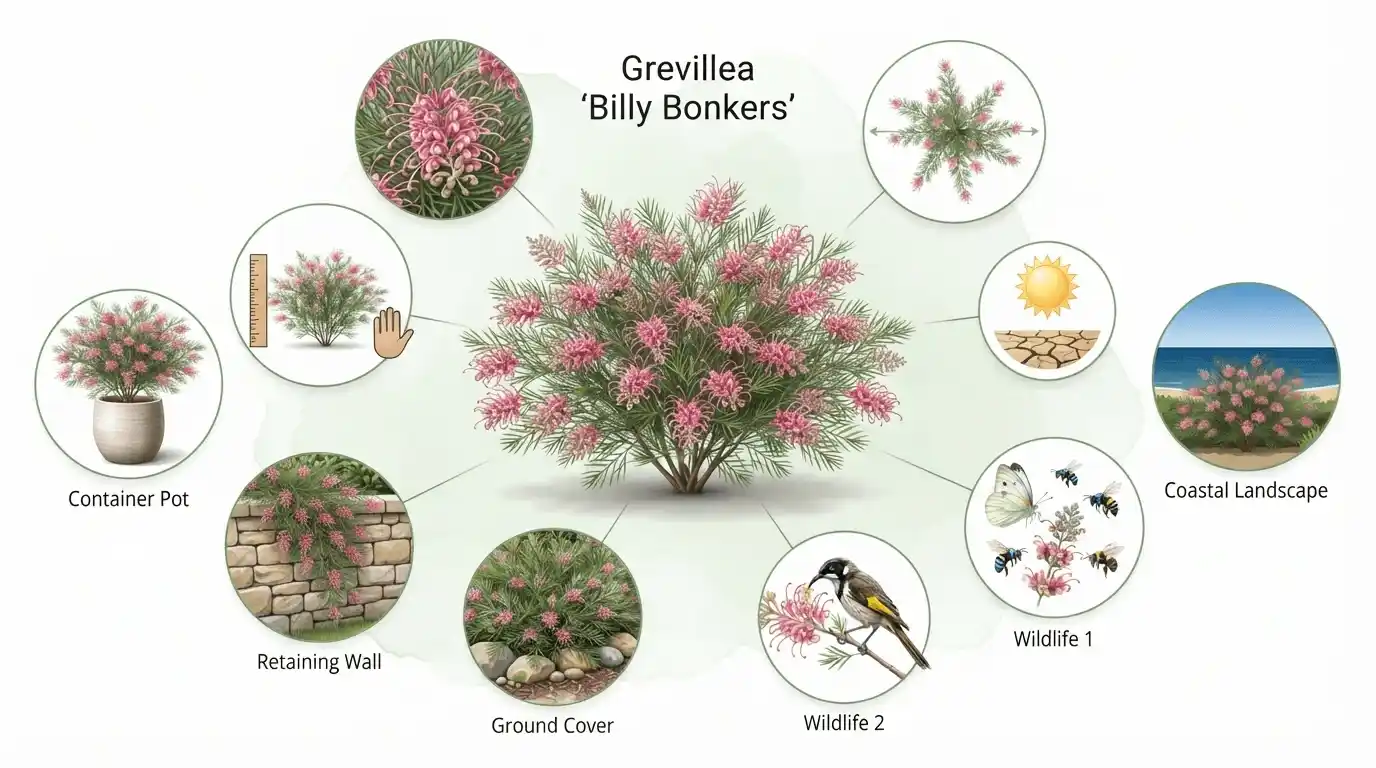
Key Features at a Glance
- Botanical Family: Proteaceae
- Plant Type: Evergreen Australian native shrub
- Growth Habit: Low-growing, spreading, cascading
- Flower Color: Bright pink to reddish-purple flowers with contrasting styles
- Foliage: Fine, narrow evergreen leaves
- Wildlife Value: Highly attractive to nectar-feeding birds, bees, butterflies, and native pollinators
- Drought Tolerance: High once established
- Landscape Uses: Ground cover, slopes, retaining walls, containers, native gardens, coastal landscapes
- Maintenance Level: Low
- Evergreen: Yes, providing year-round foliage interest
Plant Size, Height, and Growth Habit
Many gardeners search for the Grevillea Billy Bonkers height before planting because its compact size makes it suitable for a wide range of landscapes. Although growing conditions influence final dimensions, the plant generally remains much lower than upright grevillea varieties.
Under favorable conditions, the typical Grevillea Billy Bonkers size reaches:
| Feature | Typical Size |
| Height | 40–70 cm (16–28 inches) |
| Width | 1.5–2.5 m (5–8 feet) |
| Growth Habit | Low, spreading, cascading |
| Growth Form | Dense evergreen shrub |
Compared with the average grevillea height, which can range from less than one meter to more than six meters depending on species, Billy Bonkers remains distinctly compact. Its wide spread allows it to cover bare soil efficiently while suppressing weeds and reducing erosion on gentle slopes.
Instead of producing stiff upright branches, the stems arch outward and gradually cascade over edges. This trailing habit creates an attractive layered appearance around rocks, garden borders, raised beds, and retaining walls.
Because of its mature spread, gardeners should allow adequate spacing during planting. Crowding nearby shrubs may reduce airflow and limit the plant’s natural form.
Greenery Inside recommends planning for the plant’s full mature width rather than its initial nursery size. Giving Billy Bonkers enough room results in healthier branching and a more balanced landscape display over time.
Suitable planting locations include:
- Native gardens
- Sloping banks
- Rock gardens
- Coastal landscapes
- Garden borders
- Large decorative containers
- Retaining wall edges
- Wildlife gardens
Growth Rate and Mature Development
How Fast Does It Grow?
Grevillea Billy Bonkers has a moderate growth rate, establishing steadily rather than aggressively. Under ideal conditions, young plants usually develop a strong root system during their first growing season before expanding more rapidly in subsequent years.
Most healthy plants begin producing significant lateral growth within one to two years after planting. Mature size is commonly reached within three to five years, depending on climate, soil quality, and maintenance.
Growth is usually strongest during the warmer months of spring and early summer when temperatures, sunlight, and soil warmth encourage active root and shoot development.
As of the 2026 growing season, many Australian native plant growers continue to recommend focusing on healthy root establishment during the first year rather than encouraging rapid top growth through excessive fertilization. This approach improves long-term vigor and drought resilience.
Factors That Affect Growth
Several environmental conditions influence how quickly Grevillea Billy Bonkers develops.
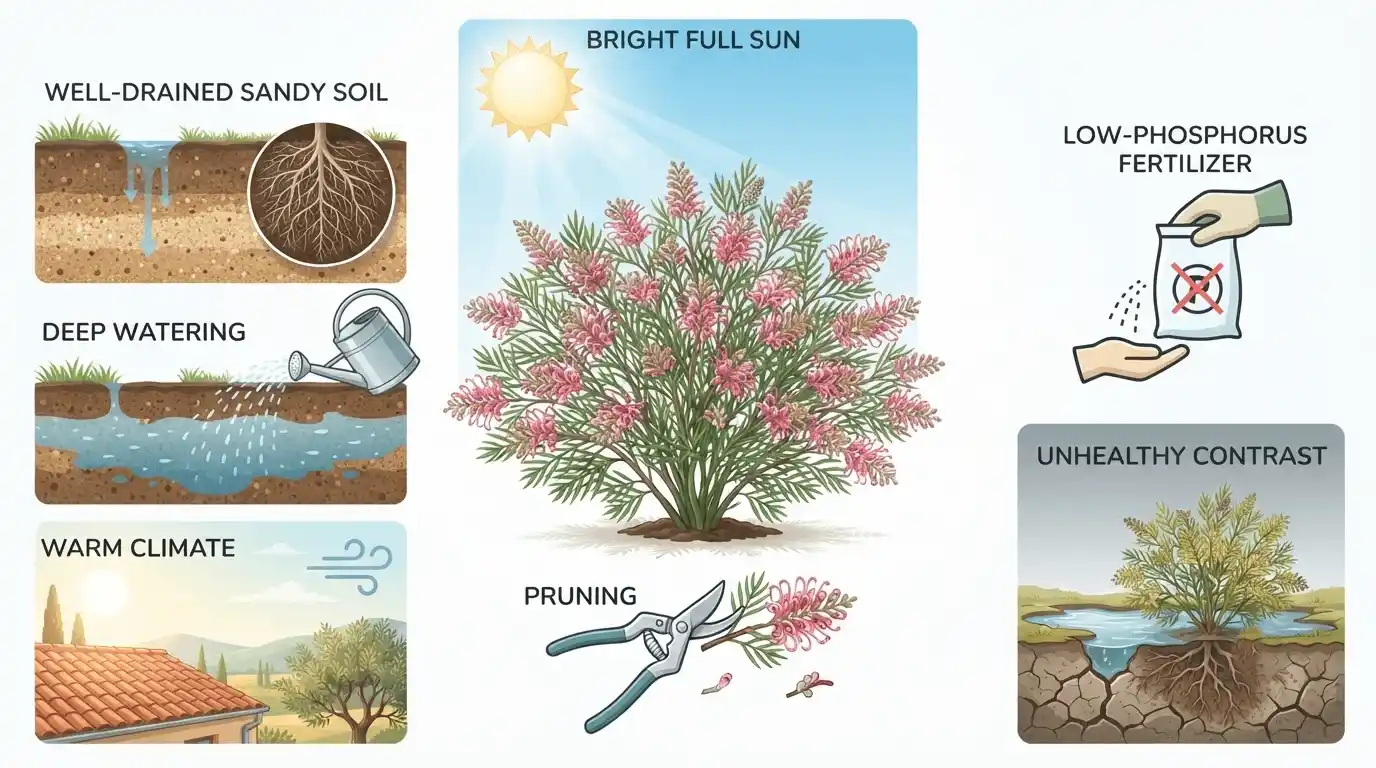
- Sunlight: Full sun encourages faster growth, denser branching, and heavier flowering.
- Soil Drainage: Free-draining soil supports healthy roots and reduces the risk of root diseases.
- Climate: Mild temperate and Mediterranean climates generally produce the best growth.
- Water Availability: Regular watering during establishment promotes stronger root development before drought tolerance improves.
- Pruning: Light pruning after flowering encourages branching and maintains a compact, vigorous shape.
Grevillea Billy Bonkers Care Guide
Best Landscaping Uses
Proper care helps Grevillea Billy Bonkers remain healthy, flower consistently, and develop its characteristic cascading form. Fortunately, it is considered one of the easier Australian native shrubs to maintain once established.
Water Requirements
Young Grevillea Billy Bonkers plants require regular watering while establishing their root systems. Deep watering once or twice each week during the first growing season is generally more beneficial than frequent shallow watering.
After establishment, watering requirements decrease significantly. Mature plants tolerate extended dry periods remarkably well, although occasional deep watering during prolonged drought helps maintain flowering and foliage quality.
Avoid keeping soil constantly wet, as excessive moisture is one of the leading causes of root problems in grevilleas.
From our experience, gardeners often lose young grevilleas through overwatering rather than underwatering. Allowing the soil surface to dry slightly between irrigation encourages healthier root development.
Light Requirements
Full sun is the preferred growing position for Grevillea Billy Bonkers.
At least six hours of direct sunlight each day promotes:
- Maximum flowering
- Dense branching
- Compact growth
- Improved disease resistance
- Stronger foliage color
Although the plant can tolerate light partial shade, reduced sunlight usually results in fewer flowers and a more open growth habit.
Best Soil Conditions
Excellent drainage is the single most important soil requirement.
Grevillea Billy Bonkers performs best in:
- Sandy soils
- Sandy loam
- Gravelly soils
- Well-drained native garden soils
Heavy clay soils that remain saturated after rainfall can lead to root rot and poor plant performance.
A slightly acidic to neutral soil pH, typically around 5.5 to 7.0, provides suitable growing conditions for most grevilleas.
Where drainage is poor, planting on raised mounds or elevated beds can significantly improve long-term success.
Fertilizing
Like many Australian native plants, Grevillea Billy Bonkers is sensitive to excessive phosphorus.
Choose fertilizers specifically formulated for Australian native plants or products labeled as low-phosphorus fertilizers.
A light application in early spring is usually sufficient to support healthy growth and flowering.
Avoid overfeeding, as excessive nutrients may encourage lush growth at the expense of flowers and can damage sensitive root systems.
Pruning Tips
Regular light pruning helps maintain the attractive cascading habit while encouraging additional flowering.
Pruning offers several benefits:
- Promotes denser branching
- Encourages more flowering shoots
- Removes spent flowers
- Maintains compact shape
- Improves air circulation
The ideal time to prune is shortly after the main flowering flush. Avoid removing large amounts of old woody growth, as recovery may be slower than from younger stems.
Greenery Inside recommends frequent light trimming instead of occasional heavy pruning. This approach maintains the plant’s natural form while supporting continuous healthy growth.
Climate and Hardiness
Grevillea Billy Bonkers is well adapted to many temperate and warm-climate regions.
It performs particularly well in:
- Mediterranean climates
- Coastal gardens
- Mild temperate regions
- Low-rainfall landscapes
- Water-wise gardens
Once established, the plant demonstrates excellent heat tolerance and withstands extended dry periods.
Light frosts are generally tolerated, although prolonged or severe freezing temperatures may damage young growth. In colder climates, planting near a sunny wall or protected location can improve winter survival.
Its tolerance of salt-laden winds also makes Grevillea Billy Bonkers a reliable choice for coastal gardens, where many ornamental shrubs struggle to thrive.
Growing Grevillea Billy Bonkers in Pots
Growing grevillea billy bonkers in pots is an excellent option for gardeners with limited space, patios, balconies, or courtyards. Thanks to its naturally compact, cascading growth habit, the plant adapts well to large containers provided its basic growing requirements are met.
Container-grown plants offer flexibility because they can be repositioned for better sunlight, protected during unusually cold weather, or incorporated into decorative outdoor displays.
In our experience, Grevillea Billy Bonkers often performs just as well in containers as in the ground when planted in a free-draining native potting mix and watered appropriately.
Choosing the Right Container
Select a sturdy pot with multiple drainage holes. Since Billy Bonkers spreads much wider than it grows tall, a broad container usually performs better than a narrow one.
General recommendations include:
- Diameter: 45–60 cm (18–24 inches) minimum
- Depth: At least 40 cm (16 inches)
- Material: Terracotta, ceramic, concrete, or quality plastic
- Excellent drainage is essential
Larger containers help stabilize soil moisture and reduce the frequency of watering during hot weather.
Best Potting Mix
Ordinary garden soil should not be used in containers because it compacts over time and restricts drainage.
Instead, use:
- Premium native plant potting mix
- Sandy, well-draining mix
- Potting mix containing coarse bark or perlite
- Low-phosphorus formulation designed for Australian native plants
Avoid heavy mixes that retain excessive moisture around the roots.
Watering Container Plants
Potted Grevillea Billy Bonkers dries out faster than garden-planted specimens.
General watering guidelines include:
- Water regularly during establishment.
- Allow the upper layer of potting mix to dry slightly before watering again.
- Increase watering frequency during prolonged summer heat.
- Reduce watering during winter when growth naturally slows.
Although the plant is drought tolerant once established, container plants should never remain completely dry for extended periods.
Long-Term Maintenance
Container-grown plants require occasional maintenance to remain healthy over many years.
Greenery Inside recommends:
- Refreshing the top layer of potting mix annually
- Applying low-phosphorus fertilizer each spring
- Removing spent flowers after blooming
- Light pruning to maintain a balanced cascading shape
- Checking drainage holes regularly to prevent blockage
Quick Container Care Checklist
- Best pot size: 45–60 cm wide or larger
- Container placement: Full sun with good airflow
- Potting mix: Free-draining native plant mix
- Repotting schedule: Every 3–5 years or when root-bound
Grevillea Billy Bonkers Standard and Grafted Forms
Many nurseries now offer Grevillea Billy Bonkers in specialty forms that suit different landscape styles. The two most common are grevillea billy bonkers standard and grevillea billy bonkers grafted plants.
Although both feature the same attractive flowers and foliage, their growing habits and maintenance requirements differ.
What Is a Standard Grevillea?
A grevillea billy bonkers standard is created by grafting or training the cascading variety onto a single upright trunk.
Instead of spreading directly across the ground, the foliage forms an elevated cascading canopy, producing a miniature tree-like appearance.
Standard forms are popular for:
- Feature planting
- Entryways
- Decorative pots
- Courtyard gardens
- Formal native landscapes
- Small garden focal points
Compared with the natural shrub form, standards require a little more maintenance to preserve their shape.
Maintenance differences include:
- Removing shoots that emerge from below the graft
- Occasional crown shaping
- Supporting young trunks if exposed to strong winds
- Monitoring the graft union for damage
What Does Grafted Mean?
A grevillea billy bonkers grafted plant combines the ornamental top growth (scion) with the root system of another compatible grevillea species.
Grafting is widely used in Australian native plant production because it improves adaptability and reliability.
Benefits of grafting include:
- Greater tolerance of heavier soils
- Improved root strength
- Better adaptability to challenging garden conditions
- Increased resistance to certain root diseases
- Improved long-term vigor in some climates
Although grafted plants can perform well in a broader range of soils, they still benefit from excellent drainage and proper watering practices.
Flower Characteristics and Pollinator Benefits
One of the biggest reasons gardeners choose Grevillea Billy Bonkers is its exceptionally long flowering season and its ability to attract beneficial wildlife.
The nectar-rich blooms provide both ornamental value and an important food source for many native species.
Flower Appearance
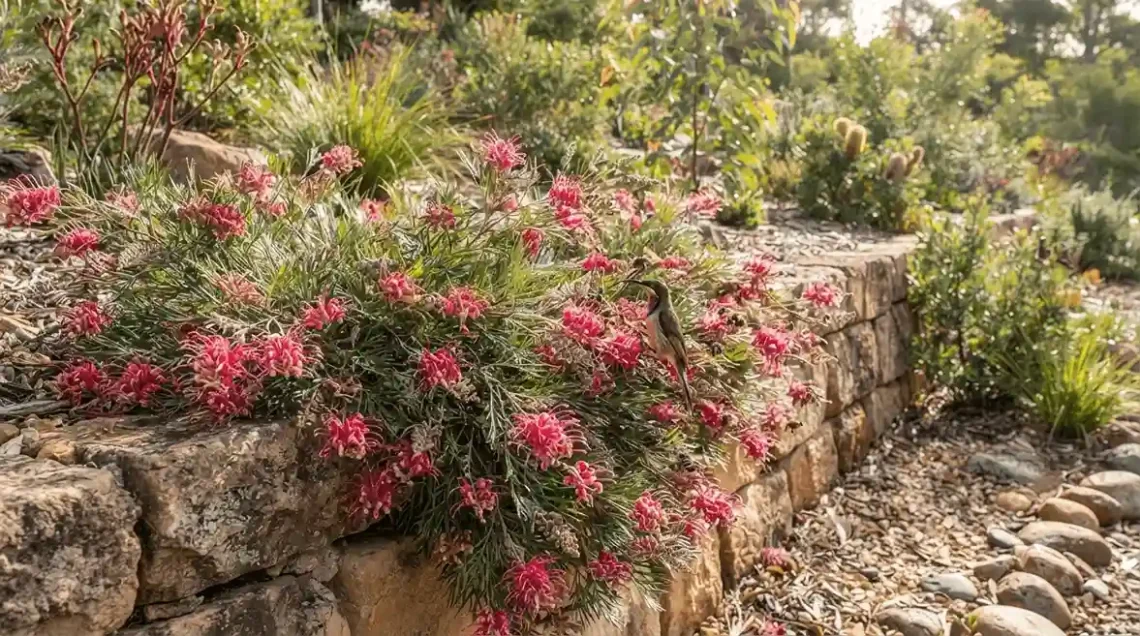
Grevillea Billy Bonkers produces clusters of distinctive spider-like flowers that appear along the arching branches.
Flower characteristics include:
- Bright reddish-pink to deep pink blooms
- Long, curved floral styles
- Rich nectar production
- Repeated flowering throughout much of the year in suitable climates
Unlike cultivars commonly described as blue grevillea or purple grevillea, Billy Bonkers does not produce true blue or purple flowers. Instead, those terms are often used when comparing different Grevillea species or cultivars with cooler-toned blooms.
The evergreen foliage provides an attractive contrast, allowing the flowers to remain visually prominent even during extended flowering periods.
Wildlife Value
Grevillea Billy Bonkers is considered one of the more wildlife-friendly ornamental shrubs.
Its nectar-rich flowers attract:
- Nectar-feeding birds such as honeyeaters
- Native bees
- Honeybees
- Butterflies
- Beneficial native pollinators
The dense branching also provides shelter for small birds and insects, increasing biodiversity in home gardens.
In our experience, planting Billy Bonkers alongside other flowering Australian native shrubs creates a continuous food source that supports pollinators throughout much of the growing season.
Are Grevilleas Poisonous?
Many gardeners ask are grevilleas poisonous before planting them around children or pets.
The answer is that Grevilleas are generally not considered highly poisonous, but some species may cause skin irritation or allergic reactions in sensitive individuals due to naturally occurring chemical compounds found in the leaves and sap.
Most people can handle grevilleas without any problems, while others may develop mild contact dermatitis after repeated exposure.
Safety Overview
For most households:
- The plant is not considered highly toxic.
- Serious poisoning is uncommon.
- Mild skin irritation may occur in sensitive individuals.
- Wearing gloves during pruning is recommended if skin sensitivity is known.
Around Children
Children should avoid chewing leaves, flowers, or stems, even though severe toxicity is not commonly reported.
Teaching children not to eat ornamental plants is always the safest approach.
Around Pets
Dogs and cats generally ignore grevilleas, and significant poisoning cases are rare.
However:
- Discourage pets from chewing foliage.
- Contact a veterinarian if unusual symptoms develop after ingestion.
- Monitor curious puppies that may chew young plants.
Safe Handling Tips
- Wear gardening gloves when pruning.
- Wash hands after handling plant material.
- Remove fallen branches from play areas.
- Dispose of pruning waste promptly.
Propagation Methods
Grevillea Billy Bonkers can be propagated, but the success of each method depends largely on the type of plant and whether it is a hybrid cultivar.
Most commercial growers rely on vegetative propagation to maintain consistent plant characteristics.
Can Grevillea Billy Bonkers Be Grown from Seeds?
Many gardeners search for grevillea billy bonkers seeds, but seed propagation is generally not recommended for this cultivar.
Because Billy Bonkers is a cultivated hybrid, seeds often do not produce plants identical to the parent.
Common limitations include:
- Variable offspring
- Reduced ornamental quality
- Lower germination consistency
- Loss of desirable growth habit
Even when seeds germinate successfully, seedlings may differ significantly in flower color, plant size, or branching pattern.
Propagation by Cuttings
Semi-hardwood cuttings are the preferred propagation method for Grevillea Billy Bonkers.
Advantages include:
- Plants remain genetically identical
- Faster establishment
- More predictable flowering
- Higher success rate than seed propagation
The best time to take cuttings is during active growth after a flowering flush when stems are partially mature but still flexible.
Commercial nurseries commonly use rooting hormone and controlled humidity to improve rooting success, although experienced home gardeners can also achieve good results with proper care.
Common Growing Problems and Solutions
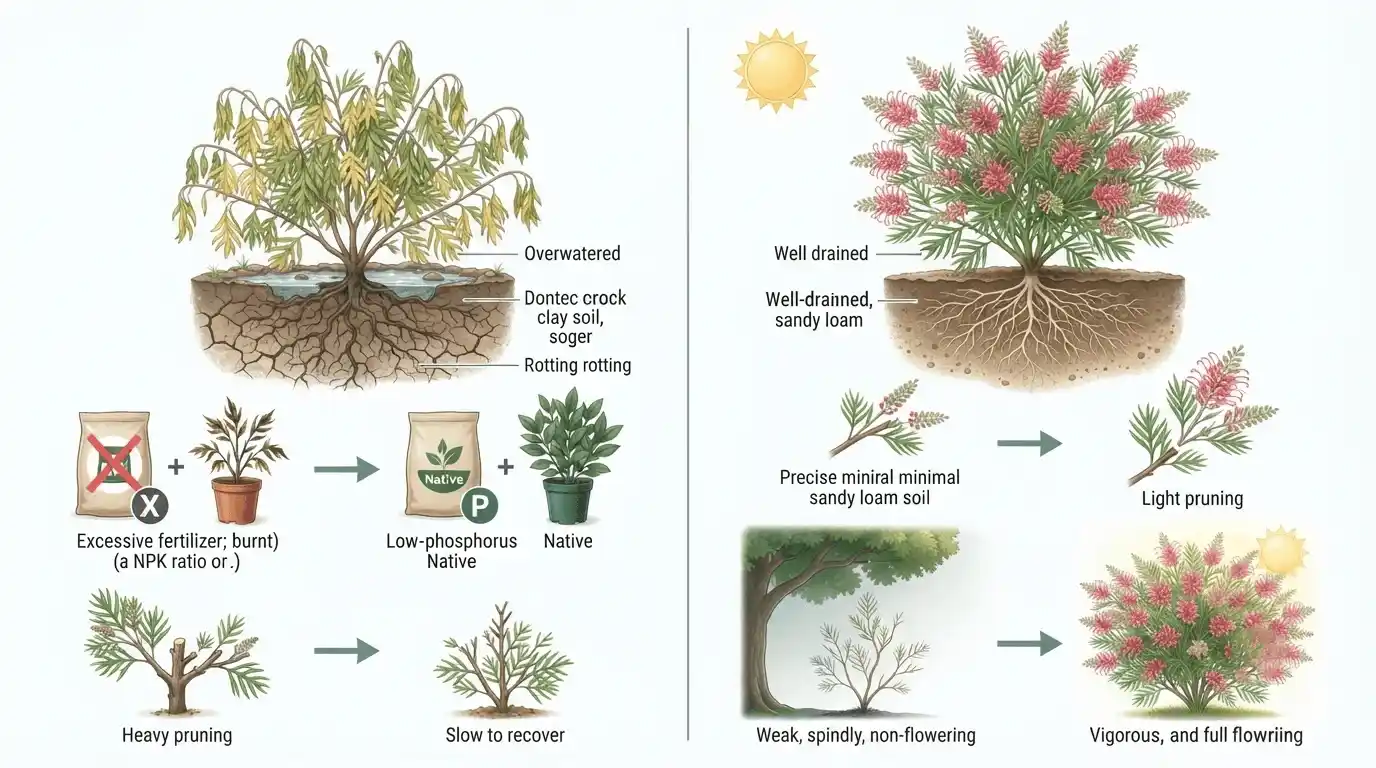
Grevillea Billy Bonkers is generally a hardy, low-maintenance shrub, but like most Australian native plants, it can develop problems if grown under unsuitable conditions. Most issues result from incorrect watering, poor drainage, inadequate sunlight, or improper fertilization rather than pests or diseases.
Recognizing symptoms early allows gardeners to correct problems before permanent damage occurs.
Poor Flowering
If Grevillea Billy Bonkers produces healthy foliage but few flowers, environmental conditions are usually the cause.
Common Causes
- Too much shade
- Excess nitrogen fertilizer
- Heavy pruning at the wrong time
- Immature plants
- Overwatering
Young plants often spend their first year establishing roots before flowering heavily.
Solutions
- Plant in full sun with at least six hours of direct light daily.
- Apply a low-phosphorus fertilizer formulated for Australian native plants.
- Prune lightly after the main flowering period rather than before flowering.
- Water deeply but allow the soil to drain between irrigations.
Prevention
- Choose a sunny planting location.
- Avoid high-nitrogen lawn fertilizers near the plant.
- Maintain excellent drainage.
- Encourage steady, healthy growth rather than rapid leafy growth.
Yellow Leaves
Yellowing foliage is usually a sign that the plant is under stress.
Possible Causes
- Overwatering
- Poor drainage
- Nutrient imbalance
- Waterlogged roots
- Natural aging of older leaves
In many cases, yellow leaves appear after prolonged periods of wet weather when oxygen levels around the roots decline.
Solutions
- Reduce watering frequency.
- Improve soil drainage.
- Remove severely damaged foliage.
- Apply a suitable native plant fertilizer if nutrient deficiency is confirmed.
Greenery Inside has found that improving drainage often resolves yellowing more effectively than adding fertilizer.
Root Problems
Healthy roots are essential for vigorous flowering and long-term growth.
The most serious root issue affecting grevilleas is root rot, which commonly develops in poorly drained soils.
Symptoms
- Wilting despite moist soil
- Yellow leaves
- Slow growth
- Dieback
- Soft, dark roots beneath the soil
Prevention
- Plant in raised beds if drainage is poor.
- Avoid heavy clay soils whenever possible.
- Never allow pots to sit in standing water.
- Water deeply but infrequently after establishment.
Once severe root rot develops, recovery can be difficult, making prevention the most effective strategy.
Pests and Diseases
Grevillea Billy Bonkers experiences relatively few serious pest problems when grown under suitable conditions.
Common issues include:
- Scale insects — Remove manually or treat with horticultural oil if infestations become heavy.
- Caterpillars — Occasionally feed on foliage but rarely cause significant damage.
- Fungal diseases — Usually associated with excessive moisture or poor air circulation.
- Root diseases — Primarily caused by prolonged waterlogging.
Prevention Strategies
- Plant in full sun.
- Maintain good airflow around the shrub.
- Avoid overhead watering late in the day.
- Prune lightly to improve air circulation.
- Keep mulch away from the base of the stems.
In our experience, healthy Grevillea Billy Bonkers plants rarely require chemical treatments when planted in well-drained soil and maintained correctly.
Grevillea Billy Bonkers vs Similar Grevilleas
Although Billy Bonkers is a distinctive cultivar, gardeners often compare it with other popular grevilleas before choosing the best variety for their landscape. The main differences usually involve mature size, growth habit, flower color, and intended garden use.
Grevillea Billy Bonkers vs Grevillea Lollypops
Grevillea Lollypops is another compact grevillea valued for its colorful flowers and manageable size.
| Feature | Billy Bonkers | Grevillea Lollypops |
| Growth Habit | Cascading, spreading | Rounded, bushy |
| Height | Lower growing | Slightly taller |
| Width | Wide spread | Moderate spread |
| Best Use | Ground cover, walls | Borders, feature shrub |
Choose Billy Bonkers when a cascading effect is desired, while Lollypops is often preferred for compact shrub borders.
Grevillea Billy Bonkers vs Grevillea Superb
Grevillea Superb is a much larger landscape shrub.
Key differences include:
- Considerably taller growth
- Upright habit
- Larger flower clusters
- Better suited to spacious gardens
- Requires more room at maturity
Billy Bonkers is generally the better option for small residential landscapes where space is limited.
Grevillea Billy Bonkers vs Grevillea Elegance
Several gardeners compare Billy Bonkers with Grevillea Elegance, also sold as Elegance Grevillea or Grevillea Poorinda Elegance.
While both are ornamental Australian native shrubs, they serve different landscape purposes.
| Characteristic | Billy Bonkers | Grevillea Poorinda Elegance |
| Growth Habit | Low and cascading | Upright, rounded |
| Mature Width | Very wide | Moderate |
| Height | Compact | Significantly taller |
| Best Application | Ground cover | Feature shrub |
Poorinda Elegance provides greater height, whereas Billy Bonkers excels as a spreading landscape plant.
Grevillea Billy Bonkers vs Lana Maree
Grevillea Lana Maree shares a similar low-growing habit, making it one of Billy Bonkers’ closest competitors.
Main differences include:
- Slight variation in flowering habit
- Different foliage texture
- Minor differences in mature spread
- Individual flower coloration varies between cultivars
Both perform exceptionally well on slopes, retaining walls, and native garden borders.
Grevillea Billy Bonkers vs Other Popular Cultivars
Several additional grevillea cultivars are commonly compared with Billy Bonkers.
These include:
- Grevillea johnsonii – Larger scrambling shrub with striking red flowers.
- Grevillea longistyla – Upright shrub featuring long, elegant flower styles.
- Grevillea jephcottii – Dense shrub with silver foliage and attractive flowers.
- Grevillea Strawberry Pops – Compact shrub valued for bright red flowers and prolonged blooming.
Each cultivar fills a different landscaping role depending on available space, desired appearance, and growing conditions.
Comparison Table
| Variety | Mature Size | Growth Habit | Best Landscape Use | Flower Characteristics |
| Billy Bonkers | Low, spreading | Cascading | Ground cover, slopes | Bright pink-red spider flowers |
| Grevillea Lollypops | Compact | Rounded | Borders | Pink-red flowers |
| Grevillea Superb | Large | Upright | Feature shrub | Large colorful flower clusters |
| Grevillea Poorinda Elegance | Medium-large | Upright | Screening, specimen | Pink-red blooms |
| Grevillea Lana Maree | Low | Spreading | Banks, retaining walls | Pink-red flowers |
| Grevillea Strawberry Pops | Compact | Bushy | Small gardens | Bright strawberry-red flowers |
Grevillea vs Banksia
When choosing Australian native plants, gardeners frequently compare grevillea vs banksia because both belong to the Proteaceae family and provide excellent wildlife value.
Although they share similar growing preferences, their appearance and landscape uses differ considerably.
| Feature | Grevillea | Banksia |
| Flowers | Spider-like, nectar-rich blooms | Cylindrical flower spikes |
| Growth Habit | Ground covers to large shrubs and trees | Mostly shrubs and trees |
| Wildlife Value | Excellent for birds, bees, butterflies | Outstanding for birds, insects, mammals |
| Water Needs | Low after establishment | Low after establishment |
| Soil Preference | Free-draining soils | Free-draining sandy soils |
| Garden Suitability | Highly versatile for gardens of all sizes | Better suited to medium and large landscapes |
Appearance
Grevilleas produce delicate spider-like flowers with long styles, while Banksias are famous for their large bottlebrush-like flower spikes that often remain attractive after flowering.
Wildlife Value
Both genera are exceptional nectar producers.
Grevilleas are particularly attractive to:
- Honeyeaters
- Native bees
- Butterflies
Banksias also support:
- Nectar-feeding birds
- Native insects
- Small mammals in some regions
Growth Habit
Grevilleas offer far greater diversity in growth form, ranging from compact ground covers like Billy Bonkers to large shrubs and trees.
Banksias generally develop into upright shrubs or small trees, making them less suitable where a spreading ground cover is needed.
Water Requirements
Both plants become highly drought tolerant after establishment.
However, excellent drainage remains essential because prolonged waterlogging can damage the root systems of both genera.
Which Is Better?
Neither plant is universally better.
Choose Grevillea Billy Bonkers if you want:
- A cascading ground cover
- Long flowering periods
- Compact growth
- Small-space landscaping
- Container planting
Choose a Banksia if you want:
- Larger specimen plants
- Architectural flower spikes
- Habitat creation for larger wildlife
- Vertical landscape structure
For many Australian native gardens, growing both together provides year-round flowers, habitat, and visual diversity.
Best Landscaping Uses
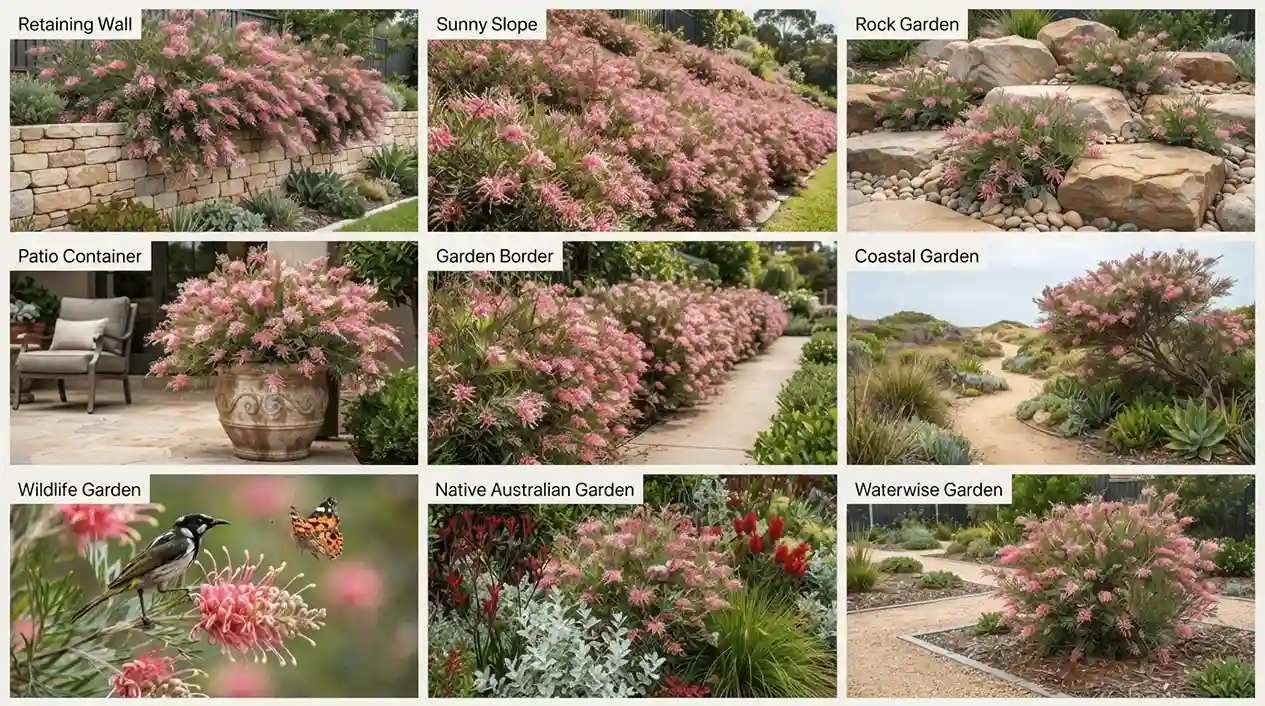
Grevillea Billy Bonkers is one of the most versatile low-growing Australian native shrubs. Its cascading branches, evergreen foliage, and long flowering period make it suitable for a wide variety of landscape designs. Whether used as a ground cover or a feature plant in a large container, it adds year-round color while supporting local wildlife.
Because it thrives in full sun and well-drained soil, it fits especially well into low-maintenance and water-wise gardens. For a broader understanding of how Grevillea fits into structured native planting designs, explore our guide to Australian native garden trees and how they shape sustainable landscapes.
Native Gardens
Billy Bonkers blends naturally with other Australian native plants, creating a cohesive landscape that supports birds and beneficial insects. This plant is also widely used in modern Australian native garden design, where low-maintenance and drought-tolerant species are prioritized for contemporary landscapes.
It pairs well with:
- Native grasses
- Westringia
- Callistemon (Bottlebrush)
- Correa
- Kangaroo Paw (Anigozanthos)
- Smaller Banksia species
Rock Gardens
Its spreading growth habit allows branches to drape naturally over rocks, softening hard landscape features while providing continuous seasonal interest.
Rock gardens also improve drainage, making them an excellent growing environment.
Slopes and Banks
The wide-spreading root system helps stabilize soil on gentle slopes.
Benefits include:
- Reduced soil erosion
- Weed suppression
- Attractive cascading appearance
- Low ongoing maintenance
Borders and Garden Edges
Because the shrub remains relatively low, it creates neat borders without blocking views or shading nearby plants.
It works particularly well along:
- Pathways
- Driveways
- Garden edging
- Raised beds
Coastal Gardens
Billy Bonkers performs well in coastal environments where many ornamental shrubs struggle.
Its tolerance of:
- Salt-laden winds
- Sandy soils
- Heat
- Periodic drought
makes it an excellent coastal landscape plant.
Wildlife Gardens
One of the plant’s greatest strengths is its ability to support biodiversity. It also performs strongly alongside other native plants that attract butterflies, making it a valuable choice for pollinator-friendly gardens.
Its nectar-rich flowers attract:
- Honeyeaters
- Native bees
- Butterflies
- Other beneficial pollinating insects
The dense foliage also provides shelter for small birds.
Ground Cover
This is one of the plant’s most popular uses.
Its wide, cascading habit naturally covers exposed soil, helping to:
- Reduce weeds
- Retain soil moisture
- Protect slopes from erosion
- Create a lush, evergreen appearance
Feature Planting
Although compact, Billy Bonkers can become an eye-catching focal point when planted:
- Beside large rocks
- Near entryways
- Around retaining walls
- In decorative raised beds
Container Displays
Large decorative pots showcase the plant’s cascading branches beautifully.
Container displays work especially well on:
- Patios
- Courtyards
- Balconies
- Outdoor entertaining areas
Ideal Planting Companions
Grevillea Billy Bonkers combines well with many drought-tolerant Australian native plants, including:
- Kangaroo Paw (Anigozanthos)
- Westringia
- Lomandra
- Dianella
- Correa
- Callistemon
- Compact Banksia species
- Native grasses
In our experience, combining Billy Bonkers with plants that have contrasting foliage textures creates a more visually balanced and natural-looking landscape.
Common Beginner Mistakes to Avoid
Although Grevillea Billy Bonkers is considered easy to grow, several common mistakes can reduce flowering, weaken the plant, or shorten its lifespan.
Understanding these issues helps gardeners achieve healthier growth from the beginning.
Overwatering
Why it happens
Many new gardeners assume flowering shrubs require frequent watering.
How to fix it
Allow the soil to partially dry between waterings after the plant has established.
How to prevent it
Use deep, infrequent watering rather than daily irrigation.
Planting in Heavy Clay Soil
Why it happens
Clay retains moisture for extended periods.
How to fix it
Improve drainage with raised beds or mounded planting.
How to prevent it
Choose sandy or well-drained soil whenever possible.
Using High-Phosphorus Fertilizer
Why it happens
General-purpose fertilizers are commonly used without considering native plant requirements.
How to fix it
Switch to a fertilizer specifically formulated for Australian native plants.
How to prevent it
Always check fertilizer labels before application.
Growing in Too Much Shade
Why it happens
The plant may initially survive in partial shade, leading gardeners to believe it prefers lower light.
How to fix it
Relocate the plant if practical or prune nearby trees to increase sunlight.
How to prevent it
Plant in full sun from the beginning.
Incorrect Pruning
Why it happens
Heavy pruning at unsuitable times removes developing flower buds.
How to fix it
Prune lightly immediately after flowering.
How to prevent it
Perform regular light trimming rather than severe pruning.
Poor Drainage
Why it happens
Improper site selection or compacted soil restricts root health.
How to fix it
Improve drainage or transplant the shrub to a better location.
How to prevent it
Test drainage before planting by observing how quickly water drains after irrigation or rainfall.
Greenery Inside recommends correcting drainage issues before planting rather than trying to solve them later, as healthy roots are the foundation of long-term plant performance.
Environmental Limitations and Seasonal Care
Although Grevillea Billy Bonkers adapts to many climates, understanding seasonal maintenance and environmental limitations helps maximize flowering and overall health.
Seasonal Maintenance
Spring
Spring is the primary growth period.
Tasks include:
- Apply a low-phosphorus fertilizer.
- Inspect for new growth.
- Refresh mulch while keeping it away from the stem.
- Begin regular watering if rainfall decreases.
Summer
Summer care focuses on moisture management.
Recommended practices:
- Deep water during prolonged dry periods.
- Monitor container-grown plants more frequently.
- Watch for heat stress during extreme temperatures.
Established plants usually tolerate hot weather very well.
Autumn
Autumn is an ideal time to prepare the plant for cooler weather.
Tasks include:
- Light pruning after flowering if needed.
- Remove damaged or dead branches.
- Reduce watering as temperatures decline.
- Check drainage before winter rains arrive.
Winter
Growth slows naturally during winter.
Maintenance includes:
- Water only when necessary.
- Protect young plants from severe frost.
- Avoid excessive fertilization.
- Monitor for prolonged soil saturation.
As of 2026, many native plant specialists continue to recommend avoiding heavy winter watering, particularly in regions with regular seasonal rainfall, to reduce the risk of root diseases.
Environmental Considerations
Frost
Established plants generally tolerate light frosts.
Young plants benefit from temporary frost protection during unusually cold conditions.
Humidity
Grevillea Billy Bonkers prefers good air circulation.
Extended periods of high humidity may increase the likelihood of fungal problems if airflow is poor.
Wind
Its flexible branches tolerate wind well.
However, newly planted shrubs may benefit from temporary protection until roots become firmly established.
Coastal Exposure
Billy Bonkers performs exceptionally well in coastal regions thanks to its tolerance of:
- Salt spray
- Sandy soils
- Strong coastal winds
- Summer heat
Extended Drought
Once established, the plant demonstrates impressive drought tolerance.
During exceptionally long dry periods, occasional deep watering helps maintain flowering and foliage quality without encouraging shallow root development.
Conclusion
Grevillea Billy Bonkers is an outstanding Australian native shrub that combines ornamental beauty with practical landscape performance. Its compact, cascading growth habit, evergreen foliage, and long-lasting nectar-rich flowers make it an excellent choice for native gardens, rockeries, slopes, borders, containers, and coastal landscapes.
With full sun, well-drained soil, moderate watering during establishment, and occasional pruning, the plant remains healthy and attractive for many years. Its ability to attract birds, bees, butterflies, and other beneficial pollinators further enhances its value in wildlife-friendly gardens.
Whether you choose the natural spreading form, a Grevillea Billy Bonkers standard, or a grevillea billy bonkers grafted specimen, proper planting and care are the keys to long-term success. For gardeners seeking a low-maintenance, drought-tolerant, and visually striking Australian native, Grevillea Billy Bonkers remains one of the most rewarding landscape choices.
Frequently Asked Questions
How big does Grevillea Billy Bonkers grow?
Grevillea Billy Bonkers typically grows 40–70 cm (16–28 inches) tall and spreads 1.5–2.5 meters (5–8 feet) wide. Its low, cascading habit makes it ideal as a ground cover, for retaining walls, and along garden borders.
Can Grevillea Billy Bonkers be grown successfully in pots?
Yes. Grevillea Billy Bonkers grows very well in large containers when planted in a premium free-draining native potting mix. Use a pot with excellent drainage, position it in full sun, and water more frequently than garden-grown plants during hot weather.
Is Grevillea Billy Bonkers drought tolerant?
Yes. Once established, Grevillea Billy Bonkers is highly drought tolerant. Deep, occasional watering during prolonged dry periods is usually sufficient to maintain healthy growth and flowering.
Does Grevillea Billy Bonkers attract birds and bees?
Yes. Its nectar-rich flowers attract honeyeaters, native bees, honeybees, butterflies, and other beneficial pollinators. The dense foliage also provides shelter for small birds, making it an excellent addition to wildlife-friendly gardens.
Can Grevillea Billy Bonkers be propagated from seeds?
Although seeds may germinate, Grevillea Billy Bonkers is a hybrid cultivar, so seedlings often differ from the parent plant. Semi-hardwood cuttings are the preferred propagation method because they produce plants with the same growth habit and flower characteristics.
Is Grevillea Billy Bonkers suitable for coastal gardens?
Yes. The plant performs exceptionally well in coastal environments due to its tolerance of salt-laden winds, sandy soils, heat, and seasonal drought. Good drainage remains essential for long-term health.
What is the difference between Grevillea Billy Bonkers and Grevillea Lollypops?
The main difference is growth habit. Grevillea Billy Bonkers has a spreading, cascading form that works well as a ground cover, while Grevillea Lollypops develops a more compact, rounded shrub shape suited to borders and feature planting.
How often should Grevillea Billy Bonkers be pruned?
Light pruning after each major flowering flush is usually sufficient. Regular, gentle trimming encourages denser branching, improves flowering, and maintains the plant’s attractive cascading form without removing excessive woody growth.