Introduction
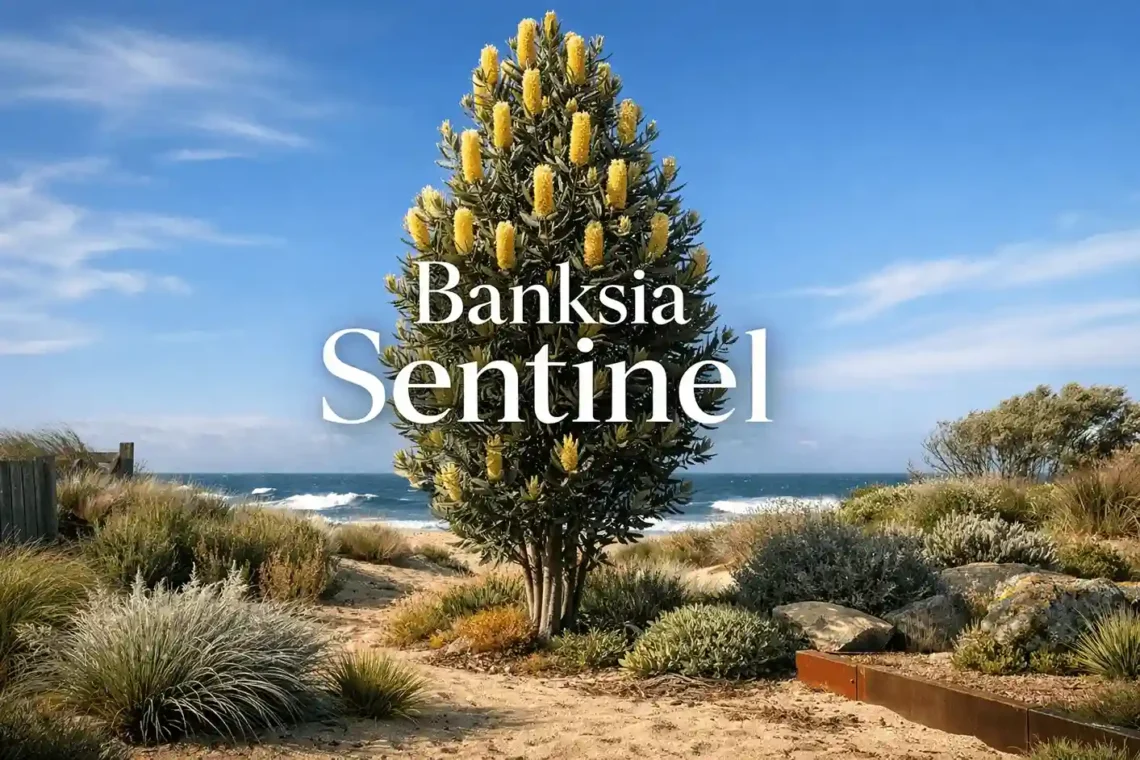
Banksia Sentinel (Banksia integrifolia ‘Sentinel’) is a narrow, upright cultivar of the coastal banksia tree known for its strong vertical growth and bright yellow flower spikes. The main keyword banksia sentinel refers to this selected form of Banksia integrifolia, bred specifically for a fastigiate, column-like structure rather than a wide-spreading canopy. Native to Australia’s eastern coastline, it is an evergreen species that thrives in sandy, coastal environments and is widely used in modern landscapes for screening, structure, and wildlife attraction through nectar-rich blooms. Banksia Sentinel is often compared with other fast-growing landscape trees such as 7+ Essential Banksia Tree Varieties: Types, Size & Colors, and is widely used in structured garden designs similar to 7+ Smart Trees That Don’t Drop Leaves in Australia.
Quick Summary
- Upright evergreen tree reaching 10–12m tall and 2–3m wide
- Produces golden-yellow flower spikes from summer to winter
- Ideal for hedging, screening, and coastal landscaping
- Fast-growing and drought-tolerant once established
What Is Banksia Sentinel?
Botanical Identity and Origin
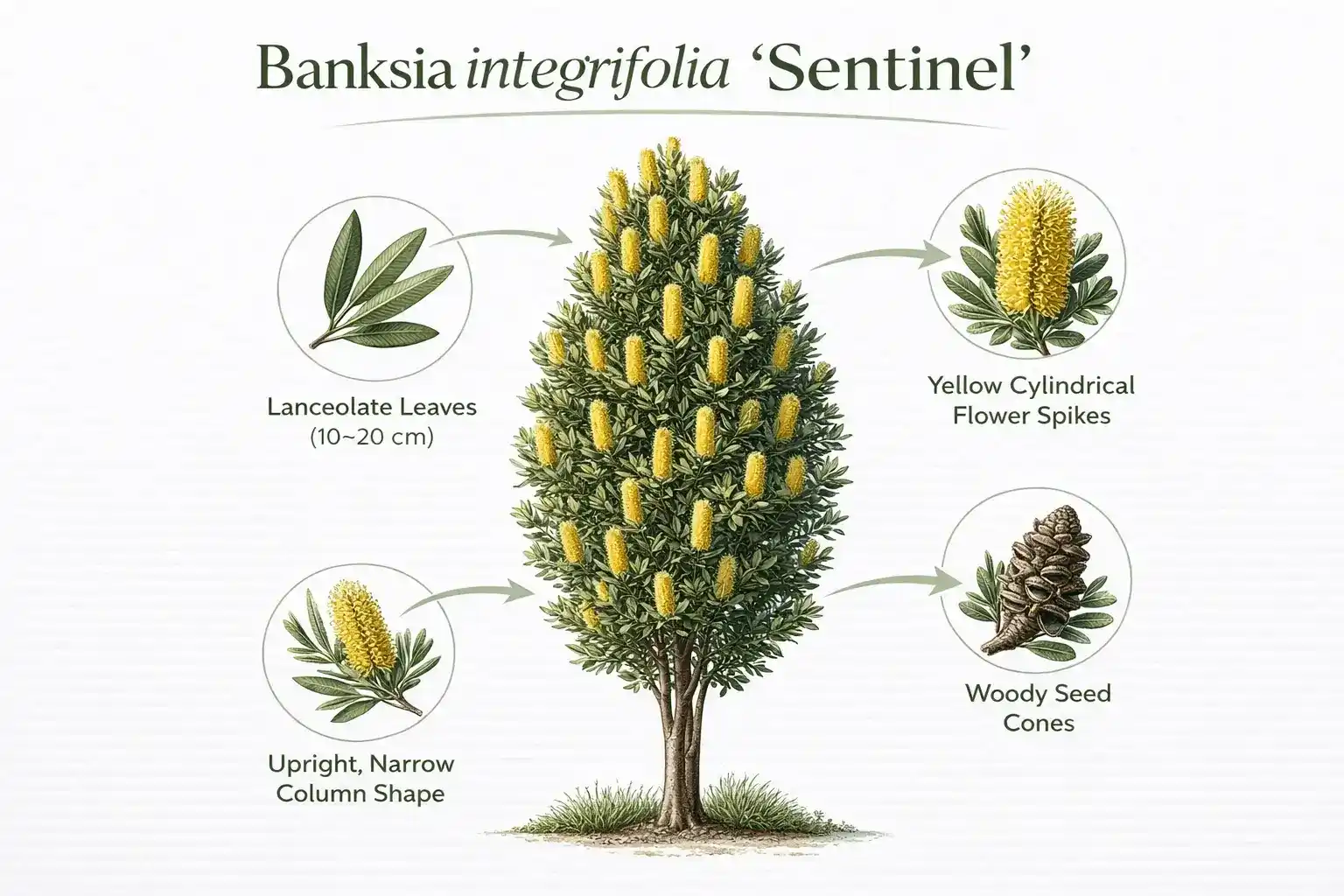
Banksia Sentinel is a cultivated selection of the coastal banksia (Banksia integrifolia), chosen for its narrow, upright growth habit. Unlike wild forms that develop broad, spreading canopies, this cultivar maintains a vertical “sentinel-like” structure, making it suitable for confined spaces and structured landscape designs.
The genus Banksia is a well-documented group of Australian native plants belonging to the family Proteaceae, widely studied for their ecological importance.
👉Banksia
Key Botanical Traits
- Evergreen foliage with sclerophyllous, drought-resistant leaves
- Leaves: Lanceolate, 10–20 cm long with glossy green upper surfaces and silvery undersides
- Flowers: Cylindrical spikes up to 12 cm long, rich in nectar
- Seed structure: Woody cones that store seeds for extended periods
Native Habitat and Adaptation
- Native to eastern Australian coastlines
- Naturally adapted to sandy, nutrient-poor soils
- Highly tolerant of salt spray and coastal winds
Cultivar Distinction
The “Sentinel” form differs from standard B. integrifolia by its strict upright habit, making it more suitable for hedging and architectural planting designs.
It belongs to a broader group of Australian native plants, similar in landscape use to 6+ Smart Australian Native Screening Trees for Privacy and Ultimate Guide to Native Trees of Australia: Identification & Care.
Plant Size
Outdoor Mature Size
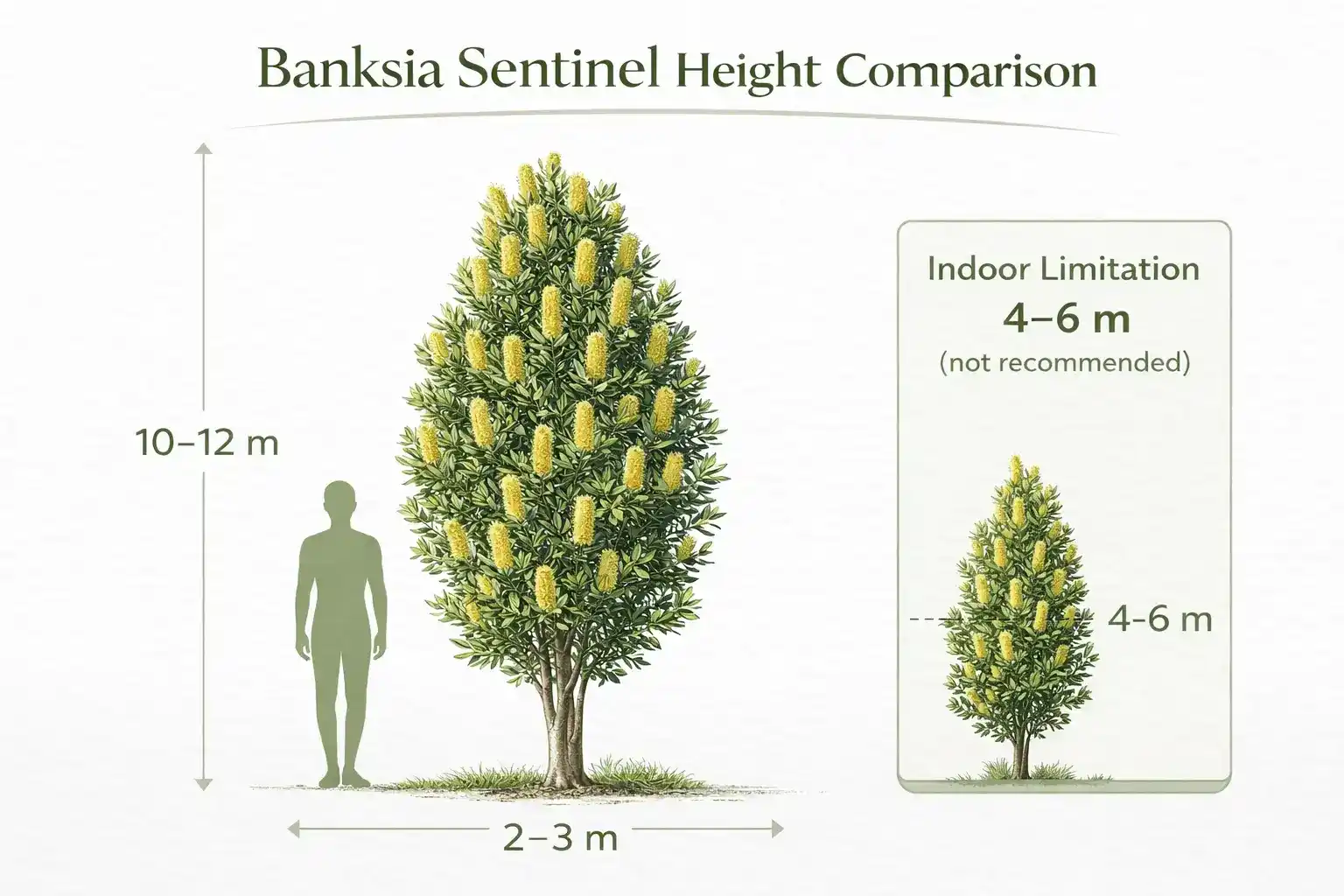
- Height: 10–12 meters
- Width: 2–3 meters
Its vertical structure makes it ideal for narrow landscape applications like Ultimate Tall Narrow Shrubs Australia for Privacy & Screening and compact garden designs featured in 7+ Smart Trees to Plant Along Driveway for Shade & Style.
Indoor Constraints
Banksia Sentinel is not typically grown indoors. In highly controlled conditions, it may reach 4–6 meters, but growth is limited and not practical for indoor environments.
Influencing Factors
- Full sun encourages taller, stronger growth
- Poor drainage restricts width and weakens development
- Wind exposure can naturally shape the upright form
- Regular pruning helps maintain dense structure
Growth Rate
Rate Classification
Banksia Sentinel is a fast-growing cultivar, especially during its early establishment phase. It typically grows 60–90 cm per year for the first 3–5 years.
Seasonal Growth Pattern
- Spring and summer: Peak growth period with rapid vertical expansion
- Autumn: Moderate growth slowdown
- Winter: Minimal growth activity
Growth Enhancers
- Application of mulch improves soil moisture retention
- Low-phosphorus native fertilizers support healthy root systems
- Well-drained sandy soils significantly improve establishment speed
Care Guide
Core Care Requirements
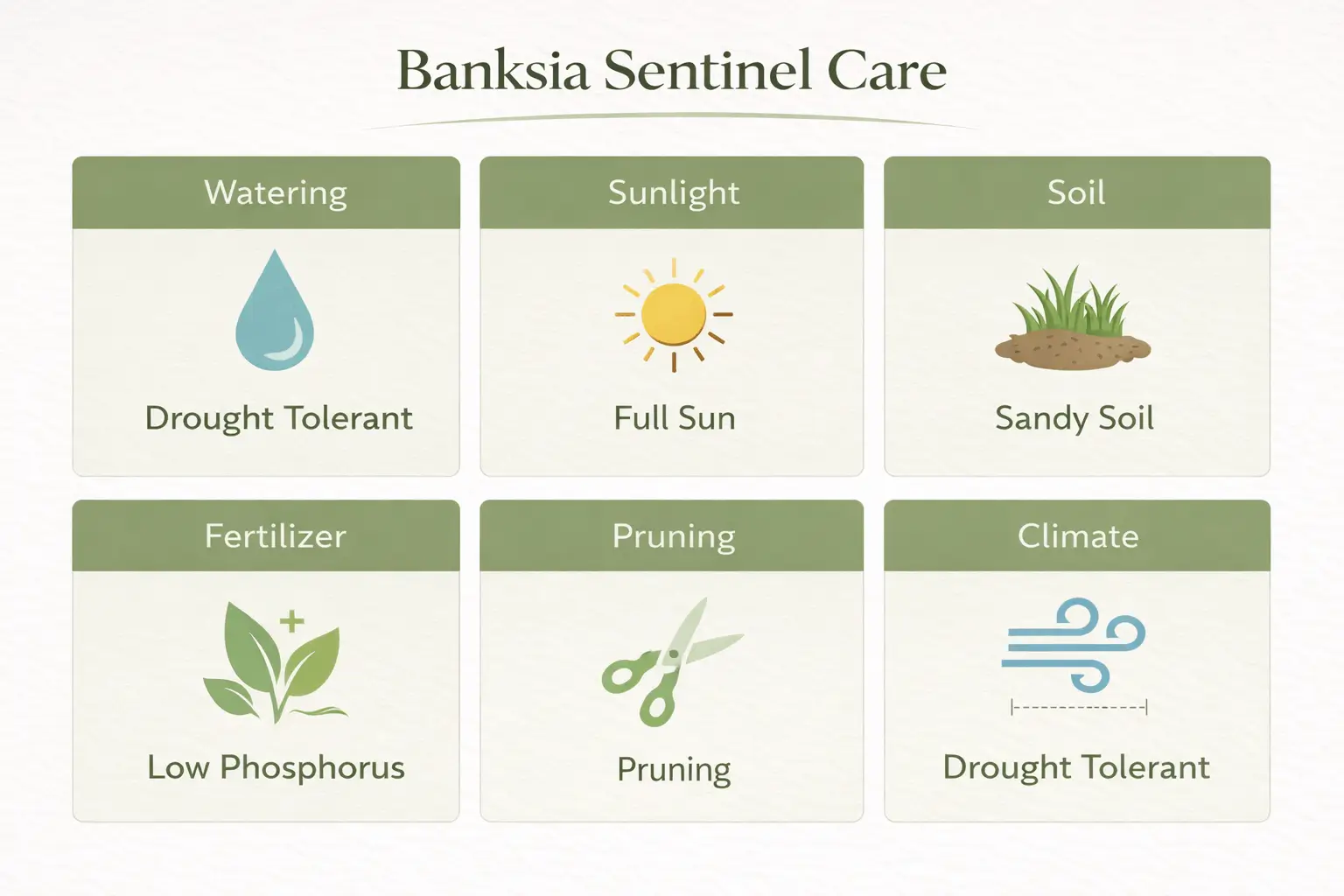
| Care Aspect | Requirements | Tips |
| Watering | Moderate first year; low after establishment | Deep watering, avoid soggy soil |
| Light | Full sun (6+ hours daily) | Tolerates partial shade |
| Soil | Sandy, well-drained, pH 5.5–7 | Add grit in clay soils |
| Fertilizer | Low-phosphorus native plant mix | Apply in spring only |
| Pruning | After flowering | Light shaping for density |
| Climate | Coastal, USDA zones 9–11 | Wind and salt tolerant |
Watering Schedule
Young plants require weekly deep watering during dry periods. Once established, Banksia Sentinel becomes highly drought-tolerant.
Pest Monitoring
Inspect annually for borers and psyllid activity, especially in stressed plants.
Banksia Sentinel as a Hedge
Hedge Formation Strategy
Banksia sentinel hedge systems perform best when planted 1.5–2 meters apart. This spacing allows the plants to merge into a dense screen within 3–5 years.
Advantages for Hedging
- Naturally narrow form reduces pruning needs
- Strong vertical growth creates instant screening effect
- Highly wind-resistant for exposed locations
Planting Steps
- Dig a hole twice the width of the root ball
- Add a well-draining native soil mix
- Water deeply immediately after planting
Comparison: Banksia Sentinel vs. Similar Varieties
Key Differences Overview
| Feature | Banksia Sentinel | B. integrifolia Fastigiata | Standard B. integrifolia |
| Height | 10–12m | 6–8m | 10–15m |
| Width | 2–3m | ~2m | 6–10m spreading |
| Flowers | Long yellow spikes | Shorter spikes | Larger, irregular blooms |
| Hedge Suitability | Excellent | Good | Poor |
| Growth Rate | Fast | Moderate | Moderate |
Summary Insight
Banksia integrifolia ‘Sentinel’ offers the best combination of height, narrow width, and hedge usability compared to other related forms.
Common Problems and Solutions
Yellow Leaves
Cause: Excess phosphorus or nutrient imbalance
Fix: Flush soil and switch to native low-phosphorus fertilizer
Prevention: Maintain correct soil chemistry
Root Rot
Cause: Poor drainage or overwatering
Fix: Improve soil drainage immediately
Prevention: Plant in raised or sandy soil beds
Pest Infestations
Cause: Banksia psyllids or stress conditions
Fix: Apply horticultural oil treatment
Prevention: Maintain plant health and spacing
Slow Growth
Cause: Heavy clay soil or poor aeration
Fix: Improve soil structure with grit and mulch
Prevention: Choose well-drained planting sites
Topical Cluster: Broader Gardening Connections
Propagation
Banksia Sentinel can be propagated through semi-hardwood cuttings taken in spring. Cuttings are placed in a free-draining mix under humid conditions, achieving moderate success rates around 70%.
Landscaping Use
- Ideal for coastal and urban gardens
- Combines well with native shrubs for biodiversity
- Supports pollinator-friendly ecosystems through nectar-rich flowers
Conclusion
Banksia Sentinel is a highly versatile and structured evergreen tree valued for its upright form, fast growth, and low-maintenance requirements. Reaching up to 12 meters in height while remaining narrow, it is especially suitable for hedging, screening, and coastal landscaping. Its adaptability to sandy soils, tolerance of wind and salt, and strong ecological value make it a reliable choice for sustainable garden design.
While Banksia Sentinel is primarily a landscape species, it complements broader plant knowledge covered in Guide to House Plants, especially in understanding plant structure, care principles, and environmental adaptation.
FAQs
What is the mature size of Banksia Sentinel?
It typically grows 10–12 meters tall and 2–3 meters wide, making it ideal for narrow garden spaces.
How do you prune Banksia Sentinel for a hedge?
Light pruning after flowering helps maintain shape and encourages dense growth without stressing the plant.
Is Banksia Sentinel suitable for coastal gardens?
Yes, it is highly tolerant of salt spray and strong coastal winds.
Why are Banksia Sentinel leaves turning yellow?
This is often due to phosphorus toxicity or poor drainage; switching to native fertilizer and improving soil helps correct it.
How fast does Banksia Sentinel grow?
It grows approximately 60–90 cm per year in its early years under optimal conditions.