Introduction
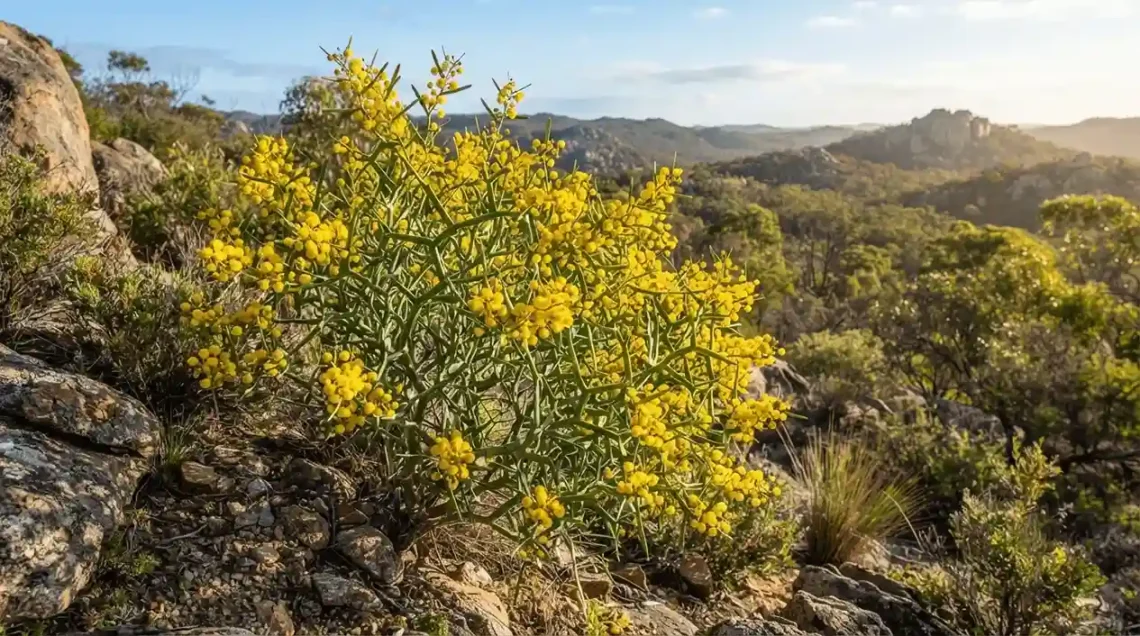
Acacia aphylla, commonly known as the leafless wattle or leafless rock wattle, is one of Australia’s most distinctive native shrubs. Unlike most wattles, it has no true leaves, relying instead on bright green stems to carry out photosynthesis. Native to the rocky landscapes of Western Australia, this drought-tolerant shrub produces vibrant golden-yellow flowers that contrast beautifully against its leafless branches. Its sculptural appearance, minimal water requirements, and adaptability make it a valuable choice for native gardens, rock gardens, and water-wise landscapes. Whether you are interested in Acacia aphylla for conservation, ornamental planting, or native habitat restoration, understanding its identification, growth habit, and care requirements is essential.
By Greenery Inside | Plant Care & Gardening Expert
In our experience growing Australian native shrubs, Acacia aphylla performs best when planted in conditions that closely resemble its natural rocky habitat. Good drainage consistently proves more important than frequent watering for long-term success.
Quick Summary
- Acacia aphylla is a rare Western Australian native shrub with leafless green stems that perform photosynthesis.
- It produces bright yellow flower clusters and thrives in full sun with well-drained soils.
- Once established, the plant is highly drought tolerant and requires relatively little maintenance.
- Propagation is usually carried out from seed or semi-hardwood cuttings under controlled conditions.
- Its unique architectural form makes it ideal for native gardens, rockeries, and xeriscaping projects.
What Is Acacia aphylla?
Botanical classification and native habitat
Acacia aphylla is a flowering shrub belonging to the legume family (Fabaceae) and is one of more than 1,000 Acacia species native to Australia. It is scientifically recognized as a distinctive member of the Australian wattle group due to its complete absence of leaves throughout maturity. The genus Acacia belongs to a large and widely distributed group of shrubs and trees in the legume family, known for their ecological importance and nitrogen-fixing ability.
Botanical Classification
| Classification | Details |
| Scientific name | Acacia aphylla |
| Common names | Leafless wattle, Leafless rock wattle |
| Family | Fabaceae |
| Genus | Acacia |
| Plant type | Evergreen native shrub |
| Native region | Western Australia |
The species naturally occurs in parts of Western Australia, particularly on rocky slopes, granite outcrops, and shallow gravelly soils where rainfall is limited. These harsh environments shaped its unusual appearance and exceptional drought resistance.
Unlike many Australian wattles that develop phyllodes (flattened leaf-like structures), Acacia aphylla evolved without producing either true leaves or phyllodes. Instead, its green stems carry out photosynthesis, reducing moisture loss while allowing the shrub to survive prolonged dry periods.
This adaptation is especially beneficial in Mediterranean-type climates characterized by hot, dry summers and mild winters.
As of current horticultural recommendations in 2026, growers continue to emphasize planting this species in free-draining sites that replicate its natural habitat, as excessive soil moisture remains the leading cause of cultivation failure.
Greenery Inside recommends avoiding rich garden soils when growing this species. Replicating its naturally lean, rocky conditions generally results in healthier growth and longer-lived plants.
Distinctive characteristics
Acacia aphylla stands apart from nearly every other Australian wattle because of its dramatic leafless structure. Its unusual architecture creates year-round ornamental interest even when it is not flowering.
Some of its most recognizable characteristics include:
- Completely leafless mature stems
- Smooth green branches that perform photosynthesis
- Upright, open branching habit
- Bright golden-yellow spherical flower clusters
- Narrow seed pods developing after flowering
- Evergreen growth throughout the year
Leafless stems
Perhaps the most defining feature is the absence of leaves. Instead of foliage, slender green stems capture sunlight and manufacture food through photosynthesis.
This evolutionary adaptation minimizes water loss while allowing the shrub to remain productive during extended droughts.
Branch structure
The branches are upright, slender, and widely spaced, creating a light, airy framework. Their vivid green color provides visual interest throughout every season.
Flower appearance
During the flowering season, numerous bright yellow pom-pom flowers emerge directly from the stems. The flowers create a striking contrast against the green branches and attract numerous beneficial insects.
Seasonal blooming
Flowering generally occurs from late winter into spring, although local climate conditions may influence bloom timing.
The flowering display often lasts several weeks, making the shrub an attractive seasonal feature in Australian native landscapes.
Wildlife value
The nectar-rich flowers attract:
- Native bees
- Honeybees
- Hoverflies
- Small pollinating insects
- Occasional nectar-feeding birds
Like many members of the Acacia genus, Acacia aphylla contributes to local biodiversity by providing food resources during important flowering periods.
How to Identify Acacia aphylla
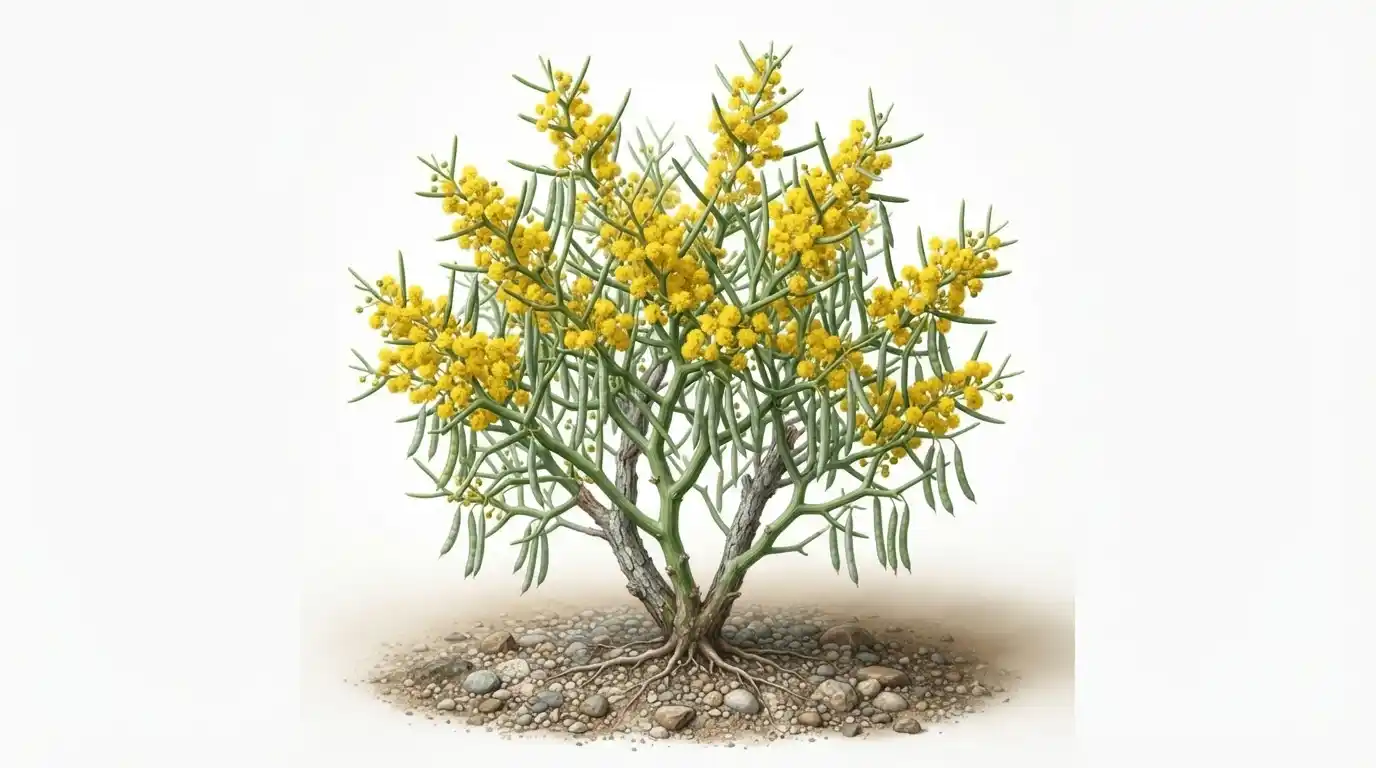
Key identification features
Acacia aphylla is relatively easy to identify because very few Australian shrubs possess its completely leafless appearance. Observing several characteristics together provides reliable identification.
Stem colour
Healthy stems are bright green to bluish-green and remain photosynthetically active throughout the year.
Young stems tend to appear smoother, while older branches gradually develop a firmer surface.
Growth habit
The shrub grows upright with an open branching framework rather than forming a dense canopy.
Its sculptural appearance makes it easily recognizable even from a distance.
Flower clusters
The flowers are:
- Bright golden yellow
- Spherical (“pom-pom” shaped)
- Produced along green stems
- Rich in nectar
- Highly visible against the leafless framework
Flowering is one of the easiest times to identify the species.
Bark
Older stems gradually develop light grey to brown bark, while younger stems remain smooth and green.
Seed pods
Following flowering, narrow seed pods develop and mature over several weeks.
The pods eventually dry and split open naturally, releasing hard-coated seeds suitable for propagation.
Identification Checklist
| Feature | Description |
| Leaves | Completely absent |
| Stem colour | Bright green |
| Growth habit | Upright, open shrub |
| Flowers | Bright yellow spherical clusters |
| Bark | Grey-brown on older stems |
| Seed pods | Narrow, elongated legumes |
How it differs from similar Australian wattles
Several Australian wattles share rocky habitats or ornamental value with Acacia aphylla, but each has distinguishing characteristics.
Acacia denticulosa
Often known for its ornamental foliage, Acacia denticulosa develops distinctive toothed phyllodes rather than remaining leafless.
Compared with Acacia aphylla, it has:
- Flattened leaf-like phyllodes
- Denser foliage
- Broader overall appearance
- Similar yellow flowering habit
Acacia rupicola
Acacia rupicola also grows naturally among rocky environments but develops small phyllodes instead of entirely leafless stems.
It generally forms a more compact shrub suited to rocky gardens.
Acacia glaucoptera
This striking species is easily recognized by its unusually broad wing-like phyllodes.
Unlike Acacia aphylla, it creates a much fuller appearance with flattened foliage and creeping growth.
Acacia drummondii
Known as Drummond’s wattle, this species carries fine phyllodes and often develops denser branching with different floral arrangements.
Rock wattle species
Many rock wattle types occupy similar habitats but differ in:
- Presence of phyllodes
- Growth density
- Branch architecture
- Mature size
- Flower arrangement
Comparison Table
| Feature | Acacia aphylla | Acacia denticulosa | Acacia glaucoptera | Acacia rupicola |
| Leaves | None | Toothed phyllodes | Broad winged phyllodes | Small phyllodes |
| Stem appearance | Bright green | Green with foliage | Winged branches | Fine branching |
| Flowers | Yellow balls | Yellow balls | Yellow flowers | Yellow flowers |
| Growth habit | Upright | Bushy | Low spreading | Compact |
| Best landscape use | Feature shrub | Native garden | Groundcover | Rock garden |
Acacia aphylla Size and Growth Habit
Mature size
The typical Acacia aphylla size makes it suitable for both residential and public landscapes without becoming overwhelming.
Under ideal growing conditions, mature plants generally reach:
| Growth Measurement | Typical Size |
| Height | 1.5–2.5 metres (5–8 ft) |
| Width | 1–2 metres (3–6.5 ft) |
| Growth habit | Upright, open shrub |
Actual size varies depending on soil quality, rainfall, climate, and available sunlight.
Plants growing in lean, rocky soils often remain slightly smaller but develop stronger branching and improved drought resistance.
In our experience, gardeners sometimes expect rapid vertical growth during the first year. However, Acacia aphylla typically invests much of its early energy into establishing a deep, resilient root system before producing substantial above-ground growth.
Growth form and landscape impact
Rather than producing dense foliage, Acacia aphylla develops an elegant architectural framework that serves as a living sculpture in the landscape.
Its upright habit creates strong vertical lines while maintaining an open, airy appearance.
Landscape designers frequently use it as:
- A specimen shrub
- A focal point in rock gardens
- A drought-tolerant feature plant
- A structural accent in native landscapes
- A xeriscape planting for low-water gardens
The open branching habit allows surrounding plants to remain visible, making it particularly effective when combined with flowering Australian natives or low-growing groundcovers.
Because of its distinctive silhouette, Acacia aphylla provides year-round visual interest, even outside its flowering season. Its combination of sculptural stems, seasonal yellow blooms, and exceptional drought tolerance makes it one of the most unusual and rewarding native shrubs for water-wise landscape designs.
Growth Rate and Lifespan
How fast does Acacia aphylla grow?
Acacia aphylla has a moderate growth rate, establishing steadily rather than rapidly. During its first one to two years, the shrub focuses on developing a strong root system, which improves drought tolerance and long-term health. Once established, annual growth becomes more consistent, especially when planted in conditions that resemble its natural habitat.
Under ideal conditions, gardeners can expect:
- Moderate growth after the establishment period
- Faster development in full sun
- Slower growth during extended drought or cold weather
- Most active growth from late winter through spring
- Reduced growth during the hottest part of summer
Unlike fast-growing ornamental shrubs, Acacia aphylla invests more energy in producing resilient stems and roots than dense foliage. This strategy allows it to survive in nutrient-poor soils where many other plants struggle.
Greenery Inside has observed that newly planted specimens often appear slow during the first growing season. This is normal, as the shrub prioritizes root development before producing noticeable top growth.
Typical Growth Timeline
| Plant Age | Expected Development |
| First year | Root establishment with modest stem growth |
| Second year | Noticeable branching and increased height |
| Third to fifth year | Strong upright framework and regular flowering |
| Mature plant | Stable size with annual seasonal growth |
Lifespan
With proper care, Acacia aphylla can remain an attractive landscape shrub for many years. While lifespan varies depending on climate and growing conditions, healthy plants commonly live 15–25 years or more in suitable environments.
Long-term survival depends largely on:
- Excellent soil drainage
- Minimal root disturbance
- Appropriate watering during establishment
- Avoiding excessive fertiliser applications
- Proper pruning practices
Factors influencing growth
Several environmental factors determine how quickly Acacia aphylla establishes and reaches its mature size.
Sunlight
Full sun is the single most important factor for vigorous growth.
Plants receiving at least six to eight hours of direct sunlight each day develop:
- Stronger stems
- Better flowering
- Improved drought resistance
- Compact, balanced growth
Excessive shade often leads to weaker branches and reduced flowering.
Soil drainage
Excellent drainage is essential because the species naturally grows in rocky, well-drained environments.
Heavy or waterlogged soils can result in:
- Slow establishment
- Root stress
- Increased disease risk
- Reduced lifespan
Adding coarse gravel or washed river sand can improve drainage in suitable garden sites.
Rainfall
Although drought tolerant once established, young plants benefit from occasional deep watering during prolonged dry periods.
Too much rainfall combined with poorly drained soil is generally more harmful than limited rainfall.
Soil fertility
Acacia aphylla naturally grows in relatively infertile soils.
Excessively rich soils may encourage soft, weak growth that is more susceptible to environmental stress. Moderate fertility is generally sufficient for healthy development.
Climate
The shrub performs best in climates that closely resemble its native range.
Ideal conditions include:
- Warm summers
- Mild winters
- Low humidity
- Seasonal rainfall
- Good air circulation
As of current horticultural guidance in 2026, growers continue to recommend selecting planting sites with maximum sunlight and free-draining soils to achieve the healthiest long-term growth.
Ideal Growing Conditions
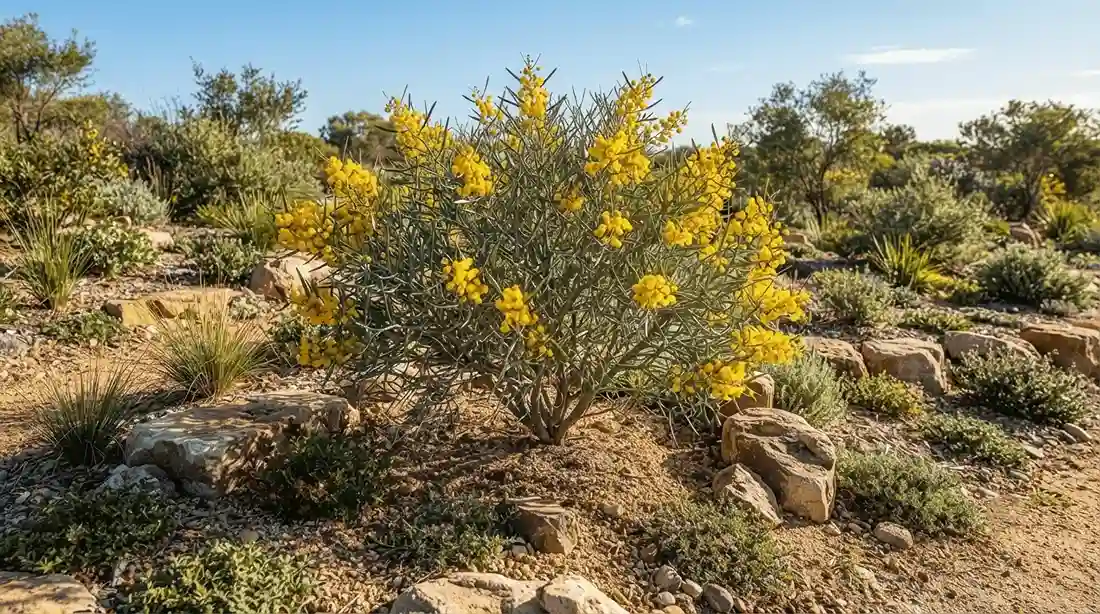
Light requirements
Acacia aphylla grows best in full sun, where it receives at least six hours of direct sunlight daily. Strong sunlight supports photosynthesis through its green stems, encourages abundant flowering, and helps maintain its naturally upright growth habit.
Full sun exposure
Full sun provides several important benefits:
- Stronger structural growth
- Increased flower production
- Better stem colour
- Improved drought tolerance
- Reduced disease pressure
Plants grown in partial shade often become less vigorous and produce fewer flowers.
Heat tolerance
As a Western Australian native, Acacia aphylla is well adapted to hot, dry conditions.
Established plants tolerate:
- High summer temperatures
- Intense sunlight
- Extended dry periods
- Reflective heat from rocks and gravel
This makes the shrub particularly valuable for water-wise and xeriscape gardens.
In our experience, shrubs planted against north- or west-facing stone walls often perform exceptionally well, provided the soil drains freely and does not retain excessive moisture.
Soil preferences
The best soil for Acacia aphylla is one that drains rapidly while remaining relatively low in nutrients.
Suitable soil types include:
- Sandy soil
- Gravelly soil
- Rocky soil
- Decomposed granite
- Well-drained native soil
Ideal soil characteristics
| Soil Characteristic | Recommendation |
| Drainage | Excellent |
| Texture | Sandy to gravelly |
| Organic matter | Moderate to low |
| Soil fertility | Low to moderate |
| Water retention | Low |
Why drainage matters
Poor drainage is one of the leading causes of failure when growing leafless wattle.
Roots require oxygen to remain healthy. Waterlogged soil reduces oxygen availability and greatly increases the likelihood of root rot.
If your garden has heavy clay, consider:
- Raised garden beds
- Rock gardens
- Sloped planting areas
- Incorporating coarse gravel into the planting site
These measures help recreate the shrub’s natural growing environment.
Climate suitability
Acacia aphylla is naturally adapted to the Mediterranean climate of southwestern Australia, where winters are relatively mild and summers are hot and dry.
Best climate conditions
The shrub performs best in regions with:
- Dry summers
- Mild winters
- Low to moderate humidity
- Good airflow
- Seasonal rainfall
Drought tolerance
Once established, Acacia aphylla is highly drought tolerant.
Its leafless stems reduce water loss through transpiration, allowing it to remain healthy during prolonged dry periods with minimal supplemental irrigation.
This characteristic makes it an excellent choice for sustainable landscapes where water conservation is a priority.
Frost sensitivity
Although mature plants tolerate occasional light frosts, prolonged or severe freezing temperatures may damage young stems.
In colder regions:
- Plant in a sheltered location.
- Protect young plants during hard frosts.
- Avoid frost-prone low-lying areas.
- Apply mulch around the root zone to moderate soil temperature.
Selecting a warm, sunny position with excellent drainage significantly improves winter survival.
Acacia aphylla Care Guide
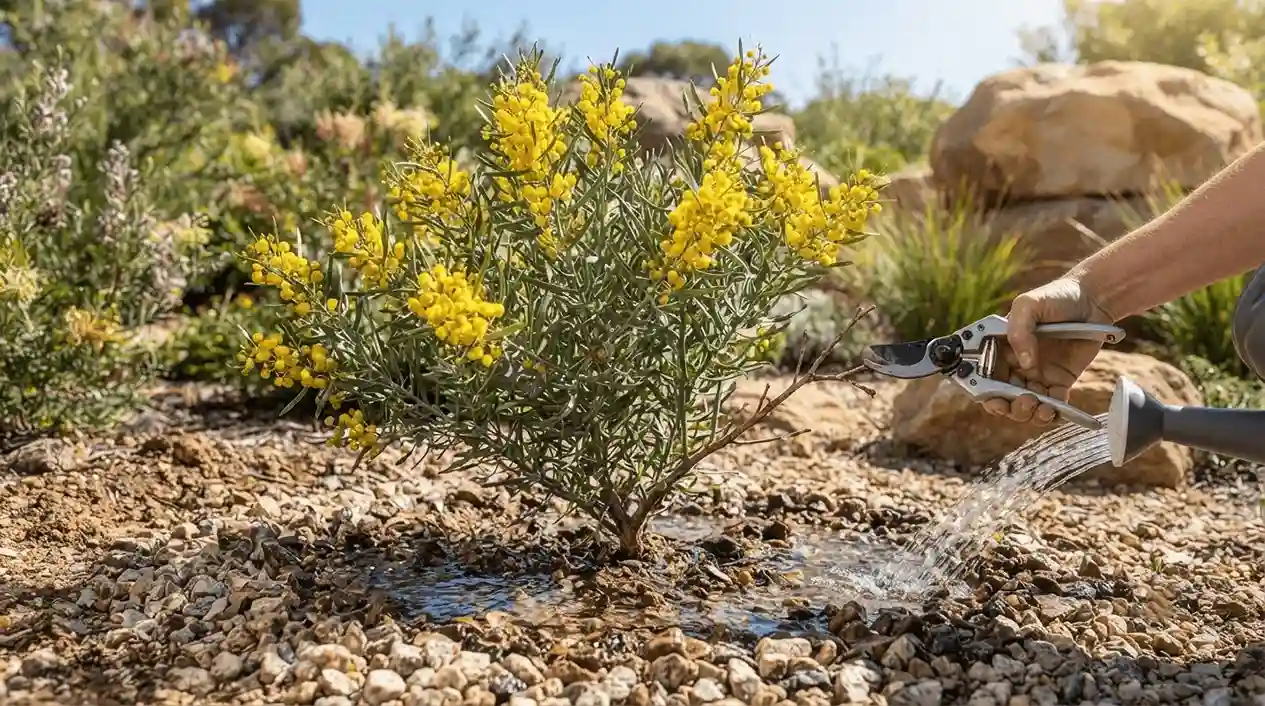
Watering
Proper watering is essential during establishment, but mature Acacia aphylla plants require surprisingly little irrigation.
Watering young plants
During the first year after planting:
- Water deeply once or twice each week, depending on rainfall.
- Allow the soil to dry slightly between waterings.
- Avoid keeping the root zone constantly wet.
Deep watering encourages roots to grow downward, improving drought resilience.
Watering established plants
Once established, the shrub generally survives on natural rainfall in suitable climates.
Supplemental watering is only necessary during prolonged periods of extreme drought.
Avoid overwatering
Overwatering is the most common cause of poor performance.
Excess moisture can lead to:
- Root rot
- Yellowing stems
- Weak growth
- Reduced flowering
- Premature plant decline
Greenery Inside recommends checking soil moisture before watering. If the top few centimetres of soil remain damp, wait before adding more water.
Fertilising
Acacia aphylla requires very little fertiliser because it naturally grows in nutrient-poor soils.
Choosing the right fertiliser
If feeding is necessary, select:
- Low-phosphorus native plant fertilisers
- Slow-release formulations
- Products specifically labelled for Australian native plants
High-phosphorus fertilisers can damage many native Australian species, including some wattles.
When fertilising is beneficial
Light feeding may help:
- Newly established plants in poor soils
- Container-grown specimens
- Plants showing nutrient deficiencies
For healthy garden plants growing in suitable soil, fertiliser is often unnecessary.
Mulching
Applying mulch helps maintain healthy root conditions while conserving soil moisture.
Benefits include:
- Reduced evaporation
- Improved soil temperature stability
- Weed suppression
- Protection of shallow feeder roots
Suitable mulch materials include:
- Coarse bark
- Gravel mulch
- Crushed stone
- Native wood chips
Keep mulch 5–10 cm (2–4 inches) away from the main stems to prevent excessive moisture around the crown and reduce the risk of fungal problems.
General maintenance
Acacia aphylla is considered a low-maintenance shrub, making it an excellent choice for gardeners seeking attractive native plants with minimal ongoing care.
Routine maintenance includes:
- Monitoring drainage after heavy rainfall
- Removing dead or damaged branches as needed
- Inspecting occasionally for pests
- Refreshing mulch annually
- Avoiding unnecessary fertiliser applications
Because of its naturally open growth habit, the shrub rarely requires extensive intervention once established.
With proper site selection and basic seasonal care, Acacia aphylla remains an attractive, drought-resilient feature plant that provides year-round architectural interest and dependable spring flowering.
Acacia aphylla Pruning Guide
When to prune
Acacia aphylla pruning is best carried out immediately after the plant finishes flowering. Pruning at this time helps maintain the shrub’s natural shape without removing developing flower buds for the following season.
For most growing regions, the ideal pruning period is:
- Late spring
- Early summer after flowering
- On a dry day to reduce the risk of disease
Avoid heavy pruning during winter or just before flowering, as this can reduce the seasonal floral display.
Why timing matters
Pruning after flowering offers several benefits:
- Encourages healthy new stem growth
- Preserves the next flowering cycle
- Removes damaged or weak branches
- Maintains the plant’s natural architectural form
Young plants generally require very little pruning beyond removing damaged stems. Mature shrubs benefit from occasional light shaping rather than regular hard pruning.
As of 2026, horticultural best practices continue to recommend minimal pruning for most Australian native wattles, as excessive cutting can shorten the lifespan of some species.
How to prune correctly
Acacia aphylla responds best to light, selective pruning. Its naturally open branching habit is part of its ornamental appeal, so the goal is to maintain rather than reshape the shrub.
Remove dead or damaged branches
Inspect the shrub annually and remove:
- Dead stems
- Broken branches
- Frost-damaged growth
- Diseased wood
- Crossing branches that rub together
Always use clean, sharp pruning tools to produce smooth cuts and reduce the chance of disease entering the stems.
Light shaping
If needed, lightly shorten overly long branches to maintain a balanced appearance.
Aim to:
- Preserve the open framework
- Improve air circulation
- Encourage even branching
Avoid clipping the shrub into formal shapes, as this detracts from its distinctive natural form.
Avoid excessive pruning
Heavy pruning should generally be avoided because it can:
- Stress the plant
- Delay flowering
- Reduce overall vigor
- Produce uneven regrowth
Greenery Inside recommends removing no more than one-third of the shrub’s growth during any single pruning session. Gentle maintenance over several years is healthier than severe pruning all at once.
Pruning Checklist
| Task | Recommendation |
| Best season | After flowering |
| Remove dead wood | Yes |
| Shape lightly | Yes |
| Heavy pruning | Avoid |
| Sanitize tools | Always |
| Frequency | Once yearly if needed |
Acacia aphylla Propagation
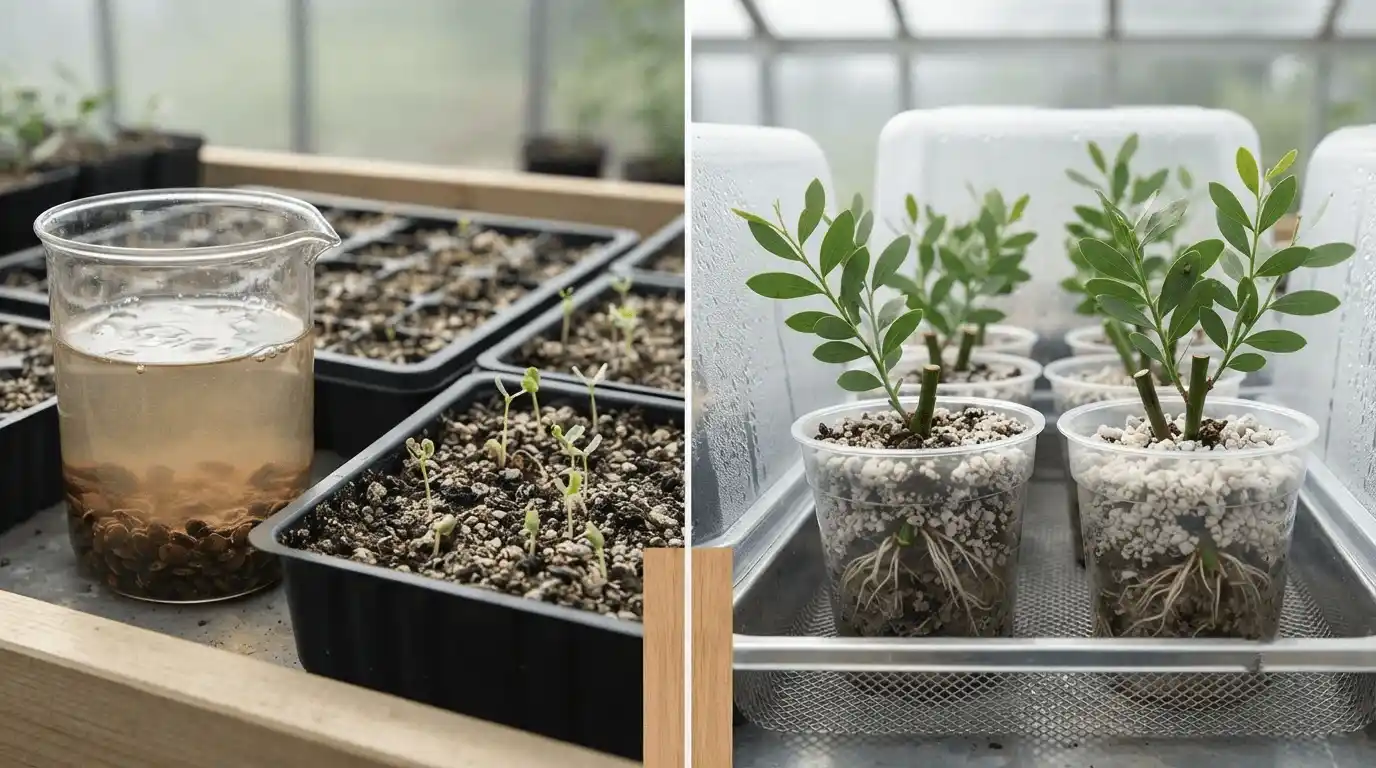
Growing from seed
Acacia aphylla propagation is most commonly carried out from seed. Although germination can be slower than in some other Australian wattles, proper preparation greatly improves success.
Like many members of the Acacia genus, the seeds have a hard outer coating that naturally delays germination until environmental conditions become favorable.
Seed scarification
Before sowing, scarification helps water penetrate the seed coat.
Common methods include:
- Pouring hot (not boiling) water over the seeds and allowing them to soak overnight
- Lightly nicking the seed coat with a file or sandpaper
- Using mechanical scarification with care
Seeds that swell after soaking are generally ready for planting.
Germination conditions
For the best results:
- Use a free-draining native seed-raising mix.
- Sow seeds approximately 5–10 mm deep.
- Keep the soil lightly moist but never waterlogged.
- Place trays in a warm, bright location with indirect sunlight.
- Maintain temperatures between 18–24°C (64–75°F).
Expected germination time
Most viable seeds germinate within:
- 2–6 weeks under ideal conditions
Some seeds may take longer depending on freshness and environmental conditions.
After seedlings produce several sets of stems, they can be carefully transplanted into individual pots.
In our experience, patience is essential. Some healthy seeds germinate later than expected, so seed trays should not be discarded too early.
Propagation from cuttings
Growing Acacia aphylla from cuttings is possible, although it is generally considered more challenging than seed propagation.
Selecting suitable cuttings
Choose:
- Healthy semi-hardwood stems
- Current season’s growth
- Disease-free branches
- Stems approximately 10–15 cm (4–6 inches) long
Remove any flowers or seed pods before planting.
Rooting hormone
Applying a rooting hormone designed for semi-hardwood cuttings can significantly improve rooting success.
Dip the cut end before inserting it into the propagation medium.
Growing medium
A suitable propagation mix should provide excellent drainage.
Recommended materials include:
- Coarse propagation sand
- Perlite
- Fine gravel
- Native propagation mix
Avoid heavy potting soils that retain excessive moisture.
Humidity requirements
Cuttings establish more successfully when humidity remains moderate.
Helpful practices include:
- Covering trays with a humidity dome
- Misting lightly when necessary
- Providing bright, indirect light
- Maintaining warm temperatures
Good air circulation is equally important to reduce fungal problems.
Success rates
Propagation from cuttings generally has a lower success rate than seed propagation because some stems root slowly or fail to produce roots altogether.
Nevertheless, cuttings allow gardeners to produce plants genetically identical to the parent shrub.
Which propagation method works best?
Both propagation methods have advantages, and the best choice depends on the gardener’s goals.
Seed propagation
Advantages include:
- Higher germination success with proper scarification
- Strong taproot development
- Suitable for producing multiple plants
- Preferred for restoration and conservation projects
Limitations:
- Slightly slower initial growth
- Seed preparation required
- Natural variation between seedlings
Cutting propagation
Advantages include:
- Produces clones of the parent plant
- Maintains desirable characteristics
- Faster to flowering once established
Limitations:
- Lower rooting success
- Requires greater environmental control
- More experience needed
Propagation Comparison Table
| Method | Difficulty | Speed | Success Rate | Best For |
| Seed | Easy to Moderate | Moderate | High with scarification | Home gardeners, conservation, large plantings |
| Cuttings | Moderate to Difficult | Moderate | Moderate | Cloning selected plants |
For most gardeners, seed propagation remains the most reliable and widely recommended method for growing Acacia aphylla.
Landscaping Uses of Leafless Wattle
Best garden applications
The unusual architecture of the leafless wattle makes it one of the most distinctive feature shrubs among Australian native plants. Its upright green stems and bright yellow flowers provide year-round visual interest while requiring relatively little maintenance.
Because it tolerates drought once established, Acacia aphylla is widely used in sustainable landscape designs that prioritize water conservation.
Ideal landscape applications include:
Native gardens
The shrub blends naturally with Australian native species and supports local biodiversity. For a deeper understanding of designing with Australian natives, explore our guide to Australian native garden trees, which highlights structural species that pair well with architectural shrubs like Acacia aphylla.
It works well alongside:
- Flowering wattles
- Native grasses
- Grevilleas
- Banksias
- Small eucalyptus species
Rock gardens
Its natural habitat consists largely of rocky slopes and granite outcrops, making rock gardens an ideal setting.
The green stems contrast beautifully with:
- Decorative gravel
- Natural stone
- Boulder groupings
- Dry creek beds
Xeriscaping
Water-wise landscapes benefit greatly from Acacia aphylla because established plants require very little supplemental irrigation.
It is an excellent choice for:
- Low-water gardens
- Sustainable landscapes
- Dry climate planting
- Mediterranean-style gardens
Feature shrub
Thanks to its sculptural appearance, the shrub performs well as a focal point.
Its leafless structure creates visual interest even outside the flowering season.
Wildlife gardens
The bright yellow flowers attract beneficial wildlife, including:
- Native bees
- Honeybees
- Butterflies
- Hoverflies
- Other pollinating insects
By providing nectar during its flowering season, the shrub contributes to healthier pollinator populations.
Companion plants
Acacia aphylla pairs well with many drought-tolerant Australian native plants that share similar growing requirements.
Suitable companion species include:
- Clay wattle
- Sandpaper wattle
- Flat wattle
- Flat leaf wattle
- Flat leaved wattle
- Drummond’s wattle
- Dwarf wattle
These native shrubs generally appreciate:
- Full sun
- Excellent drainage
- Low-phosphorus soils
- Moderate to low fertility
Combining species with different flowering times extends seasonal interest while creating habitat for a wider range of beneficial insects.
Greenery Inside recommends planting companions with similar water requirements rather than mixing drought-tolerant natives with moisture-loving ornamentals. This simplifies irrigation and helps all plants thrive under the same growing conditions.
Common Problems and How to Prevent Them
Although Acacia aphylla is a hardy Australian native shrub, it can experience problems if grown outside its preferred conditions. Most issues are related to soil moisture, site selection, or improper maintenance rather than serious pests or diseases.
With the right planting location and routine care, the leafless wattle remains one of the easiest drought-tolerant native shrubs to maintain.
Poor drainage
Poor drainage is the most common reason Acacia aphylla fails in cultivation. In its natural habitat, the plant grows in sandy, gravelly, and rocky soils where excess water drains away quickly.
When roots remain in wet soil for extended periods, they become deprived of oxygen, making them vulnerable to fungal infections.
Signs of root rot
Watch for:
- Yellowing or dull green stems
- Wilting despite moist soil
- Soft or blackened roots
- Branch dieback
- Sudden plant decline
How to prevent root rot
The best prevention is proper site preparation.
Follow these practices:
- Plant in well-drained sandy or gravelly soil.
- Avoid low-lying areas where water collects.
- Improve heavy clay soils with coarse gravel or plant in raised beds.
- Water deeply but infrequently during establishment.
- Never allow water to pool around the base of the shrub.
In our experience, gardeners often mistake drought tolerance for a need to avoid watering altogether. Young plants still require regular deep watering until their roots are fully established, but the soil should always be allowed to drain between waterings.
Slow growth
Slow growth is not always a sign of poor health. During its early years, Acacia aphylla naturally invests energy into root development before producing significant top growth.
However, persistently weak growth may indicate environmental problems.
Common causes
Poor soil conditions
Compacted or poorly drained soil limits root expansion and reduces nutrient uptake.
Improving drainage is usually more beneficial than adding fertilizer.
Too much shade
This species performs best in full sun.
Plants grown in shaded locations may develop:
- Sparse branching
- Reduced flowering
- Weaker stems
- Slower annual growth
Nutrient imbalance
Although Acacia aphylla tolerates low-fertility soils, excessive nutrients—particularly phosphorus—can damage sensitive Australian native plants.
Use only low-phosphorus fertilizers formulated for native species if feeding is necessary.
Encouraging healthier growth
For stronger growth:
- Choose a sunny planting location.
- Ensure excellent drainage.
- Avoid overwatering.
- Apply mulch to conserve soil moisture.
- Avoid excessive fertilizer applications.
As of 2026, horticultural guidance continues to emphasize that replicating the shrub’s natural rocky habitat produces healthier growth than attempting to improve the soil with rich organic amendments.
Pest and disease concerns
One advantage of growing Acacia aphylla is its relatively strong resistance to many common garden pests and diseases.
Healthy plants growing under suitable conditions rarely experience serious problems.
Occasional pests
While infestations are uncommon, gardeners may occasionally notice:
- Aphids on young stems
- Scale insects
- Caterpillars feeding on developing shoots
- Ants associated with sap-feeding insects
Most infestations remain minor and can often be managed by encouraging beneficial insects such as ladybirds and lacewings.
Potential diseases
Disease issues usually develop only when growing conditions are unfavorable.
Possible problems include:
- Root rot
- Fungal stem diseases
- Dieback caused by prolonged waterlogging
These problems are typically preventable through proper drainage and good air circulation.
Preventive care
Routine maintenance helps keep plants healthy.
Good practices include:
- Inspect plants several times during the growing season.
- Remove damaged branches promptly.
- Keep mulch away from the stems.
- Avoid overhead watering when possible.
- Maintain adequate spacing for airflow.
Greenery Inside recommends addressing environmental issues before considering chemical treatments. Healthy, well-sited plants naturally resist most pests and diseases.
Common Beginner Mistakes
Many cultivation problems can be avoided by understanding the natural habitat of Acacia aphylla. Since the species evolved in dry, rocky environments, treating it like a typical ornamental shrub often leads to disappointing results.
Below are the mistakes most frequently made by new growers.
Planting in heavy clay soil
Dense clay soils retain water for long periods, increasing the risk of root rot.
Instead, improve drainage or choose a raised planting area with sandy or gravelly soil.
Overwatering
One of the most common mistakes is watering established plants too frequently.
Remember:
- Newly planted shrubs need regular watering.
- Established shrubs require very little supplemental irrigation.
- Allow the soil to dry slightly between watering sessions.
Deep, infrequent watering encourages healthier root development than frequent shallow watering.
Using excessive fertilizer
Many gardeners assume faster growth requires more fertilizer.
However, Australian native wattles are adapted to nutrient-poor soils.
Applying large amounts of fertilizer may cause:
- Soft, weak growth
- Root damage
- Nutrient toxicity
- Reduced plant longevity
Always choose low-phosphorus native plant fertilizers if feeding is required.
Pruning too heavily
Because of its naturally open form, Acacia aphylla rarely needs extensive pruning.
Removing too much growth can:
- Delay flowering
- Reduce vigor
- Create uneven regrowth
- Stress the plant
Limit pruning to light shaping and the removal of dead or damaged branches.
Choosing the wrong planting site
Location has a greater influence on long-term success than almost any other factor.
Avoid sites with:
- Poor drainage
- Deep shade
- Constant irrigation
- Low-lying frost pockets
- Compacted soil
Instead, choose:
- Full sun
- Excellent drainage
- Good air circulation
- Rocky or sandy soils
Selecting the right site from the beginning significantly reduces future maintenance.
Common Mistakes at a Glance
| Mistake | Potential Problem | Best Solution |
| Planting in heavy clay | Root rot | Improve drainage or use raised beds |
| Overwatering | Root damage and poor growth | Water deeply but infrequently |
| Excess fertilizer | Weak growth and nutrient toxicity | Use low-phosphorus native fertilizer only if needed |
| Heavy pruning | Reduced flowering | Prune lightly after flowering |
| Poor site selection | Slow growth and decline | Plant in full sun with well-drained soil |
Environmental Benefits of Acacia aphylla
Beyond its ornamental value, Acacia aphylla provides important ecological benefits that make it an excellent addition to sustainable landscapes and native restoration projects.
Its drought tolerance, wildlife value, and adaptation to harsh environments support both biodiversity and responsible gardening practices. Acacia aphylla also plays an important role in supporting biodiversity in home gardens. It fits well into broader planting schemes such as modern Australian native garden designs, especially when combined with species that attract pollinators. For gardeners focused on ecological landscaping, pairing it with plants from our guide on native plants that attract butterflies can significantly increase pollinator activity and seasonal garden value. You can also explore more design inspiration in our Australian native garden trees resource for creating resilient, wildlife-friendly landscapes.
Habitat for pollinators
The bright yellow flowers are rich in nectar and pollen, attracting a variety of beneficial insects.
Common visitors include:
- Native bees
- Honeybees
- Hoverflies
- Butterflies
- Other pollinating insects
These pollinators contribute to healthier ecosystems by supporting the reproduction of many flowering plants.
Nitrogen fixation
Like many members of the Fabaceae family, Acacia aphylla forms a beneficial relationship with soil bacteria that help convert atmospheric nitrogen into forms plants can use.
This natural process:
- Improves soil fertility over time
- Supports neighboring plants
- Reduces dependence on synthetic fertilizers
- Contributes to healthier garden ecosystems
Drought-resilient landscaping
As water conservation becomes increasingly important, drought-tolerant plants such as Acacia aphylla play a valuable role in sustainable landscape design.
Benefits include:
- Lower irrigation requirements
- Reduced water consumption
- Lower maintenance costs
- Improved resilience during dry seasons
Its ability to thrive in harsh conditions makes it especially valuable for xeriscaping and climate-adapted gardens.
Biodiversity support
Planting native species helps recreate natural habitats for local wildlife.
Acacia aphylla contributes by:
- Providing nectar for insects
- Offering shelter for small wildlife
- Supporting native food webs
- Increasing plant diversity in gardens
Using locally adapted native plants also strengthens ecological resilience within urban and suburban landscapes.
Soil improvement
The shrub’s extensive root system helps stabilize soil, particularly on rocky slopes and erosion-prone sites.
Additional benefits include:
- Reduced soil erosion
- Improved soil structure over time
- Better water infiltration
- Increased microbial activity around the root zone
Greenery Inside recommends incorporating Acacia aphylla into native planting schemes wherever suitable. Its combination of ecological value, drought tolerance, and low maintenance makes it an excellent long-term choice for environmentally responsible gardening.
Frequently Compared Australian Native Wattles
Several Australian wattles are valued for their ornamental appeal, drought tolerance, and adaptability to native landscapes. However, Acacia aphylla stands out because of its completely leafless appearance and striking architectural form. Comparing it with similar species helps gardeners choose the most suitable plant for their landscape and growing conditions.
Acacia aphylla vs Acacia denticulosa
Although both species produce bright yellow flowers and are native to Western Australia, they differ significantly in foliage and overall appearance.
Acacia aphylla
- Completely leafless at maturity
- Green stems carry out photosynthesis
- Upright, open branching habit
- Excellent feature shrub for rock gardens
- Extremely drought tolerant once established
Acacia denticulosa
- Produces distinctive toothed phyllodes
- Bushier and denser growth
- More traditional wattle appearance
- Attractive ornamental foliage throughout the year
- Suitable for mixed native borders
Best choice: Choose Acacia aphylla if you want a sculptural, architectural shrub. Select Acacia denticulosa for a fuller, foliage-rich native planting.
Acacia aphylla vs Acacia glaucoptera
These two species are among the most visually distinctive Australian wattles, yet they have very different growth habits.
Acacia aphylla
- No leaves or phyllodes
- Upright growth
- Fine green stems
- Vertical landscape accent
- Moderate mature size
Acacia glaucoptera
- Broad wing-like phyllodes
- Low, spreading habit
- Blue-green foliage
- Excellent groundcover or border plant
- Dramatic horizontal form
Best choice: Use Acacia aphylla as a vertical focal point and Acacia glaucoptera where a spreading, low-growing specimen is preferred.
Acacia aphylla vs Acacia rupicola
Both species naturally occur in rocky environments and perform well in well-drained native gardens.
Acacia aphylla
- Completely leafless
- Taller upright shrub
- Open framework
- Strong architectural character
Acacia rupicola
- Small phyllodes
- Compact, rounded growth
- Denser branching
- Ideal for smaller rock gardens
Best choice: Gardeners with limited space may prefer Acacia rupicola, while those seeking a striking specimen plant often choose Acacia aphylla.
Leafless wattle vs other rock wattles
Many Australian rock wattles share adaptations for dry, rocky habitats, including drought tolerance and yellow flowers. However, the leafless wattle remains unique because it lacks both true leaves and phyllodes.
Compared with other rock wattle species, Acacia aphylla offers:
- A highly unusual leafless structure
- Green photosynthetic stems
- A sculptural, modern appearance
- Exceptional suitability for minimalist and water-wise landscapes
- Strong seasonal interest during flowering
Most other rock wattles retain some form of foliage, giving them a more conventional shrub-like appearance.
Comparison Table
| Plant | Leaves | Flower Colour | Mature Size | Best Landscape Use |
| Acacia aphylla | None | Bright yellow | 1.5–2.5 m tall | Feature shrub, rock gardens, xeriscaping |
| Acacia denticulosa | Toothed phyllodes | Yellow | 2–4 m tall | Native borders, ornamental foliage |
| Acacia glaucoptera | Broad wing-like phyllodes | Yellow | 0.3–1 m tall | Groundcover, edging, rock gardens |
| Acacia rupicola | Small phyllodes | Yellow | 1–2 m tall | Compact native gardens, rocky landscapes |
Conclusion
Acacia aphylla, commonly known as the leafless wattle or leafless rock wattle, is one of Australia’s most remarkable native shrubs. Its leafless green stems, brilliant yellow flowers, and natural adaptation to dry, rocky environments make it both visually distinctive and highly resilient.
With full sun, excellent drainage, and minimal maintenance, this species rewards gardeners with years of architectural beauty and seasonal blooms. Proper watering during establishment, light pruning after flowering, and propagation through seed or semi-hardwood cuttings are key to long-term success.
Beyond its ornamental value, Acacia aphylla supports pollinators, contributes to soil health through nitrogen fixation, and fits perfectly into drought-tolerant and water-wise landscapes. Whether used as a feature shrub in a native garden, a focal point in a rockery, or part of a biodiversity-focused planting scheme, it offers lasting ecological and aesthetic benefits.
Key takeaway: Acacia aphylla is an outstanding choice for gardeners seeking a low-maintenance, drought-tolerant Australian native shrub with a unique architectural form and excellent environmental value.
Frequently Asked Questions
What is Acacia aphylla commonly called?
Acacia aphylla is commonly known as the leafless wattle or leafless rock wattle. These names refer to its unusual growth habit, as mature plants lack true leaves and instead use green stems for photosynthesis.
Why does Acacia aphylla have no leaves?
The species evolved without true leaves as an adaptation to the dry climates of Western Australia. Its green stems perform photosynthesis while reducing water loss, allowing the shrub to survive extended droughts more efficiently than many leafy plants.
How large does Acacia aphylla grow?
A mature Acacia aphylla typically reaches 1.5–2.5 metres (5–8 feet) in height and 1–2 metres (3–6.5 feet) in width. Its final size depends on sunlight, soil drainage, climate, and overall growing conditions.
How do you propagate Acacia aphylla?
The most reliable method of propagation is by seed. Seeds should be scarified before sowing to improve germination. Semi-hardwood cuttings can also be used, although they generally have a lower success rate and require controlled humidity and rooting hormone.
When should Acacia aphylla be pruned?
Prune Acacia aphylla immediately after flowering in late spring or early summer. Remove dead or damaged branches and carry out only light shaping to preserve the plant’s natural form and encourage healthy future growth.
Is Acacia aphylla drought tolerant?
Yes. Once established, Acacia aphylla is highly drought tolerant. Its leafless, photosynthetic stems minimize water loss, making it an excellent choice for xeriscaping and other water-wise landscape designs.
Can Acacia aphylla grow in pots?
Yes, it can be grown in large containers provided they have excellent drainage. Use a free-draining native plant potting mix, avoid overwatering, and place the container in a location that receives full sun for best results.
What type of soil does leafless wattle prefer?
Leafless wattle grows best in well-drained sandy, gravelly, or rocky soils with low to moderate fertility. Heavy clay or poorly drained soils should be avoided, as they increase the risk of root rot and poor plant performance.