Introduction
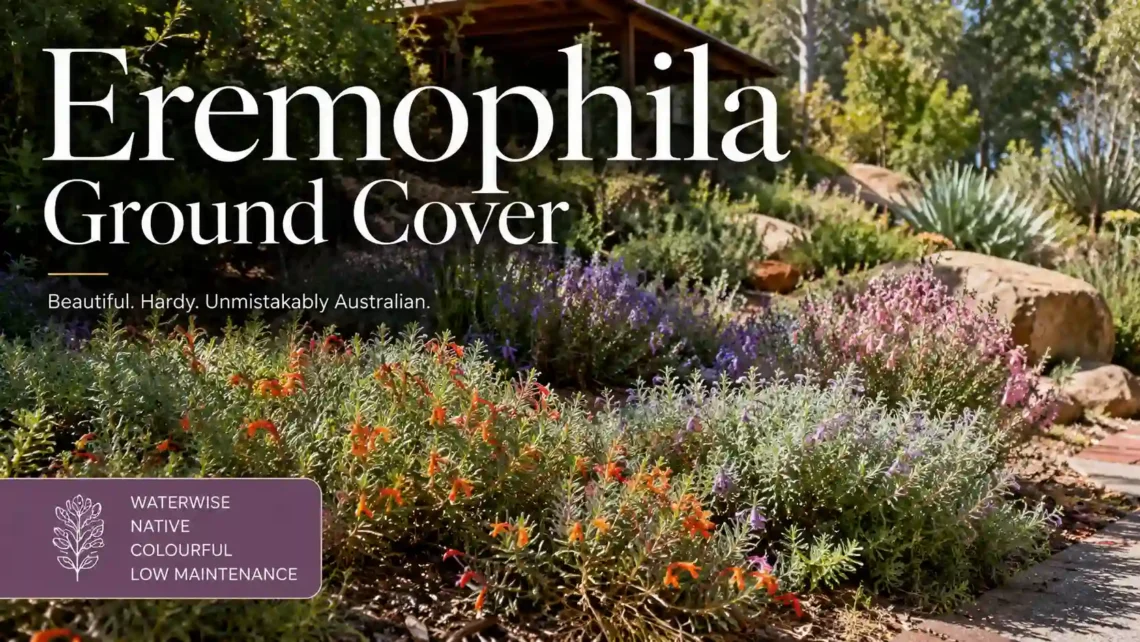
Eremophila is a diverse genus of Australian native plants that includes many excellent ground-covering forms. Ground cover plants are low-growing species that spread across the soil surface, helping suppress weeds, reduce erosion, and cover bare ground. Many gardeners choose eremophila ground cover varieties because they combine drought tolerance, attractive flowers, and minimal maintenance requirements. Prostrate eremophila cultivars are particularly valued in Australian landscapes for their ability to thrive in harsh conditions while providing year-round foliage interest. Whether used on slopes, native garden borders, or coastal landscapes, these plants offer both practical and ornamental benefits.
Quick Summary
- Eremophila is a large genus of Australian native shrubs, several of which grow as low, spreading ground covers ideal for dry and low-maintenance gardens.
- The most widely used ground cover varieties include Eremophila glabra ‘Kalbarri Carpet’, ‘Blue Horizon’, ‘Amber Carpet’, and ‘Roseworthy’.
- Ground cover eremophilas are drought-tolerant, bird-attracting, and suitable for sloped banks, coastal gardens, and native plantings across Australia.
- Most varieties spread 1–3 metres wide while remaining under 50 cm in height, making them effective low-growing weed suppressors.
What Is Eremophila and Why Is It Used as Ground Cover?
Eremophila is a genus of more than 220 species of Australian native plants commonly known as emu bush or emu plants. Many species grow as shrubs, while selected cultivars have naturally prostrate growth habits that make them ideal ground covers.
The Eremophila genus contains more than 220 species native to Australia and belongs to one of the country’s most diverse groups of flowering shrubs. Readers interested in its botanical classification can learn more on Wikipedia’s Eremophila (plant) page.
Ground cover plants spread horizontally rather than vertically. Certain eremophilas are widely used because of their dense foliage, drought hardiness, and ability to cover large areas with minimal maintenance. Eremophila glabra is the species most commonly represented in ground cover cultivars. These plants also provide habitat and food sources for small birds, native insects, and pollinators. Similar to Acacia Baileyana Prostrate, many prostrate eremophila cultivars are selected specifically for their low-growing, spreading habit.
What Is a Low-Growing Ground Cover?
A low-growing ground cover is a plant that typically remains under 50 cm tall while spreading across the soil surface. Its primary purpose is to cover bare ground, reduce weed growth, and improve landscape appearance.
Unlike herbaceous ground covers, many eremophilas are woody shrubs that maintain a spreading habit. Common ground cover examples include prostrate grevilleas, myoporums, scaevolas, and low-growing eremophilas.
How Does Ground Cover Work in the Garden?
Ground cover works by forming a dense layer of foliage that shades the soil surface. This helps suppress weeds, retain moisture, reduce erosion, and create a more finished garden appearance.
Low-growing eremophilas achieve these benefits through their spreading branches and dense foliage, making them particularly useful in difficult landscape areas.
Best Eremophila Ground Cover Varieties in Australia
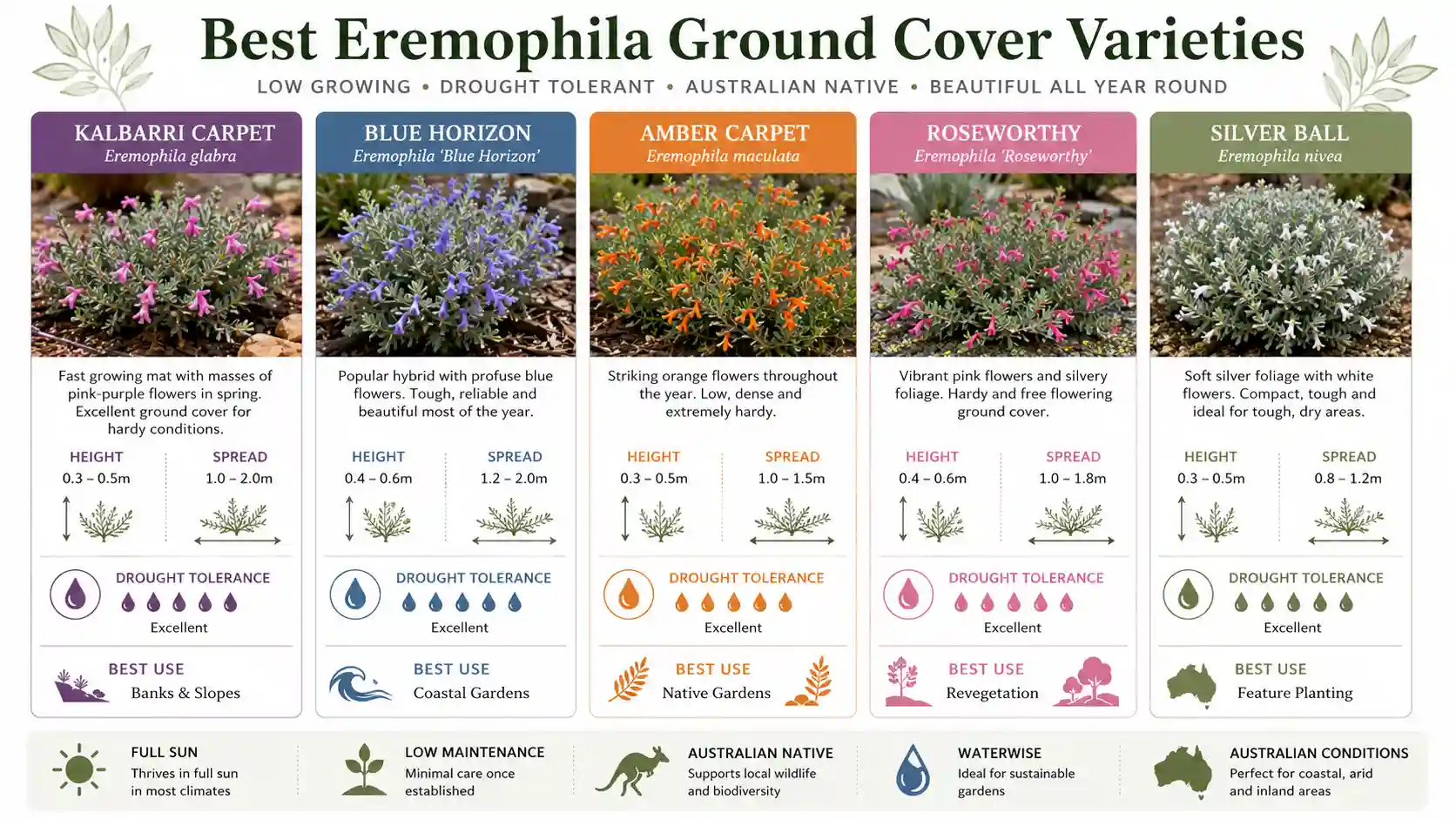
Several garden-tested cultivars are widely grown across Australia for their reliable performance and attractive appearance.
Eremophila glabra ‘Kalbarri Carpet’
Kalbarri Carpet is one of the most popular prostrate eremophila selections. It produces orange-red tubular flowers and typically reaches 20–30 cm in height while spreading up to 2.5 metres wide.
It performs exceptionally well in hot, dry, and coastal conditions and is frequently used on banks, roadsides, and native garden borders.
Eremophila glabra ‘Blue Horizon’
Blue Horizon is recognised for its blue-grey foliage and lavender-blue flowers. It generally grows 30–50 cm tall with a spread of 1.5–2 metres.
The flowers attract honeyeaters and other nectar-feeding birds. This cultivar is commonly used in coastal gardens and rockeries.
Eremophila glabra ‘Amber Carpet’
Amber Carpet features attractive amber-orange flowers and a dense spreading habit. It remains low-growing while covering substantial ground area.
Compared with Kalbarri Carpet, it offers similar growth characteristics but differs primarily in flower colour and overall visual effect.
Eremophila glabra ‘Roseworthy’
Roseworthy is valued for its pink-mauve flowers and adaptable growth habit. It is commonly used in revegetation projects, native landscapes, and public plantings.
Its reliable performance and broad adaptability make it a practical choice for many Australian regions.
Other Notable Low-Growing Eremophila Varieties
Additional low-growing selections include:
- Eremophila Silver Ball
- Eremophila Wild Berry (Wildberry)
- Eremophila Spring Mist
- Eremophila nivea ‘Spring Mist’
- Eremophila nivea ‘Blue Velvet’
- Silky Eremophila
- Eremophila biserrata prostrate forms
- Eremophila nivea
Silvery-leaved forms such as Eremophila nivea are discussed in more detail in our Nivea Plant Care Guide.
Related emu bush types include silver emu bush and spotted emu bush, although not all are true ground covers. Gardeners looking for additional native spreading shrubs may also consider Correa Alba Prostrate, which performs well in similar coastal and low-maintenance landscapes.
Eremophila Ground Cover Variety Comparison Table
| Variety | Flower Colour | Height | Spread | Drought Tolerance | Best Use |
| Kalbarri Carpet | Orange-red | 20–30 cm | 1.5–2.5 m | Very High | Banks, borders |
| Blue Horizon | Lavender-blue | 30–50 cm | 1.5–2 m | Very High | Coastal, rockeries |
| Amber Carpet | Amber-orange | 20–40 cm | 1–2 m | High | Native gardens |
| Roseworthy | Pink-mauve | 30–50 cm | 1–2 m | High | Revegetation |
| Silver Ball | White/silver | 30 cm | 1 m | High | Feature planting |
Generally, Blue Horizon performs well in coastal regions, while Kalbarri Carpet is particularly suitable for hot inland climates.
Eremophila Ground Cover Height and Spread: What to Expect
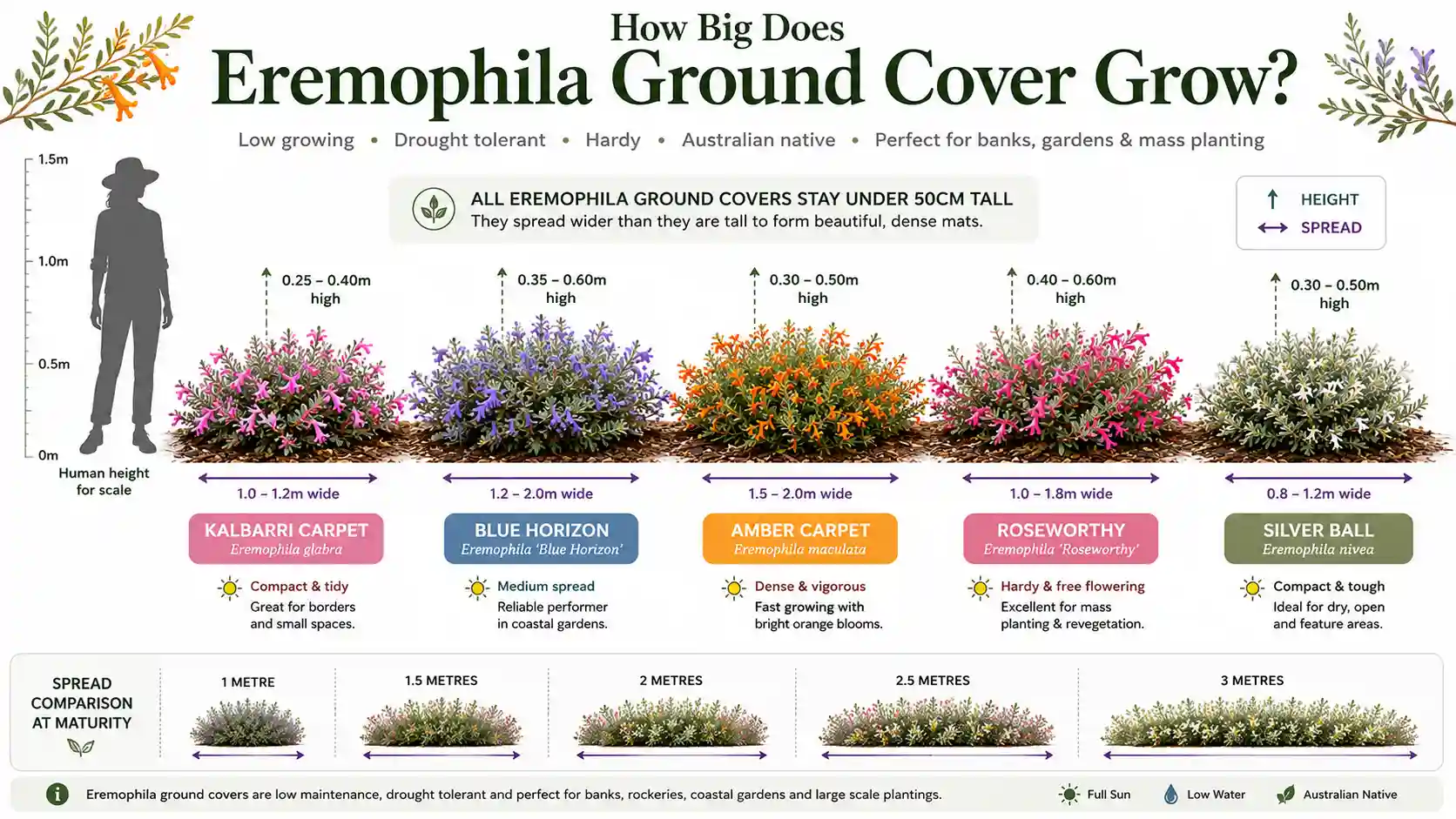
Most eremophila ground covers remain below 50 cm tall while spreading between 1 and 3 metres wide.
Factors affecting mature size include:
- Soil quality
- Water availability
- Sun exposure
- Local climate
- Cultivar selection
In ideal conditions, some vigorous cultivars may spread beyond their typical published dimensions.
How to Plant Eremophila as Ground Cover
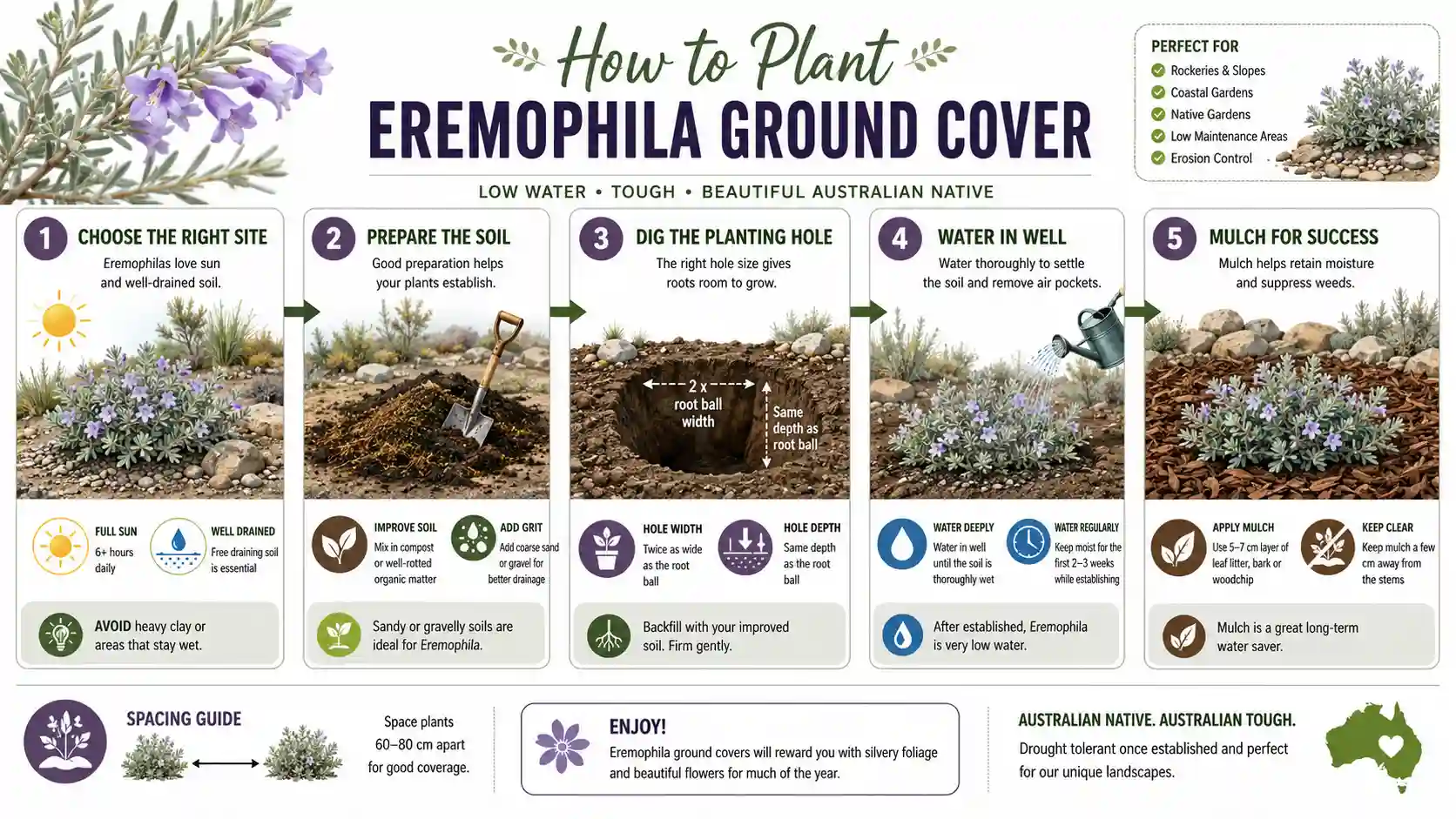
Successful establishment begins with proper site preparation.
- Choose a location with full sun.
- Ensure excellent drainage.
- Avoid heavy clay or waterlogged soils.
- Dig a planting hole slightly wider than the root ball.
- Position the crown at soil level.
- Water thoroughly after planting.
- Apply mulch around the plant, keeping it away from the crown.
- Avoid heavy fertilisation during establishment.
Eremophila Ground Cover Spacing Guide
Most cultivars should be planted approximately 1–1.5 metres apart.
Closer spacing provides faster ground coverage, while wider spacing allows each plant to reach its full mature spread without competition.
Best Soil and Site Conditions for Planting
Eremophilas prefer:
- Well-drained soils
- Slightly acidic to neutral pH
- Full sun exposure
- Low humidity environments
Poor drainage is one of the most common causes of failure in Australian native gardens. While eremophilas generally prefer full sun, gardeners with lower-light conditions may find alternatives in our Shade Loving Australian Natives Guide.
Eremophila Ground Cover Care Guide
Watering Requirements
- Water regularly during the first growing season.
- Reduce watering once established.
- Overwatering is the leading cause of plant decline.
- Avoid wetting foliage on silvery-leaved varieties such as Eremophila nivea.
Light Conditions
- Full sun is ideal.
- Minimum six hours of direct sunlight is recommended.
- Partial shade may be tolerated in extremely hot regions.
- Low light often results in reduced flowering and leggy growth.
Soil Preferences
- Sandy soils are ideal.
- Loamy soils are suitable if well-drained.
- Gravelly soils work well.
- Avoid heavy clay and permanently wet conditions.
- Preferred pH range: 6.0–7.5.
Fertilisation Guidance
- Use low-phosphorus native plant fertiliser only if necessary.
- Many plants perform well without fertiliser.
- Avoid standard high-phosphorus garden fertilisers.
Pruning and Shaping
- Light tip pruning after flowering encourages compact growth.
- Remove dead stems as needed.
- Avoid severe pruning of mature plants.
Climate Tolerance in Australia
Eremophila ground covers perform best in:
- Mediterranean climates
- Semi-arid regions
- Dry temperate areas
They are widely grown in Western Australia, South Australia, and parts of Victoria.
Common Problems With Eremophila Ground Covers (and How to Fix Them)
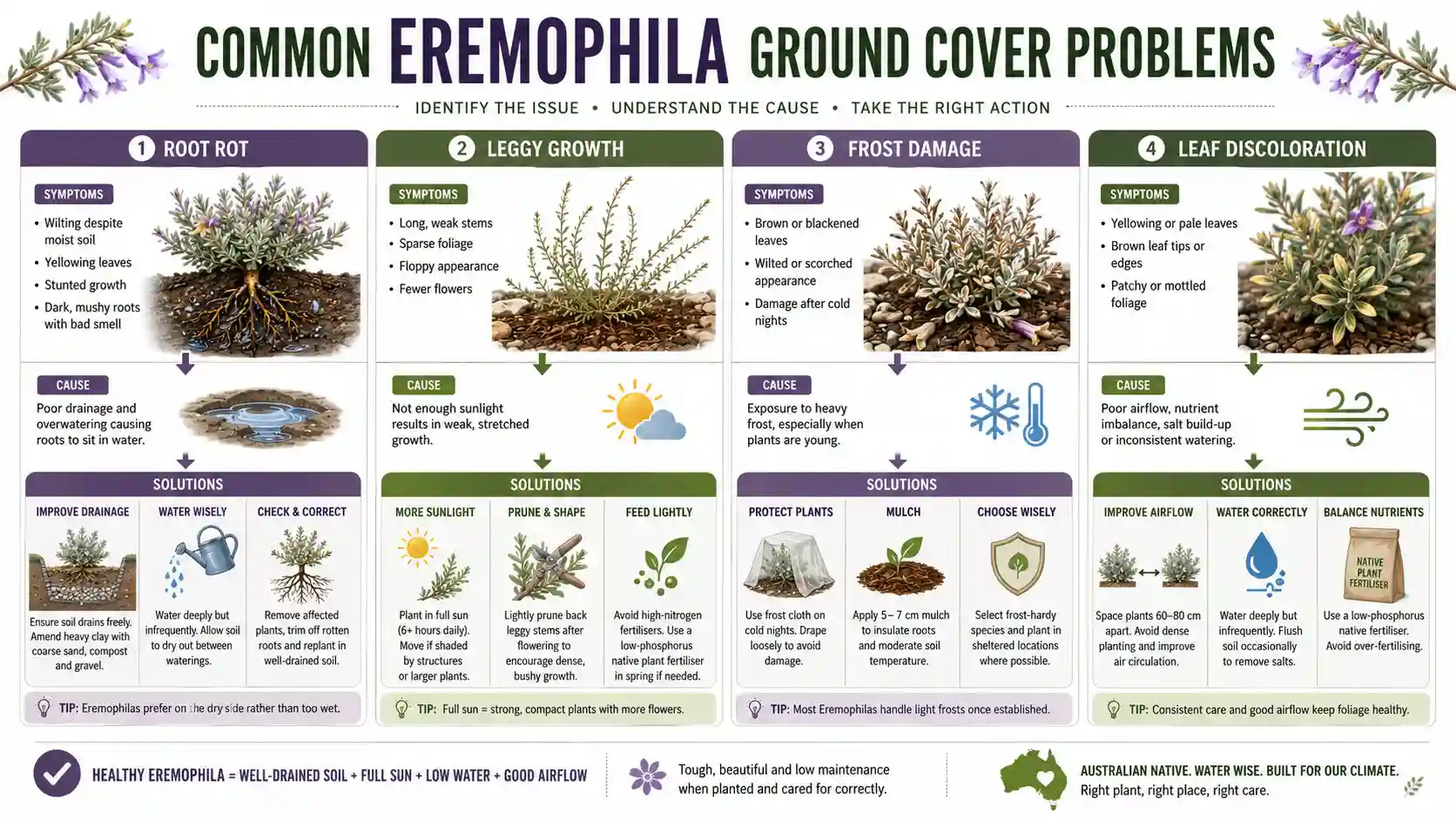
Root Rot
Cause: Overwatering and poor drainage.
Fix:
- Improve drainage.
- Reduce watering frequency.
Prevention:
- Plant in sandy or raised beds.
Leggy Growth
Cause: Insufficient sunlight.
Fix:
- Relocate to a sunnier position.
- Lightly prune to encourage branching.
Prevention:
- Plant in full sun.
Frost Damage
Cause: Exposure to severe frost.
Fix:
- Remove damaged growth after frost risk passes.
Prevention:
- Protect young plants during cold periods.
Failure to Establish
Cause: Waterlogging or clay soils.
Fix:
- Improve drainage with grit and organic matter.
Prevention:
- Select an appropriate planting site.
Leaf Discolouration on Eremophila nivea
Cause:
- Excess moisture
- Poor airflow
- Overfertilisation
Fix:
- Improve air circulation.
- Reduce watering.
Prevention:
- Avoid excessive feeding and wet foliage.
Eremophila Ground Cover in Australian Landscape Design
Eremophila ground covers are widely used in landscape projects because of their adaptability and low maintenance requirements.
Common uses include:
- Slope stabilisation
- Coastal gardens
- Native garden borders
- Wildlife corridors
- Roadside revegetation
- Public landscapes
Eremophila combines well with many flowering natives, including species commonly recommended in What to Plant with Kangaroo Paw.
Additional benefits:
- Suitable for fire-prone areas
- Effective erosion control
- Ideal for xeriscaping
- Combines well with grevilleas, westringias, and callistemons
These drought-tolerant shrubs are frequently featured in a Modern Australian Native Garden because of their low water requirements and wildlife value.
Eremophila ground covers are often incorporated beneath larger native species as part of layered landscape designs. For broader planning ideas, see our Australian Native Garden Trees: The Complete Planting Guide.
Eremophila Ground Cover vs Other Low-Growing Natives
| Feature | Eremophila | Myoporum | Grevillea Ground Covers | Scaevola |
| Drought Tolerance | Excellent | High | High | Moderate |
| Maintenance | Low | Low | Moderate | Low |
| Flower Display | Strong | Moderate | Excellent | Excellent |
| Growth Habit | Dense shrub | Spreading | Trailing shrub | Herbaceous spreader |
| Nursery Availability | Moderate | High | High | High |
For many Australian gardens, eremophila is considered one of the best low-growing ground covers because it combines drought tolerance, attractive flowers, and long-term durability. Eremophila ground covers are often compared with Creeping Myoporum, another popular Australian ground cover valued for rapid coverage and erosion control. Some gardeners also compare eremophila with low-growing grevilleas such as Grevillea Ivory Whip, particularly in bird-friendly landscapes.
Understanding the Broader Eremophila Genus: Related Species and Types
The Eremophila genus includes many species beyond ground cover forms. Popular examples include Eremophila maculata, Eremophila alternifolia, Eremophila biserrata, and Eremophila nivea.
These plants vary from compact shrubs to large screening plants and contribute significantly to Australia’s native flora.
Emu Bush — What It Is and How It Relates to Eremophila
Emu bush is the common name applied to many Eremophila species. The term covers a diverse group of native plants with different growth habits, flower colours, and environmental preferences.
Some Aboriginal communities traditionally used certain Eremophila species for medicinal and cultural purposes. While many emu bushes grow as upright shrubs, ground cover cultivars are selected specifically for their spreading habit.
Conclusion
Eremophila ground covers are among the most practical, drought-hardy, and visually appealing low-growing plants available to Australian gardeners. Cultivars such as Kalbarri Carpet, Blue Horizon, Amber Carpet, and Roseworthy provide excellent weed suppression, erosion control, and seasonal flower displays. Selecting the right variety for local climate and soil conditions is the most important step toward success. With proper drainage and minimal maintenance, these Australian native plants reward gardeners with attractive foliage, wildlife value, and reliable long-term performance.
FAQs
What are the best eremophila ground cover varieties for Australian gardens?
The most widely grown varieties are Kalbarri Carpet, Blue Horizon, Amber Carpet, and Roseworthy. The best choice depends on local climate, soil conditions, and desired flower colour.
How far apart should eremophila ground covers be planted?
Most cultivars should be spaced 1–1.5 metres apart. Closer spacing provides faster coverage, while wider spacing allows plants to reach their natural spread.
How tall does eremophila ground cover grow?
Most prostrate cultivars remain under 50 cm tall. Depending on the variety, mature spread may range from 1.5 to 3 metres.
Why is my eremophila ground cover dying?
Common causes include overwatering, poor drainage, clay soils, and frost damage. Improving drainage and adjusting watering practices often resolves problems.
Are eremophila ground covers drought-tolerant?
Yes. Most Eremophila glabra ground cover cultivars are highly drought-tolerant once established. Regular watering is primarily required during the establishment phase.
What is the difference between Eremophila glabra ‘Kalbarri Carpet’ and ‘Blue Horizon’?
Kalbarri Carpet produces orange-red flowers and grows very low, while Blue Horizon is known for blue-grey foliage and lavender-blue flowers. Both are drought-tolerant but create different visual effects in the landscape.
Can eremophila ground covers be grown outside Australia?
Yes. They can be grown successfully in Mediterranean-climate regions with dry summers and well-drained soils. However, prolonged humidity and severe frost may reduce performance.