Introduction
Melaleuca Candy Sparkles is a striking Australian native ornamental shrub or small tree admired for its vibrant pink bottlebrush-like flowers, attractive evergreen foliage, and adaptability to a wide range of garden settings. Popular in native landscapes, wildlife-friendly gardens, and contemporary home designs, it offers year-round interest while supporting local biodiversity. Closely related to Melaleuca viridiflora, this cultivar belongs to the paperbark group of plants, renowned for their distinctive bark and nectar-rich blooms. Whether you’re planning an Australian native garden or searching for a hardy feature plant, this guide explains how to identify, grow, care for, and landscape with Melaleuca Candy Sparkles while answering the most common questions gardeners have.
By Greenery Inside | Plant Care & Gardening Expert
Quick Summary
- Melaleuca Candy Sparkles is an Australian native ornamental plant prized for its vibrant pink brush-like flowers and evergreen foliage.
- It grows best in full sun with well-drained soil and becomes relatively drought tolerant after establishment.
- Its manageable mature size and non-aggressive growth habit make it suitable for feature planting, screening, wildlife gardens, and large containers.
- Regular watering during establishment, light pruning after flowering, and proper site selection promote healthy growth and abundant blooms.
- As a nectar-rich native plant, it attracts bees, butterflies, and native birds, making it an excellent choice for biodiversity-friendly landscapes.
What Is Melaleuca Candy Sparkles?
Melaleuca Candy Sparkles is an ornamental cultivar within the Myrtaceae family, valued for its colourful flowers, dense foliage, and adaptability to Australian conditions. It combines the resilience expected from native paperbarks with a compact, decorative growth habit that suits both residential and commercial landscapes.
Its long flowering season, attractive evergreen leaves, and relatively low maintenance requirements have made it increasingly popular among gardeners seeking sustainable native plants.
Botanical Background and Origin
Melaleuca Candy Sparkles belongs to the genus Melaleuca, a large group of Australian native plants commonly known as paperbarks because many species develop soft, layered bark that peels in papery sheets. The genus Melaleuca belongs to the Myrtaceae family and includes many well-known Australian native species commonly referred to as paperbarks and honey myrtles, widely documented in botanical literature such as Melaleuca (Wikipedia).
Botanical Classification
| Classification | Details |
| Kingdom | Plantae |
| Clade | Angiosperms |
| Order | Myrtales |
| Family | Myrtaceae |
| Genus | Melaleuca |
| Cultivar | Melaleuca ‘Candy Sparkles’ |
The cultivar is closely associated with Melaleuca viridiflora, one of Australia’s naturally occurring paperbark species. Plant breeders selected Candy Sparkles for its improved ornamental qualities, including prolific flowering, compact form, and reliable garden performance.
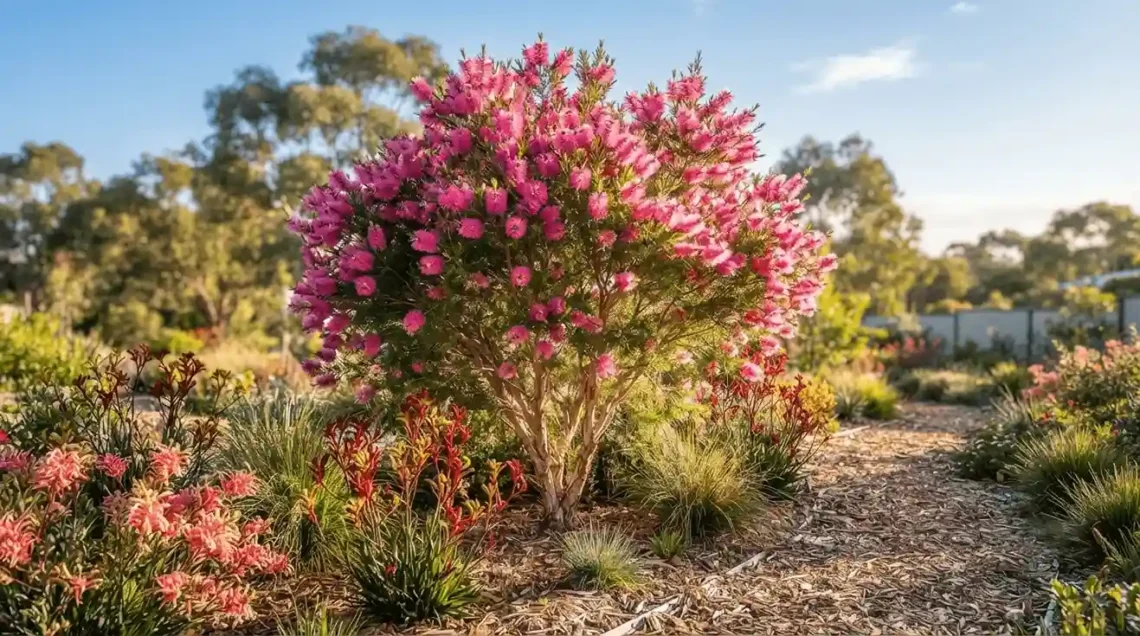
Although often sold as either a shrub or a small tree, its final shape depends largely on pruning practices and growing conditions. Left unpruned, it may develop multiple trunks and an upright canopy, while regular trimming encourages a dense, bushy appearance.
Because its parent species evolved naturally across northern Australia, Melaleuca Candy Sparkles inherits excellent adaptation to Australian climates, including tolerance for heat, seasonal rainfall variation, and periods of drought once established.
At Greenery Inside, we’ve found that young plants establish most successfully when planted during the cooler months of autumn or early spring, allowing roots to develop before periods of extreme heat.
Key Identifying Features
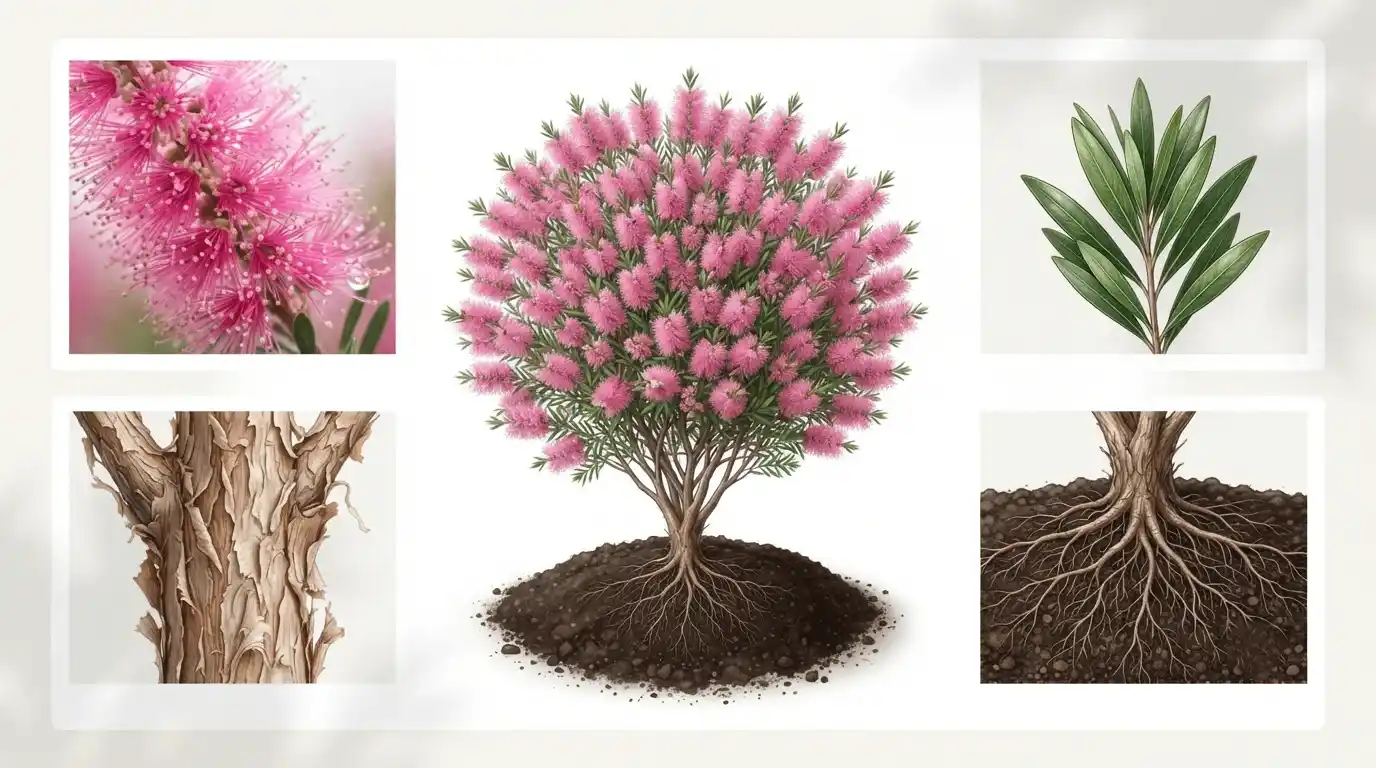
Melaleuca Candy Sparkles is easy to recognize by its colourful flowers, evergreen foliage, and compact, rounded growth habit.
Flowers
Its most distinctive feature is the abundance of vibrant pink, brush-like flower spikes that appear along the stems. Each bloom consists of hundreds of colourful stamens, creating the soft, fluffy appearance commonly associated with paperbark flowers.
Depending on local climate, flowering usually occurs from spring into summer, with occasional repeat flowering under favourable conditions.
The nectar-rich blooms are highly attractive to:
- Native bees
- Honey bees
- Butterflies
- Honeyeaters
- Other nectar-feeding birds
The flowers resemble those found on several other paperbark flower species, although Candy Sparkles generally produces brighter ornamental displays than many naturally occurring relatives.
Gardeners familiar with the red flowering paperbark group will notice similarities in flower structure, though Candy Sparkles typically produces vivid pink rather than deep red blooms.
Foliage
The foliage remains evergreen throughout the year.
Leaves are typically:
- Narrow and lance-shaped
- Medium to dark green
- Aromatic when crushed
- Densely arranged along the stems
This dense foliage provides year-round screening while creating an attractive backdrop for the colourful flowers.
Bark
Unlike some paperbark species that develop thick peeling bark with age, younger Candy Sparkles plants often display relatively smooth bark that gradually develops the characteristic papery texture as the plant matures.
The layered bark contributes additional ornamental interest during winter when flowering is less prominent.
Growth Habit
Melaleuca Candy Sparkles naturally develops:
- Upright branching
- Dense crown
- Rounded shape
- Multiple stems if left unpruned
Its balanced structure makes it suitable as:
- Feature shrub
- Informal hedge
- Small screening tree
- Wildlife planting
- Accent specimen
In our experience growing native melaleucas, occasional selective thinning of older branches improves airflow through the canopy and often results in stronger flowering during the following season.
Is Melaleuca Candy Sparkles Native to Australia?
Yes. Melaleuca Candy Sparkles is considered an Australian native ornamental cultivar because it was developed from Australian native Melaleuca species, particularly those closely related to Melaleuca viridiflora. While the cultivar itself has been selected for improved ornamental characteristics, its botanical heritage is entirely Australian.
Gardeners searching for Melaleuca Candy Sparkles native information should understand the distinction between a naturally occurring species and a cultivated selection. The parent species grow naturally across northern Australia, especially in tropical and subtropical regions where paperbarks thrive in a variety of soil and climate conditions.
Because of this heritage, Melaleuca Candy Sparkles Australia has become a popular choice for landscapes that emphasize native biodiversity, drought resilience, and low-maintenance planting. It integrates well into Australian native gardens alongside other indigenous shrubs and small trees while retaining the ecological benefits associated with the genus.
Native Distribution and Adaptation
The ancestral species of Melaleuca Candy Sparkles are found in diverse Australian environments, including:
- Open woodlands
- Coastal plains
- Wetland margins
- Seasonally moist forests
- Sandy and clay-based soils with good drainage
This natural adaptability allows the cultivar to perform well across many temperate, subtropical, and warm coastal regions when planted in appropriate conditions.
Role in Australian Native Landscapes
Melaleuca Candy Sparkles is widely used in native-inspired landscapes because it combines ornamental appeal with practical garden performance. Its evergreen foliage, extended flowering period, and moderate size make it suitable for both residential and public landscapes.
Common landscape applications include:
- Australian native gardens
- Wildlife-friendly landscapes
- Informal screening
- Mixed shrub borders
- Pollinator gardens
- Streetscape and park plantings
- Water-wise gardens
Unlike many exotic ornamentals, native melaleucas generally require fewer ongoing inputs once established, making them valuable for sustainable garden design.
Wildlife and Pollinator Benefits
One of the greatest advantages of growing Melaleuca Candy Sparkles is its contribution to local biodiversity.
Its nectar-rich flowers provide an important seasonal food source for:
- Native bees
- European honey bees
- Butterflies
- Honeyeaters
- Lorikeets
- Other beneficial insects
The dense branching also creates shelter for small birds and insects, increasing habitat diversity within the garden.
As of the 2026 growing season, many Australian native plant growers continue to recommend incorporating flowering melaleucas into residential landscapes to support pollinator populations, especially where urban development has reduced natural habitat.
From our observations at Greenery Inside, gardens that include flowering native species such as Melaleuca Candy Sparkles often experience noticeably higher pollinator activity throughout spring and early summer, benefiting not only ornamental plants but nearby fruit trees and vegetable gardens as well.
Melaleuca Candy Sparkles Size and Growth Habit
Melaleuca Candy Sparkles is a compact to medium-sized Australian native that can be grown as either a dense shrub or a small ornamental tree. Its mature dimensions depend on climate, soil quality, available moisture, and pruning practices. Understanding its ultimate size helps gardeners choose an appropriate planting location and avoid future maintenance issues.
Mature Height and Width
Under normal garden conditions, Melaleuca Candy Sparkles develops into a well-balanced plant with a naturally rounded form.
| Characteristic | Typical Size |
| Mature height | 2–4 m (6.5–13 ft) |
| Mature width | 2–3 m (6.5–10 ft) |
| Growth form | Dense shrub to small tree |
| Canopy shape | Rounded to upright |
Gardeners often search for Melaleuca Candy Sparkles height because nursery specimens appear relatively compact. While young plants remain small for the first few years, mature specimens require sufficient space to develop a healthy canopy.
The final Melaleuca Candy Sparkles size is influenced by several environmental factors, including:
- Local climate
- Sunlight exposure
- Soil fertility
- Water availability
- Pruning frequency
- Competition from nearby plants
Plants growing in full sun with fertile, well-drained soil generally become fuller and flower more heavily than those planted in shaded or poorly drained sites.
In our experience at Greenery Inside, allowing at least 2.5–3 metres (8–10 feet) of open space around the plant encourages balanced branching, improves airflow, and reduces the need for corrective pruning as the shrub matures.
Shrub or Small Tree?
Melaleuca Candy Sparkles can be grown as either a shrub or a small tree, depending on how it is pruned. This versatility makes it suitable for a wide range of landscape designs.
When left to grow naturally, it forms multiple stems from the base, creating a dense, bushy shrub ideal for:
- Informal hedges
- Privacy screens
- Wildlife gardens
- Mixed native borders
- Windbreak plantings
With selective pruning, lower branches can be gradually removed to expose one or more trunks, transforming it into a graceful Melaleuca Candy Sparkles tree. This tree form is well suited for:
- Feature planting
- Courtyards
- Front gardens
- Small landscape focal points
- Native garden displays
Regardless of whether it is grown as a shrub or tree, the plant retains its attractive evergreen foliage and vibrant pink bottlebrush-like flowers.
Growth Rate
Melaleuca Candy Sparkles has a moderate growth rate, although young plants establish quickly when provided with suitable growing conditions.
Most plants produce approximately 30–60 cm (12–24 inches) of new growth each year, while specimens growing in ideal environments may achieve up to 75 cm (30 inches) annually.
Several factors influence growth speed.
Climate
Warm temperate and subtropical climates support the strongest annual growth and longest flowering periods. In cooler regions, growth naturally slows during winter and resumes in spring.
Soil Conditions
Healthy root development depends on:
- Well-drained soil
- Moderate organic matter
- Slightly acidic to neutral pH
- Good soil aeration
Heavy clay soils that remain wet for extended periods often restrict growth and increase the risk of root diseases.
Water Availability
Consistent moisture during establishment encourages rapid root development and vigorous shoot growth. Once established, the plant becomes relatively drought tolerant, although prolonged dry periods may lead to slower growth, fewer flowers, and smaller leaves.
Seasonal Growth
The most active growth occurs during:
- Spring
- Early summer
- Following flowering after light pruning
Greenery Inside recommends avoiding excessive fertilization in late autumn, as soft new growth may become vulnerable to frost damage in cooler climates.
Melaleuca Candy Sparkles Care Guide
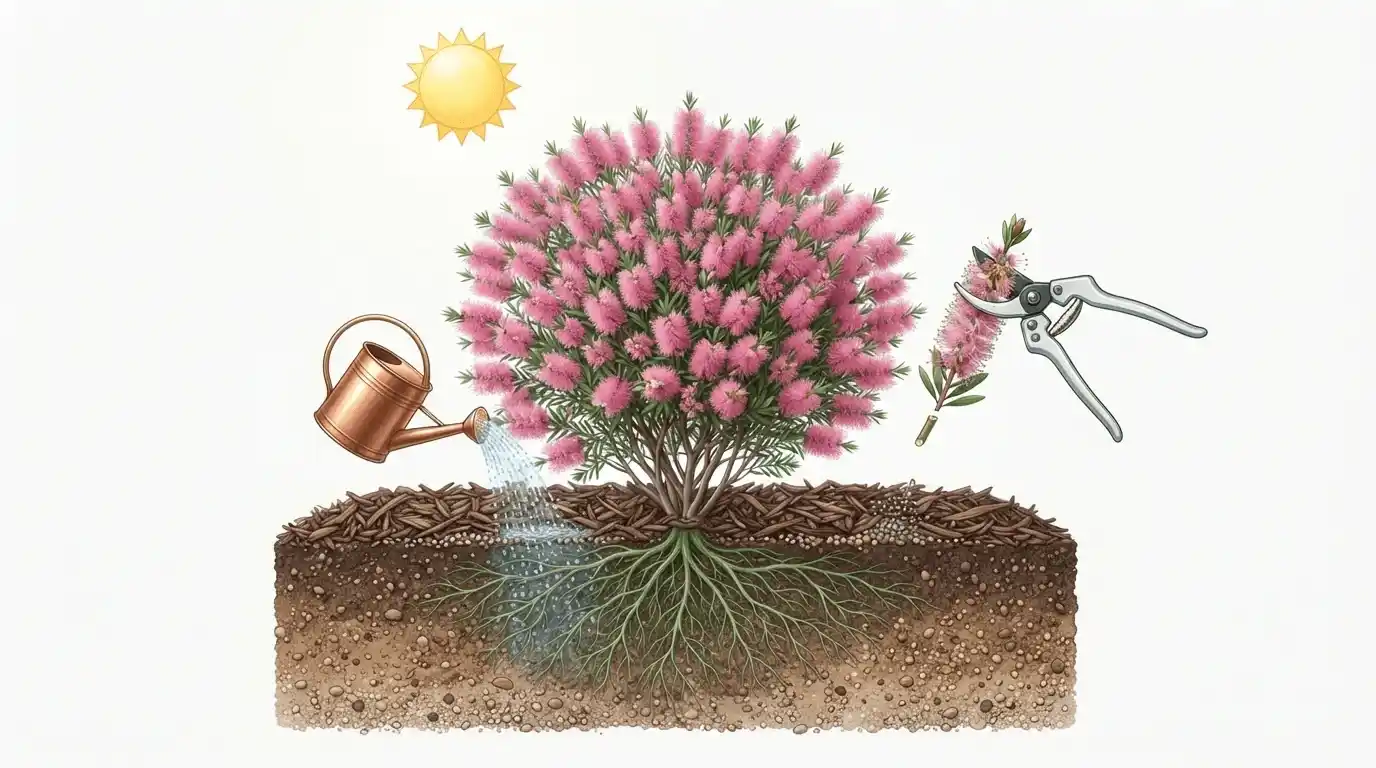
Melaleuca Candy Sparkles is a low-maintenance Australian native plant that performs best when its basic growing requirements are met. Providing the right balance of sunlight, water, soil conditions, nutrition, and pruning helps maintain healthy foliage and encourages abundant flowering year after year.
Light Requirements
Melaleuca Candy Sparkles thrives in full sun, where it receives at least 6–8 hours of direct sunlight each day.
Growing in full sun promotes:
- Abundant flowering
- Compact, dense growth
- Strong branch development
- Improved disease resistance
- Rich foliage colour
Although the plant can tolerate partial shade, reduced sunlight often results in:
- Fewer flowers
- Longer, weaker stems
- More open growth
- Reduced overall vigour
For the best ornamental display, plant it in the sunniest location available with good air circulation.
Watering Needs
Water requirements differ depending on whether the plant is newly established or fully mature.
Newly Planted Specimens
During the first 12–18 months after planting:
- Water deeply once or twice each week.
- Adjust watering according to rainfall and temperature.
- Keep the soil evenly moist but never waterlogged.
Deep watering encourages the roots to grow deeper into the soil, improving drought tolerance as the plant matures.
Established Plants
Once established, Melaleuca Candy Sparkles is relatively drought tolerant and usually requires supplemental watering only during prolonged dry periods or extreme summer heat.
Deep, infrequent watering is preferable to frequent shallow irrigation because it promotes stronger root systems and healthier long-term growth.
At Greenery Inside, we’ve consistently found that mature plants flower more reliably when the soil is allowed to dry slightly between watering rather than remaining constantly wet.
Soil Preferences
Melaleuca Candy Sparkles adapts to a wide range of soil types provided they offer excellent drainage.
Suitable soil types include:
- Sandy soil
- Sandy loam
- Loam
- Well-drained clay loam
- Raised garden beds
Drainage
Good drainage is one of the most important factors for healthy growth.
Avoid planting in locations where water remains after heavy rain, as prolonged waterlogging can lead to:
- Root rot
- Yellowing foliage
- Reduced flowering
- Poor overall growth
If your garden has heavy clay soil, improve drainage by incorporating compost and coarse organic matter before planting or consider using a raised garden bed.
Soil pH
The ideal soil pH ranges between 5.5 and 7.0, making slightly acidic to neutral soils the most suitable.
Although the plant tolerates mildly alkaline soils, extremely alkaline conditions can reduce nutrient availability and affect overall plant health.
Fertilizing
Melaleuca Candy Sparkles has relatively modest nutrient requirements compared to many ornamental shrubs.
Feeding is generally beneficial:
- In early spring
- During establishment
- When signs of nutrient deficiency become apparent
Choose a fertilizer specifically formulated for Australian native plants. These products contain lower phosphorus levels, which are better suited to many native species.
A suitable fertilizer should provide:
- Controlled nutrient release
- Low phosphorus content
- Balanced micronutrients
Avoid:
- High-phosphorus fertilizers
- Excessive nitrogen applications
- Heavy or frequent feeding
Over-fertilizing often encourages lush leafy growth at the expense of flowering and may reduce the plant’s natural resilience.
As of current horticultural recommendations (2026), slow-release native fertilizers remain the preferred option because they provide consistent nutrition without promoting excessive soft growth.
Pruning
Regular pruning helps maintain a neat shape, encourages denser branching, and supports heavier flowering in the following season.
The best time to prune is immediately after flowering, allowing the plant sufficient time to develop new flowering wood before the next blooming cycle.
Light annual pruning provides several benefits:
- Encourages compact growth
- Promotes more flowers
- Improves air circulation
- Maintains an attractive natural shape
- Removes spent flower heads
Routine maintenance should also include removing:
- Dead branches
- Damaged stems
- Crossing branches
- Diseased or weak growth
Avoid cutting heavily into old, leafless wood unless rejuvenation is necessary, as recovery may be slow.
Practical Pruning Tips
- Use clean, sharp secateurs to make clean cuts.
- Remove no more than one-third of the canopy in a single season.
- Thin crowded interior branches to improve airflow.
- Shape lightly rather than shearing heavily.
- Always prune after flowering to preserve the following season’s flower buds.
In our experience growing Australian native melaleucas, consistent light pruning each year produces a fuller canopy, stronger branching, and a noticeably more impressive floral display than occasional hard pruning. This simple maintenance routine also helps preserve the plant’s naturally attractive form while extending its ornamental value in the landscape.
Can Melaleuca Candy Sparkles Grow in Pots?
Yes, Melaleuca Candy Sparkles can be successfully grown in pots provided it is planted in a large container with excellent drainage and receives consistent care. Container growing is an excellent option for patios, courtyards, balconies, and small gardens where planting space is limited. Growing Melaleuca Candy Sparkles in pots also allows gardeners to move the plant to protect it from extreme weather or redesign outdoor spaces more easily.
Although container-grown plants typically remain slightly smaller than those planted in the ground, they still produce attractive evergreen foliage and abundant pink flowers when given suitable conditions.
Choosing the Right Container
Selecting an appropriately sized pot is one of the most important factors for long-term success.
Consider the following recommendations:
- Choose a container at least 45–60 cm (18–24 inches) wide and deep for young plants.
- Upgrade to a larger container as the plant matures.
- Use pots with multiple drainage holes to prevent waterlogging.
- Heavy ceramic, terracotta, or quality resin pots provide greater stability for taller specimens.
A premium native plant potting mix or a well-draining mix containing composted bark, coarse sand, and perlite helps maintain adequate moisture while preventing overly wet conditions.
Applying a layer of organic mulch over the soil surface also helps retain moisture and regulate soil temperature. Keep mulch a few centimetres away from the stem to reduce the risk of rot.
Container Care Considerations
Container-grown plants require slightly more attention than those growing in the ground because potting mixes dry out more quickly.
For healthy growth:
- Water thoroughly whenever the top few centimetres of potting mix begin to dry.
- Feed with a slow-release fertilizer formulated for Australian native plants in early spring.
- Inspect drainage holes regularly to ensure they remain clear.
- Repot every 2–3 years or when roots begin circling inside the container.
- Refresh the potting mix during repotting to maintain good structure and nutrient availability.
At Greenery Inside, we’ve found that placing container-grown Melaleuca Candy Sparkles in a location that receives morning sun and afternoon airflow helps reduce heat stress during hot Australian summers while still encouraging excellent flowering.
Understanding the Melaleuca Candy Sparkles Root System
The Melaleuca Candy Sparkles root system is generally considered non-invasive under normal garden conditions. Like many Australian native shrubs and small trees, it develops a broad, fibrous root network that efficiently absorbs moisture and nutrients without producing the aggressive surface roots associated with some larger tree species.
Understanding how the roots grow helps gardeners choose suitable planting locations and maintain healthy plants over the long term.
The roots typically spread wider than they grow deep, especially in well-drained soils where oxygen is readily available. In heavier soils, root growth may remain shallower due to reduced aeration.
Root System Characteristics
| Feature | Typical Characteristics |
| Root depth | Moderate, generally 60–120 cm depending on soil |
| Root spread | Often extends beyond the canopy as the plant matures |
| Invasiveness | Generally considered non-invasive |
| Suitable planting locations | Gardens, borders, screens, courtyards, large containers |
Although the root system is not usually problematic, it is still good practice to provide adequate spacing from permanent structures.
Recommended planting distances include:
- At least 2 metres from house foundations.
- Around 1.5–2 metres from paved pathways and driveways.
- Away from underground plumbing where practical.
- Sufficient spacing from neighbouring shrubs to allow healthy root competition.
Deep watering during establishment encourages roots to grow downward rather than remaining near the soil surface, improving drought tolerance over time.
From our experience growing native melaleucas, plants established in well-drained soil develop stronger and more resilient root systems than those planted in compacted or poorly drained ground.
Landscaping Ideas for Melaleuca Candy Sparkles
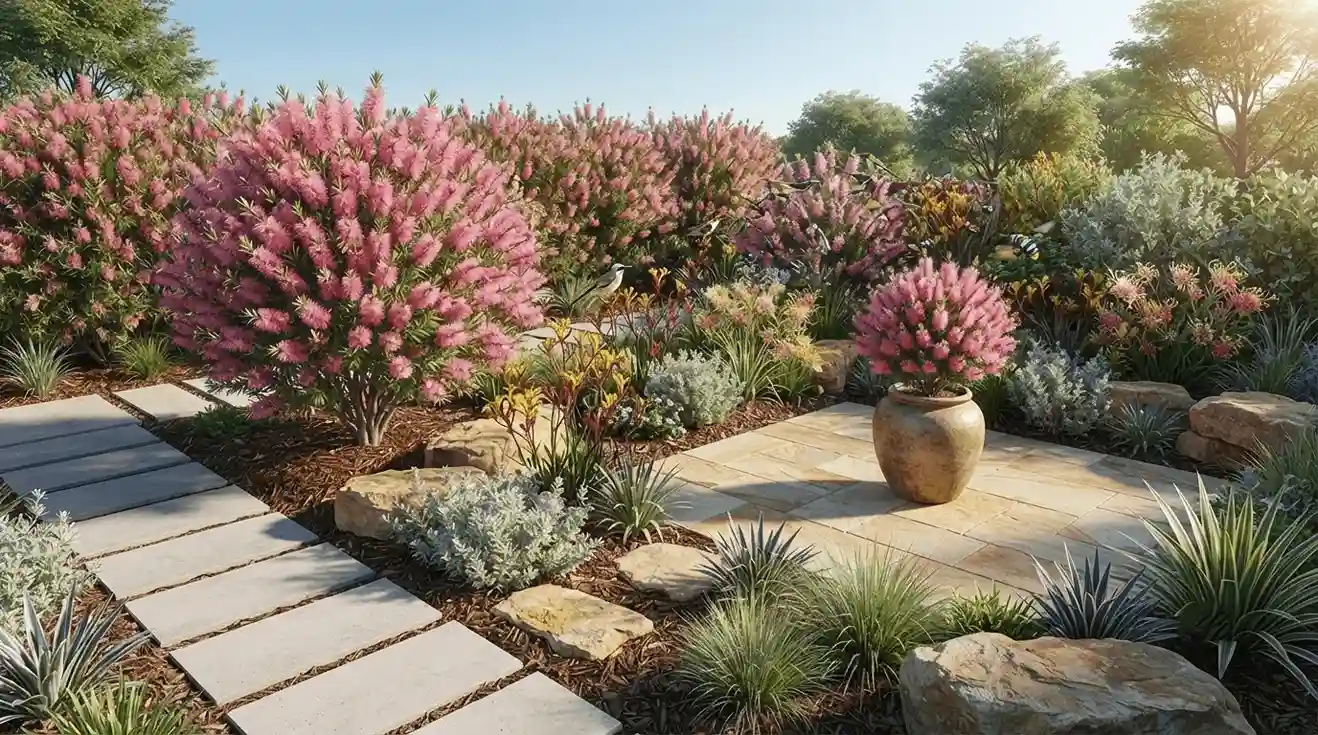
Melaleuca Candy Sparkles is a versatile ornamental native that fits naturally into a wide range of landscape styles. Its colourful flowers, evergreen foliage, and manageable size make it suitable as both a feature plant and part of larger mixed plantings.
You can strengthen the landscaping value of Melaleuca Candy Sparkles by pairing it with other structured planting guides such as Australian screening and privacy designs, including ideas from Australian Native Screening Trees, compact flowering companions like Dwarf Bottlebrush, and low-maintenance hedge combinations such as Melaleuca Nesophila Hedge, all of which help create layered Australian native garden structure.
Because it flowers over an extended period and attracts pollinators, it adds seasonal colour while contributing to garden biodiversity.
Garden Design Applications
Melaleuca Candy Sparkles performs well in numerous landscape settings.
Popular uses include:
- Feature specimen in front gardens.
- Australian native gardens.
- Wildlife-friendly landscapes.
- Informal flowering hedges.
- Mixed shrub borders.
- Courtyard gardens.
- Small ornamental trees.
- Water-wise landscapes.
- Screening between outdoor living areas.
- Council and streetscape plantings.
Its naturally rounded habit complements both contemporary and traditional garden designs.
When planted in groups, the bright pink flowers create an eye-catching display during the flowering season while the evergreen foliage provides year-round structure.
Companion Planting Ideas
Combining Melaleuca Candy Sparkles with other Australian native species creates attractive, low-maintenance landscapes that support local wildlife.
Suitable companion plants include:
- Kangaroo Paw (Anigozanthos species)
- Westringia (Westringia fruticosa)
- Bottlebrush (Callistemon species)
- Grevillea cultivars
- Correa species
- Lomandra species
- Dianella species
- Native grasses such as Poa labillardierei
For attractive colour combinations, consider pairing its vivid pink flowers with:
- Purple-flowering native shrubs
- White-flowering paperbarks
- Silver-foliaged native plants
- Blue-flowering Australian natives
Texture contrast can also improve landscape appeal. Fine-leaved grasses, strappy foliage, and broader-leaved shrubs create visual balance while enhancing biodiversity.
Melaleuca Candy Sparkles Compared With Similar Melaleuca Varieties
Several ornamental melaleucas share similar characteristics, making identification challenging for new gardeners. Comparing their flowers, growth habits, and landscape uses helps determine which variety is most suitable for a particular garden.
Melaleuca Candy Sparkles vs Melaleuca viridiflora
Because Melaleuca Candy Sparkles is closely associated with Melaleuca viridiflora, the two plants share several botanical characteristics.
However, important differences exist.
| Feature | Melaleuca Candy Sparkles | Melaleuca viridiflora |
| Growth habit | Compact shrub or small tree | Larger shrub to medium tree |
| Flower colour | Bright pink | Cream, greenish, red, or variable depending on form |
| Landscape use | Ornamental gardens, feature planting | Naturalistic landscapes, restoration planting |
| Maintenance | Compact with light pruning | May require more space |
Candy Sparkles is primarily selected for ornamental performance, while Melaleuca viridiflora is valued for its ecological significance and broader natural distribution.
Melaleuca Candy Sparkles vs Melaleuca armillaris
Melaleuca armillaris, commonly known as Bracelet Honey Myrtle, differs noticeably from Candy Sparkles despite belonging to the same genus.
Key differences include:
- Flowers: Candy Sparkles produces bright pink flower spikes, whereas Melaleuca armillaris usually bears creamy white flowers.
- Foliage: Candy Sparkles has softer ornamental foliage, while M. armillaris develops denser needle-like leaves.
- Mature size: M. armillaris often grows larger and is more suitable for shelterbelts or larger gardens.
- Hardiness: Both are hardy Australian natives, although M. armillaris is particularly tolerant of coastal exposure and wind.
Some gardeners may encounter cultivars marketed as Melaleuca armillaris pink, but these are distinct from Candy Sparkles and should not be confused.
Other Similar Pink-Flowering Melaleucas
Several ornamental cultivars produce pink flowers and may appear similar at first glance.
These include:
- Melaleuca Pink Surprise – Known for prolific pink flowering and compact growth.
- Melaleuca thymifolia ‘Cotton Candy’ – A smaller shrub with delicate foliage and soft pink flowers.
- Other ornamental paperbark cultivars selected for colourful blooms and compact forms.
It’s worth noting that names such as Melaleuca Pink Surprise and Melaleuca thymifolia Cotton Candy refer to different cultivars with their own unique growth habits, flowering characteristics, and landscape applications.
Comparison Table
| Variety | Flower Colour | Mature Size | Best Landscape Use |
| Melaleuca Candy Sparkles | Bright pink | 2–4 m | Feature plant, native gardens, informal hedges |
| Melaleuca viridiflora | Cream, greenish, red forms | 4–8 m | Natural landscapes, habitat restoration |
| Melaleuca armillaris | White to cream | 4–8 m | Coastal gardens, screening, windbreaks |
| Melaleuca Pink Surprise | Pink | 2–4 m | Ornamental feature planting |
| Melaleuca thymifolia ‘Cotton Candy’ | Soft pink | 1–2 m | Small gardens, borders, containers |
Common Growing Problems and How to Fix Them
Melaleuca Candy Sparkles is generally a hardy and resilient plant, but unsuitable growing conditions can affect its appearance, flowering, and overall health. Identifying problems early allows gardeners to correct them before long-term damage occurs.
Poor Flowering
If Melaleuca Candy Sparkles produces healthy foliage but few flowers, environmental conditions are often the cause.
Common reasons include:
- Insufficient sunlight.
- Excessive nitrogen fertilizer.
- Pruning at the wrong time.
- Young plants that have not fully matured.
How to fix it:
- Plant in full sun.
- Use a low-phosphorus native fertilizer.
- Prune immediately after flowering rather than before the flowering season.
- Avoid excessive fertilization that encourages leafy growth instead of blooms.
Yellowing Leaves
Yellow foliage usually indicates stress rather than disease.
Possible causes include:
- Waterlogged soil.
- Poor drainage.
- Nutrient imbalance.
- Compacted soil.
- Temporary transplant shock.
How to fix it:
- Improve soil drainage.
- Reduce watering frequency if soil remains wet.
- Apply a balanced native fertilizer if nutrient deficiency is suspected.
- Mulch appropriately to regulate soil moisture.
Slow Growth
Slower-than-expected growth often results from environmental limitations.
Common contributing factors include:
- Poor-quality soil.
- Insufficient sunlight.
- Limited moisture during establishment.
- Root competition from nearby plants.
- Cooler climates.
How to fix it:
- Improve soil with organic matter.
- Ensure at least six hours of direct sunlight daily.
- Water deeply during dry periods.
- Maintain adequate spacing from neighbouring vegetation.
Pest and Disease Issues
Melaleuca Candy Sparkles is generally resistant to serious pests and diseases when grown under suitable conditions.
Occasional issues may include:
- Scale insects
- Aphids
- Psyllids
- Sooty mould (secondary to sap-sucking insects)
- Root rot in poorly drained soils
Preventative care remains the most effective management strategy.
Healthy maintenance practices include:
- Planting in well-drained soil.
- Avoiding overwatering.
- Pruning to improve air circulation.
- Inspecting foliage regularly for early signs of pests.
- Removing damaged or diseased branches promptly.
In our experience at Greenery Inside, healthy plants growing in full sun with good drainage rarely experience significant pest or disease problems. Most issues can be prevented through proper watering, sensible pruning, and selecting an appropriate planting location from the beginning.
Beginner Mistakes to Avoid When Growing Melaleuca Candy Sparkles
Although Melaleuca Candy Sparkles is considered an easy-care Australian native, a few common mistakes can reduce flowering, slow growth, or shorten the plant’s lifespan. Avoiding these issues from the beginning helps establish a healthier, more resilient plant.
Planting in Poorly Drained Soil
The most common cause of failure is planting in soil that remains wet after rain or irrigation. Constantly saturated soil reduces oxygen around the roots, increasing the risk of root rot and poor growth.
How to avoid it:
- Choose a well-drained planting site.
- Improve heavy clay soils with organic matter.
- Consider raised garden beds if drainage is poor.
Overwatering Established Plants
Young plants require regular watering, but mature specimens become relatively drought tolerant.
Too much water can lead to:
- Yellow leaves
- Root diseases
- Reduced flowering
- Weak growth
Water deeply but allow the soil to dry slightly between irrigations.
Using High-Phosphorus Fertilizers
Many Australian native plants are sensitive to excessive phosphorus. Using general-purpose fertilizers can encourage excessive leafy growth while reducing overall plant health.
Instead, apply a slow-release fertilizer specifically formulated for Australian native plants.
Pruning at the Wrong Time
Heavy pruning before or during the flowering season removes developing flower buds and reduces the floral display.
For the best results:
- Prune immediately after flowering.
- Remove dead, damaged, or crossing branches as needed.
- Avoid removing more than one-third of the canopy in a single season.
Choosing an Unsuitable Planting Location
Although adaptable, Melaleuca Candy Sparkles performs best in locations that receive plenty of sunlight and good airflow.
Avoid planting in:
- Deep shade
- Permanently wet areas
- Crowded planting beds
- Poorly ventilated corners
Ignoring Mature Size
Young nursery plants appear compact, leading some gardeners to plant them too close to buildings or neighbouring shrubs.
Before planting, allow sufficient room for the mature canopy and root system to develop naturally. Proper spacing improves airflow, reduces disease pressure, and minimizes future pruning.
At Greenery Inside, we’ve found that planning for the plant’s mature size rather than its nursery size results in healthier landscapes and significantly less maintenance over time.
Environmental Conditions That Affect Growth and Flowering
Melaleuca Candy Sparkles is well adapted to many Australian climates, but environmental conditions strongly influence its overall performance, flowering intensity, and growth rate.
Frost Tolerance
Established plants tolerate light frosts better than newly planted specimens.
In regions with frequent frost:
- Protect young plants during their first winter.
- Apply mulch to help insulate the root zone.
- Cover plants with frost cloth during severe cold events if necessary.
Once mature, the plant usually recovers well from occasional light frost damage.
Coastal Conditions
Melaleuca Candy Sparkles performs well in many coastal gardens due to its tolerance of:
- Salt-laden air
- Coastal winds
- Sandy soils
However, extremely exposed beachfront sites may require temporary protection while young plants establish.
Heat Tolerance
As an Australian native, Melaleuca Candy Sparkles is highly tolerant of summer heat once established.
During prolonged heatwaves:
- Water deeply when needed.
- Maintain organic mulch around the base.
- Avoid heavy pruning during periods of extreme heat.
Wind Exposure
Moderate wind generally causes few problems and can even improve airflow around the foliage.
Very strong winds may:
- Damage young branches
- Dry out container-grown plants more quickly
- Increase water requirements
Staking young plants during establishment may be beneficial in particularly windy locations.
Rainfall
The plant adapts well to regions with moderate seasonal rainfall but dislikes prolonged waterlogged conditions.
Extended dry periods may reduce:
- Flower production
- New shoot growth
- Leaf size
Supplemental watering during drought helps maintain healthy growth.
Seasonal Flowering Performance
Flowering is influenced by several environmental factors, including:
- Sunlight exposure
- Temperature
- Soil moisture
- Nutrient availability
- Pruning practices
Plants growing in full sun with balanced nutrition and proper watering typically produce the heaviest floral displays.
As of the 2026 growing season, Australian native plant specialists continue to recommend deep, infrequent watering and annual post-flowering pruning as the most effective practices for encouraging reliable flowering in ornamental melaleucas.
Related Melaleuca Species and Commonly Confused Plants
The genus Melaleuca contains more than 300 recognised species, many of which share similar foliage, flowers, and bark characteristics. As a result, Melaleuca Candy Sparkles is sometimes confused with other ornamental paperbarks or similarly named cultivars.
Understanding these differences helps gardeners choose the right plant for their landscape.
Melaleuca viridiflora
Melaleuca viridiflora is one of the closest botanical relatives of Candy Sparkles and occurs naturally across northern Australia.
Compared with Candy Sparkles, it generally:
- Grows larger.
- Produces more variable flower colours, including cream, greenish-yellow, and red forms.
- Is commonly used in habitat restoration and natural landscapes.
- Develops into a medium-sized tree under favourable conditions.
Some selections sold as Melaleuca viridiflora red feature striking reddish flower spikes, while Melaleuca viridiflora weeping refers to forms with a graceful pendulous growth habit.
The name Viridiflora is simply derived from the species’ botanical name and is often used informally by native plant enthusiasts.
Melaleuca armillaris
Known as the Bracelet Honey Myrtle or Honey Bracelet Myrtle, Melaleuca armillaris differs from Candy Sparkles in several important ways.
It typically has:
- Creamy white flowers.
- Finer needle-like foliage.
- A taller, more upright growth habit.
- Excellent tolerance to coastal conditions and wind.
Because of its dense branching, it is commonly planted as a windbreak, screening plant, or shelterbelt rather than as a flowering feature shrub.
Weeping Melaleuca
The common name Weeping Melaleuca is used for several species that develop arching or pendulous branches.
Although visually attractive, these species differ from Candy Sparkles in:
- Overall form
- Mature size
- Branch structure
- Landscape applications
Always check the botanical name when purchasing plants to ensure you receive the desired cultivar.
Understanding Similar Cultivar Names
Several ornamental plants sold under “cotton candy” or similar names may not be closely related to Melaleuca Candy Sparkles.
For example:
- Melaleuca Cotton Candy may refer to selected ornamental melaleuca cultivars in some nurseries.
- Cotton Candy Bush is a common name that may describe entirely different shrubs depending on the country.
- Cotton Candy Plant is also used regionally for unrelated ornamental species with soft pink flowers or fluffy blooms.
Because common names vary widely, purchasing plants by their botanical or registered cultivar names is the most reliable way to obtain the correct species.
Conclusion
Melaleuca Candy Sparkles is a versatile Australian native ornamental shrub or small tree that combines vibrant pink flowers, evergreen foliage, and reliable garden performance. Its compact growth habit, manageable root system, and adaptability make it suitable for feature planting, informal hedges, wildlife gardens, and even large containers.
Providing full sun, well-drained soil, appropriate watering during establishment, and light pruning after flowering encourages healthy growth and abundant seasonal blooms. Understanding its mature size and selecting the right planting location from the outset helps minimise future maintenance while allowing the plant to reach its full ornamental potential.
Whether you’re creating a water-wise landscape, enhancing biodiversity, or designing a modern Australian native garden, Melaleuca Candy Sparkles is an excellent long-term choice that delivers colour, structure, and ecological value with relatively little ongoing care.
Frequently Asked Questions
How big does Melaleuca Candy Sparkles grow?
Melaleuca Candy Sparkles typically reaches 2–4 metres (6.5–13 feet) in height with a spread of 2–3 metres (6.5–10 feet). Its mature size varies depending on climate, soil quality, sunlight, and pruning practices.
Is Melaleuca Candy Sparkles an Australian native?
Yes. Melaleuca Candy Sparkles is an Australian native ornamental cultivar developed from native Melaleuca species closely related to Melaleuca viridiflora. It retains the hardiness and ecological value associated with Australian paperbarks.
Can Melaleuca Candy Sparkles be grown in pots?
Yes. It grows well in large containers with excellent drainage and a premium native plant potting mix. Container-grown plants require more frequent watering, regular feeding with a native fertilizer, and repotting every few years as they mature.
Does Melaleuca Candy Sparkles have invasive roots?
No. The Melaleuca Candy Sparkles root system is generally considered non-invasive. It develops a broad, fibrous root network that is unlikely to damage paths or foundations when planted with appropriate spacing.
How often should Melaleuca Candy Sparkles be watered?
Newly planted specimens should be watered deeply once or twice a week until established. Mature plants generally require supplemental watering only during prolonged dry periods or extreme heat.
When does Melaleuca Candy Sparkles flower?
Flowering usually begins in spring and continues into summer, although the exact timing varies with local climate and growing conditions. Plants growing in full sun typically produce the most abundant floral displays.
What is the difference between Melaleuca Candy Sparkles and Melaleuca viridiflora?
Melaleuca Candy Sparkles is a cultivated ornamental selection with compact growth and vibrant pink flowers, while Melaleuca viridiflora is a naturally occurring Australian species that generally grows larger and produces flowers in cream, greenish-yellow, or red forms depending on the population.
Is Melaleuca Candy Sparkles suitable for coastal gardens?
Yes. Once established, Melaleuca Candy Sparkles performs well in many coastal gardens due to its tolerance of salt-laden air, wind, and warm conditions. Young plants may benefit from temporary protection in highly exposed beachfront locations until their root systems become well established.