Introduction
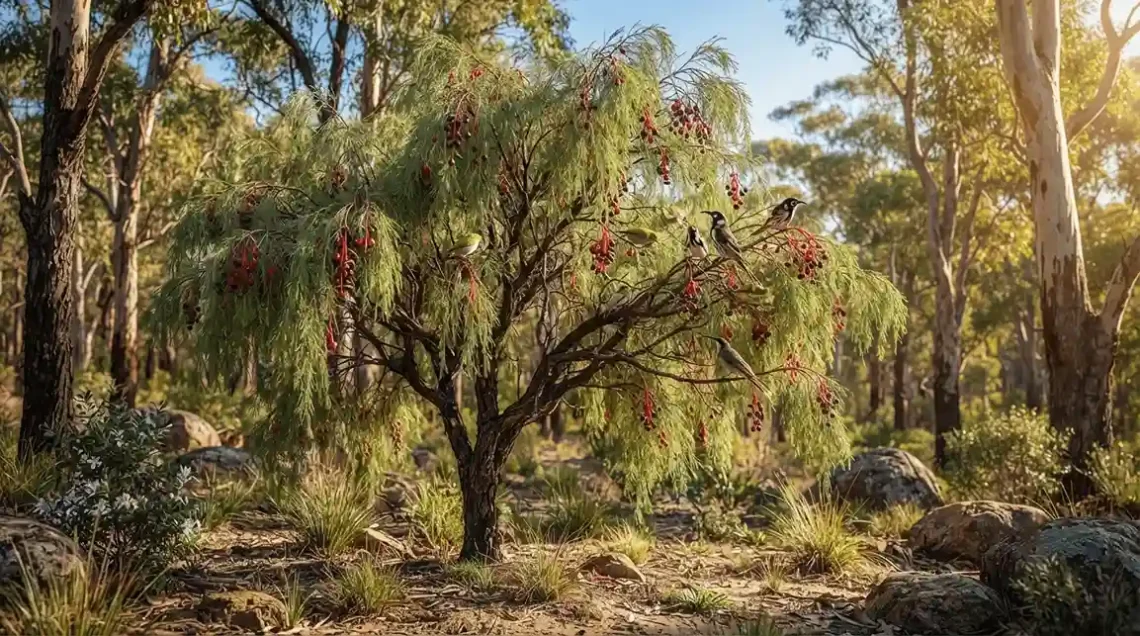
The native cherry tree (Exocarpos cupressiformis) is one of Australia’s most distinctive native trees, admired for its bright red fruit-like structures, graceful evergreen foliage, and remarkable semi-parasitic growth habit. Commonly known as the Australian native cherry, cherry ballart, or simply ballart, this species naturally grows across southern and eastern Australia. Unlike commercial cherry trees, it belongs to a completely different botanical family and produces edible fleshy red stems that surround a hard seed rather than true cherries. Today, the Australian native cherry tree is widely planted in native gardens, bushland restoration projects, and wildlife habitats because it combines ornamental beauty with ecological benefits while thriving in many Australian landscapes.
Quick Summary
- Exocarpos cupressiformis is the botanical name of the Australian native cherry tree.
- The tree produces edible red fleshy stems surrounding a hard seed instead of true cherries.
- It is a semi-parasitic native species that forms root connections with nearby plants to obtain additional water and nutrients.
- Native cherry trees are valued for supporting biodiversity, attracting wildlife, and enhancing Australian native gardens.
- Once established with suitable host plants, they become drought tolerant and long-lived.
What Is a Native Cherry Tree?
A native cherry tree is an evergreen Australian native tree belonging to the species Exocarpos cupressiformis. It is recognised for its fine, drooping foliage and vivid red edible fleshy stems that resemble cherries during the fruiting season. Although its appearance has earned it the common name “native cherry,” it is not closely related to traditional cherry trees grown for commercial fruit production.
The species naturally occurs in woodlands, open forests, heathlands, and coastal environments throughout much of southern and eastern Australia. Its distinctive appearance, adaptability, and ecological importance have made it increasingly popular in native gardens and habitat restoration projects.
The tree is commonly known by several names, including:
- Australian native cherry
- Native cherry
- Cherry ballart
- Ballart
One of its most fascinating features is its semi-parasitic nature. While the tree produces its own energy through photosynthesis, it also forms specialised underground root connections with neighbouring plants to obtain supplementary water and nutrients. This natural adaptation helps the species survive in Australia’s nutrient-poor soils without seriously affecting healthy host plants.
In our experience growing Australian native species, many gardeners are surprised to learn that the native cherry depends on nearby plants while still functioning as a healthy, self-sustaining tree.
Scientific Classification
| Classification | Details |
| Botanical name | Exocarpos cupressiformis |
| Family | Santalaceae |
| Common names | Australian native cherry, native cherry, cherry ballart, ballart |
| Plant type | Evergreen semi-parasitic native tree |
| Native distribution | Southern and eastern Australia, including Victoria, Tasmania, New South Wales, South Australia, ACT, and parts of Queensland |
| Distinguishing features | Fine needle-like foliage, small greenish flowers, bright red fleshy stems surrounding a hard seed |
Exocarpos cupressiformis belongs to the sandalwood family (Santalaceae), a group of plants known for their unique semi-parasitic characteristics. Unlike true cherry trees in the genus Prunus, the Australian native cherry develops a swollen, edible red stem beneath its seed rather than producing a true botanical fruit.
Are Cherry Trees Native to Australia?
No. Traditional cherry trees are not native to Australia. The sweet and sour cherries commonly grown for fruit belong to the genus Prunus, which originated in Europe, Asia, and parts of North America.
Australia’s native cherry is Exocarpos cupressiformis, an entirely different species that evolved naturally in Australian forests and woodlands. Although both plants produce red structures that resemble cherries, they differ significantly in their botanical classification, growth habit, fruit structure, and environmental adaptations.
The Australian native cherry is well adapted to Australia’s dry climates, nutrient-poor soils, and native ecosystems, making it an excellent choice for native landscaping and ecological restoration.
Native Cherry vs Traditional Cherry Trees
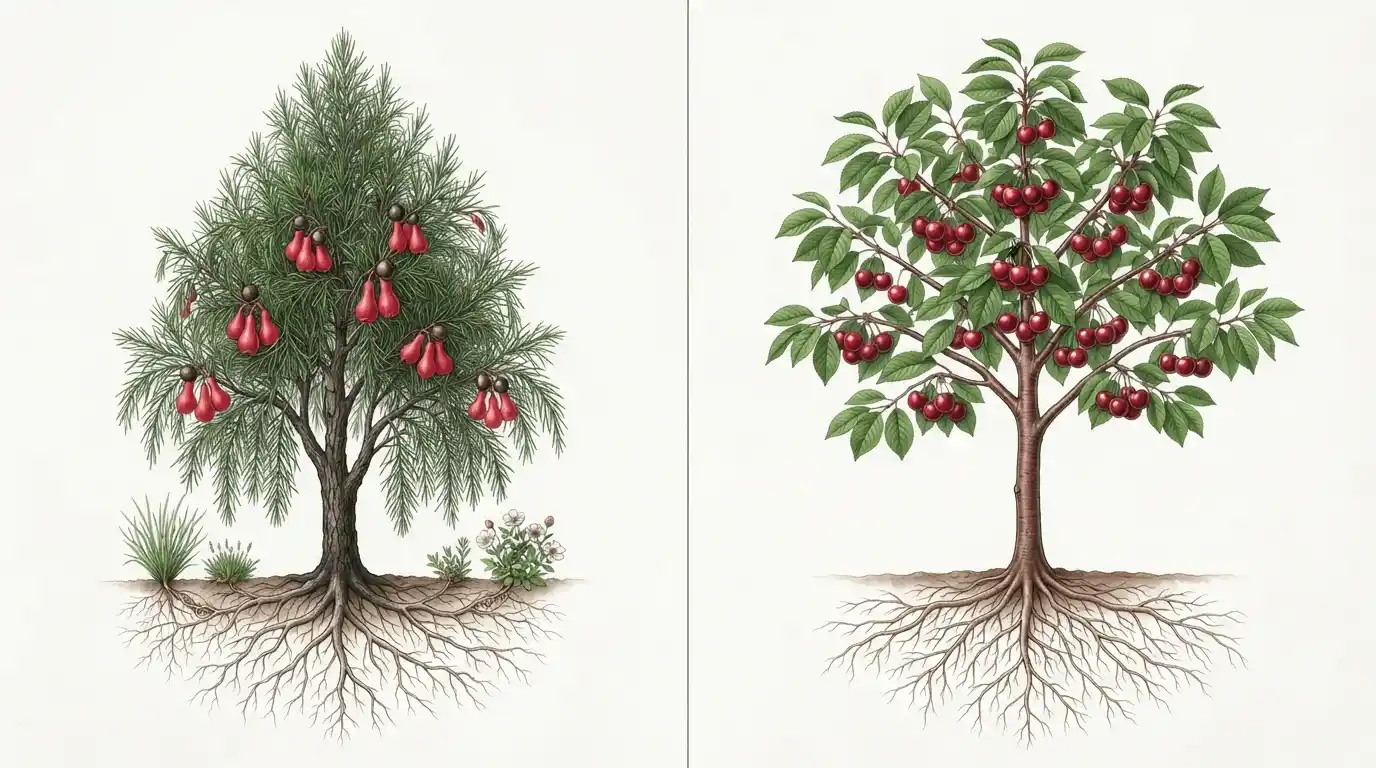
| Feature | Australian Native Cherry | Traditional Cherry Tree |
| Scientific name | Exocarpos cupressiformis | Prunus species |
| Native range | Australia | Europe, Asia, North America |
| Fruit type | Edible fleshy red stem surrounding a hard seed | True fleshy cherry fruit |
| Growth habit | Evergreen semi-parasitic native tree | Deciduous fruit tree |
| Wildlife value | Excellent food and habitat source | Moderate depending on species |
The two trees differ in several important ways:
- The Australian native cherry belongs to the sandalwood family, while traditional cherries belong to the rose family.
- The edible portion of the native cherry is a swollen stem rather than a true fruit.
- Native cherry trees remain evergreen throughout the year.
- They naturally form root connections with nearby native plants.
- They are far better adapted to Australia’s natural environments than introduced cherry species.
For gardeners looking to support native biodiversity, the Australian native cherry offers considerably greater ecological value than conventional cherry trees.
Where Does the Australian Native Cherry Grow?
The Australian native cherry grows naturally across much of southern and eastern Australia. It is commonly found in open forests, dry sclerophyll woodlands, heathlands, rocky hillsides, and coastal vegetation where soils are well drained and relatively low in nutrients. For gardeners planning a diverse Australian landscape, choosing from a range of Australian native garden trees can help create a more natural ecosystem while supporting local wildlife.
The species thrives in climates with warm summers and cool winters and is particularly successful where established native vegetation provides suitable host plants.
Its natural distribution includes:
- Victoria
- Tasmania
- New South Wales
- South Australia
- Australian Capital Territory
- Parts of Queensland
The tree performs best in sandy, gravelly, or rocky soils with excellent drainage. Heavy clay soils and prolonged waterlogging can reduce growth and increase the risk of poor establishment.
Greenery Inside recommends planting native cherry trees in locations that closely resemble their natural habitat, as this encourages stronger establishment and healthier long-term growth.
Native Cherry Tree Victoria
Victoria is one of the primary natural habitats of Exocarpos cupressiformis. The species is commonly found throughout native woodlands and forests where well-drained sandy or loamy soils dominate the landscape.
It performs particularly well in:
- Native gardens
- Bushland restoration projects
- Rural properties
- Wildlife-friendly landscapes
- Council revegetation programs
Victoria’s temperate climate provides favourable growing conditions, especially when trees are planted alongside compatible native host species.
Once established, the native cherry tolerates seasonal drought and moderate frosts experienced across many parts of the state.
Native Cherry Tree Tasmania
The Australian native cherry also occurs naturally throughout many regions of Tasmania, particularly in dry forests, coastal vegetation, and open woodland communities.
Tasmania provides suitable growing conditions when the tree receives:
- Excellent soil drainage
- Full sun to light shade
- Compatible native host plants
- Protection from prolonged waterlogging
Growth may be slightly slower in cooler Tasmanian climates, but healthy trees develop steadily under suitable conditions. The species is increasingly used in conservation plantings because it supports native birds, contributes to biodiversity, and integrates well into local ecosystems.
As of 2026, many native plant nurseries continue to recommend locally sourced Tasmanian plants for restoration projects, as local provenance specimens often establish more successfully within regional environments.
Plant Characteristics of Exocarpos cupressiformis
The Australian native cherry is an elegant evergreen tree with a light, airy appearance that stands out during its fruiting season when brilliant red fleshy stems develop beneath the seeds.
Key identifying features include:
- Graceful upright to spreading tree form
- Fine, slender, needle-like evergreen foliage
- Grey to brown bark that becomes rougher with age
- Small, inconspicuous greenish flowers
- Bright red fleshy stems surrounding a hard central seed
- Extensive root system capable of forming host attachments
Unlike many ornamental trees, Exocarpos cupressiformis combines photosynthesis with semi-parasitic root connections that help supplement water and nutrient uptake.
Its defining characteristics include:
- Evergreen
- Semi-parasitic
- Wildlife-friendly
- Long-lived
- Drought tolerant after establishment
In our experience, many first-time growers initially mistake the red fleshy stems for conventional cherries. However, these colourful structures are modified stems rather than true fruits, making this species one of Australia’s most botanically distinctive native trees.
Plant Size
The native cherry tree is generally classified as a small to medium-sized evergreen tree that suits a wide variety of Australian landscapes.
Under favourable growing conditions, mature trees typically reach:
| Characteristic | Typical Size |
| Mature height | 5–10 metres |
| Mature spread | 3–6 metres |
| Growth habit | Upright to slightly spreading |
Exceptional specimens growing under ideal bushland conditions may exceed these dimensions, while trees growing on exposed sites or poorer soils often remain smaller.
Several environmental factors influence the tree’s mature size, including:
- Availability of suitable host plants
- Soil drainage
- Rainfall
- Sunlight exposure
- Competition from surrounding vegetation
Its moderate size makes the Australian native cherry an excellent choice for:
- Small native gardens
- Wildlife gardens
- Bush-style landscapes
- Rural properties
- Habitat restoration projects
Growth Rate
The native cherry tree has a slow to moderate growth rate, especially during its first few years after planting. Young trees devote much of their energy to developing a healthy root system and establishing successful connections with nearby host plants before producing vigorous above-ground growth.
Most growth occurs during the warmer seasons when soil temperatures and moisture levels are favourable.
Growth speed is influenced by several factors, including:
- Suitable host species
- Well-drained soils
- Moderate soil moisture
- Seasonal rainfall
- Adequate sunlight
Trees growing without compatible host plants or in poorly drained soils often establish much more slowly than those planted in healthy native landscapes.
Greenery Inside recommends allowing several years for young native cherry trees to become fully established. With patience and suitable growing conditions, they develop into resilient, attractive native trees that require relatively little maintenance throughout their long lifespan.
How Does the Native Cherry Tree Grow?
The native cherry tree has one of the most unusual growth habits among Australian native plants. While it is a green, photosynthetic tree capable of producing its own food, it is also semi-parasitic, meaning it supplements its water and nutrient supply by connecting its roots to nearby host plants.
Unlike fully parasitic plants, Exocarpos cupressiformis does not rely entirely on another plant for survival. Instead, it uses a combination of photosynthesis and specialised root attachments to thrive in Australia’s naturally nutrient-poor soils. This adaptation allows the tree to survive in environments where many other species struggle.
Young native cherry trees spend much of their early growth establishing a healthy root system and locating suitable host plants. Once these underground connections develop, growth typically becomes more consistent.
Several factors influence successful growth:
- Presence of compatible host plants
- Well-drained, low-fertility soil
- Adequate sunlight
- Minimal root disturbance
- Moderate moisture during establishment
In our experience, gardeners who plant native cherry trees alongside suitable Australian native shrubs or trees generally achieve stronger establishment and healthier long-term growth than those planting the tree in isolation.
What Is a Semi-Parasitic Tree?
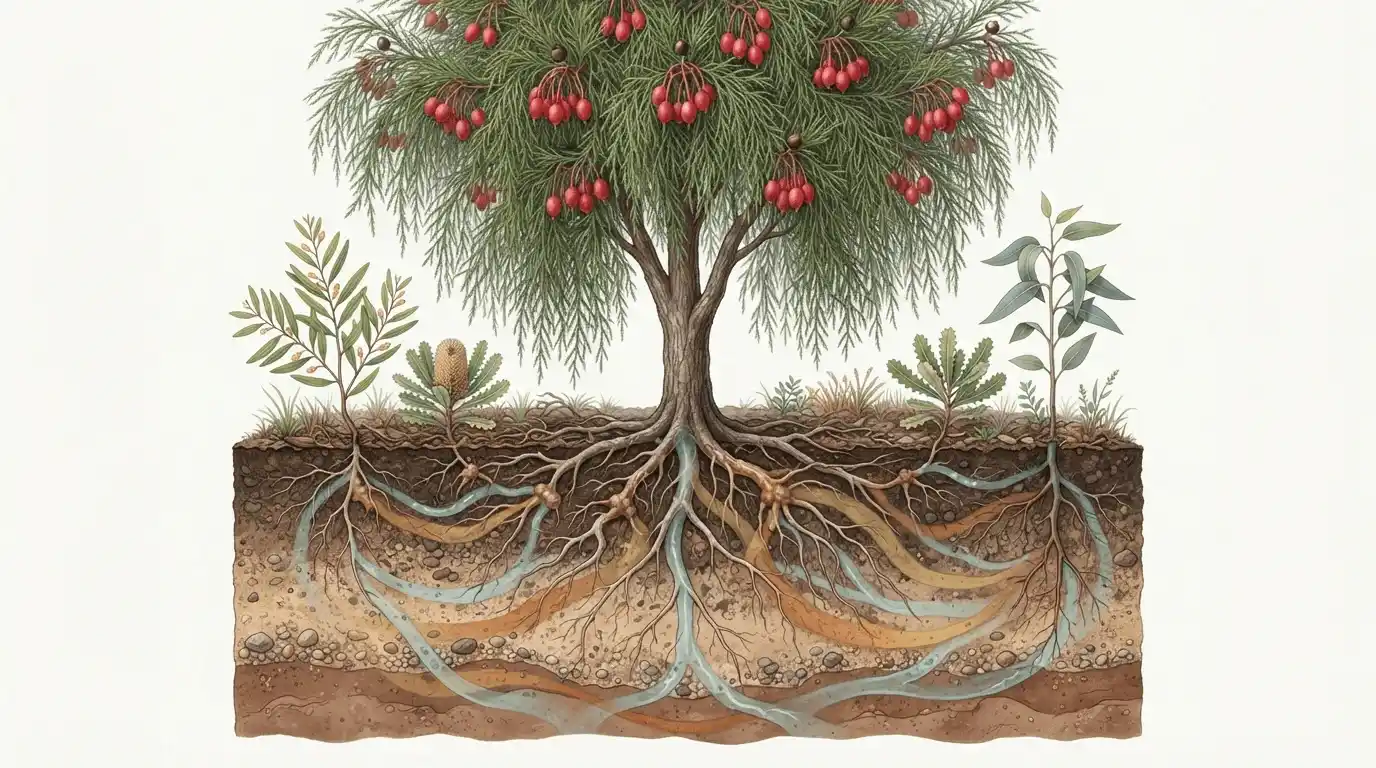
A semi-parasitic tree is a plant that produces its own energy through photosynthesis while obtaining additional water and mineral nutrients from neighbouring plants through specialised root structures called haustoria. Exocarpos cupressiformis belongs to the sandalwood family (Santalaceae), a group of plants known for unusual parasitic and semi-parasitic relationships. More information about this plant family can be found through the Santalaceae reference on Wikipedia.
For Exocarpos cupressiformis, these root attachments form naturally when compatible host plants are growing nearby. The tree connects to the roots of surrounding vegetation and draws small amounts of moisture and dissolved nutrients without significantly harming the host.
Unlike aggressive parasitic plants, the Australian native cherry usually coexists successfully with healthy host plants for many years.
Key characteristics of its semi-parasitic nature include:
- Forms underground root attachments
- Uses nearby plants as host species
- Continues to photosynthesise independently
- Supplements water and nutrient uptake
- Usually does not damage healthy host plants
This unique strategy is one of the reasons the species has adapted so well to Australia’s nutrient-deficient landscapes.
Suitable Host Plants
The native cherry tree grows best when planted near compatible Australian native species that can act as host plants. When designing mixed native gardens, gardeners can also explore native plants that grow in shade to create layered planting areas beneath taller trees and woodland species.
Examples include:
- Acacias (Wattles)
- Banksias
- Eucalypts
- Melaleucas (Paperbarks)
- Callistemons (Bottlebrushes)
- Grevilleas
- Hakeas
- Casuarinas and Allocasuarinas
- Tea trees (Leptospermum species)
These native plants naturally share habitats with Exocarpos cupressiformis and provide suitable root systems for establishing healthy underground connections.
Greenery Inside recommends planting the native cherry within a mixed native garden rather than as a standalone specimen. This closely replicates its natural woodland environment and usually results in better long-term performance.
Care Guide for Native Cherry Tree
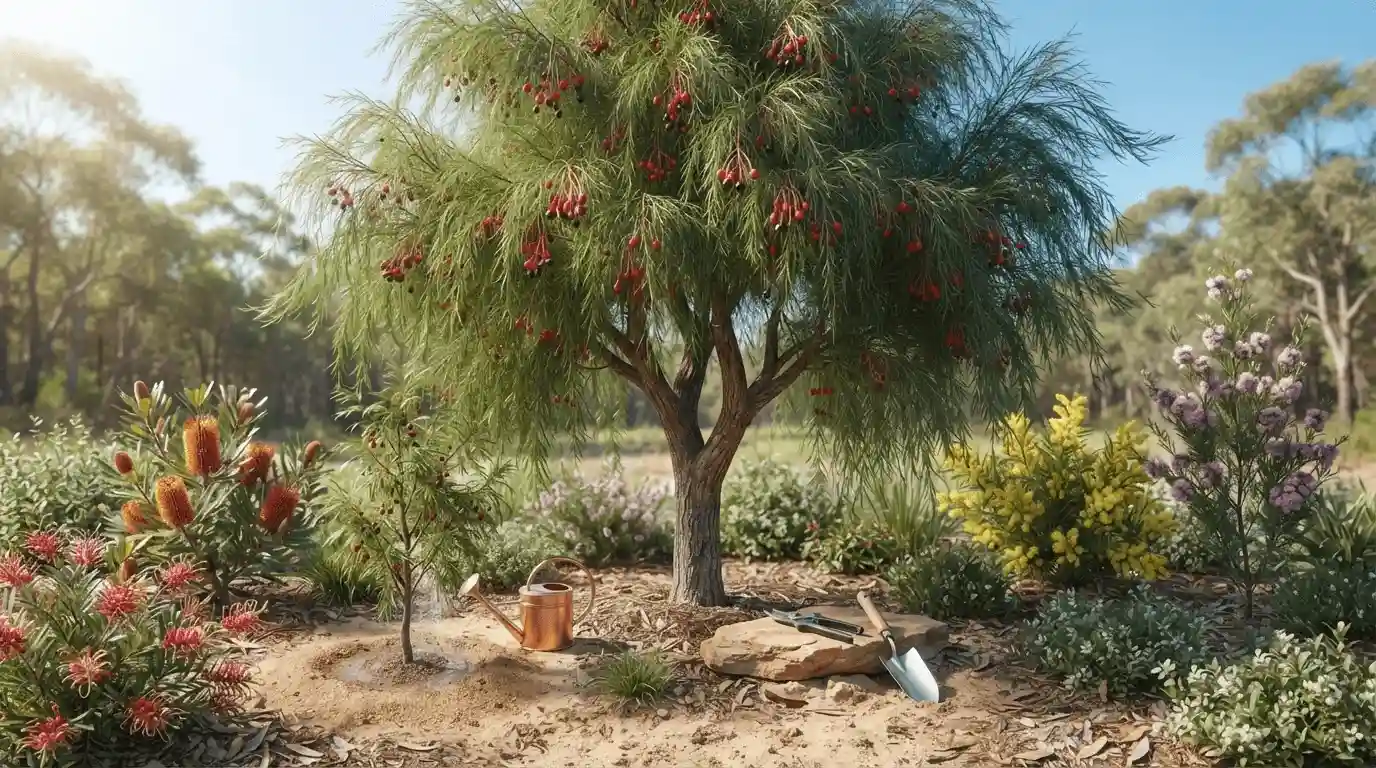
Although the Australian native cherry has specialised growing requirements, it is relatively low maintenance once established. Providing suitable growing conditions from the beginning significantly improves establishment and long-term health.
Light Requirements
The native cherry tree grows best in full sun, where it develops dense foliage and produces abundant flowering and fruit-like structures.
It also tolerates light shade, particularly beneath open woodland canopies. However, excessive shade can slow growth and reduce flowering.
For best results:
- Plant in full sun whenever possible.
- Light afternoon shade is acceptable in hotter inland regions.
- Avoid heavily shaded locations beneath dense tree canopies.
Soil Requirements
Well-drained soils are essential for healthy growth.
The species naturally grows in:
- Sandy soils
- Sandy loams
- Gravelly soils
- Rocky soils
- Low-fertility native soils
Heavy clay soils that remain wet for long periods are generally unsuitable because they restrict root development and increase the risk of root problems.
The native cherry is well adapted to nutrient-poor Australian soils and does not require highly fertile garden beds.
Watering
Young native cherry trees benefit from regular watering while establishing their root systems.
A practical watering schedule includes:
- Water deeply once or twice each week during the first growing season.
- Reduce watering frequency as roots establish.
- Allow the soil surface to dry slightly between watering.
Established trees become relatively drought tolerant and generally require supplemental watering only during prolonged dry periods.
Overwatering is one of the most common mistakes made by new growers. Constantly wet soil can weaken roots and interfere with healthy host plant connections.
Fertilising
The Australian native cherry has low nutrient requirements and generally performs well without frequent fertiliser applications.
If additional nutrition is required:
- Use a low-phosphorus fertiliser formulated for Australian native plants.
- Apply lightly during active growth.
- Avoid excessive fertiliser applications.
High-phosphorus fertilisers may damage sensitive native root systems and should be avoided.
In our experience, native cherry trees growing among healthy native vegetation often require little or no supplemental feeding.
Pruning
Minimal pruning is usually sufficient.
Pruning may be carried out to:
- Remove dead or damaged branches
- Improve tree shape
- Maintain clearance around paths or buildings
- Encourage healthy canopy development
Avoid heavy pruning, as the tree naturally develops an attractive open form with little intervention.
The best time to prune is after fruiting or during periods of active growth when recovery is quickest.
Climate Tolerance
The Australian native cherry is well adapted to many Australian climates.
It tolerates:
- Moderate frost
- High summer temperatures
- Extended dry periods after establishment
- Coastal environments with light salt exposure
Although adaptable, young trees benefit from protection against severe frost and prolonged drought while establishing.
As of 2026, native plant growers continue to recommend planting during autumn or early winter in most Australian regions, allowing roots to establish before the hotter summer months.
Is the Native Cherry Edible?
Yes. The native cherry is edible, but only part of the structure is eaten.
Unlike conventional cherries, the edible portion is the bright red fleshy stem that develops beneath the seed. The hard central seed itself is not consumed.
The fleshy red stem has been traditionally eaten by Aboriginal Australians for thousands of years as a seasonal bush food.
Its flavour is often described as mildly sweet with a slightly resinous or earthy aftertaste. Taste can vary depending on growing conditions and ripeness.
Important points include:
- The red fleshy stem is edible.
- The hard seed should not be eaten.
- Harvest only fully coloured ripe stems.
- Consume fresh after harvesting for the best flavour.
Can You Eat Native Cherries?
Yes, you can eat ripe native cherries, provided only the fleshy red portion is consumed.
Before eating:
- Wait until the red stem has fully developed.
- Remove the hard seed.
- Eat the fleshy stem fresh.
The seed is extremely hard and is not considered edible.
In traditional Aboriginal food practices, the edible portion was gathered seasonally and eaten fresh from the tree.
Gardeners should avoid harvesting fruit-like structures from plants that have been treated with pesticides or other chemicals.
Native Cherry Tree Problems
The native cherry tree is generally a hardy species, but several growing problems can occur if its natural requirements are not met.
Most issues result from unsuitable growing conditions rather than pests or diseases.
Slow Growth
Slow growth is one of the most common concerns among gardeners.
Possible causes include:
- Lack of suitable host plants
- Poor soil drainage
- Low sunlight
- Young establishment stage
- Root disturbance
Solutions include:
- Plant near compatible native host species.
- Improve drainage if necessary.
- Provide full sun.
- Avoid disturbing developing roots.
- Be patient during early establishment.
Because this species naturally grows slowly, rapid growth should not be expected.
Poor Establishment
Poor establishment often occurs during the first two years after planting.
Common causes include:
- No suitable host plants nearby
- Transplant shock
- Damaged roots
- Waterlogged soil
- Excessive fertiliser use
Prevention focuses on recreating natural growing conditions from the beginning.
Greenery Inside recommends disturbing the root system as little as possible during planting, as young native cherry trees can be sensitive to root damage.
Yellowing Foliage
Yellow leaves usually indicate environmental stress rather than disease.
Possible causes include:
- Waterlogged soil
- Poor drainage
- Root stress
- Unsuitable soil conditions
Improving drainage and adjusting watering practices generally restores healthy growth.
Persistent yellowing should prompt an inspection of surrounding soil conditions and host plant health.
Pest and Disease Issues
The Australian native cherry is generally resistant to serious pests and diseases.
Occasional issues may include:
- Minor leaf-chewing insects
- Scale insects
- Caterpillar feeding
- Temporary foliage damage
Most infestations are minor and rarely threaten established trees.
Healthy trees growing under suitable conditions usually recover naturally without significant intervention.
Avoid unnecessary pesticide use, as native cherry trees provide valuable habitat and food for beneficial insects, birds, and other wildlife.
Native Cherry Timber
Native cherry timber is valued for its fine texture, attractive colour, and decorative appearance rather than large-scale commercial use.
Because Exocarpos cupressiformis is generally a small to medium-sized tree, timber supplies are limited. Most wood comes from naturally fallen trees or carefully managed sources rather than commercial forestry.
Characteristics of native cherry timber include:
- Fine, close grain
- Attractive reddish to brown colouring
- Smooth finish when polished
- Good stability for small projects
Traditional uses have included:
- Small carved objects
- Tool handles
- Decorative woodcraft
- Turned timber items
- Fine woodworking projects
Today, sustainably sourced native cherry timber is primarily used by artisans and woodworkers creating specialty pieces.
Where possible, timber should be obtained from responsibly managed sources to help conserve Australia’s native forests and maintain healthy populations of this unique species.
Wildlife and Ecological Importance
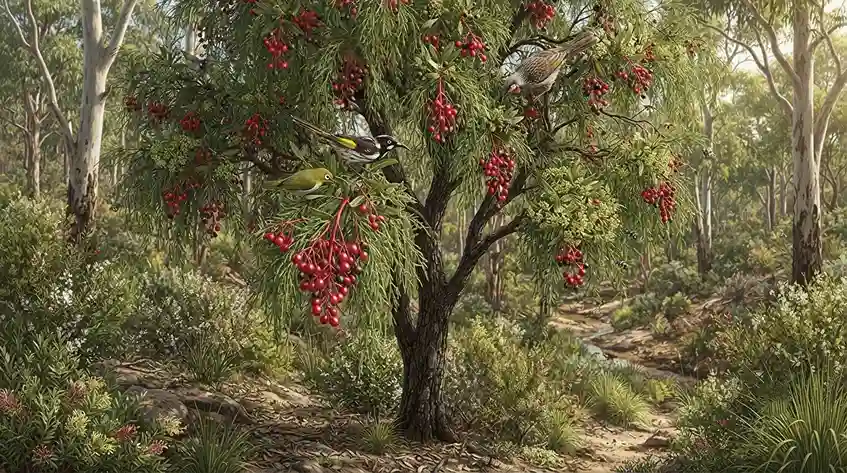
The native cherry tree plays an important role in Australian ecosystems by providing food, shelter, and habitat for a wide range of native wildlife. As a naturally occurring woodland species, Exocarpos cupressiformis contributes to biodiversity and helps maintain healthy native plant communities.
Its bright red fleshy stems are an important seasonal food source for birds and other wildlife. Animals that consume the fleshy stems also help disperse the seeds, supporting the natural regeneration of the species.
The tree provides ecological benefits by:
- Supplying seasonal food for native birds.
- Supporting pollinating insects with its flowers.
- Providing shelter for small birds and beneficial insects.
- Increasing plant diversity in native landscapes.
- Contributing to bushland restoration projects.
Because the tree naturally grows alongside many Australian native species, it is an excellent addition to habitat gardens designed to encourage local wildlife.
In our experience, mature native cherry trees often attract a greater variety of native birds during the fruiting season than many ornamental garden trees.
Wildlife Benefits
Native cherry trees support numerous Australian animals, including:
- Honeyeaters
- Silvereyes
- Wattlebirds
- Small woodland birds
- Native bees
- Other pollinating insects
Although the flowers are relatively small and inconspicuous, they provide nectar and pollen for insects that contribute to pollination within native ecosystems.
The dense branching structure also offers nesting sites and protective cover for small birds.
Importance in Bushland Restoration
Exocarpos cupressiformis is increasingly included in revegetation and bushland restoration programs because it naturally integrates into established native plant communities.
Its ecological value includes:
- Restoring native woodland diversity.
- Supporting wildlife corridors.
- Encouraging natural seed dispersal.
- Improving habitat complexity.
- Preserving locally adapted native plant populations.
As of 2026, many ecological restoration projects continue to prioritise locally sourced native cherry plants to maintain regional genetic diversity and improve long-term restoration success.
Comparison: Native Cherry vs Other Australian Native Trees
Several Australian native trees produce edible fruits or fruit-like structures. Each offers different benefits depending on available space, climate, and gardening goals.
| Feature | Native Cherry | Quandong | Lilly Pilly | Native Plum |
| Botanical name | Exocarpos cupressiformis | Santalum acuminatum | Syzygium species | Podocarpus elatus |
| Fruit | Red fleshy stem surrounding a hard seed | Bright red edible fruit | Edible berries | Purple edible fruit |
| Edible | Yes (fleshy stem only) | Yes | Yes | Yes |
| Mature height | 5–10 m | 2–8 m | 3–15 m (varies by species) | 10–20 m |
| Wildlife value | Excellent | Excellent | Excellent | High |
| Garden suitability | Native gardens, bushland plantings, habitat gardens | Dry inland gardens | Hedges, screening, feature trees | Large gardens and rainforest-style landscapes |
Each species offers unique advantages:
Native Cherry
- Unique semi-parasitic growth habit.
- Attractive bright red fruit-like stems.
- Excellent for wildlife gardens.
- Ideal for bushland restoration.
Quandong
- Produces larger edible fruits.
- Well suited to dry inland climates.
- Also has a semi-parasitic lifestyle.
Lilly Pilly
- Popular as a hedge or screening plant.
- Produces edible berries.
- Responds well to pruning.
Native Plum
- Suitable for larger gardens.
- Produces edible purple fruits.
- Thrives in moist subtropical environments.
Choosing the right tree depends on your climate, available space, and whether your priority is ornamental value, edible fruit, wildlife habitat, or ecological restoration.
Common Beginner Mistakes
Although the native cherry tree is relatively hardy, several common mistakes can reduce its chances of successful establishment. Most problems occur during the first few years after planting.
Planting Without Suitable Host Plants
The most common mistake is planting the tree in isolation.
Because Exocarpos cupressiformis is semi-parasitic, it performs best when growing near compatible Australian native species.
Planting alongside suitable host plants encourages healthier root development and more vigorous long-term growth.
Overwatering
Many gardeners assume young native trees require constantly moist soil.
In reality, the native cherry prefers well-drained conditions.
Excessive watering can lead to:
- Poor root development
- Waterlogging
- Yellowing foliage
- Reduced growth
Water deeply but allow the soil to partially dry between watering sessions.
Using Rich Fertilisers
Applying high-strength fertilisers is another frequent mistake.
The native cherry naturally grows in nutrient-poor Australian soils and generally requires very little feeding.
Avoid:
- High-phosphorus fertilisers
- Frequent fertiliser applications
- Rich compost placed directly around the roots
A low-phosphorus fertiliser formulated for Australian native plants is a much safer option if additional nutrients are needed.
Planting in Heavy Clay Soils
Poor drainage is one of the biggest challenges for this species.
Heavy clay soils can:
- Restrict root growth
- Hold excessive moisture
- Increase the risk of root problems
- Slow establishment
If clay soil cannot be avoided, improving drainage before planting is highly recommended.
Expecting Rapid Growth
The native cherry is naturally a slow to moderate-growing tree.
Some gardeners become concerned when young plants show limited growth during the first few years. However, this is normal because the tree is investing energy into establishing its root system and forming connections with nearby host plants.
Greenery Inside recommends focusing on providing suitable growing conditions rather than trying to accelerate growth with excessive watering or fertiliser.
With patience, healthy trees become resilient, long-lived landscape specimens that require relatively little maintenance.
Conclusion
The native cherry tree (Exocarpos cupressiformis) is one of Australia’s most distinctive native species, combining ornamental beauty, ecological importance, and remarkable botanical adaptations. Unlike traditional cherry trees, it produces edible fleshy red stems rather than true fruits and relies on a unique semi-parasitic growth habit to thrive in nutrient-poor Australian soils.
Its evergreen foliage, wildlife value, and adaptability make it an excellent choice for native gardens, habitat plantings, and bushland restoration projects. By selecting suitable host plants, providing well-drained soil, and avoiding excessive fertiliser or watering, gardeners can successfully establish this fascinating Australian native tree for decades of healthy growth.
Whether your goal is to support biodiversity, create a wildlife-friendly landscape, or grow an unusual native species, the Australian native cherry remains one of the most rewarding and ecologically valuable trees to include in an Australian garden.
Frequently Asked Questions
Are cherry trees native to Australia?
No. Traditional cherry trees belong to the genus Prunus and originated in Europe, Asia, and North America. Australia’s native cherry is Exocarpos cupressiformis, an unrelated species that evolved naturally in Australian woodlands and forests.
Can you eat native cherries?
Yes. The bright red fleshy stem of the native cherry is edible when ripe. However, the hard central seed should not be eaten.
Where are cherries native to?
Commercial cherry trees are native to parts of Europe, western Asia, and North America. The Australian native cherry is indigenous to southern and eastern Australia.
What are the two types of cherry trees?
The two broad groups are ornamental cherry trees, grown primarily for their flowers, and fruiting cherry trees, grown for edible cherries. Australia’s native cherry is a separate native species and is not part of the Prunus genus.
Is the Australian native cherry easy to grow?
It can be easy to grow when planted in suitable conditions. Well-drained soil, full sun, and compatible native host plants are the keys to successful establishment and long-term health.
How tall does a native cherry tree grow?
Most mature native cherry trees reach approximately 5–10 metres in height with a spread of around 3–6 metres, although size varies depending on climate, soil conditions, and available host plants.
Does the native cherry need another plant to survive?
Yes. As a semi-parasitic species, Exocarpos cupressiformis grows best when its roots can attach to nearby compatible host plants. While it performs photosynthesis independently, these root connections provide additional water and nutrients that improve growth and overall health.