Introduction
Orthrosanthus multiflorus, commonly known as the morning iris, morning flag plant, or simply morning flag, is a hardy Australian native perennial valued for its graceful grass-like foliage and delicate blue to violet flowers. The blooms are short-lived but appear repeatedly during the flowering season, bringing long-lasting colour to gardens despite each flower lasting only a day. Morning iris (Orthrosanthus multiflorus) is widely used in native landscapes because it adapts to diverse growing conditions, requires minimal maintenance, and supports sustainable, water-wise gardening. Its neat clumping habit makes it suitable for borders, naturalistic plantings, and mass displays across many Australian climates.
By Greenery Inside | Plant Care & Gardening Expert
In our experience growing Orthrosanthus in Australian gardens, it performs reliably with very little attention once established, making it an excellent choice for beginner and experienced gardeners alike.
Quick Summary
- Orthrosanthus multiflorus is an evergreen Australian native perennial with narrow, grass-like foliage and striking blue to violet flowers.
- Individual flowers open in the morning and are short-lived, but new blooms appear repeatedly throughout the flowering season.
- It grows best in full sun to partial shade in well-drained soil and tolerates drought once established.
- The plant is ideal for native gardens, borders, rockeries, mass planting, and low-maintenance landscapes.
- Propagation is most commonly achieved through clump division or growing fresh seed.
What Is Orthrosanthus multiflorus?
Botanical classification and common names
Orthrosanthus multiflorus is a flowering perennial native to Australia that belongs to the Iridaceae (iris) family, the same botanical family as many ornamental irises grown worldwide. Unlike traditional bearded irises, however, this species develops slender grassy foliage and compact clumps rather than rhizomatous fans.
Botanical Classification
| Classification | Details |
| Scientific name | Orthrosanthus multiflorus |
| Common names | Morning iris, Morning flag plant, Morning flag |
| Family | Iridaceae |
| Plant type | Evergreen perennial |
| Native range | Australia |
The genus name Orthrosanthus originates from Greek words meaning “morning flower,” reflecting one of the plant’s most distinctive characteristics—its blossoms typically open during the morning hours. The species name multiflorus translates to “many-flowered,” referring to its ability to produce numerous blooms over an extended period.
Its common names also describe its appearance and flowering behaviour:
- Morning iris refers to its iris-like flowers that open early in the day.
- Morning flag plant highlights both its upright foliage and morning-blooming habit.
- Morning flag is a shortened version commonly used in Australian horticulture.
Although each flower lasts only a single day, mature plants continuously produce fresh buds, ensuring an extended display throughout the flowering season.
Key identifying features
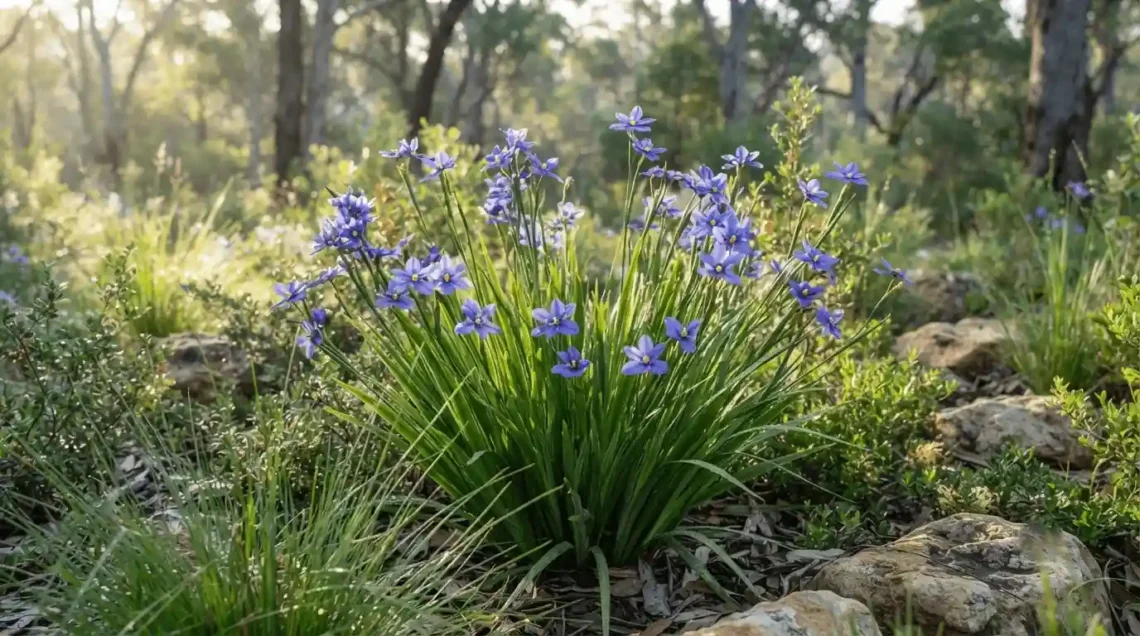
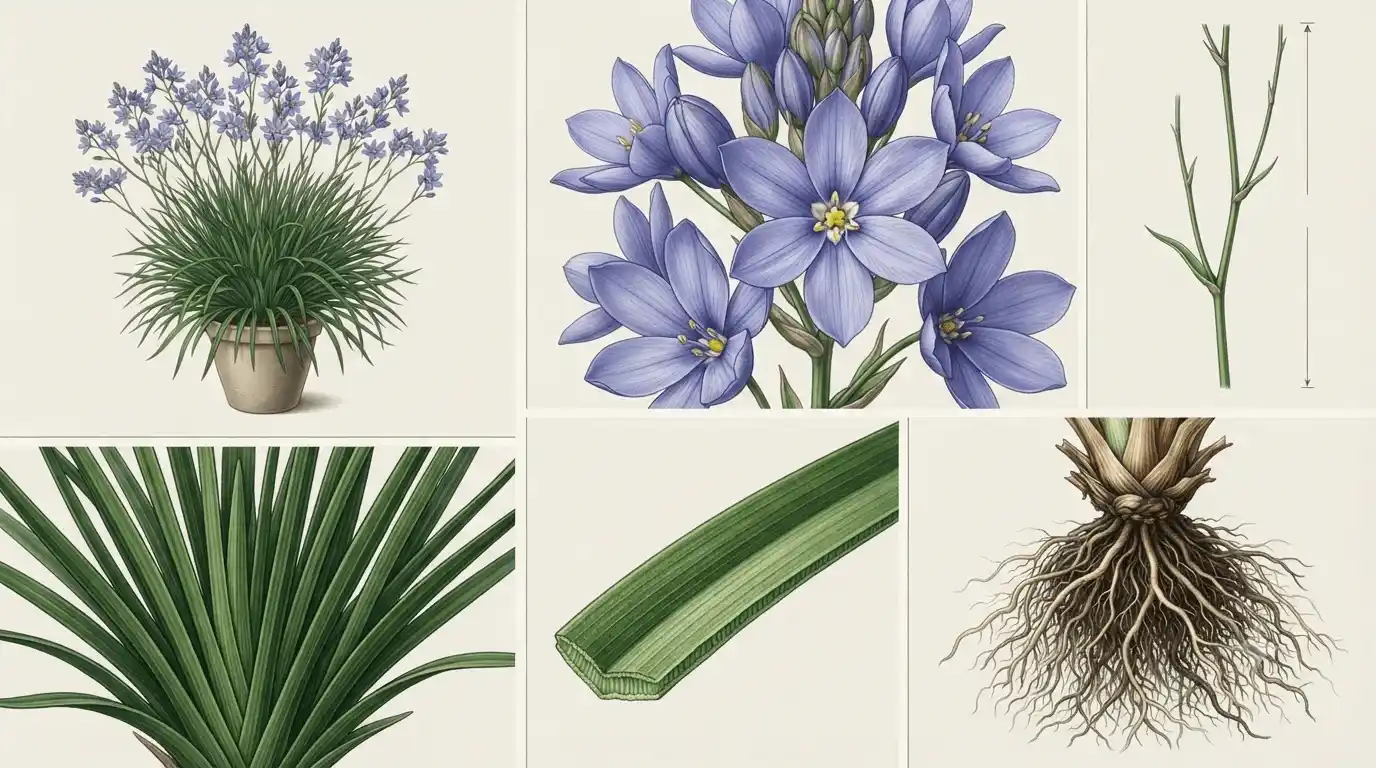
Orthrosanthus multiflorus is easily recognised by its elegant, fountain-like foliage and delicate flowers.
Key identifying characteristics include:
- Narrow, upright, grass-like evergreen leaves
- Clump-forming growth habit
- Bright blue to violet flowers with yellow centres
- Six-petalled iris-like blooms
- Slender branching flower stems held above the foliage
- Long-lived perennial habit
The foliage remains attractive throughout the year, even when the plant is not flowering. Mature clumps create soft architectural texture that blends well with other Australian native plants.
The flowers are typically 3–5 cm across and appear on thin, wiry stems. While each bloom is short-lived, flowering occurs over many weeks because unopened buds continue to develop.
Greenery Inside recommends planting several clumps together rather than individual specimens. Mass planting produces a far more impressive floral display and creates a natural meadow-like appearance.
Orthrosanthus multiflorus Distribution and Natural Habitat
Orthrosanthus multiflorus is naturally distributed across eastern and southeastern Australia, where it grows in a variety of open natural environments. Its adaptability has contributed to its popularity as an ornamental native plant.
Natural habitats include:
- Open eucalypt forests
- Woodland edges
- Heathlands
- Native grasslands
- Coastal districts where drainage is good
- Sandy and rocky slopes
The species commonly establishes in areas receiving good sunlight while benefiting from well-drained soils. It is particularly successful in landscapes where water drains freely after rainfall.
Unlike many moisture-loving iris relatives, Orthrosanthus multiflorus is adapted to Australia’s naturally variable climate. Once established, it tolerates periods of dry weather remarkably well.
Its natural habitat provides useful guidance for gardeners. Replicating these conditions with open planting positions and freely draining soils generally produces healthier plants and more abundant flowering.
Climate preferences
Orthrosanthus multiflorus grows successfully across a wide range of Australian climate zones.
Rainfall
The species tolerates both moderate and relatively low annual rainfall. Established plants survive seasonal dry periods better than many ornamental flowering perennials.
Temperature
Morning iris grows well in temperate, Mediterranean, coastal, and many subtropical climates. Warm growing seasons encourage vigorous foliage production and repeated flowering.
Frost tolerance
Light to moderate frost is generally tolerated once plants become established. In colder inland regions, foliage may suffer slight damage after severe frosts but usually recovers during spring.
Drought tolerance
One of its greatest strengths is drought resilience.
After developing a strong root system, the plant requires relatively little supplemental irrigation except during prolonged dry periods.
As of the 2026 growing season, Australian native plant growers continue to recommend deep but infrequent watering rather than frequent shallow irrigation. This encourages deeper root development and improves drought resilience.
Orthrosanthus multiflorus Size and Growth Habit
Understanding Orthrosanthus multiflorus size helps gardeners position the plant correctly and achieve attractive landscape designs.
The species forms dense evergreen clumps that gradually expand over time through slow outward growth.
Typical mature dimensions are:
| Feature | Typical Range |
| Height | 40–90 cm |
| Width | 40–80 cm |
| Growth habit | Dense evergreen clump |
| Lifespan | Long-lived perennial |
Although individual plants remain relatively compact, mature clumps become increasingly impressive after several years.
Rather than spreading aggressively, the plant slowly enlarges into rounded clumps that maintain a tidy appearance.
For landscaping purposes, spacing plants approximately 40–60 cm apart allows sufficient room for mature growth while encouraging an attractive mass-planted effect.
Environmental conditions influence mature size.
Plants growing in:
- Full sun
- Well-drained fertile soil
- Moderate moisture
- Open air circulation
typically produce denser foliage and more flowering stems than those grown in shaded or poorly drained locations.
Because the foliage remains evergreen, the plant contributes year-round structure even outside its flowering period.
In our experience, dividing mature clumps every few years not only rejuvenates older plants but also helps maintain vigorous flowering and healthy foliage.
Growth Rate and Flowering Time
How fast does it grow?
Orthrosanthus multiflorus has a moderate growth rate. Young plants spend their first growing season establishing roots before producing larger clumps and more flowering stems in subsequent years.
Growth generally follows this pattern:
- Spring: Rapid production of fresh leaves and flowering stems.
- Summer: Continued flowering with steady foliage growth.
- Autumn: Growth slows while roots continue developing.
- Winter: Minimal growth in cooler regions, although evergreen foliage remains.
Several factors influence growth speed, including:
- Sunlight availability
- Soil drainage
- Moisture levels
- Soil fertility
- Plant age
- Local climate
Healthy plants grown in full sun with well-drained soil typically establish within one to two growing seasons.
Excess shade, compacted soils, or prolonged waterlogging can significantly reduce growth and flowering performance.
Orthrosanthus multiflorus flowering time
Orthrosanthus multiflorus flowering time generally extends from late spring through summer, although flowering may continue into autumn in favourable climates.
Each flower opens during the morning and usually closes by evening. Despite this short lifespan, flowering appears continuous because numerous buds develop sequentially on each flowering stem.
Flowering is improved by:
- Full sun exposure
- Well-drained soil
- Moderate watering during active growth
- Removing spent flower stems
- Avoiding excessive nitrogen fertiliser
Mature plants often produce dozens of flowering stems over the season, creating an extended display despite the brief life of individual blooms.
For the most reliable flowering, Greenery Inside recommends positioning morning iris where it receives at least six hours of direct sunlight daily while avoiding persistently wet soils that can reduce plant vigour.
How to Grow and Care for Orthrosanthus multiflorus

Providing the right growing conditions helps Orthrosanthus multiflorus remain healthy, produce abundant flowers, and maintain its attractive evergreen foliage. This Australian native is naturally adapted to a wide range of environments, making it an excellent low-maintenance choice for home gardens.
In our experience, the plant performs best when gardeners focus on three essentials: plenty of sunlight, well-drained soil, and avoiding excessive watering once established.
Light requirements
Orthrosanthus multiflorus grows well in full sun to partial shade, but flowering is usually at its best in sunny locations. Gardeners designing lower-light landscapes can also explore other native plants that grow in shade that tolerate similar Australian garden conditions while providing texture and seasonal interest.
General light recommendations include:
- Full sun (6–8 hours daily): Produces the most flowers and compact growth.
- Partial shade: Suitable in hotter inland regions where afternoon shade reduces heat stress.
- Heavy shade: Results in fewer flowers, weaker stems, and thinner foliage.
Plants growing in bright, open positions typically develop stronger flowering stems and denser clumps than those planted beneath trees or beside large shrubs.
If planting in areas with intense summer heat, light afternoon shade can help reduce moisture stress without significantly affecting flowering.
Soil requirements
Good drainage is the single most important soil requirement for Orthrosanthus multiflorus.
Ideal soil conditions include:
- Sandy soils
- Sandy loam
- Loamy garden soil
- Gravelly native soils
- Well-improved clay with excellent drainage
Heavy clay is not unsuitable, but it should be improved before planting.
To improve clay soils:
- Incorporate coarse compost.
- Add gypsum if appropriate for your soil type.
- Create raised planting beds where drainage is poor.
- Mix coarse sand or fine gravel into the planting area if recommended for local soil conditions.
The preferred soil pH is slightly acidic to neutral, approximately 6.0–7.5, although the plant tolerates a wider range provided drainage remains excellent.
Avoid permanently wet or compacted soils, as prolonged waterlogging can damage the root system.
Watering needs
Watering requirements change as the plant matures.
During establishment
For the first 8–12 weeks after planting:
- Water deeply once or twice each week.
- Allow the soil surface to dry slightly between waterings.
- Monitor moisture during prolonged hot weather.
Regular watering during establishment encourages a strong, deep root system.
Mature plants
Once established, Orthrosanthus multiflorus requires relatively little supplemental irrigation.
Generally:
- Water during extended dry periods.
- Reduce watering during cool seasons.
- Avoid keeping soil consistently wet.
Deep, infrequent watering is more beneficial than frequent shallow watering because it promotes deeper root growth.
One common mistake we see is treating morning iris like moisture-loving ornamental irises. Unlike many traditional iris species, this Australian native is naturally adapted to periods of dry weather and performs better when the soil is allowed to drain between waterings.
Fertilising
Orthrosanthus multiflorus is not a heavy feeder.
In most gardens, one light application of fertiliser during spring is sufficient.
Suitable options include:
- Low-phosphorus native plant fertilisers
- Slow-release native fertiliser formulations
- Well-aged compost applied around the plant
Avoid:
- High-phosphorus fertilisers
- Excessive nitrogen
- Frequent fertiliser applications
Many Australian native plants, including species within the Iridaceae family, respond poorly to excessive phosphorus. Over-fertilising may encourage lush foliage while reducing flowering.
If plants are growing in naturally fertile soil, additional fertiliser may not be necessary.
Pruning and maintenance
Routine maintenance is simple and helps keep plants attractive throughout the year.
Recommended maintenance tasks include:
- Remove spent flower stems after flowering.
- Trim damaged or yellowing leaves.
- Remove dead foliage in late winter if required.
- Divide overcrowded clumps every few years.
Flower stems can be cut back to the base once blooming finishes. This improves the plant’s appearance and encourages fresh growth.
Unlike many ornamental grasses, Orthrosanthus multiflorus rarely requires severe pruning.
Dividing mature clumps every 3–5 years improves air circulation, rejuvenates older plants, and creates new plants for other parts of the garden.
Orthrosanthus multiflorus Propagation
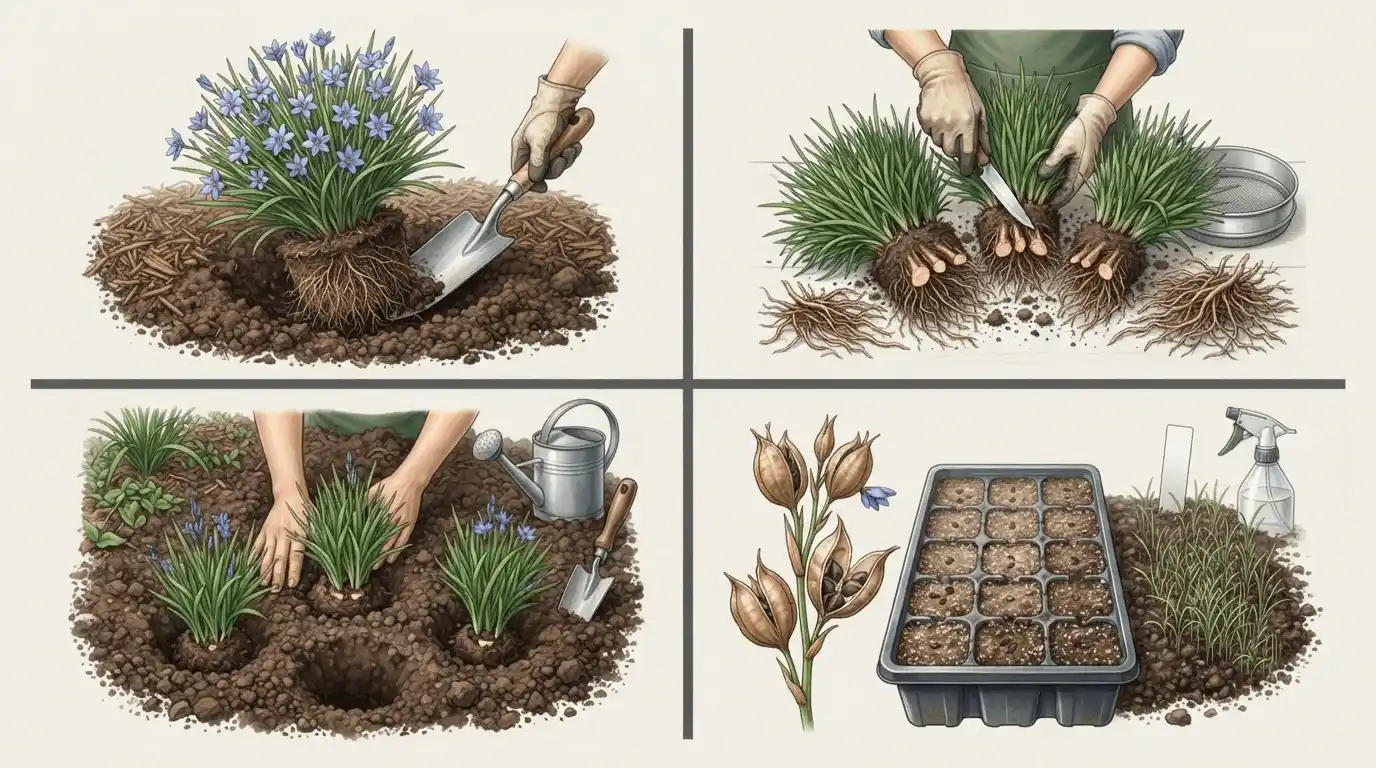
Propagation is straightforward, making this species easy to multiply for larger landscape plantings.
The two most reliable methods are:
- Division
- Seed propagation
Division is generally faster and produces flowering plants sooner than seed.
Growing from division
Division is the preferred method for propagating established plants because it produces identical offspring and allows new plants to establish quickly.
Best season
The ideal time for division is:
- Early spring
- Early autumn in mild climates
Avoid dividing plants during extreme summer heat or when frost is expected.
Step-by-step overview
- Water the plant thoroughly the day before lifting.
- Carefully dig around the clump.
- Lift the entire root ball.
- Separate healthy sections using a sharp spade or knife.
- Ensure each division has healthy roots and several growing shoots.
- Replant immediately.
- Water well after planting.
Establishment tips
After division:
- Keep the soil lightly moist for several weeks.
- Protect newly divided plants from extreme heat.
- Apply mulch around—but not against—the crown.
- Resume normal watering once new growth appears.
Greenery Inside recommends dividing only vigorous, healthy clumps, as stressed plants recover more slowly after propagation.
Orthrosanthus multiflorus seed propagation
Growing from seed is slower than division but remains an effective method for producing larger numbers of plants.
This method is particularly useful for restoration projects and native garden plantings.
Seed collection
Orthrosanthus multiflorus propagation from seed begins with collecting mature seed capsules after flowering.
Allow seed capsules to:
- Dry naturally on the plant.
- Turn brown before harvesting.
- Be stored in a cool, dry location until sowing.
Fresh seed generally produces the most reliable germination.
Germination conditions
For successful germination:
- Use a free-draining seed-raising mix.
- Sow seeds lightly on the surface.
- Cover with a thin layer of fine mix.
- Maintain even moisture without waterlogging.
- Place trays in bright filtered light.
Warm temperatures generally encourage faster germination.
Depending on conditions, seeds may germinate within several weeks.
Seedling care
Once seedlings develop several true leaves:
- Gradually reduce watering frequency.
- Provide good airflow.
- Transplant carefully into individual pots.
- Harden off before planting outdoors.
Although Orthrosanthus multiflorus seed propagation requires patience, seedlings eventually develop into long-lived garden plants that require relatively little maintenance.
Common Growing Problems and Solutions
Orthrosanthus multiflorus is considered a reliable and resilient Australian native. Most growing problems are related to environmental conditions rather than serious pests or diseases.
Correct planting practices prevent the majority of issues.
Poor flowering
Poor flowering is usually caused by growing conditions rather than plant health.
Common causes include:
- Too much shade
- Excessive nitrogen fertiliser
- Immature plants
- Seasonal weather variation
- Overcrowded clumps
Solutions include:
- Move plants to a sunnier location if practical.
- Reduce nitrogen-rich fertilisers.
- Apply a suitable native fertiliser in spring.
- Divide mature overcrowded clumps.
- Allow young plants sufficient time to establish.
Healthy mature plants generally flower more heavily after their first full growing season.
Yellow leaves
Yellowing foliage may occur for several reasons.
Possible causes include:
- Overwatering
- Poor drainage
- Ageing outer leaves
- Temporary transplant stress
Natural ageing usually affects only the oldest leaves near the base of the plant.
If widespread yellowing occurs, inspect soil moisture and drainage before applying fertiliser.
Persistent wet soil is a much more common cause than nutrient deficiency.
Root problems
Root issues almost always result from excessive soil moisture.
Common symptoms include:
- Wilting despite wet soil
- Yellow leaves
- Soft plant bases
- Reduced flowering
- Stunted growth
Root rot can often be prevented by:
- Planting in well-drained soil.
- Avoiding low-lying wet areas.
- Using raised beds where necessary.
- Watering only when required.
- Improving heavy clay before planting.
Once severe root rot develops, recovery may be difficult, making prevention the most effective strategy.
Pest and disease issues
One advantage of Orthrosanthus multiflorus is its natural resistance to most common garden pests.
Occasionally gardeners may notice:
- Snails
- Slugs
- Minor chewing insects
Young plants are more susceptible than established clumps.
Preventive measures include:
- Removing garden debris where pests hide.
- Watering early in the day.
- Encouraging beneficial wildlife.
- Hand-removing snails and slugs when populations are low.
Serious fungal diseases are uncommon when plants receive good airflow and grow in freely draining soil.
Landscaping Uses for Morning Iris
Morning iris is one of the most versatile Australian native perennials for ornamental landscapes. Its fine-textured foliage, seasonal blue flowers, and low-maintenance nature make it suitable for both formal and naturalistic garden designs.
Once established, Orthrosanthus multiflorus requires little attention while providing year-round foliage and reliable seasonal colour. Its tidy clumping habit also makes it easy to combine with other Australian native plants.
Common landscaping uses include:
- Native gardens
- Cottage gardens
- Wildlife-friendly gardens
- Mixed perennial borders
- Rock gardens
- Mass planting
- Water-wise landscapes
- Erosion control on gentle slopes
Native gardens
As a true Australian native, Orthrosanthus multiflorus blends naturally with local shrubs, grasses, and flowering perennials. It adds fine texture between larger native plants and contributes seasonal colour without overwhelming the planting design. For larger landscape designs, morning iris can be combined with suitable Australian native garden trees to create layered planting schemes with ground-level colour, mid-storey shrubs, and taller structural plants.
Cottage gardens
Although native in origin, morning iris complements informal cottage-style gardens. The soft blue to violet flowers contrast beautifully with flowering daisies, salvias, and other long-blooming perennials.
Wildlife gardens
The flowers attract a range of beneficial pollinating insects, helping support biodiversity within the garden. Dense foliage can also provide shelter for small reptiles and beneficial invertebrates.
Borders and pathways
Its neat clumping habit makes it an excellent edging plant along pathways, driveways, and garden borders. Unlike spreading groundcovers, it stays relatively contained and rarely becomes invasive.
Rock gardens
Because it naturally grows in well-drained soils, morning iris performs exceptionally well in rockeries and gravel gardens where many moisture-loving plants struggle.
Mass planting
Planting groups of five or more creates a striking display during the flowering season. Repeated clumps also establish a cohesive landscape design with minimal maintenance.
Erosion control
The fibrous root system helps stabilise soil on gentle embankments and sloping gardens. While not a substitute for deep-rooted shrubs, it contributes to reducing surface erosion.
Water-wise landscaping
After establishment, Orthrosanthus multiflorus tolerates extended dry periods, making it well suited to drought-conscious landscapes and sustainable native gardens.
Greenery Inside recommends using morning iris in repeated drifts rather than isolated specimens. Repetition creates a more natural appearance and highlights the plant’s graceful foliage even outside the flowering season.
Companion plants
Morning iris pairs well with many Australian native species that prefer similar growing conditions.
Suitable companion plants include:
- Lomandra longifolia
- Dianella caerulea (Blue Flax Lily)
- Themeda triandra (Kangaroo Grass)
- Poa labillardierei (Common Tussock Grass)
- Westringia fruticosa (Coastal Rosemary)
- Grevillea lanigera
- Correa alba
- Myoporum parvifolium
These species complement the texture and flowering habit of Orthrosanthus multiflorus while thriving in similar well-drained soils and sunny positions. Coastal rosemary is another excellent companion plant, especially for coastal gardens and low-maintenance native landscapes.
Orthrosanthus multiflorus vs Similar Plants
Several Australian native plants resemble Orthrosanthus multiflorus because of their grass-like foliage or clumping habit. Understanding the differences helps gardeners choose the most suitable species for their landscape.
Orthrosanthus multiflorus vs Orthrosanthus polystachyus
Both species belong to the same genus and share similar foliage, but they differ in size, habitat, and natural distribution.
| Feature | Orthrosanthus multiflorus | Orthrosanthus polystachyus |
| Height | 40–90 cm | Often taller, up to around 1.2 m |
| Flowers | Blue to violet | Blue to violet |
| Habitat | Open forests, woodlands, heath | Moist forests and woodland margins |
| Distribution | Eastern and southeastern Australia | Broader eastern Australian range |
| Garden suitability | Excellent for low-maintenance gardens | Better suited to larger naturalistic plantings |
Orthrosanthus multiflorus is generally preferred for residential landscapes because of its compact size and tidy growth habit.
Orthrosanthus multiflorus vs Orthrosanthus laxus
Although closely related, these species can be distinguished by several characteristics.
Orthrosanthus multiflorus
- Dense, compact clumps
- Numerous flowering stems
- Reliable garden performer
- Widely grown in landscaping
Orthrosanthus laxus
- Looser overall habit
- More open flowering stems
- Less commonly cultivated
- Occurs naturally in different ecological settings
Correct identification is easiest when plants are flowering, as floral structure and growth habit become more apparent.
Morning iris vs Lomandra Lime Tuff
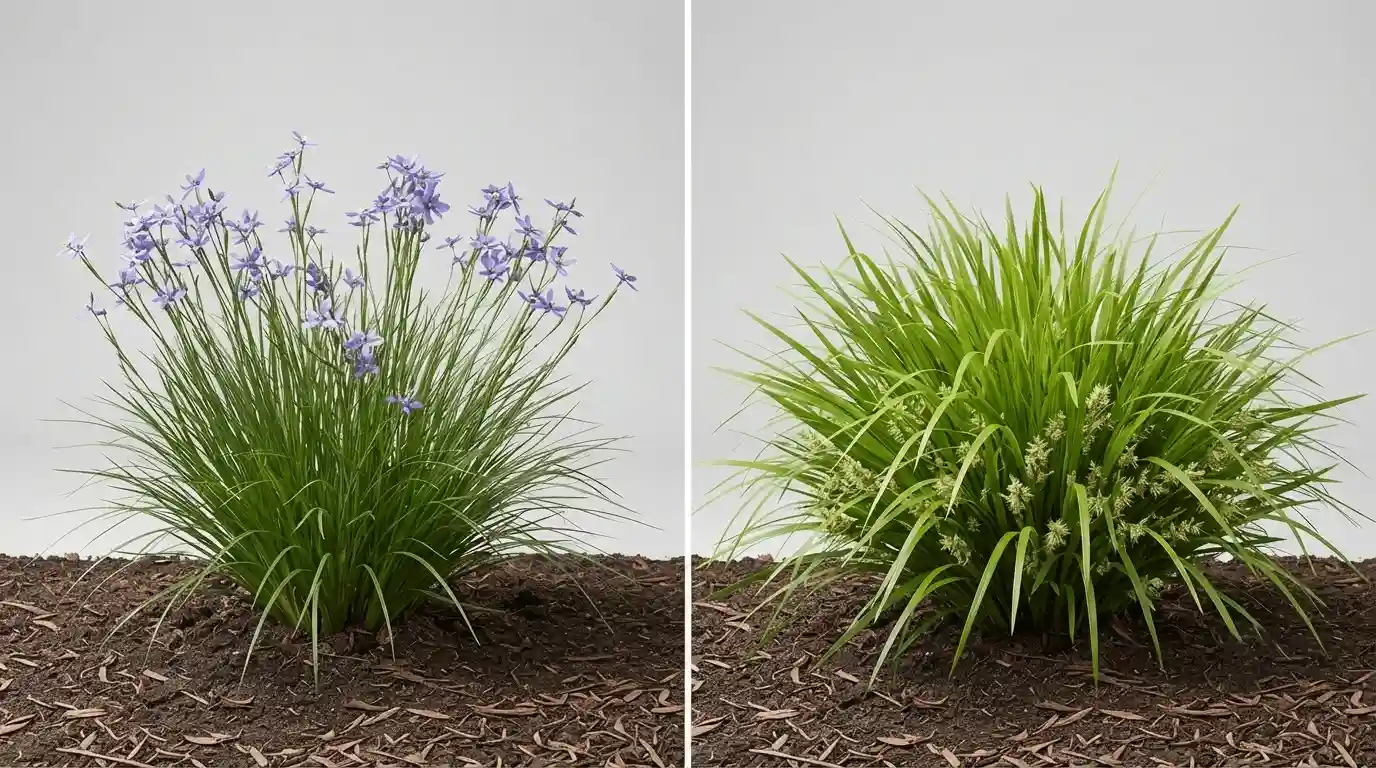
Because both plants have strappy foliage, Lomandra Lime Tuff, Lime Tuff Lomandra, and Lomandra longifolia ‘Lime Tuff’ are often confused with morning iris.
However, they serve different landscaping purposes.
| Feature | Morning Iris | Lime Tuff Lomandra |
| Flowering | Showy blue-violet flowers | Small cream-yellow flowers |
| Leaf texture | Fine, soft, grass-like | Dense, arching strappy foliage |
| Height | 40–90 cm | Approximately 50–70 cm |
| Maintenance | Very low | Extremely low |
| Best landscape use | Flowering native gardens, borders | Structural planting, edging, mass landscaping |
The main distinction is flowering.
Morning iris is grown primarily for its colourful seasonal blooms, whereas Lomandra longifolia ‘Lime Tuff’ is valued mainly for its evergreen architectural foliage and exceptional toughness.
Many landscape designers successfully combine both plants to create year-round texture with seasonal bursts of colour.
Common Beginner Mistakes to Avoid
Although Orthrosanthus multiflorus is easy to grow, several common mistakes can reduce flowering and overall plant health.
Planting in poorly drained soil
The most frequent cause of failure is waterlogged soil. Poor drainage increases the risk of root rot and weak growth.
Always improve drainage before planting if soil remains wet after rain.
Applying too much fertiliser
Many beginners assume more fertiliser produces more flowers.
In reality, excessive nutrients—especially phosphorus and nitrogen—can reduce flowering and encourage soft foliage growth.
Use only low-phosphorus fertilisers formulated for Australian native plants.
Growing in heavy shade
Morning iris tolerates partial shade but flowers best in sunny positions.
Too much shade often results in:
- Sparse flowering
- Long, weak leaves
- Reduced vigour
Choose a location receiving at least six hours of sunlight whenever possible.
Overwatering
Once established, the plant is naturally drought tolerant.
Frequent watering keeps soil overly wet, increasing the likelihood of root diseases and yellowing foliage.
Water deeply but infrequently during dry periods instead of applying small amounts every day.
Incorrect spacing
Planting too closely restricts airflow and creates overcrowded clumps over time.
Allow approximately 40–60 cm between plants to accommodate mature growth while still achieving an attractive mass-planted appearance.
Ignoring clump division
Older clumps gradually become crowded.
Dividing plants every few years helps:
- Improve flowering
- Increase air circulation
- Produce healthy new plants
- Maintain a tidy growth habit
Regular rejuvenation keeps morning iris vigorous for many years.
Conclusion
Orthrosanthus multiflorus is an attractive Australian native perennial that combines elegant evergreen foliage with beautiful blue to violet flowers that bloom repeatedly throughout the warmer months. Its adaptability to a wide range of climates, excellent drought tolerance after establishment, and minimal maintenance requirements make it a dependable choice for both experienced gardeners and beginners.
Whether planted in native gardens, borders, rockeries, wildlife landscapes, or water-wise designs, morning iris provides year-round texture and reliable seasonal colour. By growing it in full sun to partial shade, using well-drained soil, and avoiding excessive watering or fertilising, gardeners can enjoy healthy clumps for many years.
The key takeaway: Orthrosanthus multiflorus is a hardy, long-lived Australian native that offers outstanding ornamental value with very little maintenance, making it one of the best flowering grass-like plants for sustainable landscaping.
Frequently Asked Questions
Is Orthrosanthus multiflorus native to Australia?
Yes. Orthrosanthus multiflorus is native to Australia and naturally occurs across parts of eastern and southeastern Australia in woodlands, open forests, heathlands, and other well-drained habitats.
Where does Orthrosanthus multiflorus grow naturally?
It naturally grows in open eucalypt forests, woodland edges, heathlands, grasslands, and some coastal areas with well-drained soils. It prefers sunny to lightly shaded environments.
How large does Orthrosanthus multiflorus grow?
Most mature plants reach 40–90 cm in height with a spread of approximately 40–80 cm, forming dense evergreen clumps that gradually increase in size over time.
When does morning iris flower?
Morning iris typically flowers from late spring through summer, with blooming sometimes continuing into autumn in favourable climates. Individual flowers last only one day, but new blooms open continuously during the flowering season.
How do you propagate Orthrosanthus multiflorus?
The easiest propagation method is dividing mature clumps during spring or early autumn. Plants can also be grown from fresh seed collected after flowering, although this method takes longer to produce mature flowering plants.
Is morning iris drought tolerant?
Yes. Once established, Orthrosanthus multiflorus is considered drought tolerant and usually requires supplemental watering only during prolonged dry periods.
Can morning iris grow in shade?
Yes, it tolerates partial shade. However, the best flowering occurs in full sun. Heavy shade generally reduces flower production and results in weaker, less compact growth.
What is the difference between Orthrosanthus multiflorus and Lomandra Lime Tuff?
Although both have grass-like foliage, Orthrosanthus multiflorus is primarily grown for its attractive blue flowers, while Lomandra longifolia ‘Lime Tuff’ is valued for its dense evergreen foliage and architectural form. Morning iris provides more seasonal floral colour, whereas Lime Tuff is mainly a foliage plant.