Introduction
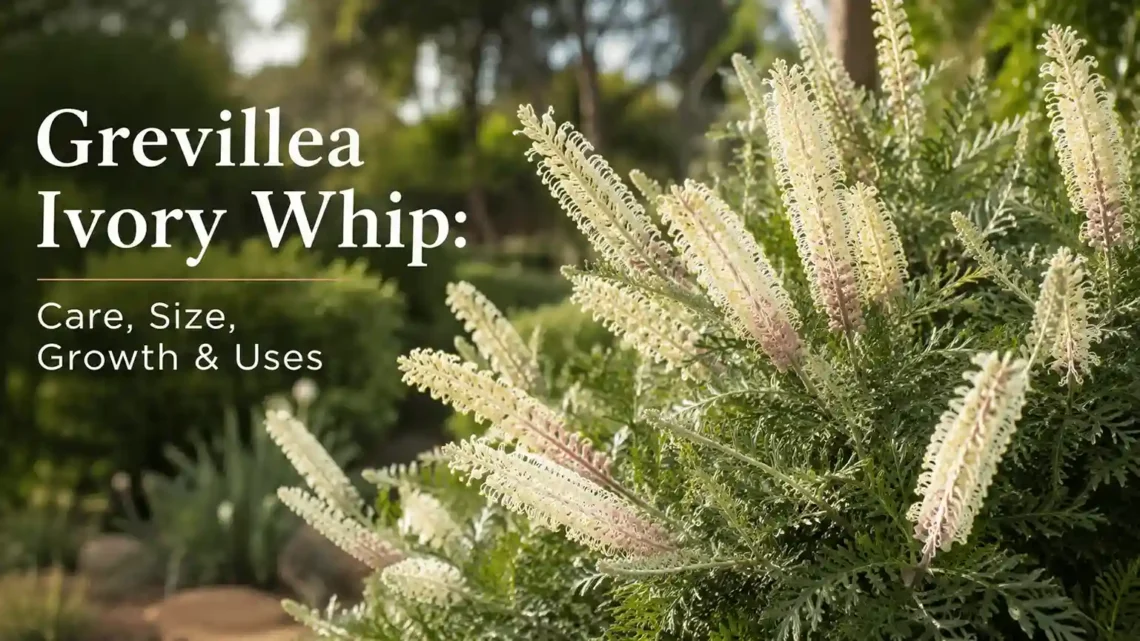
Grevillea Ivory Whip is a distinctive Australian native shrub prized for its creamy-ivory flower spikes, attractive silvery foliage, and exceptionally long flowering season. Known for blooming almost year-round, this versatile cultivar has become a popular choice in Australian gardens, wildlife landscapes, and native planting schemes. Its elegant flower displays, combined with relatively low maintenance requirements, make it suitable for both beginner and experienced gardeners. Whether grown as a compact feature shrub, a screening plant, or a grafted ornamental tree, Grevillea Ivory Whip offers outstanding ornamental value while supporting local pollinators and birdlife. If you are planning a broader native landscape, our Australian Native Garden Trees: The Complete Planting Guide explores how Grevillea Ivory Whip fits into Australian garden design alongside other native shrubs and trees.
Quick Summary
- Grevillea Ivory Whip is a medium-sized Australian native shrub producing long creamy-ivory flower spikes with soft pink centres and near year-round blooms.
- Standard plants typically grow 1.5–2 metres tall and wide, while grafted forms may reach 4–6 metres in height.
- It attracts honeyeaters, bees, and butterflies, making it an excellent wildlife garden plant.
- The cultivar thrives in full sun, free-draining soil, and requires only modest maintenance once established.
- Grafted forms provide greater soil adaptability, stronger vigour, and improved performance across diverse growing conditions.
What Is Grevillea Ivory Whip?
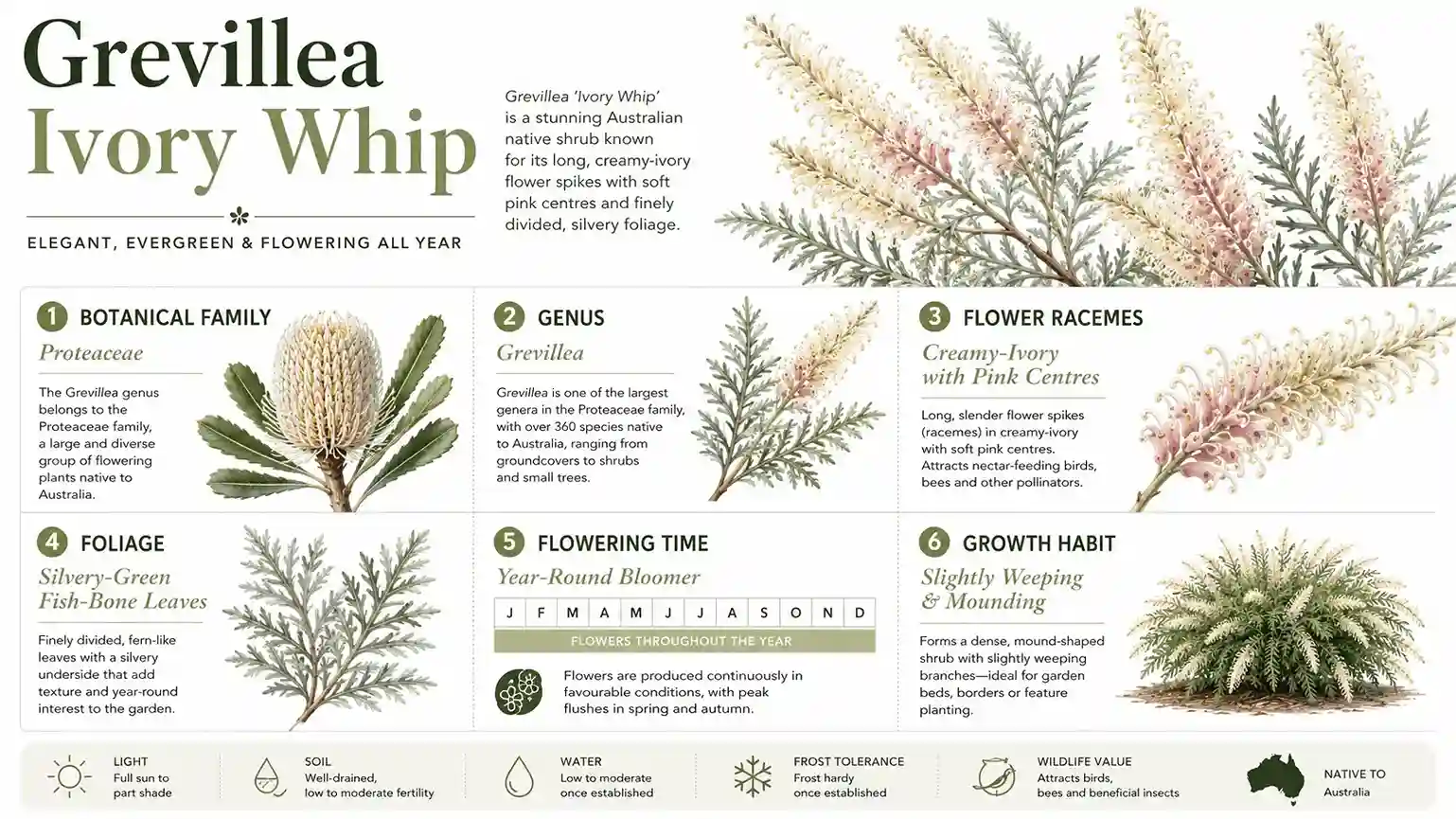
Grevillea Ivory Whip is a cultivated hybrid within the genus Grevillea, a large group of Australian native plants belonging to the Proteaceae family. It was bred by Richard Tomkin of Changers Green Nursery and is widely recognised for producing some of the most striking pale-coloured flowers among white-flowering grevillea cultivars.
The Grevillea genus includes many attractive species, including Grevillea sericea: 8+ Essential Care & Growth Guide, which is widely grown for its spider-like flowers.
Unlike many grevilleas that display red, pink, or orange flowers, Ivory Whip produces elegant cylindrical racemes approximately 15 centimetres long. These blooms are creamy-white to ivory in colour with subtle soft-pink centres, creating a refined appearance that stands out in both native and ornamental landscapes.
Botanical Classification
| Characteristic | Details |
| Genus | Grevillea |
| Family | Proteaceae |
| Cultivar | ‘Ivory Whip’ |
| Plant Type | Australian native hybrid shrub |
| Flower Colour | Creamy-white with pink centres |
| Flower Shape | Cylindrical racemes |
| Flower Length | Approximately 15 cm |
| Bloom Period | Nearly year-round |
| Foliage | Silvery-green, deeply divided |
The foliage is another distinguishing feature. The leaves are deeply divided into narrow segments, creating a fish-bone appearance that adds texture throughout the year. Combined with its slightly weeping growth habit, the plant maintains visual interest even when flower production temporarily slows.
Grevillea Ivory Whip is often compared with other white-flowering grevilleas due to its unusual bloom colour, prolonged flowering season, and adaptability across a range of Australian garden styles.
Grevillea Ivory Whip Size and Growth Habit
Grevillea Ivory Whip is available in several forms, and mature size varies considerably depending on whether the plant is grown as a standard shrub, compact variety, or grafted standard. Understanding these differences is important when selecting the right plant for a particular landscape application. Gardeners who enjoy cascading forms may also like Grevillea Standard Weeping: 7+ Essential Care Facts, which showcases another elegant weeping grevillea.
Environmental conditions, soil quality, pruning practices, and rootstock selection can all influence ultimate size and growth habit.
Standard Shrub Form
The standard shrub form typically grows approximately 1.5–2 metres tall and 1.5–2 metres wide.
Its growth habit is naturally mounding with slightly weeping branches that create a soft, cascading appearance. Over time, regular pruning can encourage the plant to develop a rounded, umbrella-like form.
Common landscape uses include:
- Informal screening
- Feature planting
- Native garden borders
- Wildlife habitat gardens
- Mixed shrubbery plantings
The dense growth also makes it effective as a privacy screen without appearing overly formal.
Larger Tree Form (Grafted Standards)
Grafted forms sold as “Ivory Whip Grafted” or “Ivory Whip Standard” can reach significantly larger dimensions.
Typical mature size ranges from:
- Height: 4–6 metres
- Width: 3–5 metres
These larger specimens develop into small ornamental trees suitable for:
- Tall screening
- Windbreak planting
- Large garden focal points
- Boundary hedges
- Feature lawn specimens
Many gardening references that describe Ivory Whip as a large shrub are often referring to these grafted forms rather than the standard shrub.
Because grafted plants benefit from vigorous rootstocks, they often achieve greater height, stronger growth, and improved adaptability to challenging soil conditions.
Compact Form
A compact-growing version of Grevillea Ivory Whip is also available for gardeners with limited space.
This smaller form is particularly useful for:
- Courtyard gardens
- Small suburban landscapes
- Rockeries
- Decorative containers
- Cottage-style borders
The compact form retains the attractive flower display and silvery foliage of the larger plant while occupying significantly less space.
Its manageable size makes it a practical choice for gardeners seeking year-round flowering without committing to a larger shrub or tree.
Growth Rate of Grevillea Ivory Whip
Grevillea Ivory Whip is generally considered a fast-growing Australian native shrub.
Under favourable conditions, young plants establish quickly and begin producing substantial growth within their first few growing seasons. This rapid growth contributes to its popularity as a screening plant and landscape filler. If year-round flowering is a priority, Grevillea Semperflorens: 8+ Essential Care Tips covers another long-blooming grevillea valued by Australian gardeners.
Grafted plants typically outperform cutting-grown specimens in both growth speed and overall vigour.
Seasonal Growth Patterns
The strongest growth flushes usually occur during:
- Spring
- Autumn
These periods provide moderate temperatures and favourable moisture levels, encouraging active root and shoot development.
Growth often slows during:
- Very hot summer periods
- Cold winter conditions
- Extended drought
Factors Affecting Growth Rate
Several environmental factors influence how quickly Grevillea Ivory Whip develops.
| Factor | Impact on Growth |
| Full sun | Promotes fastest growth |
| Part-shade | Slower growth and reduced flowering |
| Free-draining soil | Encourages healthy roots |
| Heavy clay soil | May restrict development |
| Regular establishment watering | Improves early growth |
| Overwatering | Increases risk of root problems |
| Grafted rootstock | Increases vigour and consistency |
A common beginner mistake is assuming that more water equals faster growth. Once established, Grevillea Ivory Whip performs best with moderate watering and excellent drainage.
Grevillea Ivory Whip Care Guide
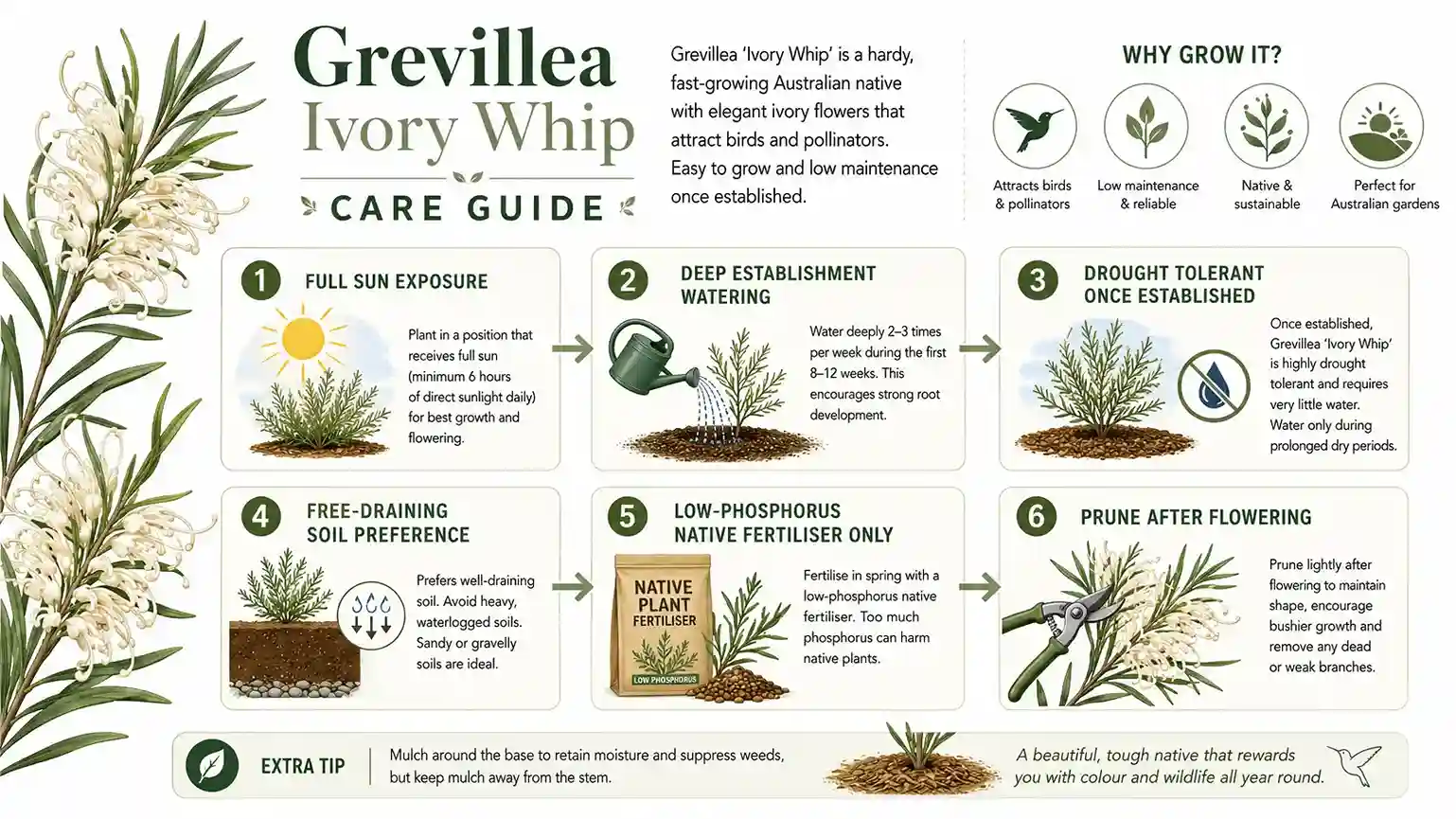
Grevillea Ivory Whip care is relatively straightforward when its natural Australian growing preferences are respected. The plant thrives with plenty of sunlight, good drainage, and low-phosphorus nutrition.
Gardeners throughout Australia value this cultivar because it combines ornamental beauty with drought tolerance and wildlife benefits.
Sunlight Requirements
Grevillea Ivory Whip performs best in full sun.
A position receiving at least six hours of direct sunlight daily will produce the strongest flowering displays and healthiest growth.
Benefits of full sun include:
- Increased flower production
- Denser growth habit
- Better disease resistance
- Enhanced foliage colour
Although the plant tolerates part-shade, flowering may become noticeably reduced and growth less compact.
Good airflow around the plant further improves health and reduces fungal issues.
Watering
Newly planted Grevillea Ivory Whip requires regular watering during establishment.
For the first 8–12 weeks:
- Water deeply when soil begins to dry
- Keep moisture consistent but not excessive
- Avoid prolonged saturation
Once established, the plant becomes highly drought tolerant.
Occasional deep watering during extended dry periods can help maintain flowering performance and overall vigour.
Avoid:
- Constantly wet soil
- Poor drainage
- Frequent shallow watering
These conditions increase the risk of root diseases.
Soil Preferences
Grevillea Ivory Whip grows best in free-draining soils ranging from sandy soils to clay loams.
Ideal soil characteristics include:
- Excellent drainage
- Moderate fertility
- Slightly acidic to neutral pH
- Good root aeration
Grafted plants offer an advantage because they tolerate heavier soils and temporary wet conditions better than non-grafted specimens.
Soil Suitability Comparison
| Soil Type | Suitability |
| Sandy soil | Excellent |
| Sandy loam | Excellent |
| Clay loam | Good |
| Heavy clay | Moderate (best with grafted forms) |
| Waterlogged soil | Poor |
Fertilising
Fertiliser selection is critical for Grevillea Ivory Whip.
As a member of the Proteaceae family, the plant is highly sensitive to phosphorus.
Important fertilising guidelines include:
- Use only low-phosphorus native fertilisers
- Select slow-release native plant formulations
- Follow label directions carefully
- Apply during active growth periods
Avoid:
- Standard garden fertilisers
- High-phosphorus products
- Excessive feeding
Phosphorus toxicity can severely damage roots and may eventually kill the plant.
Mulching is optional but can help conserve moisture and moderate soil temperatures. Always keep mulch away from direct contact with the trunk or stem base.
Pruning
Regular pruning helps maintain shape, improve density, and encourage continued flowering.
Recommended pruning practices include:
- Tip prune after flowering flushes
- Remove weak or damaged stems
- Maintain desired size and form
Every 3–4 years, a harder rejuvenation prune can stimulate vigorous new growth and a fresh flowering cycle.
Important pruning rules:
- Do not cut into old leafless wood
- Avoid removing excessive healthy growth
- Prune shortly after flowering
For grafted plants, inspect below the graft union regularly and remove any rootstock shoots immediately.
Frost and Climate Tolerance
Grevillea Ivory Whip tolerates light frost down to approximately -3°C.
It performs well across many Australian climate zones, including:
- Coastal regions
- Warm temperate areas
- Subtropical gardens
- Mediterranean-style climates
The plant is especially successful in coastal landscapes where salt exposure and wind may challenge less adaptable species.
However, it is less suitable for:
- Alpine environments
- High-altitude regions
- Areas with prolonged heavy frost
- Sites with poor drainage
Selecting an appropriate climate and planting position remains one of the most important factors in achieving long-term success with Grevillea Ivory Whip.
Grevillea Ivory Whip — Grafted vs. Non-Grafted: What’s the Difference?
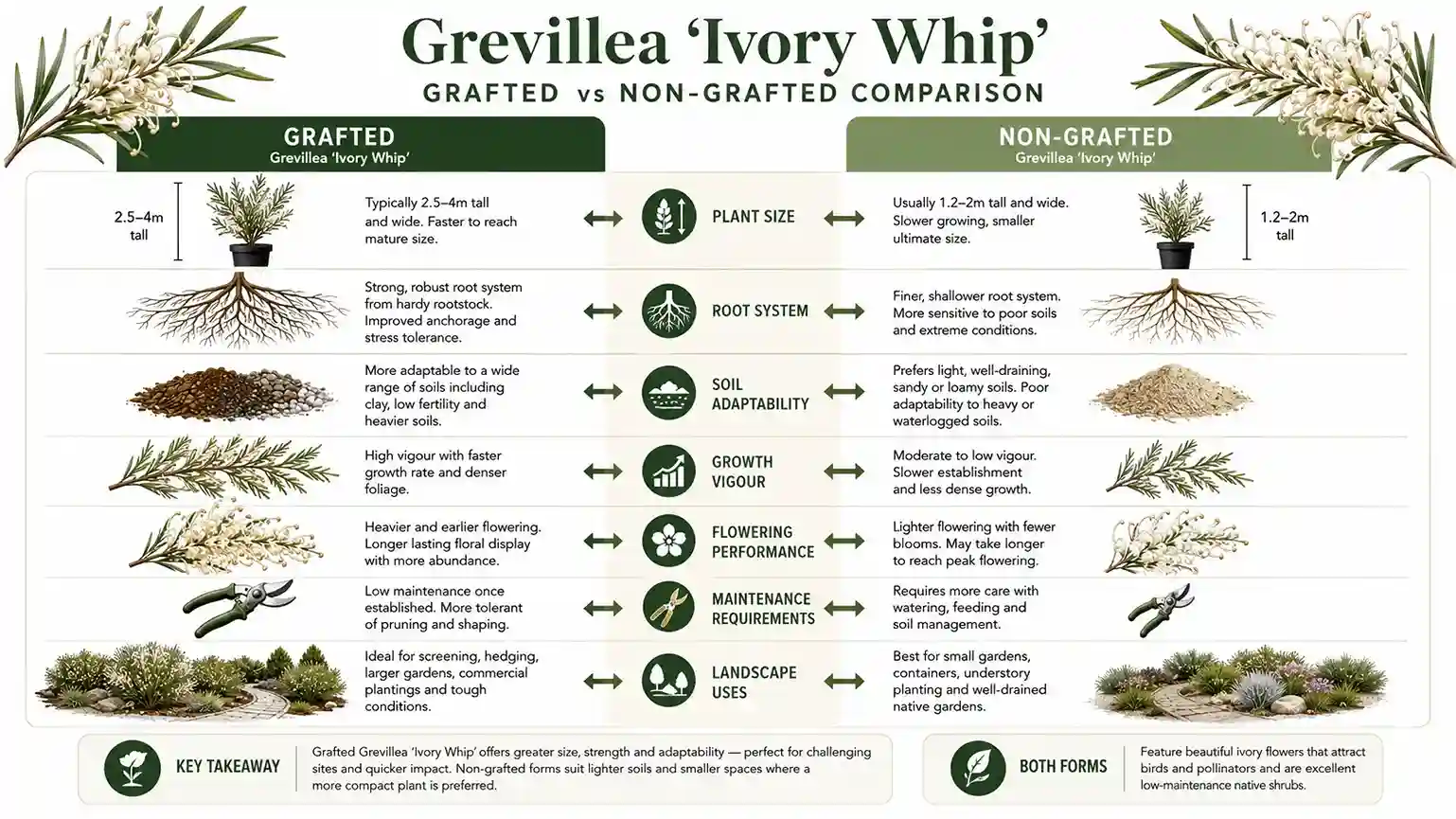
Grevillea Ivory Whip does not require grafting to grow successfully, but grafted plants generally provide greater vigour, broader soil adaptability, and more reliable long-term performance. For gardeners dealing with heavier soils or challenging growing conditions, grafted forms are often the preferred choice.
Grafting involves attaching the desirable Grevillea Ivory Whip cultivar onto a stronger rootstock. This process combines the ornamental characteristics of the cultivar with the resilience of the root system.
Why Grafting Matters
Benefits of grafted Grevillea Ivory Whip include:
- Faster establishment after planting
- Greater tolerance of clay and heavier soils
- Increased growth vigour
- Improved adaptability across different climates
- Reduced risk of root-related stress in difficult conditions
Non-grafted plants can perform exceptionally well when grown in naturally free-draining sandy or loamy soils.
Does a Grafted Plant Need Special Care?
The primary difference in maintenance involves monitoring the graft union.
Gardeners should:
- Regularly inspect below the graft point
- Remove any shoots emerging from the rootstock
- Prevent rootstock growth from dominating the plant
Apart from this additional maintenance task, general care requirements remain largely the same.
Grafted vs. Non-Grafted Grevillea Ivory Whip
| Feature | Standard (Non-Grafted) | Grafted Form |
| Height | 1.5–2 m | 4–6 m |
| Soil tolerance | Requires free-draining soil | Tolerates wider soil range, including clay |
| Vigour | Moderate | High |
| Flowering | Year-round | Year-round, often heavier |
| Maintenance | Standard pruning | Remove rootstock suckers |
| Availability | Some specialist nurseries | Widely available |
| Best use | Pots, compact gardens, borders | Screening, hedging, feature tree |
White Grevillea Varieties — How Does Ivory Whip Compare?
Grevillea Ivory Whip is one of several popular white-flowering grevilleas grown in Australian gardens. Each variety offers unique characteristics in terms of size, growth habit, frost tolerance, and landscape use. Another popular ornamental option is Grevillea Elegance: 7+ Essential Care & Growth Tips, known for its colorful blooms and bird-attracting qualities. Gardeners looking to complement Ivory Whip with contrasting blooms can explore our 7+ Essential Native Pink Flowers Australia Guide.
Understanding these differences helps gardeners select the most suitable plant for their space and climate.
Grevillea Ivory Whip vs. Grevillea Moonlight
Grevillea Moonlight is one of the most widely planted white grevilleas.
Key differences include:
- Moonlight grows approximately 4 m tall and 1.5 m wide.
- Ivory Whip is generally wider and more mounding.
- Moonlight produces larger racemes reaching around 25 cm.
- Moonlight has a more upright, columnar structure.
- Ivory Whip offers compact and grafted forms for greater versatility.
Both varieties flower for extended periods and attract nectar-feeding birds.
Grevillea Ivory Whip vs. Grevillea White Knight
Grevillea White Knight is significantly smaller and more cold tolerant.
Major distinctions include:
- White Knight reaches about 1 m × 1 m.
- It features needle-like foliage resembling rosemary.
- Flowers are smaller and appear mainly during winter and spring.
- Frost tolerance extends to approximately -6°C.
Gardeners in colder regions often prefer White Knight, while Ivory Whip delivers larger flower spikes and longer flowering periods.
Grevillea Ivory Whip vs. Grevillea White Wings
White Wings differs primarily in growth habit.
Characteristics include:
- Low-growing, spreading form
- Excellent groundcover performance
- Smaller flower clusters
- Arching stems
Ivory Whip is a better choice when vertical structure, screening, or feature planting is desired.
Grevillea Ivory Whip vs. Grevillea Dorothy Gordon
Grevillea Dorothy Gordon is a larger shrub with more colourful blooms.
Key differences:
- Height commonly reaches 3–4 m.
- Flowers range from rosy-pink to white.
- Foliage tends to be more silver-grey.
- Colour display is warmer and more vibrant.
Ivory Whip remains the better option for gardeners seeking a predominantly ivory-white floral display. For a detailed growing guide on this related cultivar, see Grevillea ‘Dorothy Gordon’: 7+ Essential Care Tips.
White Grevillea Varieties at a Glance
| Variety | Height | Flower Colour | Frost Tolerance | Best Use |
| Ivory Whip | 1.5–6 m* | Ivory-white with pink centre | Light (-3°C) | Hedge, feature, container |
| Moonlight | 4 m | Creamy-white | Light to moderate | Screening, tall hedge |
| White Knight | 1 m | Ivory-white | Hardy (-6°C) | Pots, small hedges |
| White Wings | 1–1.5 m | White | Light | Groundcover, borders |
| Dorothy Gordon | 3–4 m | Rosy-pink to white | Light | Screening, specimen planting |
*Depends on whether the plant is grown as a standard shrub or grafted form.
Landscape Uses for Grevillea Ivory Whip
Grevillea Ivory Whip is highly versatile and fits naturally into a wide range of Australian garden styles. Its attractive foliage, long flowering season, and wildlife value make it useful as both a design feature and a functional landscape plant. Grevillea Ivory Whip works particularly well in contemporary landscapes featured in our Modern Australian Native Garden: 10+ Smart Design Ideas Guide.
Wildlife Garden Specimen
The nectar-rich flowers attract:
- Honeyeaters
- Native bees
- Butterflies
- Other beneficial pollinators
This makes Ivory Whip a valuable component of wildlife-friendly gardens.
Informal Hedge or Screen
Dense growth and rapid establishment allow the plant to function effectively as:
- Privacy screening
- Boundary planting
- Wind protection
- Informal native hedges
Grafted forms are particularly effective where additional height is desired. Gardeners interested in creating larger native privacy screens may also benefit from our Ultimate Grevillea Olivacea Hedge Guide: 7+ Easy Care Tips, which covers another reliable hedging grevillea. For larger-scale privacy planting projects, see 6+ Smart Australian Native Screening Trees for Privacy for additional screening options.
Feature Plant
Its elegant flower spikes and silvery foliage create a strong visual focal point.
Popular feature uses include:
- Lawn specimens
- Entryway plantings
- Native garden centrepieces
- Accent planting
Cut Flower Production
The long ivory flower spikes are highly valued in floral arrangements.
Benefits for cut flower use include:
- Attractive colour contrast
- Long stems
- Extended flowering season
- Excellent vase appeal
Container Growing
The compact form adapts well to large containers.
Successful pot cultivation requires:
- Free-draining native potting mix
- Full sun
- Adequate drainage holes
- Low-phosphorus fertilisation
Rockeries and Shrubberies
The plant integrates naturally into:
- Native rockeries
- Dry garden designs
- Shrub borders
- Water-wise landscapes
Underplanting Opportunities
When trained into an umbrella-shaped canopy, Grevillea Ivory Whip can create light shade beneath its branches.
Suitable underplanting options include:
- Shade-tolerant native grasses
- Small groundcovers
- Low-growing flowering perennials
Common Problems with Grevillea Ivory Whip and How to Fix Them
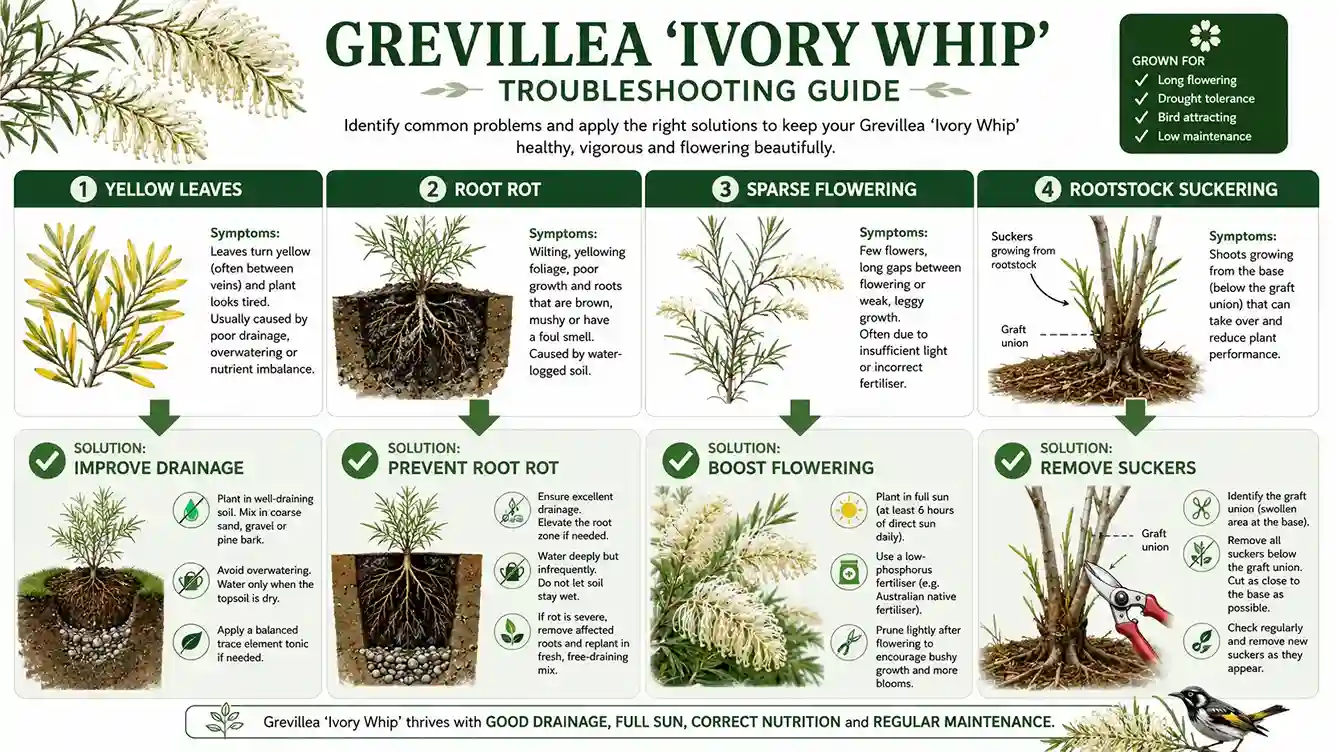
Although generally low maintenance, Grevillea Ivory Whip can experience several common problems. Most issues stem from incorrect watering, unsuitable fertilisers, or poor drainage.
Yellow Leaves
Yellow leaves are most commonly caused by fungal infection, phosphorus toxicity, or root stress.
Why It Occurs
Potential causes include:
- Phyllosticta fungal disease
- Cercospora fungal infection
- Excess phosphorus
- Overwatering
- Poor drainage
How to Fix It
- Inspect foliage for fungal spotting.
- Stop using any standard fertiliser immediately.
- Apply an appropriate native-safe fungicide when necessary.
- Improve drainage if soil remains wet.
How to Prevent It
- Use only native low-phosphorus fertilisers.
- Water at soil level rather than overhead.
- Maintain good airflow around the plant.
Root Rot
Root rot is one of the most serious problems affecting Grevillea Ivory Whip.
Why It Occurs
Poor drainage allows pathogens such as Phytophthora cinnamomi to develop.
Signs
Common symptoms include:
- Persistent wilting
- Yellow, red, or purple foliage
- White fungal growth near the base
- Brown streaking beneath bark
How to Fix It
Unfortunately, severe root rot is usually fatal.
Affected plants often require removal to prevent disease spread.
How to Prevent It
- Plant only in free-draining soil.
- Avoid waterlogging.
- Improve drainage before planting.
- Consider grafted forms for heavier soils.
No Flowers or Sparse Flowering
Poor flowering is usually linked to environmental or pruning issues.
Why It Occurs
Possible causes include:
- Insufficient sunlight
- Excess nitrogen
- Incorrect pruning
- Poor drainage
- Plant stress
How to Fix It
- Move container-grown plants into full sun.
- Prune immediately after flowering.
- Use a low-phosphorus native fertiliser.
- Correct drainage issues.
How to Prevent It
- Choose a sunny planting location.
- Follow proper seasonal pruning practices.
- Avoid excessive feeding.
Rootstock Suckering (Grafted Plants Only)
Rootstock suckers can weaken the desired cultivar.
Why It Occurs
Shoots emerging below the graft union belong to the rootstock rather than Grevillea Ivory Whip itself.
How to Fix It
Remove suckers immediately where they originate.
How to Prevent It
- Inspect graft unions regularly.
- Check after pruning.
- Monitor growth following disturbance.
Beginner Mistakes to Avoid with Grevillea Ivory Whip
Many growing problems can be avoided by understanding a few common mistakes.
Using Standard Fertiliser
This is the most damaging mistake.
Proteaceae plants are highly sensitive to phosphorus, and excessive phosphorus can severely damage roots.
Overwatering Young Plants
New plants require establishment watering, but continuing heavy irrigation beyond the first few months significantly increases root rot risk.
Pruning at the Wrong Time
Pruning too late can remove developing flower buds and reduce future flowering.
Always prune after a flowering flush.
Planting in Shade
Although Ivory Whip tolerates partial shade, flower production declines considerably.
Full sun provides the best display.
Ignoring Rootstock Suckers
Allowing rootstock growth to remain can eventually weaken or outcompete the grafted cultivar.
Not Checking the Graft Tape
Biodegradable graft tape normally breaks down naturally, but occasional inspection helps ensure it is not restricting stem development.
Is Grevillea Ivory Whip Suitable for Your Garden? Climate and Placement Guide
Grevillea Ivory Whip performs best in climates similar to those found throughout much of coastal and temperate Australia.
Best Climates
Ideal growing regions include:
- Warm temperate climates
- Subtropical regions
- Mediterranean-style climates
- Coastal environments
Frost Tolerance
The plant tolerates light frost down to approximately -3°C.
Areas experiencing:
- Heavy frost
- Repeated freezing conditions
- Alpine winters
are generally unsuitable.
Coastal Garden Performance
Grevillea Ivory Whip performs particularly well near the coast when:
- Drainage is adequate
- Soil is not permanently wet
- Air circulation remains good
Locations to Avoid
Avoid planting in:
- Waterlogged soils
- Heavy unamended clay
- Frost pockets
- Cold highland regions
Its drought tolerance and wildlife value also make it a strong candidate for broader native garden and bird-attracting landscape designs.
Conclusion
Grevillea Ivory Whip is an elegant, long-flowering Australian native shrub that combines ornamental beauty with practical landscape performance. Its creamy-ivory flower spikes, attractive silvery foliage, and ability to bloom almost year-round make it a standout choice for wildlife gardens, hedges, feature plantings, and native landscapes. Whether you choose a compact form for containers, a standard shrub for borders, or a grafted specimen for screening, selecting the right form for your available space and climate is the key to long-term success. With proper drainage, full sun, and low-phosphorus care, Grevillea Ivory Whip can provide reliable colour and habitat value for many years.
Frequently Asked Questions About Grevillea Ivory Whip
How tall does Grevillea Ivory Whip grow?
The standard shrub form typically grows 1.5–2 metres tall and 1.5–2 metres wide. Grafted or tree forms can reach 4–6 metres in height and 3–5 metres in width. Compact varieties remain smaller and are suitable for pots and small gardens.
What is the difference between Grevillea Ivory Whip and Grevillea Moonlight?
Grevillea Moonlight is generally taller and more upright, reaching around 4 metres high with larger flower racemes. Grevillea Ivory Whip is typically wider, more mounding, and available in compact forms. Moonlight also has better humidity and frost tolerance.
Does Grevillea Ivory Whip need a grafted plant, or will a non-grafted version grow just as well?
A non-grafted plant can grow very well in free-draining sandy or loamy soil. However, grafted forms offer better soil tolerance, stronger vigour, faster establishment, and improved performance in heavier clay soils.
Why are the leaves on my Grevillea Ivory Whip turning yellow?
The three most common causes are fungal disease, phosphorus toxicity from unsuitable fertilisers, and overwatering. Correct diagnosis is important because treatment varies depending on the underlying cause.
Can Grevillea Ivory Whip be grown in a pot?
Yes. The compact form is particularly suitable for container growing. Use a free-draining native potting mix, ensure excellent drainage, place the container in full sun, and fertilise only with low-phosphorus native plant products.
When and how should I prune Grevillea Ivory Whip?
Tip prune after each flowering flush to encourage dense growth and continued blooming. A harder rejuvenation prune every three to four years can stimulate fresh growth. Avoid cutting into old leafless wood.
Is Grevillea Ivory Whip frost-hardy?
Grevillea Ivory Whip tolerates light frost down to approximately -3°C. It is not suitable for areas that experience severe or prolonged frost. In colder climates, White Knight is generally a more frost-hardy white-flowering grevillea option.