Introduction
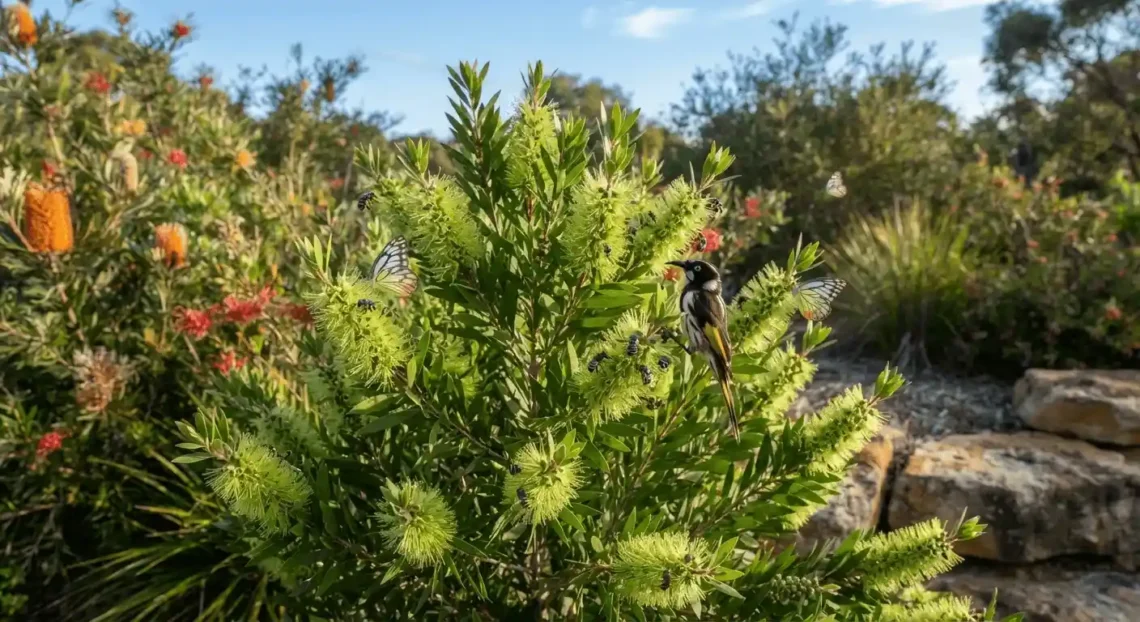
The green bottle brush is an unusual and attractive Australian native shrub or small tree admired for its distinctive green flower spikes and evergreen foliage. Unlike the familiar red-flowering bottlebrush varieties, several green-flowering species and cultivars—including Callistemon pinifolius Green, Callistemon viridiflorus, and the Wallum Bottlebrush—offer gardeners something unique while still providing nectar-rich blooms that attract birds and beneficial insects. As members of the Callistemon group, these plants are valued for their adaptability, drought tolerance, and ornamental appeal. Whether used as a feature shrub, informal hedge, or wildlife-friendly planting, green bottlebrushes thrive in many Australian landscapes with relatively little maintenance.
By Greenery Inside | Plant Care & Gardening Expert
In our experience growing Australian native plants, green bottlebrushes perform best when planted in sunny, open locations with good airflow. Once established, they are among the easiest native shrubs to maintain while providing reliable seasonal interest and excellent habitat for pollinators.
Quick Summary
- Green bottle brush refers to several Australian native Callistemon species and cultivars that produce unusual green bottlebrush-shaped flower spikes.
- Most green bottlebrush varieties are hardy, drought-tolerant plants suited to full sun and well-drained soils.
- Different species vary in mature size, foliage type, flowering season, and landscaping applications.
- Many green bottlebrushes provide valuable nectar for native birds, bees, butterflies, and other beneficial wildlife.
- Several species traditionally classified as Callistemon are now placed within the genus Melaleuca, although both names remain widely used by gardeners.
What Is a Green Bottle Brush?
A green bottle brush is a common name used for several Australian native shrubs and small trees that produce green or greenish-yellow bottlebrush-shaped flower spikes instead of the more familiar red blooms. These plants belong primarily to the Callistemon group, although modern botanical classification places many former Callistemon species within the genus Melaleuca based on genetic research.
The name green bottlebrush does not refer to a single plant. Instead, it includes several naturally occurring species and cultivated selections that share similar green floral displays but differ in growth habit, foliage, flower size, and preferred growing conditions.
Among the best-known examples are:
- Callistemon pinifolius Green
- Callistemon viridiflorus
- Wallum Bottlebrush
- Callistemon Green Envy
- Callistemon Green John
Although these plants vary in appearance, they all belong to the Myrtaceae (myrtle) family, a large botanical family that includes eucalyptus, tea trees (Melaleuca), lilly pilly (Syzygium), and paperbarks.
Botanical Classification
| Classification | Details |
| Common Name | Green Bottle Brush |
| Botanical Group | Callistemon / Melaleuca |
| Family | Myrtaceae |
| Plant Type | Evergreen shrub or small tree |
| Native Range | Australia |
| Flower Colour | Green to greenish-yellow |
| Main Pollinators | Native bees, honeyeaters, butterflies |
| Growth Habit | Upright, spreading, or compact depending on species |
Green bottlebrushes naturally occur across different parts of Australia, from coastal heathlands to open forests. Their adaptability allows them to grow successfully in home gardens across a wide range of climates.
One reason these plants remain popular is their year-round ornamental value. Their evergreen foliage provides structure even when not flowering, while the unusual blooms create a striking contrast against surrounding native plants.
Greenery Inside recommends choosing species suited to your local climate rather than selecting solely for flower colour. Matching the plant to site conditions usually results in stronger growth, improved flowering, and fewer maintenance problems.
Why Are the Flowers Green Instead of Red?
Green bottlebrush flowers are green because of their natural pigmentation and genetic characteristics, not because they have been artificially coloured or modified. Their flower spikes contain higher concentrations of chlorophyll and lower amounts of the red pigments known as anthocyanins that give many other bottlebrush species their bright crimson appearance.
Like all bottlebrush flowers, the showy “brush” is formed primarily by hundreds of colourful stamens rather than petals. In green-flowering species, these stamens remain green or yellow-green throughout flowering, creating their distinctive appearance.
The green colouring is a naturally evolved characteristic found in several Australian native species. It is not the result of genetic engineering or recent breeding, although horticulturists have selected attractive forms and cultivars for garden use.
Despite lacking the vivid red colour commonly associated with bottlebrushes, green-flowering species remain highly attractive to wildlife. Their abundant nectar continues to provide an important food source for:
- Native bees
- European honey bees
- Honeyeaters
- Wattlebirds
- Butterflies
- Other nectar-feeding insects
Many pollinators rely more on nectar availability, flower shape, scent, and seasonal timing than flower colour alone. As a result, green bottlebrushes often support biodiversity just as effectively as their red-flowering relatives.
As of the 2026 growing season, Australian native plant growers continue to recommend green-flowering bottlebrushes for wildlife-friendly gardens because they provide reliable nectar while adding uncommon colour variation to native landscapes.
Another benefit is that their softer flower colour blends naturally with Australian bushland plantings, making them particularly suitable for native gardens, coastal landscapes, and ecological restoration projects where subtle, naturalistic planting designs are preferred.
Green Bottle Brush Species and Cultivars
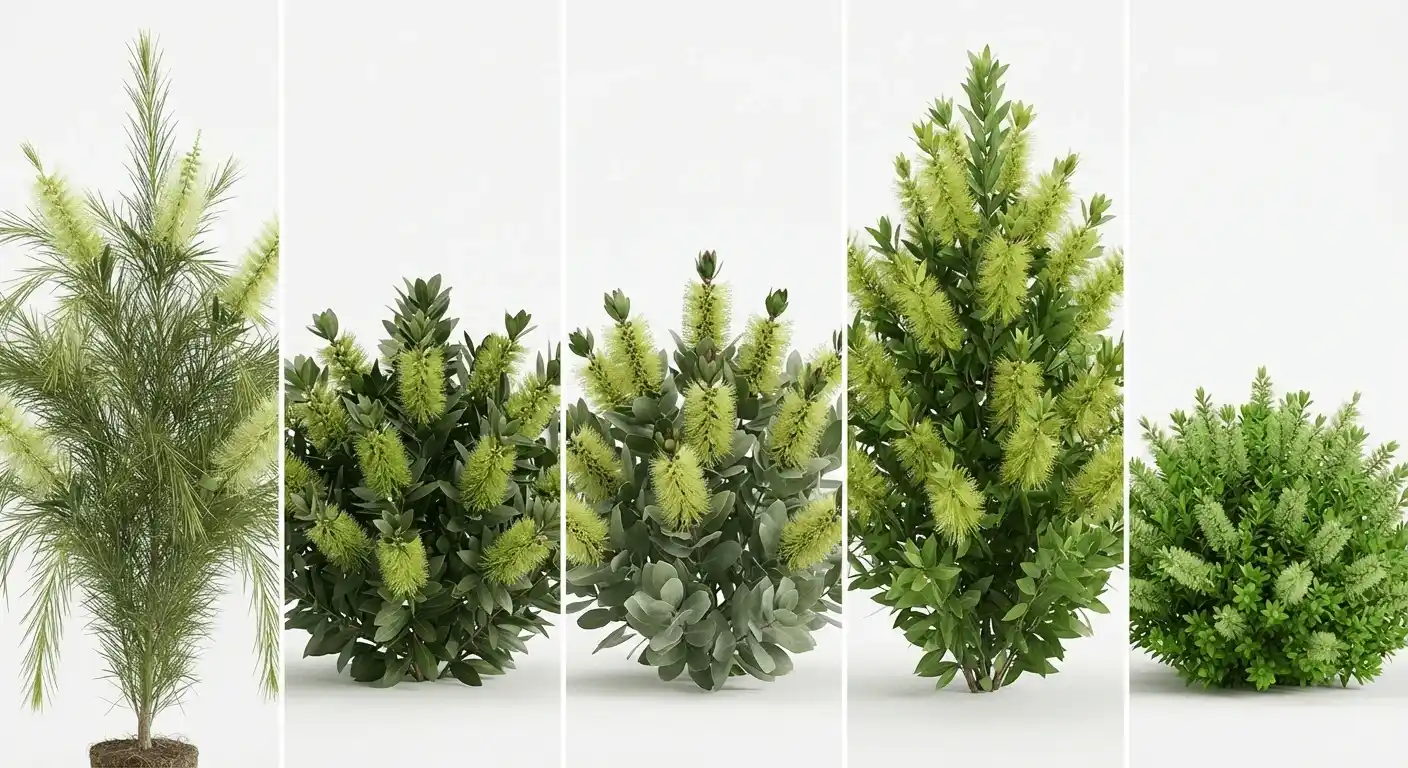
The name green bottle brush covers several naturally occurring species and cultivated selections that share green or greenish-yellow flower spikes. While they belong to the Callistemon group (with many now botanically classified as Melaleuca), each variety differs in mature size, foliage, flowering season, and landscape use.
Some remain compact shrubs suited to small gardens, while others develop into larger shrubs or small trees ideal for screening or habitat planting. Understanding these differences helps gardeners choose the most suitable variety for their climate and available space.
Green Bottle Brush Varieties at a Glance
| Variety | Mature Size | Flower Colour | Best Garden Use | Distinguishing Feature |
| Callistemon pinifolius Green | 1–1.5 m × 1–1.5 m | Bright green | Rock gardens, borders, containers | Fine pine-like foliage and compact habit |
| Callistemon viridiflorus | 2–4 m × 2–3 m | Green to yellow-green | Native gardens, feature planting | Naturally occurring green flower spikes |
| Wallum Bottlebrush | 1–3 m × 1–2 m | Pale green | Coastal gardens, heath plantings | Adapted to sandy, low-nutrient soils |
| Callistemon Green Envy | 1.5–2.5 m | Lime-green | Feature shrub, mixed borders | Dense growth with vivid green flowers |
| Callistemon Green John | 1–2 m | Green | Small gardens, low hedges | Compact, rounded growth habit |
| Green John Callistemon | 1–2 m | Green | Courtyards and native landscapes | Improved compact selection of Green John |
| Green John Bottlebrush | 1–2 m | Green | Wildlife gardens | Excellent nectar production |
| Callistemon pachyphyllus Green | 2–3 m | Greenish-yellow | Coastal and dry gardens | Thick foliage with excellent drought tolerance |
| Callistemon pinifolius dwarf green | 60 cm–1 m | Bright green | Containers, edging, rockeries | Naturally dwarf, dense form |
Callistemon pinifolius Green
Callistemon pinifolius Green is one of the most popular green-flowering bottlebrush cultivars for residential gardens. It forms a neat, compact shrub with slender, pine-like leaves that remain attractive throughout the year. For a more detailed guide covering its individual growing requirements, flowering habits, and landscape uses, see our complete guide to Callistemon pinifolius Green.
Its bright green flower spikes appear mainly during spring and early summer, creating a distinctive display that contrasts beautifully with grey-green native foliage. Because of its compact size, it works well in:
- Small gardens
- Rockeries
- Native borders
- Container plantings
- Low-maintenance landscapes
In our experience growing Australian native shrubs, this variety responds well to light pruning after flowering, producing a denser plant with improved flowering the following season.
Callistemon viridiflorus
Callistemon viridiflorus, often known as the Green Bottlebrush, is a naturally occurring species native to southeastern Australia, including Tasmania and parts of Victoria.
Unlike many cultivated bottlebrushes, this species has evolved naturally with green flower spikes rather than being selected through horticultural breeding.
Key characteristics include:
- Upright shrub or small tree
- Broader leaves than Callistemon pinifolius
- Green to yellow-green flowers
- Reliable nectar production
- Adaptation to cooler climates
Its natural appearance makes it especially valuable for bushland-style gardens and ecological restoration projects.
Wallum Bottlebrush
The Wallum Bottlebrush is associated with Australia’s coastal wallum heath ecosystems, where it thrives in sandy, acidic, nutrient-poor soils.
This species has evolved to tolerate challenging growing conditions that would stress many ornamental shrubs.
Its advantages include:
- Excellent drought tolerance after establishment
- Good coastal wind resistance
- Adaptation to sandy soils
- Low fertilizer requirements
- Strong wildlife value
Greenery Inside recommends the Wallum Bottlebrush for coastal properties where salt-laden winds and free-draining soils limit plant choices.
Callistemon Green Envy
Callistemon Green Envy is a cultivated ornamental selection valued for its attractive lime-green flower spikes and dense evergreen foliage.
Compared with some naturally occurring species, Green Envy typically has a more compact, garden-friendly growth habit, making it suitable for suburban landscapes.
It performs particularly well as:
- Feature shrub
- Informal hedge
- Native mixed border
- Pollinator planting
- Accent specimen
Its vibrant green flowers provide an unusual focal point while still attracting nectar-feeding birds and beneficial insects.
Callistemon Green John
Callistemon Green John is another compact ornamental cultivar selected for reliable flowering and manageable size.
It develops into a rounded shrub that requires minimal pruning and fits comfortably into modern gardens where space is limited.
Benefits include:
- Compact growth
- Dense branching
- Easy maintenance
- Attractive evergreen foliage
- Excellent bird habitat
Because of its tidy shape, Green John is often planted along pathways, driveways, and small property boundaries.
Green John Callistemon
The name Green John Callistemon generally refers to the same cultivated selection marketed under a slightly different common name.
Garden centres may use either label depending on the supplier, but both describe the same compact green-flowering bottlebrush valued for its ornamental qualities.
When purchasing, focus on the botanical name rather than the marketing name to ensure you obtain the desired plant.
Green John Bottlebrush
Green John Bottlebrush is another common retail name for the Green John cultivar.
Despite the variation in naming, gardeners can expect the same key characteristics:
- Green bottlebrush flowers
- Compact shrub habit
- Wildlife-friendly nectar production
- Low maintenance requirements
- Suitability for smaller landscapes
This variety is particularly useful where homeowners want the appearance of a traditional bottlebrush without the larger size of many older cultivars.
Callistemon pachyphyllus Green
Callistemon pachyphyllus Green is recognised for its thicker foliage and strong tolerance of hot, dry conditions.
Although less commonly planted than some other green-flowering selections, it performs well in:
- Dry native gardens
- Coastal landscapes
- Water-wise gardens
- Large mixed shrub borders
Its leathery foliage helps reduce moisture loss during prolonged dry periods, making it a dependable option for drought-prone regions.
Callistemon pinifolius dwarf green
Callistemon pinifolius dwarf green is the smallest selection among the commonly available green bottlebrushes.
Typically reaching less than one metre in height, it is ideal for gardeners seeking a compact native shrub that requires very little maintenance.
Common landscape uses include:
- Container gardening
- Courtyard planting
- Rock gardens
- Garden edging
- Small native borders
Although compact, it still produces nectar-rich flowers that attract bees and small nectar-feeding birds.
Choosing Between Green Bottle Brush Varieties
Selecting the right green bottlebrush depends on your garden’s size, climate, and intended use.
- Choose Callistemon pinifolius Green for compact gardens and decorative borders.
- Select Callistemon viridiflorus if you prefer a naturally occurring species with broader foliage.
- Plant the Wallum Bottlebrush in coastal or sandy locations.
- Use Callistemon Green Envy where a colourful feature shrub is desired.
- Grow Callistemon Green John or Green John Bottlebrush in smaller landscapes requiring minimal pruning.
- Consider Callistemon pachyphyllus Green for dry, exposed sites.
- Pick Callistemon pinifolius dwarf green for containers, courtyards, or edging.
In our experience, matching the variety to local soil and climate conditions is more important than choosing solely based on flower appearance. A well-suited green bottlebrush establishes more quickly, flowers more reliably, and requires significantly less maintenance over its lifetime.
How Green Bottle Brush Compares with Other Bottlebrush Varieties
Although all bottlebrush plants belong to the same broader group, green-flowering varieties differ noticeably from the more familiar red, weeping, and willow bottlebrushes. These differences include flower colour, growth habit, foliage, mature size, and preferred landscape use.
Understanding these distinctions helps gardeners choose the most suitable plant for their garden design, climate, and maintenance preferences.
Green vs Crimson Bottlebrush
The main difference between a green bottle brush and a crimson bottlebrush is flower colour. Green bottlebrushes produce green or yellow-green flower spikes, while crimson bottlebrushes are known for their vibrant red blooms that create a bold visual display.
The Crimson Bottlebrush is commonly associated with Callistemon citrinus, previously known by the synonym Callistemon lanceolatus. It is one of Australia’s most widely grown ornamental bottlebrush species due to its spectacular flowering and adaptability.
| Feature | Green Bottle Brush | Crimson Bottlebrush (Callistemon citrinus) |
| Flower Colour | Green to lime-green | Bright crimson red |
| Mature Size | 1–4 m depending on species | 2–5 m |
| Wildlife Value | Excellent | Excellent |
| Garden Style | Naturalistic and native | Bold ornamental display |
| Pruning Needs | Light annual pruning | Light annual pruning |
Green bottlebrushes blend naturally into native landscapes, while crimson bottlebrushes often become focal points because of their intense flower colour.
In our experience, gardeners seeking a softer, more subtle planting palette usually prefer green-flowering selections, whereas crimson varieties are ideal when vibrant seasonal colour is the priority.
Green vs Weeping Bottlebrush
The most noticeable difference between green bottlebrushes and the Weeping Bottlebrush lies in their growth habit.
Most green bottlebrush species develop upright or rounded shrubs, whereas Callistemon viminalis, now widely classified as Melaleuca viminalis, forms graceful arching branches that create a cascading appearance.
The weeping bottlebrush is especially popular as a shade tree or feature specimen in larger gardens and parks.
| Feature | Green Bottle Brush | Weeping Bottlebrush (Callistemon viminalis / Melaleuca viminalis) |
| Growth Habit | Upright or compact shrub | Graceful weeping tree |
| Mature Height | 1–4 m | 4–10 m |
| Flower Colour | Green | Usually bright red |
| Best Use | Borders, hedges, native gardens | Feature tree, street planting |
| Maintenance | Low | Moderate |
Because of its larger mature size, the weeping bottlebrush requires considerably more space than most green bottlebrush varieties.
Green vs Willow Bottlebrush
The Willow Bottlebrush differs primarily in its long, narrow leaves that resemble those of willow trees.
Traditionally known as Callistemon salignus, this species is now generally classified as Melaleuca salignus, although some references also mention Melaleuca salicina in related classifications.
Compared with green bottlebrushes, willow bottlebrushes typically produce creamy-white, pale yellow, or occasionally pink-tinted flower spikes and develop into taller trees.
| Feature | Green Bottle Brush | Willow Bottlebrush (Callistemon salignus / Melaleuca salignus) |
| Flower Colour | Green | White to creamy yellow |
| Leaf Shape | Fine or narrow | Long willow-like leaves |
| Mature Height | 1–4 m | 5–10 m |
| Growth Form | Shrub or small tree | Medium tree |
| Best Use | Native gardens | Shade trees and screening |
Willow bottlebrushes are excellent choices where a taller evergreen tree is needed, while green bottlebrushes fit better into compact landscapes and mixed native plantings.
Plant Size
Green bottle brush plants range from compact dwarf shrubs to small trees, depending on the species or cultivar. Most garden varieties remain manageable, making them suitable for residential landscapes.
Typical Mature Size
| Variety | Height | Spread |
| Dwarf selections | 60 cm–1 m | 60 cm–1 m |
| Compact shrubs | 1–2 m | 1–2 m |
| Medium shrubs | 2–3 m | 2–3 m |
| Small tree forms | 3–5 m | 2–4 m |
Species such as Callistemon pinifolius dwarf green remain naturally compact, while Callistemon viridiflorus can eventually develop into a small tree under favourable conditions.
Shrub vs Small Tree Forms
Green bottlebrushes may grow as:
- Dense rounded shrubs
- Upright multi-stemmed shrubs
- Open small trees
- Broad spreading specimens
Their final shape depends on genetics, pruning practices, soil quality, and available growing space.
Indoor vs Outdoor Size
Green bottlebrushes are primarily outdoor plants.
While young specimens may be temporarily grown in large containers, they require abundant sunlight and generally do not perform well as permanent indoor plants. Outdoor specimens develop healthier foliage, stronger root systems, and significantly better flowering.
Environmental Factors Affecting Plant Size
Several factors influence mature growth:
- Amount of sunlight
- Soil drainage
- Available moisture
- Soil fertility
- Annual pruning
- Local climate
Greenery Inside recommends allowing enough space for the plant’s mature dimensions rather than planting too close to buildings or pathways. Proper spacing improves airflow, reduces disease risk, and minimizes future pruning.
Growth Rate
Green bottle brush generally has a moderate growth rate, although this varies among species and growing conditions.
Most varieties establish steadily during their first few years before producing stronger seasonal growth once their root systems become established.
Growth Speed
- Dwarf cultivars: Moderate
- Compact shrubs: Moderate
- Larger species: Moderate to moderately fast
Young plants often prioritize root development during the establishment phase before significant top growth occurs.
Seasonal Growth
Most active growth occurs during:
- Spring
- Early summer
- Following periods of consistent rainfall
Growth slows during winter in cooler climates and may temporarily pause during prolonged drought unless irrigation is provided.
Climate Effects
Warm climates with reliable sunshine encourage faster development.
In cooler regions, growth remains healthy but is generally slower, particularly during winter.
Most green bottlebrushes benefit from:
- Mild temperatures
- Good air circulation
- Full sunlight
- Moderate seasonal rainfall
Soil Fertility
Although these Australian natives tolerate relatively poor soils, moderate fertility encourages healthier growth.
Avoid excessive fertilization, especially products high in phosphorus, as many native plants are sensitive to elevated phosphorus levels.
Instead, use:
- Low-phosphorus native fertilizers
- Organic mulch
- Slow-release native plant products
Establishment Period
Most green bottlebrushes require approximately one to two years to establish after planting.
During this period:
- Water regularly but avoid waterlogging.
- Apply mulch to conserve soil moisture.
- Control competing weeds.
- Avoid heavy pruning until healthy new growth develops.
In our experience, gardeners who focus on consistent watering during the first summer achieve stronger root systems and noticeably better drought tolerance in later years.
Green Bottle Brush Care Guide
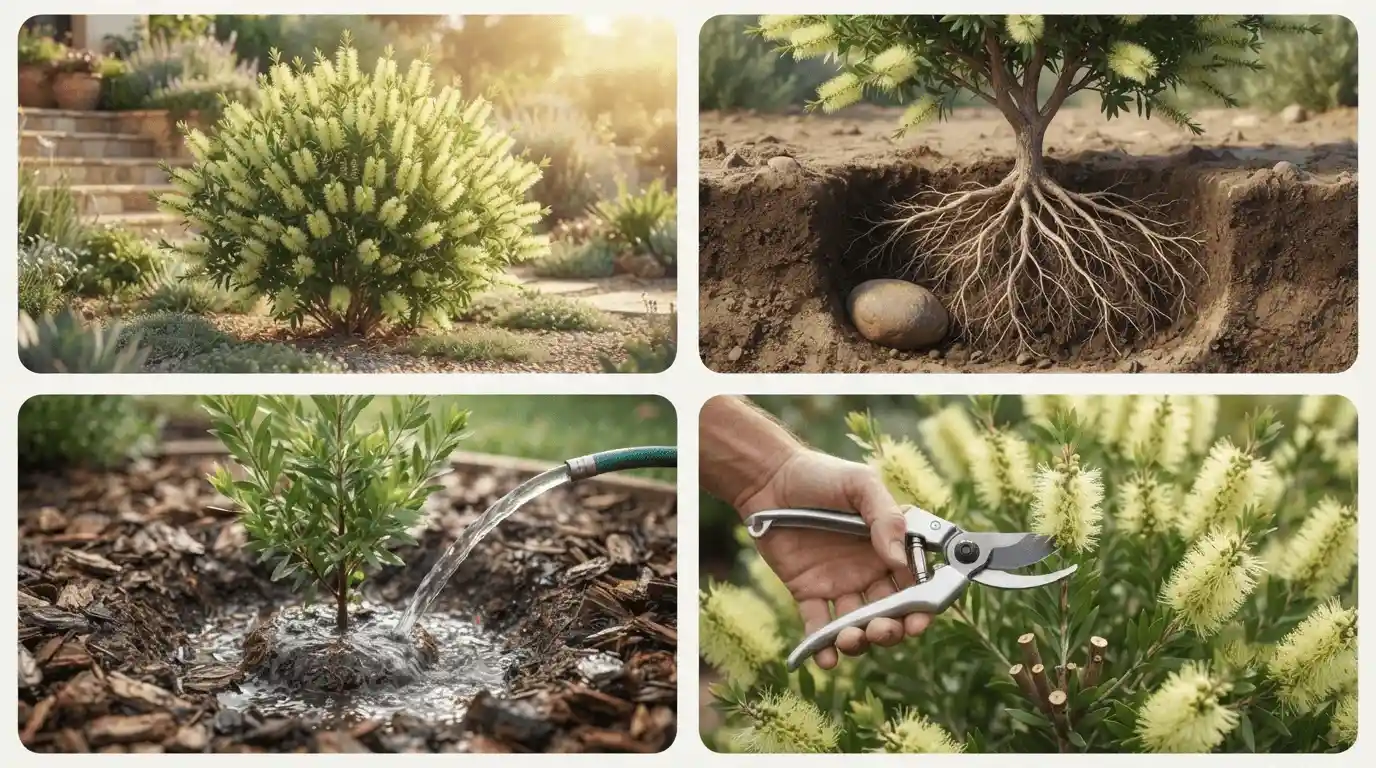
Green bottle brush is a hardy Australian native that requires relatively little maintenance once established. Like most Callistemon species, it performs best when grown in full sun, planted in well-drained soil, and watered appropriately during its establishment period.
Following good horticultural practices helps encourage vigorous growth, abundant flowering, and long-term plant health.
Sunlight Requirements
Green bottle brush grows best in full sun, receiving at least six hours of direct sunlight each day. Adequate sunlight promotes dense foliage, stronger stems, and more prolific flowering.
While most species tolerate partial shade, reduced light often results in fewer flowers, leggier growth, and a more open plant structure.
Ideal Light Conditions
- Full sun for maximum flowering
- Partial shade in very hot inland climates
- Good airflow around the plant
- Avoid deep shade beneath large trees
If planting near buildings or fences, position the shrub where it will receive consistent morning and afternoon sunlight.
Greenery Inside recommends choosing the sunniest suitable location available. In our experience, insufficient sunlight is one of the most common reasons green bottlebrushes produce limited flowers.
Soil Requirements
Green bottle brush adapts to many soil types provided they drain well. Naturally occurring species often grow in sandy, gravelly, or rocky soils that do not remain wet after rainfall.
Preferred Soil Conditions
- Well-drained sandy soil
- Sandy loam
- Gravelly native soils
- Slightly acidic to neutral pH
Many species also tolerate poorer soils where ornamental shrubs struggle.
Improving Heavy Clay Soil
Heavy clay retains excessive moisture, increasing the risk of root diseases.
Before planting:
- Incorporate coarse compost and gypsum where appropriate.
- Create raised garden beds if drainage is poor.
- Avoid planting in waterlogged depressions.
- Improve surface drainage before the wet season.
Coastal Gardens
Many green bottlebrush species perform exceptionally well in coastal environments because they tolerate:
- Sandy soils
- Salt-laden winds
- High summer temperatures
- Dry conditions
The Wallum Bottlebrush and Callistemon pachyphyllus Green are particularly well suited to coastal landscapes.
Watering Needs
Green bottle brush needs regular watering while establishing but becomes relatively drought tolerant once mature.
Newly Planted Bottlebrush
During the first 12 months:
- Water deeply once or twice each week during dry weather.
- Allow the top layer of soil to dry slightly between waterings.
- Apply organic mulch to conserve moisture.
- Reduce watering during extended rainy periods.
Deep watering encourages roots to grow downward, producing stronger, more resilient plants.
Established Plants
Once established, most green bottlebrush varieties only require supplemental watering during prolonged dry spells.
Established shrubs generally benefit from:
- Deep watering every two to four weeks during drought
- Natural rainfall during cooler months
- Minimal irrigation during winter
Drought Tolerance
Most green bottlebrushes have excellent drought tolerance thanks to their Australian heritage.
Healthy mature plants can withstand extended dry periods better than many exotic ornamentals. However, occasional deep watering during severe drought helps maintain flowering and foliage quality.
In our experience growing native gardens, mature bottlebrushes recover more quickly from hot summers when watered deeply but infrequently rather than receiving frequent shallow irrigation.
Fertilizing
Green bottle brush requires only modest feeding. Excess fertilizer, particularly phosphorus-rich products, can damage many Australian native plants.
Best Fertilizers
Choose:
- Low-phosphorus native plant fertilizer
- Controlled-release native fertilizer
- Well-aged compost
- Organic mulch
Avoid:
- High-phosphorus lawn fertilizers
- Heavy applications of manure
- Excess nitrogen that encourages leafy growth instead of flowers
Feeding Schedule
| Season | Recommendation |
| Early spring | Apply low-phosphorus native fertilizer |
| Summer | Feed only if growth is weak |
| Autumn | Light compost application if needed |
| Winter | Generally no fertilizing required |
Using less fertilizer often produces healthier native plants than overfeeding.
Pruning
Green bottle brush responds well to light pruning, which helps maintain a compact shape and encourages additional flowering the following season.
Best Time to Prune
The ideal time is immediately after flowering.
This allows the plant to develop new shoots before the next flowering cycle.
Light Shaping
Remove:
- Long, untidy shoots
- Crossing branches
- Dead wood
- Damaged stems
Avoid cutting into old, leafless wood unless necessary, as recovery may be slow.
Deadheading
Removing spent flower spikes helps:
- Improve appearance
- Encourage bushier growth
- Stimulate additional branching
- Reduce unnecessary seed production
Many gardeners lightly trim just behind each faded flower spike.
Encouraging Bushier Growth
Young plants become denser when lightly tip-pruned during their first few growing seasons.
Greenery Inside recommends frequent light pruning rather than occasional heavy cutting. This produces fuller shrubs while preserving the plant’s natural form.
Climate and Hardiness
Most green bottle brush species are highly adaptable and grow successfully across many Australian climate zones.
Their resilience makes them popular for home gardens, public landscapes, and ecological restoration projects.
Frost Tolerance
Frost tolerance varies by species.
Generally:
- Mature plants tolerate light frosts well.
- Young plants benefit from protection during severe frost events.
- Some species, including Callistemon viridiflorus, are naturally better adapted to cooler climates.
Applying mulch around the root zone helps protect roots during winter.
Heat Tolerance
Green bottle brush performs exceptionally well in hot Australian summers.
Established plants tolerate:
- High temperatures
- Extended sunshine
- Low humidity
- Dry seasonal conditions
Occasional deep watering during extreme heat helps maintain vigorous growth.
Coastal Exposure
Many species naturally occur near the coast and tolerate:
- Salt spray
- Strong coastal winds
- Sandy soils
- High light intensity
This makes them excellent choices for seaside gardens where many ornamental shrubs struggle.
Wind Resistance
The flexible branches and sturdy root systems of established green bottlebrushes provide good resistance to strong winds.
However, newly planted shrubs should be staked if exposed to persistent coastal or inland winds until roots become established.
Flowering Season and Pollinator Benefits
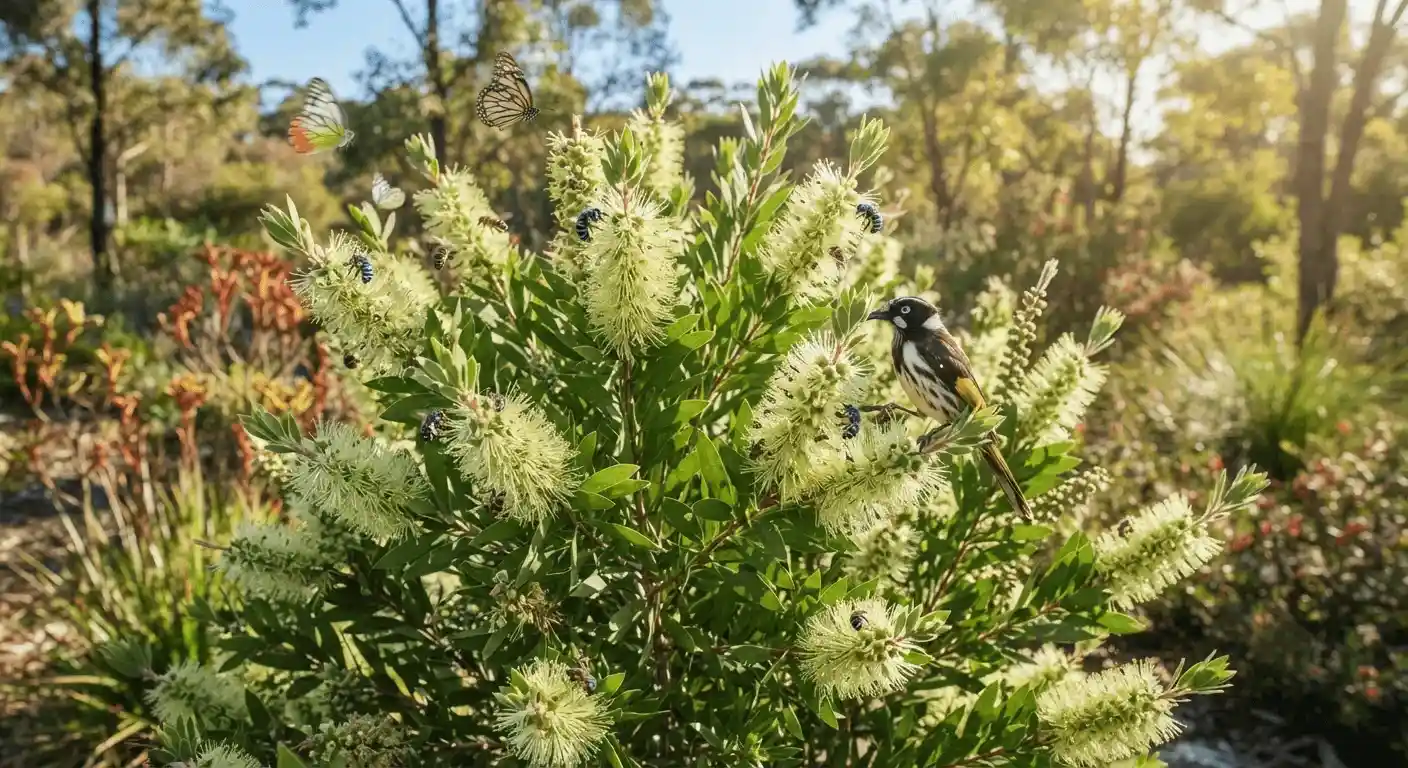
Green bottle brush typically flowers from spring through early summer, although some species and cultivars may produce additional flushes of blooms during autumn if growing conditions remain favourable. Combining green bottlebrush with other nectar-rich species, including native plants that attract butterflies, can create a more diverse and wildlife-friendly garden.
The distinctive bottlebrush-shaped flower spikes consist mainly of long stamens packed with nectar, making them highly attractive to a wide range of pollinators.
Typical Flowering Period
Most varieties bloom during:
- Spring
- Late spring
- Early summer
Warm climates may encourage a lighter second flowering later in the year, especially after rainfall or light pruning.
Nectar Production
Green bottle brush flowers produce abundant nectar that supports local wildlife throughout the flowering season.
The nectar is an important food source for many native species, particularly during periods when fewer plants are in bloom.
Wildlife It Attracts
These shrubs are especially valuable for attracting:
- Native bees
- European honey bees
- Honeyeaters
- Wattlebirds
- Butterflies
- Hoverflies
- Other beneficial pollinating insects
Because pollinators respond primarily to nectar availability rather than flower colour, green-flowering bottlebrushes are just as beneficial to wildlife as traditional red varieties.
Biodiversity Benefits
Planting green bottle brush contributes to healthier garden ecosystems by:
- Supporting native pollinators
- Increasing insect diversity
- Providing food for nectar-feeding birds
- Improving habitat connectivity
- Enhancing biodiversity in urban and suburban gardens
As of the 2026 growing season, Australian native plant specialists continue to recommend bottlebrush species for pollinator-friendly landscapes due to their dependable nectar production and adaptability.
In our experience, combining green bottle brush with other flowering Australian natives creates a succession of blooms throughout the year, ensuring a more consistent food supply for birds, bees, and beneficial insects.
Landscaping Uses for Green Bottle Brush
Green bottle brush is one of the most versatile Australian native shrubs for residential and public landscapes. Its evergreen foliage, unusual green flower spikes, and adaptability make it suitable for a wide range of garden styles. Whether planted as a specimen, hedge, or part of a native planting scheme, it provides year-round structure while supporting local wildlife. For gardeners planning a broader native landscape, exploring Australian native garden trees can help create a layered design with canopy plants, shrubs, and flowering species that support local biodiversity.
Native Gardens
Green bottle brush naturally complements Australian native gardens because it blends well with indigenous shrubs, grasses, and flowering plants.
It pairs well with:
- Grevilleas
- Banksias
- Tea trees (Melaleuca)
- Native daisies
- Kangaroo paws
Its subtle green flowers create a natural bushland appearance rather than a highly ornamental display.
Wildlife Gardens
One of the greatest strengths of green bottle brush is its ability to attract beneficial wildlife.
A wildlife-friendly planting may include:
- Green bottle brush
- Grevillea
- Banksia
- Native grasses
- Flowering groundcovers
Together, these plants provide nectar, shelter, and nesting habitat throughout the year.
Coastal Landscapes
Several green bottlebrush species tolerate harsh coastal conditions, including:
- Salt-laden winds
- Sandy soils
- High summer temperatures
- Periodic drought
The Wallum Bottlebrush is especially well suited to seaside gardens due to its natural adaptation to coastal heath environments.
Screening and Privacy
Larger green bottlebrush varieties can be planted as informal screening shrubs.
Benefits include:
- Evergreen foliage year-round
- Dense branching
- Wildlife habitat
- Attractive seasonal flowering
- Reduced maintenance compared with many exotic hedges
Allow adequate spacing so each shrub can develop naturally without overcrowding.
Informal Hedges
Compact cultivars such as Callistemon Green John and Callistemon pinifolius Green respond well to light trimming, making them excellent choices for informal native hedges.
Unlike tightly clipped formal hedges, informal hedges maintain a softer, more natural appearance while continuing to flower.
Feature Shrubs
Green bottle brush also performs well as a standalone specimen.
Its unusual flower colour creates visual interest in:
- Front gardens
- Courtyards
- Entryways
- Rock gardens
- Native display beds
Mixed Native Borders
Green bottle brush blends beautifully with contrasting foliage textures and flower colours.
Consider combining it with:
- Silver-leaved shrubs
- Native grasses
- Flowering groundcovers
- Small eucalyptus species
- Banksias
The contrasting forms add year-round interest without overwhelming the landscape.
Landscaping Ideas
Green bottle brush is suitable for:
- Feature planting
- Rock gardens
- Low-maintenance gardens
- Pollinator gardens
- Council landscaping
- Bushland-style gardens
- Water-wise landscapes
- Coastal plantings
Greenery Inside recommends grouping native plants with similar water and soil requirements. This simplifies maintenance and promotes healthier long-term growth.
Common Problems and How to Fix Them
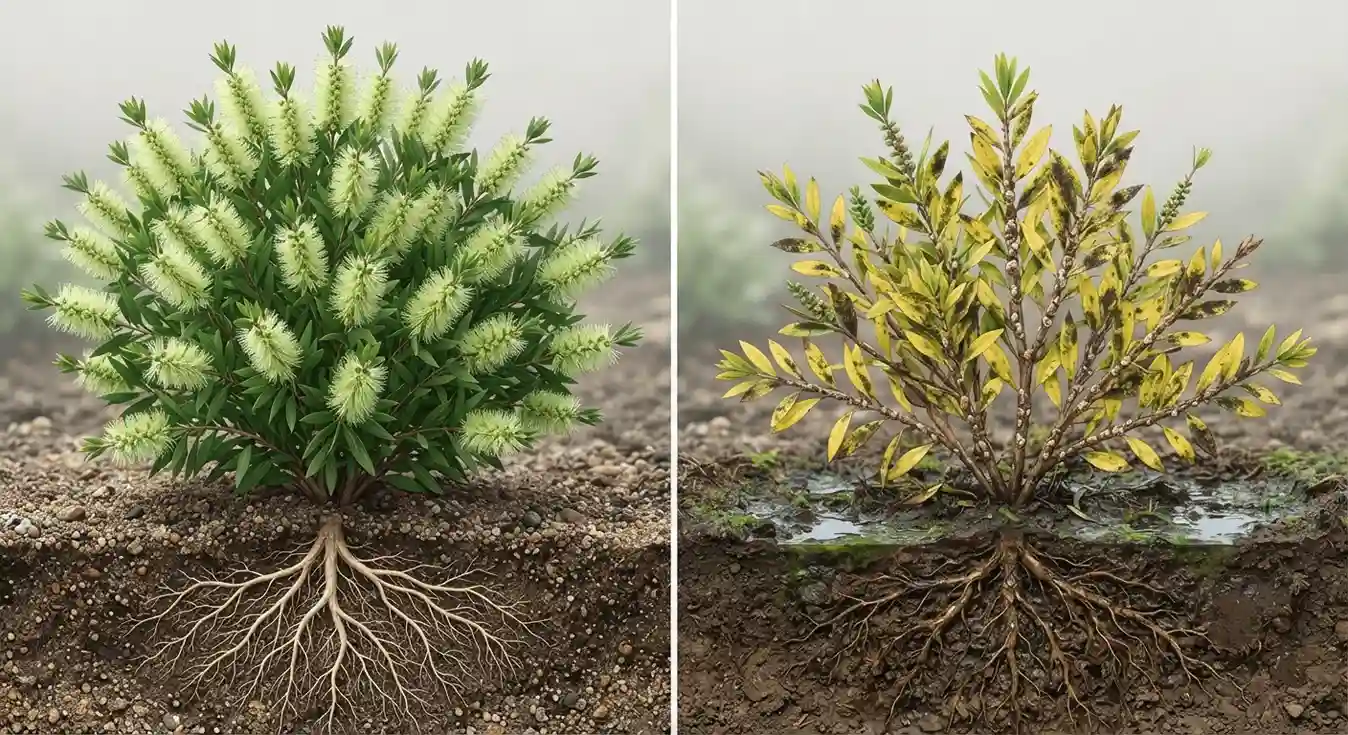
Green bottle brush is generally a resilient plant, but poor growing conditions can occasionally lead to reduced flowering, foliage problems, root diseases, or pest infestations. Most issues can be prevented through proper planting, watering, and routine monitoring.
Poor Flowering
Poor flowering is usually caused by insufficient sunlight, excessive fertiliser, or incorrect pruning.
Common Causes
- Too much shade
- High-nitrogen fertilisers
- Heavy pruning before flowering
- Young plants still establishing
- Water stress during bud formation
How to Fix It
- Plant in full sun.
- Switch to a low-phosphorus native fertiliser.
- Prune immediately after flowering instead of before.
- Water consistently during prolonged dry periods.
- Avoid excessive feeding.
Healthy mature plants generally flower more reliably each year once fully established.
Yellow Leaves
Yellow foliage often indicates root stress rather than disease.
Possible Causes
- Poor drainage
- Waterlogged soil
- Nutrient imbalance
- Compacted soil
- Damaged roots
Solutions
- Improve soil drainage.
- Reduce watering if soil remains wet.
- Apply a suitable native plant fertiliser if deficiencies are suspected.
- Mulch to regulate soil moisture.
- Check for root damage during nearby construction or digging.
Monitoring new growth often helps determine whether the problem is improving.
Root Rot
Root rot develops when roots remain in saturated soil for extended periods.
Symptoms include:
- Wilting despite moist soil
- Yellow leaves
- Blackened roots
- Slow growth
- Sudden branch dieback
Prevention
- Plant in well-drained soil.
- Avoid overwatering.
- Use raised beds where drainage is poor.
- Improve heavy clay before planting.
Once severe root rot develops, recovery can be difficult, making prevention the best approach.
Pest Issues
Green bottle brush experiences relatively few serious pest problems, but occasional infestations may occur.
Scale Insects
Scale insects attach themselves to stems and leaves, feeding on plant sap.
Signs include:
- Sticky honeydew
- Small raised bumps
- Reduced plant vigour
Psyllids
Psyllids are tiny sap-feeding insects that may distort young leaves or shoots.
Healthy, vigorous plants generally tolerate minor infestations without lasting damage.
Sooty Mould
Sooty mould develops on the honeydew produced by sap-feeding insects such as scale.
Although it rarely infects plant tissue directly, heavy growth can reduce photosynthesis.
Prevention
Reduce pest problems by:
- Inspecting plants regularly
- Encouraging beneficial insects
- Maintaining good airflow
- Avoiding excessive nitrogen fertiliser
- Removing heavily infested branches
Organic Treatments
Suitable options include:
- Horticultural oil
- Eco-friendly insecticidal soap
- Manual removal of scale insects
- Washing honeydew from foliage with water
Greenery Inside recommends treating pest problems early. Small infestations are much easier to control than widespread outbreaks, and early intervention usually prevents long-term damage.
Common Beginner Mistakes
Many green bottle brush problems can be avoided by following basic Australian native plant care practices.
Common mistakes include:
- Planting in heavy shade, which reduces flowering.
- Using high-phosphorus fertilisers instead of native plant products.
- Growing plants in poorly drained soil.
- Watering too frequently after establishment.
- Hard pruning at the wrong time, removing future flower buds.
- Ignoring the plant’s mature size when selecting a planting location.
- Planting too close to buildings or fences, restricting airflow and growth.
- Neglecting young plants during their first summer, when regular watering is most important.
In our experience, the most successful gardens establish green bottle brush in the correct location from the beginning rather than trying to compensate later with extra fertiliser or excessive pruning.
Choosing the Best Green Bottle Brush for Your Garden
The best green bottle brush depends on your available space, local climate, soil conditions, and the role you want the plant to play in your landscape. Some varieties remain compact and are ideal for courtyards, while others grow into larger shrubs or small trees suitable for screening or habitat planting.
Selecting a species that matches your site’s conditions will generally result in healthier growth, improved flowering, and lower maintenance.
Best for Small Gardens
Compact cultivars are perfect where space is limited. Gardeners looking for smaller bottlebrush selections can also explore dwarf bottlebrush varieties, which are ideal for courtyards, borders, and compact native gardens.
Recommended choices include:
- Callistemon pinifolius Green
- Callistemon pinifolius dwarf green
- Callistemon Green John
These varieties typically remain under two metres tall, making them suitable for:
- Courtyards
- Small suburban gardens
- Rock gardens
- Container displays
- Low borders
Their naturally compact growth also reduces the need for regular pruning.
Best for Large Landscapes
If you have a larger property, taller species provide greater visual impact and habitat value.
Good options include:
- Callistemon viridiflorus
- Callistemon pachyphyllus Green
These plants can be used as:
- Feature shrubs
- Informal screens
- Wildlife plantings
- Mixed native borders
- Small specimen trees
Allow enough room for mature growth to maintain good airflow and natural branching.
Best for Coastal Gardens
Coastal environments require plants that tolerate sandy soils, salt spray, and strong winds.
Suitable selections include:
- Wallum Bottlebrush
- Callistemon pachyphyllus Green
These species naturally adapt to coastal conditions and generally require little supplemental watering once established.
Best for Frost-Prone Areas
Gardeners in cooler regions should select varieties with better cold tolerance.
Callistemon viridiflorus is often recommended because it naturally occurs in cooler parts of southeastern Australia, including Tasmania.
Young plants should still receive some protection during severe frosts until fully established.
Best for Wildlife Gardens
Nearly all green bottlebrush varieties support native wildlife through abundant nectar production.
For maximum biodiversity, choose:
- Callistemon viridiflorus
- Callistemon Green Envy
- Green John Bottlebrush
These shrubs attract:
- Honeyeaters
- Native bees
- Honey bees
- Butterflies
- Other beneficial pollinating insects
Planting several native flowering species together extends nectar availability throughout the year.
Best for Low-Maintenance Gardens
If easy care is your priority, look for naturally compact cultivars that require only occasional pruning.
Excellent low-maintenance choices include:
- Callistemon Green John
- Callistemon pinifolius Green
- Callistemon pinifolius dwarf green
Once established, these plants generally require:
- Minimal watering
- Light annual pruning
- Occasional feeding with a native plant fertilizer
- Routine pest monitoring
Greenery Inside recommends choosing the right plant for your site rather than relying on frequent pruning to control size. A well-matched variety is healthier, flowers more consistently, and requires significantly less maintenance over time.
Green Bottle Brush vs Other Australian Native Shrubs
Green bottle brush is often compared with other popular Australian native shrubs because they share similar growing conditions and are widely used in native landscapes. While each group has its own strengths, bottlebrushes stand out for their unusual flowers, dependable flowering, and exceptional value to pollinators.
| Plant Group | Main Feature | Wildlife Value | Drought Tolerance | Best Garden Use |
| Green Bottle Brush (Callistemon) | Green bottlebrush-shaped flowers | Excellent | High | Wildlife gardens, hedges, feature shrubs |
| Grevillea | Spider-like flowers in many colours | Excellent | High | Bird-attracting gardens |
| Banksia | Large cone-shaped flower spikes | Excellent | High | Coastal and native landscapes |
| Tea Tree (Melaleuca) | Fine foliage and fluffy flowers | Good | Moderate to High | Screening and habitat planting |
| Native Mint Bushes (Prostanthera) | Aromatic foliage with colourful flowers | Good | Moderate | Cottage and sensory gardens |
Green Bottle Brush vs Grevillea
Grevilleas are renowned for their long flowering seasons and nectar-rich blooms that attract birds throughout the year.
Green bottle brush may be the better choice if you want:
- A more upright growth habit
- Easier hedge formation
- Distinctive bottlebrush flowers
- Reliable spring flowering
Grevilleas often provide greater flower colour diversity, while bottlebrushes contribute stronger structural form.
Green Bottle Brush vs Banksia
Banksias produce striking cone-shaped flower spikes and woody seed cones that remain decorative long after flowering. Gardeners interested in expanding their native planting palette can explore different banksia tree varieties for additional structure and seasonal interest.
Choose green bottle brush when you need:
- Faster establishment
- More compact growth
- Easier pruning
- Smaller garden suitability
Banksias generally require more space and are often better suited to larger native landscapes.
Green Bottle Brush vs Tea Tree
Tea trees (Melaleuca) are valued for their soft foliage and masses of fluffy flowers.
Green bottle brush is usually preferable when:
- Nectar production is a priority.
- A denser shrub is desired.
- More structured growth is required.
- Seasonal flowering displays are important.
Both groups tolerate Australian conditions well and complement one another in mixed native gardens.
Green Bottle Brush vs Native Mint Bushes
Native mint bushes (Prostanthera species) are prized for their fragrant leaves and colourful blossoms.
Compared with mint bushes, green bottle brush generally offers:
- Better drought tolerance
- Longer lifespan
- Greater wind resistance
- Improved suitability for public landscapes
- Higher nectar production for birds
Many gardeners combine both plants to create gardens with varied foliage, fragrance, and flowering times.
Conclusion
Green bottle brush is one of Australia’s most distinctive native ornamental plants, offering unusual green flower spikes, evergreen foliage, and excellent wildlife value. Whether you choose Callistemon pinifolius Green, Callistemon viridiflorus, the Wallum Bottlebrush, or another green-flowering cultivar, each variety brings unique characteristics suited to different garden styles and growing conditions.
Most green bottlebrushes thrive in full sun, well-drained soil, and require only modest watering and light pruning once established. Their adaptability, drought tolerance, and nectar-rich flowers make them outstanding choices for native gardens, coastal landscapes, informal hedges, and pollinator-friendly plantings.
By selecting the right variety for your climate and available space, you can enjoy a long-lived, low-maintenance Australian native shrub that enhances biodiversity while providing year-round ornamental appeal.
Frequently Asked Questions
Is green bottle brush a different species from regular bottlebrush?
Not always. The term green bottle brush refers to several species and cultivars that naturally produce green flower spikes instead of the more common red flowers. These include species such as Callistemon viridiflorus and cultivars like Callistemon pinifolius Green.
What is the difference between Callistemon pinifolius Green and Callistemon viridiflorus?
Callistemon pinifolius Green is typically a compact shrub with fine, pine-like foliage, making it ideal for small gardens. Callistemon viridiflorus is a naturally occurring species that usually grows larger, has broader leaves, and is better suited to larger native landscapes.
Does green bottle brush attract birds and bees?
Yes. Green bottle brush produces nectar-rich flowers that attract honeyeaters, native bees, honey bees, butterflies, and many other beneficial pollinators. Despite their green colour, the flowers are highly valuable for supporting local biodiversity.
How fast does a green bottle brush grow?
Most green bottlebrush varieties have a moderate growth rate. Under suitable conditions, they usually establish within one to two years and produce steady seasonal growth during spring and early summer.
Can green bottle brush tolerate frost?
Many species tolerate light frosts once established. Varieties such as Callistemon viridiflorus are particularly well adapted to cooler climates, although young plants benefit from frost protection during their first few winters.
When should I prune a green bottlebrush?
The best time to prune is immediately after flowering. Light pruning encourages bushier growth and helps promote more flowers during the following season while preserving the plant’s natural shape.
Is Wallum Bottlebrush suitable for coastal gardens?
Yes. The Wallum Bottlebrush naturally grows in coastal heath environments and is well adapted to sandy soils, salt-laden winds, and dry conditions, making it an excellent choice for seaside landscapes.
Which green bottlebrush variety is best for small gardens?
For compact spaces, Callistemon pinifolius Green, Callistemon pinifolius dwarf green, and Callistemon Green John are among the best choices. Their manageable size, attractive foliage, and low-maintenance nature make them ideal for courtyards, borders, and smaller residential gardens.