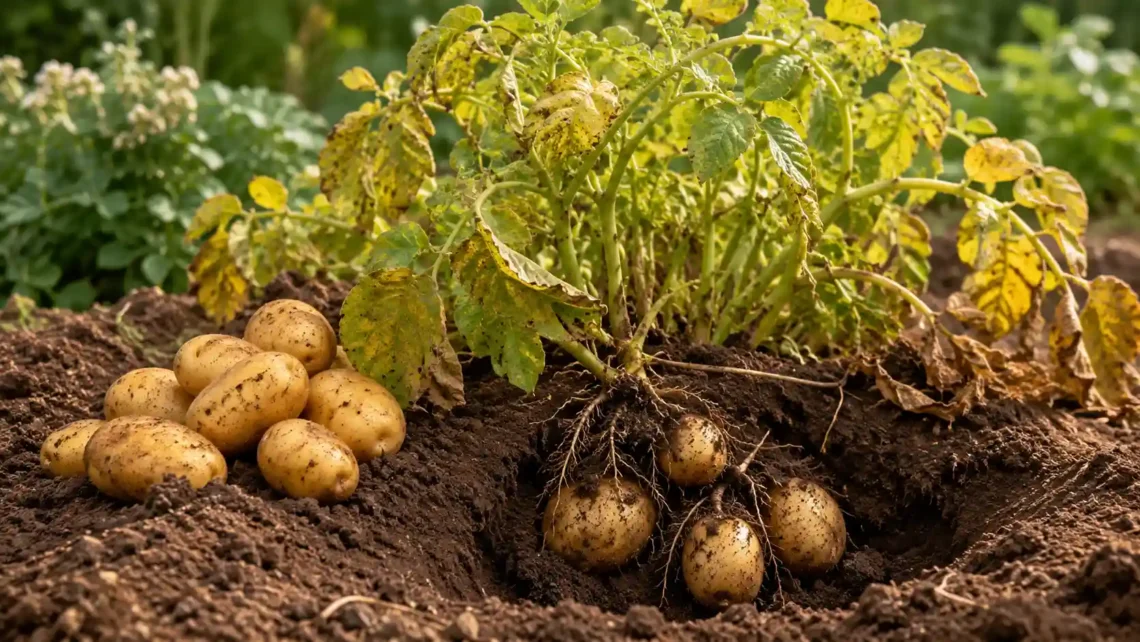
According to Greenery Inside, potato plants signal harvest readiness when their foliage turns yellow and begins dying back, with stems and leaves collapsing or browning. For mature main crop potatoes, wait until the vines have fully died back; flowering and dropped blossoms also indicate tubers below have reached full size.
New potatoes meant for immediate eating can be dug two to three weeks after flowering, while their skins are still thin and rub off easily. Main crop potatoes benefit from sitting in the soil seven to fourteen days after the vines die back, which toughens the skin for longer storage. Leaving tubers in the ground too long past maturity raises the risk of slug damage, rot, and regrowth in warm, wet soil.
By Greenery Inside | Plant Care & Gardening Expert
Last Updated: July 2026
Quick Summary
- Potato plants are generally ready for a mature harvest when their leaves turn yellow, vines wilt, and the above-ground growth dies back.
- Flowering indicates that tubers are developing, but it does not mean the crop has reached full maturity.
- Most varieties need approximately 70 to 120 days, while Yukon Gold potatoes are commonly harvested after about 70 to 90 days.
- Container potatoes use the same readiness signals as in-ground potatoes, although warm containers may sometimes speed development.
Understanding Potato Growth Stages
A potato plant passes through several recognizable growth stages before its tubers are ready to harvest. Understanding these stages prevents gardeners from confusing normal flowering, temporary heat stress, or early yellowing with true maturity. A potato plant, botanically known as Solanum tuberosum, produces edible underground stem tubers rather than true roots.
Potatoes belong to the nightshade family, Solanaceae, alongside tomatoes, peppers, and eggplants. The visible stems and leaves collect energy through photosynthesis, while underground stems called stolons produce and support the developing tubers.
The 5 Stages of Potato Growth
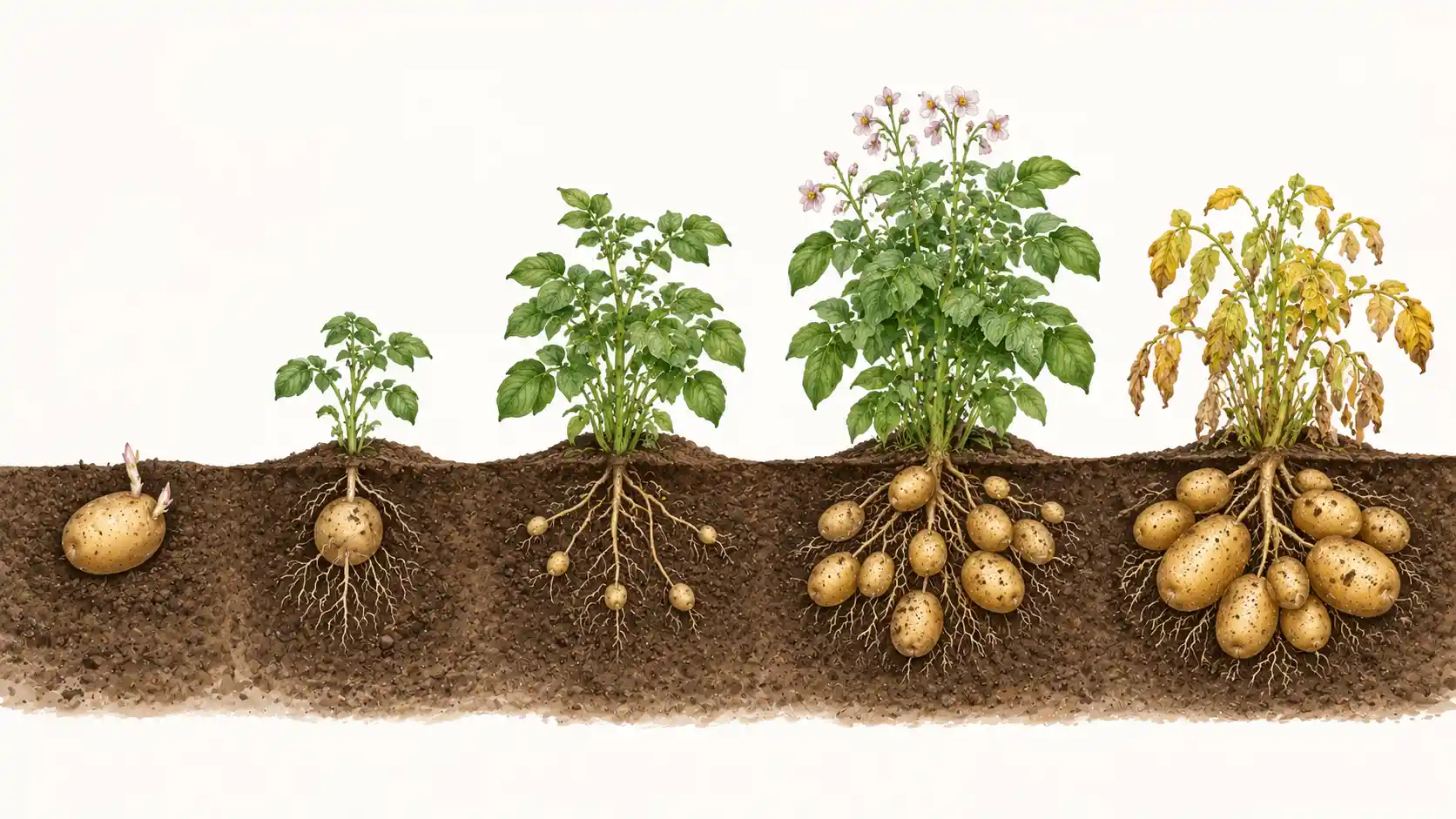
- Sprout development
Growth begins when shoots emerge from the eyes of a seed potato. Roots develop below the seed piece, and pale underground shoots move upward toward the soil surface.
- Vegetative growth
Once shoots emerge, the plant rapidly produces green stems and compound leaves. During this stage, the plant builds the leaf canopy needed to capture sunlight and produce carbohydrates.
- Tuber initiation
Underground stolons begin forming small swellings at their tips. These swellings become young potatoes. Tuber initiation often occurs around the time flower buds develop, although timing varies by cultivar and environment.
- Tuber bulking
The young potatoes increase in size as carbohydrates move from the leaves into the tubers. Consistent moisture is especially important during this stage because severe fluctuations can reduce yield or contribute to defects.
- Maturation or die-back
Foliage growth slows, leaves turn yellow, vines lose strength, and the canopy eventually dries. Tuber enlargement stops, and the skins begin becoming thicker and more firmly attached. Mature potatoes are normally harvested after this stage.
What Potato Plants Look Like When They First Sprout
Newly emerged potato plants have short, upright shoots with folded or partially opened green leaves. The first leaves may appear slightly crinkled before expanding into broader compound leaves with several oval leaflets.
A potato seedling does not usually resemble a single grass-like sprout. Instead, several shoots may emerge from one seed piece, creating a small cluster of thick green or purple-tinged stems. As growth continues, these stems branch and form a dense leafy canopy.
A sprouting seed potato that is ready to plant should have firm skin and short, sturdy shoots emerging from its eyes. Chitted potatoes commonly develop compact green, purple, or pink shoots. Long, pale, fragile sprouts usually indicate that the tuber was stored in conditions that were too dark or warm.
Fresh shoots should not be mistaken for harvest readiness. A newly sprouted potato plant is actively building foliage and has not yet produced a mature underground crop.
Signs a Potato Plant Is Ready for Harvest
A potato plant is ready for a mature harvest when most of its foliage has yellowed, wilted, and naturally died back. Healthy green vines indicate that the plant is still photosynthesizing and may still be enlarging its tubers.
The most reliable method is to combine foliage condition, days since planting, cultivar information, and a careful test dig. In Greenery Inside’s practical experience, relying on only one sign—especially flowering—frequently leads to harvesting storage potatoes too early.
Visual Cues in the Foliage and Vines
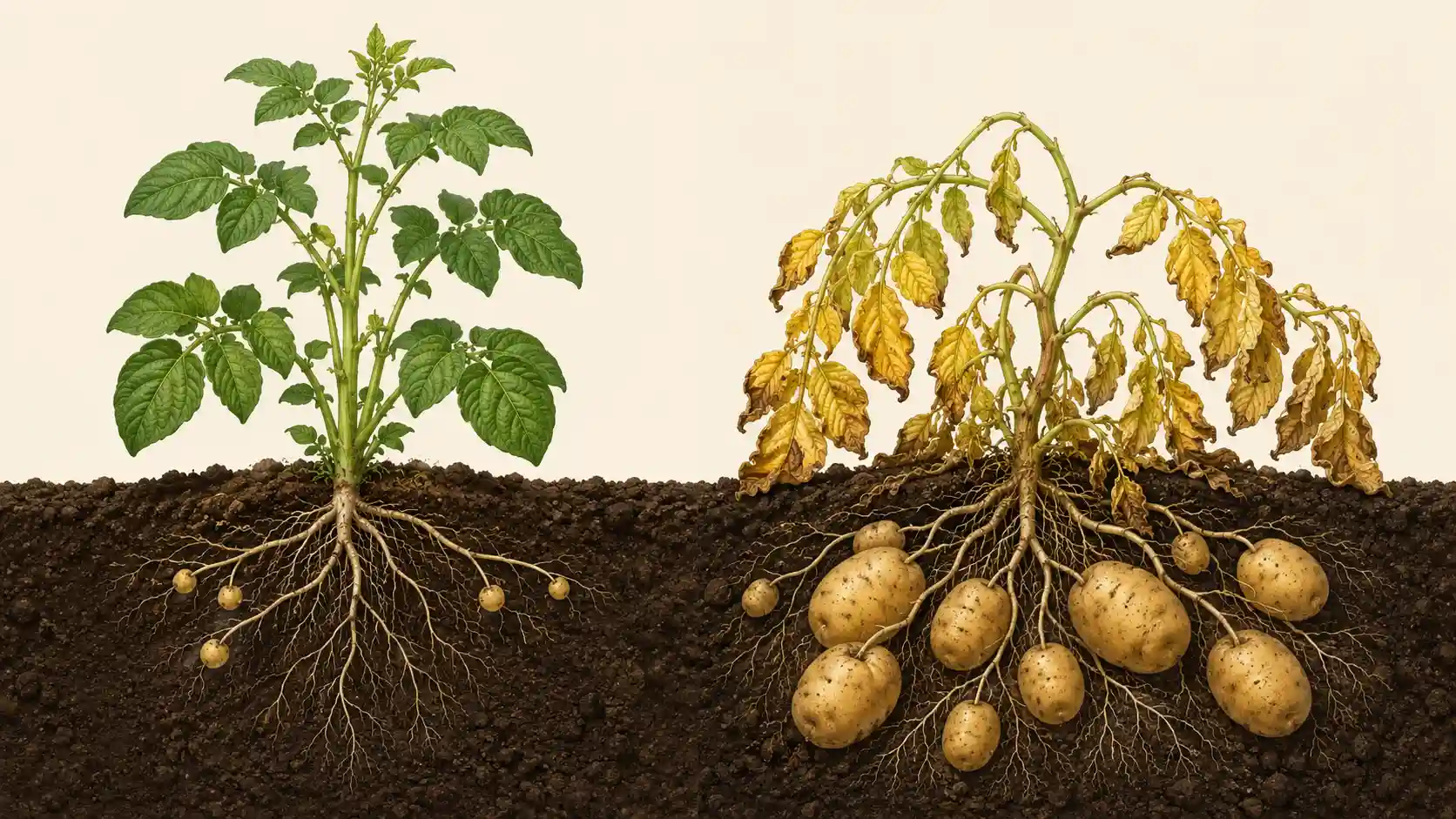
Harvest-ready potato foliage commonly shows the following signs:
- Leaves change from deep green to pale green or yellow.
- Lower leaves may yellow first before the change moves upward.
- Stems lose their rigid, upright appearance.
- Vines droop, fall outward, or collapse onto the soil.
- Leaf edges become brown and dry.
- Most above-ground growth eventually becomes dry and lifeless.
- New leaves and flowers stop forming.
Healthy, actively growing foliage looks different. Immature potato plants generally have green leaves, firm stems, active new growth, and an upright or spreading canopy.
Natural maturation normally affects much of the plant gradually. Sudden yellowing in isolated plants, yellowing while neighboring plants remain vigorous, stem lesions, leaf spots, or rapid collapse can indicate disease, drought, nutrient deficiency, or waterlogged roots rather than normal maturity. Potassium deficiency, for example, can cause premature vine die-back that may be confused with harvest readiness.
For mature storage potatoes, gardeners can wait until the vines are largely dead. Leaving the tubers undisturbed for approximately one to two additional weeks can help their skins become firmer, provided the soil is not saturated, excessively hot, frozen, or heavily infested with pests.
The Role of Flowering in Harvest Timing
Potato flowering is an early indication that tuber formation is underway, not proof that the potatoes are fully mature. Gardeners may carefully harvest a few small new potatoes around or shortly after flowering, but the main crop should remain underground until the foliage dies back.
New potatoes are young tubers harvested while their skins are thin and the plant is still green. A gardener can perform a test dig approximately two to three weeks after flowering begins, or around seven to eight weeks after planting, depending on the variety and growing conditions.
For full-sized potatoes:
- Do not harvest automatically when the first flowers open.
- Allow the plant to continue photosynthesizing during tuber bulking.
- Watch for widespread yellowing and natural vine decline.
- Confirm maturity by rubbing the skin of a test tuber with a thumb.
If the skin rubs away easily, the potato is still immature and will not store as well. If the skin remains firmly attached, it has developed a better skin set for harvesting and storage. University extension guidance similarly distinguishes new potatoes, which may be dug seven to eight weeks after planting, from mature potatoes harvested after the plants dry down.
When to Harvest Potatoes — By Month and Variety
Potatoes are harvested according to their planting date and cultivar maturity period rather than one universal calendar month. In many temperate climates, spring-planted potatoes are harvested from early summer through fall.
Best Month to Harvest Potatoes
The best harvest month depends on local frost dates, soil temperature, planting time, and whether the cultivar is early, mid-season, or late-season.
A general calendar is:
- March planting: Harvest may begin in June or July.
- April planting: Early varieties may be ready in June or July; later varieties may continue into August.
- May planting: Harvest commonly occurs from July through September.
- Early summer planting in mild climates: Harvest may occur in late summer or fall.
- Fall or winter planting in frost-free climates: Harvest timing may fall in winter or early spring.
In cool northern climates, gardeners often plant after the soil has thawed and warmed to at least about 45°F. In warmer regions, potatoes may be planted earlier so tuber development occurs before extreme summer heat.
The calendar should always be checked against the plant itself. An unusually cool spring can delay emergence and maturity, while sustained heat, drought, or disease may cause vines to decline earlier than expected.
As of the 2026 growing season, current university extension guidance continues to recommend using both cultivar days to maturity and natural vine die-back rather than relying solely on a fixed harvest date.
Harvesting Yukon Gold Potatoes
Yukon Gold potatoes are generally classified as early- to mid-season potatoes. Depending on the seed supplier, climate, and growing method, they commonly mature in approximately 70 to 90 days.
For new Yukon Gold potatoes, begin checking after flowering or around 55 to 70 days after planting. For a mature crop, wait until approximately 70 to 90 days have passed and most foliage has yellowed or died.
A test tuber should have:
- Yellow flesh
- Light tan or golden skin
- A round to slightly oval shape
- Skin that does not rub off easily
- A size appropriate for the plant’s spacing and growing conditions
Yukon Gold maturity classifications vary somewhat between references. Iowa State University describes Yukon Gold as early-season, while other potato references classify it as mid-season. This difference reflects regional growing conditions and different maturity-rating systems, so gardeners should treat 70 to 90 days as an estimate rather than a guaranteed deadline.
Yukon Gold vs. late-season storage potatoes
| Feature | Yukon Gold | Late-Season Storage Variety |
| Typical maturity | About 70–90 days | About 100–120 days |
| Seasonal type | Early to mid-season | Late-season |
| First useful harvest | New potatoes may be checked after flowering | Usually allowed to bulk for a longer period |
| Main readiness signal | Yellowing and dying vines | Complete vine die-back |
| Storage potential | Moderate; thin skin requires careful handling | Often selected for longer storage |
| Common use | Boiling, roasting, mashing, general cooking | Baking, processing, or winter storage |
How Long Do Potatoes Take to Grow?
Most potatoes take approximately 70 to 120 days to grow from planting to mature harvest. Early varieties mature fastest, while late-season cultivars need a longer period to develop full-sized tubers and storage-quality skins.
| Potato Type | Approximate Days to Maturity | Typical Harvest Signal |
| Early-season | 60–80 days | Flowers fade, foliage begins yellowing, or test tubers reach the desired size |
| Yukon Gold | 70–90 days | Vines yellow and decline; test tuber skin remains attached |
| Mid-season | 80–100 days | Most foliage turns yellow and starts dying back |
| Late-season | 100–120 days | Vines are largely or completely dead |
| New potatoes | About 50–60 days or 7–8 weeks | Small tubers form while foliage remains green |
Days to maturity are estimates calculated under suitable conditions. Cool soil, delayed emergence, low sunlight, drought, waterlogging, nutrient imbalance, or pest damage can slow growth.
Greenery Inside recommends recording the planting date and variety name when planting. This simple step makes it easier to distinguish normal late-season die-back from premature yellowing caused by stress.
Watering and Pre-Harvest Care
Watering should remain consistent while the plants are actively growing and tubers are bulking, but irrigation should be reduced as the foliage naturally dies back. Excess moisture close to harvest increases the risk of soft rot, skin damage, and difficult digging.
Should You Stop Watering Before Harvest?
Yes, watering can usually be stopped approximately one to two weeks before a planned mature harvest, especially after the vines have yellowed and begun dying. The soil should be allowed to become moderately dry, but not baked hard.
Stopping or reducing irrigation before digging can:
- Encourage firmer skin development.
- Reduce wet soil clinging to the tubers.
- Lower the chance of damaging potatoes in muddy soil.
- Reduce conditions favorable to some rotting organisms.
- Make harvesting cleaner and easier.
Do not stop watering too early while the plant remains green and is still bulking tubers. Potatoes need steady moisture during active growth, but they should not be watered every day automatically. Watering should always respond to soil moisture, plant type, and environmental conditions rather than a rigid schedule, a principle also explained in our guide to how often to water Heartleaf Philodendron. Water according to soil moisture, rainfall, temperature, drainage, and container size.
Late-season overwatering can reduce crop quality and postharvest life. However, plants in sandy soil or containers may need more frequent monitoring because their growing medium dries faster.
Do Coffee Grounds Help Potato Plants?
Coffee grounds do not provide a special or complete fertilizer for potatoes. Small quantities of composted grounds may contribute organic matter and nutrients, but thick layers of fresh grounds can compact, restrict air movement, and interfere with water movement.
Used coffee grounds should not replace:
- A soil test
- Balanced fertilizer
- Finished compost
- Proper crop rotation
- Consistent irrigation
- Loose, well-draining soil
For safer use, add coffee grounds to a compost pile first or apply only a very thin layer as part of a mixed organic mulch. Do not assume that coffee grounds will reliably acidify the soil to the ideal level for potatoes.
Washington State University advises against using thick layers of coffee grounds as a stand-alone mulch because the fine particles can compact and limit air and moisture movement.
Plant Size
A mature potato plant commonly reaches approximately 18 inches to 3 feet tall, depending on variety, fertility, spacing, light, and moisture. Its stems may remain upright or spread outward, creating a canopy roughly 18 to 36 inches wide.
Yukon Gold plants are generally medium-sized, with upright growth that may spread as the season progresses. Above-ground plant size does not directly reveal the exact number or size of tubers below the soil.
Underground, potatoes form along stolons extending outward from the lower stems. Most tubers develop within the upper several inches of loose soil, which is why hilling is important. Hilling protects developing potatoes from sunlight, supports the stems, suppresses weeds, and reduces greening.
Container-grown plants may have similar foliage height but a more restricted underground spread. A small container can limit root and stolon development, causing lower yields or a greater number of small tubers.
Factors affecting plant size include:
- Cultivar genetics
- Seed-piece vigor
- Plant spacing
- Soil depth
- Sunlight exposure
- Nitrogen availability
- Water consistency
- Root-zone temperature
- Pest or disease pressure
Potato plants may reach approximately 3 feet under suitable conditions, but unusually large foliage does not guarantee a large harvest. Excess nitrogen can encourage leafy growth while delaying tuber development.
Growth Rate
Potatoes are moderate-to-fast-growing garden crops. Many early cultivars can produce usable new potatoes within seven to eight weeks, while fully mature crops usually require about 70 to 120 days.
Growth is typically fastest after emergence, when stems and leaves expand rapidly. Tuber initiation follows, often near flowering, and then the plant directs increasing amounts of energy into tuber bulking.
The seasonal pattern usually follows this sequence:
- Slow underground sprout development
- Rapid foliage expansion
- Flower and stolon formation
- Fast tuber enlargement
- Slower growth as vines yellow
- Natural die-back and skin maturation
Potatoes grow best in cool conditions. Extremely cold soil slows sprouting, while excessive heat can reduce tuber formation and accelerate vine stress. Adequate daylight supports photosynthesis, but tuber development also depends on cultivar-specific responses to temperature and day length.
Moisture should remain relatively even during tuber initiation and bulking. Alternating severe drought with heavy irrigation can contribute to irregular growth, cracking, or internal defects.
Care Guide
Potatoes require full sun, loose soil, reliable drainage, balanced nutrition, and consistent moisture during active growth.
Watering: Keep soil evenly moist but not waterlogged. Water more carefully during tuber initiation and bulking. Reduce irrigation when natural die-back begins.
Light: Provide at least six hours of direct sunlight, with eight hours or more supporting stronger growth where temperatures remain suitable.
Soil: Use loose, well-draining soil that allows tubers to expand. A slightly acidic soil is generally preferred. Avoid compacted ground and fresh, uncomposted organic matter around developing tubers.
Fertilization: Base fertilizer applications on soil-test results. Avoid excessive nitrogen because it can produce heavy foliage at the expense of timely tuber development. Potassium and phosphorus availability also influence plant and tuber growth.
Hilling: Hill loose soil around the stems when plants are approximately 6 to 12 inches tall. Repeat as necessary to keep developing tubers covered. Complete major hilling before flowering and avoid damaging shallow roots and stolons.
Pruning: Routine pruning is unnecessary. Healthy leaves are needed for photosynthesis. Remove only badly diseased material, and sanitize tools when disease is suspected.
Climate tolerance: Potatoes tolerate cool conditions and light frost better than warm-season crops, but a hard freeze can kill foliage and damage exposed tubers.
Planting time: The best month depends on location. Plant when the soil is workable, no longer saturated, and has warmed to approximately 45°F or above.
Seed potatoes: A grocery-store potato may grow if it has viable eyes, but certified seed potatoes are strongly preferred because they are selected for planting and reduce the risk of introducing diseases.
Crop rotation: Do not grow potatoes in the same location every year. Rotate away from potatoes and other nightshade crops for approximately three to four years when space permits. Repeated planting can allow soilborne diseases and overwintering pests to build up.
Growing and Harvesting Potatoes in Containers
Potatoes grow well in containers when the container is opaque, has drainage holes, and provides enough soil volume. Grow bags, large nursery pots, food-safe buckets, and purpose-made potato pots can all work. Correct drainage, container size, and root-space management are important for many potted species, as explained in our complete guide to Australian native plants in pots.
Plant certified seed potatoes near the bottom of the container and gradually add growing medium as the stems develop. Do not completely bury all active foliage at once. Maintain enough exposed leaves for photosynthesis.
For broader guidance on matching light, soil, watering, and growing conditions to different plant types, explore our complete guide to house plants.
In-ground vs. container potatoes
| Factor | In-Ground Potatoes | Container Potatoes |
| Soil temperature | Changes more slowly | Warms and dries faster |
| Watering | Usually less frequent | Requires closer monitoring |
| Yield potential | Greater root and stolon space | Limited by container volume |
| Harvesting | Requires digging | Container can be emptied |
| Readiness cues | Yellowing and vine die-back | Same yellowing and die-back |
| Pest exposure | More soil-dwelling pest contact | Some pests are easier to exclude |
| Timing | Based on variety and weather | May mature slightly earlier in warm containers |
Container potatoes do not automatically mature faster. Dark containers exposed to sun can warm quickly, but excessive heat may stress roots and reduce production.
Container size and approximate planting capacity
| Container Size | Recommended Plants | Approximate Potential Yield |
| 5 gallons | 1 plant | About 1–3 pounds |
| 10 gallons | 1–2 plants | About 2–5 pounds |
| 15 gallons | 2–3 plants | About 3–7 pounds |
| 20 gallons | 3–4 plants | About 4–10 pounds |
These yield figures are broad planning estimates, not guarantees. Variety, seed quality, fertility, spacing, water, sunlight, and container depth can significantly change the final harvest. Large 10- to 15-gallon opaque containers with drainage are commonly recommended for home potato growing.
How to Tell When Container Potatoes Are Ready
Container potatoes are ready for a mature harvest when the foliage has yellowed, wilted, and largely died back. The visual cues are the same as those used for in-ground potatoes.
Check the planting date and expected maturity period before emptying the container. If the vines are still green, the tubers may continue growing.
To check readiness without harvesting everything:
- Gently move soil away near the container edge.
- Locate one tuber without tearing the main stems.
- Check its size and skin firmness.
- Replace the soil if the potatoes need more time.
- Stop watering when natural die-back is advanced.
- Empty the container after the soil becomes moderately dry.
For new potatoes, carefully remove a few small tubers while leaving the main plant intact. This is easier in containers with access panels, but disturbing roots and stolons can still reduce the remaining yield.
What Happens If You Harvest Too Early or Too Late?
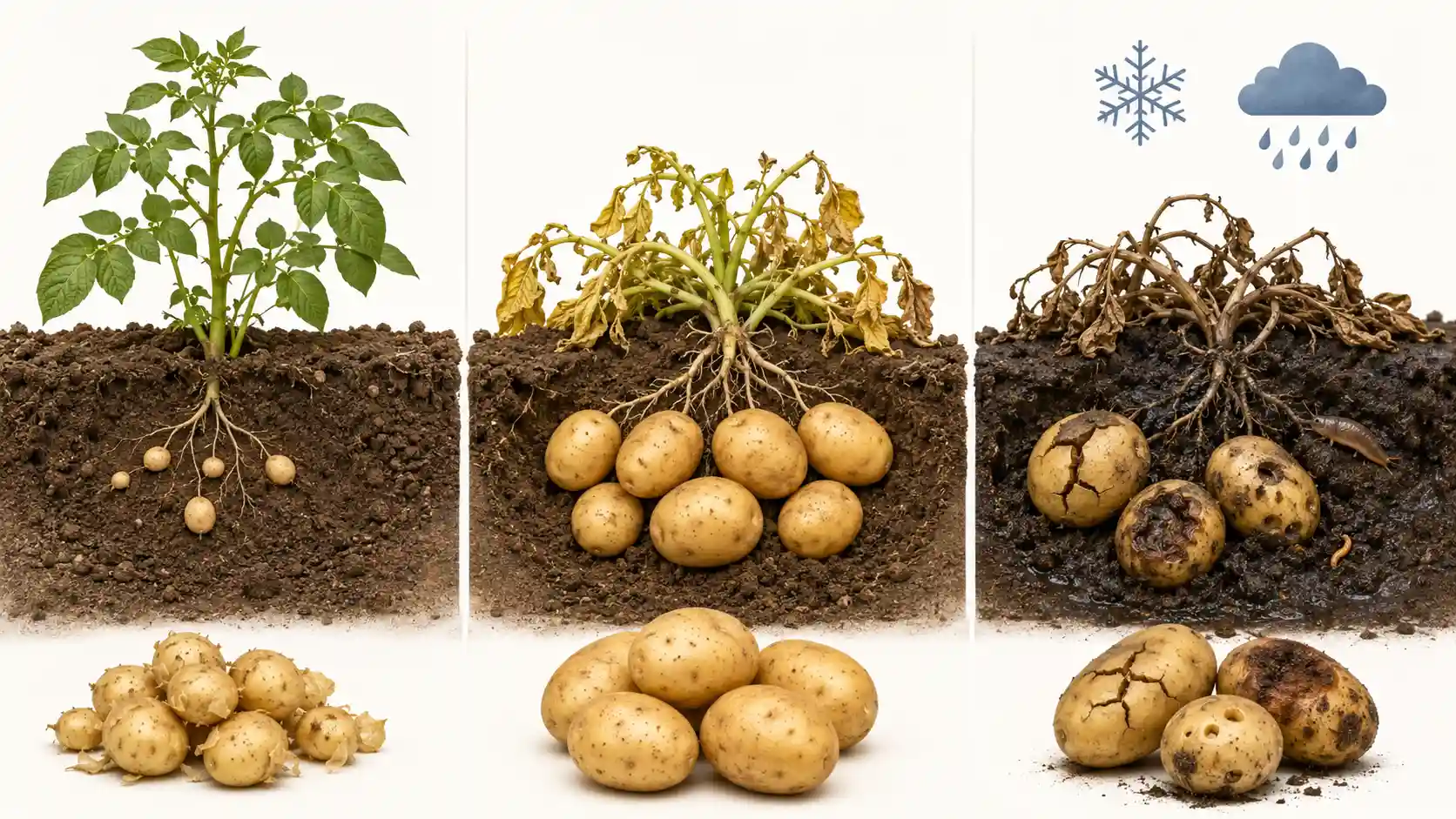
Harvesting too early produces smaller potatoes with delicate skins, while harvesting too late increases exposure to wet-soil diseases, pests, heat, freezing, and physical damage. The best harvest window begins after the crop reaches the desired size and the skins are sufficiently set.
Risks of Harvesting Too Early
Potatoes harvested too early are usually edible, but they are less suitable for storage. Their thin skins rub off easily, allowing moisture loss and creating entry points for decay organisms.
Early harvesting may result in:
- Smaller tubers
- Lower total yield
- Thin, easily damaged skins
- Shorter storage life
- More bruising and scraping
- Greater moisture loss
New potatoes are intentionally harvested early and should be eaten relatively soon. They are valued for their tender skins and texture, not for long-term storage.
A gardener can remove a few potatoes without killing the plant by carefully feeling around the outer edge of the hill and detaching selected tubers. However, excessive digging can damage roots, stolons, and remaining potatoes.
Can Potatoes Stay in the Ground Too Long?
Yes, potatoes can remain in the ground too long. Once the vines have died and the tubers are mature, leaving them indefinitely exposes them to changing soil conditions without providing meaningful additional growth.
Potential risks include:
- Tuber rot in saturated soil
- Slug, wireworm, or rodent damage
- Disease infection
- Heat-related deterioration
- Freezing injury
- Skin cracking
- Accidental cutting during later garden work
- Sprouting when conditions become favorable again
A short period underground after vine death can improve skin set, but potatoes should be harvested before hard frost and before prolonged wet weather. University extension guidance recommends harvesting after vine death and before severe frost, while also avoiding excessively hot soil conditions.
How Many Potatoes Can You Expect Per Plant?
One seed potato or seed piece commonly produces approximately three to eight marketable potatoes, although the number and weight vary widely. Small potatoes may be more numerous, while widely spaced plants may produce fewer but larger tubers.
A reasonable home-garden expectation is approximately 1 to 3 pounds per plant under suitable conditions. Highly productive varieties in excellent soil may exceed this range, while heat, disease, poor drainage, crowding, or inadequate sunlight can sharply reduce it.
Yukon Gold plants commonly produce approximately five to seven tubers under suitable conditions, but the cultivar is not always among the highest-yielding potato varieties. A realistic Yukon Gold harvest may be about 1 to 2 pounds per plant, depending on tuber size and growing conditions.
Ten pounds of seed potatoes may contain approximately 80 to 100 usable seed pieces when cut into sections weighing roughly 1.5 to 2 ounces each. Depending on spacing and productivity, this amount could produce approximately 75 to 150 pounds of potatoes in an ordinary home-garden setting, although results outside this range are possible.
Yield depends on:
- Number of viable eyes
- Seed-piece health
- Variety
- Plant spacing
- Soil fertility
- Soil texture
- Moisture consistency
- Sun exposure
- Hilling depth
- Pest and disease control
- Length of the growing season
Greenery Inside recommends recording the total harvest weight and number of plants each season. Garden-specific records are more useful for future planning than generic yield claims.
Common Potato Growing Mistakes and Problems
Common potato-growing mistakes include overwatering, poor drainage, planting in the same location repeatedly, allowing tubers to receive light, applying excessive nitrogen, and misreading premature yellowing as maturity. Yellow leaves and slow growth can have several causes across different garden plants; our guide to Cheese Tree problems similarly explains how watering, drainage, pests, and root stress can produce overlapping symptoms.
Leaves turning yellow before expected harvest time
Why it happens: Early yellowing may result from drought, waterlogged soil, nutrient deficiency, early blight, late blight, bacterial disease, root damage, or pest pressure.
How to fix it: Check soil moisture several inches below the surface. Inspect both sides of leaves, stems, and the soil line for spots, lesions, insects, or rot. Compare affected plants with healthy neighboring plants and use a local extension diagnostic service when disease is suspected.
How to prevent it: Use certified seed potatoes, rotate crops, avoid overhead irrigation late in the day, maintain balanced nutrition, and provide well-draining soil.
Overwatering issues
Why it happens: Potatoes are sometimes watered on a fixed daily schedule even when the soil remains wet. Containers without adequate drainage create a similar problem.
How to fix it: Stop irrigation temporarily, improve drainage, empty standing water from saucers, and resume watering only after the upper soil begins drying.
How to prevent it: Check soil moisture before watering. Use loose soil and containers with several unobstructed drainage holes.
Pest infestations
Why it happens: Colorado potato beetles, flea beetles, wireworms, aphids, slugs, and other pests may locate potato plants or survive near previous nightshade plantings.
How to fix it: Identify the pest before choosing a control. Hand-pick beetles and larvae when practical, remove heavily damaged material, manage weeds, and use locally recommended controls according to label directions.
How to prevent it: Rotate crops, inspect leaves regularly, remove volunteer potatoes and nightshade weeds, and avoid leaving damaged tubers in the soil. Colorado potato beetle adults and larvae can rapidly defoliate plants, while flea beetles create numerous small holes.
Slow plant growth
Why it happens: Slow growth may be caused by cold soil, poor-quality seed, insufficient sunlight, compacted soil, low fertility, drought, excessive moisture, or disease.
How to fix it: Confirm that the plant receives adequate sunlight, check drainage and soil moisture, inspect stems for rot, and apply fertilizer only according to a soil test or product instructions.
How to prevent it: Plant certified seed pieces in workable soil, maintain proper spacing, avoid excessive nitrogen, and wait until the soil is warm enough for active sprouting.
After the Harvest — Curing, Storing, and Eating
Harvested potatoes should be handled gently, protected from sunlight, sorted for damage, and either eaten promptly or cured before long-term storage. Do not leave freshly dug potatoes exposed to direct sun because light causes greening.
Can You Eat Potatoes Right Away?
Yes, freshly harvested potatoes can be eaten immediately if they are healthy, firm, undamaged, and not green. New potatoes are commonly cooked soon after harvest because their thin skins do not provide long storage life.
Wash only the potatoes you plan to eat. Potatoes intended for curing or storage should generally remain unwashed because added moisture and abrasion can encourage decay.
Do Potatoes Ripen After Harvesting?
No, potatoes do not ripen after harvesting in the way that tomatoes, peaches, or bananas do. Once separated from the plant, a potato will not continue enlarging or developing harvest maturity.
Curing does not ripen potatoes. It allows minor wounds to heal and the skin to become better suited to storage. A potato harvested too small will remain small.
How to Cure Yukon Gold Potatoes
Cure Yukon Gold potatoes by placing sound, unwashed tubers in a dark, well-ventilated environment at approximately 50 to 60°F for about 7 to 14 days. Avoid direct sunlight and excessive dryness.
The curing process is:
- Brush off loose soil without scrubbing.
- Remove cut, diseased, soft, or badly bruised tubers.
- Arrange potatoes in shallow layers.
- Maintain darkness and airflow.
- Keep humidity moderately high without allowing condensation.
- Check regularly and remove any tubers that begin rotting.
- Transfer cured potatoes to cool, dark storage.
University of Minnesota guidance recommends curing potatoes at approximately 50 to 60°F for about 14 days, while other postharvest guidance recommends roughly two to three weeks at 50 to 55°F where longer healing is needed.
Because Yukon Gold potatoes have relatively thin skins, handle them carefully and use damaged tubers first.
When You Shouldn’t Eat Home-Grown Potatoes
Do not eat home-grown potatoes that are extensively green, bitter, severely sprouted, rotten, moldy, slimy, or badly damaged.
Potatoes exposed to light produce chlorophyll, which causes greening. Greening can also indicate increased concentrations of natural glycoalkaloids. These compounds are concentrated in green tissue, sprouts, and areas near damaged skin.
Discard potatoes when:
- A large part of the tuber is green.
- The potato tastes noticeably bitter.
- It is soft, wet, or smells rotten.
- Mold extends into the flesh.
- Sprouting is extensive and the tuber is shriveled.
- The potato has been exposed to flooding or chemical contamination.
- Internal tissue is extensively black, brown, or decayed.
Small sprouts and very limited green areas are sometimes removed deeply from otherwise firm potatoes, but heavily green or bitter potatoes should be discarded. Potato sprouts should never be eaten.
Conclusion
A potato plant looks ready to harvest when its foliage turns yellow, its vines wilt and collapse, and the above-ground growth naturally dies back. Flowering is useful for estimating when small new potatoes may be available, but it does not confirm full maturity.
Most potatoes mature within approximately 70 to 120 days. Yukon Gold potatoes are usually ready earlier, often around 70 to 90 days after planting. Before digging the entire crop, check one tuber for suitable size and firmly attached skin.
The clearest takeaway is simple: flowering means tubers are developing, while widespread vine die-back means mature potatoes are generally ready to harvest.
FAQs
How do I know if my potato plants are ready to pick?
Potato plants are ready for a mature harvest when most leaves have turned yellow, the vines have wilted or collapsed, and the above-ground growth is dying. Confirm readiness by digging one potato and checking whether its skin remains firmly attached when rubbed gently.
What do potato plants look like when they first come up?
Potato plants first emerge as clusters of thick green or purple-tinged shoots. The young leaves may initially look folded or crinkled before opening into compound leaves with several oval leaflets. These fresh, upright shoots indicate early vegetative growth, not harvest readiness.
Do you pick potatoes before or after they flower?
You can harvest small new potatoes around or shortly after flowering, but mature potatoes are generally picked later. For full-sized potatoes with firmer skins, wait until the flowers have faded and the plant’s foliage has yellowed and died back.
Can you leave potatoes in the ground too long?
Yes. Mature potatoes left in the ground too long may be damaged by saturated soil, rot, pests, freezing temperatures, excessive heat, or renewed sprouting. A short period after vine death can improve skin firmness, but the crop should be dug before severe weather develops.
When do you harvest Yukon Gold potatoes specifically?
Yukon Gold potatoes are commonly harvested approximately 70 to 90 days after planting. New potatoes may be checked earlier, around flowering, while the mature crop should be harvested after the foliage yellows, declines, and the tuber skins no longer rub off easily.
Do potatoes ripen after they’ve been harvested?
No. Potatoes do not ripen or continue growing after harvest. Curing can heal minor skin injuries and improve storage quality, but it cannot increase tuber size or turn an immature potato into a fully mature one.