Introduction
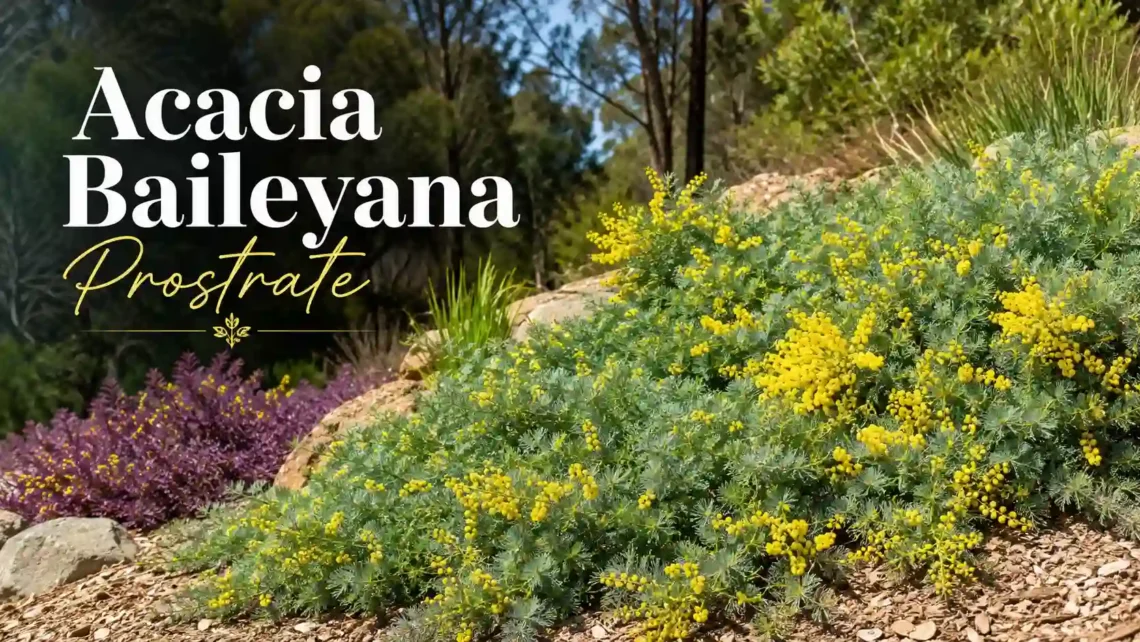
Acacia baileyana prostrate is the low-spreading, ground-hugging form of the well-known Cootamundra Wattle, valued for its drought tolerance, ornamental foliage, and ability to cover large areas with minimal maintenance. In botanical terms, “prostrate” refers to a growth habit that spreads horizontally across the ground rather than growing upright. Commonly known as Prostrate Cootamundra Wattle, Prostrate Wattle, Bailey Acacia, and ground cover wattle, this Australian native is widely used in gardens, revegetation projects, and erosion-control plantings. Gardeners also appreciate the ornamental purple variant, Acacia baileyana purpurea, which produces attractive silver-purple foliage alongside the species’ signature golden flowers.
Quick Summary
- Acacia baileyana prostrate is the low-growing, spreading form of Cootamundra Wattle and functions as an effective Australian native ground cover.
- It typically grows 30–60 cm tall and spreads 1.5–3 m wide, making it useful for weed suppression, erosion control, and slope stabilisation.
- The purple-leafed cultivar, Acacia baileyana purpurea prostrate, is prized for its silver-purple new growth and bright golden-yellow flowers.
- The plant performs best in full sun and well-drained soil and becomes highly drought-tolerant once established.
- Minimal pruning, low fertilizer requirements, and strong adaptability make it suitable for many Australian gardens.
What Is Acacia Baileyana Prostrate? (Definition and Overview)
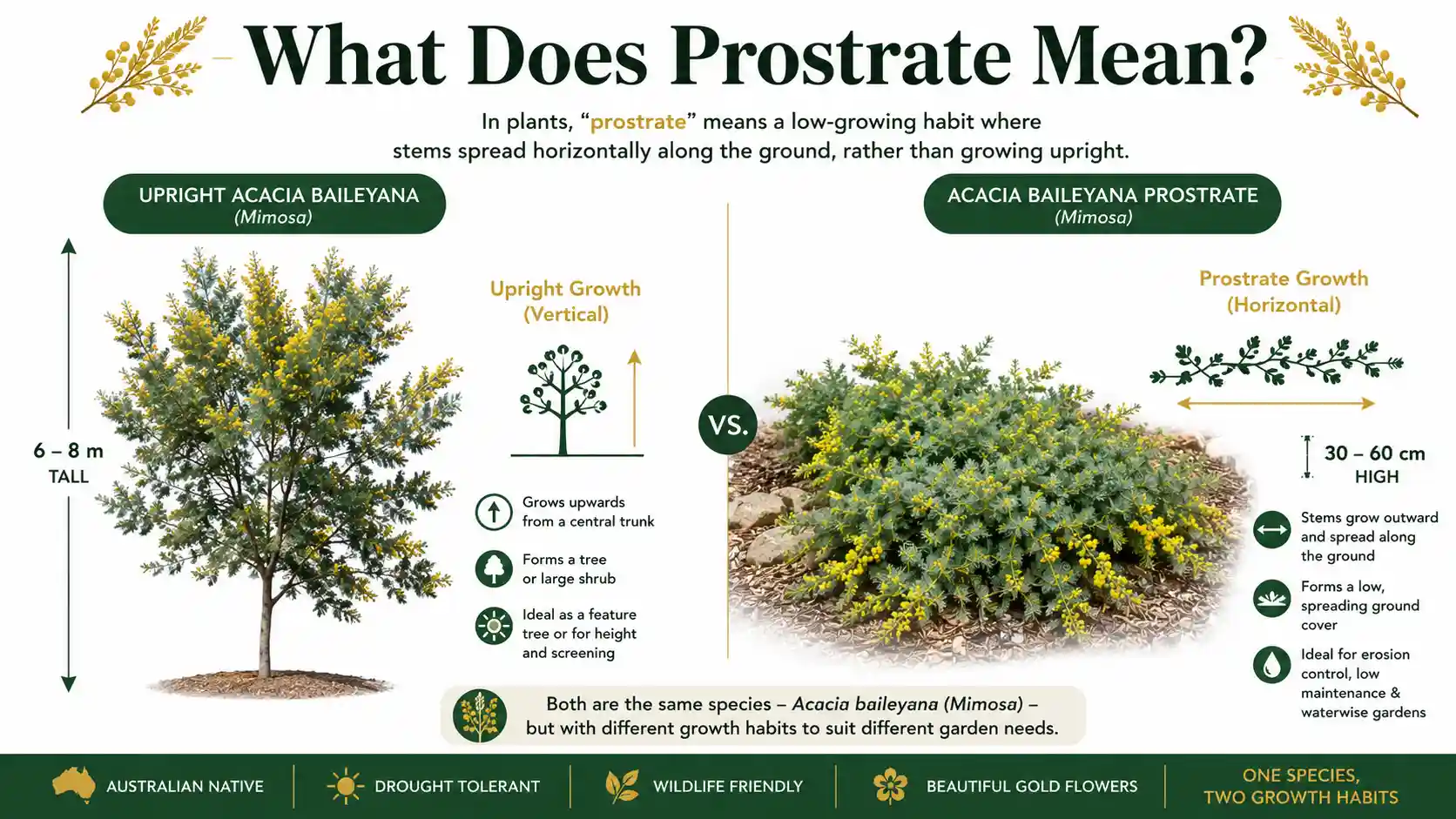
Acacia baileyana prostrate is a low-growing form of Acacia baileyana, commonly known as Cootamundra Wattle. Unlike the standard tree form, which develops into a medium-sized ornamental tree, the prostrate form spreads horizontally along the ground and rarely exceeds 60 cm in height.
In botanical terminology, a prostrate plant is one that grows close to the soil surface rather than upright. This growth habit allows the plant to form a dense mat of foliage that helps suppress weeds, reduce soil erosion, and stabilize slopes.
The prostrate form is considered either a cultivated selection or naturally occurring variant of the standard Acacia baileyana species. While the upright tree can reach heights of 6–8 metres, the prostrate form remains compact and spreading, making it useful where ground coverage is preferred over vertical structure.
Although Acacia baileyana prostrate is a low-growing ground cover rather than a tree, it originates from the same species featured in our comprehensive guide to Australian native garden trees, making it useful to understand both growth forms when planning a native landscape.
Common names include:
- Prostrate Cootamundra Wattle
- Prostrate Wattle
- Prostrate Acacia
- Ground Cover Wattle
- Bailey Acacia
Acacia baileyana belongs to the Fabaceae family and is native to a relatively small area around Cootamundra in New South Wales, Australia. Despite its limited natural distribution, it has become one of Australia’s most widely cultivated wattles due to its attractive foliage and abundant winter flowers.
Varieties and Cultivars of Acacia Baileyana Prostrate
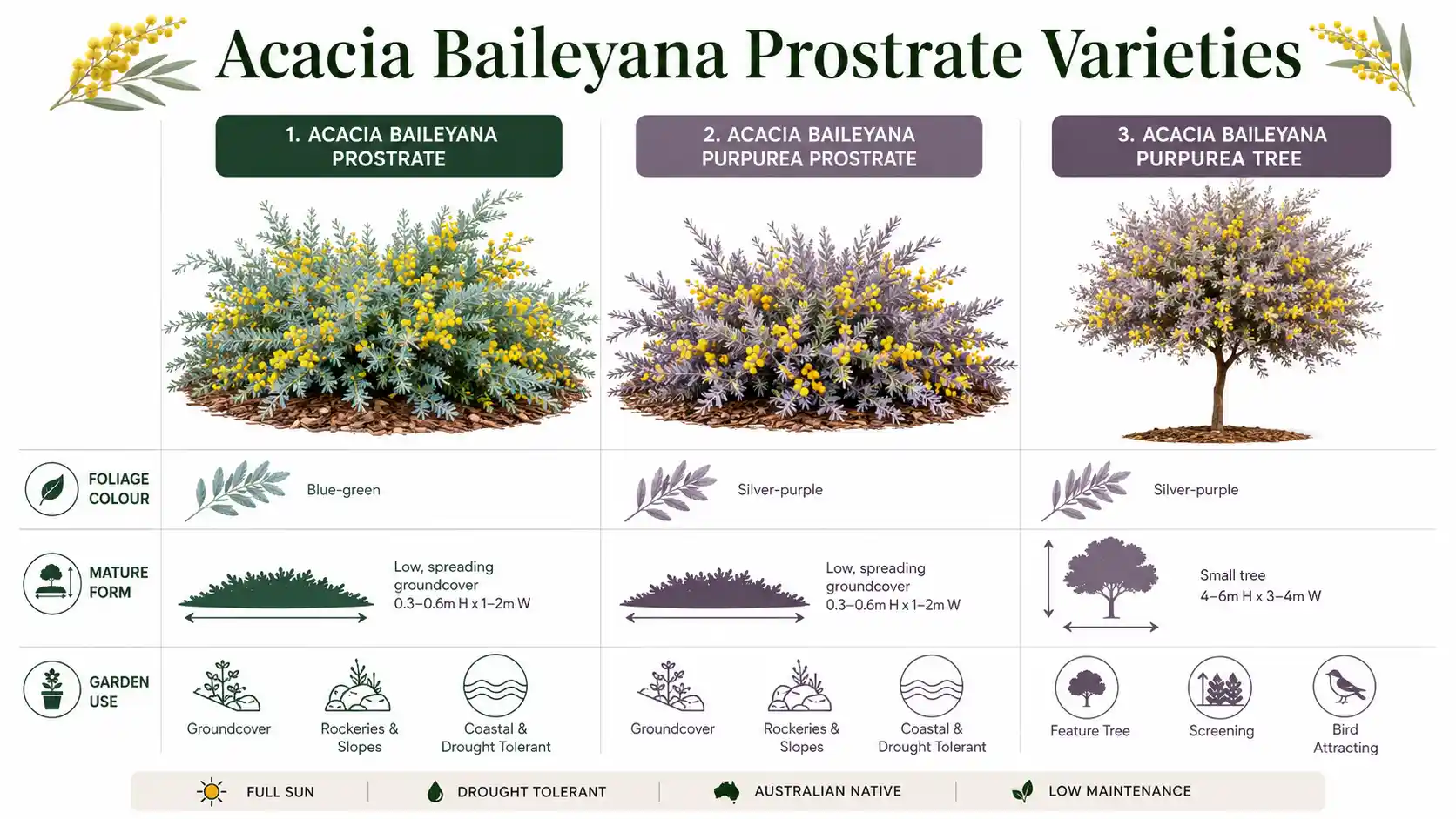
Gardeners typically encounter two primary prostrate forms of Acacia baileyana.
Standard Acacia Baileyana Prostrate
The standard form features finely divided blue-green bipinnate foliage and produces masses of golden-yellow flower clusters during late winter and early spring.
Key characteristics include:
- Blue-green feathery foliage
- Dense spreading habit
- Golden-yellow flowers
- Excellent erosion-control capabilities
- Strong drought tolerance after establishment
This form is commonly used in native landscaping, slope stabilisation, and revegetation projects.
Acacia Baileyana Purpurea Prostrate
Acacia baileyana purpurea prostrate shares the same spreading growth habit but is distinguished by its striking silver-purple new growth.
Common names include:
- Purple Cootamundra Wattle
- Purple Prostrate Cootamundra Wattle
- Purple Acacia
- Purple Wattle
- Purple-Leafed Cootamundra Wattle
The purple foliage creates year-round visual contrast in native gardens and ornamental landscapes.
It is important to note that “Acacia baileyana purpurea” and “Acacia purpurea baileyana” refer to the same cultivar. Similarly, garden retailers may use informal names such as “Acacia purpurea” or “Acacia purple” when marketing the plant.
Gardeners should also be aware that Acacia baileyana purpurea is available in an upright tree form. This tree maintains the distinctive purple foliage but grows into a medium-sized ornamental specimen rather than a ground cover. Other Acacia species such as Acacia fimbriata Care, Growth & Varieties Guide show similar fast-growing native characteristics.
Variety Comparison Table
| Variety | Common Name | Foliage Colour | Flower Colour | Primary Garden Use |
| Acacia baileyana prostrate | Prostrate Cootamundra Wattle | Blue-green | Golden yellow | Native ground cover, erosion control |
| Acacia baileyana purpurea prostrate | Purple Prostrate Cootamundra Wattle | Silver-purple new growth | Golden yellow | Ornamental feature planting, ground cover |
| Acacia baileyana purpurea (tree) | Purple Cootamundra Wattle | Silver-purple | Golden yellow | Feature tree, screening |
Plant Size — How Big Does Acacia Baileyana Prostrate Get?
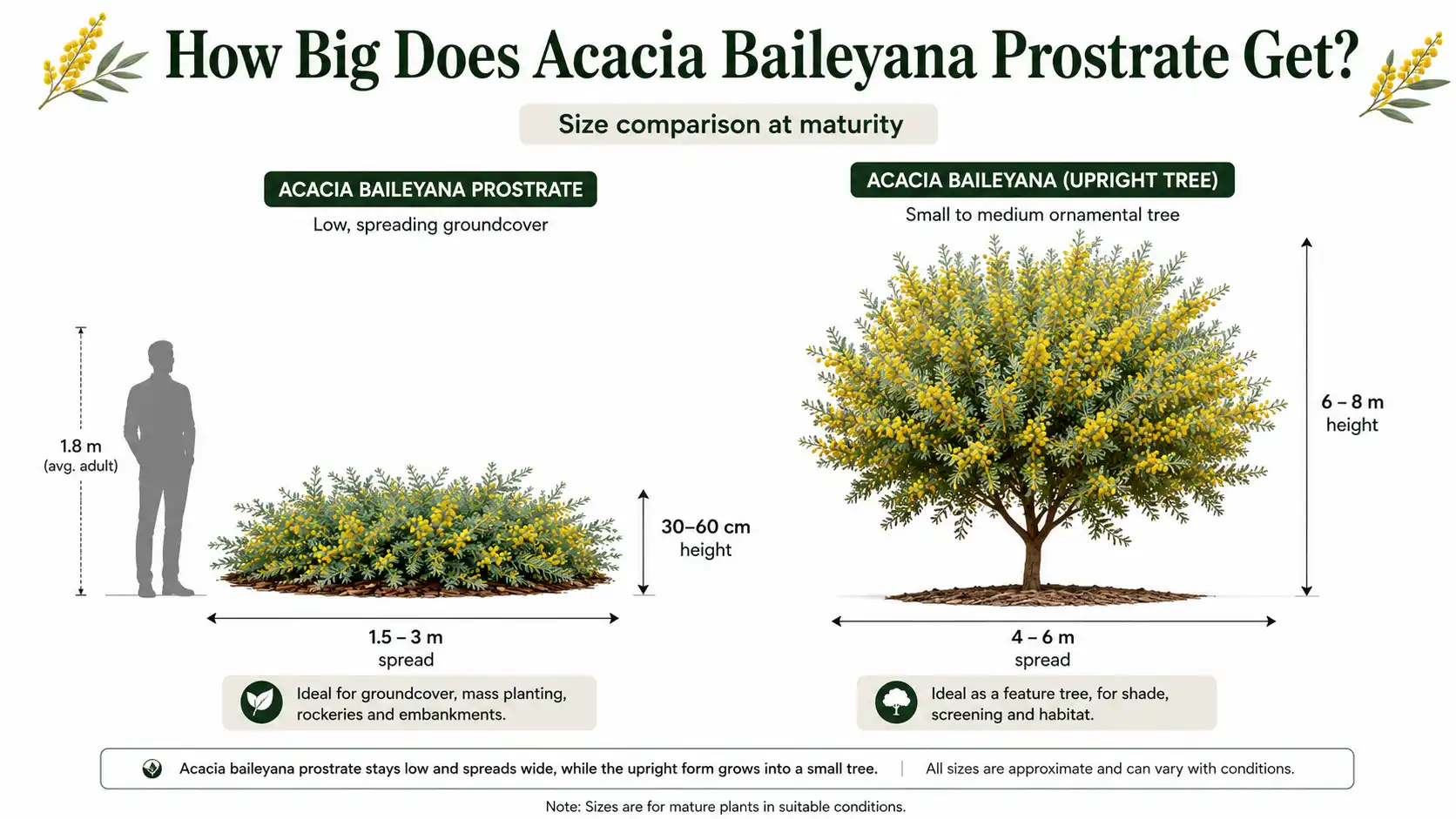
Acacia baileyana prostrate remains significantly smaller than the standard tree form, making it suitable for ground-cover applications.
Typical mature dimensions include:
- Height: 30–60 cm
- Spread: 1.5–3 metres
Under ideal growing conditions, some specimens may exceed the average spread range, particularly in well-drained soils with adequate sunlight.
For comparison, the upright Acacia baileyana tree commonly reaches:
- Height: 6–8 metres
- Width: 4–6 metres
Likewise, the upright Acacia baileyana purpurea tree can reach similar dimensions, which is why gardeners should verify whether they are purchasing a prostrate or tree form before planting.
Several environmental factors influence final size:
- Soil fertility
- Sun exposure
- Water availability
- Climate conditions
- Competition from nearby plants
Although Acacia baileyana prostrate can be grown in large containers, its natural spreading habit becomes restricted. For best results, it should be planted in open garden beds, embankments, or landscape areas where it can spread freely.
Growth Rate of Acacia Baileyana Prostrate
Acacia baileyana prostrate is generally considered a moderate to fast-growing native plant. Once established, it commonly expands by approximately 30–50 cm laterally each growing season. This growth rate makes it an effective choice for gardeners seeking relatively rapid ground coverage. Similar growth patterns can be seen in dwarf wattles like Essential Acacia Cognata Dwarf Varieties & Care Guide.
Growth is usually strongest during:
- Spring
- Autumn
These seasons provide moderate temperatures and favourable soil moisture conditions throughout much of southern Australia.
Conditions that encourage faster growth include:
- Full sun exposure
- Well-drained soil
- Deep establishment watering
- Good air circulation
- Minimal root competition
Growth may slow when plants are exposed to:
- Heavy clay soils
- Waterlogged conditions
- Deep shade
- Severe frost
- Extended drought during establishment
Like many Australian wattles, Acacia baileyana prostrate has a relatively short lifespan. Most plants remain productive for approximately 10–15 years before decline becomes noticeable.
For long-term landscape projects, gardeners often plan for periodic replacement or propagation from seed to maintain continuous coverage.
Acacia Baileyana Prostrate as a Ground Cover — Landscape Uses and Spacing
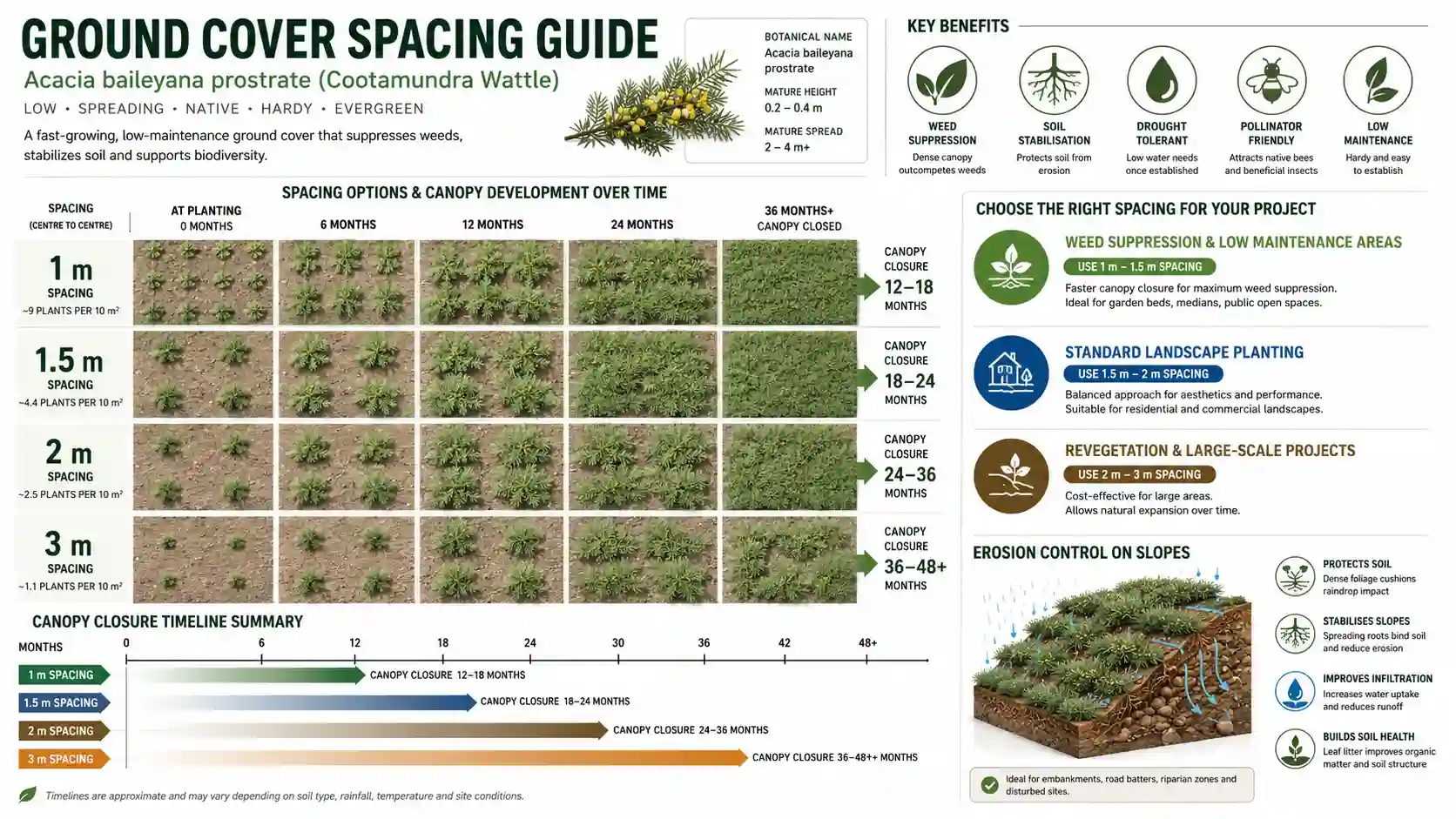
Acacia baileyana prostrate functions exceptionally well as a ground cover because its dense, horizontally spreading canopy blocks sunlight from reaching the soil surface. This natural shading effect suppresses weed growth while helping retain soil moisture and reduce erosion. It is often combined with grasses such as Lomandra Variegated: Features, Varieties, and Care Guide in landscape design. It is commonly used alongside flowering natives such as Grevillea Elegance: 7+ Essential Care & Growth Tips.
Its combination of rapid lateral growth and drought tolerance makes it one of the most useful native ground-cover wattles available for Australian landscapes.
Common Landscape Applications
- Slope stabilisation and erosion control on banks and embankments
- Weed suppression in native garden beds
- Underplanting beneath larger native trees and shrubs
- Revegetation and habitat restoration projects
- Low-maintenance borders along pathways and driveways
- Wildlife-friendly gardens that support birds, bees, and beneficial insects
The plant’s extensive spreading habit also helps protect exposed soil from wind and water erosion, particularly on sloping sites.
Recommended Spacing
Plant spacing should be adjusted according to the intended landscape purpose. In large-scale planting, it pairs well with structural grasses like Variegated Lomandra: Features, Varieties, and Care Guide.
Dense Weed Suppression
For rapid canopy closure and effective weed control, plant specimens approximately 1–1.5 metres apart.
Standard Garden Planting
For ornamental gardens and feature plantings, spacing of 1.5–2 metres allows each plant to develop its natural form without overcrowding.
Large-Scale Revegetation
In restoration projects, plants are typically spaced 2–3 metres apart and supplemented with mulch during establishment.
Spacing Guide Table
| Planting Goal | Recommended Spacing | Coverage Timeline |
| Dense weed suppression | 1–1.5 m apart | 12–18 months to close canopy |
| Standard garden planting | 1.5–2 m apart | 18–24 months |
| Large-scale revegetation | 2–3 m apart | 2–3 years |
Proper spacing improves airflow, reduces disease risk, and allows the plant to achieve its characteristic spreading growth habit without excessive competition.
Care Guide for Acacia Baileyana Prostrate
Acacia baileyana prostrate is a relatively low-maintenance Australian native plant. Once established, it requires minimal intervention, provided it is grown in the right conditions. The key requirements are full sun, excellent drainage, and avoidance of excessive fertilizer and watering.
Watering
Acacia baileyana prostrate is drought-tolerant once established, typically after 6–12 months of growth.
During the establishment period, deep but infrequent watering helps encourage a strong root system. In most Australian climates, watering every 1–2 weeks is adequate, depending on rainfall, temperature, and soil type.
After establishment:
- Natural rainfall is usually sufficient.
- Supplemental watering is only necessary during prolonged drought.
- Deep watering is preferable to frequent shallow irrigation.
A common mistake is overwatering. Excess moisture around the roots can lead to root rot, particularly in poorly drained soils.
For best results:
- Allow the soil surface to dry between waterings.
- Avoid constantly damp conditions.
- Apply mulch around the root zone while keeping it clear of stems and trunks.
Light Requirements
Acacia baileyana prostrate performs best in full sun.
For maximum flowering and dense growth, provide:
- At least 6 hours of direct sunlight daily
- An open position with good air circulation
- Minimal shading from nearby trees or structures
The plant tolerates light partial shade, but performance may decline. Its golden blooms are part of the broader group of plants featured in Australian Native Yellow Flowers: 8+ Essential Types.
Potential effects of excessive shade include:
- Reduced flowering
- Sparse growth
- Leggy stems
- Less vibrant foliage colour
In very hot inland regions, light afternoon shade may help reduce moisture stress during extreme summer temperatures.
Soil Preferences
Well-drained soil is the single most important requirement for long-term success.
Ideal soil types include:
- Sandy soils
- Sandy loams
- Free-draining loams
- Gravelly native soils
Like many Australian native plants, Acacia baileyana prostrate tolerates relatively poor soils and does not require high fertility. Like other native shrubs such as Grevillea Ivory Whip: Care, Size, Growth & Uses, it prefers well-drained soils.
Recommended soil pH:
- Slightly acidic to neutral
- Approximately pH 5.5–7.0
Avoid:
- Heavy clay soils
- Compacted soils
- Permanently wet sites
- Areas prone to waterlogging
Where drainage is poor, improvement methods include:
- Raised garden beds
- Mounded planting positions
- Incorporating coarse sand or gravel
- Improving surface runoff
Fertilization
Acacia baileyana prostrate has very low fertilizer requirements. In many gardens, no fertilizer is needed once plants are established. A critical consideration for Australian native plants is phosphorus sensitivity.
Avoid:
- Standard garden fertilizers
- High-phosphorus products
- Excessive feeding
High phosphorus levels can cause toxicity and may kill the plant.
If fertilization is necessary:
- Use only native plant-specific fertilizers
- Choose slow-release formulations
- Apply lightly during spring
Avoid fertilizing:
- During drought
- During extreme heat
- In midsummer
Pruning
Light pruning helps maintain a dense and attractive growth habit. The best time to prune is immediately after the main flowering period, typically in late winter or early spring.
Benefits of pruning include:
- Encouraging lateral branching
- Maintaining shape
- Reducing legginess
- Improving overall density
Recommended techniques:
- Tip prune fresh growth
- Remove dead stems
- Remove damaged branches
- Improve airflow through the canopy
A very important rule applies to wattles:
- Never cut back into old bare wood.
- Unlike some shrubs, Acacia species generally do not regenerate well from old, leafless stems.
Climate and Temperature Tolerance (Australia Focus)
Acacia baileyana prostrate is well adapted to many Australian climates.
It performs particularly well in:
- New South Wales
- Victoria
- South Australia
- Parts of Western Australia
- Parts of Queensland
Suitable climate types include:
- Temperate
- Warm temperate
- Semi-arid
Frost tolerance is moderate.
Established plants can usually withstand:
- Light frosts
- Occasional cold snaps
Young plants may require temporary frost protection during their first few winters. The species generally performs better in drier inland climates than in highly humid coastal environments. Long dry summers and relatively mild winters closely match the plant’s natural adaptation strategy.
Acacia Baileyana Uses — Beyond Ground Cover
Although best known as a ground cover, Acacia baileyana prostrate has a wide range of practical and ornamental uses.
Erosion Control
The spreading root system and dense foliage make it highly effective for stabilising:
- Banks
- Road verges
- Creek embankments
- Sloping landscapes
Its ability to hold soil in place makes it valuable in erosion-prone areas.
Native Habitat Creation
The plant provides habitat and food resources for wildlife.
Benefits include:
- Nectar for pollinators
- Shelter for small birds
- Habitat for beneficial insects
- Seasonal resources for native bees
Revegetation Projects
Acacia baileyana prostrate is frequently used in:
- Bushland restoration
- Native revegetation
- Land rehabilitation
- Environmental planting programs
Its fast establishment and adaptability make it useful for restoring degraded sites.
Ornamental Landscaping
The finely divided foliage creates year-round texture and contrast.
Garden designers often use it:
- In native gardens
- Around boulders
- On slopes
- Along pathways
- In mixed shrub plantings
The purple-leafed forms provide additional visual interest through their silver-purple foliage.
Companion Planting
Acacia baileyana prostrate combines well with:
- Lomandras
- Native grasses
- Grevilleas
- Kangaroo paw
- Native daisies
These combinations create diverse, low-maintenance Australian native landscapes. Ground covers like Hardenbergia Violacea Care, Growth, and Varieties are often paired with it for seasonal contrast.
Seasonal Flower Display
One of the plant’s most attractive features is its late winter to spring flowering display.
Masses of golden-yellow flower clusters appear across the foliage, creating:
- Strong seasonal colour
- High ornamental value
- Important nectar resources for wildlife
Related Prostrate Acacia Species — How Does It Compare?
Several other low-growing Acacia species and cultivars may be suitable alternatives depending on site conditions and landscape goals.
Acacia saligna Prostrate
Often referred to as a prostrate form of Golden Wreath Wattle, this plant is known for:
- Coastal tolerance
- Salt tolerance
- Adaptability to sandy soils
- Strong drought resistance
It is often preferred in challenging coastal environments.
Acacia lasiocarpa Prostrate
This Western Australian species is valued for:
- Extremely low growth habit
- Excellent drought tolerance
- Adaptation to sandy soils
- Suitability for dry climates
It performs particularly well in Western Australian gardens.
Acacia ‘Springtime Cascade’
Springtime Cascade is a popular ornamental cultivar featuring:
- Semi-weeping growth
- Cascading branches
- Attractive floral display
- Slightly greater height than true prostrate forms
It is commonly used as a feature plant.
Glow Wattle
Glow Wattle is another ornamental member of the Acacia genus. Although it differs in growth habit and habitat preferences, it is often considered by gardeners seeking colourful flowering wattles for ornamental landscapes.
Comparison Table
| Species / Cultivar | Common Name | Mature Height | Spread | Key Feature | Best For |
| Acacia baileyana prostrate | Prostrate Cootamundra Wattle | 30–60 cm | 1.5–3 m | Fast-spreading feathery foliage | Ground cover, erosion control |
| Acacia baileyana purpurea prostrate | Purple Prostrate Cootamundra Wattle | 30–60 cm | 1.5–3 m | Silver-purple ornamental foliage | Feature planting |
| Acacia saligna prostrate | Prostrate Golden Wreath Wattle | 30–50 cm | 1.5–2.5 m | Coastal and salt tolerance | Coastal revegetation |
| Acacia lasiocarpa prostrate | Prostrate Hairy Wattle | 20–40 cm | 1–2 m | Sand tolerance | Dry sandy gardens |
| Acacia ‘Springtime Cascade’ | Springtime Cascade Wattle | 60–100 cm | 1.5–2 m | Cascading habit | Feature planting and pots |
Common Problems and How to Fix Them
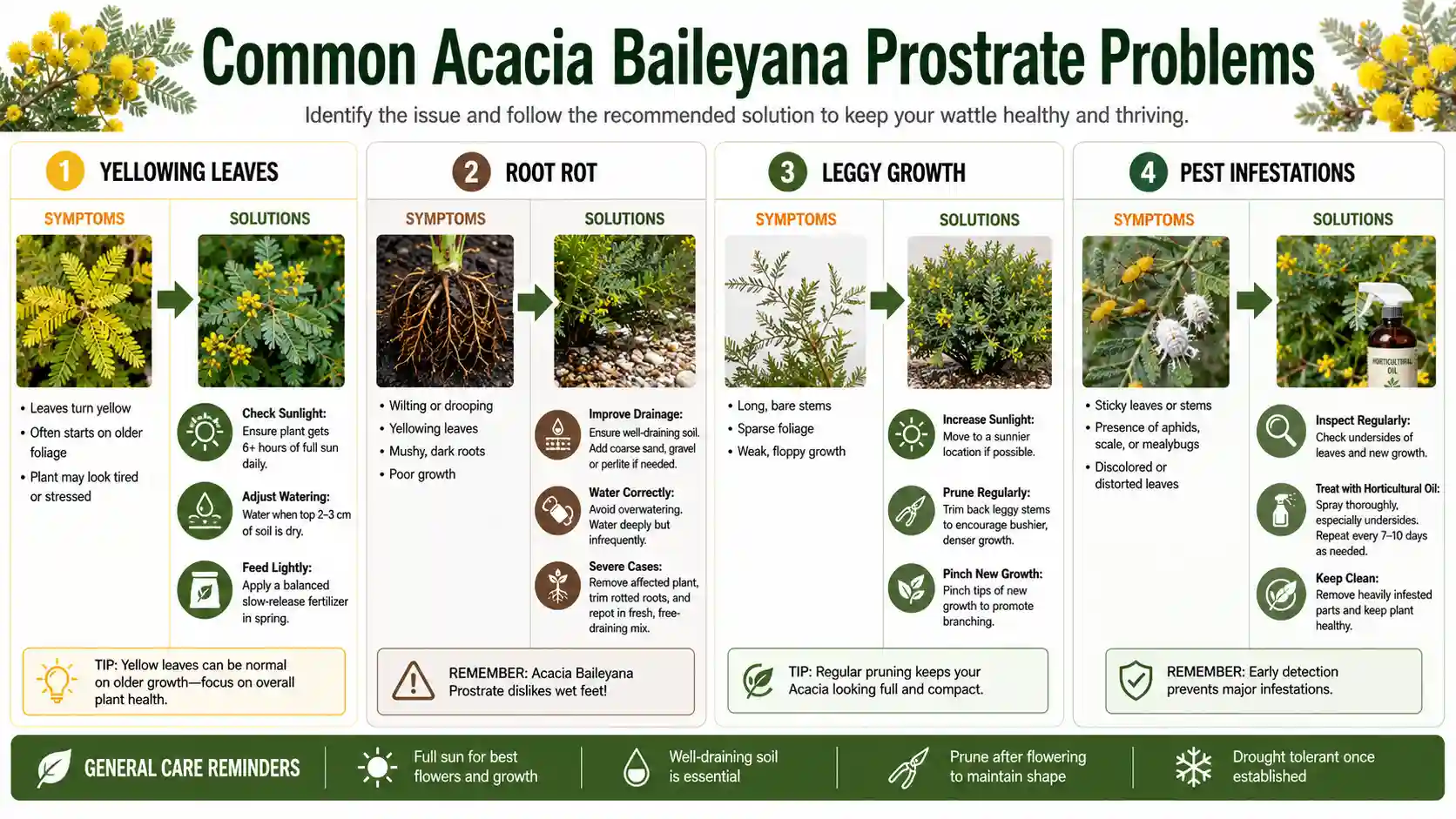
Yellowing Leaves
Why it occurs:
Yellow leaves are commonly caused by overwatering, poor drainage, nutrient deficiencies, or phosphorus toxicity.
How to fix it:
- Improve drainage
- Reduce watering frequency
- Check fertilizer type
- Use native plant fertilizers only
How to prevent it:
- Plant in free-draining soil
- Avoid high-phosphorus fertilizers
- Water only when necessary
Root Rot and Plant Collapse
Why it occurs:
Prolonged waterlogging deprives roots of oxygen and encourages fungal diseases.
How to fix it:
- Improve drainage immediately
- Reduce irrigation
- Move container-grown plants to better-drained media
How to prevent it:
- Avoid heavy clay soils
- Use raised beds where necessary
- Prevent prolonged soil saturation
Leggy, Sparse Growth
Why it occurs:
Insufficient sunlight is the most common cause.
How to fix it:
- Increase sun exposure
- Prune lightly to encourage branching
- Remove competing vegetation
How to prevent it:
- Plant in full sun
- Maintain adequate spacing
Pest Infestations (Scale, Aphids, and Borers)
Why it occurs:
Stressed plants are more vulnerable to pest attacks.
How to fix it:
- Treat scale and aphids with horticultural oils
- Remove heavily affected stems
- Improve growing conditions
How to prevent it:
- Maintain plant vigour
- Avoid excessive fertilization
- Reduce environmental stress
Failure to Flower
Why it occurs:
Common causes include:
- Too much shade
- Excess nitrogen fertilizer
- Plant immaturity
How to fix it:
- Increase sunlight exposure
- Reduce fertilizer applications
- Allow young plants time to mature
How to prevent it:
- Plant in full sun
- Fertilize sparingly
- Follow native plant care practices
Beginner Mistakes to Avoid When Growing Acacia Baileyana Prostrate
Many cultivation problems result from avoidable mistakes during planting and establishment.
Common mistakes include:
- Overwatering established plants that naturally prefer relatively dry conditions.
- Planting directly into poorly drained clay soils without improving drainage.
- Applying standard garden fertilizers that contain excessive phosphorus.
- Underestimating the mature spread and planting too close to structures or pathways.
- Hard-pruning into old wood, which rarely regenerates.
- Growing the plant in heavy shade while expecting strong flowering and dense growth.
- Failing to mulch during establishment, leading to moisture loss and root stress.
Avoiding these mistakes significantly increases the likelihood of developing a healthy, long-lived ground cover with strong flowering performance.
Growing Acacia Baileyana Prostrate in Australia — Climate and Regional Suitability
Acacia baileyana prostrate performs best in Australia’s temperate, warm-temperate, and semi-arid regions. Its drought tolerance, low nutrient requirements, and adaptability to well-drained soils make it suitable for a wide range of landscapes across southern and eastern Australia. While native to Australia, its adaptability contrasts with temperate ornamentals like Native Plants Illinois: Shade-Tolerant Flowers and Garden Tips.
Best Regions for Growing Acacia Baileyana Prostrate
The plant generally performs well in:
- New South Wales (NSW)
- Victoria (VIC)
- South Australia (SA)
- Southern Western Australia (WA)
- Parts of Queensland (QLD)
These regions provide the combination of sunlight, seasonal rainfall, and drainage conditions that support healthy growth and reliable flowering.
Suitability for Dry Inland Areas
One of the greatest strengths of Acacia baileyana prostrate is its adaptation to dry conditions.
It is particularly well suited to:
- Inland gardens
- Semi-arid landscapes
- Water-wise native gardens
- Drought-prone regions
Once established, the plant can withstand extended dry periods with little supplemental irrigation.
Environmental Weed Considerations
Gardeners should be aware that Cootamundra Wattle (Acacia baileyana), including some cultivated forms, is considered an environmental weed in certain areas outside its natural range.
Parts of:
- Victoria
- Australian Capital Territory (ACT)
have identified self-seeding populations as a concern in native ecosystems.
Before planting, it is advisable to:
- Check local council guidelines
- Review state environmental regulations
- Confirm suitability for your region
Responsible planting helps protect local biodiversity and native bushland.
Seasonal Performance
Acacia baileyana prostrate is well adapted to Australia’s climate patterns.
The plant typically experiences:
- Active growth in spring and autumn
- Reduced growth during extreme summer heat
- Flowering from late winter to early spring
Its golden flower display often serves as a seasonal indicator that winter is ending and spring growth is beginning.
Topical Cluster Connections — Related Gardening Themes
Acacia baileyana prostrate fits naturally into several broader Australian gardening topics.
Native Plant Propagation
Acacia baileyana can be propagated from:
- Scarified seed
- Semi-hardwood cuttings
Seed propagation is commonly used in revegetation and restoration projects, while cuttings are often preferred for maintaining desirable cultivated forms.
Australian Native Garden Design
This ground cover combines effectively with other Australian native plants.
Popular companions include:
- Lomandras
- Native grasses
- Grevilleas
- Kangaroo paw
- Native daisies
These combinations create layered plantings that provide habitat, colour, and year-round interest.
Erosion Control Ground Covers
Acacia baileyana prostrate is frequently compared with other erosion-control species such as:
- Native violets
- Mat rushes
- Native daisies
- Creeping native shrubs
The best choice depends on site conditions, rainfall, soil type, and maintenance goals.
Choosing the Right Ground Cover
When selecting a ground cover, consider:
- Soil drainage
- Climate
- Available space
- Maintenance requirements
- Desired visual effect
Acacia baileyana prostrate is often chosen where rapid coverage, drought tolerance, and native habitat value are priorities.
Conclusion — Is Acacia Baileyana Prostrate Right for Your Garden?
Acacia baileyana prostrate stands out as one of Australia’s most versatile and low-maintenance native ground covers. Its low-growing habit, wide spread, drought tolerance, and attractive foliage make it suitable for erosion control, weed suppression, habitat creation, and ornamental landscaping.
Gardeners seeking a naturalistic native planting often prefer the standard blue-green form for revegetation and large-scale ground coverage. Those looking for greater ornamental impact may favour Acacia baileyana purpurea prostrate, which adds striking silver-purple foliage while retaining the same spreading growth habit and golden-yellow flowers.
Before planting, ensure:
- A full sun position
- Well-drained soil
- Appropriate spacing for mature spread
- Use of native plant fertilizers only
- Avoidance of high-phosphorus products
With the right site conditions, Acacia baileyana prostrate can provide years of reliable performance while supporting wildlife and enhancing Australian landscapes.
As explored throughout this guide on Acacia baileyana prostrate, this species remains one of the most reliable native ground covers.
FAQs
What is Acacia baileyana prostrate?
Acacia baileyana prostrate is the low-growing, horizontally spreading form of Cootamundra Wattle (Acacia baileyana). The term “prostrate” refers to a plant growth habit that spreads along the ground rather than growing upright. Common names include Prostrate Cootamundra Wattle, Prostrate Wattle, Prostrate Acacia, Bailey Acacia, and ground cover wattle.
How fast does Acacia baileyana prostrate grow?
Acacia baileyana prostrate is generally considered a moderate to fast-growing native plant. Under favourable conditions, it can spread approximately 30–50 cm per year. Growth is typically strongest during spring and autumn. Like many wattles, it usually has a lifespan of around 10–15 years before replacement may be required.
What is the difference between Acacia baileyana prostrate and Acacia baileyana purpurea prostrate?
The main difference is foliage colour. Standard Acacia baileyana prostrate has blue-green feathery foliage, while Acacia baileyana purpurea prostrate produces attractive silver-purple new growth. Both forms share the same spreading habit, golden-yellow flowers, growth requirements, and drought tolerance. The purpurea form is generally chosen for its stronger ornamental appeal.
How far apart should I plant Acacia baileyana prostrate?
Plant spacing depends on your landscaping objective. For dense weed suppression, space plants 1–1.5 metres apart. For standard garden plantings, allow 1.5–2 metres between plants. This spacing accommodates the mature spread of approximately 1.5–3 metres and promotes healthy airflow and canopy development.
Is Acacia baileyana prostrate drought-tolerant?
Yes. Acacia baileyana prostrate is highly drought-tolerant once established, usually after 6–12 months. During establishment, regular deep watering is important. Afterward, natural rainfall is often sufficient in many Australian climates. Ongoing overwatering should be avoided because it can cause root rot and plant decline.
What are the best landscape uses for Acacia baileyana prostrate?
This plant is widely used for:
- Erosion control
- Slope stabilisation
- Weed suppression
- Native garden ground cover
- Wildlife habitat creation
- Revegetation projects
The purple-leafed form is also highly valued as an ornamental feature plant due to its distinctive foliage colour.
Can Acacia baileyana prostrate be grown in pots?
Yes, Acacia baileyana prostrate can be grown in large containers provided excellent drainage is maintained. A quality native plant potting mix is recommended. However, container-grown plants will not achieve the same spread as those planted in open ground and may require more frequent watering during establishment.
Is Acacia baileyana prostrate an environmental weed in Australia?
In some regions, yes. Cootamundra Wattle (Acacia baileyana) is considered an environmental weed in parts of Victoria and the ACT where it occurs outside its natural range. Gardeners should check local council regulations and environmental guidelines before planting, particularly in eastern Australian states where weed management policies may apply.