What Is Banksia ‘Giant Candles’?
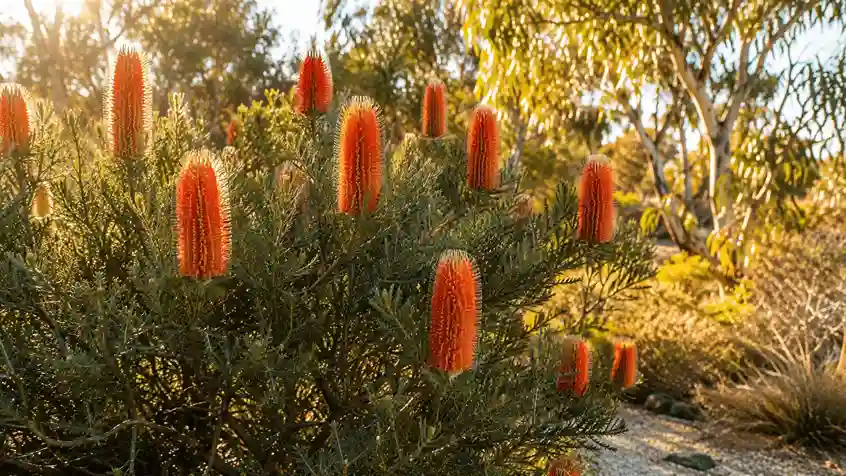
Banksia ‘Giant Candles’ is a cultivated hybrid banksia — a cross between Banksia ericifolia and Banksia spinulosa — bred for its exceptional flower display and garden versatility. The ‘Giant Candles’ cultivar name directly references its most recognisable feature: tall, cylindrical, torch-like flower spikes that erupt in deep orange-red tones during autumn and winter. As a hardy Australian native shrub, it has become a popular choice for landscaping across temperate and subtropical regions, valued for its drought tolerance, wildlife appeal, and dramatic visual impact. This guide covers everything from the giant candle banksia’s botanical origins to its full care requirements. Banksia ‘Giant Candles’ sits within one of Australia’s most diverse and garden-worthy plant genera. Explore the full range in our guide to Banksia Tree Varieties: Types, Size & Colors.
At a Glance — Banksia ‘Giant Candles’
- A cultivated hybrid of Banksia ericifolia and Banksia spinulosa
- Known for tall, cylindrical orange-red flower spikes resembling candles
- Hardy Australian native — drought-tolerant once established
- Attracts honeyeaters and other native wildlife; widely used in landscaping
- Grows 2–4 m tall with a bushy, upright habit suited to screens and feature planting
Botanical Identity: Parent Species and Hybrid Origin
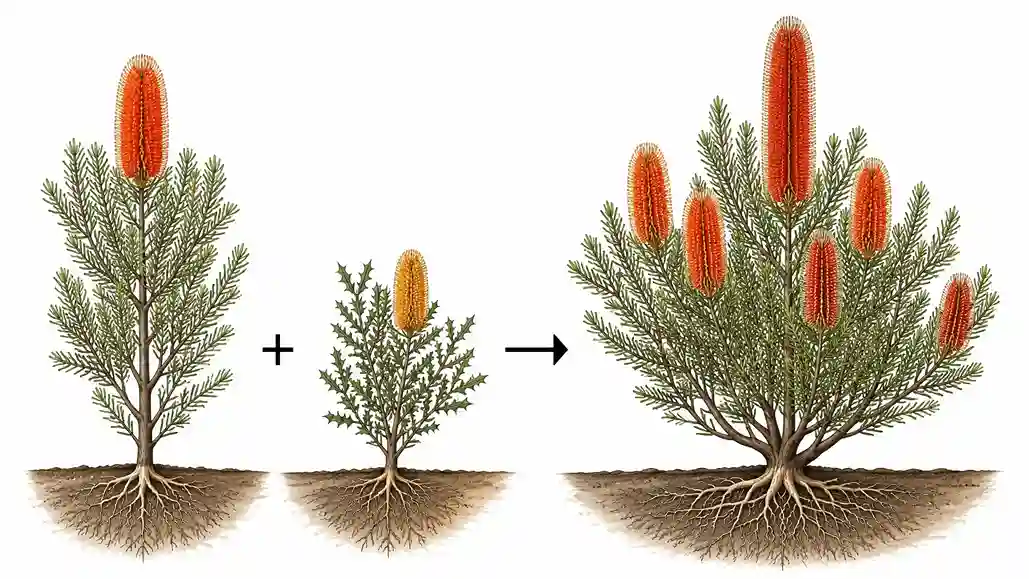
Banksia ‘Giant Candles’ (Banksia ericifolia × spinulosa) is a deliberate hybrid combining two of Australia’s best-known banksias. Banksia ericifolia, known as the heath-leaved banksia or heath banksia, contributes the hybrid’s large flower spike size and vigorous upright growth. Banksia spinulosa, the hairpin banksia, brings needle-fine foliage, compact branching structure, and reliable flowering across varied conditions. Together, these parent species produce a hybrid that outperforms both in ornamental value — delivering taller, more dramatic flower spikes on a manageable, garden-ready shrub.
What Is Banksia ericifolia?
Banksia ericifolia, the heath-leaved banksia or heath banksia, is a large shrub to small tree native to coastal and highland regions of New South Wales. It typically reaches 3–6 m in height with a dense, bushy form. Its foliage consists of short, narrow, heath-like leaves arranged in whorls along the stems — a feature reflected in its species name, ericifolia, meaning “heather-leaved.” The flower spikes are medium to large, displaying characteristic orange-red colouring and emerging primarily in autumn and winter. Banksia ericifolia is well adapted to sandy, well-drained, low-phosphorus soils and is a critical nectar source for honeyeaters and other wildlife. Banksia ericifolia is also available in smaller cultivated forms suited to compact gardens and tighter planting spaces. See our Banksia Ericifolia Dwarf Care Tips for Easy Growth guide for full details.
What Is Banksia spinulosa?
Banksia spinulosa, commonly called the hairpin banksia, is a highly variable species found across eastern Australia, from Queensland to Victoria. It ranges from a low spreading groundcover to a multi-stemmed shrub of around 0.5–3 m, depending on the variety and growing conditions. Its leaves are narrow with spine-tipped margins — the “spinulosa” name references these small spines. Flower spikes are smaller than those of B. ericifolia, typically gold to orange, and produced prolifically across the shrub. Banksia spinulosa is especially valued for its adaptability, tolerating a wide range of soils and climates, which makes it an excellent hybridising partner. One of the most popular low-growing selections from this species is widely used in coastal and exposed garden designs. Discover its uses in our Coastal Cushion Banksia: Care & Growth Tips guide.
Parent Species Comparison
| Feature | Banksia ericifolia | Banksia spinulosa | Hybrid ‘Giant Candles’ |
| Common name | Heath-leaved banksia | Hairpin banksia | Giant Candles banksia |
| Leaf shape | Short, needle-like | Narrow, spine-tipped | Intermediate |
| Flower colour | Orange-red | Gold to orange | Deep orange-red |
| Flower spike size | Medium | Small-medium | Tall / “giant” |
| Typical height | 3–6 m | 0.5–3 m | 2–4 m |
Banksia ‘Giant Candles’ Size and Growth Habit
Banksia ‘Giant Candles’ typically reaches a mature height of 2–4 metres with a spread of 1.5–2.5 metres. It grows with an upright, bushy habit, making it suitable as a feature shrub, informal hedge, or screen planting in medium to large gardens. In full sun with well-drained soil, it will reach its upper height range and develop a dense, full canopy. In containers or shadier positions, it tends toward a more compact form, though flowering may be reduced.
Environmental factors — particularly soil drainage, sun exposure, and rainfall — significantly influence final plant size. In sandy, free-draining soils typical of coastal Australian gardens, Giant Candles banksia thrives and grows vigorously. In clay-heavy soils without amendment, growth is slower and root health may be compromised.
Growth Rate of Banksia ‘Giant Candles’
Banksia ‘Giant Candles’ grows at a moderate rate — typically 30–50 cm per year under good conditions. Growth is most active during spring and autumn, slowing in the peak of summer heat and during cooler winter months. Most plants will produce their first flowering in their second or third year after planting, with flowering performance improving significantly as the plant matures.
Consistent moisture during the establishment phase (the first one to two growing seasons) accelerates early growth. Once established, the plant’s drought tolerance means it requires less supplemental watering, and growth continues steadily with minimal intervention. Applying a low-phosphorus native plant fertiliser in spring can support healthy, moderate growth without the risk of phosphorus toxicity that standard fertilisers present.
How to Care for Banksia ‘Giant Candles’
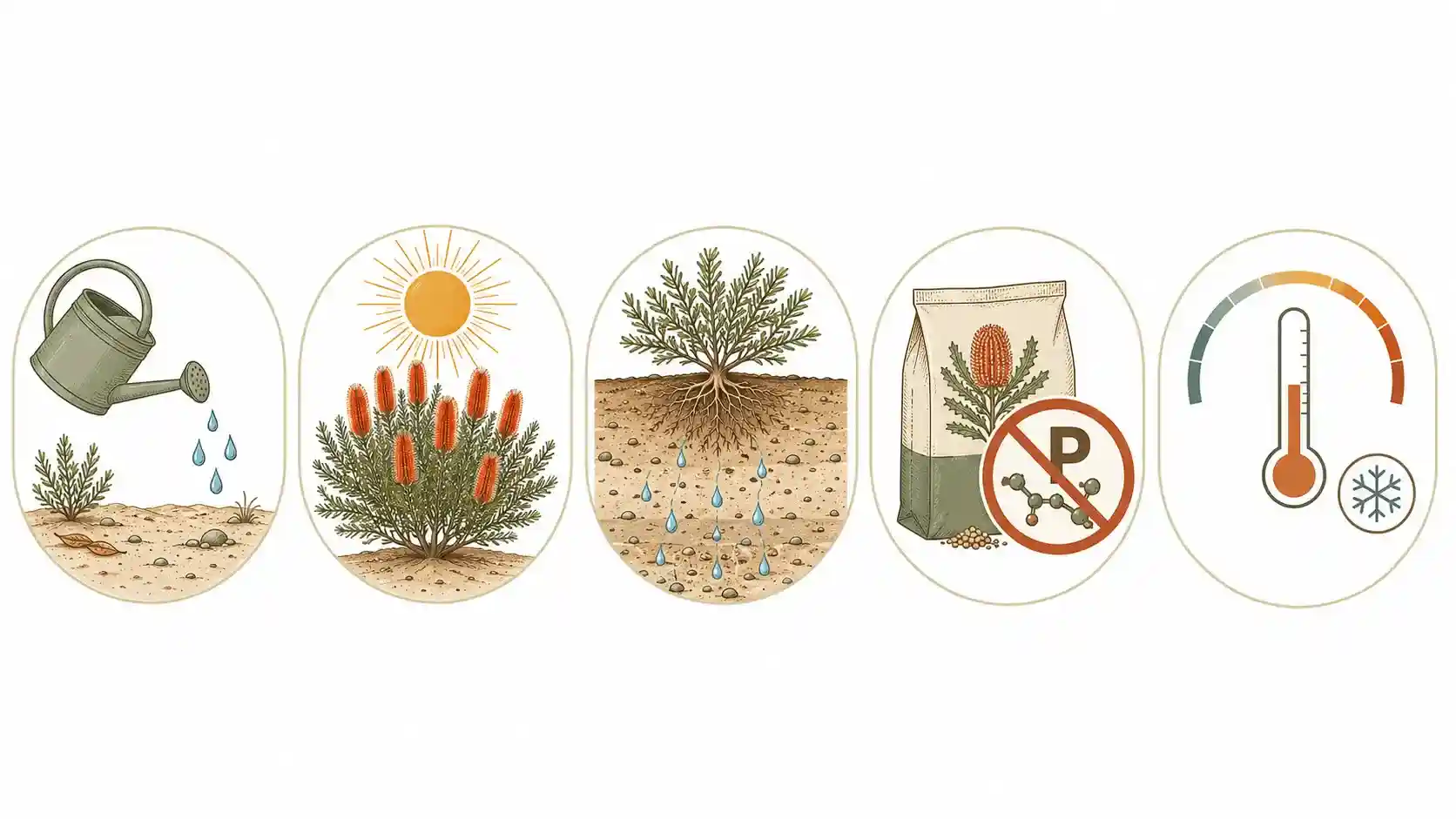
Banksia ‘Giant Candles’ is a low-maintenance shrub once established, but a few specific care requirements are essential to its health and flowering performance.
- Watering: Water regularly during the first one to two years to support establishment. Once established, the plant is drought-tolerant and requires only occasional deep watering during extended dry periods. Avoid overwatering — constantly moist soil is a leading cause of root rot in banksias.
- Light: Full sun is strongly preferred, with a minimum of 6 hours of direct sunlight daily. The plant will tolerate partial shade, but flower production decreases significantly in lower-light positions.
- Soil: Well-drained, low-phosphorus soil is essential. Sandy loam or sandy soils are ideal. In heavier soils, incorporate coarse grit or plant in raised beds to ensure adequate drainage. Native garden mixes are generally suitable.
- Fertilising: Use only low-phosphorus fertilisers specifically formulated for Australian native plants. Conventional fertilisers with moderate to high phosphorus content are toxic to banksias and can cause rapid leaf yellowing and plant death.
- Climate tolerance: Best suited to temperate, Mediterranean, and subtropical Australian climates. Tolerates mild frosts (down to approximately −3°C) but performs best in frost-free or light-frost areas. In colder inland climates, plant in a sheltered position with northern or north-eastern aspect.
- Mulching: Apply a 5–7 cm layer of coarse organic mulch around the root zone, keeping it clear of the stem. Mulch conserves moisture, moderates soil temperature, and suppresses weeds.
Pruning Banksia ‘Giant Candles’
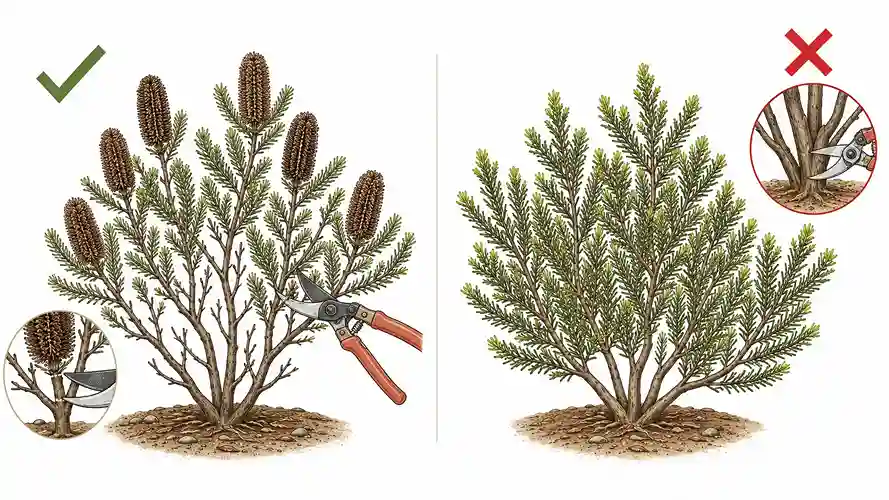
Pruning Banksia ‘Giant Candles’ is best carried out immediately after flowering — typically late winter to early spring. Light to moderate pruning at this time encourages dense, bushy regrowth and stimulates strong flower spike production for the following season.
Key pruning guidelines:
- Remove spent flower spikes at their base once the display has finished
- Tip-prune new growth to encourage lateral branching and a fuller habit
- Avoid cutting into old, woody growth — banksias do not reliably regenerate from bare wood
- Do not prune more than one-third of the plant’s total foliage mass in a single season
- Use clean, sharp secateurs and sterilise blades between plants to prevent disease spread
Hard rejuvenation pruning is generally not recommended for this hybrid, as recovery from severe cutting into old wood is uncertain.
Banksia ‘Giant Candles’ vs Related Cultivars
Several banksia cultivars share similar parentage or growth habits with ‘Giant Candles’. Understanding the differences helps gardeners select the right plant for their specific space and purpose.
| Cultivar | Size | Flower colour | Best for |
| ‘Giant Candles’ | 2–4 m | Deep orange-red | Feature shrub, screens |
| ‘Birthday Candles’ | 0.3–0.5 m | Gold-yellow | Small gardens, pots |
| ‘Little Eric’ | ~1 m | Orange | Compact borders |
| ‘Dwarf Red’ | 0.5–1 m | Red-orange | Ground cover, rockeries |
‘Giant Candles’ vs ‘Birthday Candles’: The most commonly compared pair, these two cultivars occupy opposite ends of the size spectrum. Banksia ‘Birthday Candles’ (Banksia spinulosa ‘Birthday Candles’) is a dwarf form suited to small gardens, pots, and low-maintenance borders. Its gold-yellow flowers are smaller and less dramatic than the deep orange-red spikes of ‘Giant Candles’. Gardeners with limited space or seeking a container banksia should choose ‘Birthday Candles’; those wanting a bold garden statement or screening plant will find ‘Giant Candles’ the superior choice.
‘Giant Candles’ vs ‘Little Eric’: Banksia ‘Little Eric’ is a compact cultivar of Banksia ericifolia, reaching around 1 m in height. It delivers a similar orange flower colour but on a much smaller framework. ‘Little Eric’ suits formal borders and restricted spaces where ‘Giant Candles’ would be too large.
Other Banksia spinulosa Varieties and Related Species
Beyond the named garden cultivars, Banksia spinulosa encompasses several recognised botanical varieties that contribute to the broader species complex from which ‘Giant Candles’ was developed:
- Banksia spinulosa var. collina (Banksia collina) — a highland form with slightly broader leaves and a tendency toward a more open habit. Found in the ranges of NSW and Queensland.
- Banksia cunninghamii — formerly treated as a variety of B. spinulosa, this form is found in coastal and near-coastal areas of NSW and Queensland, distinguished by minor leaf and cone differences.
- ‘Coastal Cushions’ — a low, spreading form suited to exposed coastal gardens.
- Bush Candles and Candlestick forms — several informal selections exist under these names in the nursery trade, referring to upright-flowering clones of B. spinulosa selected for their candle-like flower presentation.
Understanding this variety complex is useful for interpreting nursery labelling, where Banksia collina and Banksia cunninghamii names are sometimes still encountered alongside B. spinulosa stock. Another closely related species from eastern Australia shares similar foliage characteristics and low-maintenance garden appeal. Learn more in our Banksia oblongifolia: Care, Size, Growth & Identification Guide.
Common Problems With Banksia ‘Giant Candles’ and How to Fix Them
Yellowing Leaves
Why it happens: The most common cause is phosphorus toxicity from the application of standard garden fertilisers. Even small amounts of phosphorus at concentrations toxic to proteaceous plants (which include all banksias) can cause rapid, severe leaf chlorosis. Overwatering and waterlogged soil are the second leading cause, as they deprive roots of oxygen and impair nutrient uptake.
How to fix it: Stop all fertiliser applications immediately. If soil is consistently wet, improve drainage by aerating around the root zone or moving the plant if in a container. Use only certified low-phosphorus native plant fertiliser going forward.
How to prevent it: Never apply standard fertilisers near banksias. Always read fertiliser labels and select products specifically formulated for proteaceous or Australian native plants.
Poor Flowering
Why it happens: Insufficient direct sunlight is the primary cause of reduced or absent flowering. Incorrect pruning timing — particularly pruning in late summer or autumn, just before bud development — also removes the season’s flower potential.
How to fix it: Relocate the plant to a sunnier position if possible, or remove overhanging vegetation that is shading it. Adjust pruning timing to immediately post-flowering (late winter to early spring only).
Root Rot
Why it happens: Heavy clay soils with poor drainage create persistently moist conditions that favour Phytophthora cinnamomi (cinnamon root rot), a water mould that is devastating to banksias and other Australian natives.
How to fix it: There is no reliable cure once root rot is established. Prevention is critical — plant only in well-drained soils, avoid overwatering, and do not mulch directly against the stem. In high-risk areas, plant in raised beds with a freely draining native soil mix.
Understanding how banksia root systems behave underground also helps with site selection and drainage planning before planting. See Are Banksia Roots Invasive? 7+ Essential Facts to Know for guidance.
Pest Issues
- Banksia moth (Psalidostetha banksiae): Larvae tunnel into flower cones and stems. Prune and destroy affected material promptly.
- Scale insects: Appear as small brown or white encrustations on stems. Treat with horticultural oil spray during cooler months, ensuring thorough coverage of affected stems.
Slow Growth
Why it happens: Compacted or nutrient-deficient soils, incorrect soil pH (banksias prefer slightly acidic to neutral soil, pH 5.5–7.0), or insufficient sunlight all contribute to slow establishment and growth.
How to fix it: Apply a low-phosphorus native fertiliser in spring, check soil pH with a basic kit and adjust if needed (sulfur to lower pH), and ensure the plant is in full sun.
Using Banksia ‘Giant Candles’ in Garden Design
Banksia ‘Giant Candles’ functions as a high-impact structural plant in native and mixed Australian gardens. Its upright habit, dense foliage, and vivid autumn-winter flower display make it versatile across several design roles:
- Feature shrub: Plant as a standalone specimen where the flower spikes can be appreciated at eye level and above. It performs particularly well against a backdrop of lower grey-green foliage from kangaroo paws (Anigozanthos spp.) or native grasses.
- Informal screen or hedge: Planted at 1.5–2 m spacing, Giant Candles banksia forms an effective year-round privacy screen with seasonal flowering interest.
- Windbreak planting: Its dense structure and moderate height make it useful in coastal or exposed gardens where low-to-medium windbreaks are needed.
- Wildlife garden: The large, nectar-rich flower spikes are an exceptional resource for honeyeaters — particularly eastern spinebills, New Holland honeyeaters, and noisy miners — as well as native bees and other beneficial insects.
- Companion planting: Pairs well with other low-phosphorus-tolerant natives including grevilleas, leucadendrons, banksias of contrasting size, and native grasses. Avoid planting near phosphorus-hungry vegetables or conventional garden beds where fertiliser drift may occur. Grevillea ‘Blood Orange’ is one of the most compatible and visually complementary companions for this hybrid. Read our Grevillea Blood Orange: Care & Growth Tips guide for pairing advice.
Growing Banksia ‘Giant Candles’ in Different Australian Climates
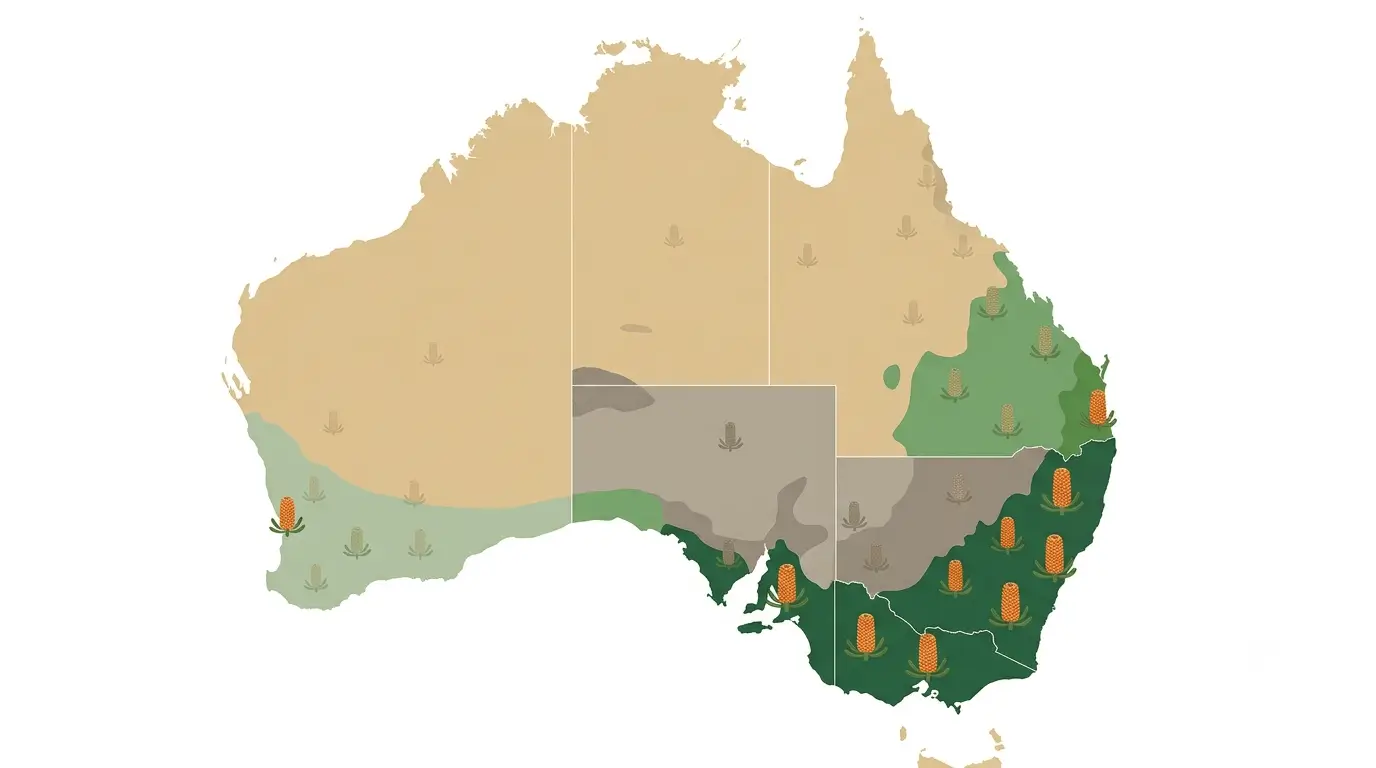
Banksia ‘Giant Candles’ performs across a broader climate range than many garden banksias, but its suitability varies by region.
| Climate Zone | Suitability | Key Considerations |
| Temperate (Sydney, Adelaide, Melbourne) | Excellent | Ideal conditions; full sun, well-drained soil |
| Subtropical (Brisbane, SE QLD) | Very good | Performs well; ensure good drainage in summer wet season |
| Mediterranean (Perth, SW WA) | Good | Drought-tolerant once established; summer irrigation may be needed |
| Tropical / monsoonal | Poor | Not suited to high-rainfall wet seasons; root rot risk |
| Cool temperate / alpine | Moderate | Protect from heavy frost; shelter from cold winds |
Growing Banksia ‘Giant Candles’ in Brisbane and subtropical Queensland: This hybrid adapts well to subtropical conditions. The key challenge is soil drainage during the summer wet season — ensure planting sites drain freely within 30 minutes of rainfall. Mulching is particularly important in subtropical gardens to moderate soil temperature during hot summer months. Flowering typically occurs in autumn, which aligns well with subtropical dry season conditions.
Seasonal care calendar:
- Spring: Light prune after any late winter flowering; apply low-phosphorus native fertiliser; mulch refresh
- Summer: Monitor drainage; water during extended dry spells; watch for scale insects
- Autumn: Main flowering season; minimal intervention required; enjoy the display
- Winter: Secondary flowering possible; protect young plants from frost; prune spent spikes
Conclusion: Is Banksia ‘Giant Candles’ the Right Plant for Your Garden?
Banksia ‘Giant Candles’ is one of Australia’s most rewarding garden banksias — a robustly performed hybrid that combines the best traits of its parent species into a versatile, hardy, and visually striking shrub. Its tall, deep orange-red flower spikes provide exceptional autumn-winter interest, its drought tolerance suits the Australian climate, and its wildlife value is outstanding. It suits medium to large gardens in temperate and subtropical regions where well-drained soil can be provided. Gardeners who follow its core care requirements — avoiding phosphorus fertilisers, ensuring full sun, and pruning at the right time — will find Giant Candles banksia a long-lived, low-maintenance feature plant that delivers season after season.
Banksia ‘Giant Candles’ pairs beautifully with other native trees and shrubs across all Australian climate zones. Plan your full garden around our 🌿 Australian Native Garden Trees: The Complete Planting Guide — and find design inspiration in our Modern Australian Native Garden: 10+ Smart Design Ideas Guide.
Frequently Asked Questions
1. What is Banksia ‘Giant Candles’ and what are its parent species?
Banksia ‘Giant Candles’ is a cultivated hybrid banksia with the botanical designation Banksia ericifolia × Banksia spinulosa. It was bred by crossing the heath-leaved banksia (B. ericifolia) with the hairpin banksia (B. spinulosa). The hybrid inherits large, dramatic flower spikes from B. ericifolia and adaptable, fine-textured foliage from B. spinulosa, resulting in a garden shrub that surpasses both parent species in ornamental value.
2. How tall does Banksia ‘Giant Candles’ grow?
Banksia ‘Giant Candles’ typically grows to a mature height of 2–4 metres, with a spread of 1.5–2.5 metres. Plants in full sun with free-draining soil reach the upper end of this range, while those in shadier positions or containers tend to remain more compact. It grows with an upright, bushy habit suitable for use as a feature shrub or informal screen.
3. How fast does Banksia ‘Giant Candles’ grow?
Banksia ‘Giant Candles’ grows at a moderate rate — approximately 30–50 cm per year under good growing conditions. Growth is most vigorous in spring and autumn. Most plants will begin flowering in their second or third year. Consistent watering during the establishment period and annual application of low-phosphorus native fertiliser in spring will support steady, healthy growth.
4. What is the difference between Banksia ‘Giant Candles’ and ‘Birthday Candles’?
The primary difference is size. Banksia ‘Giant Candles’ is a medium-to-large shrub growing 2–4 m tall with deep orange-red flower spikes. Banksia ‘Birthday Candles’ (Banksia spinulosa ‘Birthday Candles’) is a compact dwarf form reaching only 0.3–0.5 m, with smaller gold-yellow flower spikes. ‘Birthday Candles’ suits pots, small gardens, and low borders; ‘Giant Candles’ is the choice for feature planting, screening, and larger landscape applications.
5. Why are the leaves on my Banksia ‘Giant Candles’ turning yellow?
Yellowing leaves on Banksia ‘Giant Candles’ are most commonly caused by phosphorus toxicity — the result of applying standard garden fertilisers that contain phosphorus levels toxic to banksias and other proteaceous plants. Overwatering and poor soil drainage are the second most likely cause, leading to oxygen deprivation in the root zone. Cease all standard fertiliser applications immediately, improve soil drainage if needed, and switch to a certified low-phosphorus native plant fertiliser.
6. When and how should you prune Banksia ‘Giant Candles’?
Prune Banksia ‘Giant Candles’ immediately after flowering finishes — typically late winter to early spring. Remove spent flower spikes at their base and tip-prune new growth to encourage a denser, more compact habit. Avoid cutting into old, bare wood, as banksias do not reliably regenerate from hard pruning into woody stems. Do not prune more than one-third of the plant at one time, and always use clean, sharp, sterilised secateurs.
7. Is Banksia ‘Giant Candles’ suitable for growing in Brisbane and subtropical climates?
Yes, Banksia ‘Giant Candles’ grows well in Brisbane and subtropical southeast Queensland. The critical requirement in these climates is excellent soil drainage, particularly during the summer wet season, as persistently moist soil promotes root rot. Plant in a raised bed or well-drained native garden mix, apply a generous layer of coarse mulch, and ensure the site receives full sun. Flowering occurs in autumn, which aligns well with subtropical dry season conditions.