Anthurium hookeri, commonly called Bird’s Nest Anthurium, is a rosette-forming aroid native to South America and the Caribbean, prized for its broad, leathery, paddle-shaped leaves marked with dark glandular dots on the underside. According to Greenery Inside, it thrives in bright indirect light, high humidity, and well-draining aroid soil, rarely developing a visible stem.
Those underside dots are glandular cells, not pest damage or disease, though new growers often misdiagnose them and attempt unnecessary treatment. Nursery trade frequently mislabels this species as Anthurium “pseudospectabile,” and mature specimens can produce leaves exceeding 30 inches under greenhouse conditions, far larger than typical houseplant growth.
By Greenery Inside | Plant Care & Gardening Expert
Last Updated: August 2026
Quick Summary
- Anthurium hookeri is a tropical species native to parts of Central America, northern South America, and the Caribbean, where it grows in warm, humid forests.
- It thrives in bright indirect light, evenly moist but well-drained soil, high humidity, and temperatures between 70–90°F (21–32°C).
- Variegated Anthurium hookeri forms are uncommon because stable variegation is rare, making healthy specimens highly sought after by collectors.
- True Anthurium hookeri can be distinguished from similar bird’s nest anthuriums by its broad rosette, characteristic leaf structure, and unique botanical features.
What Is Anthurium Hookeri?
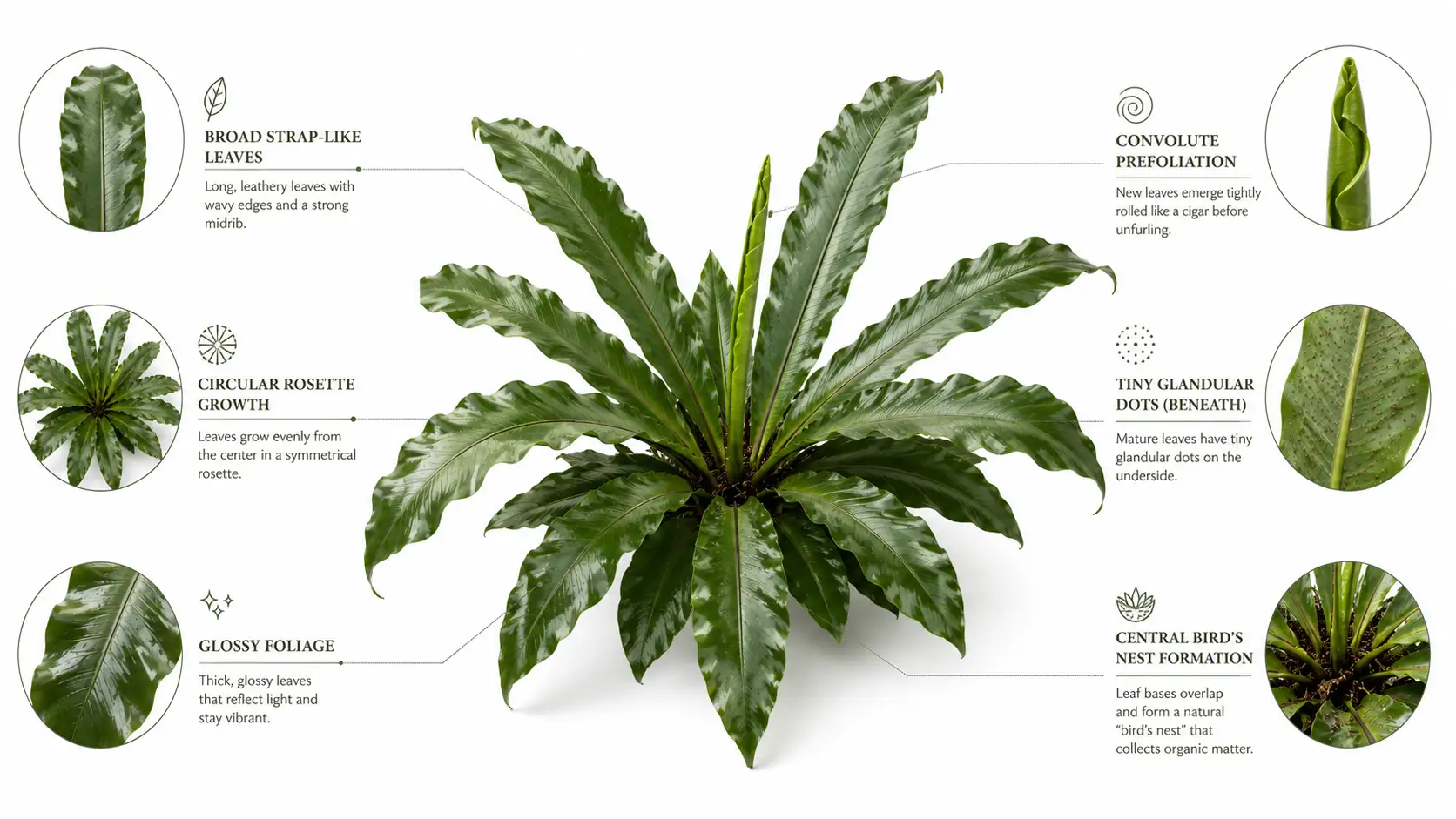
Anthurium hookeri is a tropical evergreen perennial belonging to the Araceae (aroid) family. It is one of several species commonly referred to as bird’s nest anthuriums, but true Anthurium hookeri possesses botanical characteristics that distinguish it from many plants sold under the same common name.
Anthurium hookeri belongs to the diverse Anthurium genus, one of the largest groups within the Araceae family, encompassing hundreds of tropical species with a wide range of foliage forms and growth habits.
Named after the celebrated botanist Sir William Jackson Hooker, this species develops a dense rosette of long, leathery leaves instead of climbing like many other Anthurium species. Mature plants often create an impressive architectural display, making them popular as statement houseplants and tropical landscape specimens.
In the wild, Anthurium hookeri can grow as both an epiphyte, attaching itself to trees, and a terrestrial plant, rooting directly in organic forest soil. This adaptability explains why it performs well in airy potting mixes that balance moisture retention with excellent drainage.
One feature that helps botanists identify true Anthurium hookeri is its convolute prefoliation, meaning new leaves emerge tightly rolled before gradually unfurling. The undersides of mature leaves also contain tiny black glandular dots, a characteristic often absent in closely related species frequently mistaken for hookeri.
The plant is commonly marketed as a hookeri plant, anthurium bird nest, or simply bird’s nest anthurium, although many cultivated hybrids are incorrectly labeled as true Anthurium hookeri.
Greenery Inside Tip: In our experience, many garden centers sell hybrids under the Anthurium hookeri name. Checking for the characteristic gland dots beneath mature leaves is one of the most reliable ways to distinguish genuine specimens from similar hybrids.
Why Is It Called “Bird’s Nest Anthurium”?
The name bird’s nest anthurium comes from the plant’s distinctive growth pattern rather than its flowers.
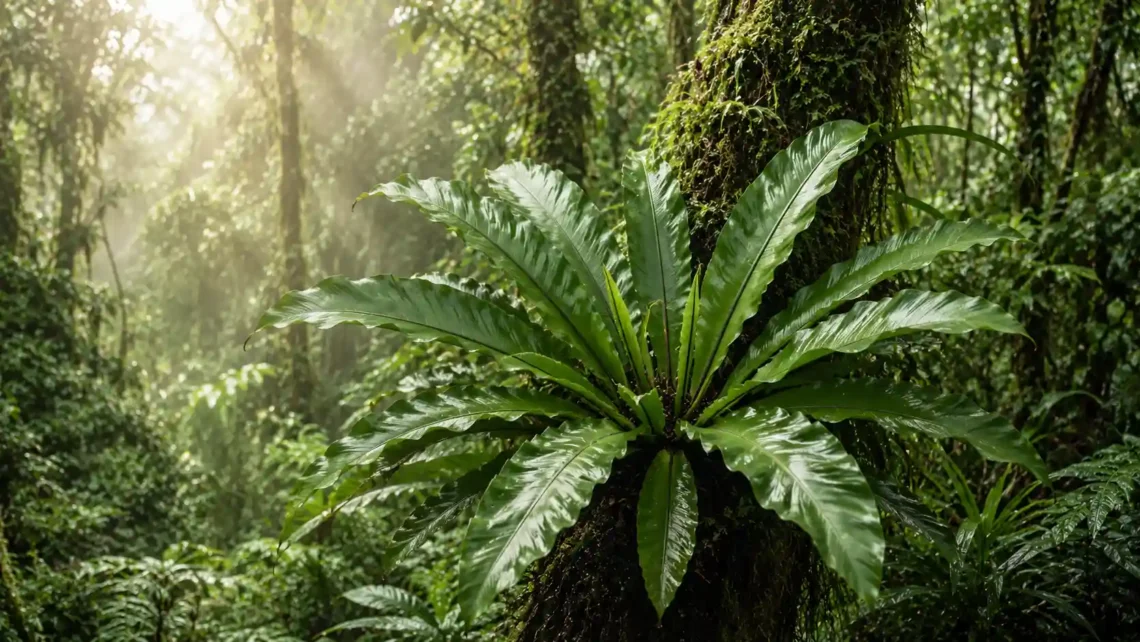
Instead of producing long climbing stems, Anthurium hookeri grows as a compact circular rosette. Each new leaf emerges from the center, gradually radiating outward to form a layered arrangement that resembles the shape of a bird’s nest.
This natural structure provides several advantages in its rainforest habitat:
- Captures falling organic debris that slowly decomposes into nutrients.
- Helps retain moisture around the plant’s root system.
- Protects developing leaves within the central crown.
- Creates a stable growth habit capable of supporting very large foliage.
Because of this appearance, you’ll often encounter names such as:
- Bird’s nest anthurium
- Bird nest anthurium
- Anthurium bird’s nest
- Anthurium bird nest
Although these names are widely used, they may refer to several different Anthurium species rather than true Anthurium hookeri.
Native Habitat and Origin
Anthurium hookeri is native to the tropical rainforests of:
- Central America
- Northern South America
- Several Caribbean islands
Its natural environment provides valuable clues about its care requirements.
Wild plants typically grow beneath the rainforest canopy, where sunlight is filtered through taller trees. Temperatures remain consistently warm throughout the year, while humidity often exceeds 70%. Frequent rainfall keeps roots moist without allowing them to remain waterlogged because forest debris provides naturally airy, well-drained growing conditions.
Depending on the environment, Anthurium hookeri may establish itself:
- On tree trunks as an epiphyte
- On moss-covered rocks
- In organic-rich forest soil
These growing conditions explain why the species dislikes heavy garden soil and prolonged standing water.
As of 2026, professional growers continue recommending highly aerated aroid mixes rather than dense peat-only soils because improved airflow significantly reduces the risk of root diseases while encouraging healthier root development.
Anthurium Hookeri Care Guide
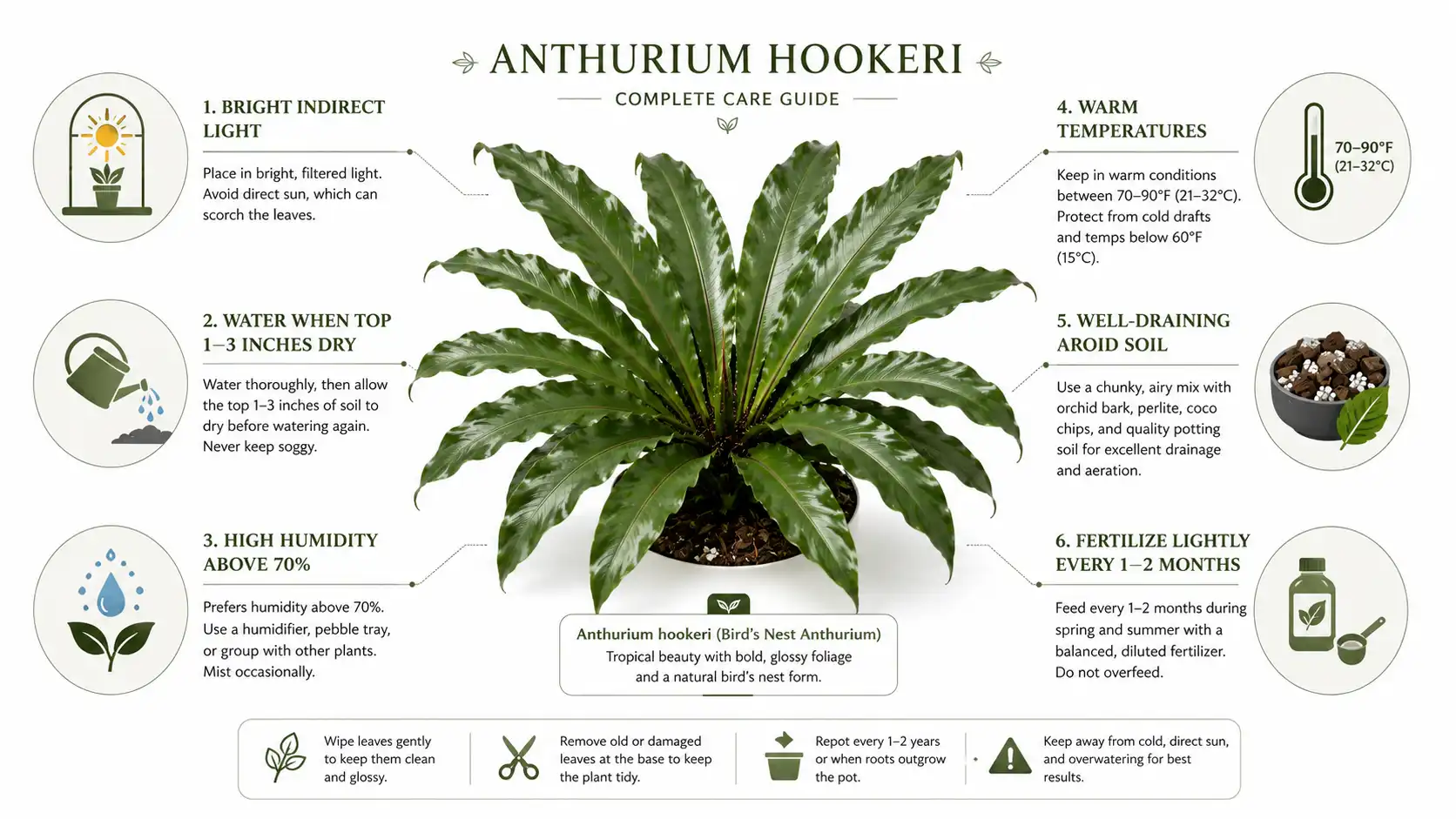
Providing the right growing conditions is the key to maintaining healthy foliage and encouraging steady growth. Fortunately, Anthurium hookeri is considered relatively forgiving once its basic environmental needs are met.
If you enjoy growing tropical aroids, you may also find our Alocasia Silver Dragon Care: Complete Growing Guide helpful, as both plants thrive in bright indirect light, warm temperatures, and high humidity.
Greenery Inside Recommendation: We’ve found that consistency matters more than perfection. Stable humidity, careful watering, and good airflow usually produce healthier plants than frequent changes in care routines.
Light Requirements
Anthurium hookeri grows best in bright, indirect light that closely resembles the filtered sunlight of tropical forests.
An east-facing window or a bright room with sheer curtains usually provides ideal conditions. The plant can tolerate medium light, but growth slows noticeably, and new leaves may become smaller over time.
Avoid prolonged exposure to intense afternoon sun because direct rays can scorch the broad foliage, leaving permanent brown or bleached patches.
Ideal lighting conditions
- Bright indirect light
- Morning sun is acceptable
- Medium light tolerated
- Avoid harsh afternoon sunlight
- Rotate the pot every few weeks for even growth
Artificial grow lights can also support healthy growth if natural light is limited, especially during shorter winter days.
Watering Needs
Water Anthurium hookeri when the top 1–3 inches (2.5–7.5 cm) of the potting mix feels dry.
The goal is to keep the soil lightly moist without allowing it to become saturated. Constantly wet soil deprives roots of oxygen and creates favorable conditions for fungal diseases.
One unique consideration for bird’s nest anthuriums is the central rosette. Water should not remain trapped inside the crown for extended periods because stagnant moisture may encourage crown rot.
Many experienced growers prefer watering around the edge of the pot or using bottom watering, allowing roots to absorb moisture while keeping the crown relatively dry.
Best watering practices
- Check soil moisture before watering.
- Water thoroughly until excess drains away.
- Empty drainage trays promptly.
- Never allow the pot to sit in standing water.
- Reduce watering frequency during winter when growth naturally slows.
Greenery Inside Experience: One of the most common reasons we see Anthurium hookeri decline indoors is overwatering. Waiting until the upper layer of soil dries slightly almost always results in stronger root systems than watering on a fixed schedule.
Humidity and Temperature
As a tropical rainforest species, Anthurium hookeri thrives in warm, humid environments.
Similar humidity recommendations also apply to Alocasia Cuprea Red Secret Care Guide, another tropical aroid that performs best in consistently warm and humid conditions.
An ideal humidity level is 70% or higher, although healthy plants can often adapt to 50–60% humidity if watering and airflow are properly managed.
Maintain temperatures between 70°F and 90°F (21–32°C) whenever possible.
Avoid exposing the plant to:
- Cold drafts
- Air conditioning vents
- Frost
- Temperatures below 55°F (13°C)
Low humidity often causes:
- Brown leaf edges
- Slower growth
- Curling foliage
- Reduced leaf size
Using a humidifier or grouping tropical plants together can help create a more suitable microclimate indoors.
Soil and Potting
The ideal growing medium for Anthurium hookeri is a well-draining aroid mix that retains moisture while allowing excellent airflow around the roots.
A commonly recommended mix includes:
- Peat moss or coco coir
- Orchid bark
- Perlite
- Horticultural charcoal (optional)
- Compost or worm castings (optional)
Drainage holes are essential because standing water greatly increases the risk of root rot.
Interestingly, Anthurium hookeri often performs better when slightly root-bound, so avoid choosing oversized containers. A pot only slightly larger than the root ball usually encourages healthier growth.
Fertilizing
Anthurium hookeri benefits from regular but moderate feeding during its active growing season. Unlike heavy-feeding foliage plants, it responds best to light, consistent fertilization rather than large doses.
Feed the plant every 4–8 weeks during spring and summer using a balanced, diluted fertilizer. Organic options, such as worm castings, fish emulsion, or seaweed extract, provide slow-release nutrients while reducing the risk of fertilizer burn.
During autumn and winter, growth naturally slows. Reduce or pause fertilizing until new growth resumes in spring.
Fertilizing Tips
- Use a balanced fertilizer (such as 10-10-10 or 20-20-20) diluted to half strength.
- Feed every 1–2 months during active growth.
- Water the soil before applying fertilizer to protect the roots.
- Avoid excessive nitrogen, which can produce weak, overly soft leaves.
- Flush the potting mix occasionally with clean water to prevent salt buildup.
Greenery Inside Experience: We have found that light, consistent feeding produces healthier foliage than frequent heavy fertilization. Overfeeding often causes leaf tip burn and salt accumulation in container-grown Anthuriums.
Pruning and Repotting
Anthurium hookeri requires very little pruning. The primary goal is to remove aging or damaged foliage so the plant can direct its energy toward healthy new growth.
Prune leaves using clean, sterilized scissors or pruning shears. Remove yellow, brown, or diseased leaves by cutting them close to the base without damaging the central crown.
Repot the plant every 2–3 years, or sooner if roots begin growing through the drainage holes or circling heavily inside the container.
The ideal time to repot is during spring or early summer, when warmer temperatures encourage faster root establishment.
When repotting:
- Select a pot only 1–2 inches larger than the current container.
- Refresh the potting mix with a fresh, airy aroid blend.
- Inspect the roots and trim any black, mushy, or damaged sections.
- Water lightly after repotting and keep the plant in bright indirect light while it recovers.
Avoid disturbing healthy roots unnecessarily, as Anthurium hookeri generally prefers minimal root disturbance.
Anthurium Hookeri Care at a Glance
| Care Factor | Recommendation |
| Light | Bright indirect light |
| Water | Water when the top 1–3 inches of soil are dry |
| Humidity | 70% or higher is ideal |
| Temperature | 70–90°F (21–32°C) |
| Soil | Well-draining aroid mix with bark and perlite |
| Fertilizer | Every 4–8 weeks during spring and summer |
| Repotting | Every 2–3 years |
| Toxicity | Toxic if ingested by pets and humans |
Anthurium Hookeri Variegated: What Makes It Different
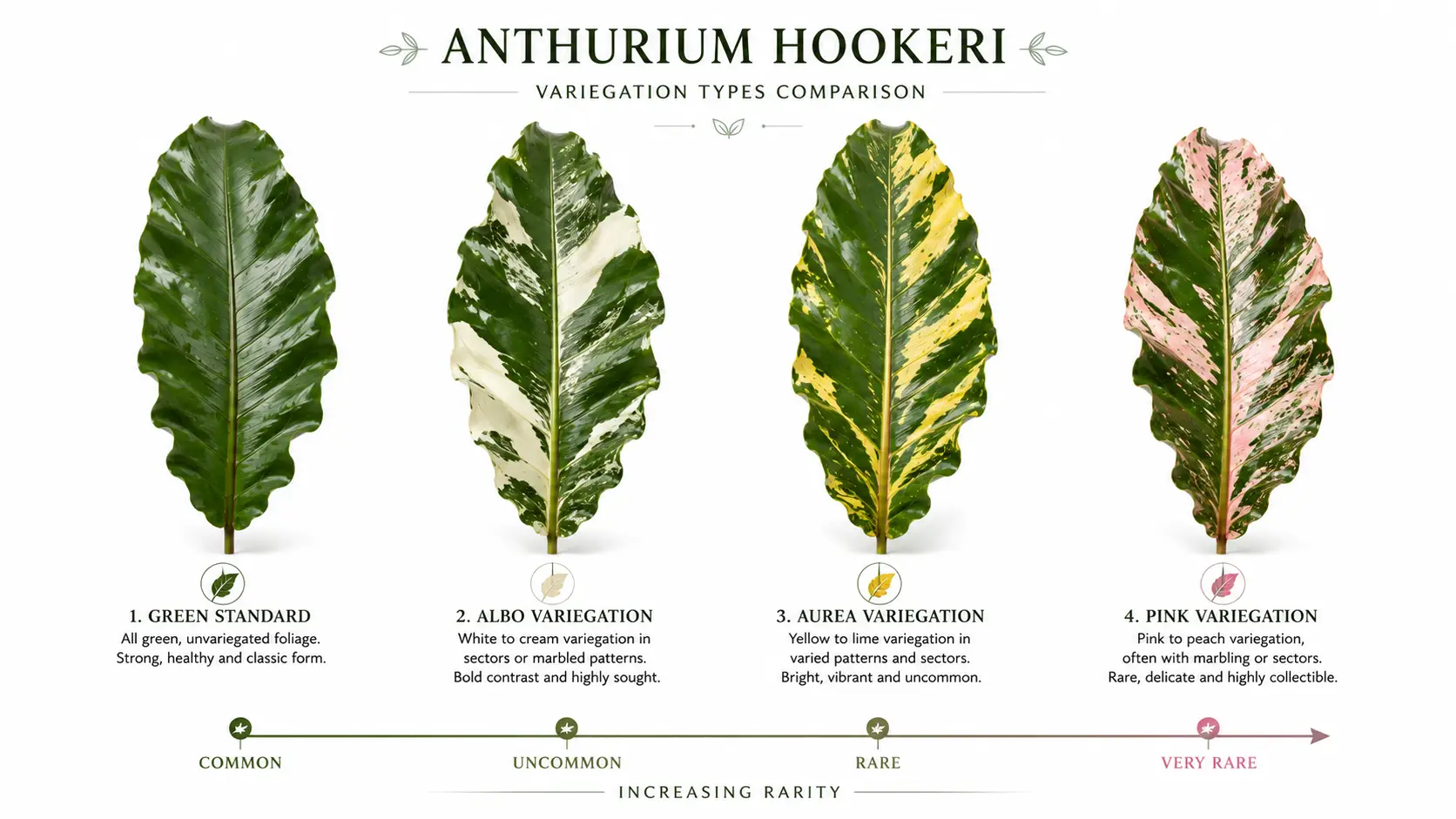
Variegated Anthurium hookeri is one of the most desirable forms among collectors because each plant develops a unique combination of green and non-green leaf tissue. These striking patterns make every specimen visually distinct and significantly more valuable than standard green plants.
You may also see these plants listed as:
- Variegated Anthurium hookeri
- Anthurium hookeri variegated
- Anthurium hookeri variegata
- Anthurium bird’s nest variegated
- Anthurium hookeri pink
While these names are commonly used in the plant trade, the actual pattern and coloration vary greatly from one specimen to another.
Because variegation is often unstable, no two plants look exactly alike, and future leaves may display different amounts of coloration.
What Causes Variegation in Anthurium Hookeri?
Variegation occurs when portions of the leaf lack chlorophyll, the green pigment responsible for photosynthesis. This creates contrasting sections of cream, white, yellow, or occasionally pink tissue alongside normal green areas.
Most naturally variegated Anthurium hookeri plants develop their coloration due to a chimeral mutation, where genetically different cell layers exist within the same plant.
Some commercially available plants are also produced through carefully selected tissue culture, although maintaining stable variegation remains challenging.
Because the lighter portions of the leaves contain less chlorophyll, they produce less energy through photosynthesis.
As a result, variegated plants typically:
- Grow more slowly
- Produce fewer leaves each year
- Require brighter indirect light
- Demand more careful watering
- Need stable growing conditions
This slower growth contributes to their rarity and higher market value.
Types of Variegated Hookeri
Variegation appears in several distinct patterns, each appealing to different collectors.
Albo Variegation
The most recognizable type features crisp white or creamy-white sectors against deep green foliage.
Characteristics include:
- Bright white marbling
- Half-moon patterns
- Speckled leaves
- High visual contrast
Because white tissue lacks chlorophyll entirely, these plants generally require more attentive care.
Aurea (Yellow) Variegation
Aurea forms display yellow, lime, or golden patches instead of pure white.
They often feature:
- Warm yellow marbling
- Golden streaks
- Lime-green sectors
- Softer contrast than Albo varieties
These plants may tolerate slightly brighter light because yellow tissue often retains more chlorophyll than white sections.
Pink Variegation
Although uncommon, some Anthurium hookeri plants produce pink-toned variegation, especially on newly emerging leaves.
Pink coloration may appear as:
- Pink sectors
- Soft blush patches
- Rose-colored streaks
- Temporary pink flushing on fresh growth
True stable pink variegation is considerably rarer than white or yellow forms.
Half-Moon Variegation
Half-moon plants display one side of the leaf almost entirely variegated while the opposite side remains green.
Collectors highly value this dramatic pattern because of its symmetry and rarity.
However, half-moon leaves often contain large areas without chlorophyll, making them more susceptible to browning if light or humidity levels fluctuate.
Why Variegated Forms Cost More
Variegated Anthurium hookeri plants command premium prices for several reasons.
First, naturally stable variegation is rare. Even when propagated successfully, new plants may not inherit the same attractive patterns.
Second, slower growth means growers need more time before plants reach a marketable size.
Third, some specimens gradually revert to solid green growth. Reversion reduces the plant’s uniqueness and can lower its value.
Several additional factors influence pricing:
- Stability of the variegation
- Amount of contrasting color
- Overall plant size
- Root health
- Number of mature leaves
- Demand among collectors
When purchasing a variegated specimen, always examine recent growth rather than relying solely on older leaves. Healthy new leaves provide the best indication of whether the variegation remains stable.
Greenery Inside Recommendation: We recommend purchasing variegated Anthurium hookeri from reputable growers who provide clear photos of the newest leaves and healthy root systems. Stable, vigorous growth is far more important than dramatic variegation alone.
Anthurium Hookeri vs. Other Bird’s Nest Anthurium Varieties
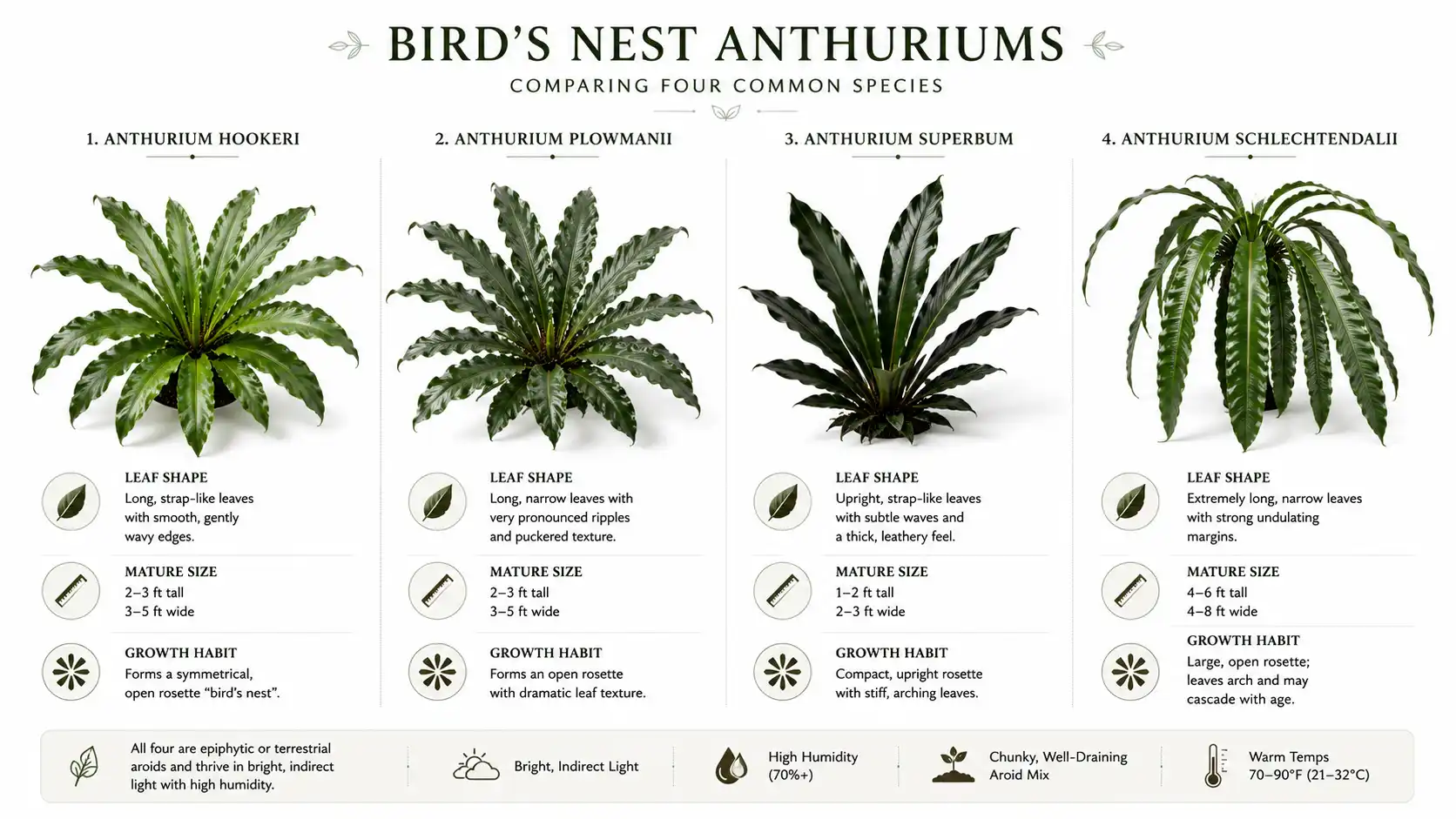
Although many plants are sold as bird’s nest anthuriums, several different species belong to this group. Understanding their differences helps prevent misidentification and ensures you provide the most appropriate care.
If you’re comparing large tropical foliage plants for your collection, our Philodendron Billietiae Growth Rate: Care, Size & Tips explains how another popular aroid differs in growth habit, mature size, and care requirements.
Comparison of Popular Bird’s Nest Anthuriums
| Species | Leaf Shape | Mature Size | Distinguishing Trait |
| Anthurium hookeri | Broad, strap-like leaves | Medium to large | Convolute prefoliation and glandular dots beneath leaves |
| Anthurium plowmanii | Broad, heavily rippled leaves | Large | Deeply wavy foliage known as “Wave of Love” |
| Anthurium superbum | Upright, dark green leaves | Medium | Rosette form with reddish-purple new growth and pinkish roots |
| Anthurium schlechtendalii | Long, elongated strap leaves | Very large | Giant foliage that can exceed several feet in length |
Anthurium hookeri
True Anthurium hookeri develops broad, leathery leaves arranged in a wide rosette. Mature plants typically have smoother leaf margins than many related species and produce the characteristic glandular dots beneath the foliage.
Anthurium plowmanii
Often marketed as the Wave of Love Anthurium, Anthurium plowmanii is easily recognized by its dramatically ruffled leaf edges.
While beginners sometimes mistake it for hookeri, the heavily rippled foliage immediately distinguishes it from the smoother leaves of true Anthurium hookeri.
Anthurium superbum
Anthurium superbum forms a compact upright rosette with thick, dark green leaves that stand almost vertically.
Young foliage often emerges with attractive reddish-purple tones, and mature plants may develop distinctive pinkish roots near the base.
Anthurium schlechtendalii
Sometimes called the Giant Anthurium, Anthurium schlechtendalii is considerably larger than most bird’s nest species.
Its elongated leaves can reach several feet in length under ideal conditions, making it better suited for conservatories and spacious tropical gardens than average indoor settings.
Common Anthurium Hookeri Problems (and How to Fix Them)
Most Anthurium hookeri problems are caused by excess moisture, unsuitable light, low humidity, temperature stress, or pests. Because the plant grows from a central rosette and prefers airy roots, early diagnosis is important. Correcting the underlying growing condition usually prevents the problem from returning.
Yellowing Leaves
Yellow leaves on Anthurium hookeri are most commonly associated with overwatering, poor drainage, natural leaf aging, or nutrient deficiency.
If only one older outer leaf turns yellow while the rest of the plant remains healthy, the change may be part of normal aging. Multiple yellow leaves appearing at once are more likely to indicate a care problem.
Common causes include:
- Soil remaining wet for too long
- Poorly draining or compacted potting mix
- A pot without adequate drainage holes
- Excess fertilizer salts
- Nutrient depletion in old potting media
- Insufficient light combined with frequent watering
To fix yellowing caused by excess moisture, allow the upper portion of the potting mix to dry before watering again. Check that excess water can drain freely and inspect the roots if the soil smells sour or remains wet for many days.
If the plant has not been fertilized for several months during active growth, a diluted balanced fertilizer may help correct mild nutrient deficiency.
Prevention is straightforward: provide bright indirect light, use an aerated aroid mix, and base watering on soil moisture rather than a fixed calendar.
Root Rot
Root rot occurs when Anthurium hookeri roots remain deprived of oxygen in waterlogged soil. A constantly wet growing medium allows pathogenic fungi and other microorganisms to damage root tissue.
Typical signs include:
- Yellowing leaves
- Wilting despite wet soil
- Black or brown roots
- Soft, mushy root tissue
- Unpleasant-smelling potting mix
- Slow or completely stalled growth
Remove the plant from its pot and gently clear away the wet soil. Healthy roots should feel firm, while rotten roots are typically soft, dark, or easily detached.
Trim damaged roots with sterilized pruning shears and repot the plant in fresh, well-draining aroid soil.
Water collecting for long periods inside the central rosette can also contribute to crown problems. Avoid repeatedly pouring water directly into the crown, particularly in cool indoor environments with limited airflow.
Greenery Inside Experience: When recovering an overwatered bird’s nest anthurium, we recommend reducing moisture rather than immediately increasing fertilizer. Damaged roots cannot efficiently absorb nutrients, and additional fertilizer may place more stress on the plant.
Good drainage, moderate watering, suitable pot size, and adequate airflow remain the most reliable ways to prevent root rot.
Slow or Stalled Growth
Slow growth does not always mean Anthurium hookeri is unhealthy. The species grows more slowly during periods of cooler temperatures, reduced daylight, or environmental adjustment.
However, prolonged lack of new growth can indicate:
- Insufficient light
- Temperatures that are too low
- Poor root health
- Nutrient deficiency
- Extremely compacted soil
- Recent transplant stress
- Severe pest infestation
Start by checking light levels. A plant growing several feet from a dim window may survive but produce little new foliage. Move it gradually into brighter indirect light rather than exposing it suddenly to direct sun.
Temperature is another important factor. Anthurium hookeri is tropical and grows most actively in consistently warm conditions. Growth commonly slows when indoor temperatures fall significantly below its preferred range.
If lighting and temperature are suitable, inspect the roots and potting mix. Dense soil can restrict oxygen and reduce root activity.
Seasonal slowing is also normal. During shorter winter days, reduce watering and wait for active growth to resume before increasing fertilizer.
Pests
Anthurium hookeri can attract several common houseplant pests, particularly when grown indoors in warm conditions.
The most frequent pests include:
- Spider mites
- Mealybugs
- Scale insects
- Thrips
- Aphids
Spider mites often cause fine stippling, pale patches, or delicate webbing around the leaves.
Mealybugs appear as small white cotton-like clusters near leaf bases, petioles, or protected crevices.
Scale insects attach themselves to foliage and stems as small brown or tan bumps.
Thrips may leave silvery scars, distorted new leaves, or tiny dark spots on damaged tissue.
Inspect both sides of the leaves regularly, especially around the central crown.
For mild infestations:
- Isolate the affected plant from other houseplants.
- Rinse or wipe away visible pests.
- Remove severely damaged foliage when necessary.
- Apply an appropriately labeled insecticidal soap or horticultural treatment according to product directions.
- Repeat inspections because several pest life stages may survive an initial treatment.
Maintaining healthy plants does not guarantee pest prevention, but routine inspection makes infestations much easier to control before they spread.
Beginner Mistakes to Avoid
The most common Anthurium hookeri mistakes involve treating it like a conventional moisture-loving tropical plant without considering its epiphytic adaptations. The roots need both moisture and oxygen, while the broad leaves require filtered rather than intense sunlight.
Avoid these frequent mistakes:
- Watering on a fixed schedule: Soil may dry at different speeds depending on temperature, pot size, season, and humidity. Check the growing medium first.
- Using dense potting soil: Standard garden soil can remain saturated and restrict airflow around the roots.
- Choosing an oversized pot: Extra soil retains more water than the root system can use, increasing rot risk.
- Leaving water in the central rosette: Persistent moisture in the crown can encourage decay, especially in cooler rooms.
- Placing the plant in harsh direct sun: Strong midday or afternoon sunlight can permanently scorch foliage.
- Keeping the plant too dark: Low light slows growth and keeps soil wet for longer.
- Overfertilizing: Excess nutrients do not force faster healthy growth and may damage roots.
- Repotting too frequently: Anthurium hookeri generally tolerates being slightly root-bound.
- Assuming every bird’s nest anthurium is Anthurium hookeri: Several related species and hybrids are sold under the same common name.
- Assuming variegation is permanently stable: A variegated plant can produce increasingly green growth or, less commonly, overly pale growth with insufficient chlorophyll.
Greenery Inside Recommendation: Before changing several care factors at once, identify the most likely cause of the problem. Adjusting light, water, fertilizer, humidity, and soil simultaneously makes it difficult to determine what actually helped the plant.
Variegated plants require additional restraint. More white or yellow tissue does not necessarily mean a healthier or more valuable long-term plant. Balanced green tissue is necessary for photosynthesis and sustained growth.
Is Anthurium Hookeri Safe for Pets and Children?
No. Anthurium hookeri should not be considered safe to eat or chew because Anthurium species contain insoluble calcium oxalate crystals.
These microscopic crystals can irritate tissues of the mouth, tongue, lips, and digestive tract when plant material is chewed or swallowed.
Possible signs of exposure can include:
- Oral irritation
- Drooling
- Pawing at the mouth in pets
- Difficulty swallowing
- Mouth discomfort
- Vomiting in some cases
The plant should therefore be positioned where curious pets and young children cannot chew its leaves.
The sap may also irritate sensitive skin, so wearing gloves when pruning or repotting is a sensible precaution.
If a person or pet consumes part of the plant and develops significant symptoms, contact an appropriate medical or veterinary professional for individualized advice.
Conclusion
Anthurium hookeri is a distinctive bird’s nest anthurium recognized for its broad strap-like leaves, central rosette growth, convolute prefoliation, and characteristic glandular dots beneath mature foliage. Although several related Anthurium species share the bird’s nest appearance, true hookeri has botanical features that help separate it from common lookalikes.
Successful Anthurium hookeri care depends on recreating the essential features of its tropical habitat: bright indirect light, warm temperatures, high humidity, an aerated aroid substrate, and careful watering that keeps roots moist without waterlogging them.
Variegated Anthurium hookeri plants require additional attention because their chlorophyll-deficient tissue reduces photosynthetic capacity and can make growth slower. Variegation may also change or revert over time, so buyers should evaluate the newest leaves and overall plant health rather than judging a specimen by one highly variegated leaf.
Before purchasing a hookeri plant, confirm its identification where possible, inspect the roots and newest growth, and make sure your growing environment can provide warmth, drainage, humidity, and appropriate light. A correctly identified, healthy specimen grown under stable conditions can develop into an impressive architectural foliage plant for many years.
FAQs
What’s the Difference Between Anthurium Hookeri and Other Bird’s Nest Anthuriums?
Anthurium hookeri differs from other bird’s nest anthuriums through specific botanical characteristics, particularly convolute prefoliation and small glandular dots on the undersides of mature leaves. Other species may have strongly rippled, unusually upright, much larger, or differently textured foliage.
For example, Anthurium plowmanii is known for pronounced wavy leaf margins, while Anthurium superbum generally develops a more upright, compact rosette. Anthurium schlechtendalii can produce much longer foliage and develop into a substantially larger specimen.
Because nursery labels are not always botanically precise, plants sold simply as “bird’s nest anthurium” should not automatically be assumed to be true Anthurium hookeri.
Is Anthurium Hookeri Easy to Care For?
Yes, Anthurium hookeri can be relatively easy to maintain when its basic tropical requirements are met. It needs bright indirect light, warm temperatures, adequate humidity, good airflow, and a loose potting mix that drains quickly.
The most important challenge for beginners is avoiding overwatering. Allowing the upper 1–3 inches of the growing medium to dry before watering again helps maintain the balance between moisture and oxygen around the roots.
Once established in a stable location, the plant generally requires little pruning and only occasional repotting.
Why Is My Anthurium Hookeri Variegated Turning Green?
A variegated Anthurium hookeri can produce greener leaves because chimeral variegation is not always genetically stable. New growth may contain a larger proportion of chlorophyll-producing green cells than previous leaves.
Insufficient light may also encourage the plant to favor greener growth because green tissue photosynthesizes more efficiently.
Move the plant to brighter indirect light if conditions are currently dim, but do not expose it to harsh direct sunlight.
A single greener leaf does not necessarily indicate complete reversion. Watch several successive leaves to determine whether the pattern is continuing.
If a stem or growth point consistently produces only green leaves, future growth from that section may remain green.
How Often Should I Water Anthurium Hookeri?
Water Anthurium hookeri when the top 1–3 inches of the potting mix have become dry, rather than following a strict weekly schedule.
How quickly this happens depends on:
- Temperature
- Humidity
- Pot size
- Soil composition
- Light intensity
- Root density
- Season
During warm, bright periods, the plant may need water more frequently. During cooler winter conditions, the potting mix usually dries more slowly.
Water thoroughly, allow excess moisture to drain, and never leave the container standing in water.
Is Anthurium Hookeri Rare?
True Anthurium hookeri is less commonly encountered than many mass-produced Anthurium houseplants, although rarity varies by region and horticultural market.
Variegated Anthurium hookeri is considerably less common because desirable variegation can be unstable, propagation is slower, and plants with attractive patterns are produced in limited numbers.
Rarity alone should not determine value. A healthy root system, correct identification, stable new growth, and strong variegation across multiple leaves are more meaningful indicators when evaluating a collector plant.
Can Anthurium Hookeri Grow Outdoors?
Yes. Anthurium hookeri can grow outdoors successfully in warm, humid, frost-free climates where temperatures resemble its tropical native habitat.
Choose a location with:
- Filtered or dappled sunlight
- Protection from intense midday sun
- Excellent drainage
- Warm temperatures
- Protection from strong wind
- Consistently moderate to high humidity
In cooler climates, it is usually safer to grow Anthurium hookeri in a container that can be moved indoors before temperatures become too low.
Plants moved outdoors for summer should be acclimated gradually. Sudden exposure to stronger sunlight can scorch leaves that developed under indoor conditions.