Introduction
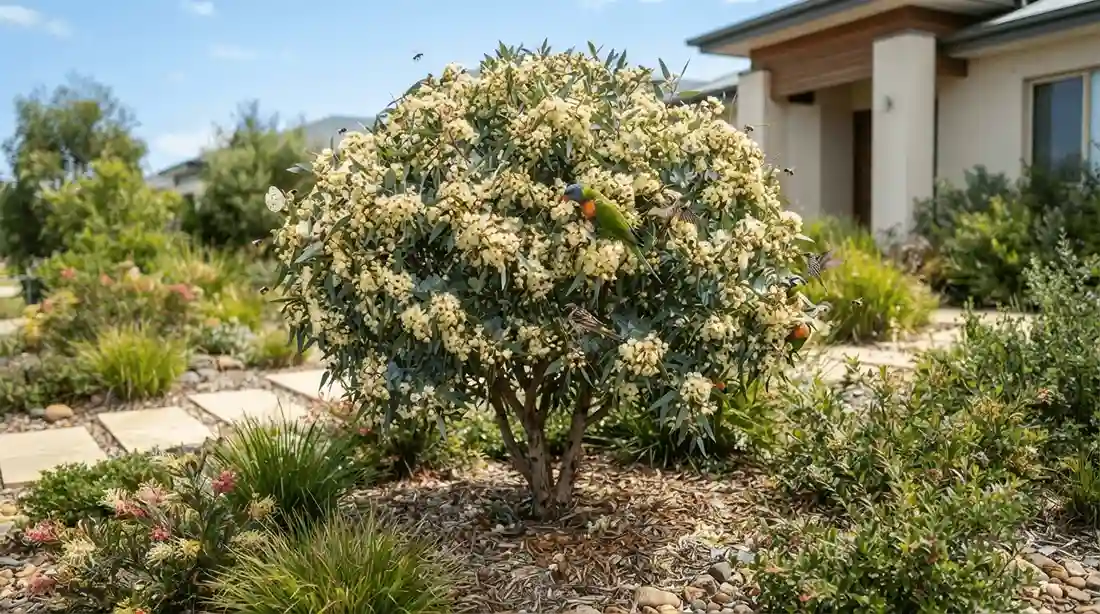
Eucalyptus Honey Pots is a compact ornamental eucalyptus admired for its nectar-rich flowers, attractive foliage, and suitability for smaller landscapes. Often marketed as Eucalyptus Tucker Time Honey Pots or simply Tucker Time Honey Pots, this selection is associated with Eucalyptus wimmerensis, a naturally compact Australian mallee species. Its manageable size, drought tolerance, and ability to attract birds, bees, and other beneficial wildlife make it a valuable addition to native gardens, urban landscapes, and even containers. Whether grown in the ground or in a large pot, this versatile eucalyptus combines ornamental beauty with ecological benefits, making it an excellent choice for Australian gardeners seeking a low-maintenance native tree. If you’re selecting species for a wildlife-friendly landscape, our guide to Australian native garden trees explores more native trees suitable for gardens of all sizes.
Quick Summary
- Eucalyptus Honey Pots is a compact Australian eucalyptus ideal for small gardens and container growing.
- It produces nectar-rich flowers that attract birds, bees, butterflies, and other pollinators.
- Full sun, well-drained soil, and regular watering during establishment encourage vigorous growth.
- Its naturally compact habit makes it suitable for both garden beds and eucalyptus in pots.
- Once established, it offers excellent drought tolerance while providing year-round ornamental appeal.
What Is Eucalyptus Honey Pots?
Eucalyptus Honey Pots is a compact ornamental eucalyptus selected for its attractive flowers, manageable growth, and excellent performance in residential gardens. Often sold under the name Eucalyptus Tucker Time Honey Pots, it is closely associated with Eucalyptus wimmerensis, a naturally small mallee eucalyptus native to southeastern Australia. Honey Pots belongs to the Eucalyptus genus, one of Australia’s most diverse groups of native flowering trees and mallees.
Unlike large forest eucalypts that can reach impressive heights, Honey Pots was selected specifically for gardeners wanting the beauty of a flowering eucalyptus without requiring extensive space. Its naturally rounded form, decorative bark, and abundant nectar-rich blossoms have made it increasingly popular in modern Australian landscaping.
Although commonly referred to as a honey pot plant or honey pots plant in garden centres, it is not a separate botanical species. Instead, it is an ornamental selection valued for its compact growth and reliable flowering.
In our experience at Greenery Inside, Honey Pots performs particularly well in suburban gardens where space is limited but wildlife-friendly planting remains a priority. Its compact habit also makes maintenance considerably easier than larger eucalyptus species.
Botanical Classification
| Classification | Details |
| Scientific Name | Eucalyptus wimmerensis (Honey Pots selection) |
| Common Names | Eucalyptus Honey Pots, Tucker Time Honey Pots |
| Plant Family | Myrtaceae |
| Plant Type | Evergreen mallee tree |
| Native Habitat | Semi-arid regions of Victoria, Australia |
| Growth Form | Multi-stemmed compact mallee |
| Wildlife Value | High nectar production for birds and pollinators |
Like many Australian mallee eucalypts, Eucalyptus wimmerensis develops multiple stems from a lignotuber, allowing it to recover after drought, fire, or pruning. This natural resilience contributes to its excellent adaptability in home gardens.
Key Features of Eucalyptus Honey Pots
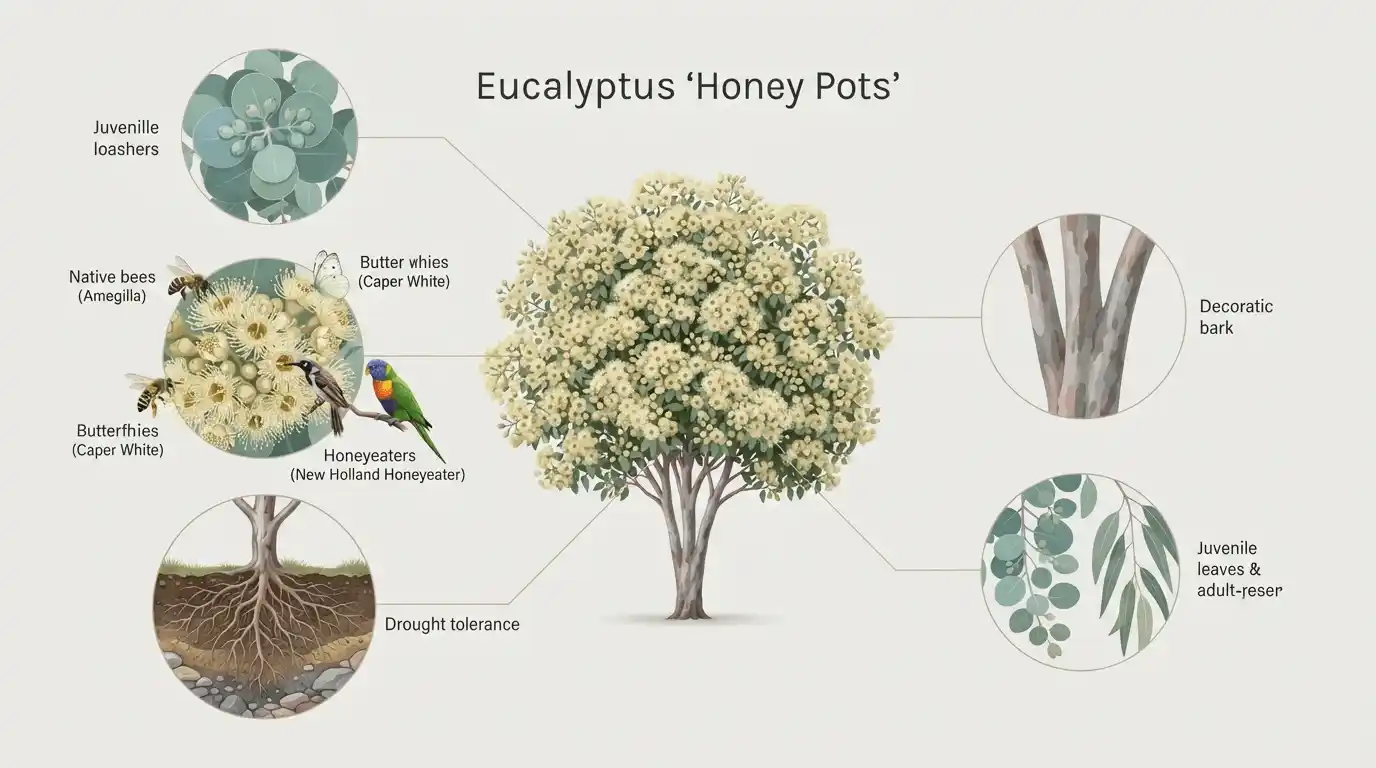
Eucalyptus Honey Pots combines ornamental beauty with practical landscape performance. Its compact size allows gardeners to enjoy colourful flowering eucalyptus trees even in smaller outdoor spaces.
Key characteristics include:
- Naturally compact mallee growth habit
- Rounded, dense canopy suitable for urban gardens
- Attractive smooth bark with seasonal colour variation
- Decorative juvenile and mature foliage
- Abundant nectar-rich blossoms that support wildlife
- Excellent bird and bee attraction
- High drought tolerance once established
- Suitable for feature planting, native gardens, and large containers
- Adaptable to many Australian climates with proper drainage
One reason Tucker Time Honey Pots has become increasingly popular is its balance between ornamental value and manageable maintenance. Unlike towering eucalyptus species, it rarely overwhelms surrounding garden plants.
Greenery Inside recommends planting it where its flowers can be easily observed, as the nectar often attracts colourful lorikeets, honeyeaters, native bees, and beneficial insects throughout the flowering season.
Plant Size and Growth Habit
One of the biggest advantages of Eucalyptus Honey Pots is its naturally compact growth habit. While many eucalyptus species become large shade trees, this selection remains considerably smaller, making it suitable for suburban landscapes and courtyard gardens. Gardeners comparing compact gum trees may also find our guide to the Dwarf Eucalyptus Tree helpful when choosing the right eucalyptus for smaller landscapes.
It typically develops as a multi-stemmed mallee with a rounded canopy rather than a single tall trunk. This growth form creates year-round structure while providing seasonal flowers and attractive foliage.
Typical mature size:
- Height: 3–5 metres
- Width: 2–4 metres
- Growth habit: Compact, rounded mallee
- Evergreen: Yes
- Suitable for containers: Yes, with appropriate pruning and pot size
Environmental conditions influence ultimate size. Plants growing in deep, fertile soil with consistent moisture may become slightly taller than those growing in drier sites.
Mature Size Comparison
| Plant | Mature Height | Mature Width | Best Use |
| Eucalyptus Honey Pots | 3–5 m | 2–4 m | Small gardens, feature tree, containers |
| Eucalyptus wimmerensis | 4–7 m | 3–5 m | Native landscapes, wildlife gardens |
| Eucalyptus leucoxylon | 10–20 m | 8–12 m | Parks, large gardens |
| Blue Gum (Eucalyptus globulus) | 30–55 m | 12–20 m | Forestry, windbreaks, large rural properties |
Compared with Eucalyptus leucoxylon and the towering Eucalyptus Blue Gum (blue gum tree), Honey Pots remains far easier to manage in residential settings.
Growth Rate
Eucalyptus Honey Pots has a moderate to fast growth rate under favourable conditions. Most young plants establish quickly during their first two years before settling into steady annual growth.
Typical growth expectations include:
- Moderate growth during the establishment phase
- Faster development once roots become established
- Most vigorous growth during spring and early summer
- Slower growth through cooler winter months
Several environmental factors influence growth speed.
Sunlight
Full sun promotes dense foliage, stronger branching, and heavier flowering. Plants growing in partial shade often become less compact.
Watering
Consistent watering during the first one to two years supports rapid root development. Once mature, watering requirements decrease significantly.
Soil
Well-drained soils encourage healthy root systems. Heavy clay or permanently wet ground often slows growth and increases disease risk.
Climate
Warm, sunny Australian climates provide ideal growing conditions. Growth naturally slows in colder regions with extended frosts.
In our experience growing compact eucalyptus selections, avoiding excessive irrigation after establishment produces stronger root systems and improves drought resilience.
As of the 2026 growing season, Australian growers continue to recommend deep but infrequent watering rather than frequent shallow irrigation for compact mallee eucalypts.
Flowers, Leaves, and Seasonal Interest
The ornamental appeal of Eucalyptus Honey Pots extends well beyond its compact size. Its flowers, foliage, bark, and evergreen structure provide year-round visual interest while supporting local wildlife.
Flower Characteristics
The nectar-rich blossoms are among the defining features of this honey pot plant. Their abundant nectar attracts a wide range of pollinators, making Tucker Time Honey Pots an excellent addition to biodiversity-focused gardens.
Flower characteristics include:
- Cream to pale yellow flowers
- Clusters of nectar-rich blossoms
- Long flowering period depending on local climate
- Strong attraction for honeyeaters, lorikeets, native bees, butterflies, and beneficial insects
- Excellent nectar production throughout the blooming season
The flowers are especially valuable during periods when fewer native plants are blooming, providing an important food source for wildlife.
Greenery Inside recommends planting Honey Pots near outdoor seating areas where flowering displays and visiting birds can be enjoyed throughout the season.
Leaf Shape and Colour
Like many eucalyptus species, Honey Pots displays noticeable differences between juvenile and mature foliage.
Juvenile foliage
- Rounded to broadly oval leaves
- Blue-green to silvery-green colour
- Soft, ornamental appearance
- Dense branching
Mature foliage
- Narrower lance-shaped leaves
- Glossy grey-green colour
- More upright orientation
- Aromatic when crushed
Because of its rounded juvenile leaves, gardeners sometimes confuse Honey Pots with Eucalyptus orbifolia, commonly known as round leaf eucalyptus or round-leaved eucalyptus. However, these are distinct species.
Key differences include:
- Eucalyptus orbifolia retains almost circular leaves for much longer.
- Honey Pots gradually develops narrower adult foliage as it matures.
- Gardeners searching for eucalyptus round leaves or eucalyptus with round leaves are usually referring to Eucalyptus orbifolia, not Eucalyptus wimmerensis.
The transition from juvenile to mature foliage adds seasonal character and visual interest while preserving the plant’s compact ornamental form.
How to Grow Eucalyptus Honey Pots
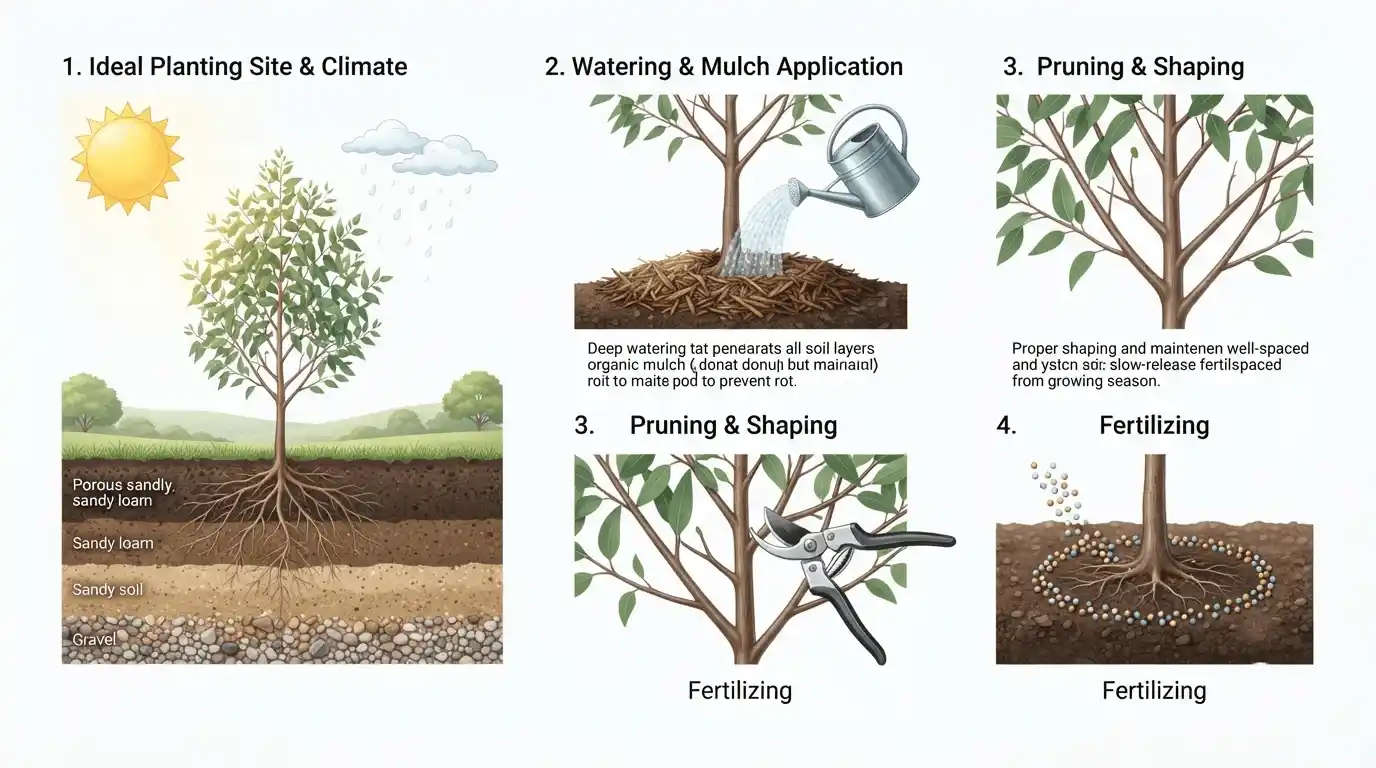
Eucalyptus Honey Pots is relatively easy to grow when planted in the right conditions. Like most Australian native eucalypts, it performs best with plenty of sunlight, excellent drainage, and moderate watering during establishment. Once established, it requires little maintenance and becomes highly resilient to dry conditions.
Whether you’re planting it in a garden bed or keeping it as one of your eucalyptus honey pots Australia landscape features, following basic horticultural practices will encourage healthy growth, abundant flowering, and a long lifespan.
In our experience at Greenery Inside, the biggest factor influencing success is soil drainage. Even healthy nursery plants can struggle if planted in waterlogged soil.
Best Climate
Eucalyptus Honey Pots thrives in temperate to warm Australian climates and adapts well to many regions when planted in full sun.
Ideal growing conditions include:
- Temperate climates
- Mediterranean climates
- Mild coastal regions
- Inland areas with good drainage
- Areas receiving full sunlight
It also tolerates:
- Moderate frost once established
- High summer temperatures
- Dry periods after establishment
- Wind in open landscapes
Young plants are more susceptible to frost damage than mature specimens. If severe frost is expected during the first winter, temporary frost protection can help prevent leaf burn.
Suitable Australian regions include:
- Victoria
- South Australia
- New South Wales
- ACT
- Southern Queensland
- Parts of Western Australia with similar climates
Gardeners in tropical regions should ensure excellent drainage and good airflow to reduce humidity-related stress.
Sunlight Requirements
Full sun is essential for compact growth and prolific flowering.
For the best performance, provide:
- At least 6–8 hours of direct sunlight daily
- An open planting position
- Good air circulation around the canopy
Plants grown in excessive shade may develop:
- Sparse foliage
- Longer, weaker branches
- Reduced flowering
- Slower growth
- Increased disease susceptibility
If growing near buildings, allow enough space so the tree receives unobstructed sunlight for most of the day.
Soil Requirements
Like most mallee eucalypts, Honey Pots prefers soils that drain freely and allow oxygen to reach the roots.
Ideal soil characteristics include:
| Soil Feature | Recommendation |
| Drainage | Excellent drainage is essential |
| Texture | Sandy, sandy loam, or light loam |
| pH | Slightly acidic to neutral (approximately 6.0–7.5) |
| Organic matter | Moderate amounts are sufficient |
| Compaction | Avoid heavily compacted soils |
Heavy clay soils can retain excessive moisture, increasing the risk of root diseases. If clay soil cannot be avoided, improve drainage by incorporating coarse sand, gravel, or planting on a raised mound.
Greenery Inside recommends checking drainage before planting by filling the planting hole with water. If water remains after several hours, improve drainage before installing the tree.
Watering Needs
Proper watering is particularly important during the establishment period.
Newly planted trees
During the first 12–24 months:
- Water deeply once or twice each week during dry weather.
- Allow the soil surface to dry slightly between waterings.
- Adjust watering according to rainfall.
Deep watering encourages roots to grow downward rather than remaining near the surface.
Established plants
After establishment:
- Water only during prolonged dry periods.
- Mature trees tolerate drought well.
- Avoid frequent shallow watering.
Extended overwatering often causes more problems than temporary dryness.
During drought
During unusually long dry spells:
- Water deeply every 2–4 weeks.
- Apply mulch around the root zone to conserve moisture.
- Keep mulch away from direct contact with the trunk.
A thick organic mulch also helps regulate soil temperature and suppress weeds.
Fertilising
Unlike many ornamental trees, Eucalyptus Honey Pots generally requires very little fertiliser.
Healthy plants growing in suitable soil usually obtain sufficient nutrients naturally.
If additional feeding is needed:
- Apply a slow-release, low-phosphorus fertiliser formulated for Australian native plants.
- Feed in early spring before active growth begins.
- Avoid excessive nitrogen, which encourages leafy growth at the expense of flowering.
Over-fertilising can produce rapid, weak growth that is more vulnerable to pests and wind damage.
In our experience growing Australian natives, less fertiliser generally produces stronger, healthier eucalyptus trees than frequent feeding.
Pruning
Pruning requirements are minimal because Honey Pots naturally develops an attractive rounded form.
Routine pruning should include:
- Removing dead or damaged branches
- Eliminating crossing stems
- Maintaining desired shape
- Improving airflow within the canopy if necessary
The best time to prune is:
- Late winter
- Early spring before vigorous new growth
Avoid removing large portions of the canopy at one time, as excessive pruning can temporarily reduce flowering.
Light annual maintenance is usually sufficient to preserve the plant’s compact appearance.
Growing Eucalyptus Honey Pots in Pots
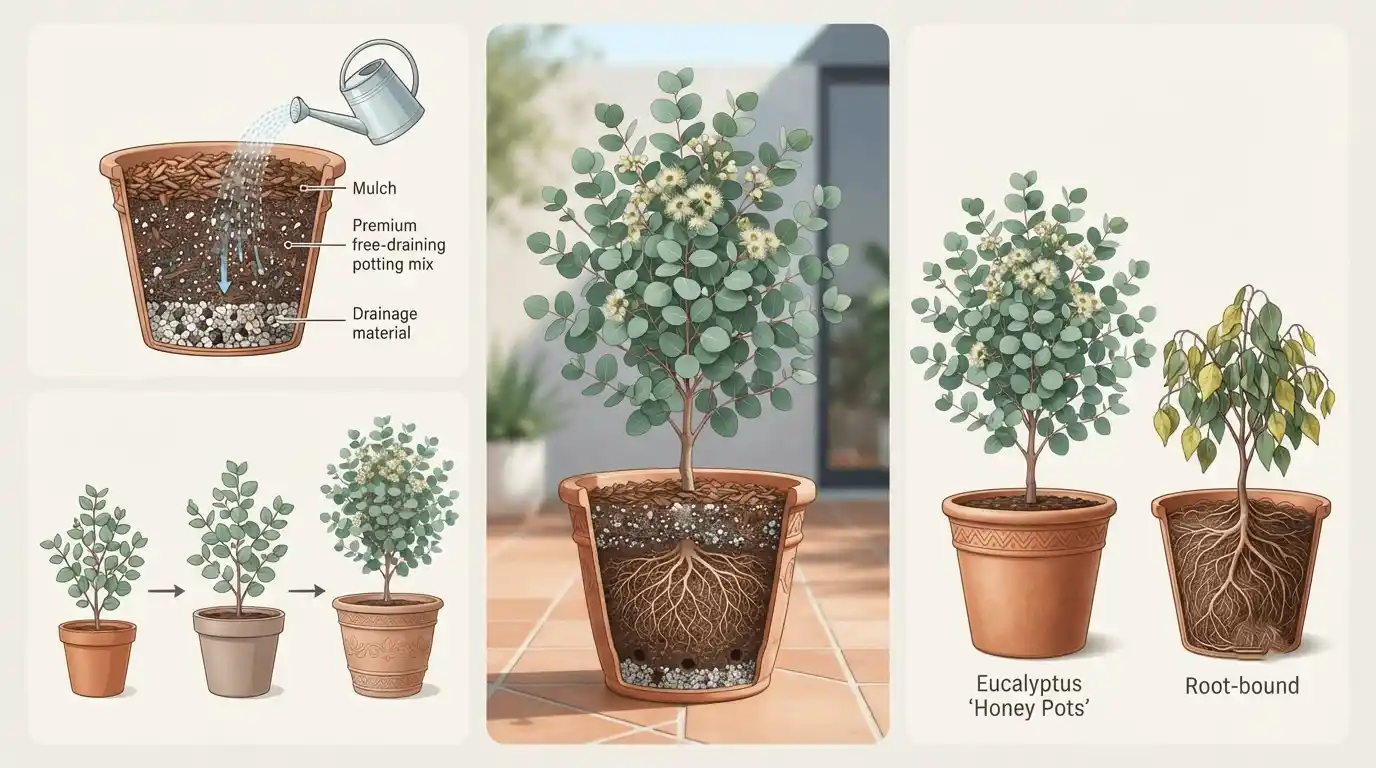
One of the major advantages of Honey Pots is its suitability for container growing. Gardeners with courtyards, balconies, patios, or limited garden space can successfully grow eucalyptus in pots provided the container is large enough and drainage remains excellent. For more container-growing tips, see our complete guide on Growing Trees in Pots, including pot selection, watering, and long-term maintenance.
Although many eucalyptus species become too large for containers, Honey Pots maintains a naturally compact habit that adapts well to long-term pot culture.
Choosing the Right Pot
Selecting an appropriate container greatly influences long-term success.
Choose:
- A pot at least 50–60 cm wide for young plants
- Larger containers as the tree matures
- Containers with multiple drainage holes
- Heavy pots that resist tipping in strong winds
Suitable materials include:
- Terracotta
- High-quality resin
- Concrete
- Glazed ceramic
Avoid very small containers, which restrict root development and dry out rapidly.
Whether growing eucalyptus in a pot as a feature plant or on a patio, stability and drainage should always be priorities.
Best Potting Mix
Garden soil should not be used in containers because it compacts easily and drains poorly.
Instead, use a premium native plant potting mix that provides:
- Excellent drainage
- Good aeration
- Moderate water retention
- Slow-release nutrition
A suitable mix often contains:
- Composted pine bark
- Coarse sand
- Perlite
- Quality organic matter
Good aeration helps prevent root diseases while supporting healthy root growth.
Watering Container Plants
Container-grown eucalyptus dries out much faster than garden-planted specimens.
General watering guidelines include:
- Check soil moisture several times each week during summer.
- Water thoroughly until moisture drains from the bottom.
- Allow the upper few centimetres of potting mix to dry before watering again.
- Reduce watering during winter.
Avoid leaving eucalyptus pots standing in saucers filled with water, as prolonged saturation increases the likelihood of root rot.
Repotting Tips
As Honey Pots grows, its roots gradually occupy the entire container.
Repot every 2–3 years or whenever:
- Roots circle the inside of the pot.
- Water drains unusually quickly.
- Growth slows noticeably.
- The plant becomes root-bound.
When repotting:
- Choose a container one size larger.
- Refresh the potting mix.
- Trim damaged roots if necessary.
- Water thoroughly after transplanting.
Repotting is best completed during early spring before active growth resumes.
Common Container Growing Mistakes
Many problems can be avoided by following a few simple practices.
Common mistakes include:
- Using containers without drainage holes
- Choosing pots that are too small
- Overwatering during cool weather
- Allowing potting mix to remain permanently wet
- Using heavy clay soil instead of quality potting mix
- Placing containers in too much shade
- Forgetting to repot root-bound plants
- Applying excessive fertiliser
Greenery Inside recommends monitoring container-grown eucalyptus more frequently than garden specimens, particularly during heatwaves, as potting mix can dry much faster.
Wildlife Benefits
One of the greatest strengths of Eucalyptus Honey Pots is its exceptional value as a wildlife-supporting native tree. Its nectar-rich flowers provide reliable food sources for many Australian pollinators while its evergreen canopy offers shelter throughout the year. If you’re planning a pollinator-friendly native garden, Banksia Honey Pots is another excellent Australian plant that produces abundant nectar for birds and bees.
The blossoms attract a diverse range of beneficial wildlife, including:
- Native bees
- European honey bees
- Honeyeaters
- Rainbow lorikeets
- Wattlebirds
- Butterflies
- Hoverflies
- Other nectar-feeding native insects
Because flowering often occurs over an extended period, Honey Pots supplies nectar when other plants may have finished blooming. This makes it an excellent addition to biodiversity-focused gardens and urban wildlife corridors.
Its dense foliage also provides:
- Safe nesting sites for small birds
- Shelter from extreme weather
- Habitat for beneficial insects
- Year-round greenery that supports healthy garden ecosystems
In our experience, combining Eucalyptus Honey Pots with other Australian flowering natives such as grevilleas, bottlebrushes, and correas creates a garden that supports pollinators across multiple seasons rather than during a single flowering period.
As of recent Australian gardening recommendations, increasing the diversity of nectar-producing native plants remains one of the most effective ways home gardeners can help sustain local bird and pollinator populations while creating attractive, low-maintenance landscapes.
Eucalyptus Honey Pots Compared with Similar Eucalyptus Species
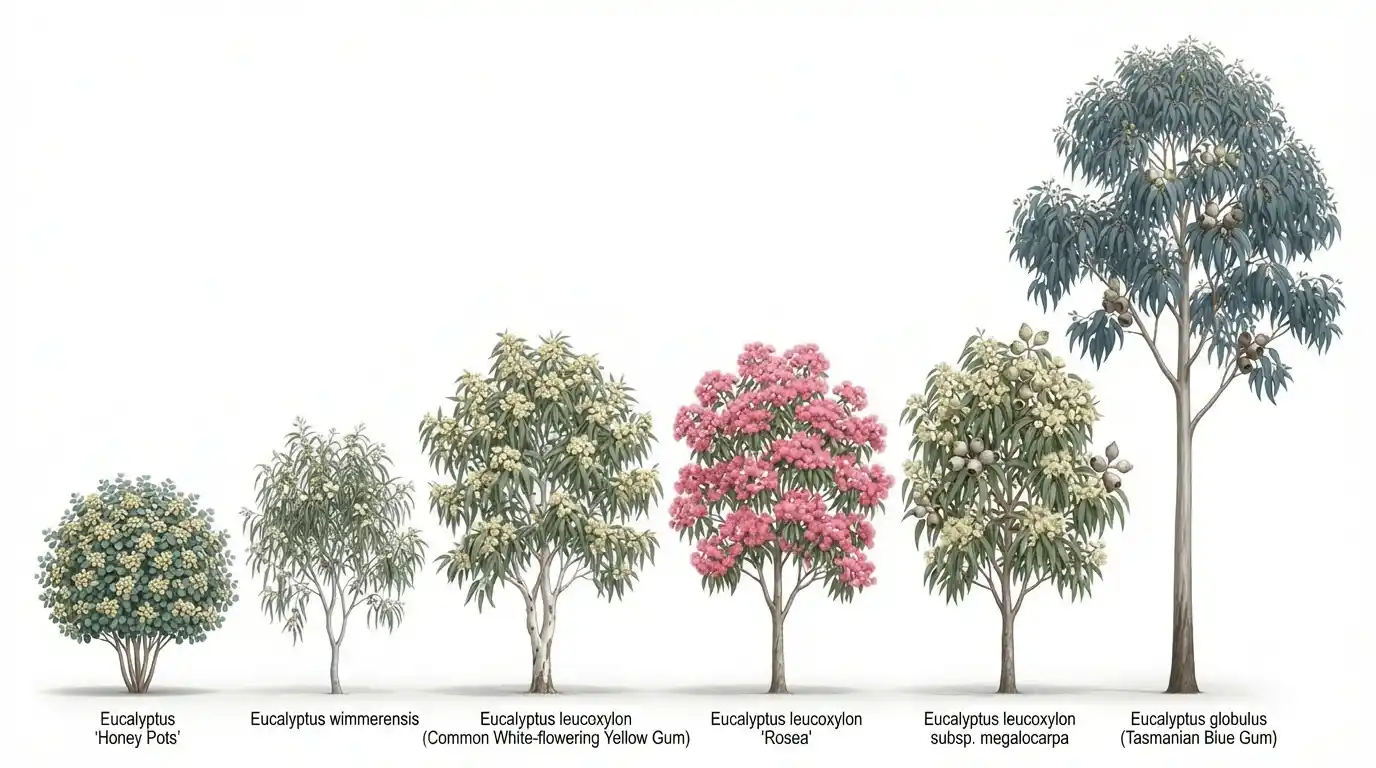
Eucalyptus Honey Pots is valued for its compact size, ornamental appeal, and excellent suitability for residential landscapes. While it is closely associated with Eucalyptus wimmerensis, gardeners often compare it with other flowering eucalyptus species, including Eucalyptus leucoxylon, its ornamental forms, and the much larger Blue Gum. Although these trees all belong to the Myrtaceae family and provide valuable nectar for wildlife, they differ significantly in size, flower colour, foliage, and the amount of space they require.
Understanding these differences makes it easier to select the best eucalyptus for your garden, whether you’re looking for a compact feature tree or a large shade tree.
Species Comparison
| Species | Mature Size | Flower Colour | Leaf Appearance | Best Garden Use | Wildlife Value |
| Eucalyptus Honey Pots | 3–5 m tall × 2–4 m wide | Cream to pale yellow | Rounded juvenile leaves, narrow mature leaves | Small gardens, feature planting, containers | Excellent |
| Eucalyptus wimmerensis | 4–7 m × 3–5 m | Cream to pale yellow | Blue-green juvenile foliage, lance-shaped mature leaves | Native gardens, wildlife landscapes | Excellent |
| Eucalyptus leucoxylon | 10–20 m × 8–12 m | Pink, red, cream or white | Long, narrow grey-green leaves | Large gardens, streetscapes | Excellent |
| Eucalyptus leucoxylon ‘Rosea’ | 10–15 m × 6–10 m | Bright pink to deep rose | Narrow grey-green foliage | Feature tree | Excellent |
| Eucalyptus leucoxylon subsp. megalocarpa | 10–15 m × 6–10 m | Large pink flowers | Grey-green lance-shaped leaves | Spacious gardens and parks | Excellent |
| Blue Gum (Eucalyptus globulus) | 30–55 m × 12–20 m | White to cream | Large blue-grey juvenile leaves, sickle-shaped adult leaves | Rural landscapes, forestry, windbreaks | High |
Eucalyptus Honey Pots vs. Eucalyptus wimmerensis
Because Eucalyptus Honey Pots is linked to Eucalyptus wimmerensis, the two are often confused. Honey Pots is generally regarded as a selected ornamental form chosen for its consistent compact habit and garden-friendly size, while Eucalyptus wimmerensis refers to the naturally occurring species.
Both produce nectar-rich flowers, attractive foliage, and multi-stemmed mallee growth, but Honey Pots is typically favoured for urban landscapes where limited space is available.
Eucalyptus Honey Pots vs. Yellow Gum
Eucalyptus leucoxylon, commonly known as Yellow Gum, is a much larger tree than Honey Pots and is widely planted in parks, avenues, and spacious native gardens.
The main differences include:
- Honey Pots remains compact and easy to manage.
- Yellow Gum develops a broad, spreading canopy.
- Honey Pots is suitable for courtyards and smaller residential gardens.
- Yellow Gum is better suited to larger landscapes where it has room to mature.
- Both species produce nectar-rich blossoms that attract birds, bees, and other pollinators.
Several ornamental selections are available under the names:
- Eucalyptus leucoxylon rosea
- Euc leucoxylon rosea
- Leucoxylon rosea
- Eucalyptus rosea
These pink-flowering forms are especially popular for their colourful floral displays and are often recommended for gardeners wanting a striking flowering gum with ample growing space.
Eucalyptus Honey Pots vs. Large-Fruited Yellow Gum
Another popular ornamental eucalyptus is Eucalyptus leucoxylon megalocarpa, also sold or referenced as:
- Eucalyptus leucoxylon subsp. megalocarpa
- Eucalyptus leucoxylon ssp. megalocarpa
- Eucalyptus megalocarpa
Known as the large fruited Yellow Gum or large-fruited Yellow Gum, this subspecies produces noticeably larger flower buds and gum nuts than standard Yellow Gum.
Compared with Honey Pots, it:
- Grows significantly taller and wider.
- Requires considerably more planting space.
- Produces larger flowers and fruits.
- Is better suited to parks, large gardens, and streetscapes than compact residential landscapes.
Eucalyptus Honey Pots vs. Blue Gum
The Blue Gum (Eucalyptus globulus) is one of Australia’s most iconic eucalyptus trees and is dramatically different from Honey Pots in both size and purpose.
Key differences include:
- Blue Gum can exceed 50 metres in height.
- Honey Pots usually matures at only 3–5 metres.
- Blue Gum develops a massive canopy suitable for rural properties.
- Honey Pots fits comfortably into suburban gardens and courtyards.
- Blue Gum is commonly grown for forestry, shelterbelts, and large landscape plantings.
- Honey Pots is primarily cultivated as an ornamental flowering tree.
Although the blue gum tree is highly valuable for wildlife and timber production, its enormous mature size makes it unsuitable for most home gardens.
In our experience at Greenery Inside, Eucalyptus Honey Pots is the better option for gardeners who want the beauty, fragrance, and wildlife benefits of a flowering eucalyptus without the maintenance challenges or space requirements associated with larger gum trees.
Common Problems and How to Fix Them
Eucalyptus Honey Pots is a hardy Australian native that experiences relatively few issues when grown in suitable conditions. Most problems arise from incorrect watering, poor drainage, unsuitable planting locations, or minor pest infestations rather than serious diseases.
Regular monitoring and prompt action usually keep the tree healthy and vigorous for many years.
Yellow Leaves
Yellowing leaves are one of the most common concerns and usually indicate environmental stress rather than a serious disease.
Common causes
- Overwatering
- Poorly drained soil
- Temporary transplant shock
- Extended drought
- Natural ageing of older foliage
How to fix it
- Allow the soil surface to dry slightly before watering again.
- Improve drainage if water remains around the roots.
- Remove damaged or dead leaves.
- Water deeply but less often to encourage stronger root growth.
How to prevent it
- Plant in well-drained soil.
- Avoid constantly wet conditions.
- Apply mulch to help regulate soil moisture while keeping it away from the trunk.
Poor Flowering
A healthy, established Honey Pots tree should flower reliably each season. If flowering is sparse, growing conditions are usually the cause.
Common causes
- Too much shade
- Excess nitrogen fertiliser
- Heavy pruning before the flowering season
- Plants that are still becoming established
How to fix it
- Grow the tree in full sun.
- Reduce applications of high-nitrogen fertilisers.
- Prune only after flowering when shaping is required.
- Allow young plants time to mature.
How to prevent it
- Provide at least six hours of direct sunlight daily.
- Feed only when necessary using a fertiliser formulated for Australian native plants.
- Avoid excessive pruning.
Root Rot
Root rot is one of the few serious problems that can affect Eucalyptus Honey Pots, but it is almost always preventable.
Common causes
- Waterlogged soil
- Poor drainage
- Pots without adequate drainage holes
- Frequent overwatering
Signs to watch for
- Yellow leaves
- Wilting despite moist soil
- Slow or stunted growth
- Branch dieback
- Soft, dark, or decaying roots
How to fix it
- Improve soil drainage immediately.
- Reduce watering frequency.
- Repot container-grown trees into fresh, free-draining potting mix if necessary.
- Remove severely damaged roots during repotting.
How to prevent it
- Never allow roots to remain in standing water.
- Plant in raised beds if drainage is poor.
- Use premium free-draining potting mixes for container-grown plants.
Pest Problems
Honey Pots is generally resistant to serious pest infestations, although occasional insect activity is normal for Australian native trees.
Common pests include:
- Psyllids
- Scale insects
- Eucalyptus leaf beetles
- Gum tree caterpillars
How to fix it
- Encourage natural predators such as birds and beneficial insects.
- Remove heavily infested branches if necessary.
- Apply horticultural oil only for severe infestations.
- Avoid broad-spectrum insecticides that may harm pollinators.
How to prevent it
- Keep the tree healthy through proper watering and good drainage.
- Inspect new growth regularly.
- Promote biodiversity by growing a variety of native flowering plants nearby.
In our experience, minor insect feeding rarely affects the long-term health of a well-established Honey Pots tree and often forms part of a balanced garden ecosystem.
Slow Growth
Growth rates vary depending on climate, soil quality, and the amount of sunlight the tree receives.
Common causes
- Insufficient sunlight
- Nutrient-poor soil
- Root restriction in containers
- Heavy clay soils
- Cool seasonal temperatures
How to fix it
- Move container plants into a sunnier location if possible.
- Repot root-bound trees into larger containers.
- Improve soil drainage and structure.
- Apply a slow-release fertiliser for native plants in early spring if needed.
How to prevent it
- Plant in full sun.
- Select a site with well-drained soil.
- Water consistently during establishment.
- Avoid disturbing the roots once the tree is established.
As of the 2026 growing season, horticultural best practices continue to recommend encouraging deep root development rather than rapid leafy growth. This approach produces stronger, healthier, and more drought-tolerant eucalyptus trees over the long term.
Common Beginner Mistakes
Eucalyptus Honey Pots is one of the easier eucalyptus trees to grow, but a few common mistakes can affect its health, flowering, and long-term performance. Most problems are preventable by choosing the right planting location and following basic care practices from the beginning.
Planting in Heavy Clay Soil
One of the most frequent mistakes is planting Honey Pots in heavy clay that remains wet after rain. Eucalyptus species naturally prefer free-draining soils, and prolonged moisture around the roots can lead to poor growth or root rot.
How to avoid it:
- Improve clay soil with coarse sand, gravel, or organic matter.
- Plant on a raised mound or raised garden bed if drainage is poor.
- Check that water drains away within a few hours after heavy rainfall.
Watering Too Frequently
Newly planted trees need regular watering, but mature plants are surprisingly drought tolerant. Frequent shallow watering encourages weak surface roots and increases the risk of fungal diseases.
How to avoid it:
- Water deeply rather than lightly.
- Allow the top layer of soil to dry slightly between watering.
- Reduce watering once the tree is well established.
In our experience at Greenery Inside, overwatering causes far more problems than underwatering for established eucalyptus trees.
Growing in Too Much Shade
Although Honey Pots can tolerate light afternoon shade in very hot regions, it performs best in full sun. Insufficient light often results in fewer flowers, slower growth, and an open, leggy canopy.
How to avoid it:
- Choose a location that receives at least 6–8 hours of direct sunlight each day.
- Avoid planting beneath large trees or on the heavily shaded side of buildings.
Choosing a Pot That’s Too Small
When growing eucalyptus in pots, using a container that is too small restricts root growth and causes the potting mix to dry out quickly.
How to avoid it:
- Start with a sturdy container at least 50–60 cm wide.
- Upgrade to a larger pot as the tree matures.
- Ensure the container has several drainage holes.
Over-Fertilising
Many gardeners assume native plants need frequent feeding, but excessive fertiliser can encourage lush, weak growth while reducing flowering.
How to avoid it:
- Feed only when necessary.
- Use a slow-release fertiliser formulated for Australian native plants.
- Apply fertiliser once in early spring if growth appears weak.
Ignoring Pruning
Although Honey Pots naturally develops an attractive rounded shape, dead, damaged, or crossing branches should still be removed.
Ignoring basic maintenance can reduce airflow through the canopy and affect the tree’s appearance over time.
How to avoid it:
- Inspect the tree annually.
- Remove damaged branches in late winter or early spring.
- Avoid heavy pruning, which may reduce flowering.
Is Eucalyptus Honey Pots Right for Your Garden?
If you’re looking for a compact flowering eucalyptus that combines ornamental beauty with wildlife value, Eucalyptus Honey Pots is an excellent choice. Its manageable size makes it suitable for gardens where traditional gum trees would simply become too large.
Unlike many eucalyptus species that eventually dominate a landscape, Honey Pots retains a naturally compact form while still delivering attractive foliage, colourful seasonal flowers, and year-round interest.
It is particularly well suited to:
- Small suburban gardens
- Native Australian landscapes
- Wildlife-friendly gardens
- Urban courtyards
- Modern landscape designs
- Feature planting
- Patio and terrace gardens
- Large decorative containers
Because of its excellent adaptability, Honey Pots also works well alongside other Australian native plants such as grevilleas, bottlebrushes, correas, and westringias, creating a diverse garden that supports birds, bees, and beneficial insects throughout the year.
Why Home Gardeners Choose Honey Pots
Many gardeners choose Honey Pots because it offers the visual appeal of a flowering gum tree without requiring the space needed for larger eucalyptus species.
Some of its biggest advantages include:
- Compact, easy-to-manage size
- Attractive evergreen foliage
- Nectar-rich flowers that support local wildlife
- High drought tolerance after establishment
- Low maintenance requirements
- Excellent suitability for container growing
- Strong performance in Australian climates
- Year-round ornamental appeal
In our experience, Honey Pots is especially valuable for gardeners who want to introduce native biodiversity into smaller landscapes without compromising on space or ease of maintenance.
Conclusion
Eucalyptus Honey Pots is an outstanding compact eucalyptus that combines ornamental beauty, ecological value, and practical garden performance. Closely associated with Eucalyptus wimmerensis, it offers many of the desirable characteristics of larger gum trees while remaining an ideal size for modern residential landscapes.
Its rounded growth habit, attractive foliage, and nectar-rich flowers provide year-round interest while supporting birds, bees, butterflies, and other important pollinators. Once established, it is highly drought tolerant, requires minimal maintenance, and adapts well to a range of Australian climates.
Whether planted as a feature tree in a native garden or grown as eucalyptus in pots on a patio or courtyard, Honey Pots rewards gardeners with reliable flowering, manageable growth, and long-lasting ornamental appeal. With full sun, well-drained soil, and sensible watering during establishment, it can remain a beautiful and wildlife-friendly addition to your garden for many years.
Frequently Asked Questions
Is Eucalyptus Honey Pots the same as Eucalyptus wimmerensis?
Not exactly. Eucalyptus Honey Pots is generally regarded as a compact ornamental selection associated with Eucalyptus wimmerensis. While they share many characteristics, Honey Pots is marketed specifically for its consistent compact growth habit and suitability for residential gardens.
Can Eucalyptus Honey Pots grow successfully in pots?
Yes. Honey Pots is one of the few eucalyptus selections that performs well in large containers. Choose a sturdy pot with excellent drainage, use a high-quality native plant potting mix, and water regularly during hot weather. Repotting every few years helps maintain healthy root growth.
How large does Eucalyptus Honey Pots grow?
Most mature trees reach approximately 3–5 metres in height with a spread of 2–4 metres. Its naturally compact mallee habit makes it ideal for smaller gardens, courtyards, and feature planting.
Does Eucalyptus Honey Pots attract birds and bees?
Yes. The nectar-rich flowers are highly attractive to honeyeaters, lorikeets, native bees, honey bees, butterflies, and other pollinating insects. It is an excellent choice for wildlife-friendly gardens.
How often should I water a newly planted Eucalyptus Honey Pots?
Water deeply once or twice a week during the first growing season, depending on rainfall and soil type. Once established, the tree generally requires watering only during extended dry periods.
Is Eucalyptus Honey Pots drought tolerant?
Yes. After developing a strong root system, Honey Pots becomes highly drought tolerant. Occasional deep watering during prolonged dry weather is usually sufficient to keep mature plants healthy.
What is the best soil for Eucalyptus Honey Pots?
The ideal soil is well-drained sandy or loamy soil with a slightly acidic to neutral pH of approximately 6.0–7.5. Avoid heavy clay or permanently waterlogged sites, as poor drainage can lead to root problems.
How does Eucalyptus Honey Pots differ from Yellow Gum and Blue Gum?
Honey Pots is significantly smaller than both Yellow Gum (Eucalyptus leucoxylon) and Blue Gum (Eucalyptus globulus). While those species can grow into large landscape trees, Honey Pots remains compact, making it better suited to small gardens, urban landscapes, and container growing. Despite its smaller size, it still provides abundant nectar-rich flowers and excellent habitat for pollinators.